
War Memorials – WW2 – Surnames M
Back to our main war memorials page
Index
Click on the name to jump to the relevant entry
MacDONALD, William Albert (Revised 05/09/2018)
MacGOWAN, George Thomas Clive (Revised 10/03/2020)
MACKIE, James Lionel (Revised 05/09/2018)
MADDERS, Angus Kingsley * (Revised 14/03/2018)
MALLETT, Eric Herbert (Revised 05/09/2018)
MALONEY, Thomas James * (Revised 07/09/2018)
MANBEY, Basil Keble * (Revised 14/09/2018)
MANIKUM, Patricia Carol * (Revised 21/03/2018)
MANSFIELD, Harry Walter (Revised 27/03/2018)
MARCH, Leslie * (Revised 12/05/2020)
MARCH, Wilfred Leonard Hayward *(Revised 09/09/2018)
MARKS, Montague Maurice * (Revised 09/09/2018)
MARSH, Leslie Henry (Revised 29/02/2020)
MARTIN, Em(m)anuel James * (Revised 30/07/2019)
MARTIN, Reginald William (Revised 10/09/2018)
MARTIN, Robert John (Revised 03/11/2018)
MASKELL, Edward Ernest * (Revised 21/03/2018)
MASKELL, Roland George (Revised 05/01/2019)
MATTHEWS, Reginald William (Revised 24/4/2023)
MAYNARD, Howard Charles Alan * (Revised 22/09/2019)
MAYNARD, John Henry * (Revised 07/09/2025)
MAYS, John Claude (Revised 29/11/2017)
McBRION, Arthur Albert (Revised 11/09/2018)
McCORMICK, Barbara Winifred (Revised 01/10/2018)
McCORMICK, George Franklin Hurley (Revised 01/10/2018)
McGRATH, Brian (Revised 16/01/2019)
McINTYRE, Charles Campbell * (Revised 21/09/2019)
McLENNAN, Alexander William (Revised 13/09/2018)
McMILLAN, Eric John * (Revised 13/09/2018)
McMULLAN, Hugh * (Revised 27/04/2020)
MEADEN, Bertram Grant (Revised 10/03/2020)
MEADES, Jack Charles * (Revised 31/03/2018)
MEATYARD, Robert Lawrence (Revised 15/09/2019)
MEEK, Denis John (Revised 08/02/2021)
MENARD, Edmund Sylvain * (Revised 14/09/2018)
MEPHAM, Thomas * (Revised 02/04/2018)
MILES, Robert John (Revised 14/09/2018)
MILLER, Frederick Stanley * (Revised 15/09/2019)
MINN, Charles William * (Revised 14/09/2018)
MITCHELL, Cecil Laurence Edward (Revised 14/09/2018)
MITCHELL, Frederick Peacock * (Revised 18/09/2019)
MITCHENER, Charles William * (Revised 18/09/2019)
MOGER, James Edward (but actually Edward James) * (Revised 24/09/2019)
MOGER, William Charles * (Revised 24/09/2019)
MONNEY, John Douglas * (Revised 15/09/2018)
MONTGOMERY, Cyril George * (New 02/12/2018)
MOORE, Alan Beresford * (Revised 15/09/2018)
MOORE, Harry (Revised 15/09/2018)
MOORE, Rachel Matilda * (Revised 15/09/2018)
MORGAN, Bernard Wm. Frederick Carnal * (Revised 16/09/2018)
MORGAN, Emrys (Revised 16/09/2018)
MORRILL, Gordon Henry Edward (Revised 16/09/2018)
MORRIS, Charles Patrick (Revised 16/09/2019)
MORRIS, Ellis (Revised 31/12/2019)
MORRIS, Jane * (Revised 16/09/2018)
MORRISH, Francis Leo (Revised 24/01/2024)
MORRISH, Joan (Revised 24/01/2024)
MURPHY, William (Revised 16/09/2018)
MYERS, Anthony Wallis (Revised 16/09/2018)
* = Not included in the Book of Remembrance for reasons unknown.
If you are looking for someone whose name starts with a different letter please try:
A B C D E F G H I J K L M N O P Q R S T U V W X Y Z
Content
MacDONALD William Albert. Butcher.
SS Orcades (London), Merchant Navy
Died 10 October 1942, aged 35
William was born Q4 1907 to William Edwin MacDonald and Ethel Susan (née Young – they had married Q4 1902). It seems that he was their second child, the first having died. The 1911 Census records the family living at 3 Frederick Place, Gray’s Inn Road, St Pancras. 31 year old William senior is listed as an “Exhibition Fitter & Temporary Ballroom Furnisher”. 27 year old Ethel will have had her hands full with not only 3 year old William junior but also 2 year old Margaret and new-born Doris. Also living with them was Ethel’s unmarried sister, 25 year old Sophia Young listed as a “Tobacco Packer”.
By the time of the September 1939 Register, the family home was 53 Oaks Avenue, North Cheam. 60 year old William senior is now listed as an “Electrotype Stereotyper” (the operator of a machine for setting newsprint) and 56 year old Ethel with the conventional “Unpaid Domestic Duties”. 32 year old William junior is not there, presumably being at sea in his career as a merchant seaman. The couple’s two daughters, 30 year old Margaret and 28 year old Doris, were still unmarried and at home, both listed as “Milliners” – with Doris’s entry annotated “incapacitated”.
The family then moved again, into the Borough – hence William junior’s entry in the Book of Remembrance. The Probate record of administration of his £185 estate being awarded to William senior notes the address as 55 Salisbury Road, Worcester Park.
The readily available records do not indicate when William joined the Merchant Navy. The first mention found of him is as a butcher working aboard the SS Orcades. This 23,456 ton passenger ship (built by Vickers-Armstrongs Ltd, Barrow-in-Furness for the Orient Steam Navigation Company of London) had been completed in July 1937. In 1939, she was requisitioned by the Ministry of War Transport as a troopship. (As set out in our separate article, the ship played a small part in the remarkable story of WW2 survivor Arthur Peddie.)
 SS Orcades
Photograph (from the Allan C Green Collection) and incident details below courtesy of uboat.net
On 9 October 1942, Orcades left Cape Town (having made a stop there during a trip which had begun in Suez). She was making for Liverpool with 741 passengers (mostly service personnel returning to the UK), 3,000 tons of general cargo and 2,000 bags of post. Adding in the 290 crew members and 36 gunners, there were 1,067 people on board.
At 10:28 hours on 10 October 1942 the Orcades (which was unescorted) was hit on the port side by two torpedoes from U-172. She was sinking only slowly. Lifeboats were launched and, while gunners retaliated against the U-boat, most on board were able to abandon ship. Other ships responded to the Orcades‘ distress call both to help with the rescue and to harry the attacker.
Nevertheless, shortly before 13:00 hours, the U-boat fired two more torpedoes which struck the Orcades on the starboard side in the engine room and forward of amidships, causing her to sink with a broken back and a heavy list to starboard about six minutes after the last hit.
Orcades was the third largest ship to be sunk by U-boats during WW2. However, almost all the 1,067 people on board were rescued. Only 45 – including William – were lost.
William is one of nearly 24,000 WW2 merchant seamen commemorated on the Tower Hill Memorial as having “no grave but the sea”.
Roger Morgan © 2018
Please contact us if you have information or pictures that can extend this entry.
MacGOWAN George Thomas Clive
Civilian
Died 3 July 1944, aged 46
George was born in Kempsford, Gloucestershire, on 31 December 1897. He was the first child of George Lionel MacGowan and Anita N (née Thomson). The 1901 Census records the family living at Dunfield House, Kempsford. 29 year old George senior is listed as “Retired Lieutenant, Royal Horse Artillery”. George junior, now aged 3, has been joined by 1 year old Alexander. Also living with them was 25 year old Anita’s younger brother, Robert Thompson: aged 16, he is listed as an “Engineer (Civil)”. It was clearly a prosperous household: they were supported by two domestic servants.
By the time of the 1911 Census, both boys were away at Charterhouse School. George junior then studied Aeronautical Engineering and, on 30 May 1918 enlisted in the newly-established Royal Air Force. He transferred to the Reserve in January 1919. (It seems that George senior rejoined the Army during WW1. By the time of his Q3 1918 death in Winchester, he had attained the rank of Major.)
George was employed by a number of engineering firms over his career which saw him living in various parts of the country. In Q2 1920, he married Margot E Bennett, registered in the Chelsea District. He divorced her in 1925 and, in Q4 1930, remarried – to Mary Olive Gray, registered in the Manchester South District.
The September 1939 Register records the couple living at 18 Ashley Court, Ashley Road, Epsom. The 41 year old George is listed as a “Travelling Liaison Manager on Armament Contracts, Qualified Engineer” (he was a member of the Institution of Mechanical Engineers) – and the original record (rather than the transcript) also notes that he was a local ARP Warden. (From some Forces’ records, it is also known that he was active as a Pilot Officer in the RAFVR Training Branch.) The 39 year old Mary is listed with the conventional “Unpaid Domestic Duties”. Also living with them was the apparently unrelated 42 year old Edith McIlwraith, “Housewife”.
George was killed at Ashley Court on 3 July 1944 by the V1 flying bomb or “doodlebug” that landed in Ashley Road – which also killed Katherine Keeble, Bertram Meaden and Hilda Vick. (If his wife and Edith were injured in the raid, they recovered.)
George was buried in Epsom Cemetery (Grave O.514) on 7 July 1944. Administration of his £ 1,980 estate was awarded jointly to his widow and “Anita Neilsen Humpden-Gurney married woman” who would appear to be his previously widowed and now re-married mother.
Roger Morgan © 2020
Please contact us if you have information or pictures that can extend this entry.
MACKIE James Lionel. Gunner (1099863)
74 Field Regiment, Royal Artillery
Died 13 July 1943, aged 36
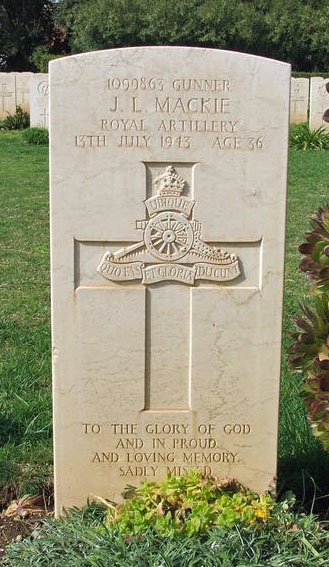 James’s headstone in the Syracuse War Cemetery
Image © The Syracuse Virtual Cemetery, used with permission
James was born in Lavender Hill, Clapham Q3 1907, the second surviving child of Herbert Thomas Mackie and Florence (née Ford – they had married Q4 1904, registered in the Lambeth District). The 1911 Census records the family living at 77 Landor Road, Stockwell. 29 year old Herbert is listed as a “Compositor” (or print typesetter). 32 year old Florence had been born in Birmingham. Their children were 5 year old Herbert junior and 3 year old James. (The original return notes that another child of the couple had died.)
The parents (with Herbert as a “Printers Reader Compositor” and Florence listed with the conventional “Unpaid Domestic Duties”) were recorded in the 1939 Register living at 117 Walsingham Gardens, Stoneleigh. There is one currently closed record at the address – perhaps the couple’s last child, Arthur born Q1 1915.
The 32 year old James is not found in that 1939 Register, and it seems likely that he was already in uniform as a Gunner with the 74 Field Regiment, Royal Artillery. Throughout WW2, the Regiment was an integral part of the 50th (Northumbrian) Infantry Division. This first saw action in France in 1940 as part of the British Expeditionary Force readying to counter the expected German invasion. As is well known, the invasion when it came was of unanticipated speed and ferocity. James’s Regiment was among those that made a fighting retreat to Dunkirk and he was among the survivors evacuated from Dunkirk in early June 1940.
Back in England, the Division and its constituent Regiments were made back up to full strength and re-equipped. During this period – in Q2 1941 – James married Beatrice Pernet in the local Surrey Mid-Eastern District. She had been born in Islington Q4 1908. The 1911 Census records her as the second of three children in the household of Alfred and Beatrice Pernet at 44 Ambler Road, Islington. Alfred is listed as a “Lithographer”, so perhaps there was some printing trade connection between the two families. The 31 year old Beatrice junior is not readily found in the 1939 Register, perhaps because of an error in transcribing the unusual surname.
The Division was sent to the Middle East in late 1941. In 1942, it was relocated to North Africa and served with distinction in turning the tide at El Alamein against the Axis forces which were then pushed back to Tunis and defeated. With North Africa secure in Allied hands, the way was clear for the invasion of Sicily.
The landings began on 9 July 1943 – in James’s case, a little to the south of Syracuse. Initially, the weather conditions were much less than ideal. There was, of course, strong Axis resistance and it took nearly seven weeks of fierce fighting before the Allies had captured the island, providing the base for the invasion of the Italian mainland. Casualty List No 1332 reported that James was killed in action in the first week of the overall battle. He is one of the 1,059 Commonwealth WW2 burials in the Syracuse War Cemetery, Sicily.
No record has been found of James and Beatrice having any children. The widowed Beatrice (whom the Commonwealth War Graves Commission’s post-war records list as being “of Hollingworth, Cheshire”) took the option of adding a personal inscription to the headstone on Grave III.H4,
“To the glory of God and in proud and loving memory. Sadly missed.”
Roger Morgan © 2018
Please contact us if you have information or pictures that can extend this entry.
MADDERS Angus Kingsley. Lieutenant (138698)
2nd Battalion, West Yorkshire Regiment (Prince of Wales’s Own)
Died 13 February 1944, aged 31
Not listed in the Book of Remembrance
Angus was in Birkenhead, Cheshire, Q1 1913, the second of four children born to Kingsley Ambrose and Naomi Madders. Kingsley and Naomi Mathews (sic) had married on 7 June 1910. The 1911 Census records them, their new-born first child, Max, and Kingley’s widowed mother living at 5 Rock Park, Rock Ferry, Birkenhead. The 30 year old Kingley is listed as a “Cotton Salesman”. It was a prosperous household, employing a nurse for the baby and a general domestic servant.
While his parents remained in Birkenhead – the 1939 Register records them living at 42 Rock Lane West – Angus moved south. In Q4 1936, he married Elsie E V Goodship. The marriage was registered in the local Surrey Mid-Eastern District, consistent with her parents – Alfred Percy (a “Master French Polisher”) and Florence (née Lawrence) being recorded in the September 1939 Register living at 30 River Way, Ewell. (They had married Q3 1912, before which the 24 year old Alfred was recorded in the 1911 Census living with his parents at 19 Elm Road, Ewell.)
Angus and Elsie set up home at nearby 120 Stoneleigh Avenue. By the time of the 1939 Register, Angus was presumably already in uniform and the 26 year old Elsie, living there alone, is listed with the conventional “Unpaid Domestic Duties”. (The subsequently widowed Elsie – who seems not to have had any children, and whom the Commonwealth War Graves Commission’s post-war records note as being “of Ewell, Surrey” – remarried Frank H Clark in Q4 1949, registered in the local Surrey Mid Eastern District.)
Angus’s WW2 service was in the 2nd Battalion, West Yorkshire Regiment (Prince of Wales’s Own). This was active in India and then Burma as part of the 9th Indian Infantry Brigade which, in turn, was part of the British Fourteenth Army commanded by the charismatic Lieutenant General William Slim.
After Japan declared war on the UK and USA in December 1940, its forces swiftly captured the Far East including Burma (modern-day Myanmar). The aspiration was to move on into British India. But Empire & Commonwealth forces managed (at great cost) to halt this in northeast India.
While the Japanese were held there, the Allies sought to broaden the front in 1943 with an offensive into Arakan, a coastal province of Burma and home to a strategically important airfield. It had failed disastrously: Allied tactics and equipment were not suited to the jungle-covered hills, and Japanese units repeatedly achieved surprise by crossing rivers and hills which the Allies had dismissed as impassable.
After extensive jungle training, another attack was launched in early 1943. This was much more successful and, supported from nearby Chittagong, the Allies managed to establish a useful base. Inevitably, the Japanese counter-attacked. The resulting battle, which lasted from 5 to 23 February 1943, has become known as the Battle of the Admin Box – named after the Allies “administration area” which became a makeshift, rectangular defensive position.
Angus was killed in action on 7 February, a couple of days into the Battle. After heavy losses on both sides, the Allies won the Battle. The victory was an enormous boost to the Fourteenth Army’s morale, and the lessons learned played a significant part in the also costly mid-1944 Battles of Imphal and Kohima in northeast India which decisively turned the tide against the Japanese.
Those actions were contemporaneous with significant Allied action in Italy and then the D-Day landings. For long after the end of WW2 the fierce fighting against the Japanese on the India/Burma front was significantly under-reported and, by those in the know, the Fourteen Army was often referred to as the “Forgotten Army”.
Angus’s body was lost in all the action and he is commemorated on the Rangoon Memorial as one of nearly 27,000 members of the Commonwealth Land Forces who died during the campaigns in Burma and who have no known grave.
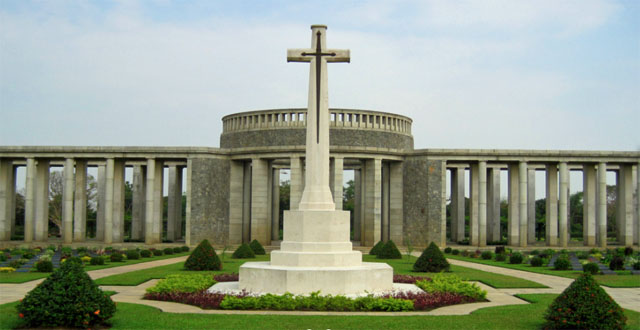 The Rangoon Memorial
Image source: The Commonwealth War Graves Commission
Roger Morgan © 2018
Please contact us if you have information or pictures that can extend this entry.
MALLETT Eric Herbert. Leading Aircraftman (1236072)
301 Maintenance Unit, Royal Air Force Volunteer Reserve
Died 23 December 1942, aged 21
Eric was born on 7 May 1921, the only child of Herbert George Mallett and Lilian Ann (née Roberts). Their Q4 1920 marriage and Eric’s birth were both registered in the Wandsworth District.
The September 1939 Register records the 40 year old parents and 18 year old Eric living at 54 Wolsey Crescent, Morden. Eric is listed as “Clerk (Paint Contractor)”; his mother with the conventional “Unpaid Domestic Duties”; and his father as “Fitter-Machinist, Mechanical Engineer”.
In view of his father’s job, it is perhaps no surprise to find that Eric’s WW2 service was in one of the RAF’s Maintenance Units – in his case, 301 MU stationed at RAF Drigh Road, Karachi in what was then the west of India, now Pakistan.
Drigh Road Airfield had been founded soon after the formation of RAF India Command in 1918. Its main mission was to receive aircraft in knocked down condition off ships, assemble, test fly and then ferry them to squadrons all over India. It was here that, in 1927, T E Lawrence (“Lawrence of Arabia”) worked as AC2 T E Shaw in the Engine Repair Shop for over a year.
In 1942, the Aircraft Depot was redesignated No 1 (India) Maintenance Unit and served as the main supply base not only for the RAF in (then unpartitioned) India but for all of the Burmese and Malayan campaigns. Practically every new aircraft destined for these fronts would have passed through Drigh Road.
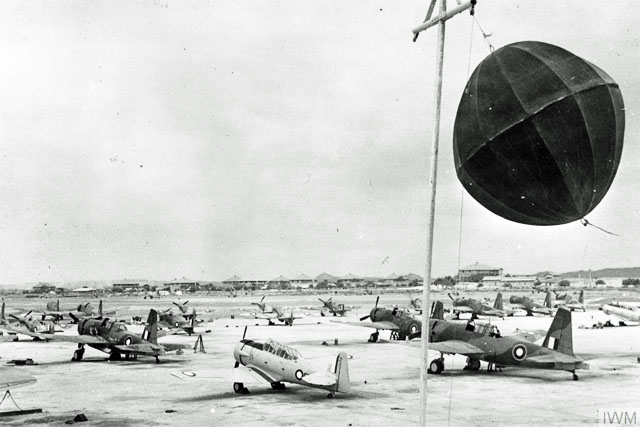 Aircraft lined up for flight testing after assembly at Drigh Road Airfield, Karachi.
IWM Photograph (CI 330) – Public Domain
The readily available records provide no information about the cause of Eric’s death on 23 December 1942. As RAF Drigh Road was far from any front line, this is more likely to be the result of illness, disease or accident than enemy action. He was buried at Holy Trinity Church, Karachi, the following day, Christmas Eve 1942.
He was later reinterred in the Karachi War Cemetery. This was created to receive graves from civil and cantonment cemeteries scattered throughout the region and contains 642 Commonwealth WW2 burials. His parents took the opportunity of adding a personal inscription to his headstone on Grave 5.D.6,
“So very young, so dear and kind, forever in our hearts enshrined. ‘Beloved'”
The compilers of the Book of Remembrance knew of some connection with the Borough that has yet to be rediscovered. The Commonwealth War Graves Commission’s post-war records list the parents as being “of Cheam, Surrey”.
Roger Morgan © 2018
Please contact us if you have information or pictures that can extend this entry.
MALONEY Thomas James
Civilian
Died 27 September 1940, aged 71
Not listed in the Book of Remembrance
Thomas was born in Camberwell on 29 March 1869. In Q2 1897, he married Helen (in some records “Ellen”) Frost, registered in the Lambeth District. The 1911 Census records the couple living at 48 Camden Grove, North Peckham, and 41 year old Thomas is listed as a “Dock Labourer”. They had two daughters, aged 4 and 9. Shortly after the Census, on 26 May 1911, 40 year old Helen gave birth to their last child, Thomas.
The September 1939 Register records the couple living at 228 St. George’s Way, Peckham. 70 year old Thomas senior is listed as “Wharf Labourer – Casual” and his wife with the conventional “Unpaid Domestic Duties”. Their 28 year old son, Thomas junior, had not married and was still living with them. His occupation is listed as “Maintenance Bricklayer”.
Unusually, the Commonwealth War Graves Commission’s records do not state where and when Thomas senior was so injured by enemy action that he had to be brought to Horton Emergency Hospital – one of Epsom’s “cluster” of mental hospitals that, as for WW1, had been taken over for handling wartime casualties. His injuries could have been sustained at the docks in those early days of the Blitz. (If he was injured at home, his wife and son survived.) All we do know that is that he died at Horton on 27 September 1940.
Roger Morgan © 2018
Please contact us if you have information or pictures that can extend this entry.
MANBEY Basil Keble. (Military Cross) Volunteer
5th Buckinghamshire Battalion, Home Guard
Died 17 September 1940, aged 52
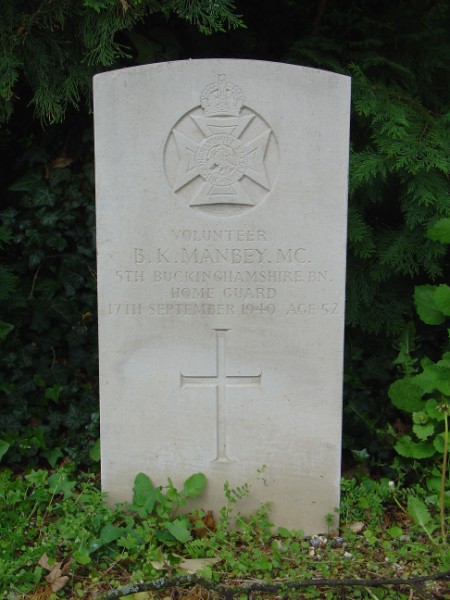
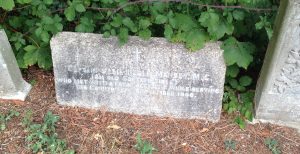 Basil’s two grave markers in Chalfont St Peter.
Photographs (69188385) by Andrew Pritchard (top) and “mynwent” (bottom) via findagrave.com
Basil is not listed in the Book of Remembrance, but is remembered here because the Commonwealth War Graves Commission’s post-war records note that his widow, Esther, was “of Epsom, Surrey”. However, it does not appear that Basil himself ever had any connection with the Borough.
Basil was born in Acton on 17 June 1888, the fifth of at least seven children born to the Revd George Henley Manbey and Mary Jane (née Richardson – their Q4 1915 marriage was registered in London’s Pancras District.)
The 1901 Census records the family – the parents in their 40s and seven children aged from 4 to 19 – living at 55 Warrior Square, Prittlewell on the outskirts of Southend-on-Sea, Essex. The father, George, is listed as not only a “Clerk in Holy Orders” but also a “Schoolmaster” – and his oldest son and daughter were listed as “Assistant Schoolmaster” and “Assistant Schoolmistress”. By the time of the 1911 Census, the parents had moved to 60 Boscome Road, Prittlewell. 56 year old George is now listed as “Schoolmaster and Clergyman” (he ran the now-lost “Southend Grammar School” in Southchurch Avenue). 59 year old Mary Jane is listed as having “Private Means”. Four of their children – still unmarried – lived with them. These included 22 year old Basil (the subject of this article), now listed as “Clerk Insurance”.
During WW1, Basil served in the Royal Field Artillery and was awarded the Military Cross. The citation, published in Gazette issue 30287 of 17 September 1917 reads:
For conspicuous gallantry and devotion to duty when acting as Advanced Intelligence and Forward Observation Officer during an attack. He sent in very valuable information, and showed the greatest energy and fearlessness in obtaining it, pushing forward with the advanced patrols and going to and fro constantly under heavy shell fire to report on the situation.
In Q4 1915 and registered in London’s Pancras District, Basil married Esther Mary Gertrude Richardson. They appear to have had one child, Molly, whose Q4 1918 birth was registered in the Yarmouth District.
The September 1939 Register records the couple, now in their early 50s, living alone at “Elmhurst”, Hillfield Road, Amersham. (Daughter Molly had married William Glanville in Q3 1938, registered in Billericay.) Basil is listed as “Insurance Cashier” and Esther with the conventional “Unpaid Domestic Duties”.
In May 1940, the Government called for men not in military service to join the new Local Defence Volunteers as the last line of defence against the expected German invasion. By July, nearly 1.5 million men had enrolled and the name of this people’s army was changed to the more inspiring Home Guard – but affectionately known as “Dad’s Army”. Basil joined his local 5th Buckinghamshire Battalion.
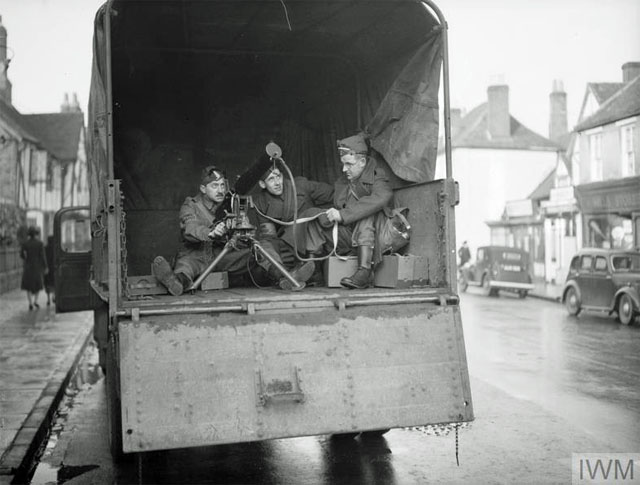 Some of the Amersham Company, 5th Buckinghamshire Battalion Home Guard.
Photograph © IWM (H 5745)
As noted on Basil’s first grave marker in the Chalfont St Peter graveyard (which proudly ranks him as one of the “Old Contemptibles” – British regular WW1 soldiers), he died on 17 September 1940 in a fatal accident while on duty. The 18 December 1940 Probate record of administration of his nearly £ 5,000 estate being awarded to the widowed Esther notes the place of death as Gravel Hill Amersham Road (the modern-day A413) Chalfont St Peter. As pictured at the head of this article, the original grave marker was later replaced by a standard forces’ issue.
As noted at the beginning of this article, the Commonwealth War Graves Commission’s post-war records note that the widowed Esther Manbey was “of Epsom, Surrey”. In at least in 1947 and 1948, she was living with the Richardsons at “Denewood” (the property between Grove Stables and Grove House) in Grove Road, Epsom.
Roger Morgan © 2018
Please contact us if you have information or pictures that can extend this entry.
MANIKUM Patricia Carol
Civilian
Died 16 August 1940, aged 2
Not listed in the Book of Remembrance
Patricia was born in Amersham on 7 July 1938, the second child of Guy David Manikum and Hilda Eileen (née Lemon – they had married Q2 1936, registered in the Wandsworth District). The birth and, sadly, death of the couple’s first child, David, had been registered in the Banbury District in Q4 1936.
The September 1939 Register records the parents and 1 year old Patricia living with Hilda’s widowed mother, 38 year old Florence Lemon, at 31 Graham Road, New Malden. Both Florence and 26 year old Hilda are listed with the conventional “Unpaid Domestic Duties”. 31 year old Guy is listed as “Traveller (Commercial)”.
The Commonwealth War Graves Commission’s post-war records note that the parents were “of 20 Higher Green, Ewell”, and that is consistent with the birth of their other two children (Phillip in Q4 1943 and Rosalie in Q4 1946) being registered in the local Surrey Mid Eastern District. However, it seems they were still at 31 Grayham Road in 1940, as that is the place noted by the Commission as the location of 2 year old Patricia’s death from enemy action on 16 August. If others at the address were injured in the attack, they recovered.
Roger Morgan © 2018
Please contact us if you have information or pictures that can extend this entry.
MANSFIELD Harry Walter. Marine (PLY/X107370)
HMS Copra, Royal Marines
Died 16 May 1944, aged 19
 Harry’s gravestone in Epsom Cemetery.
Photograph (97119227) by Lawrence Hennessy via findagrave.com
Harry was born on 16 November 1924, the second of two children born to James W Mansfield and Florence Mary (née Lee – they had married in Christ Church Epsom Common in 1917). Details of Florence’s family background are in the article about her brother, Edwin William LEE, who was killed in action during WW1.
The 1939 Register recorded the family of four living at 19 Rosendale Road, Stoneleigh. 45 year old James is listed as a “Coal Carman – Horse Keeper” and 43 year old Florence with the conventional “Unpaid Domestic Duties”. 14 year old Harry’s occupation is listed as “Petrol pump attendant” and his 17 year old brother, Edwin, as a “General Fitters Assistant”.
Harry’s WW2 service (given his age, not until well into the war) was as a Royal Marine. The records state that this was on HMS Copra – misleading Naval shorthand when the craft on which a sailor was serving at the time of his death was not recorded. HMS Copra was not a ship, but the Royal Navy shore base (in Largs on the banks of the Clyde) for the maintenance of personnel records and the calculation of pay and allowances for RN personnel attached to Combined Operations: COPRA is the acronym of “Combined Operations Pay Records & Accounts”.
The details of Harry’s death on 19 May 1944 are not currently known. However, and reinforced by the personal inscription his parents added to his headstone, namely
“He died and never knew whether it went ill or well. ‘England’ he died for you.”
there is a very strong possibility that Harry’s death was on one of the then top-secret (and still little-known) Combined Operations Pilotage Parties. Based on Hayling Island, COPP personnel ran many cross-Channel reconnaissance missions, and their work in surveying the Normandy beaches was invaluable preparation for the successful D-Day landings on 6 June 1944.
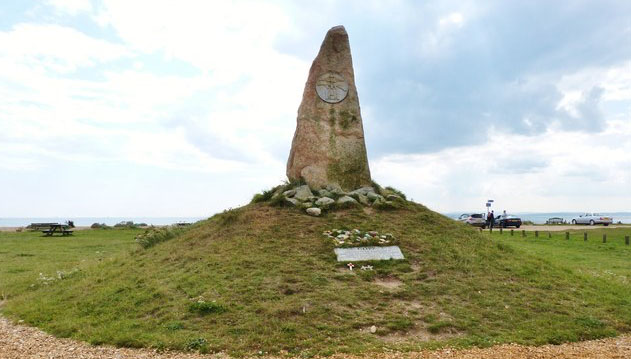 The memorial on Hayling Esplanade “dedicated to the volunteers of
Combined Operations Pilotage Parties” erected in 2012.
Photograph © Copyright Derek Voller and licensed for reuse under this Creative Commons Licence.
Harry was buried in Epsom Cemetery (Grave O486) on 15 June 1944, and the Cemetery records note his place of death as “at Sea”. His parents were later buried in the same plot: James in 1948 and Florence in 1989.
Roger Morgan © 2018
Please contact us if you have information or pictures that can extend this entry.
MARCH Leslie. Lieutenant (190734)
5th Battalion, Queen’s Own Cameron Highlanders
Died 1 July 1944, aged 29
Leslie is not listed in the Borough’s Book of Remembrance but is remembered here because the Commonwealth War Graves Commission’s records note that he was the “husband of Margot Mary March, of Ewell, Surrey”. While, as noted below, that connection has now been established, it appears to have been only brief – and it seems unlikely that Leslie himself ever lived in the Borough.
The Commonwealth War Graves Commission’s record of Leslie’s family background is simply that he was the “Son of Mr and Mrs A March”, and there is a Forces War Record noting his birth county as Sussex. As, according to the Commission, he was aged 29 when he died in 1944, he would have been born in about 1915. The General Record Office has only four people with the first name Leslie and surname March born in the period 1913-1917 – none of whom were registered in Sussex. Only one of the four had the single first name of Leslie, and his birth was registered in the Lanchester District of County Durham. Might it be that our Leslie was adopted?
For the time being, his parentage and early years remain a mystery. Sadly, that is also the case for his marriage to Margot which has not yet been found in the readily available records. The marriage took place before the 1939 Electoral Roll was compiled as this records “March, Leslie” and “March, Margot Mary” at 503 Green Lanes, Tottenham N4. The Registration was on “Business Premises” grounds (as a “House & Estate Agent – see below) and the Roll annotates both entries with “Abode: “Marco,” [sic] Highview Gardens, Finchley, N3”. Indeed, the 1939 Electoral Roll for Finchley registers them both at “Marlo”, Highview Gardens, N3 – together with the apparently unrelated Catherine Agnes O’Donovan.
However, in the 1939 Register (taken on 29 September), “Marlo” in Highview Gardens was vacant – and the residents of 503 Green Lanes (presumably a flat over the commercial premises) were the apparently unrelated mid-40s Stanley and Corina Tucker. While Leslie has not yet been traced in that Register, it does record a married Margot M March (born on 12 May 1912) visiting or staying with a Cyril and Joan (née Stanley) Green at 13 High Street, Evesham, Worcestershire. These two were of an age at which they could have been Margot’s brother or sister, but searching the records for a “Margot Green” or “Margot Stanley” born around 1912 draws a blank.
Leslie’s apparent absence from the Register was not because he was already in uniform. The 1940 and 1941 Post Office Business Directories list him at the previously mentioned 503 Green Lanes, Tottenham as a “House & Estate Agent”.
To compound the disappointment in all this, the Probate record of the widowed Margot being awarded administration of Leslie’s £137 estate notes their address as 47 Uphill Road, Mill Hill, London. (Frustratingly, the September 1939 Register’s record of the one person at that address is currently closed.) One bright spot is that we have been able to substantiate the widowed Margot’s being “of Ewell”: the May 1945 Electoral Roll finds her living/lodging with the apparently unrelated Bowman and Jane McNeil at 14 The Headway, Ewell. Her next appearance in the readily available records is when she married Edward Green in Q1 1952, registered in the Westminster District.
Contrary to the various unresolved questions in all the above, it is certain that Leslie’s WW2 service was in the 5th Battalion, Queen’s Own Cameron Highlanders (although it currently remains unclear just when that service began). As part of the 51st (Highland) Division, the Battalion took part in the key battles of North Africa and Sicily, before returning to the UK in preparation for D-Day. The Battalion landed in Normandy on D-Day+1 (7 June 1944). While, thanks to careful preparation, the initial landings were an unqualified success, the next stages – particularly capturing the German stronghold of Caen just 10 miles inland – proved much harder than the Allies had anticipated. Caen was finally taken on 6 August 1940, but Leslie was killed on 1 July in one of the multiple actions on the way to achieving that goal.
Leslie is one of the 2,236 Commonwealth WW2 burials in the Ranville War Cemetery, about mid-way between Caen and the coast. His widow took the option of adding a personal inscription to his headstone on Grave I.W.1,
“Until we meet again my darling. Margot.”
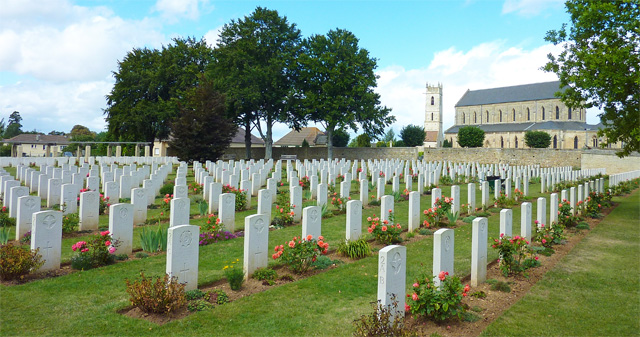 The Ranville War Cemetery
Photograph by “Woose” via findagrave.com
Roger Morgan © 2020
With special thanks to Hazel Ballan
Please contact us if you have information or pictures that can extend this entry.
MARCH Wilfred Leonard Hayward. Serjeant (768631)
344 Battery, 109 Heavy Anti Aircraft Regiment, Royal Artillery
Died 22 July 1944, aged 39
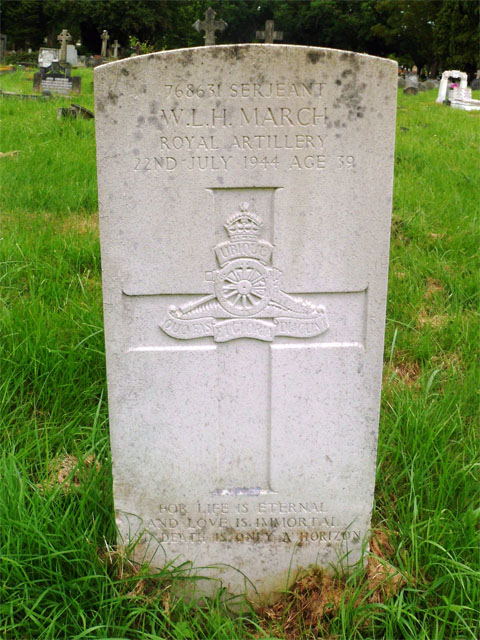 Wilfred’s headstone in Putney Vale Cemetery
Photograph (24758320) by Lawrence Hennessy via findagrave.com
Not listed in the Book of Remembrance
Wilfred was born Q2 1906, the first child of Wilfred Hayward March and Violet (née Waldin – they had married Q1 1902, registered in the Fulham District). Their second (and apparently last) child, Gladys Violet, was born Q1 1907. The 1911 Census records the family of four living at “West View”, Wimbledon Park Road, Southfields, and 30 year old Wilfred senior’s occupation is listed as “Poster and Showcard Designer”.
Thanks to his entry on the Company WW2 memorial, we know that Wilfred junior became an employee of The Gas, Light and Coke Company – one of the largest employers in the London area, employing thousands at several different sites. In Q2 1929, he married Lillian A Randall, registered in the Wandsworth District.
The 33 year old Wilfred is not found in the September 1939 Register, perhaps because he was already in uniform. 33 year old Lillian is recorded at 8 Earl Road, Barnes and listed as a “Cashier & Book keeper (Butchers)”. She was either living with, or perhaps just visiting, her parents – 76 year old William J N Randall (a “Carpenter & Joiner (Retired)”) and 72 year old Susannah (listed with the conventional “Unpaid Domestic Duties”).
Certainly by the time of Wilfred’s death in 1944, the couple’s home was 32 Lakehurst Road, Ewell – being the address given in the 1944 Probate records about administration of Wilfred’s £ 1,036 estate. Indeed, it is likely that this was the address in Q3 1942 when Lillian gave birth to what appears to be the couple’s only child, Janice: the birth was registered in the local Surrey Mid Eastern District.
The readily available records provide only very limited information about Wilfred’s WW2 service in 344 Battery of the Royal Artillery’s 109 Heavy Anti Aircraft Regiment. Is known that, in 1942, the Battery was stationed at the Old Woking Heavy Anti Aircraft Battery (located between Broadmead Road and the River Wey at Old Woking). Equipped with four 3.7″ mobile anti-aircraft guns, it was one of six sites serving the Brooklands “Gun Defended Area”.
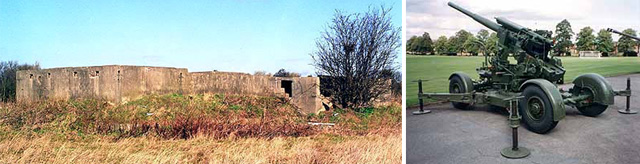 Ruins of the Old Woking Battery in 1998 and a 3.7″ mobile gun
Photographs with thanks to Nick Catford and Bob Jenner via Subterranea Britannica
As part of 30 Corps, the regiment later landed in France on D-Day, 6 June 1944, and fought on to Germany. However, it is not clear if Wilfred made it to France. On 22 July 1944, only seven weeks after D-Day, he died at the General Hospital in Ramsgate. Casualty List No. 1510 states that he “Died”, which suggests that this was the result of illness rather than injuries.Wilfred is buried in Putney Vale Cemetery. The widowed Lillian took the option of adding a personal inscription to the headstone on Grave S.661,
“For life is eternal / and love is immortal / and death is only a horizon.”
Roger Morgan © 2018
Please contact us if you have information or pictures that can extend this entry.
MARKS Montague Maurice. Leading Aircraftman (929643)
Royal Air Force Volunteer Reserve
Died 24 December 1942, aged 28
Not listed in the Book of Remembrance
Montague was born in Ewell on 28 September 1914 the only child of Henry Marks and Emma Amelia (née Morris) who, aged 41 and 42, respectively had married in Q1 1913. That was registered in the Guildford District, but both parents had strong links to Ewell.
Emma Amelia had been born in Ewell on 24 September 1870, the first child of George and Emma Morris. The 1871 Census records the 25 and 29 year old George (a “Miller”) and Emma, and 6 month old Emma Amelia living in Meadow Walk, Ewell. The family moved away in the mid 1870s. Emma then went into service
The 1891 Census records her as one of three general servants living in the household of Henry and Helen Deacon in Waldegrave Park, Twickenham. In the 1901 Census, she was a domestic servant in the household of John Barrett-Leonard at 15 Wellington Mansions, Fulham. The 1911 Census records Emma Amelia, now aged 40, visiting her now married sister Charlotte Jaques and family at Medge Hall, Doncaster.
Henry had been born in Cheam on 21 March 1872. As described in the separate article, his father, also a Henry, was a baker on High Street Cheam who, in the mid-1870s took over the bakery at 15 Kingston Road, Ewell from William Shepherd – probably a relative of his wife, Mary Ann (née Shepherd). By the time of the 1891 Census, the now 19 year old Henry junior is listed as a “Baker Assistant” – progressing to “Journeyman Baker” in the 1901 Census and “Assistant Baker” in 1911.
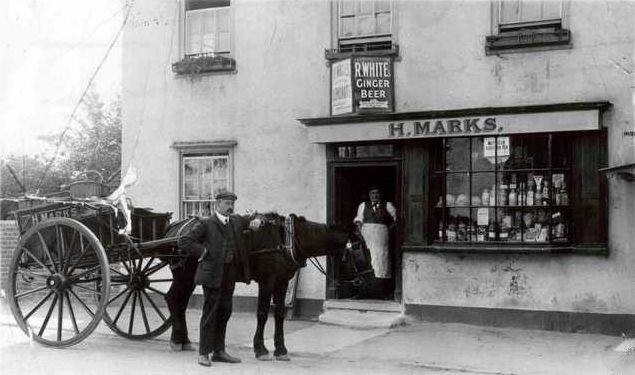 Marks Bakery, date unknown.
Image source Bourne Hall Museum.
After Henry Junior and Emma married in 1914 – their fathers’ trades as a baker and miller – surely having something to do with their getting together – they set up home at “Tedworth” Elm Road, their address when Montague, the subject of this article, was baptised at St Mary’s Church, Ewell on 15 November that year.
Henry senior died in 1920 and Henry junior, now 48, took over the business. When (having attended Ewell Infants School) Montague was enrolled at Ewell Boys School on 3 April 1922, the family address was 15 Kingston Road again. Reaching the age of 14, Montague left school on 21 December 1928, and almost certainly began work in the family business. The September 1939 Register records the 67 year old Henry (a “Master Baker”), 69 year old Emma (listed with the conventional “Unpaid Domestic Duties”) and 25 year old Montague (a “Baker Assistant”) still at 15 Kingston Road.
Shortly after that, Montague enlisted in the Royal Air Force at Uxbridge. It is disappointing that the readily available records provide no information about his WW2 service. From his burial in the Suez War Memorial Cemetery (on the outskirts of Suez at the Red Sea end of the Suez Canal), he was evidently sent to serve in Egypt and joined the large garrison based in and around Suez. It has not been possible to identify on which particular RAF station he was based.
Nor is the cause of Montague’s death on 24 December 1942 known. Of the 377 Commonwealth WW2 casualties (alongside 513 from WW1) buried in Suez War Memorial Cemetery – in his case, in Grave 2.E.7, he is the only person who died on that date, so it is presumed that this was the result of combat of other injury, or of illness.
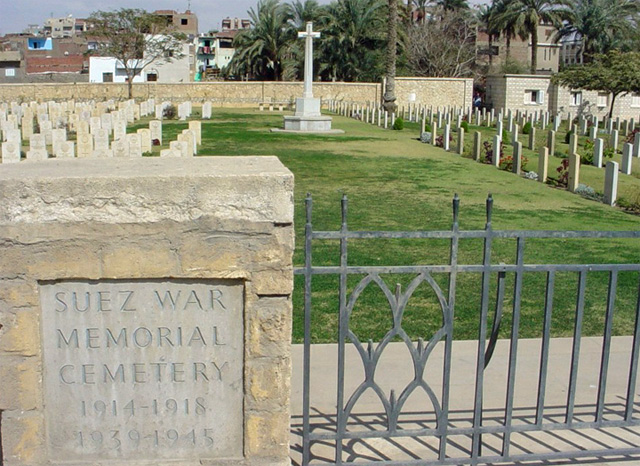 The Suez War Memorial Cemetery
Photograph with thanks to the Commonwealth War Graves Commission
Brian Bouchard & Roger Morgan © 2018
Please contact us if you have information or pictures that can extend this entry.
MARSH Leslie Henry. Stoker 2nd Class (P/KX 178745)
HMS Penelope, Royal Navy
Died 18 February 1944, aged 19
Leslie’s Q1 1925 birth was registered in Wandsworth, the first child of Henry Robert Marsh and Gladys Mary Brown whose Q3 1925 marriage was registered in Epsom. The couple had at least one other child, Alan – whose 26 May 1928 birth was registered in Epsom.
The September Register 1939 records the family living at 33 East Street. 38 year old Henry is listed as a “Master Chimney Sweep” (and this was in the firm of “Tester & Tuck” which had long operated from the address) and 37 year old Gladys with the conventional “Unpaid Domestic Duties”. Living with them were 11 year old Alan and Gladys’s 39 year old brother Sidney J Brown – a “Temporary Postman (Formerly Steel Scaffolder)”. There is one currently closed record at the address, perhaps the 14 year old Leslie.
Leslie’s WW2 service was as a Stoker on HMS Penelope – an Arethusa-class light cruiser commissioned in November 1936. Most of this ship’s illustrious WW2 career is described in the article on Herbert Knight who was killed on 8 October 1943 in the aftermath of yet another successful action, this time off Rhodes.
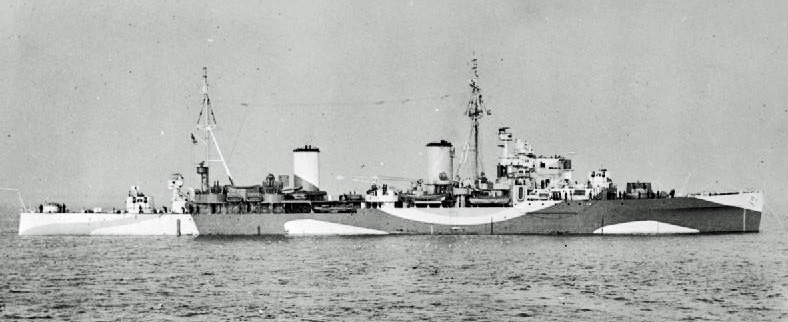 HMS Penelope at Spithead, 23 December 1942
IWM Photograph FL4822 – Public Domain
After the repairs (carried out in Alexandria) necessary after that action HMS Penelope was back in action by February 1944 when she was involved in helping operations at the Anzio beachhead by bombarding the enemy’s positions. The Anzio landings were intended to outflank the German forces that, at their well-prepared defensive “Winter Line”, were holding the Allies advancing north from the “foot” of Italy. The initial landings were the intended surprise but, instead of capitalising on this and advancing to the high ground, the local commander took time to prepare for the expected counter-attack. When this came, the Allies were pinned down in the marshy area round Anzio. The operation was nearly as disastrous as WW1’s Gallipoli landings and it was only with very heavy casualties over the next four and half months that the Allies prevailed.
However, HMS Penelope’s demise was not the result of fighting in the Battle of Anzio. On 18 February 1944, she was heading back to Anzio for (having just re-stocked on ammunition at Allied-held Naples – some 90 miles south of Anzio) when, at 0658 hours, she was hit in the after engine room by a T5 acoustic torpedo fired by U-Boat U-410. (The acoustic torpedo was a fairly new development and used sophisticated electronics to home in on the distinctive noise “signature” of the selected target.) When first hit, the cruiser was making 26 knots or 30 mph – understood to be the first and only time during WW2 that a ship running at such speed was successfully attacked by a U-boat. HMS Penelope was badly damaged and began to sink. At 0716 hours, U-410 fired another torpedo which hit the crippled ship in the after boiler room. Its explosion set off the after magazine. The combined massive explosions broke the cruiser’s back and, some 35 miles west of Naples, she sank in less than two minutes.
415 of the crew, including the captain, Leslie and Geoffrey Stephens went down with the ship. There were 206 survivors.
Leslie is one of the nearly 15,000 Commonwealth WW2 sailors with no know grave commemorated on the Portsmouth Naval Memorial.
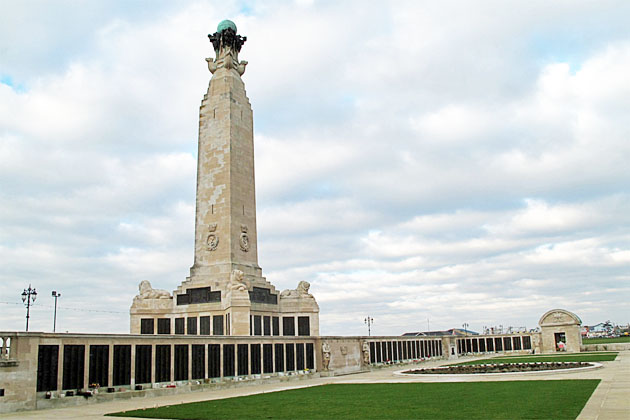 The Portsmouth Naval Memorial
Photograph with thanks to ww2cemeteries.com
Roger Morgan © 2020
Please contact us if you have information or pictures that can extend this entry.
MARTIN Emmanuel James. Able Seaman (C/SSX 27759)
Royal Navy.
Died 8 October 1944, aged 26
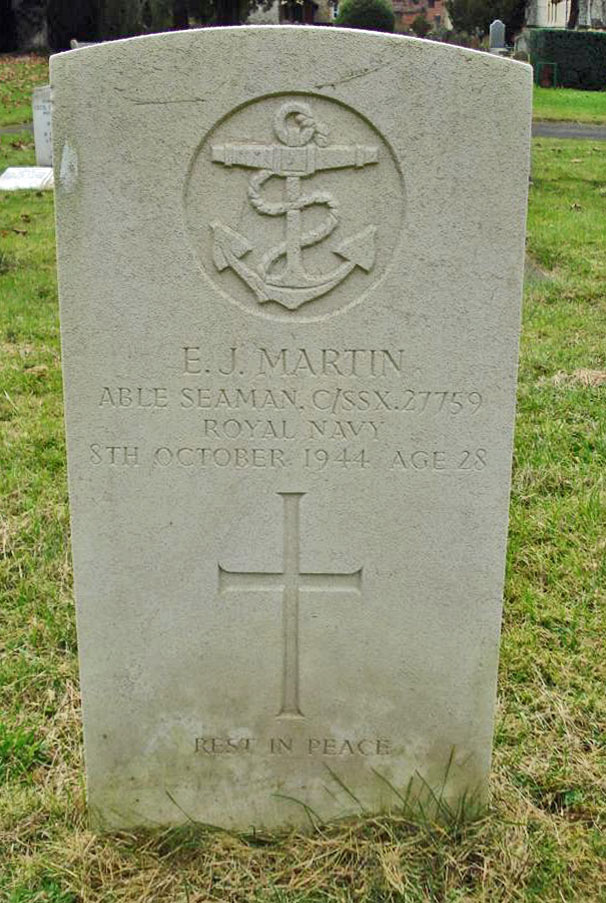 Emmanuel’s headstone in Dorking Cemetery.
Photograph (31430965) by “julia&keld” via findagrave.com
This article was researched and first written in early 2018 because, while Emmanuel (in the available service records, “Emanuel”) is not listed in the Epsom & Ewell Borough Book of Remembrance, the Commonwealth War Graves Commission database indicated an Epsom connection for this Able Seaman: it had an entry for him as the 28 year old “son of Mr and Mrs James Martin & husband of Rose F Martin, of Epsom”.
There appears to be almost no basis for that Epsom address (but see the hint in the final paragraph of this article) and, indeed the Commission has since deleted that record while retaining the confusingly parallel one for Emmanuel as a Civilian casualty (with the details “Husband of R F Martin, of 51 Kellett Road, Brixton, London. Injured 25 February 1944, at Shakespeare Road, Herne Hill; died at Dorking and District Hospital.”).
The search for the truth behind all this has yielded a convoluted story which it seems useful to set out here for the record – not least to continue to acknowledge Emmanuel’s otherwise now-ignored WW2 service in the Royal Navy. (Sadly, no detail of what that service actually was has yet been found in the readily available records.)
The since deleted Commission record noted that Emmanuel was aged 28 at the time of his death in October 1944, so his birth year should have been 1916 (or late 1915). However, neither of the two Em(m)anuel Martins born in the decade 1910-20 fit that bill. His Death Certificate gives his age as 26, and further research shows that he was the son of a James Martin and a Ms Wright born in the Chorley district of Lancashire in March 1918. Sadly, these common surnames make it impossible to trace his family background in the readily available records with any confidence. (The heading of this article gives his correct age but, as can be seen from the image under that, the headstone says “28”.)
Emmanuel has left a very light trace in the records. His 1944 Death Certificate notes his “Rank or Profession” as “AB No C/SS27759 Royal Navy (Farmer)” – “farmer” presumably being his pre-war occupation. He is not found in the September 1939 Register – probably because he was already in uniform as an Able Seaman. Anyway, after his 1918 birth, the first certain sighting of him in the records is his 20 April 1941 marriage to the widowed Rose Frances Deere at the Holy Trinity Church, Islington.
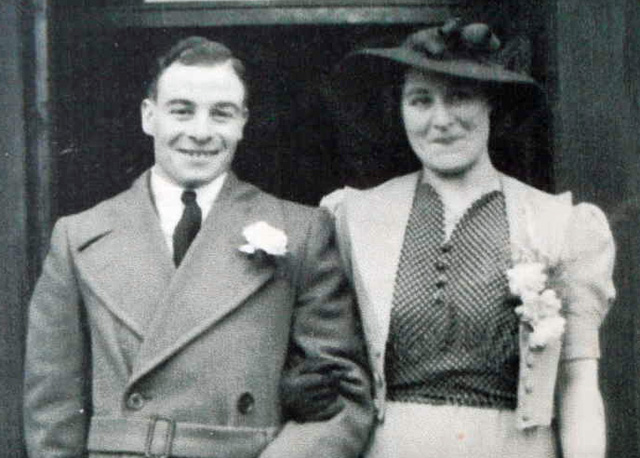 Emmanuel and Rose on their wedding day, 20 April 1941
Copyright acknowledged
Rose was born on 27 October 1910, the third child of Tom Freestone and Frances (née Vickers – they had married in Kettering Q3 1907). The 1911 Census records the couple in their mid 20s living, with new-born Rose, in a four-room dwelling on Rockingham Road, Cottingham, near Corby, Northants. Tom is listed as a Platelayer in the Ironstone Mines.
Rose’s first marriage had been to Idris Deere in Q4 1931. While that had also been registered in Islington, the couple seem to have set up home in Pontypool, Monmouthshire, where they had two children – John (born Q4 1932) and Joan (born Q2 1934).
In the mid-1930s, Idris Deere had joined the Royal Navy (as C/K 65814) and later became Stoker 1st Class serving on HMS Versatile. While the September 1939 Register records the 32 year old Idris visiting family at 18 Church Terrace, Pontnewynydd, Pontypool, it finds 28 year old Rose staying with the apparently unrelated Leonard and Jessie Dudding at 4 Lonsdale Place, Islington. She is listed as “Restaurant Steam Hand”. It is not clear where the children were.
On 28 February 1940, and presumably in connection with his Naval service, Idris drowned when he fell from the dock at Bootle. He was buried in the war graves section of Bootle Cemetery, and Rose added the personal inscription “Rest in Peace” to his headstone.
Just over a year later, as noted above, the widowed Rose married Emmanuel in April 1941. They had one child, Edward, whose Q4 1943 birth was registered in the Berkhamsted District of Hertfordshire.
In 1944, Rose (and Emmanuel when on leave) was again living in the London area, but there is confusion about the address: some sources give it as 51 Kellett Road, Brixton; and others as 321 Shakespeare Road, Herne Hill.
However, It seems clear that, on 25 February 1944, Emmanuel was injured on by enemy action while at 321 Shakespeare Road. It is understood that he was on leave at the time – having swapped leave so that he could be with Rose and their 3 month old son, Edward (later known as “Jim”), during a period of air raids.
He was taken to Dorking and District Hospital for treatment where he died on 8 October 1944, some nine months later. His Death Certificate gives the cause as “a. Intestinal obstruction b. Multiple adhesions”. These were presumably the result of operations to deal with the injuries he had received earlier in the year. The informant was Emmanuel’s widow, Rose F Martin, whose address was given there as 321 Shakespeare Road, Herne Hill.
Emmanuel is buried in the Dorking Cemetery (Plot 1. Grave 5283) where the widowed Rose added the personal inscription to his headstone, “Rest in Peace” – as for her first husband, Idris Deere, in Bootle Cemetery.
As to the again widowed Rose, it appears that, with a David Flynn as the father, she gave birth to a daughter Claire Rose in Epsom – the only hint of a local connection so far found – on 29 September 1952. Anyway, Rose ended her days in New Zealand: she married the widowed August Frank Neustroski there on 3 December 1977 and, aged 85, predeceased him on 7 June 1996.
Roger Morgan © 2019
Please contact us if you have information or pictures that can extend this entry.
MARTIN Reginald William. Sergeant (under training Pilot) (1387904)
Royal Air Force Volunteer Reserve
Died 24 July 1942, aged 20
Reginald’s birth on 16 June 1922 was registered in the Lambeth District. He was the second and last child of Robert Francis Alexander Martin and Maud Julia (née Pacey) who were married in the Wandsworth District on 6 March 1920. (The Q4 1920 birth of the couple’s first child – Robert, another WW2 casualty – was, like Reginald’s, registered in the Lambeth District.)
The September 1939 Register records the family of four (assuming that older son Robert is behind the currently closed record) living at 1 Lyndhurst Square, Camberwell. The 43 year old Robert senior is listed as a “Builder & Decorator” and 43 year old Maud with the conventional “Unpaid Domestic Duties”. 17 year old Reginald is listed as “Seeking Work, Not Previously Employed”.
During WW2, the family home moved to 81 Cromwell Road, Worcester Park – hence Reginald’s entry in the Borough’s Book of Remembrance. Having lost both their children in the war, the parents then moved to Pagham in West Sussex, which is where, in Reginald’s case, the Commonwealth War Graves Commission’s post-war records note them as being “of”. (For his brother Robert, the Commission notes the parents as being of “Worcester Park, Surrey”.)
Reginald’s Service Number 1387904 indicates that he enlisted with the Royal Air Force Volunteer Reserve at Euston during September 1940 for air crew development. Apparently, he was subsequently sent to Rhodesia (modern-day Zimbabwe), to train as a pilot. His training was at No 26 Elementary Flying Training establishment (“Guinea Fowl”) at Gwelo (now Gweru), about 120 miles south west of Salisbury (now Harare). Instruction there was provided on De Havilland Tiger Moths and Fairchild Cornells.
It would seem Reginald was involved in a fatal accident, but details have not been established. He is buried in Grave 4,A,5 of the Gweru Cemetery, one of 87 Commonwealth WW2 casualties there.
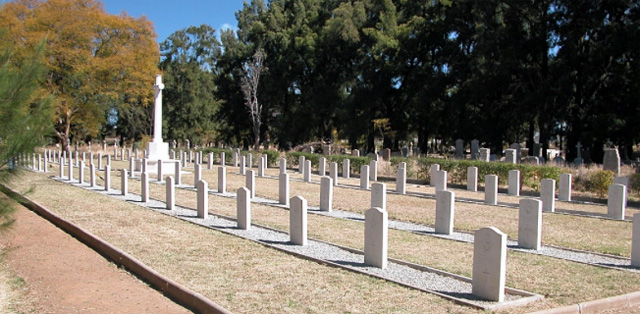 The Gweru Cemetery, Zimbabwe
Photograph with thanks to the Commonwealth War Graves Commission
Brian Bouchard & Roger Morgan © 2019
Please contact us if you have information or pictures that can extend this entry.
MARTIN Robert John. Flight Sergeant (1387761)
228 Squadron, Royal Air Force Volunteer Reserve
Died 12 July 1943, aged 22
Robert’s Q4 1920 birth was registered in the Lambeth District. He was first child of Robert Francis Alexander Martin and Maud Julia (née Pacey) who were married in the Wandsworth District on 6 March 1920. (The 1922 birth of the couple’s second and last child – Reginald, another WW2 casualty – was, like Robert’s, registered in the Lambeth District.)
The September 1939 Register records the family of four (assuming that 18 year old Robert is behind the currently closed record) living at 1 Lyndhurst Square, Camberwell. The 43 year old Robert senior is listed as a “Builder & Decorator” and 43 year old Maud with the conventional “Unpaid Domestic Duties”.
During WW2, the family home moved to 81 Cromwell Road, Worcester Park – hence Robert’s entry in the Borough’s Book of Remembrance. Having lost both their children in the war, the parents then moved to Pagham in West Sussex, which is where, in brother Reginald’s case, the Commonwealth War Graves Commission’s post-war records note them as being “of”. For Robert, however, the Commission notes the parents as being of “Worcester Park, Surrey” and 81 Cromwell Road was noted as Robert’s address in the June 1944 Probate record of administration of his £ 430 estate being awarded to his parents.
The Service number 1387761 indicates that Robert enlisted with the Royal Air Force Volunteer Reserve at Euston during September 1940 for air crew development. His specialism has not been established. By 1943 he was attached to 228 Squadron, based at Pembroke Dock and flying Short Sunderland “flying boats” on patrol over the Bay of Biscay.
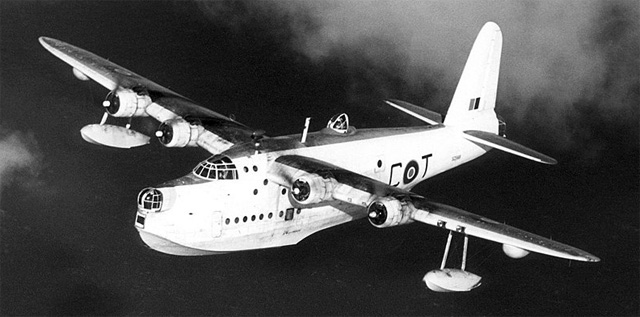 A Short Sunderland Mk V
A Public Domain Image from Wikimedia
On 12 July 1943, Robert was one of eleven aboard Sunderland DV977 being piloted by Sergeant Roy Codd on a Bay of Biscay patrol. The aircraft was shot down, reportedly at 15.18 hours by Lt Ulrich Hanshen, l5/KG 40 in Junkers Ju88 P/Q.24W/l679. Robert was among the ten of the Sunderland’s crew never recovered, namely:
Sgt Roy Codd (1293582)
Sgt Robert John Martin (1387761)
Sgt James Handley Sowerby (1029411)
Fl/Sgt Percy Edward Harding (1381495)
Sgt David Holmes Hamilton (1133127)
Fl/Sgt Richard Clyde Armstrong (405770)
Sgt Andrew Sparks (1066882)
Sgt James Bowling Graham (1041076)
Sgt Douglas Allenby Waterman (921037) – another WW2 casualty from Epsom
Sgt Roy Gilbert Whale (1850056)
(The one crew member saved was the flight engineer, Sergeant E. Davidson, who had been operating the mid-upper turret. After eight and a half hours in the sea, was picked up by a Royal Navy sloop.)
As some of the 20,000+ members of the RAF who were lost during WW2 operations and who have no known grave, Robert and his crewmates are commemorated on the RAF Memorial at Runnymede.
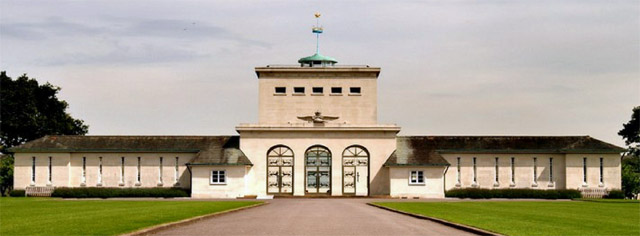 The RAF’s Runnymede Memorial
Photograph with thanks to the Commonwealth War Graves Commission
Brian Bouchard & Roger Morgan © 2018
Please contact us if you have information or pictures that can extend this entry.
MASKELL Edward Ernest
Civilian
Died 28 August 1941, aged 59
Not listed in the Book of Remembrance
Edward was born on 18 April 1882. In Q1 1926 and registered in Croydon, he married Lily Maud Welsford (born 12 December 1889). The couple had four children over the following 11 years. The September 1939 Register records the parents living at 11 Goodwin Gardens, Violet Lane, Croydon. Edward’s occupation is listed as “Labourer General Hand (Motor Garage)” and Lily’s as the conventional “Unpaid Domestic Duties”. The currently closed records at the address are doubtless of their children, now aged between 2 and 13.
During the night of 10/11 May 1941, Edward was working at the Croydon Bus Garage in the Brighton Road, South Croydon. The dates are those taken as marking the end of the German’s “Blitz” bombing campaign which had begun on 7 September 1940. The ferocity of this last mass assault on the London area was unprecedented. By the following morning, the German bombers had claimed 1,486 lives, destroyed 11,000 houses and, within central London, hit the Houses of Parliament, Waterloo Station, the British Museum and many other landmark buildings.
Croydon Bus Garage had a direct hit by two high explosive bombs. The depot was full of buses being serviced and refuelled for the following day’s work. The blast and the ensuing blaze killed seven men outright and injured many others, including Edward. The building and 65 buses were destroyed.
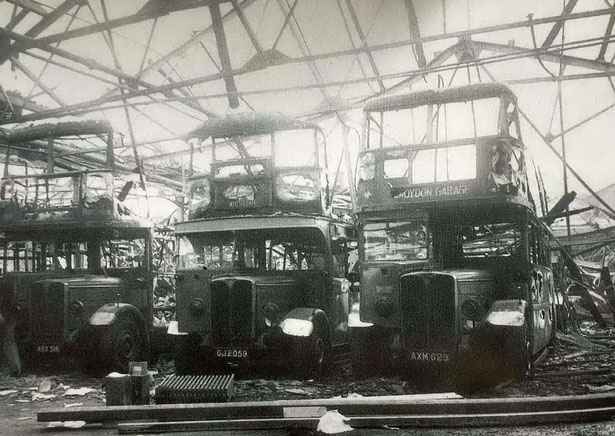 Croydon Bus Garage after the May 1941 bombing
Picture by Bob Ogley of the Croydon Advertiser, copyright acknowledged
The injured Edward was taken to the Horton Emergency Hospital, one of Epsom’s “cluster” of mental hospitals that, as for WW1, had been taken over for dealing with wartime casualties. Some 15 weeks later, on 28 August 1941, he died there.
Roger Morgan © 2018
Please contact us if you have information or pictures that can extend this entry.
MASKELL Roland George. Gunner (950400)
4th Survey Regiment, Royal Artillery
Died 12 June 1942, aged 22
Roland was born in Epsom Q4 1919, the first of three children born to George Maskell and Margaret Catherine (née Walker – they had married the previous year in the Stanstead Abbots District of Hertfordshire). Roland’s father, George (son of John Maskell, “The Repented Sinner“), had also been born in Epsom, but the 1908 record of his enlisting as Gunner 49016 in the Royal Horse Artillery noted his current “residence town” as Stanstead Abbots. (He subsequently served in India, and was thus a recipient of the 1911 Delhi Durbar medal issued to servicemen there to mark the proclamation of George V as Emperor.)
George and Margaret had two other children whose births were also registered in the Epsom District – Donald (Q4 1920) and Albert (Q1 1923). The September 1939 Register records the family living at 13 Church Road, Epsom. 51 year old George is listed as “Lorry Driver LCC Highways & Bridges Dept” and 48 year old Margaret with the conventional “Unpaid Domestic Duties”. Those who were teenagers and younger at the time of the 1939 Register are, currently, normally concealed and the two closed entries at the address are likely to be of Roland and Donald. Exceptions are when such youngsters are know to have died. The transcribers could therefore have revealed 19 year old Roland’s entry. They did reveal the entry at the address for 17 year old Albert (listed as “Chartered Accountants Junior Clerk”) as they were aware of his death in Q4 1940 – which does not appear to have been for wartime reasons.
Roland’s WW2 service was in was in the Royal Artillery’s 4th Survey Regiment. This Unit was formed in January 1937 under the Durham County TAAF Association with headquarters at Gateshead-on-Tyne and is sometimes referred to as the “4th (Durham) Survey Regiment”. In May 1940, the Regiment moved to the South of England and, in November 1940, was sent to Egypt. Its members’ specialist survey skills were soon put to good use in maximising the effectiveness of British artillery in the North African campaign.
The fighting in that theatre got under way with the Italian declaration of war in June 1940 and its forces’ advance towards Egypt from Libya, then an Italian colony. British forces pushed them back and, indeed, gained ground to take Tobruk. German forces then came to the Italians’ aid and the combined Axis forces under Rommel then had the upper hand until the crucial turning point of the Battles of El Alamein in the second half of 1942.
In the ebb and flow of this fighting, Roland was killed in action on 12 June 1942. Initially buried near where he fell in Cyrenaica, he was later re-interred (as were many others from scattered desert sites) in the Knightsbridge War Cemetery. This is about 15 miles west of Tobruk in eastern Libya and contains 2,672 WW2 Commonwealth burials.
Roland’s parents took the option of adding a personal inscription to his headstone on Grave1.C.4,
“Until the day break and the shadows flee away.”
 The Knightsbridge War Cemetery, Libya.
Photograph with thanks to the Commonwealth War Graves Commission
Roger Morgan © 2018
Please contact us if you have information or pictures that can extend this entry.
MATTHEWS Reginald William. Able Seaman (P/J 97401)
HMS Acheron, Royal Navy
Died 17 December 1940, aged 35
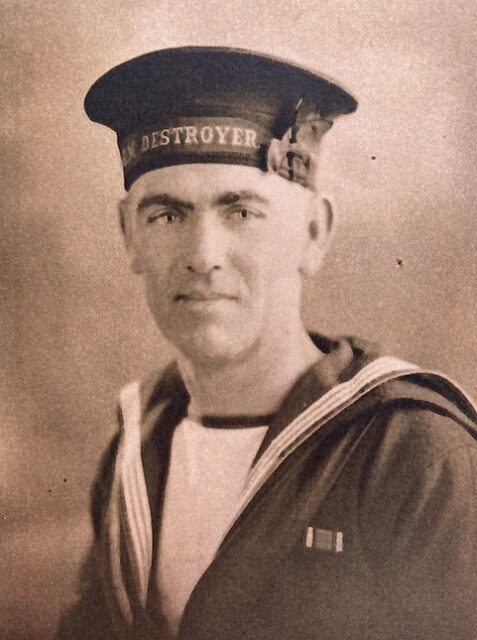 Reginald Matthews in 1939/40.
(The generic “HM Destroyer” hat ribbon was a wartime security measure.)
Photograph with thanks to his grand daughter, Debra Lancastle.
Unusually, the Commonwealth War Graves Commission’s database does not have Reginald’s age when he died, noting only – apart from the service details and date of death above – that he was the “son of Horace and Alice May Matthews; husband of Nellie Rose Matthews, of Leatherhead, Surrey”. However, as outlined below, those were not his parents’ names – and both Reginald and his wife had strong Epsom connections, hence his entry in not only the Borough’s Book of Remembrance but also on the WW2 memorial at Christ Church Epsom Common.
Reginald’s parents were actually Henry William and Alice Maud Matthews. Henry, born in 1879, was originally from the Cotswold village of Churchill, where his father was the village blacksmith. That was not the trade for Henry, and the 1901 Census finds him as an asylum attendant at Brookwood Hospital in Knaphill, four miles from Woking.
On 23 April 1904, the 26 year old Henry married 27 year old Alice Maude Hoare in St John’s Church, Woking. The couple had doubtless met at the Brookwood Hospital, where the 1901 Census had recorded Alice working as a laundry maid. Alice, however, was originally from Epsom: the 1901 Census records her parents (Harry and Kate – respectively a “stableman” and “laundress”) and three other children all living at 1 Bristow Cottages in Woodlands Road, Epsom.
More than a little devilling in the readily available records finds that Reginald, the couple’s first child and the subject of this article, was born in Woking on 5 February 1905 (hence his age at death given above). The parents then moved (presumably for work purposes) to Salisbury where they had four more children. Sadly, the family then fell apart. In June 1910, the terminally-ill Alice admitted her five children to the local workhouse, where the guardians immediately got the now 5 year old Reginald admitted to the nearby Church of England School in Britford.
Alice returned to her family home in Woodlands Road, Epsom where, aged 32, she died of TB in October. She was buried in Grave A223A of Epsom Cemetery on 11 October 1910, recorded as the “wife of Henry Matthews” and having died at “Bristows Cottages, Woodlands Road, Epsom” – being her family home.
The 1911 Census records the 6 year old Reginald and his four siblings (Leonard, 5; Stanley, 4; Ronald, 2; & Horace, 1) as inmates of the Alderbury Union Workhouse, Coombe Road in East Harnham – now a southern suburb of Salisbury. The same Census records their now 33 year old father (listed as widowed and working as a general labourer in the building trade) as lodging with the unrelated Moses Newman (a general labourer in the local gasworks) and family at 82 Ashley Road, Salisbury. Reginald’s father is then lost to the readily available records. There is some understanding in the family that he was killed during WW1, but that has not yet been substantiated.
Reginald left the Bintford school aged 12 on 1 August 1913, the stated reason being that he had “Boarded out of W[iltshire].” He very soon enlisted as a “Boy” in the Royal Navy at Portsmouth, being 4′ 10½” tall with a chest measurement of 30″ and with light hair, blue eyes and a fair complexion. By the age of 18, he had grown to 5’ 7″ with a 35″ chest and sported a tattoo on his right arm. By December 1923 he had advanced to Able Seaman. His character was always assessed as “Very Good”.
As an aside from Reginald’s story, it is worth noting that in May 1916, the wife of one of the late Alice’s Epsom-based brothers applied to take in two of Reginald’s brothers, Stanley and Horace, only to be refused by the Workhouse Guardians as they had already formally adopted the children under the Poor Law Acts. In due course, the 1921 Census records Reginald’s brothers, Leonard and Stanley (now at school in their early teens), lodging with retired farmer Walter Andrews and his wife at Broom Hill, Landford, Wiltshire. In both cases, their entries are marked “Father nk [not known], Mother dead”.
Anyway, it seems clear that Reginald kept in touch with his Epsom relations, and it must be in this way that he came to meet Epsom girl Nellie Rose Dench: family members were near neighbours on Woodlands Road. (In our map of Epsom Cottages in 1896, Reginald’s late mother’s family lived in Bristows Cottages – marked 77 – only about 100 metres from the Dench family home in Newton Cottages – marked 79.)
According to the 1911 Census, Nellie was the eighth child – of an eventual 10 – born to John (a “Labourer”) and Annie Jane Dench of Newton Cottages. She was born on 25 March 1906 and baptised at Christ Church Epsom Common on 26 May 1907.
Nellie’s father, John, died in 1915 aged only 45. The 1921 Census records the widowed and now 48 year old Annie at 46 Woodlands Road (doubtless the now numbered Newton Cottages) and working in one of the local laundries together with the now 15 year old Nellie (also a laundress) and six of her other children.
The 1929 Electoral Roll records Annie, Nellie and Nellie’s brother Percy lodging with the apparently unrelated Thomas Wiltshire at 78 Bracken Path, only a stone’s throw from Christ Church on the other side of Epsom Common. And it was from 78 Bracken Path that, on 27 September 1930, the 24 year old Nellie married 25 year old Reginald Matthews. The marriage was in Christ Church and the Register entry records that Reginald’s residence was HMS Cairo of the Mediterranean Fleet. While that entry correctly records Nellie’s father as “John Dench, deceased”, the sad circumstances of Reginald’s family background are shown by his wrongly reporting his father’s name as what could be read as “Horace” (the name of Reginald’s youngest brother – and presumably leading to the mistake in the CWGC’s records as noted in the first paragraph of this article) and recording his father’s ”Rank or Profession” as “unknown”.
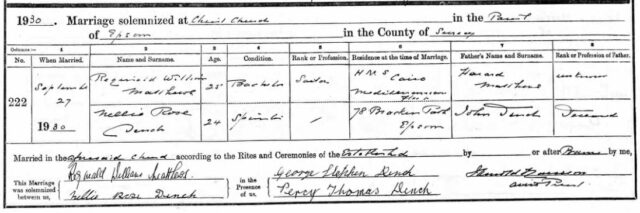 The Register entry for the September 1930 marriage of Reginald and Nellie.
It was also from 78 Bracken Path that, on 5 August 1933, Nellie’s 22 year old sister Agnes married 25 year old William Haynes. The Register entry notes that they were both laundry workers, perhaps explaining how they met. And Reginald was again home on leave for that, being listed as one of the witnesses.
In Q2 1935 (and registered the local Surrey Mid Eastern District), Nellie gave birth to the couple’s only child, Donald. Reginald left the Navy at about this time and then worked in Epsom as a postman. The 1938 Electoral Roll records the couple as residents of 23 The Crescent, on Epsom’s newly built Wells Estate – and a stone’s throw from Nellie’s childhood home in Woodlands Road.
Reginald was back in the Navy by the start of WW2, which explains why he is not found in the September 1939 Register. Although it is known that Nellie continued at 23 The Crescent into the early years of WW2, the 1939 Register records her (together with a currently closed record, doubtless covering the 5 year old Donald) at 77 Belfield Road, Ewell – being the home of (sister) Agnes and William Haynes. Also recorded there was Agnes’s and Nellie’s mid-60s widowed mother, Annie. (Nellie and Donald subsequently returned to 23 The Crescent, Epsom – being the address given in the March 1941 Probate record of Nellie being awarded administration of Reginald’s £225 estate.)
Reginald’s WW2 service was as a stoker on HMS Acheron, an A-class destroyer. After service off the Norwegian coast, the ship returned to patrol and escort duties in the English Channel. On 20 July 1940, while sailing off St. Catherine’s Point, she was attacked by German dive bombers and damaged by nine near misses. She began repairs at Portsmouth Dockyard but, on 24 August, was yet more seriously damaged during an air raid which killed two of her crew and injured another three.
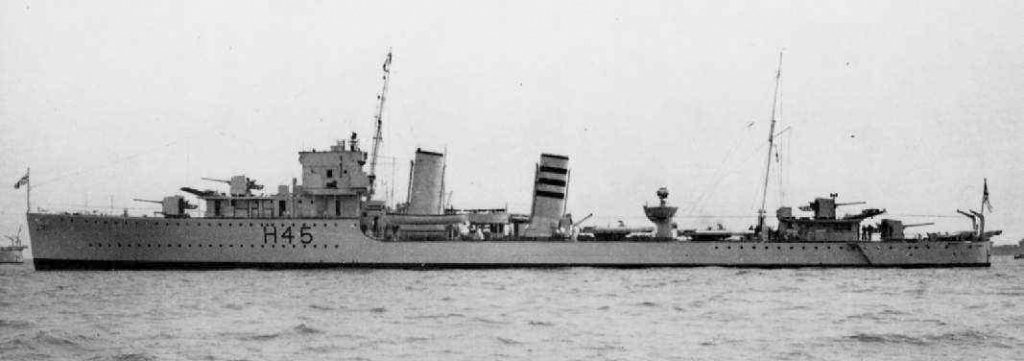 HMS Acheron
Picture © NavyPhotos.com
After completion of the extensive repairs, HMS Acheron began post-refit trials. Late on 17 December, she was conducting steaming exercises over a measured mile, again off St. Catherine’s Point. There were heavy seas with a strong north-east wind and, on one of the passes, she struck a mine – probably one of those laid by the Luftwaffe in no definite pattern along the Channel coast. The explosion caused major structural damage below the waterline near the bow and the ship’s speed (she was capable of 35 knots, some 40 mph) helped drive her under. She sank within four minutes, taking 196 crewmen and yard workers (who were on board for the trials) to the bottom. There were only 19 survivors.
The site of the wreck is designated under the Protection of Military Remains Act, and Reginald and the others lost are among nearly 15,000 WW2 naval personnel commemorated on the Portsmouth Naval Memorial as lost or buried at sea. Reginald is also commemorated in the Borough’s Book of Remembrance and on the WW2 memorial at Christ Church Epsom Common.
The Portsmouth Naval Memorial
Photograph with thanks to ww2cemeteries.com
The Commonwealth War Graves Commission’s post-war records state that Nellie was “of Leatherhead”. However, as noted above, she was at 23 The Crescent, Epsom until at least March 1941. She and young Donald did later move to live with her married sister Annie and husband, Frederick Keay, in Cleeve Road, Leatherhead. And, on 9 April 1945, the widowed Nellie got married again – to Frederick A Wickett, also of Leatherhead.
Roger Morgan © 2018 & 2023
2023’s major update with special thanks to Reginald’s granddaughter, Debra Lancastle
Please contact us if you have information or pictures that can extend this entry.
MAYNARD Howard Charles Alan. Warrant Officer Class II/Navigator (R/57637)
12 (RAF) Squadron, Royal Canadian Air Force
Died 9 October 1943, aged 22
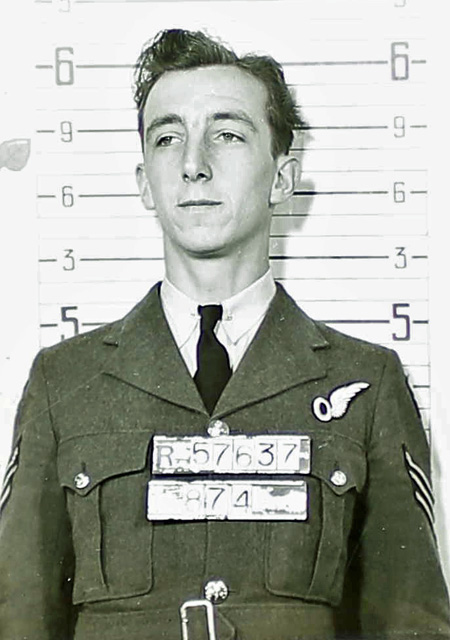
Howard’s official RCAF picture
Copyright acknowledged
Howard is not listed in the Borough’s Book of Remembrance, but is remembered here because he is commemorated on the WW2 memorial in St Martin’s, Epsom. That is a little surprising since the Commonwealth War Graves Commission database notes that he was the “Son of Augustus J and Catherine M Maynard, of Vancouver, British Columbia, Canada”. The only link with Epsom appears to be through his uncle, Hugh Roland Maynard – perhaps visiting him when on leave. The September 1939 Register records this 53 year old “Valuation Officer, City Corporation” living with his wife, Norah, and three children at 46 Woodcote Hurst, Epsom.
Howard’s father, Augustus Jackson Maynard, was Hugh’s older brother. The 1901 Census records them as the middle two of the four children of Henry William (a “Law Company’s Clerk) and Anne Maynard, living at 92 Gardeners Lane, Putney. 14 year old Hugh was still at school, while the 17 year old Augustus was a “Solicitor’s Clerk”.
In 1903, Augustus emigrated to Canada. He returned to England in 1910 and, on 10 December in St Mary’s Putney, married Catherine Mary Louise Bray. The record of the marriage describes the 27 year old Augustus as a “Bank Manager” resident at 92 Felsham Road, Putney (his parents’ address – and presumed to be the renamed Gardeners Lane of the 1901 Census). The 29 year old spinster Catherine was of 63 Clarendon Road, Putney, presumed to be the now numbered “Wakefield” where the 1901 Census had recorded her as a 19 year old “Pupil Teacher”, the middle of three children living with their parents, Charles (a “Solicitor’s Clerk”) and Mary Bray.
Augustus and Catherine are not found in the 1911 Census because they returned to Canada. Its 1916 Census records them living at 117 Broadway, Battleford, Saskatchewan, with their first two children: 3 year old Kenneth and new-born Marion.
Catherine (but not Augustus) was back in the UK in early 1921 when, on 13 January, she gave birth to Howard – the subject of this article – and his twin Francis. They returned to Canada in July 1921, when Howard’s immigration form notes that he was coming to live with his father in Portage la Prairie, a city in Manitoba. The family later moved from central Canada to the west coast: their address being 4144 West 12th Avenue, Vancouver, British Columbia. Howard’s secondary education was at Vancouver’s Lord Byng High School, from which he graduated on 26 June 1939.
Howard enlisted in the Royal Canadian Air Force on 20 March 1940 and trained as a navigator. He was brought to the UK in November 1942 and, in July 1943, was assigned to 12 Squadron, part of the RAF’s Bomber Command and equipped with the Lancaster heavy bomber. In late 1943, the squadron was based at the newly-built RAF Wickenby in Lincolnshire.
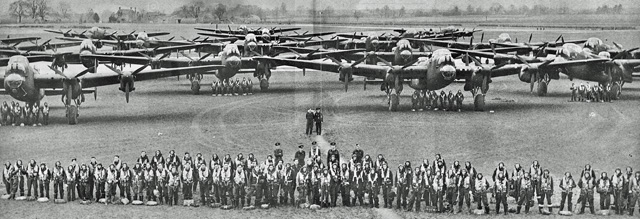 16 of the crews of 12 and 626 Squadrons and their Lancasters at RAF Wickenby, January 1944
Photograph with thanks to forgottenairfields.com
At 23:05 hours on 8 October 1943, James was the navigator among the 7 man crew of Lancaster Mk III JB406 PH-D which took off from RAF Wickenby to take part in a bombing raid on Hanover. Shortly before 2am on 9 December, the aircraft was not only attacked by night fighter pilot Unteroffizier Heinz Amsberg of the 9./NJG 1 (flying a Bf 110G from the airfield at Twente in the Netherlands) but also hit by Flak.
The Lancaster crashed near Schwarmstedt, about 25 miles north of Hanover, killing all seven on board. They were initially buried at Schwarmstedt and, on 15 May 1947, reinterred in Collective Grave 6.B.3-7 of the Hanover War Cemetery which holds 2,358 Commonwealth WW2 casualties. James’s parents took the option of adding a personal inscription to his headstone,
“Into the light which never more shall fade.”
 The Hanover War Cemetery
Photograph (126080528) by Wouter van Dijken via findagrave.com
Roger Morgan © 2019
With special thanks to Hazel Ballan
Please contact us if you have information or pictures that can extend this entry.
MAYNARD John Henry. Fireman
National Fire Service
Died 9 November 1941, aged 37
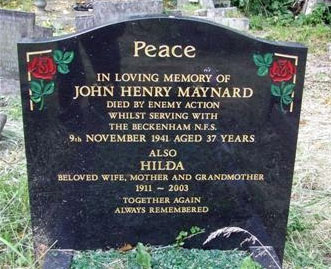 John’s headstone in Beckenham Cemetery.
Photograph (53326287) by Geoffrey Gillon via findagrave.com
Not listed in the Book of Remembrance
John was born on 24 January 1904, the first child of Henry Albert and Annie Elizabeth Maynard. The 1911 Census records the family (now with five children from new-born Florence to 7 year old John) living at 28 Donald Road, West Croydon. 27 year old Henry is listed as a “Golf Groundsman”.
In Q1 1931, the 27 year old John married 26 year old Hilda Bertha Esther Kenward, registered in the Bromley District. The September 1939 Register records the couple living at 21 Gowland Place, Beckenham together with two currently closed records – presumably their children (Jean born Q2 1932 and Jill born Q3 1939). John is listed as an “Assistant Golf Professional”. This was no doubt at the Private Club where his 55 year old father was (according to the 1939 Register entry for him, Annie and three of their children now at 16 Anthony Road, Woodside, Croydon) the “Green keeper (Private Club)”.
John became a member of The National Fire Service created in August 1941 by the amalgamation of the wartime national Auxiliary Fire Service (of which he may also have been a member) and the local authority fire brigades. He was assigned to his local Beckenham Fire Station.
On 16 April 1941 – towards the end of the Luftwaffe’s “Blitz” bombing campaign – John and fellow firemen were on their way to a call-out. Their appliances had reached the junction of Wickham Road (B230) with Courts Down Road in Beckenham when a bomb exploded nearby. Fragments from that pierced the petrol tank and their vehicle was enveloped in flames. Three firemen (Richard Beacon, David James Chalmers and Stanley Richard Hudders) died there and then.
John was badly injured and taken to the Horton Emergency Hospital, one of Epsom’s “cluster” of mental hospitals that, as for WW1, had been taken over for dealing with wartime casualties. Some 7 months later, on 9 November 1941, he died there. His body was taken home for burial in the Beckenham Cemetery. When his widow, Hilda, died in 2003 she was buried in the same grave.
Roger Morgan © 2018
Please contact us if you have information or pictures that can extend this entry.
MAYS John Claude
Civilian
Died December 1940, aged 28
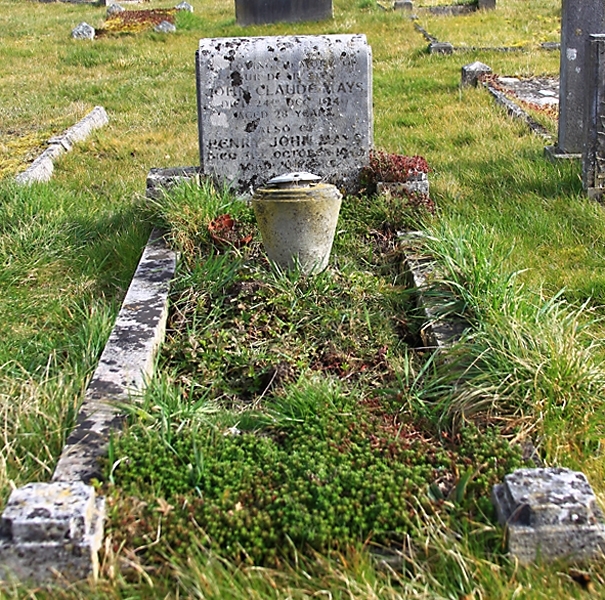 John’s headstone in Epsom Cemetery
Image courtesy of Clive Gilbert © 2018
John Claude Mays was born on 20 September 1912 (GRO reference: Dec 1912 Coleman Kingston 2a 804), the son of John Henry and Isabel Kate Mays (nee Coleman). When his parents married on 3 August 1903 in St. Margaret’s’ Church, Plumstead, his father was a 30 year old Sergeant in the 1st Battalion East Surrey Regiment, his mother was aged 24, and they lived at 98 Hudson Road, Plumstead.
| JOHN CLAUDE MAYS AND HIS SIBLINGS | ||
| Name______________ | Born -Died | Notes |
| Henry William Thomas | Born: 21 April 1905 Kingston Died: 1980 |
Baptised 9 November 1906 St. Pauls Kingston |
| Cyril Ernest Charles | Born: 1906 Died: 1906 |
|
| Isabel Daisy Lilian | Born: 24 Sept 1908 Kingston Died: 1909 |
Baptised 16 October 1908 St. Pauls Kingston |
| Violet Blanche | Born: 22 Sept 1910 Kingston Died: 1973 |
Baptised 19 October 1910 St. Pauls Kingston |
| Claude John | Born: 20 Sept 1912 Kingston Died: 1940 Epsom |
Baptised 11 October 1912 St. Pauls Kingston. Buried Epsom Cemetery, grave M548, on 31 December 1940 |
| Horace A F | Born: 23 Sept 1914 Kingston Died: 16 December 1914 |
|
| Leonard Lewis | Born: 6 March 1918 Devonport Died: 1998 Wycombe |
|
Claude was baptised ‘John Claude’ on 11 October 1912 and the family were recorded as living at 120 Kings Road, Kingston. The St. Paul’s baptismal record also shows that his father was a Colour Sergeant in the East Surrey Regiment.
John’s father fought in the Boer War and served on the home front with the East Surrey Regiment during the Great War. His father’s pension records also tell us that in 1920 the family lived at 34 Broughton Street, Battersea.
Electoral rolls show the family lived at Queen Mary’s Convalescent Centre, Woodcote between the years 1921 and 1925, and from 1925 to 1945 at 112 Hook Road, Epsom.
John is listed as a “Motor Mechanic” in the September 1939 Register living with his parents and older sister at 112 Hook Road, Epsom.
John died on 24 December 1940 in Epsom County Hospital and was buried in grave M548 in Epsom Cemetery on 31 December. The gravestone reads:
“In Loving memory of our dear son John Claude Mays died 24th December 1940 aged 28 years.”
The cemetery burial register describes him as a fitter. His cause of death is not known, although the Book of Remembrance in the Foyer of Epsom Town Hall records that he died through ‘Enemy Action’. In addition to John’s commemoration there, he is also listed on the St. Barnabas Roll of Honour. However, unlike the other Civilian on the latter, John does not have an entry in the Commonwealth War Graves Commission’s database (which covers both Service and Civilian casualties).
The Epsom Herald dated 3 January 1941 printed the following death notice:
“Mays, John Claude on December 24th 1940, at County Hospital, Epsom, of 112 Hook Road, Epsom, who passed peacefully away.”
John’s father, of 112 Hook Road, died on 31 October 1949. Probate was granted to his widow Isobel Kate in the sum of £1547 15s 7d. John’s mother died on 16 January 1954. Both parents were buried with their son in grave M548 Epsom Cemetery.
Clive Gilbert & Hazel Ballan 2014
Please contact us if you have information or pictures that can extend this entry.
McBRION Arthur Albert
Civilian
Died 11 Octobre 1940, aged 32
Arthur was born in Portsmouth on 2 August 1908, the fourth child of John McBrion and Jessie Lavinia (née Link). The 1911 Census records the family of five (one of the children had died) living at 60 Charles Street, Landport on Portsea Island, with 39 year old John’s occupation listed as a “Shipwright” in the Government Dockyard at Portsmouth.
Arthur’s next appearance in the readily available records is in the September 1939 Register as a 31 year old unmarried lodger with the similarly aged Railwayman John Connaughton and his wife Kathleen at 22 Beaconsfield Place, Epsom. Arthur’s occupation was recorded as “Horse Racing Stable Man”.
On 11 October 1940 – a month into the Luftwaffe’s “Blitz” bombing campaign – Arthur was killed by enemy action in Woodcote Side, Epsom. This was perhaps on his way between one of Epsom’s stables and his then residence of 101 Park Lawn Avenue, Epsom as noted by both the Commonwealth War Graves Commission’s and the records of Epsom Cemetery where he was buried in (Grave M549) on 21 October 1940.
Roger Morgan © 2018
Please contact us if you have information or pictures that can extend this entry.
McCORMICK Barbara Winifred
Civilian
Died 7 November 1940, aged 37
&
McCORMICK George Franklin Hurley
Civilian
Died 7 November 1940, aged 39
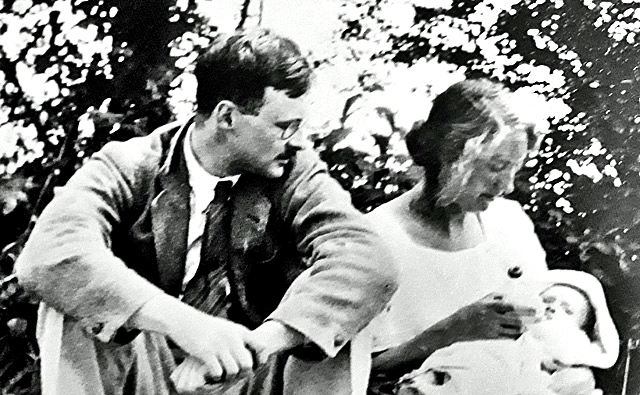 George (Hurley), Barbara and baby John McCormick in 1929
Photograph © John McCormick, and used here with his kind permission
Barbara was born on 2 July 1903, the first of four children born to Arthur George Bloxam and Winifred Mary (née Shapland – in some records “Shapland-Rugg”). The 1911 Census records the parents and family (and two domestic servants) boarding – and presumably on holiday – at the sea-front Runnymede Hotel, The Leas, Westcliff-on-Sea, with 45 year old Arthur listed as a “Chartered Patent Agent”. The return notes that he and 35 year old Winifred had been married for 8 years (the record of which has proved elusive) and that the four daughters were all born in Hampstead. (Oddly, Barbara’s birth was registered in Kingston upon Thames.) Back in Hampstead, the couple’s last child, George Arthur, was born in Q4 1913.
In Q3 1928, and registered in Hampstead, the 25 year old Barbara married 27 year old George Franklin Hurley McCormick. The family apparently always called him by his third name of “Hurley”, and we follow suit here.
Hurley had been born on 11 April 1901, the first child of Samuel George (noted only as “George” in the Commonwealth War Graves Commission’s records) McCormick and Ada Louisa (née Guilford – they had married on 14 June 1900 in St John’s Church, Chelsea). Although born in Niagara, Canada, Samuel was an American citizen. He had trained in dentistry in New York and, having qualifying in 1891, moved to England where he joined the American Dental Institute in London.
Hurley was born just days after the 1901 Census was taken. This had recorded the relatively newly-wed parents living at 176 Stockwell Road, Lambeth. 40 year old Samuel’s occupation was listed as an “American Dentist” (and it was noted that he was an “employer”). The heavily pregnant Ada (born in Amberley, Sussex) was aged 26. The only other residents were Samuel George’s widowed 65 year old mother, Grace (who had been born in Bristol), and two domestic servants.
The 1911 Census recorded the family at 15 Terrapin Road, Balham or Upper Tooting. Samuel and Ada, Samuel’s widowed mother, and now four children – all seven of whom were noted as “USA citizens” – were still supported by two domestic servants (but different people from those in the 1901 Census). Samuel is still listed as an “American Dentist” and it seems he had already set up his practice at 18a Thurlow Place, Kensington. The couple’s last child, Napier, was born in Q3 1914.
The family subsequently moved to Loudwater, High Wycombe, Buckinghamshire. It was outside this home that the photograph below was taken of the teenage Hurley in uniform. He saw no service in WW1, so this seems to have been in his school’s cadets or similar.
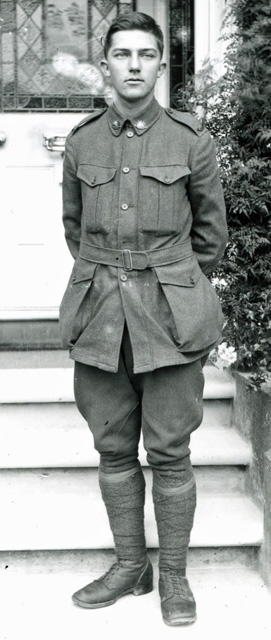 Hurley in cadet uniform in about 1915
Photograph © Tom Walker and used here with his kind permission
Hurley followed in his father’s footsteps and, following study in London University, qualified as a dentist with MRCS, LRCP and LDS. It seems that he then joined his father’s practice at 18a Thurlow Place, Kensington – indeed, taking it over in due course. (His father died in 1932.)
Anyway, Barbara and Hurley had two children, John and Robert, born on 26 March 1929 and 12 January 1931 respectively – and both registered in the Wandsworth District. The family then moved into the Borough. The September 1939 Register records them living at 19 Links Road, Epsom. Living with the 38 year old Hurley (still practising as a Dentist – but also a wartime Air Raid Warden) and 37 year old Barbara were:
• their two children, 10 year old John and 8 year old Robert;
• Hurley’s now 66 year old and widowed mother, Ada McCormick (only a temporary stay as, after her husband’s death, she lived with her daughter Grace at 11 Park Road West, Wolverhampton – the address the Commonwealth War Graves Commission’s post-war records note her as being “of “); and
• Barbara’s parents, 73 year old Arthur (still a “Chartered Patent Agent”) and Winifred Bloxam.
(All the women were listed with the conventional “Unpaid Domestic Duties”.)
During an air raid on 7 November 1940 – a few weeks into the Luftwaffe’s “Blitz” bombing campaign – a bomb fell on 19 Links Road. It killed both Barbara and Hurley as well as Barbara’s father Arthur Bloxham – together with another Air Raid Warden, Edward Conran, who was with them at the time.
Sons John and Robert – and their grandmother, Winifred Bloxam – survived the attack. John and Robert were temporarily taken in by neighbours, but later collected and then adopted by their aunt Molly (their mother’s younger sister) and her husband Barnes Wallis – among other things, inventor of the Dam Busters’ “bouncing bomb” and pioneer of the geodetic airframe construction that made the Vickers Wellington bomber such a robust aircraft.
Barbara and Hurley were buried together in Epsom Cemetery (Grave M404) on 13 November 1940, alongside Barbara’s father, Arthur, buried the same day in Grave M405.
The 1941 Probate records of administration of Barbara’s and Hurley’s estates (of, respectively, £2,848 and £1,415) being awarded to Edgar Taylor Worsley chartered accountant and Jacob Henry Lazaris barrister-at-law seems likely to have been in trust for the couple’s two not yet teenage sons – the executors were the boys’ uncles.
Roger Morgan © 2018
With special thanks to Tom Walker (George’s nephew) &
John McCormick (George’s son)
Please contact us if you have information or pictures that can extend this entry.
McGRATH Brian Robin. Private (6018923). Mentioned in Despatches.
1st Battalion, Cambridgeshire Regiment
Died 9 May 1943, aged 24
Unusually, the Commonwealth War Graves Commission database contains no information about Brian’s family background. This is, however, readily found in other records.
Brian was born on 1 October 1918, the second of four children born to Patrick McGrath and Violet Maud (née Mitchley). Their Q1 1908 marriage had been registered in Wandsworth, and the 1911 census records the mid 20s couple living at 62 Broomwood Road, Clapham Common, with Patrick’s occupation listed as a “Grocer’s Assistant”. The subsequent births of all four children were registered in that Wandsworth District: Eileen Q1 1911; Brian Q4 1918; Patricia Q3 1920; and Maureen Q1 1927.
At some point, the McGrath family moved to the Borough, where the September 1939 Register records them living at 64 Bradstock Road, Stoneleigh. The 52 year old parents are listed, for Patrick, as an “Insurance Inspector” and, in Violet’s case, with the conventional “Unpaid Domestic Duties”. Brian, just short of his 21st birthday, is listed as “Touring Bureau NCU” (presumably the National Cyclists’ Union which, in 1959 merged with the British League of Racing Cyclists to form the British Cycling Federation). There are two currently closed records at the address, presumably of other children. One of these seems certain to be of 19 year old Patricia who, in Q1 1944 and registered in the local Surrey Mid Eastern District, married Herbert Dutfield – another Borough WW2 casualty.
Brian’s WW2 service was with the 1st Battalion of the Cambridgeshire Regiment. After training and home duty on the Norfolk Coast, the Battalion was sent – as part of the 18th (East Anglian) Infantry Division – to the Far East. It was in Malaya when the Japanese invaded from the north on 8 December 1941. As is well-known, Commonwealth forces were, in spite of heroic efforts and significant losses in terms of both casualties and prisoners, unable to halt the unexpectedly ferocious and rapid Japanese advance. The survivors were driven back to Singapore, and Brian’s battalion was, for two days, involved in the defence of the Sime Road Camp (the Army and RAF Operational Headquarters) until the Commanding Officer, Lt-Gen Percival, ordered the surrender of Singapore to the Japanese.
Brian was one of the 80,000 troops then taken prisoner by the Japanese (joining the 50,000 captured during the Japanese advance through Malaya). There are records of his being in camps in Siam (modern-day Thailand) so, like many others, he was probably used as slave labour on the infamous Burma-Siam Railway – which fully earned its nickname “the Death Railway”. His death (in the Malai camp on 9 May 1943) was the result of malaria. His body would have been buried locally but records were lost. While he may have subsequently been re-interred in a War Cemetery, this would have been only as one “Known unto God”. Brian is commemorated on the Singapore Memorial as one of over 24,000 Commonwealth WW2 casualties from the region who have no known grave.
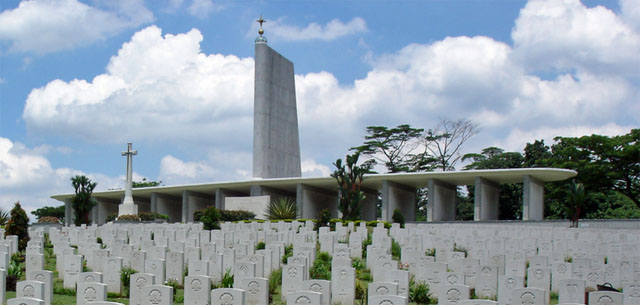 The Singapore Memorial (rear) in the Kranji War Cemetery
Picture with thanks to the Commonwealth War Graves Commission
The supplement to the London Gazette of one August 1946 listed Brian (noting that he had since died) as one of the many that “The King has been graciously pleased to approve … be Mentioned in recognition of gallant and distinguished services in Malaya in 1942.”
Roger Morgan © 2018
Please contact us if you have information or pictures that can extend this entry.
McINTYRE Charles Campbell. Lance Serjeant (2878582)
3rd Battalion, The Parachute Regiment, Army Air Corps
Died 6 January 1943, aged 21
Charles is not listed in the Borough’s Book of Remembrance, but is remembered here because the Commonwealth War Graves Commission records note, among other things, that Charles was the “nephew of Elsie Boorman, of Stoneleigh, Epsom, Surrey”
Before getting to that connection, here’s some earlier background. Charles was born on 14 March 1921 in Giffnock, a few miles south of Glasgow. He was only child of Charles Campbell McIntyre and Magdalen Mary (née Adams) who had married in Edinburgh on 7 October 1920. (Charles senior had been sent – as Private 11694 in the Cameron Highlanders – to serve with the BEF in France on 10 May 1915, but was discharged on 9 August 1916 as no longer fit for war service following a wound to his left forearm.)
The family moved to the London area. The 1923 Electoral Roll records the parents living with Magdalene’s widowed mother, Mary Adams at 140 Woodmansterne Road, Streatham. This was still Magdalene’s home address when she died in St James’s Hospital, Balham on 2 January 1931.
In due course, young Charles began work in the London Office of the Scottish Distillers Company. He also became a Territorial Army Sergeant in the 1st Battalion, London Scottish Regiment.
It is not clear in the readily available records what happened next. Neither Charles senior nor Charles junior are found in the September 1939 Register. However, when Charles senior died on 19 February 1940, his address was 193 Norbury Crescent, Croydon – an address that was unoccupied in 1939.
As noted above, the Commonwealth War Graves Commission list Charles junior as also being the “nephew of Elsie Boorman, of Stoneleigh, Epsom, Surrey”, rather implying some guardianship of him. She was born as Elsie G Reid on 20 February 1899 in the Camberwell District. The 1901 Census records her as the youngest of 6 children (the oldest being aged 19) living with their 40 year old parents at 13 Grove Vale, Camberwell. Her father, Thomas Peter Reid, made bicycles. (The family had moved along to No. 41 Grove Vale by the time of the 1911 Census.)
In Q4 1922, and registered in the Camberwell District, the 23 year old Elsie married 30 year old Victor Arthur Boorman. The 1939 Register records Elsie and Victor living at 4 Cuda’s Close, Stoneleigh. Victor is listed as a “Chartered Patents Agents’ Clerk (with Accountancy)” and Elsie with the conventional “Unpaid Domestic Duties”. There is one currently closed record at the address. As no record has been found of Elsie and Victor having any children, that closed record is perhaps of the 17/18 year old Charles. It is not currently clear quite how the McIntyres/Adams and Reids/Boormans were related, and it may be that the aunt/nephew relationship was an informal one.
Anyway, Charles junior’s WW2 service was in the 3rd Parachute Battalion. This had been formed in 1941 from volunteers from various infantry regiments – in Charles’s case, the London Scottish Regiment as noted above.
These Paras first saw action during the 8-16 November 1942 “Operation Torch” – the invasion of French North Africa to begin a pincer movement on Axis forces that had been held and then turned back at the crucial Battles of El Alamein. (Torch was a joint British/US operation, and the first major one that US troops undertook in the European/North African theatre.)
The invaders quickly overcame the Vichy French response. Fighting on into Tunisia (into which the Germans immediately sent reinforcements from Sicily) was much more intense and the Allies’ progress stalled at Medjez-El-Bab, about 35 miles west of Tunis. This remained the front line until the decisive Allied advances of April and May 1943 which – coupled with Allied forces which, after El Alamein, had advanced through Libya – led to the capture of Tunis on 12 May 1943 and the defeat of Axis forces in North Africa.
It was during the stalemate around Medjez-El-Bab that Charles was (as reported in Casualty List No. 1044) killed in action on 6 January 1943. In the ebb and flow of that fighting, his body was lost. He is remembered on the Medjez-el-Bab Memorial, Tunisia, which commemorates almost 2,000 soldiers who died during WW2 operations in Algeria and Tunisia, and who have no known graves.
Probate on his estate was not settled until March 1946. The record of that gave his home address as 193 Norbury Crescent, Croydon – his late father’s address in 1941. The Boormans remained in Stoneleigh: when Arthur died in 1956, his home address was 42 Waverley Road, Stoneleigh.
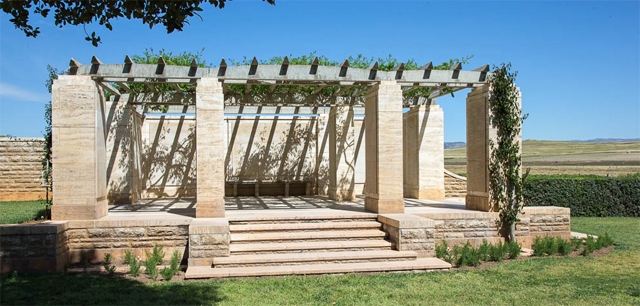 The Medjez-el-Bab Memorial, Tunisia
Photograph with thanks to nzwargraves.org.nz
Roger Morgan © 2019
With special thanks to Hazel Ballan
Please contact us if you have information or pictures that can extend this entry.
McLENNAN Alexander William. Sergeant/Pilot (1339244)
578 Squadron, Royal Air Force Volunteer Reserve
Died 31 March 1944, aged 23
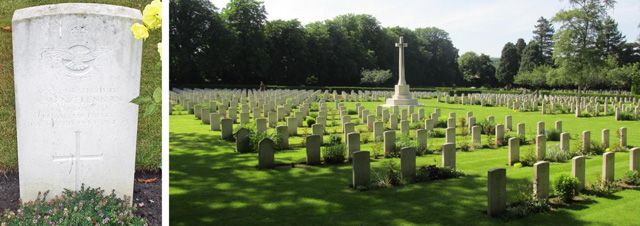 Left: Alexander’s headstone
Photograph (57190092) by Stephen Potts via findagrave.com
Right: The Oxford (Botley) Cemetery
Photograph with thanks to the Commonwealth War Graves Commission
Alexander was born in the Epsom District on 26 January 1921, the second and last child of 50 year old Alexander McLennan and 34 year old Ethel Maud (née Crisp) whose Q1 1915 marriage was registered at Dartford. Their first child, Jessie Ethel May, was born on 30 December 1917, also in the Epsom District. The children were baptised together at St Mary’s Ewell on 27 March 1921. Their father was a male nurse – doubtless in one of Epsom’s “cluster” of mental hospitals – and the family lived at 2 Oakdale Road, Ewell.
Alexander junior attended Ewell Infants School, went up to the Boys’ School on 3 September 1928 and on leaving there, was enrolled in Wimbledon Technical School on 14 September 1934.
The September 1939 Register records the family still at 2 Oakdale Road, Ewell. 69 year old Alexander senior is listed as “Nurse Mental Retired”, 52 year old Ethel with the conventional “Unpaid Domestic Duties”; 21 year old Jessie as an “LJR Telephonist”; and 18 year old Alexander junior as “Ledger Clerk Estat[e Agents?]”; and
Alexander junior subsequently enlisted with the Royal Air Force Volunteer Reserve. With the service number 133924, this was after September 1943 and probably at Uxbridge. He became Sergeant/Pilot and was assigned to 578 Squadron, part of Bomber Command equipped with Halifax heavy bombers.
On 30 March 1944, Alexander was second pilot aboard Halifax LW478-LK-S taking part in a raid on Nuremberg. In a 578 Squadron history it is explained: –
“On 30 March 1944 fourteen 578 Squadron Halifaxes were detailed for a raid on Nuremburg. Two cancelled and twelve took off. Of those 12 only one returned to base and this with engine trouble. Eight landed at bases across England. Three 578 squadron aircraft were lost…
Halifax LW 478 – LK-S Piloted by Squadron Leader Maurice McCreanor became the 105th aircraft lost. It had been damaged by enemy action and struggled back to England on three engines. This aircraft crashed on overshooting at Silverstone, the crew being on their 14th operation. Crews that had already landed at this O.T.U. (Operational Training Unit) watched this aircraft come in on three engines. The pilot could not line up with the runway and the control tower heard him say “I’ll try again.” But the wheels of the Halifax touched the roof of the airfield’s section building. It tumbled and exploded across some playing fields for 200 yards. Pilot, 2nd Pilot, Bomb Aimer, Wireless Operator, Flight Engineer were killed. Sgt. D.A. Hooker, rear gunner, died of his injuries nine days later at Halton. Silverstone was later to become the famous motor racing circuit. A memorial to this crew [see below] now stands on the trig point near the Luffield grandstand.”
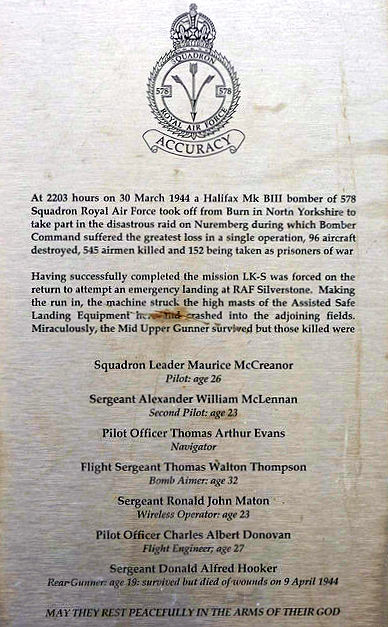 War Memorial Plaque at Silverstone Circuit
Image © Ian S and licensed for reuse under this Creative Commons Licence.
Alexander is buried in Grave I/2.191 of the Oxford (Botley) Cemetery, one of 516 WW2 casualties there. (The cemetery was designated a Royal Air Force regional cemetery and was used by RAF stations in the area during the war.)
Brian Bouchard & Roger Morgan © 2018
Please contact us if you have information or pictures that can extend this entry.
McMILLAN Eric John. Sergeant (1338724)
Royal Air Force Volunteer Reserve
Died 22 October 1943 Age 21
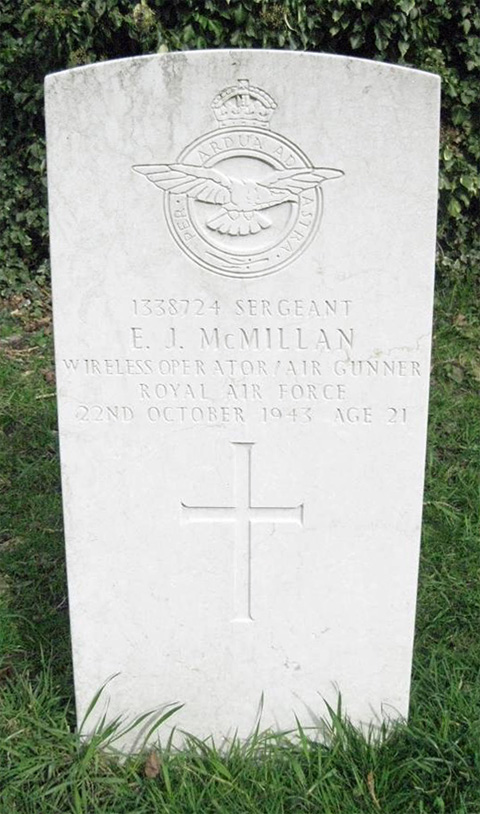 Eric’s headstone in Wandsworth (Earlsfield) Cemetery
Photograph (24757951) by “Julia&keld” via findagrave.com.
Eric is not listed in the Book of Remembrance but is remembered here because the Commonwealth War Graves Commission’s records note that his widow was “of Epsom, Surrey.” That address has yet to be established, although a post-war one just outside the Borough has been found.
Eric was born in Q2 1922, the only child of 30 year old Horace Macmillan and 31 year old Daisy (née Kingston). The birth was registered in Wandsworth only child – as had been the parent’s marriage in Q2 1917.
The September 1939 Register records the parents living at 19 Jessica Road, Wandsworth. 47 year old Horace is listed as a “Salesman, Typewriter & Office Supplies” and 49 year old Daisy with “Domestic Duties”. There is one currently closed record at the address, likely to be of the 17 year old Eric. During November 1940, he enlisted with the Royal Air Force, probably at Uxbridge, and trained as a Wireless Operator, possibly at Blackpool.
In Q2 1943, the 21 year old Eric married 22 year old Doris Catherine Mary Steadman. Doris had been born in Sevenoaks, Kent, on 15 October 1920, apparently the only child of William Steadman and Dorothy (née Martin). The September 1939 Register recorded her (a “Shorthand Typist”) living with her early 40s parents at 18 Beverley Road, Bromley. Her father was a Metropolitan Police Constable. Living with the family was Doris’s widowed maternal grandmother, the 72 year old Lillie Martin. Both Lillie and her daughter, Dorothy, were listed with the conventional “Unpaid Domestic Duties”. It is not currently known how Eric and Doris met, but the fact that their 1943 marriage was registered in the local Surrey Mid Eastern District suggests a pre-existing link with the area by one or the other.
In late 1943, Eric was at the 1657 Heavy Conversion Unit (based at RAF Stradishall, Suffolk) which was training aircrew on the Short Stirling heavy bomber. On 22 October 1943, he was the Wireless Operator aboard Stirling Mk.1 EF352 XT-U which took off from Stradishall at 17.45 hours on a special night navigation exercise with three navigators on board.
At 21.20 hours, the aircraft crashed to the ground in flames at Rosemaund Farm, Preston Wynne (about 6 miles NNE of Hereford) instantly killing all on board, being: –
AUS420551 F/Sgt. ELSTUB, THOMAS CLIFFORD (Pilot)
146302 P/O GERRARD, VICTOR (Screen Navigator)
133773 P/O STALKER, JOHN LAWRENCE (2nd. Navigator)
156343 P/O HEWSON, GEORGE PETER (Navigator)
1338724 Sgt. MacMILLAN, ERIC JOHN (W.O/p)
AUS415982 Sgt. HINES, ALBERT HENRY (A/B)
1852352 Sgt. SMITH, ALFRED JACK (A/G)
AUS423657 Sgt. CRIBB, STANLEY BRIDSON (A/G)
1550321 Sgt. DICKSON, DESMOND (F/E)
Eric is buried in Grave 6.9269 Wandsworth (Earlsfield) Cemetery.
The plaque by a tree planted in the Cemetery at Hedge End, Hampshire, in memory of the Sergeant Alfred Smith killed in this crash states that the crew of this burning plane gave their lives saving the village of Preston Wynne.
(It is reported that all bar one of this crew – and probably including Eric – had survived a serious accident just 19 days previously at Earls Colne, Essex. Stirling W6383 of 1657 HCU attempted to take off at 21.20 hours when it developed a swing and, on leaving the runway, the undercarriage collapsed completely wrecking the aircraft.)
There is no record of Eric and Doris having any children. In Q4 1944, the widowed Doris got married again, to Thomas James Mintram. In 1945, Doris Mintram may be found at 7 Tattenham Grove – just over the Borough border into Banstead – with her widowed (?) mother Dorothy Steadman and maternal grandmother, Lillie Martin. Thomas Mintram joined the household following the cessation of hostilities.
A Memorial Plaque to the crew was unveiled at Holy Trinity Church, Preston Wynne, on 8 June 1987 with a service at the crash site. Doris Mintram reportedly attended another remembrance service at Preston Wynne in 1997. She was presented with a model of a Stirling bomber by Ron Miles who, as a lad of 15, had cycled from Pencombe to Rosemaund Farm the day after the crash in which her first husband had been killed.
Brian Bouchard & Roger Morgan © 2018
Please contact us if you have information or pictures that can extend this entry.
McMULLAN The Revd Hugh. Squadron Leader (144188)
Chaplain, Royal Air Force
(and, apart from war service, Vicar of Christ Church Epsom Common 1940-47)
Died 5 August 1947, aged 57
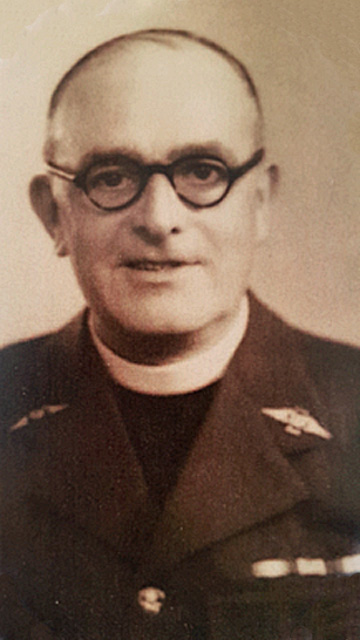
The Revd Hugh McMullan as an RAF Chaplain in 1943-44.
Photograph with thanks to his granddaughter, Sarah Thoma.
Hugh was born at Glencraig, Craigavad, County Down, Ireland on 18 July 1890, the son of Hugh (a Gentleman Farmer) and Annie McMullan.
He joined the Army before WW1, serving first with the Argyll and Sutherland Highlanders and then on the Special Reserve of Officers. The 24 year old Second Lieutenant then joined the 2nd Battalion Lancashire Fusiliers and went with them to France as soon as war was declared.
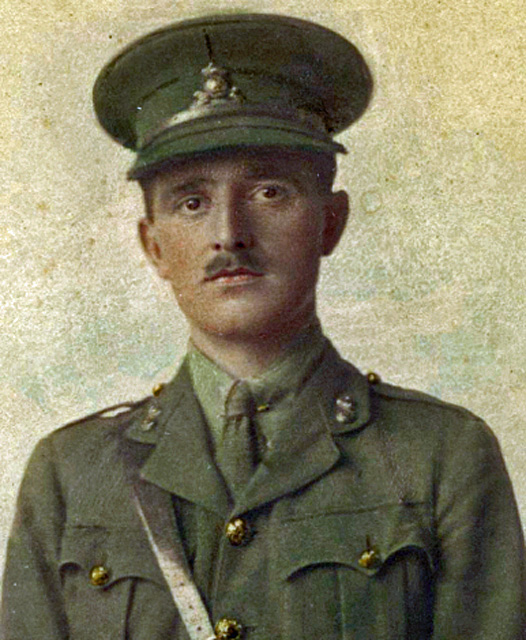
Hugh McMullan as a Second Lieutenant in the Lancashire Fusiliers, in about 1914.
Photograph with thanks to his granddaughter, Sarah Thoma.
Hugh served on the front line until February 1916 when he sustained near-fatal injuries during action in the Somme area. (This was some months before the Allies’ main Somme offensive.) As noted in a subsequent press report:
“He was badly wounded and taken prisoner by the Germans near Gommecourt Wood in February 1916. Probably few men have sustained more extensive injuries and lived to tell the tale. As a result of his meeting with the enemy, he sustained a fractured base of skull, was forcibly dragged by the legs across No Man’s Land and bayonetted through the chest and right lung. Given up for dead, he was thrown out of enemy trenches and eventually brought in many hours later by an officer and NCO of his battalion. A year in hospital followed during which time for the most part he lay between life and death; health gradually returned and, after a period of convalescence, he was passed as fit for light duty.”
Those light duties were with the 233rd Infantry Brigade in Norfolk. Promotion followed: he was appointed adjutant of the 25th Battalion of Kings Liverpool Regiment; and then Staff Captain of the 233rd Brigade. All the commanding officers under whom he served testified in eulogistic terms to his high powers of organisation and administration.
In Q2 1917 and registered in the Edmonton District, the 27 year old Hugh married 26 year old Edith Maud – the youngest daughter of James and Sarah (née Morton) Anderson of “Braidwood”, Highgate. (At least in later life, the bride called herself Maud rather than Edith, and we follow suit here.) The couple’s first child, Elizabeth, was born on 21 April 1918, the birth being registered in Erpingham, Norfolk.
After the war, Hugh was invalided out of the army on pension because the effect of his wartime wounds meant he was unfit to accompany his regiment to India. Instead, he attended Selwyn College, Cambridge and, in 1919, gained his BA (becoming MA in 1923).
Hugh then studied at the Theological College at Wells in Somerset, where the birth of the couple’s second child, Maud junior, was registered in Q1 1920. Later that year, Hugh was ordained Deacon and was appointed Curate at All Saints Church, Hove. While there, he was ordained priest in 1921.
On completion of his curacy, the family moved to East Molesey for Hugh to take up his appointment as Vicar of St Paul’s Church. The couple’s third and last child, Margaret, was born there on 16 June 1926.
In 1929, the family moved to Norwich for Hugh to take up his appointment as Vicar of the imposing 15th Century church of St Peter Mancroft (the second largest parish church in England). Norwich was a city that Hugh had come to love from his time there in the closing years of WW1. The area was also familiar to Maud: her family were originally from nearby Sheringham.
Hugh served at St Peter’s for the next 11 years. (It seems likely that the roles he took on there as padre to the police and unofficial padre to ex-servicemen was influential in his choice of WW2 service.)
The family (less 19 year old Maud junior, who is not readily found elsewhere) was recorded in the September 1939 Register living at “The Chantry”. 49 year old Hugh is listed as “Vicar, Saint Peter Mancroft Church” and 48 year old Maud senior with the conventional “Unpaid Domestic Duties”. Of the two daughters at home, 21 year old Elizabeth is listed as a Hospital Nurse and 13 year old Margaret as at school. The family was supported by a 43 year old domestic servant, Minnie Hoddinott, and 25 year old Elizabeth O’Reilly as Cook.
In late 1940, the family moved to Epsom for Hugh to take up his appointment as Vicar of Christ Church Epsom Common, where the congregation was in shock at the sudden death of the 53 year old Revd John Matthews on 18 June after barely three years in post.
At a meeting of the Church Council on 17 March 1943, Hugh announced that he felt compelled to respond to the Air Ministry’s appeal for experienced priests to serve as RAF chaplains. Arrangements were made for the Revd William Dudley Dixon (alongside his duties as Priest in charge of St. Mary’s, Burgh Heath, while its own Vicar, the Revd Leyland Bird, was in the forces) to be acting Vicar at Christ Church, and Hugh began his RAF Chaplaincy in the late summer.
Less than a year into his chaplaincy, Hugh fell seriously ill with heart trouble which led to his being invalided out of the RAF. Having recovered sufficiently (although, as we shall see, far less than completely), he was back at Christ Church by October 1944 and was active in helping the parish mark the end of WW2 in mid 1945.
However, his illness returned and, for about a year from mid-1946, much of the running of the parish was in the hands of Christ Church’s new Curate, the Revd F W Phillips: the minutes of the Church Council consistently logging the absence of the Vicar through illness. The Church Council meeting on 13 March 1947 noted Hugh’s intention, after a spell in hospital, to “resign the living” on grounds of ill health with effect from 30 June 1947. The minutes record, “The announcement was received with great regret, but it was realised by all present that the Vicar was too ill to carry on the work and that it was the only course to adopt.”
Hugh and Maud retired to 14 Walrond Road, Swanage where, just five weeks later, Hugh died on 5 August 1947. After a simple local funeral (at which Christ Church was represented by the Revd Noel George, who had been Curate at Christ Church for much of Hugh’s tenure there) Hugh was buried in Grave A.1287 of the Swanage (Godlingston) Cemetery. The widowed Maud was doubly supported by the knowledge that, at exactly the same time as the funeral in Swanage, there was a well-attended memorial service held in Christ Church Epsom Common.
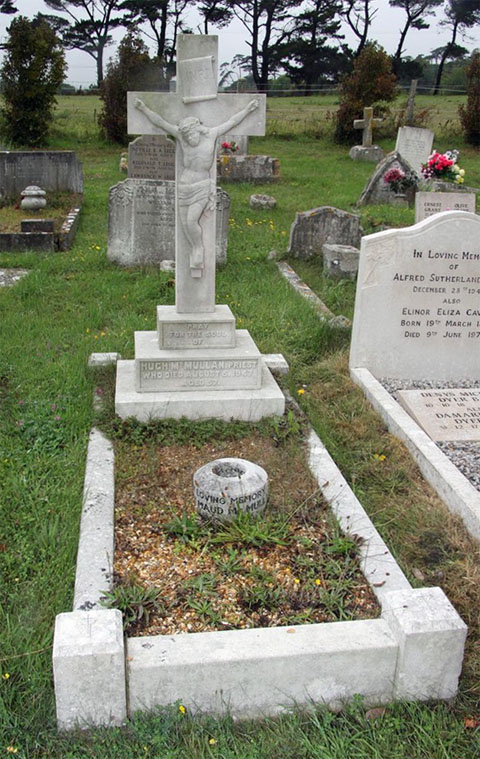 Hugh’s headstone in the Swanage (Godlingston) Cemetery
Photograph (57484075) by “julia&keld” via findagrave.com
The inscription on the headstone reads:
“Pray / For the Soul of / Hugh McMullan, Priest / Who died August 5th 1947 / Aged 57”.
Hugh’s (albeit short) WW2 service and his death before the end of 1947 mean that he is included in the Commonwealth War Graves Commission’s database of WW2 casualties. However – and presumably because his death was not seen as conflict-related – his name was not included either on Christ Church’s WW2 memorial or in the Borough’s Book of Remembrance.
The widowed Maud never remarried. In the late 1960s, she moved to stay with her eldest daughter and family in Worthing. Some ten years later and aged 85, she died there on 25 February 1977. Her ashes were taken back to Swanage and, as will be seen from the photograph above, a memorial to her was placed in the centre of her late husband’s grave.
Roger Morgan © 2020
with special thanks to Hugh’s granddaughter, Sarah Thoma, for details of Hugh’s early years and WW1 service
Please contact us if you have information or pictures that can extend this entry.
MEADEN Bertram Grant
Civilian
Died 3 July 1944, aged 64
Tracking Bertram down in the available records has been complicated by some confusion over his age when he died in July 1944 (and thus over his year of birth): the Commonwealth War Graves Commission gives his age as 62; and the Epsom Cemetery records as 60. He was, in fact, 64 – having been born on 27 September 1879.
While the birth was registered in the Tendring District of Essex, the 1881 Census records this now 18 month old as the third of four children (between new-born Alfred and 3 year old John – and then 8 year old George) living on the outskirts of Birmingham – at 37 Archibald Road, Handsworth, with their early 30s parents Edwin (an Inland Revenue Official) and Elizabeth plus two domestic servants. By the time of the 1891 Census, the family (now with two more children) had moved nearer to Birmingham, living at 58 Witton Road, Aston.
The 1901 Census records the 21 year old Bertram – now listed as a “Civil Engineer” – lodging with Albert and Lucy Phillips at 13 Kepler Road, Lambeth. The parents (now with just four children at home) had moved again – to 70 Gillott Road, Birmingham.
Bertram is not found in the 1911 Census because he had gone out to Ceylon (modern-day Sri Lanka) where, over time, he rose to be a – or even the – “Director of Irrigation”, as stated in the 1941 Probate records of his being granted administration of his wife’s estate. It was almost certainly in Ceylon that, first, he met and married Lily Annie and then, in about 1915, their daughter Christina Diane Phyllis was born.
There is a record of Bertram, Lily and Christina returning to Ceylon on the SS Nore which sailed from London on 9 September 1921. The manifest notes that their most recent address had been 42 St George’s Road, Broadstairs – the address to which, in the 1911 Census, Bertram’s parents had retired. Another record is of Lily and Christina returning to Ceylon on the SS Staffordshire which sailed from Liverpool on 9 June 1932.
It is not clear when any of them returned to the UK. The September 1939 Register records the 60 year old Bertram – listed as a “Civil Engineer Retired” (and he was a Member of the Institute of Civil Engineers) – and the 54 year old Lily staying at the White Hermitage Hotel, Exeter Road, Bournemouth. (This was still a hotel in 2018.) Daughter Christina is not found in the 1939 Register, but in Q2 1940 married Laurance J O’Donnell, registered in the Westminster District.
Bertram and Lily moved to 10 Ashley Court, Ashley Road, Epsom. Lily died there on 10 June 1941, aged 58, and Bertram – whom the Commonwealth War Graves Commission note as having served in the Home Guard – continued living there, apparently alone.
Bertram was killed in Ashley Court on 3 July 1944 by the V1 flying bomb or “doodlebug” that landed in Ashley Road – which also killed Katherine Keeble, George MacGowan and Hilda Vick.
Almost three years after the death of his wife, Lily, he joined her in the grave M232 in Epsom Cemetery. Administration of his £3,930 estate was awarded to the married Christina.
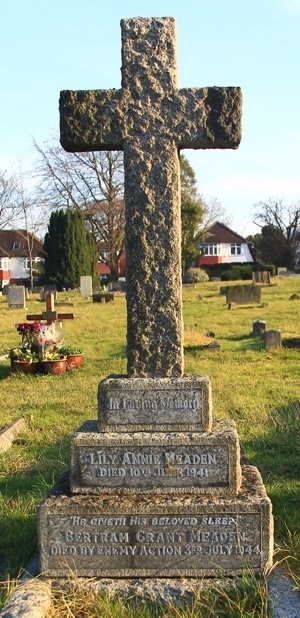 The Meaden Family Grave in Epsom Cemetery
Photograph courtesy of Clive Gilbert © 2019
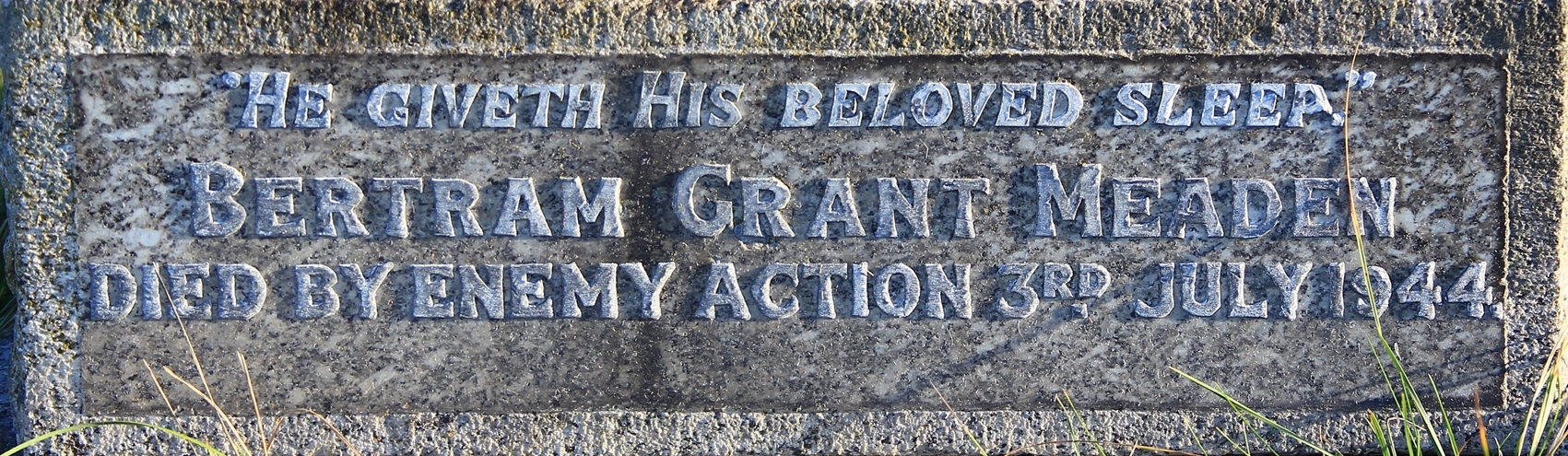 Bertram’s inscription on the family grave
Photograph courtesy of Clive Gilbert © 2019
Roger Morgan © 2020
Please contact us if you have information or pictures that can extend this entry.
MEADES Jack Charles. Sapper (6190781)
Royal Engineers
Died 18 August 1942, Age 47
Not listed in the Book of Remembrance
Jack was born on 31 March 1895 to Arthur George Meades and Elizabeth Mary (née Hitchcock – they married Q2 1887). Jack was their fifth or sixth child: the 1901 Census records the family with seven children (an eighth had died) ranging from to 3 year old Reginald to 12 year old Edwin. They were living at Hogbens House, Worth, near Sandwich, Kent. Jack’s 35 year old father, Arthur, is listed as a Wheelwright. Within a month or so of the 1901 Census, Jack’s mother, Elizabeth, died aged 27.
In the 1911 Census, the widowed 45 year old Arthur is recorded living at Stone Cross, near Sandwich, together with his three youngest children. The oldest of these was 16 year old Jack who, like his father, was now a wheelwright. The family were supported by 35 year old spinster Rosie Larlitt as Housekeeper. Arthur died Q1 1929 – registered in the Croydon District even though he had been born in and spent most of his life in Kent.
The September 1939 Register records Jack living with William and Elizabeth Soden at Talywaen, Nant Conwy, Caernarvonshire, North Wales. 54 year old William is listed as a “Market Gardener and Farmer”, and Jack is a “Market Gardener” as well.
In Q1 1941, Jack married Irene Ethel Kemp, registered in the local Surrey Mid Eastern District. Irene had been born on 7 June 1902 in Catford, Kent. The 1911 Census records her, then an 8 year old schoolgirl, living with her mid-30s parents – Edgar (a “Railway Signalman”) and Ethel – at 53 Bethel Road, Welling, Kent. In the 1939 Register, she was recorded as having a room at 35 Whitworth Road, Croydon – and is listed as a “Shorthand Typist Book Keeper”.
The Commonwealth War Graves Commission’s post-war records note that the widowed Irene was “of Tattenham Corner, Epsom.” That address has yet to be established and may be in Banstead rather than the Borough of Epsom & Ewell. If that is the case, it is currently not known whether either or both of the couple were ever resident in the Borough.
It is not currently known when Jack joined the Royal Engineers, but Casualty List No. 920 notes that his duty location was at home. This also states that he “died” on 18 August 1942, implying a death from illness or disease rather than the result of enemy action. He was buried on 21 August 1942 in Wallington (Bandon Hill) Cemetery (Grave K.336). Irene took the option of adding a personal inscription to his headstone,
“At the going down of the sun and in the morning we will remember him”.
The widowed Irene E Meades was resident with Arthur E & Alma M O Banwell at 80 Tattenham Grove in 1945/6. By 1951 she had moved to 29 Culvers Avenue, Carshalton.
There is no record of Jack and Irene having any children. In Q2 1972, she married Herbert T Russell, registered in the Weymouth District.
Roger Morgan © 2018
Please contact us if you have information or pictures that can extend this entry.
MEATYARD Robert Lawrence. Able Seaman (C/LD/X 5345)
SS Whitford Point, Royal Naval Volunteer Reserve.
Died 20 October 1940, aged 26
Unusually, the Commonwealth War Graves Commission database contains no information about either Robert’s family background or, indeed, his age. However, and greatly helped by the unusual surname, it is certain that he was born on 25 June 1914 (hence the “aged 26” entered above) as the fourth child of Robert Edward Meatyard and Florence May (née Howard).
The parents had married Q2 1907, registered in the Hastings District (Florence’s home territory – the 1901 Census records her as an 18 year old living with her parents there). The 1911 Census records the couple living at 38 Upper Grotto Road, Twickenham – some way from Robert senior’s 1901 home patch of Camberwell) with three children (from new-born Florence to 2 year old Horace) and Robert’s widowed 60 year old mother, Elizabeth Ann. 32 year old Robert senior is listed as a “Book-Keeper, London County Council” (from the records of his WW1 service in the Labour Corps, he worked in the LCC’s Tramway Department). His wife, Florence was 28 at the time of the Census and went on to have three more children: Robert (as noted above in Q3 1914); and in Q2 1918, twins Ronald and Stanley.
There are two elements in Robert junior’s connection with Epsom & Ewell that earned his entry in the Borough’s Book of Remembrance. The first is that he had been a member of the Council staff – as noted on the plaque in the Town Hall. The second is that he is recorded in the September 1939 Register as one of three mid-20s unmarried Council employees lodging with the widowed Amy K Calcutt at 139 Hook Road, Epsom. (The 24 March 1941 Probate record of administration of his £94 estate being awarded to his father muddies the waters by noting that Robert junior was “of 1 The Byeway, Little Common, Bexhill-on-Sea, Sussex”. That was presumably where his parents had retired to – and was the address at which Robert senior died on 5 May 1952.)
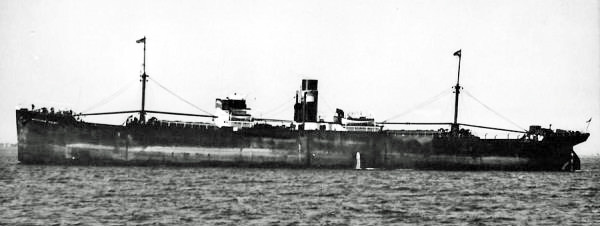 The SS Whitford Point
Image and incident details with thanks to uboat.net
Anyway, Robert’s WW2 service was as a DEMS (Defensively Equipped Merchant Ship) Gunner on the merchant ship SS Whitford Point. In October 1940, this ship – carrying a cargo of nearly 8,000 tons of steel – was part of convoy HX-79 crossing the North Atlantic to the UK. At 01:48 hours on 20 October 1940, she was hit by one torpedo from U-47 and sank 90 miles southwest of Rockall. The master, 33 crew members and two gunners (including Robert) were lost – only three crew members were rescued.
Robert is commemorated in the Chatham Memorial as one of over 10,000 Royal Navy personnel of WW2 who have no known grave.
Roger Morgan © 2019
with special thanks to Hazel Ballan
Please contact us if you have information or pictures that can extend this entry.
MEEK Denis John. Serjeant (5572516)
5th Battalion, Wiltshire Regiment.
Died 7 August 1944, aged 26
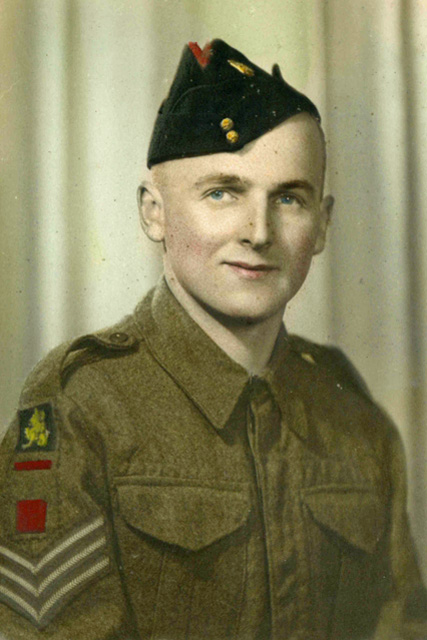
Denis Meek in uniform.
Photograph with thanks to Bourne Hall Museum.
Denis was born on 9 September 1917, the second child of Edward Lancey Meek and Dorothy May (née Lee).
The parents had married on 12 February 1915 at St Matthew’s, West Kensington. The Register entry notes that the 39 year old Edward (a bachelor and “Clerk” – from the 1911 Census, we know that he was a Bank Clerk) lived at 22 Kingston Road, Ewell and that his father was a Wine & Spirit Merchant. 20 year old Dorothy’s (a spinster) address is recorded as 114 Blythe Road, West Kensington. While (as usual at the time) no occupation is recorded for her, her father (Herbert Lee) is recorded as a Publican.
Local Kelly’s directories show that, since 1912, Herbert had been the landlord of the Eight Bells public house at 78 Kingston Road, Ewell. That was quite a change of career for him: the 1911 Census had recorded him as a “Photographer”, living with his wife and two daughters at 85 Whitehorse Road, Croydon. One of the daughters was Dorothy, then 16 years old and working as a “Cashier, Butcher”.
Like the birth (on 25 April 1915) of his older brother, Herbert, Denis’s birth was registered in the Epsom District. The family’s address was probably Capel Cottage, Chessington Road, West Ewell – being Edward’s home address in the Probate records of the widowed Dorothy’s being awarded administration of his £847 estate following his death on 1 October 1928. However, that Probate records notes that Edward’s place of death was his father in law’s Eight Bells pub at 78 Kingston Road.
While the widowed Dorothy is recorded in the 1929 Electoral Roll as still resident at Capel Cottage, she (doubtless with her two teenage sons) then moved to live with her parents at the Eight Bells in Kingston Road, where she and they are recorded in Electoral Rolls of the 1930s. The September 1939 Register also records the now 45 year old widow (of “Private Means”) there, doubtless helping out her 70 year old “Licensed Victualler” father and 69 year old “Invalid” mother. Also there was 24 year old Herbert (a “Chauffeur Mechanic”).
Denis, however, had left home. The transcript of the September 1939 Register records him, now aged 22, as a household of 1 living at 9/11 London Road, Croydon, and listed as “Shop Assistant, Provisions”. However, the original record shows him to be one of 18 people at this address, the first named being 49 year old Fred Fowler listed as “Provisions Shop – Manager”. A little further digging reveals that 9/11 London Road opened in the 1880s as the eighth shop in John Sainsbury’s grocery chain – and was a turning point in the growth of his grocery empire (click here for more details). After some years in other use, the premises re-opened as a “Sainsbury’s Local” in 2014. Anyway, in 1939, Denis would appear to be one of a number of staff literally “living above the shop”.
In Q3 1940 and registered in the Croydon District, the 23 year old Denis married 20 year old Dorothy Joan Coomber. The 1939 Register had recorded her living with her 59 year of widowed mother, Eileen (a “Millinery Saleswoman”), and 23 year old unmarried sister, Molly (a Clerical Officer in the Civil Service) at 193 Sydenham Road, Croydon. Dorothy’s occupation is listed as “Provision Clerk” – likely to be at the Sainsbury’s where Denis also worked. No record has been found of the couple’s having any children.
Their marriage was some months after Denis had enlisted at Tisbury 18 January 1940 – when his Soldier’s Service Book notes that he was 5 feet 7 inches tall, weighed 140 lbs and had blue eyes, a fair complexion and sandy hair. His service was in the 5th Battalion of the Wiltshire Regiment, which was a Territorial Army unit, stationed at home for most of the war.
Its front-line service began with the invasion of Normandy. The Battalion landed there on 24 June 1944 – a couple of weeks after D-Day itself – and was soon in the thick of the action seeking to press on from the quickly established beachhead past the German stronghold of Caen a few miles inland. Actions included: Operation Epsom from 26-30 June, the thwarted effort to outflank Caen on the west; Operation Jupiter from 10-11 July for the eventual capture of the strategic Hill 112; and the 30 July to 7 August Operation Bluecoat which finally secured the road junction in the town of Vire and the high ground of Mont Pinçon.
In was in the last day’s fighting for Mont Pinçon that, as noted in Casualty List No. 1535, Denis was killed in action on 7 August 1945. The Battalion’s War Diary for the day records that they had held their position on Mont Pinçon “under continuous shell and mortar fire and against enemy counter attacks until finally relieved by 5 DCLI at 1900hrs“.
A couple of months after Denis’s death, his mother received the following letter, dated 12 September 1944, from Denis’s Captain, E J Townsend:
Sgt Denis Meek was killed in the following circumstances on 7th August. We were attacking the enemy, who was replying with heavy mortar fire, and Denis had gone forward to try to locate these mortars. Whilst he was moving down the side of a road a bomb burst close to him. He was hit by a small fragment in the side of the temple and was killed instantly. When we found him, he was still kneeling on one knee and it was not until he was spoken to that it was realised that he was no longer alive.
Sgt Meek was one of the best NCOs in the Battalion. He always did his job cheerfully and well and was a fine example to his men.
We all miss him very much and offer you our very sincere sympathy in your loss.
I can assure you that he felt no pain, and I regret that I have been unable to write to you before this owing to the speed of the advance.
Denis was, with a few of his comrades, initially buried at Chantepie. In December 1945, they were moved to the Tilly-sur-Seulles War Cemetery, about 12 miles west of Caen, which now holds 990 Commonwealth WW2 casualties. The widowed Dorothy took the option of adding a personal inscription to his headstone on Grave VI.C.10,
“These we loved, loveliest and best, have one by one crept silently to rest”.
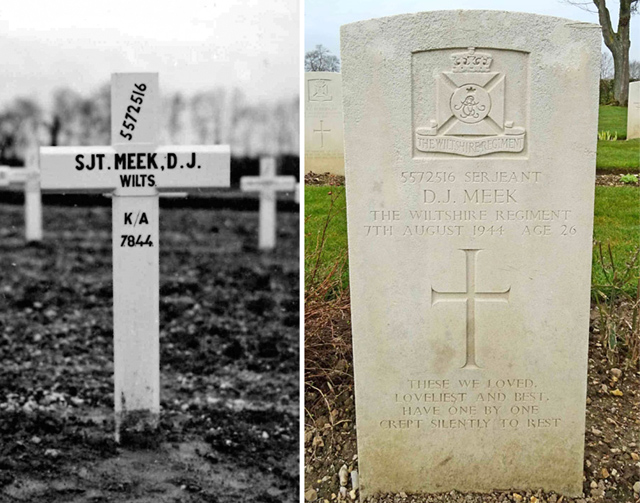
Denis’s grave in the Tilly-sur-Seulles War Cemetery.
Left: the original grave marker – photograph with thanks to Bourne Hall Museum.
Right: the subsequent headstone – photograph (56498761) by “Len” via findagrave.com
The Commonwealth War Graves Commission’s post-war records note that the widowed Dorothy was “of Wimbledon, Surrey.” The relevant Roll Of Assistant Nurses records that, when she enrolled on 22 July 1949, her address was 29 Ridgway, Wimbledon. She later moved to Worthing where, in Q1 1953, she married Albert J Butcher.
However, Denis’s inclusion in the Borough’s Book of Remembrance reflects not only his pre-war connection with Ewell but also that of his mother,Dorothy, long into the post-war years. In Q4 1945, she married her widowed neighbour (of 84 Kingston Road) Henry George Harold Cooke (a “Private Chauffeur” in the 1939 Register). It is likely that they helped run – or even took over – the Eight Bells pub from her ageing father (who died, aged 88, in December 1956). Henry, however, died in April 1956, aged only 57. Indeed, Dorothy was still “of” Kingston Road, Ewell – now No 68 – when she died, aged 93, on 9 February 1988.
Roger Morgan © 2021
with thanks to Clive Gilbert
Please contact us if you have information or pictures that can extend this entry.
MENARD Edmund Sylvain (or Sylvaire Edmund). Croix De Guerre.
Civilian
Died 4 August 1944, aged 47
Not listed in the Book of Remembrance
Edmund was born in on 3 March 1897 in Manhattan USA, the son of Henry George and Gertrude Millage Menard. His name was properly “Sylvaire Edmund Menard”, but he seems to have preferred to use his second forename, and we follow suit here. (The Commonwealth War Graves Commission noted his other forename as “Sylvain”.)
It appears that Edmund served in WW1 – being awarded the French Croix De Guerre – and then settled in England. He had married Georgette Jeanne Leborgne (born 8 February 1897). The couple had three children:
• George Edmund Menard, whose birth on 19 February 1920 was registered in Hammersmith;
• Ida M G Menard, whose Q4 1926 birth was also registered in Hammersmith; and
• John E Menard, whose Q3 1933 birth was registered in the Croydon District.
The family came to live at 7 First Avenue, West Ewell, where they were recorded in the September 1939 Register. 42 year old Edmund and 19 year old George are both listed as “Furrier ([indecipherable] Cutter)” and 42 year old Georgette with the conventional “Unpaid Domestic Duties”. There are two currently closed records at the address, doubtless of 13 year old Ida and 6 year old John.
During 2003, the 77 year old Ida Menard wrote: –
“In 1939 I was nearly 14 when the war broke out. I had an older brother who was conscripted into the army and eventually went to Egypt and fought in the desert. He later was posted into the Special Services because he spoke French and became a wireless operator. He contacted people who had been parachuted behind enemy lines. Living in Ewell, we were bombed and had one of the first doodle bugs which exploded in Riverholme Drive, killing 3 people. When I was about 16 years old and returning home from the village up towards the station, the siren sounded. When I reached the top of the hill, I heard the sound of an aircraft which came out of the clouds and saw three bombs fall like a string of sausages. I found out later, they had fallen in Ewell East – they were apparently aimed at the railway line. I was told by my younger brother that a doodle bug was being chased by (he thought) a Spitfire which tipped the wing of the doodle bug which made it crash in the brickfields, which is now part of Kiln Lane. When I was 18, I went to London with a friend from school to celebrate V.E. Day with the thousands of others doing the same thing.”
(Further to her note, older brother George was attested for service with the Royal Artillery in 1939 with a Service number 974270. He was, however, attached to the US Army – No. 4 SFU, HQ 7th Army, APO 757.)
To return to Edmund, the subject of this article, the 47 year old was at Motspur Park Station on 4 August 1944 when, at 7 pm, he was killed by a V1 Flying Bomb or “Doodlebug”. Six days later, on 10 August, he was buried in Grave G442 of Epsom Cemetery (the transcribed records of which list him as “Edward Minard”.)
The original report of this civilian WW2 casualty from the Merton and Morden Urban District Council noted that Edmund had been the “son of Gertrude Niels (formerly Menard), of Alpins, Crosslands Road, Redhill, and of the late Henry Menard; husband of Georgette Jeanne Menard, of 7 First Avenue, West Ewell.” Elsewhere his mother is recorded as Mrs Gertrude Bjarnesen who, in 1931/2, lived at 4 Melrose Terrace, Hammersmith.
In October 1944, the widowed Georgette was awarded administration of her late husband’s £1,004 estate. Other funds seem to have been held in trust for her: following her death in Q3 1983 (registered in the local Surrey Mid Eastern District) there was, on 2 December 1983, a further grant of administration of £ 38,000 on the estate of “MENARD, Sylvaire Edmund otherwise Edmond”.
Brian Bouchard & Roger Morgan © 2018
Please contact us if you have information or pictures that can extend this entry.
MEPHAM Thomas
Civilian
Died 4 November 1940, aged 69
Not listed in the Book of Remembrance
Thomas was born in Battle, Sussex on 21 January 1871, the fourth child of James (an “Agricultural Labourer”) and Mary A Mepham. The family were still in Battle by the time of the 1881 Census, but four more children had been born to the couple and father James is now listed as a “Milkman’s Labourer”.
The 1891 Census records the 20 year old Thomas (listed as a “Railway Porter”) still in Battle, but lodging with 45 year old widow Maria Barber (a “Charwoman”). In Q3 1892 and registered in Battle, Thomas married Ellen Parks. The 1901 Census records them living at 78 Windsor Road, Bexhill with three children aged from 2 to 7. The 30 year old Thomas is listed as a “General Carrier”. The family was still at 78 Windsor Road for the 1911 Census. Another child had arrived, and the two oldest (aged 15 and 17) are now both listed as “Carrier’s Assistant” – doubtless assistants to their “General Carrier” father.
Ellen died Q1 1935 and, in Q1 1936, Thomas (now aged 65) married 55 year old Alice Elizabeth Firr. The September 1939 Register records the couple living at 57 Amherst Road, Bexhill, Sussex. Thomas is listed as a “Removal Contractor Retired” and Alice with the conventional “Unpaid Domestic Duties”. With them at the time of the Register was 11 year old schoolboy Raymond Dick who would appear to be Thomas’s nephew: his 17 May 1928 birth was registered in the Battle District and his mother’s maiden name was Mepham.
On 8 October 1940, a few weeks into the Luftwaffe’s 1940-41 “Blitz” bombing campaign, Thomas was injured by enemy action while at home in 57 Amherst Road, Bexhill. He was taken to Horton Emergency Hospital – one of Epsom’s “cluster” of mental hospitals that, as for WW1 had been taken over to deal with wartime casualties – where he died four weeks later, on 4 November 1940. (If Alice was also injured, she survived.)
Roger Morgan © 2018
Please contact us if you have information or pictures that can extend this entry.
MILES Robert John. Aircraftman 1st Class (1029783)
Royal Air Force Volunteer Reserve
Died 18 May 1942, aged 29
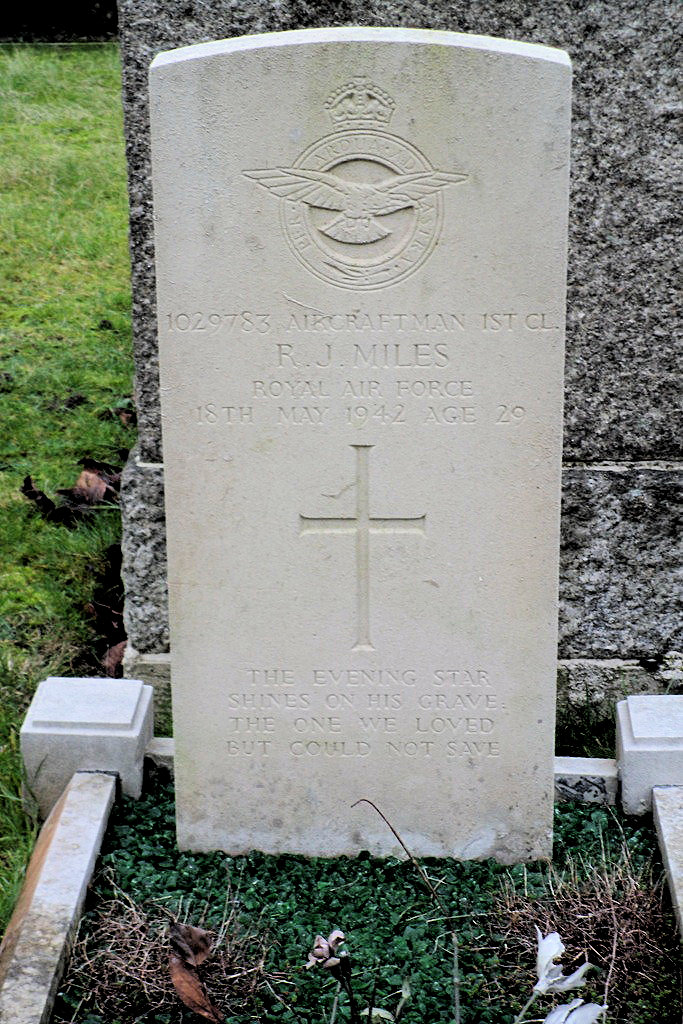 Robert’s headstone in Epsom Cemetery.
Photograph (102706937) by Laurence Hennessy via findagrave.com
Robert was born in Epsom on 4 January 1913, the first child of Epsom-born John (sometimes “Jack”) Miles and Edith Sarah (née Evans). The couple married in Q4 1910, registered in Edith’s home patch of Hambledon, south of Guildford, and set up home at 50 Albert Road, Epsom where the 1911 Census recorded the newlyweds living alone, with 30 year old John listed as a “Greengrocer’s Assistant” and, as usual at the time, no occupation is shown for 23 year old housewife Edith.
The couple had three children, all born in Epsom:
• Robert (the subject of this article), as above on 4 January 1913;
• Lily E M in Q2 1917; and
• William A J on 28 June 1926.
In Q2 1937 and registered in the local Surrey Mid Eastern District, the 24 year old Robert married 22 year old Cecilia A Pitchell (her birth on 5 June 1915 had been registered in Kingston). The couple lived with Robert’s parents at 50 Albert Road. The September 1939 Register records the 26 year old Robert (an “Electrician’s Mate”) while Cecilia (listed with the conventional “Unpaid Domestic Duties”) was visiting presumed relatives as “Sunny Bank”, Shere Road, Guildford. Other residents of 50 Albert Road in the 1939 Register were 58 year old John (a “General Labourer, now employed as a Temporary Postman”); 51 year old Edith (the conventional “Unpaid Domestic Duties”); and 13 year old schoolboy William. (The couple’s daughter, Lily, had married Charles F Taylor in Q1 1936.)
Shortly after the 1939 Register was taken, Robert enlisted with the Royal Air Force at Padgate. There is disappointingly little information about his RAF service as an Aircraftman 1st Class, although it seems clear that this was wholly or mainly in the UK. In Q3 1941, Robert and Cecila had a daughter, Cecilia C A Miles, whose birth was registered in the local Surrey Mid Eastern District.
The following year, Robert was stationed at RAF Leuchars in Fife, the base for key maritime patrols., The Statutory Deaths Register for Scotland records that, at 6.45 pm on 18 May 1942, AC 1 Robert J Miles died at RAF Station Leuchars due to multiple injuries “sustained whilst on active service.”
Robert’s body was brought back to Epsom and buried in the Cemetery on 26 May 1942. The widowed Cecilia took the option of adding a personal inscription to his headstone on Grave O287,
“The evening star shines on his grave; the one we loved but could not save”
In Q4 1949, Cecilia got married again – to Albert E Murphy, registered in the Battersea District.
Brian Bouchard & Roger Morgan © 2018
Please contact us if you have information or pictures that can extend this entry.
MILLER Frederick Stanley. Sergeant (515573)
82 Squadron, Royal Air Force
Died 17 May 1940, aged 26
Frederick is not listed in the Book of Remembrance but is remembered here because the Commonwealth War Graves Commission post-war records note that his widow Emily was “of Ewell, Surrey”. As noted further below, a local address has been established for her, but it does not seem that Frederick himself ever had any connection with the Borough.
Frederick was born on 17 January 1914, the seventh of ten children born to Edward George Miller and Jane (née Overy). The parents’ Q4 1904 marriage was registered in the Bethnal Green District (the home area for both of them), and the birth of at least their first child was registered in the same District.
By the time of the 1911 Census, the parents were living at 22 Etloe Road, Church Road, Leyton – in the West Ham District. 28 year old Edward is listed as a “Carbon Paper Cutter”. As usual, no occupation is listed for 27 year old housewife Jane, whose hands were full looking after three children aged between 1 and 4. (The Census return records that another child of theirs had died.) The two youngest children had been born in Leyton – as were the six that followed between 1912 and 1921. These included Frederick in 1914 – and there is a record of his being baptised at St Mary The Virgin, Leyton on 11 February 1914.
In Q1 1939, the 25 year old Frederick (who appears to have entered the RAF from civilian life before September 1934) married 22 year old Emily May Pretty, registered at Epping. The Q4 1939 birth of their son, Frederick (‘Fred’) J Miller, was registered in Edmonton, where they were then resident at 350 Hertford Street, Edmonton.
Frederick’s WW2 service was in the light bomber 82 Squadron, flying Bristol Blenheims. In the early months of the war, it played a prominent part in No. 2 Group’s offensive against enemy shipping in the English Channel and the North Sea, and ‘fringe’ targets on the Continent.
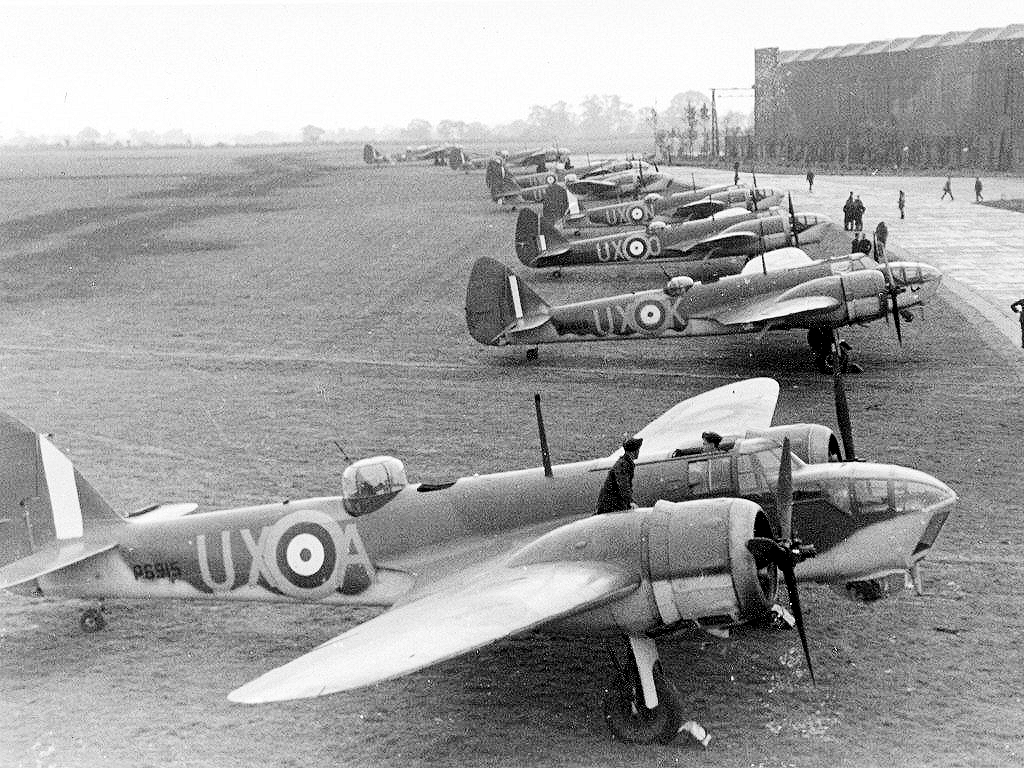 Bristol Blenheim Mk IVs of 82 Squadron at its base, RAF Watton, in Norfolk.
Image source Wikimedia
On 17 May, 1940, Frederick was the Observer aboard Blenheim Mk.1V P4838 UX-R. This was one of twelve Blenheims from 82 Squadron that, at 04.50 hours took off from RAF Watton, to attack troop concentrations at Gembloux, Belgium, where the German army was sweeping west towards the Channel ports.
The Blenheims had expected to have a Hurricane fighter escort but, presumably because of some higher priority, that was not available and the Blenheims proceeded unescorted. As they reached their target, they were attacked by fifteen Luftwaffe Messerschmitt Bf-109 fighters. Eleven of the twelve Blenheims were shot down. (Although the survivor, P8858 UX-W, managed to return to Watton, it was badly damaged and subsequently written off.)
Frederick’s Blenheim P4838 UX-R was among those lost. The crew of three, namely:-
• Flying Officer Alexander M Gofton, RAF 39312, 82 Sqdn., age 29, Pilot;
• Corporal Thomas H Cummins, RAF 537830, 82 Sqdn., age 20, W.Op/AG; and
• Sergeant Frederick S Miller, RAF 515573, 82 Sqdn., age 27, Observer
were declared missing in action, presumed dead. As some of the 20,000+ members of the RAF who were lost during WW2 operations and who have no known grave, Frederick and his crewmates are commemorated on the RAF Memorial at Runnymede.
The RAF’s Runnymede Memorial
Photograph with thanks to the Commonwealth War Graves Commission
(The Gembloux catastrophe could have wiped out 82 Squadron but – thanks to the exceptional determination of the CO, Wing Commander the Earl of Bandon – it was re-formed within 48 hours to fight again. Only four months later, he achieved the same remarkable result after the Squadron’s 13 August catastrophic raid on an airfield at Aalborg, Denmark – when, again, eleven out of twelve Blenheims were lost to German fighters.)
The probate record of the widowed Emily being granted administration of Frederick’s £181 estate Probate notes their address as 38 Larkshall Crescent, Chingford, Essex. However, at some point during the mid 1940s, Emily moved to the Borough. In Q4 1949 and registered the local Surrey Mid Eastern District she married Robert L Cox They set up home together in 10 Manor Drive, Ewell – the address where Emily died, aged 51, in Q4 1967.
Brian Bouchard & Roger Morgan © 2019
Please contact us if you have information or pictures that can extend this entry.
MINN Charles William. Sergeant (975720)
47 Squadron, Royal Air Force Volunteer Reserve
Died 16 March 1941 aged 20
Not listed in the Book of Remembrance
Charles was born Q1 1920, the first child of Charles Minn and Henrietta Grace (née Tharlow). The parents’ Q3 1920 marriage was registered in the Peterborough District, as was Charles’s birth and that of the couple’s other child, Dennis, on 6 January 1925.
By 1936, the family had moved into the Borough, living at 36 Meadowview Road, Ewell, where they were recorded in the September 1939 Register. 41 year old Charles senior is listed as an “Electrician” and 44 year old Henrietta with the conventional “Unpaid Domestic Duties”. Also recorded at the address is 14 year old Dennis, listed as an “Apprentice Motor Mechanic”. Between him and his parents is a currently closed record, likely to be of 19 year old Charles junior. (As he is known to have died in 1941, this should not have been redacted. The younger Dennis’s has been left open as he died in 1998.) The death of Charles, senior aged 61, was registered Surrey Mid E, 3/1959.
Charles junior’s WW2 service was in the RAF, apparently enlisting at Padgate in late 1939. He became a member of 47 Squadron, one of the few squadrons to use the Vickers Wellesley light bomber in combat. The mid-30s aircraft was beginning to show its age. It was unsuited to the European air war, but was used to good effect against Italian forces in their East African colonies of Eritrea and Ethiopia – which, in the Battle of Keren (“Cheren” in the Italian spelling) ended in a decisive Allied victory on 1 April 1941.
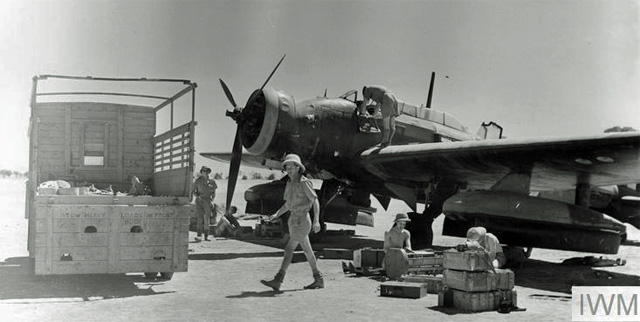 Loading incendiaries into the underwing panniers of
Vickers Wellesley Mark I, K8527, at Kassala, Sudan.
Note that this aircraft is fitted with a lengthened cockpit canopy.
Image source © IWM (ME(RAF) 889)
A couple of weeks before that, on 16 March 1941, Charles was Wireless Operator/Air Gunner among the three-man crew of Wellesley Mk.I K8527 (the very aircraft pictured above) on a mission over Keren, probably from a captured airstrip at Agordat, Eritrea. Their aircraft was shot down in a counter-attack by five Fiat CR 42 Italian fighters. All three members of the crew were killed in the crash.
Charles is one of the 440 Commonwealth WW2 casualties buried in the Keren War Cemetery. His parents took the option of adding a personal inscription to his headstone on Grave 1.D.14,
“They shall grow not old as we that are left grow old.”
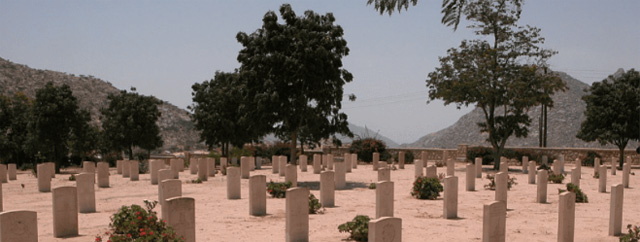 The Keren War Cemetery, Eritrea
Photograph with thanks to ww2cemeteries.com
Brian Bouchard & Roger Morgan © 2018
Please contact us if you have information or pictures that can extend this entry.
MITCHELL Cecil Laurence Edward. Second Lieutenant (130484)
2/6th Battalion, Duke of Wellington’s (West Riding Regiment)
Died 25 April 1941, aged 31
Cecil was born on 5 April 1910, the second child of Thomas Alfred and Kate Mitchell. The 1911 Census records the family of four living at 10 Everthorpe Road, East Dulwich. 32 year old Thomas is listed as a “Commercial Traveller Timber Trade”. 35 year old Kate had her hands full with their first child, 5 year old Doris, and Cecil who was still short of his first birthday.
In Q3 1938, 28 year old Cecil married 26 year old Mildred Lucy Long, registered in the Lambeth district. The September 1939 Register records the couple living with Cecil’s parents who had moved to 36 Coulsdon Rise, Coulsdon. 63 year old Thomas was still a “Commercial Traveller Flooring & Timber”. 29 year old Cecil is listed as an “Insurance Official, Accountant”. Both his mother, 66 year old Kate, and 27 year old Mildred are listed with the conventional “Unpaid Domestic Duties”. (The original record was annotated also to record that Cecil was “A.R.P. Aux. Commercial Unit” and Mildred “British Red X V.A.D. Nurse”.)
Cecil and Kate later moved to “Puckaster”, Downs Road, Epsom – the address in the 1941 Probate records awarding administration of Cecil’s £1,454 estate to the widowed Mildred.
Cecil’s WW2 service was in the 2/6th Battalion of the Duke of Wellington’s (West Riding Regiment). This was one of the units created by the Territorial Army throughout the spring and summer of 1939, in response to the order to double its strength by creating duplicate units.
As part of the 137th Infantry Brigade, attached to the 46th (West Riding and North Midland) Infantry Division, the 2/6th Battalion was sent to France in April 1940 to join the British Expeditionary Force. Poorly trained and equipped, it (and its fellow 2/7th Battalion) was battered during the German Army’s blitzkrieg during the Battle of France and survivors retreated to Dunkirk for evacuation to England. The Battalion spent the next two years on home defence, preparing for the expected German invasion.
Cecil’s death on 25 April 1941 was registered in the King’s Lynn District. Casualty List No. 500 notes that he had “Died” which implies that the cause was illness or disease rather than enemy action. He is buried in King’s Lynn Cemetery, Norfolk The widowed Mildred took the option of adding a personal inscription to his headstone on Grave P.38,
“Their dauntless spirit was the living breath of freedom and of chivalry and truth.”
There is no record of Cecil and Mildred having had any children in their short marriage. Mildred never remarried and in May 2006, aged 94, she died in South Hams, Devon.
Roger Morgan © 2018
Please contact us if you have information or pictures that can extend this entry.
MITCHELL Frederick Peacock. Captain (107710)
Royal Engineers
Died 20 April 1947, aged 49
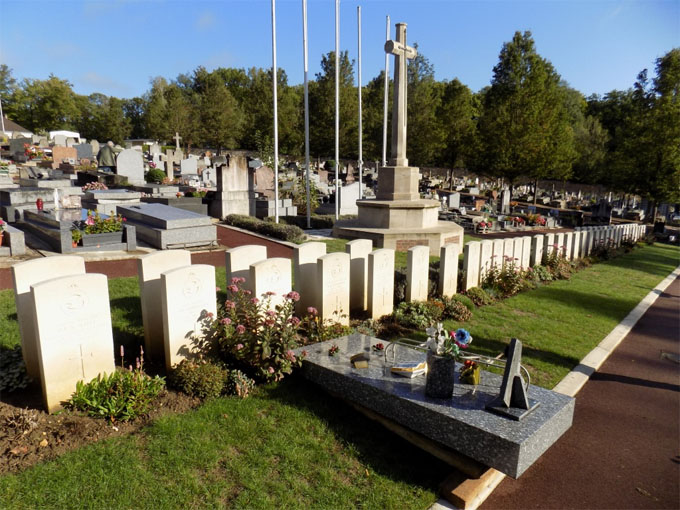 WW2 headstones in the Viroflay New Communal Cemetery.
Photograph © The Commonwealth War Graves Commission
Not listed in the Book of Remembrance
The Commonwealth War Graves Commission notes that Frederick was the “son of Frederick Mornington Mitchell and of Sarah Elizabeth Mitchell (née Peacock); husband of Henriette Cecile Yvonne Mitchell (née Gaquerel [in other records, the more likely “Gaquerelle”]), of Stoneleigh, Ewell, Surrey.”
Tracking the family background is complicated by some confusion in the readily available records about names. Frederick’s birth on 7 September 1897 was registered in the Salford District of Lancashire as Frederick P MUTCHELL. For his baptism on 22 September 1897 in St Clement’s, Ordsall-in-Salford, Lancashire, the family surname is recorded as MATCHELL – and his parents’ first names as Frederick MOERINGTON & Sarah Elizabeth.
Nothing is found in the readily available records about either where Frederick’s wife, Henriette, was born or the couple’s (probably late 1920s) marriage. However, it seems pretty certain that both events were in France – as was the birth of their second child, Micheline, on 12 August 1932 . The couple were, however, back in the UK by September 1939, being recorded in that Register as lodging with the apparently unrelated Arthur and Sarah Wilson at 11 Feversham Road, Salisbury.
Frederick’s time abroad is supported by his occupation’s being listed in the 1939 Register as “Travel & Transport Company Business Manager”. Henriette’s date of birth is given as 3 January 1902, and she is listed with the conventional “Unpaid Domestic Duties”. Also there is their son, 13 year old schoolboy Frederick R Mitchell. His 24 November 1930 birth is not found in the readily available records so seems likely also to have been in France. There is a currently closed record following his which seems certain to be of 11 year old Micheline.
As to Henriette’s being “of Stoneleigh”, she is found in 1945 staying in Stoneleigh Hotel. By 1947, she was with Nellie B Osborne at 15 Park Road West, Stoneleigh. She was joined there in 1952 by her son, Frederick, and both of them were still there up to 1958.
Few details of Frederick’s WW2 service in the Royal Engineers are readily available. It is clear that he was in France with the British Expeditionary Force in 1940. When this failed to hold the unexpectedly rapid German invasion, Frederick was one of a good number of Commonwealth forces unable to get to Dunkirk for evacuation. Instead, they made their way west and south to seek other means of getting home. However, Casualty List No. 267 reported Frederick “Missing” on 20 July 1940 – corrected in Casualty List No. 275 which, on 7 August 1940, reported him as a Prisoner of War.
The readily available records contain only two further mentions of Frederick’s service career. The first in in Casualty List No. 1281 which, on 3 November 1943, reported him “Repatriated”. Had he escaped from his PoW camp and somehow got home? The second is the Commonwealth War Graves Commission’s record of his death, aged 49, on 20 April 1947 – nearly two years after the end of the War – and burial in Paris. This was initially in the Paris’s Thiais Cemetery. In mid-1953, he was reinterred among the 76 WW2 Commonwealth casualties in the Viroflay New Communal Cemetery, southwest of Paris, just short of Versailles. His headstone on Grave B.18 carries the personal inscription,
“In memory of our dear Daddy. R.I.P.”
The 23 October 1947 Probate record of administration of Frederick’s £589 estate being awarded to the widowed Henriette states that he had died at The Hospital “Prive de Chuirurgie, 219 Rue Vercingetorex” in the south of Paris – and that, notwithstanding Henriette’s link with the Borough, his address was 25 Avenue Fleury, Colombes (in the northwest suburbs of Paris).
Roger Morgan © 2019
With special thanks to Hazel Ballan
Please contact us if you have information or pictures that can extend this entry.
MITCHENER Charles William. Private (6092498)
2/5th Battalion, The Queen’s Royal Regiment (West Surrey)
Died 4 December 1943, aged 24
Not listed in the Book of Remembrance
Charles was born Q2 1919, the seventh and last child of John Mitchener and Ellen Mary (née Southgate – they had married Q1 1901, registered in the Brentford District. The 1911 Census records the couple living at The Oaks Cottage, Chobham, Woking. 37 year old John’s occupation is listed as “Cowman on Farm”. 32 year old Ellen had her hands full looking after five children aged from 1 to 9. They had all been born in Chobham – as was Selina, born shortly after the Census, in Q3 1911.
The family moved to the Borough of Epsom & Ewell in early 1917: the record of admissions to Ewell Boys National School notes that sons 9 year old Walter and 7 year old Herbert were both admitted to the school on 12 February when, Father John’s address was noted as “Ruxley”. On 1 November 1927, the 8 year old Charles (whose Q2 1919 birth was registered in the Epsom District) was also admitted to the school, with his father’s address now being noted as “Ruxley Farm Cottage” – the site of Ruxley Farm subsequently being developed as Epsom & Ewell High School.
By the time of the September 1939 Register, the parents (65 year old John, a “General Labourer” and 61 year old Ellen, an “Invalid”) are found at 2 Fernhurst Cottages, South Holmwood, near Dorking. There is one currently closed record at the address which could be of the 20 year old Charles.
The parents subsequently returned to the Borough: the 1947 electoral Roll records them at “Hayes” in Cox Lane, West Ewell. That is consistent with the Commonwealth War Graves Commission post-war records noting that they were “of Ewell, Surrey” – and father John’s death in Q2 1949 being registered in the local Surrey Mid Eastern District.
To revert to Charles, the main subject of this article, the readily available records provide few details of his WW2 service in the 2/5th Battalion, The Queen’s Royal Regiment (West Surrey). This may have begun in time for him to have been sent to France in 1940 as part of the British Expeditionary Force. The Battalion was still less than fully trained and, when the unexpectedly ferocious German invasion came, suffered heavy casualties during the fighting retreat to Dunkirk. After being brought back up to strength and re-equipped in the UK, the Battalion then saw action with the Eighth Army in the Western Desert Campaign against Axis powers in North Africa.
Success there provided the springboard for the Allied invasion of Sicily and, after that island’s hard-won capture in mid-August, the invasion of the Italian mainland. The Battalion landed at Salerno in September 1943, in the immediate aftermath of which Reginald was wounded on 10 September (Casualty List No. 1264). They then took part in some of the fiercest fighting of the Italian Campaign as the German forces (the Italians had re-entered the war on the Allied side) retreated northwards to well-prepared defensive lines. Charles seems to have recovered from his wounds to rejoin the fighting, only to be killed in action two months later, on 4 December 1943.
He is one of 4,271 Commonwealth WW2 servicemen buried or commemorated in the Cassino War Cemetery, some 85 miles southeast of Rome. The family took the option of adding a personal inscription to his headstone on Grave VII.G.9,
“In loving memory of / Our dear son and brother, / Always in our thoughts. / Mum and Dad.”
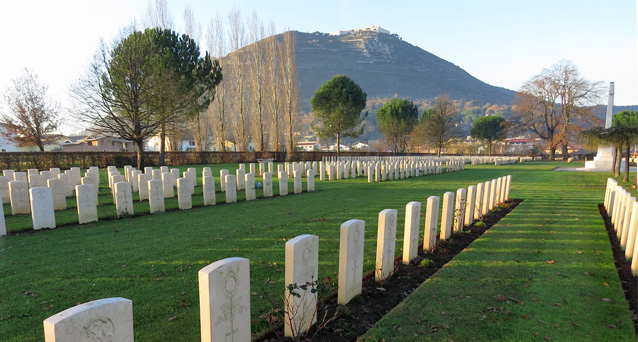 The Cassino War Cemetery
Photograph (56059499) courtesy of Iain MacFarlaine via findagrave.com
Roger Morgan © 2019
With special thanks to Hazel Ballan
Please contact us if you have information or pictures that can extend this entry.
MOGER Edward James (NOT James Edward), Sergeant
King’s Shropshire Light Infantry
Died June 1943, aged 26

The headstone of Edward’s and his stepfather’s grave in Epsom Cemetery,
which also commemorates his half brother William Charles
(The headstone immediately behind is that of William Brown)
One of the servicemen commemorated on the WW2 memorial in St Martin’s, Epsom is “MOGER, JAMES EDWARD. K.S.L.I.”. The WW2 memorial at Glyn School (which was Epsom County Boys School at the time) commemorates the same “J. E. MOGER”. However, and most unusually, the normally comprehensive Commonwealth War Graves Commission database has no entry for this casualty.
As WW2 service records are not yet publicly available, the Commission’s usual brief background is normally an essential starting point in researching the individual stories we have recorded on this site. In the present case, however, we are enormously helped by not only the uncommon surname but also by St Martin’s memorial specifying the regiment of those who had served in the Army – “K.S.L.I.” being, as shown in this article’s heading, the King’s Shropshire Light Infantry.
The Christian names “James Edward” initially led us down a blind alley – which, for the record and the benefit of others similarly misled, is described at the end of this article. It is abundantly clear that the individual commemorated in St Martin’s and at Glyn School is actually “Edward James” Moger.
His headstone in Epsom Cemetery, illustrated above, gives us his rank of Sergeant, the exact date of his death and his age. Its inscription is now rather worn but, on close examination reads:
IN
LOVING MEMORY OF
SERGT EDWARD JAMES MOGER
K.S.L.I.
DIED 12TH JUNE 1943 AGED 26
ALSO OF
SERGT WILLIAM CHARLES MOGER
HAMPSHIRE REGT.
KILLED IN ACTION 9TH SEPT. 1943 AGED 20
ALSO OF
WILLIAM ADOLPHUS MOGER
PASSED AWAY 10TH JUNE 1946 AGED 61
Careful work in the records finds that Edward was born on 13 September 1916 as Edward James William HAWKINS, the only child of Edward James Hawkins and Rosina/Rose Jane Caroline (née Moger), who had married on 26 April 1915 in Christ Church, Southwark. (Rosina was the daughter of Charles Henry and Elizabeth Moger.) The boy’s first two Christian names were the same as his father’s. Was he perhaps always called by the second, leading to the confusion here?
Anyway, Edward senior attested into the Royal Field Artillery on 7 June 1915, giving his address as 51 Brunswick Street, Blackfriars, and was given the service number 1325. Based in Deptford, he was reported Absent Without Leave on four occasions, the last being between 26 – 28 December 1915, a total of 31 hours.
That visit to Rosina left her pregnant, and Edward junior was born on 13 September 1916. On 1 October 1916, he was baptised in Christ Church, Southwark – the church where his parents had married. On 6 October, just five days later, Edward senior was killed in action on the Somme – it was his 24th birthday. He is buried in the Contalmaison Chateau Cemetery.
On 4 April 1920, the widowed Rosina married her paternal cousin William Adolphus Moger. William had served in WW1 as a Company Sergeant Major (regimental number 7333) in the Shropshire Light Infantry – the probable explanation of the later KSLI connection for his stepson, now a “Moger”.
Rosina and William had three children together:
• Rosina J, born 1922 (whose husband David Hodgson was a WW2 casualty);
• William Charles (also a WW2 casualty), born 1923; and
• Mary E, born 1925.
The births of the first two were registered in the Farnham District, but Mary’s was registered in Epsom. The 1928 Electoral Roll records the parents living at 81 Albert Road – the address at which they were recorded in the September 1939 Register (with William senior listed as ‘Physical Instructor Epsom College”).
Epsom Cemetery’s record of Edwards’s 17 June 1943 burial in Grave O365 notes that he had died in Kings College Hospital, S.E.5. and describes him as an “Ex serviceman”. As noted at the head of this article, the Commonwealth War Graves Commission’s otherwise comprehensive database of WW2 casualties has no record of this casualty – whether as: “James Edward Moger” (of whom more in the appendix below); “Edward James Moger”; or, indeed, “Edward James Hawkins” – his birth surname.
Had Edward’s service (in the KSLI) been entirely before WW2, thus not qualifying for entry in the Commonwealth War Graves Commission’s database of WW2 casualties? Did his widowed mother nevertheless feel his name merited mention alongside his half brother on St Martin’s memorial?
We say “widowed mother” there because William senior had died at home (81 Albert Road, Epsom) on 10 June 1946. On 15 June 1946, he was buried in the same grave as his stepson, Edward James (né Hawkins, later Moger).
Appendix: James Edward MOGER
Confusingly, there is a superficially plausible James Edward Moger found in the readily available records (other than those of the Commonwealth War Graves Commission).
He was born on 15 February 1901, the birth being registered in the Kensington District. The 1901 Census (taken just six weeks later) records him as the first child of 39 year old James Moger (a “Lift Porter) and 22 year old Sarah (née Fencome), living at 5 Clarence Place, Kensington. By the time of the 1911 Census, the family had moved to 37 Kenway Road, Earls Court S W, Kensington. James senior was still working as a “Lift Porter” and the couple had had three more children.
On 29 June 1924, the 24 year old James married 23 year old Caroline May Rutherford at the parish church of St Matthias, Earls Court. The record of that shows James (a “Butcher’s Roundsman”) was still living at the 1911 address of 37 Kenway Road. No occupation is shown for his bride, the daughter of William Rutherford (a “Miner, retired”) and of nearby 6 Lexham Gardens.
The September 1939 Register records the now mid-30s couple – with two children – still living in Kenway Road but now at number 29. James is listed as a “Butcher (Van Driver)” and Caroline with the conventional “Unpaid Domestic Duties”.
James’s next appearance in the readily available records is his death at Kensington’s St Mary Abbots Hospital on 1 May 1944 at the age of 43. The Probate record of administration of his £97 estate being awarded to the widowed Caroline says nothing about any war service and notes the home address still as Kenway Road, but now number 53.
Extensive searching found nothing about either this James’s war service or any link with Epsom & Ewell. But it was the search for the Borough link that led us to Edward James Moger – as in the first part of this article – who is clearly the individual commemorated on the St Martin’s and Glyn School WW2 memorials.
Roger Morgan © 2019
With special thanks to Hazel Ballan
Please contact us if you have information or pictures that can extend this entry.
MOGER William Charles. Lance Serjeant (6026185)
2nd Battalion, Hampshire Regiment
Died 9 September 1943, aged 20
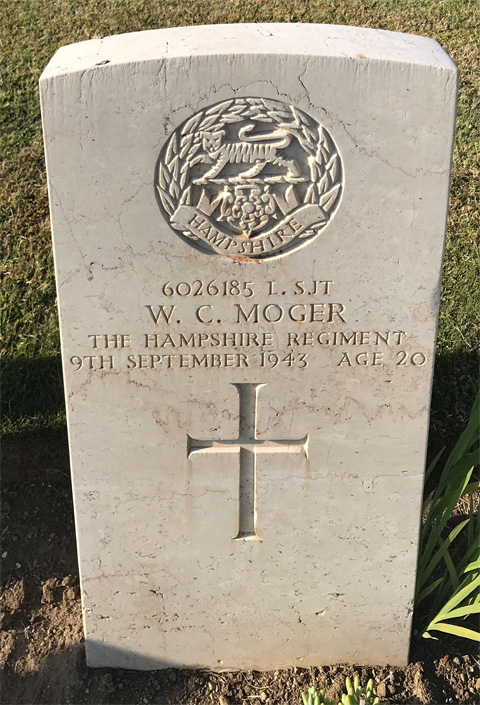 William’s headstone in the Salerno War Cemetery
Photograph (56576329) by R K Franklin via findagrave.com
William is not listed in the Borough’s Book of Remembrance, but is commemorated on the WW2 memorial in St Martin’s, Epsom – together with his half-brother, Edward James Moger.
William’s birth on 24 May 1923 was registered in the Farnham District. He was the middle of three children born to William Adolphus and Rosina Jane Caroline Moger.
As set out in the second part of the immediately preceding article about William junior’s half-brother, Edward – Rosina (née Moger) was William Adolphus’s paternal cousin. Her first husband, Edward James William Hawkins, had been killed on the Somme. She was widowed, with a son, when she married William Adolphus on 4 April 1920 in Christ Church, Southwark. Her new husband had served during WW1 as Company Sergeant Major in the Shropshire Light Infantry.
The couple made their first home in the Farnham area but, by the 1925 birth of their third and last child, Mary, had moved to 81 Albert Road, Epsom. They were still at that address by the time of the September 1939 Register. This records 54 year old William senior as ‘Physical Instructor Epsom College” and 43 year old Rosina with the conventional “Unpaid Domestic Duties”. 16 year old William junior is listed as “Standard Newspaper Agent” and appears between two currently closed records – one of which seems certain to be his older sister, Rosina junior, who later married David Hodgson (see the final paragraph of this article).
William’s WW2 service was in the 2nd Battalion, Hampshire Regiment. Given his age, his first experience of action is likely to have been the November 1942 Operation Torch landings in Algeria and in the ensuing fierce fighting which helped corner Axis forces in Tunis. (The other half of the pincers was the Eighth Army advancing west after El Alamein.) The capture of Tunis in mid-May 1943 paved the way for the Allied invasion of Sicily and, after that island’s hard-won capture in mid-August, the invasion of the Italian mainland.
The main Allied landings were at Salerno (about 25 miles south of Naples) on 9 September 1943. These were not the surprise the planners had intended: German forces (the Italians had re-entered the war on the Allied side) were waiting for them in some strength. According to Casualty List No. 1274, William was killed in action on the first day of that action in which, after a week’s fierce fighting and heavy losses, the Allies secured on 16 September the base needed for further advances.
William is one of 1,846 Commonwealth WW2 casualties buried in Grave III.D.17 of the Salerno War Cemetery. He is also commemorated on the headstone over the grave of his father (and half-brother Edward James Moger) in Epsom Cemetery.
(A fortnight after William’s death, his brother in law, David Hodgson, was killed in the fighting around Salerno: he is also buried in the Salerno War Cemetery – and commemorated on the St Martin’s WW2 memorial.)
Roger Morgan © 2019
Please contact us if you have information or pictures that can extend this entry.
MONNEY John Douglas
Civilian
Died 8 August 1940, aged 35
Not listed in the Book of Remembrance
John was born on 16 October 1905, probably the second child of William John and Anna Monney. William and Anna (in some records “Annie”) may both have been born in India. That was certainly where William was serving in the Army when, on 5 October 1903, he married Anna/Annie Cusack/Cassack. They seem to have had only two children, Letitia born on 2 July 1904 and John in October 1905.
The family appear to have returned to the UK in the 1920s. John, the subject of this article, subsequently took up employment in Argentina. There are two records of his leaving London bound for Buenos Aires. The first is as a 23 year old aboard the SS Highland Monarch on 18 October 1928. His UK address – presumably that of his parents – is listed as 15 Trinity Square, London EC3. Having returned in the meantime, he left again on 22 January 1934 aboard the SS Highland Chieftain. This time, he gave his home address as “Hillcot”, The Rise, Ewell. In both manifests, his occupation is described as “Engineer”.
The September 1939 Register records him back in the UK again, staying with his parents and sister at 15 The Rise, Ewell – presumably the “Hillcot” noted in the 1934 manifest. 71 year old William is listed as a “Shipping Clerk” and 54 year old Anna with the conventional “Unpaid Domestic Duties”. 35 year old Letitia – who, in Q4 1941, would marry Harold G Howes in the Ormskirk District of Lancashire – is listed as a “Trained Hospital Nurse”. 33 year old John is listed as “Argentina Estancia Administration Cattle Horses etc (on leave)”.
The Commonwealth War Graves Commission records note that his employment was at Estancia – a “station” or “ranch” – Aurora, Forestal Land. This was in the Province of Santa Fe, about 250 miles up the Parana River from Buenos Aires. La Forestal (The Forest Land, Timber and Railways Company Limited) was an English company set up in the late nineteenth century to exploit the extensive quebracho forests of the Province. It became effectively a state within a state, founding around 40 towns, with ports, 400 kilometres of its own railways and around 30 factories. It had a bad reputation: the company’s local workers 1919-22 struggles for improved conditions ended in what has been termed a massacre. When the company ceased activities in Argentina in the 1960s, it had cleared almost 90% of the forests in its area and left behind a devastated landscape.
Shortly after the 1939 Register was taken, John returned to Argentina but, by mid-1940, was on his way back to the UK as one of a dozen passengers aboard the 9,120 ton merchant ship Upwey Grange. It had left Buenos Aires with a cargo of 5,380 tons of frozen meat and 51 cases of tinned meat.
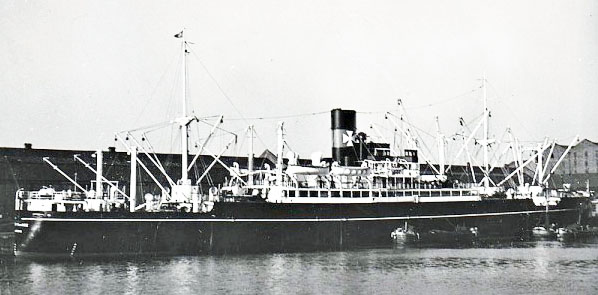 MV Upwey Grange.
Photo courtesy of the Paul Johnson Collection –
with thanks to uboat.net for this and the incident details
On 8 August 1940, the unescorted Upwey Grange was about 200 miles west of Achill Head, Co. Mayo. At 13:14 hours, it was hit on the port side by one torpedo from U-37 and sank by the stern. The crew and passengers abandoned ship and took to the lifeboats. In the bad weather, the lifeboats were separated and the one carrying the master, 31 crew members, one gunner, John and two other passengers was never seen again. The other 50 (crew members and passengers) were picked up after three days and landed at Liverpool.
Roger Morgan © 2018
Please contact us if you have information or pictures that can extend this entry.
MONTGOMERY Cyril George. Flying Officer (145552)
246 Squadron, Royal Air Force Volunteer Reserve
Died 14 March 1945, aged 32
Almost all the above details are taken from the Commonwealth War Graves Commission database. The exception is Cyril’s age when he died, but his birth on 26 January 1903 (registered in the Rye District of Sussex) is easily found in the readily available records.
The Commission’s database also lacks the usual brief family background, noting only that Cyril is buried in the Lajes War Cemetery in the Azores. However, some details are readily found elsewhere. The 1911 Census records the 8 year old Cyril as the second of three children living with their early 40s parents (William – a “Medical Practitioner” – and Edith) at 234 London Road, West Croydon.
In Q3 1936 and registered in the Marylebone district, the 33 year old Cyril married 32 year old Muriel Edith Fish. While, perhaps because of transcription errors, Muriel has not yet been found in the September 1939 Register, this records the married 36 year old Cyril (a “Clerk, Bank of England”) as one of many living at 5-22 Northwood Hall, Hornsey – a celebrated Art Deco apartment building erected in 1935.
The couple subsequently moved to the Borough. The Frances M Montgomery born in Q2 1941 (whose mother’s maiden name was Fish and whose birth was registered in the local Surrey Mid Eastern District) seems certain to be their child. And the Probate record of administration of Cyril’s £ 390 estate being awarded to the widowed Muriel notes his home address as 22 Woodcote Park Road, Epsom.
Cyril’s WW2 service was in 246 Squadron, which had two wartime incarnations. The first of these was as part of Coastal Command from August 1942. Based at RAF Bowmore on Islay and equipped with Short Sunderland Flying Boats, it undertook anti-submarine patrols but was disbanded in April 1943.
On 11 October 1944, it was reformed at RAF Lyneham in Wiltshire as a transport squadron, moving in December 1944 to RAF Holmsley South, Hampshire. Equipped with the Consolidated Liberator, it specialised in long distance transport services
 A Consolidated B24 Liberator heavy bomber
Public domain image via Wikimedia.
At 01.10 hours on 14 March 1945, Cyril was among the five-strong crew of Liberator EW626 which, with 14 passengers on board, took off from Lajes airfield (on the island of Terceira in the Azores) for a 1,200 mile flight back to England. Three minutes after take off, while in initial climb and about 4 miles west of the airfield, the aircraft banked right and crashed into the hillside. The consequent huge explosion killed at 19 on board.
All are among the 47 WW2 casualties buried in Terceira’s Lajes War Cemetery, in Cyril’s case, in Grave D.7.
 The Lajes War Cemetery, Terceira, Azores
Photograph with thanks to the Commonwealth War Graves Commission
Roger Morgan © 2018
Please contact us if you have information or pictures that can extend this entry.
MOORE Alan Beresford. Trooper (7917119)
23rd Armoured Brigade, Royal Armoured Corps
Died 22 May 1942, aged 33
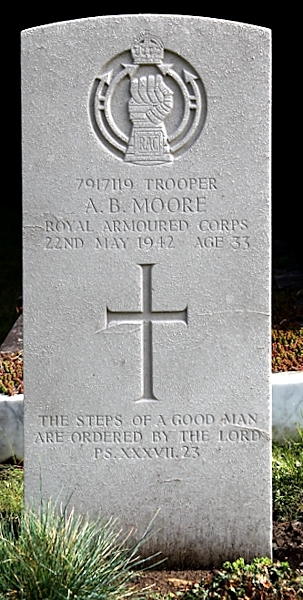 Alan’s headstone in Epsom Cemetery
Image courtesy of Clive Gilbert © 2018
Not listed in the Book of Remembrance
Alan was born on 27 March 1909, the fourth child of Henry Beresford Moore and Lucy May (née Dodd – they had married in St Hillary’s, Wallasey on 1 January 1902). The 1911 Census recorded the family living at 5 School Lane, Wallasey, Cheshire. 35 year old Henry is listed as a “Commercial Traveller, Silversmiths”. 36 year old Lucy has her hands full with five children – from new-born Henry Kenneth to 8 year old Edna. Henry senior’s 68 year old mother, Charlotte, was visiting and his 21 year old sister, Mabel (a “Telephone Operator” in the Liverpool Exchange) was living with them. The household was supported by an 18 year old general domestic servant, Ellen Howey.
Alan worked for some years in the 1920s as a “boy” aboard Canada Steamship’s SS Montroyal as it criss-crossed the Atlantic. His cards note that he had blue eyes, brown hair and a fresh complexion.
The September 1939 Register records Alan living at 149 Rake Lane, Wallasey, with his recently widowed father: Lucy had died Q4 1938. 63 year old Henry was still a Commercial Traveller, but now in Stationery. 30 year old Alan is listed as a “Chauffeur (Chef)”.
Alan’s WW2 service was with the Royal Armoured Corps’ 23rd Armoured Brigade. Initially, this was based in the UK while it built up its strength. In May 1942, it was among the forces sent to the Middle East to join the British Eighth Army, becoming active there in early July. It seems certain that Alan did not go with them since his death on 22 May occurred at Horton Emergency Hospital – one of Epsom’s “cluster” of mental hospitals that, as for WW1, had been taken over to deal with wartime needs. The readily available records give no clue as to the cause of death: this could have been the result of some accidental injury during training, but the cause might have been some illness or disease.
He was buried in Epsom Cemetery on 28 May 1942, where the records describe him as an “Ex-serviceman”. The family took the option of adding a personal inscription to the headstone on Grave N.261,
“The steps of a good man are ordered by the Lord. Ps.XXXVII.23”.
Roger Morgan © 2018
Please contact us if you have information or pictures that can extend this entry.
MOORE Harry, Corporal, 351185
Royal Air Force
Died 28 June 1940, aged 37
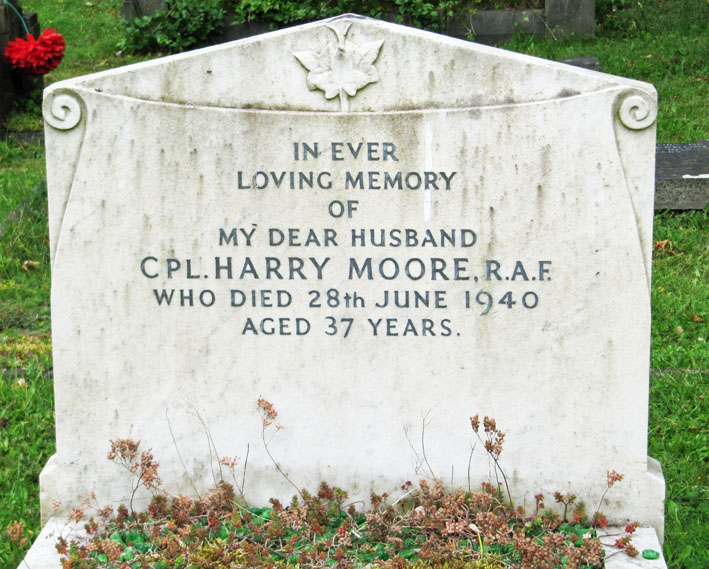 Harry’s headstone in Epsom Cemetery
Photograph courtesy of Roger Morgan © 2017
Harry was born on 15 February 1903, the ninth child of William George Moore (b. 1868) and Fanny (née Kingshott) (b. 1867). The parents had married in Haslemere on 18 March 1888. And that is where all ten of their children were born.
The 1911 Census records the family (all but the two oldest children then into their 20s) living at 6 Path Fields, Haslemere. 43 year old William George’s occupation is listed as “Rural Postman” and that of Jenny, also aged 43, as “Home Industry”. The four oldest children still at home (aged between 14 and 20); the next three (from 8 year old Harry to a 12 year old) were at school; and the last child was aged just 2.
After a short period of employment as a Butler (at Stoney Crest, Hindhead), Harry enlisted with RAF on 22 February 1922 for 8 years with the colours and a further 4 in reserve. He trained with the RAMC at Crookham Barracks, Aldershot to become a Hospital/Nursing Orderly at Halton Hospital. From 19 September 1924 to the end of January 1927 he was in Iraq at Hinaidi, rising to the rank of LAC (Leading Aircraftman). Having been posted to SHQ Upavon on 1 February 1927, he moved to Central Flying School, RAF Wittering, on 30 July 1927.
In Q3 1928, the 25 year old Harry married 26 year old Winifred Emily Taylor. The marriage was at Epsom, which is where Winifred had been born in Q4 1901. (She was the first child of Tom Taylor and Maude Jane (née Tutte) who had married in Epsom in Q2 1901. The 1911 Census recorded the Taylor family – now with three children – living at 6 Girault Cottages, Epsom Common. 33 year old Tom is listed as a “Bricklayer”. 9 year old “Winnie” and her two younger siblings were “at School”.)
After their Epsom wedding, Harry and Winifred lived in the village of Barnack, near Stamford, Lincs. When his period of full time service came to an end in 1930, Harry would have returned to civilian life, eventually taking up residence with Winifred’s widowed father, now at 57 Stamford Green Road, Epsom. That is where Winifred (a “Housewife”) was recorded in the September 1939 Register. Her entry is followed by one that is currently closed, perhaps a child of the marriage.
Harry was not at home as he had re-enlisted, with his original service number, at the beginning of WW2 to take up duties at No 1 Elementary Training School [formerly the de Havilland School of Flying] at Hatfield. It was presumably while travelling between Epsom and Hendon on 28 June 1940 that Harry died in a road traffic accident. The Probate record of the administration of his £ 155 estate being granted to the widowed Winifred specifies the location as being “at Watford Way near Selborne Gardens, Hendon, Middlesex”. (The Probate record also confirms his home address as 57 Stamford Green Road, Epsom.)
On 4 July 1940, Harry was buried in Grave U.31 of Epsom Cemetery – where the records note that he was “late of RAF Aerodrome, Hatfield, Herts.”
Brian Bouchard & Roger Morgan © 2018
Please contact us if you have information or pictures that can extend this entry.
MOORE Rachel Matilda
Civilian
Died 11 August 1944, aged 31
Not listed in the Book of Remembrance
Rachel Matilda Lyons was born on 14 January 1913, registered in the Holborn District of London. In Q3 1934, she married Henry Peter Moore. What appears to be their only child, Victor, was born Q1 1935. Like their marriage, this was registered in the Lambeth District.
Those registrations are consistent with the September 1939 Register recording them living at 83 Bentley House, Peckham Road, Camberwell. In that Register, 27 year old Henry is listed as a “Shop Assistant” and 26 year old Rachel as a “Laundry Calender Hand” (i.e. operating a machine for ironing large quantities of flat linen). The conventional “Unpaid Domestic Duties” is allocated to Rachel’s widowed 65 year old mother, Anne Lyons (née Baker) living with them – doubtless helping with 4 year old Victor who was presumably behind the currently closed record at the address.
On 28 June 1944, Rachel was injured at home by enemy action. She was taken to St Ebba’s Hospital – one of Epsom’s cluster of mental hospitals which, unlike Horton Hospital which had been taken over as a War Hospital, continued as such during WW2. It seems likely that space at St Ebba’s was being used as an annex for the hard-pressed Horton.
On 11 August 1944, some six weeks after her injury and aged 31, Rachel died at St. Ebba’s.
Roger Morgan © 2018
Please contact us if you have information or pictures that can extend this entry.
MORGAN Bernard William Frederick Carnal
Home Guard
Died 29 November 1940, aged 35
Not listed in the Book of Remembrance
Bernard was born on 25 June 1905, the first child of Bernard William Morgan and Florence Matilda (née Bull – they had married Q3 1904, registered in the St George Hanover Square District of London).
The 1911 Census records the parents, both now aged 29, living at 16 Redgrave Road, Putney, with 5 year old schoolboy Bernard and his recently arrived sister, 1 year old Nora. William is listed as a Book Keeper (Clerk) for a Picture Frame Maker. At some point, the family moved to 63 Riverview Road, Kingston Road, Ewell. This is where the parents were recorded in the September 1939 Register, together with now married daughter Nora E E Selby. Both women are listed with the conventional “Unpaid Domestic Duties”. William’s occupation is given as “Picture Frame & Cabinet Maker”.
In the meantime, Bernard had married Ada Rose Finch, registered in the Wandsworth District in Q3 1928. It does not appear that the couple had any children. The September 1939 Register records them, now both aged 34, living at 30 Orme Road, New Malden. Bernard’s occupation is listed as “Chief Erection Supervisor Electric Lifts” and Ada with the conventional “Unpaid Domestic Duties”.
The Commonwealth War Graves Commission’s records note that Bernard had joined the Home Guard, but his death was unconnected with those duties. On 29 November 1940 – a couple of months into the Luftwaffe’s September 1940 to May 1941 “Blitz” bombing campaign – both Bernard and Ada were killed by enemy action while at home in 30 Orme Road, New Malden.
Roger Morgan © 2018
Please contact us if you have information or pictures that can extend this entry.
MORGAN Emrys. Stoker 1st Class (P/KX 129884)
HM LST-422, Royal Navy
Died 26 January 1944, aged 33
All that the Commonwealth War Graves Commission notes about the family background for Emrys is that he was the “son of John and Catherine Morgan” and “husband of Mary Morgan, of Epsom, Surrey”.
From the second part of this, it is certain that Emrys and Mary are the married couple found in the September 1939 Register living at 391 Upper High Street, Epsom. This lists Emrys (born on 2 June 1911) as a “Heavy Worker” and Mary (born 26 June 1910) with the conventional “Unpaid Domestic Duties”.
From Emrys’s precise date of birth, his can only be the birth registered in the Pontypridd District of South Wales in Q2 1911 where the mother’s maiden name was Hopkins. The names are, however, too common in the readily available records to trace more of the family background with any confidence.
Also at 391 Upper High Street in the 1939 Register is what seems certain to be Emrys and Mary’s son, David. He had been born only the previous year (on 1 November 1938) and the registration of his birth in the local Surrey Mid Eastern District notes that his mother’s maiden name was Chick. This leads to a record of the couple having a second child, Barrie, whose Q3 1940 birth was also registered in the Surrey Mid Eastern District. Perhaps because of some transcription error, no record has yet been found of Mary’s marriage to Emrys – but having her maiden name and exact date of birth means that she must the Mary Ann Chick whose Q2 1910 birth was registered in the Bedwellty District of South Wales – and, given this less common name, also the Mary Ann Chick found in the 1911 Census at 34 Alfred Street, Ebbw Vale with her mid-20s parents Walter John Chick (a “Gardener”) and Mary (née Price).
It is not clear when Emrys joined the Royal Navy, but it is known that, in early 1944 he was serving on HMS LST-422 – a “Landing Ship Tank”. This was a United States Navy LST-1-class craft, built in Baltimore over the turn of 1942/43 and transferred to the Royal Navy, in which it was commissioned on 4 February 1944. As with many of the class, she was not named but referred to by her hull designation.
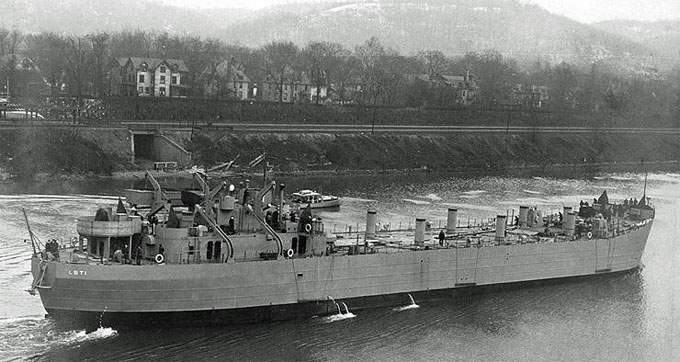 USS LST-1 (with which HMLST-422 was identical) soon after completion near Pittsburgh, USA
Official US Navy photo (NH 97857) – Public Domain
HMS LST-422 met her end in the early days of the Battle of Anzio (on the west coast of Italy, a little south of Rome) which began with amphibious landings on 22 January 1944. Following the Allies’ invasion of the Italian mainland from Sicily on 3 September 1943 (which had coincided with an armistice made with the Italians who then re-entered the war on the Allied side), they had made relatively speedy advance northwards until they came to the German’s well-prepared winter defensive position (known as the Gustav Line) across Italy just north of Naples.
The assault at Anzio aimed was to outflank the Germans and capture the key target of Rome. It is another story that, instead of the intended dash for and capture of the key target of Rome, the local Commander’s cautious tactics led to a hard-fought and campaign leading to the Allies’ costly victory some five months later.
Late on 25 January 1944, three days after the initial landings, LST-422 was one of a dozen such craft which left Naples with additional men and material for the Anzio campaign. In LST-422’s case, she was carrying: the C and D Companies, and the Headquarters of the US Army’s 83rd Chemical Battalion, Motorized and also members of the 68th Coast Guard Artillery Battalion; a capacity load of well-stocked trucks; as deck cargo, many 50 US gallon (190 litres) steel barrels of motor fuel; and ammunition for the craft’s own armaments.
On the way to Anzio, the weather deteriorated with gale force winds and 20-30 ft waves. Shortly after midnight and about 12 miles offshore LST-422 had set anchor. The anchor did not hold and, shortly after 05:00 hours, she was blown into a known mine field and an explosion ripped open a 50 ft hole in her bottom starboard side, between the main and auxiliary engine rooms. The ship’s fuel oil supply caught fire. The vehicles on the tank deck, which were fuelled and loaded with ammunition, began to explode, which in turn ignited the gasoline that had been stored on the top deck. Hundreds of men were killed instantly. The order was given to abandon ship, but only four life rafts were undamaged and many who jumped into the cold January sea perished before being rescued.
Emrys was one of the many lost in this disaster. He is one of the nearly 15,000 WW2 naval personnel commemorated on the Portsmouth Naval Memorial.
Roger Morgan © 2018
Please contact us if you have information or pictures that can extend this entry.
MORRILL Gordon Henry Edward. Lieutenant (224921)
East Surrey Regiment – attached to 4th Battalion, Lincolnshire Regiment
Died 10 July 1944, aged 22
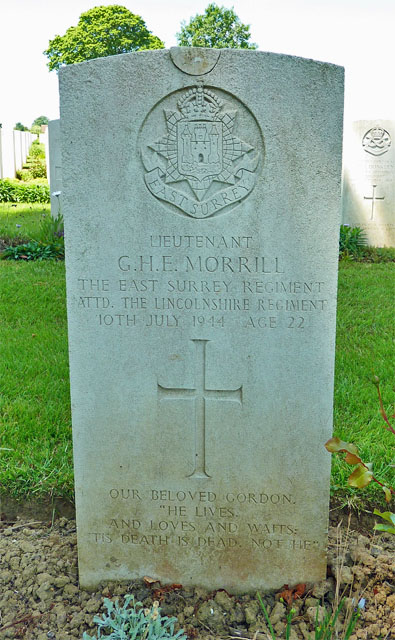 Gordon’s headstone in the St. Manvieu War Cemetery
Photograph (56562590) by “Woose” via findagrave.com
As illustrated below, the Borough’s Book of Remembrance lists a plain Gordon Morrill of “The Bedfordshire & Hertfordshire Regiment”. However, the intended casualty must be the above: he is the only Gordon Morrill in the Commonwealth War Graves Commission’s database and, as noted below, has clear links to the Borough.
 The entry for Gordon in the Borough’s Book of Remembrance
Image courtesy of Clive Gilbert © 2014
Gordon was born Q1 1922, the first child of Henry John Morrill and Hilda Kate (née Court) The couple’s Q4 1919 marriage was registered in the Fulham District but they set up home in Croydon, where Gordon’s birth was registered as was that of his brother, Alan, in Q2 1925.
The family then moved to the Borough: the September 1939 Register records them living at 21 Chestnut Avenue, Ewell. 51 year old Henry is listed as “Clerk, Supreme Court Judicators” and 43 year old Hilda with the conventional “Unpaid Domestic Duties”. There are two currently closed records at the address which are doubtless of their children: now 17 year old Gordon and 14 year old Alan.
Given his age, it seems likely that, after training, Gordon’s first taste of action was in the June 1944 Normandy landings. The initial landings were every bit as successful as the planners had hoped. However, overcoming the German strategic stronghold of Caen, ten miles inland, proved much harder than anticipated. Caen was finally taken by the Allies on 6 August (two months after D-Day).
However, Gordon did not get to see this. In the fierce fighting that helped lead to that outcome, Casualty List No. 1504 records that he was killed in action on 10 July.
Gordon is one of 1,627 WW2 casualties buried in the St. Manvieu War Cemetery, Cheux – about 6 miles east of Caen. His parents (which the Commonwealth War Graves Commission’s post-war records note were now “of Wootton Courtney, Somerset”) took the opportunity of adding a personal inscription to his headstone on Grave V.B.12:
“Our beloved Gordon. / ‘He lives, / and loves and waits: / ’tis death is dead, not he’.”
(This draws on Percy Bysshe Shelley’s Adonais: An Elegy on the Death of John Keats.)
Roger Morgan © 2018
Please contact us if you have information or pictures that can extend this entry.
MORRIS Charles Patrick. Pilot Officer (43108)
53 Squadron, Royal Air Force
Died 4 February 1941, aged 25
Charles born on 28 Dec 1915 in Saltash, Devon, the only child of Charles Sebastian Morris and Dorothy Frances (née Reay). The parents had married on 30 Jul 1914 in Southsea, Hampshire when both were aged 28.
Sadly, the marriage was only a short one. Charles senior was a Lieutenant Commander in the Royal Navy. He served on the armoured cruiser HMS Black Prince and, during the controversially-managed WW1 Battle of Jutland, was killed in action on 31 May 1916, to be commemorated on the Portsmouth Naval Memorial.
The Commonwealth War Graves Commission describes Charles junior as the “son of Charles Sebastian Morris and Dorothy Frances Morris, of Epsom, Surrey”. As just noted, his father had died in 1916 and, in Q4 1919, the widowed Dorothy had got married again to Henry Howard Long, registered in the Portsmouth District. (They had a child together, Marian K R Long, whose Q4 1920 birth was registered in the Kingston District.) As described at the end of this article, Dorothy (and Howard) – and, indeed, Charles junior – were eventually “of Epsom”.
Charles junior appears to have been educated at Allhallows School, Honiton. Following training as a Cadet in the Officer Training Corps, he became a 2nd Lieutenant in the East Lancashire Regiment on 2 January 1937. With effect from 11 April 1940, he transferred to the Royal Air Force with a temporary commission as Pilot Officer. He joined 53 Squadron, part of the RAF’s Coastal Command and equipped with the Bristol Blenheim light bomber.
On 4 February 1941, Charles was the pilot of Blenheim T2283 PZ-F 53 which, with others from 53 Squadron, took off from RAF Thorney Island (near Chichester) on a night bombing raid on the port facilities at Brest in northern France. Near Morlaix, the aircraft was shot down by a Messerschmitt 109 of JG 77 and crashed into sea off Brest, killing the three man crew who were:-
• Pilot Officer Charles Patrick MORRIS RAF (Pilot)
• Sergeant Gerard Willington F ASHWIN RAFVR (Observer)
• Sergeant Ian Ronald W CLARK RAFVR (Wireless Operator/Air Gunner).
(The Squadron also lost two other Blenheims on the raid.)
The bodies of Charles and his crewmates were never recovered. They are three of the 20,000+ commemorated on the RAF Memorial at Runnymede as members of the service who were lost during WW2 operations and who have no known grave.
The RAF’s Runnymede Memorial
Photograph with thanks to the Commonwealth War Graves Commission
The Probate record of administration of Charles’s £ 750 estate being awarded to the Public Trustee notes that his address had been 16 Denham Road, Epsom – a property that was vacant at the time of the September 1939 Register. It seems likely that this was also the home of his mother and stepfather. They subsequently moved to White Cottage in nearby Windmill Lane, Epsom which was noted in the Probate records as their address when Henry died on 4 April 1959 and Dorothy on 25 February 1972.
Brian Bouchard & Roger Morgan © 2018
Please contact us if you have information or pictures that can extend this entry.
MORRIS Ellis. Captain (136103)
Royal Army Ordnance Corps.
Died 31 May 1944, aged 53
Ellis was born on 29 November 1890, the second and apparently last child of Thomas Alexander and Agnes Wylie Morris. The 1911 Census records the family of four living at 90 Hermon Hill, South Woodford, in the Wanstead district of Essex. 52 year old Thomas is listed as an “Auctioneer, Estate Agent and Surveyor” – as is his older son 24 year old Alexander. 20 year old Ellis is listed as an “Articled Surveyor’s Clerk”. 45 year old Agnes was supported by two live-in domestic servants.
Ellis saw service during WW1 – a record is found of him in 1914, aged 23, as a territorial attestation to the Honourable Artillery Company at Armoury House, Finsbury. The record notes that his “Residence Place” was Grove Hall, Woodford Essex and that he was given the Regimental number 477.
Having survived the War, the next readily available record is of the now 30 year old Ellis’s Q2 1921 marriage to 28 year old May Bell. (May was the sister of Frederick Bell who, in December 1939, was captain of HMS Exeter in the “Battle of the River Plate” – see our separate article.) The marriage was registered in the Epsom District, which is where May had been recorded in the 1911 Census, staying with her uncle and aunt, Henry John and Minnie Caroline Bell, at Linden House, College Road, Epsom (converted to a Care Home some years ago now). Henry was a Goldsmith and clearly well-to-do – the three residents were supported by four live-in domestic servants.
No record has been found of Ellis and May having any children. The September 1939 Register records them living at “Field House”, 18 Burgh Heath Road, Epsom. The 48 year old Ellis is listed as “Auctioneer & Surveyor – now whole time fireman” (with the original record being annotated to show that this was with the Borough’s Auxiliary Fire Service). 46 year old May is listed with the conventional “Unpaid Domestic Duties” (with the original record being annotated to show she had taken on ARP duties and was also a voluntary canteen worker). Living with them was May’s now-widowed and “semi-invalid” 73 year old aunt Minnie. The three of them were supported by a live-in domestic servant.
The readily available records tell us neither when Ellis later joined Royal Army Ordnance Corps nor the nature of his service – other than that the Duty Location was “Home”. As to the cause of his death on 31 May 1944, which was registered in the Eton District, Casualty List No. 1462 records that he “died”, implying illness or disease rather than enemy action.
Ellis’s body was brought home for cremation at the South London Crematorium, Mitcham and he is commemorated on the Forces’ memorial there.
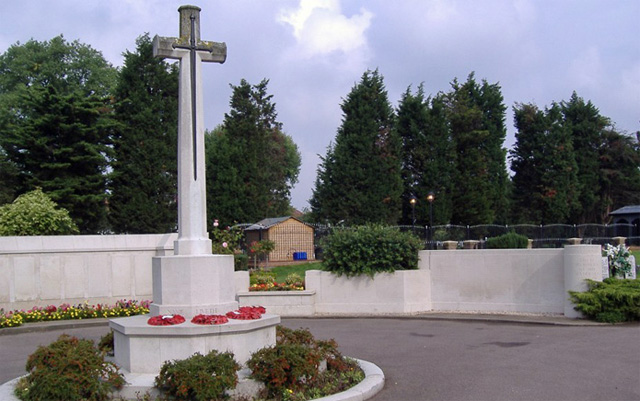
The WW2 memorial at South London Crematorium.
Photograph with thanks to the Commonwealth War Graves Commission
Roger Morgan © 2019
Please contact us if you have information or pictures that can extend this entry.
MORRIS Jane
Civilian
Died 28 November 1940, aged 70
Not listed in the Book of Remembrance
The Commonwealth War Graves Commission notes that Jane was “of 24 Albert Road, Croydon” and “Widow of H Morris”. She was not, however, living there at the time of the September 1939 Register – nor is there any record of her estate in the Probate records. Without the information her entries there might have yielded, the names are far too common in the readily available records to be able to trace the family background.
Jane died on 28 November 1940 at Horton Emergency Hospital – one of Epsom’s “cluster” of mental hospitals that, as in WW1, had been taken over for dealing with wartime casualties. While the Commonwealth War Graves Commission records specify that date, they do not give the usual information about when or where Jane was injured by enemy action.
Jane was buried in Epsom Cemetery (Grave M.358) on 6 December 1940.
Roger Morgan © 2018
Please contact us if you have information or pictures that can extend this entry.
MORRISH Francis Leo
Civilian
Died 29 September 1940, aged 34
&
MORRISH, Joan
Civilian
Died 29 September 1940, aged 27
Francis was born in Wandsworth on 6 October 1905, the second child of Frank and Annie Morrish. The 1911 Census records the family living at 4 Christ Church Villas, Union Grove, Wandsworth. 37 year old Frank is listed as a “Checker” on the London & Southwest Railway. As usual at the time, no occupation is listed for 43 year old housewife Annie. The couple now had three children: Harold, born 1904; Francis, born 1905; and Ellalline, born 1909. By the time of the September 1939 Register, Frank (now retired) and Annie had moved to 39 Knollmead, Tolworth. Their now 20 year old daughter, Ellaline, was living with them and working as a “Shorthand Typist (Solicitors)”.
In Q3 1937, the now 32 year old Francis married 24 year old Joan Hughes. This was registered in the Yorkshire’s Wakefield district, where Joan had been born 2 June 1913, probably the fourth child of William Henry and Sarah Harriett Hughes. The 1911 Census had recorded 30 year old William (a “Postal Telegraph Clerk, GPO”) and 32 year old Harriett living at 18 Haigh Villas, Park Lane, Wakefield with three children aged from 0 to 3. The family were supported by a 16 year old live-in domestic servant.
During WW1, Joan’s father, William, served as Company Sergeant Major 27610 in the Postal Section of the Royal Engineers. He was among the 33 who died on 21 February 1917 when the SS Princess Alberta – “Fleet Messenger No 58” – sank in the Aegean after hitting an enemy mine. He is commemorated on the Mikra Memorial in Thessaloniki, Greece.
The 1921 Census records the widowed Sarah at 41, Park Lodge Lane, Wakefield together with her widowed father and 8 year old schoolgirl daughter, Joan. As for the now nearly 16 year old Francis, the 1921 Census records him living with his parents at 4 Church Villas, Wandsworth and (having followed in his father’s footsteps), working as a Railway Clerk in Battersea.
It is not clear how Francis and Joan met, but the newly-married couple set up home in 29 Mortimer Crescent, Ewell. The September 1939 Register recorded them there, living alone – there is no record of their having any children. Francis is listed as a “Railway Clerk” and Joan with the conventional “Unpaid Domestic Duties”.
On 29 September 1940, in the early days of the Luftwaffe’s Blitz bombing campaign, Francis and Joan were both killed while at home in 29 Mortimer Crescent. They are buried in Cuddington Cemetery (also known as the Sutton and Cheam Cemetery) in Worcester Park.
The Probate records note that administration of both estates was granted to Joan’s long-widowed mother, (Sarah) Harriett, of – according to the Commonwealth War Graves Commission’s post-war records – 3 Marsland Avenue, Berners Street, Wakefield, Yorkshire.
Roger Morgan © 2018 & 2024
Please contact us if you have information or pictures that can extend this entry.
MURPHY, William. Corporal (5628181)
2nd Battlion, Dorsetshire Regiment
Died 4 May 1944, aged 28
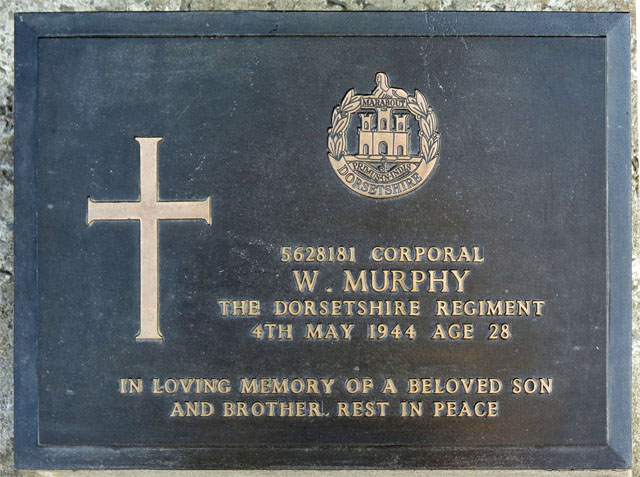 William’s grave marker in the Kohima War Cemetery in NE India
Photograph (18859290) by Iain MacFarlaine via findagrave.com
William was born on 2 June 1915, apparently the first child of Michael Murphy and Bessie Emily Yendell (in some records, “Yendall”). His birth was registered in the Epsom District, as was that of his sister Florence in Q1 1918. The parents did not marry until Q4 1930, registered in the St Pancras District – shortly before Michael’s death aged 71 in January 1931. He is buried in Epsom Cemetery, where the records note that he had been a labourer and had died in “Middle House, Dorking Road, Epsom” (being Epsom Hospital, still using the name inherited form its origins as the Workhouse Infirmary).
The September 1939 Register records the widowed Bessie and her son William living at 1 Mayfield Terrace, Rosebery Road, Langley Vale, Epsom. 50 year old Bessie’s occupation is listed as “Home Duties, Charwoman” and 24 year old William’s as “Builders’ Labourer, Heavy Worker”.
William’s WW2 service was in the 2nd Battalion of the Dorsetshire Regiment. It is not clear from the readily available records whether he joined them in time to be sent to France in 1940 with the British Expeditionary Force. If he did, then he would have been part of the gallant holding of the La Bassée Canal against several attacks by a greatly superior German force. This enabled many others to reach Dunkirk for evacuation, where a much depleted Battalion later joined them.
The rebuilt Battalion was then stationed on the Yorkshire coast in case of the threatened German invasion. As that receded, it was sent to India for training in jungle warfare. In March 1944, Japanese forces invaded Assam over the border from Burma (present-day Myanmar) which they had seized earlier in the War. They advanced about 100 miles into India before Commonwealth forces were able to halt them. The 2nd Dorsets were despatched from India to relieve the beleaguered garrison at Kohima.
In some of the fiercest fighting of the whole War (matched only by the parallel battle at nearby Imphal), the Dorsets fought their ruthless enemy in the incongruous setting of the grounds of what had been the District Commissioner’s bungalow in a peacetime hill station. The centre of the Japanese defence was around the tennis court where, for eighteen days from 26 April 1944, the Dorsets fought a battle of attrition. In the steeply terraced gardens, their positions were within 25 yards of the Japanese. It was in the thick of this fighting that, as noted in Casualty List No. 1465, William was killed in action. Commonwealth forces finally prevailed at Kohima on 22 June and at Imphal on 3 July 1944 – two victories that were key turning points in the Far East WW2. (Because so much of the attention at home was on the post D-Day advances, these crucial and other actions in NE India and adjoining Burma/Myanmar are sometimes called “the forgotten war.”)
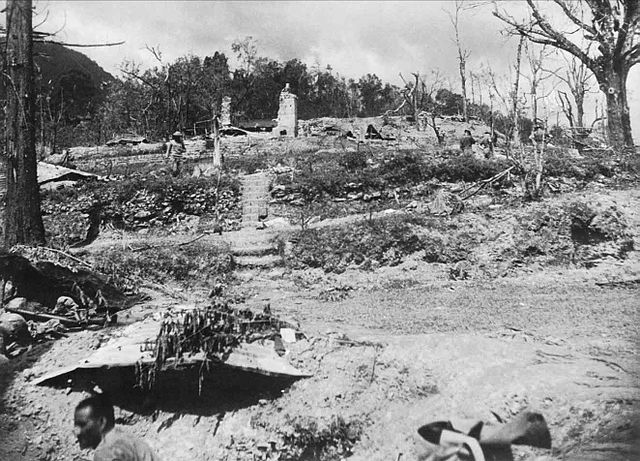 The mined tennis court and terraces of the District Commissioner’s bungalow in Kohima
Post-battle photograph from the Imperial War Museum Collections © IWM (IND 3483)
Initially buried locally, William was later re-interred in collective Grave 7.D.5-13 of the Kohima War Cemetery which holds 1,275 Commonwealth WW2 casualties. His mother and sister took the opportunity of adding a personal inscription to his grave marker,
“In loving memory of a beloved son and brother. Rest in Peace.”
Roger Morgan © 2018
Please contact us if you have information or pictures that can extend this entry.
MYERS Anthony Wallis. Corporal (T/89871)
Royal Army Service Corps
Died between 16 May and 12 August 1940, aged 28.
Anthony was born in Epsom Q2 1912, the fourth of seven children born to Arthur Wallis Myers and Lilian Agnes (née Gentry). The couple had married in Brixton on 14 June 1900. The 1901 Census records these 22 year olds living in Albert Mansions, 31 Albert Bridge Road, Battersea, supported by a live-in domestic maid. Arthur’s occupation is listed as “Journalist”. He was also a top-rank tennis player. He became the highly-regarded tennis correspondent of the Daily Telegraph and, among other sporting achievements, captained British tennis teams on tour in Europe, South Africa and India. (More information in Wikipedia.)
William’s journalistic and tennis career meant that he travelled widely, but the growing family settled in Epsom, at “Berrow” in Downs Avenue. William died there on 16 June 1939. The September 1939 Register records the newly-widowed Lilian living there with two of her unmarried daughters: 31 year old Thora, a “Journalist”; and the last of her seven children, 21 year Prudence, an “Art Student”. They were supported by a live-in domestic servant/cook. Also logged there were three apparently unrelated individuals.
The readily available records provide disappointingly little information about Anthony’s WW2 service in the Royal Army Service Corps. However, it is clear that he was sent to France as part of the British Expeditionary Force. As is well-known, this was unable to resist the German invasion which, while expected, was of unanticipated speed and ferocity. In the fighting retreat to Dunkirk, Anthony was wounded and listed as missing. He was rather later found to have died – hence the 16 May to 12 August 1940 window for his death.
Anthony is one of the 793 Commonwealth WW2 casualties buried in the Dunkirk Town Cemetery. (The Cemetery is also contains the Dunkirk Memorial which commemorates 4,512 members of the British Expeditionary Force who have no known grave.) The family took the option of adding a personal inscription to his headstone on joint grave 2.1.8,
“Remembering you, we will be brave and strong.”
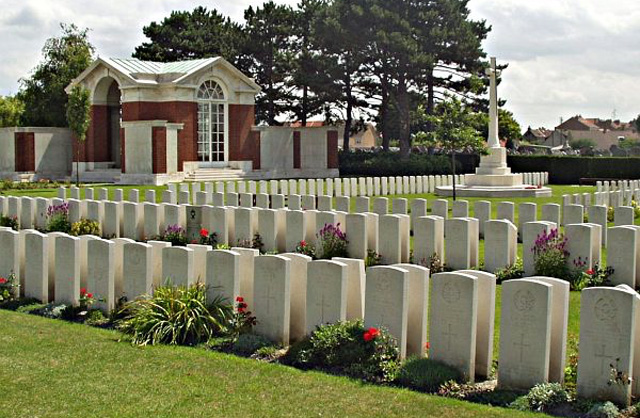 The Dunkirk Town Cemetery
Photograph with thanks to the Commonwealth War Graves Commission
Roger Morgan © 2018
Please contact us if you have information or pictures that can extend this entry.
Please Note: We believe that the information on this page is accurate however users should satisfy themselves that the information is correct before incurring any expense or undertaking any journeys. This is particularly important when purchasing certificates from other bodies, for example the General Register Office. You might like to use the following links to Freebmd and Find My Past (Links open in a new window).