
Local Newspaper Cutting 1 Dec 1944
BROTHER AND SISTER
—
Adopted by Epsom Firemen
—
Tomorrow evening Epsom N.F.S. are holding a dance at the Fire Station to raise money for the children’s Christmas party.
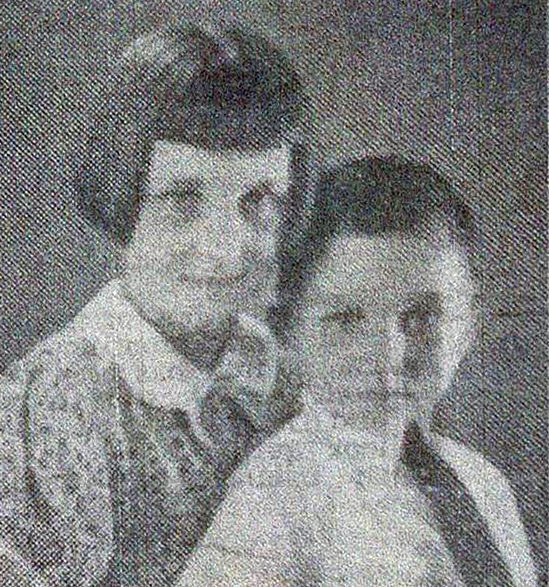
Among the little guests who look forward to this party annually are the orphans adopted by the Epsom firemen – Brian and Sylvia Aylott – whose photograph we publish herewith. They were adopted under the N.F.S. Orphan Adoption Scheme, by Epsom Fire Station after the 1940-41 blitz , when their father*, a New Malden fireman, was killed by enemy action. At the time they were 8 and 11 years of age respectively. To ensure the 4s per week each necessary under the scheme, Epsom N.F.S. had to raise £86 10s., which they did by means of dances, concerts, whist drives, a garden party, and a football match against Epsom Town, the latter presenting the firemen with the gate money. By September 1943 over £100 had been raised, with which the necessary annuity insurance policies were purchased to assist with the children’s keep until 14 years of age.
That was all the firemen were obliged to do under the Orphan Adoption Scheme, but they have not been content to stop there. Birthday and Christmas presents have been sent each year, and various members of the Force have had the children to stay with their own families, or taken them away for holidays, as opportunity offered. For their last birthday each child received 50s to spend.
The sum of 4s a week per child seems very small when seen in print, but in practice it means that firemen throughout the country have to raise £6000 by spare-time efforts. And this of course, is only one of many activities undertaken by the N.F.S. Benevolent Fund which in the past six months has paid out over £28,000 in grants of one sort or another. It is hoped in future to extend the Orphan Adoption Scheme to all children of firemen who lose their fathers, instead of confining it, as at present to those fathers who die on active service or otherwise by enemy action.
Leading Fireman H C Sutton is the Epsom Representative of the fund.
With thanks to David Brookes for suggesting this item.
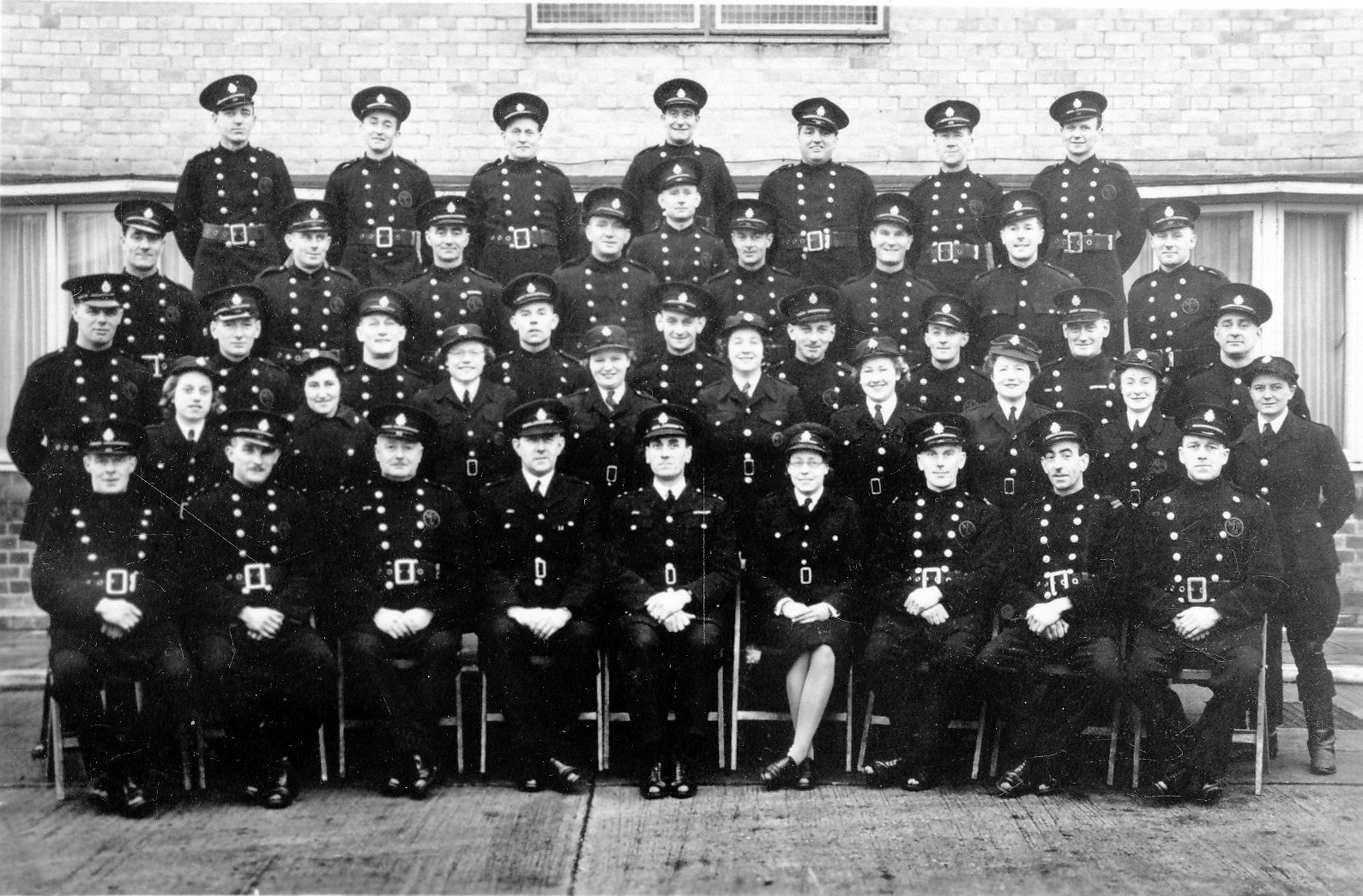
N.F.S. Personnel at station 38E5Z Epsom Feb 1944
Photo by T H Everitt & Son
Image courtesy of Bourne Hall Museum
* Webmasters Note:
Charles Aylott was born in New Malden on 16 September 1901, the son of George and Fanny Aylott née Shepherd who had married in Ware, Hertfordshire in 1887. The 1911 census records Charles living at 69 Kingston Road, New Malden, with his parents and seven siblings. Charles’ brothers Edward and William Thomas both lost their lives in the Great War.
On 20 July 1927 Charles, aged 25, married Marjorie Bensley, aged 20. in Christ Church, New Malden. He was then a fireman and she a domestic servant who was born 10 May 1907.
Charles and Marjorie had two children – Sylvia born 27 February 1932 and Brian born on 27 January 1935. The September 1939 Register records the family living at 19 Cambridge Road, New Malden, with Charles listed as ‘Station Officer, Fire Brigade’ and Marjorie with the conventional ‘Unpaid Domestic Duties’. In the later part of the war Sylvia and Brian were evacuated to Rhonda.
That remained the home address when Charles died at 26 Wolverton Avenue, Kingston, the address of Kingston District Hospital, on 1 November 1942. He was then buried in Kingston Cemetery plot C 5740. On 1 March 1943, administration of his estate (valued at £1,988 5s 3d) was granted to the widowed Marjorie and George Henry Aylott, nurseryman.
With thanks to Clive Gilbert and Graeme Hodge
And Marie Aylott for providing additional information.
Background on the Fire Service National Benevolent Fund
In 1940 the London Fire Service Benevolent Fund is set up to support the bereaved families of firefighters who had died during the Blitz. In 1943 the fund’s remit was extended to cover the whole country and became the Fire Service National Benevolent Fund (FSNBF). By 1945 almost 1,400 fire service orphans were supported by grants and allowances from the fund.
Today the fund is called The Fire Fighters Charity who welcome donations from the public.
Background on the National Fire Service
The National Fire Service (NFS) was a single fire service created in Great Britain in 1941 during the Second World War. It was formed by the amalgamation of the wartime national Auxiliary Fire Service (AFS) and the local authority fire brigades (about 1,600 of them). The NFS existed until 1948, when it was again split by the Fire Services Act 1947, with fire services reverting to local authority control.
The NFS was created in response to the threat of German air raids. The AFS had been formed in 1938 to supplement the regular fire brigades, but it was quickly overwhelmed by the scale of the bombing. The NFS was designed to provide a more unified and effective fire service, with a single command structure and a standardized fleet of equipment.
The NFS was a huge organization, with over 370,000 personnel, including 80,000 women. The women were mostly employed on administrative duties, but they also played a vital role in firefighting, especially in the early days of the war when there were not enough men available.
The NFS firefighters faced many challenges during the war. They had to deal with the constant threat of air raids, which often caused large fires that could spread quickly. They also had to contend with the lack of resources, as the war effort took priority over civilian needs.
Despite the challenges, the NFS firefighters did an outstanding job. They extinguished countless fires, saved countless lives, and helped to protect Britain’s cities from the worst effects of the bombing.
The NFS was disbanded in 1948, but its legacy lives on. The fire services that exist today in Great Britain are all descended from the NFS, and they continue to uphold the high standards of professionalism and dedication that were set by the NFS firefighters during the Second World War.
Here are some of the key achievements of the NFS during the Second World War:
- Extinguished over 1 million fires
- Saved over 100,000 lives
- Protected millions of pounds worth of property
- Developed new firefighting techniques and equipment
- Set the standard for fire service training and organization
The NFS firefighters were an essential part of the British war effort, and their courage and dedication helped to save the country from the worst effects of the bombing. They are a testament to the strength and resilience of the British people, and their legacy will never be forgotten.
Text produced by Google’s AI program Bard.