
SIR ALLEN LANE CH (1902-70)
(Formerly Allen Lane Williams)
Book publisher

Sir Allen Lane
Image courtesy N.P.G. Creative Commons
Introduction
Sir Allen’s paternal aunt, Mrs Lil(l)ian Eliza Smith (née Williams), lived for many years in The Avenue, Worcester Park, at Number 35, a house known as Eastwood; as a young man, Allen lodged with the family and, subsequently, he visited frequently.
Background and early life
The male line of the family had Welsh roots/connections and also strong links with Bristol, where Allen was born on 29 September 1902. His father was Samuel Allen Gardiner Williams (later Lane, 1863-1950) but the publishing connection came somehow via his mother, Camilla Matilda Lane (1872-1958). Samuel and Camilla were married in 1901. The Lanes were an extensive Devon family and one of them was John Lane, who moved to London quite early in life and became a publisher. I am mystified as to precisely how John was related to Camilla, despite several protracted crawls up, down and around the family tree, but there was a legion of farming Devonian Lanes, all of whom seem to have been related in some way or another, and it’s nigh on impossible to sort them out. John is said to be an uncle of Camilla’s children, although I don’t think it’s that straightforward, but let’s move on. Our Williams family became Lanes to perpetuate that name in publishing and everything that followed with Allen and his brothers flowed from John Lane.
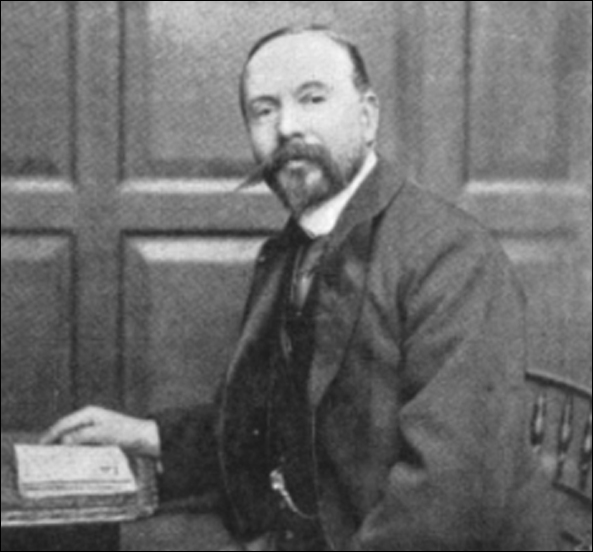 John Lane (1854-1925)
Image source: Wikimedia Commons
Allen had two younger brothers and a sister and all three boys became involved in the publishing business. Their sister, Nora, the youngest of all, eventually emigrated to Australia and died in Sydney at the grand age of 91, having been widowed some 30 years previously.
Here’s something we’re sure about! Mrs Lilian Eliza Smith was the sister of Allen’s father, Samuel etc Williams/Lane, and married Edward William Smith in 1908. Lilian allegedly died in 1950, but I cannot find a death record for her. Nor can I find the exit of Mr Smith but both of them were definitely alive at The Avenue address in 1939. There are comprehensive family trees on Ancestry but most, if not all, of them were copied from someone else, so that mistakes and omissions have been perpetuated – there is no documentary proof offered concerning the death of Mrs Smith, several of them have Edward born in Wales in about 1883 (he wasn’t from Wales) and all three Smith daughters were born in Raynes Park, not Wales.
We pick up Allen in the 1911 census, when he was eight years old and at home in Bristol with his parents and younger brothers. Samuel was an architect and surveyor for Bristol Corporation. Allen’s brothers were Richard Grenville Williams (possibly named after the 16th century mariner Sir Richard Grenville – Samuel’s father, also Samuel, had been a master mariner), born 1905 Bristol, and John Lane Williams, born 1908 Bristol.
Allen was educated at Bristol Grammar School and in 1919, with a view to continuing John Lane’s publishing legacy, his whole family added Lane to the surname.
John Lane
John was a co-founder of The Bodley Head publishing house in 1887, along with Elkin Mathews. The duo originally traded in antiquarian books. Whilst they did publish important literary works (probably not the kind of books which would be attractive to mainstream readers now – e.g. a biography of Immanuel Kant, the 18th century philosopher), they also produced the sometimes rather risqué ‘Yellow Book’ (see the section entitled ‘Fame and Notoriety’ in our article on Aubrey Beardsley ). Lane eventually sacked Beardsley as the art editor of ‘Yellow Book’. Aside from its occasional notoriety, ‘Yellow Book’ did contain some excellent literary work, but it ceased publication in 1897, by which time Mathews had left the firm. Lane also published, in 1911, ‘The New Machiavelli’ by H G Wells, which already has a mention on this website in the Wells article . By then Wells was on the downward slope as an author and this book in particular was controversial because it drew on his affairs with various women (other publishers, less brave than Lane, had turned it down fearing libel actions) and mixed up all that with Wells’ views on society, politics etc. You can read it, free of charge, on the internet, should you feel so inclined.
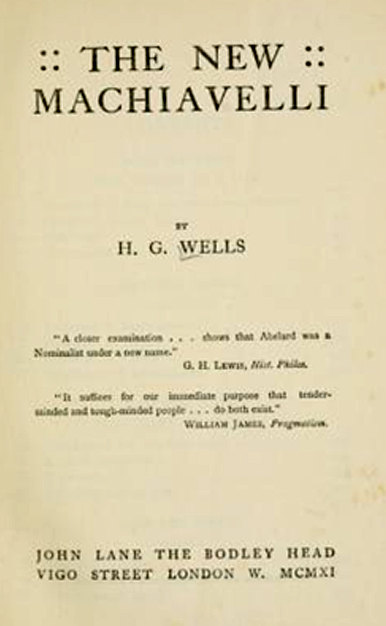
Frontispiece of ‘The New Machiavelli’, published by John Lane/The Bodley Head
Image source: Wikimedia Commons
The Bodley Head ultimately had financial problems and Allen Lane inherited it following John Lane’s death in 1925.
The Smiths
Inevitably we’ve got ahead of ourselves with John Lane and The Bodley Head, but that was necessary in order to paint a picture of the scenario that Allen was in as a young adult. We can now return to the Smith family and The Avenue.
By the time of the 1921 census our Williams family were Lanes and Allen’s father, Samuel, was calling himself Allen. Most of the family were at home in Bristol, with Allen Williams Lane (Samuel) as head of household, but young Allen was with the Smiths, described as a publisher’s clerk, the publisher being John Lane. As mentioned earlier, Mrs Lilian Eliza Smith was a sister of Samuel.
Online trees notwithstanding, Edward William Smith was born in Paddington on 7 December 1883 and baptised on 14 June 1884 at All Souls, Harlesden, his parents being Edward, a master mariner, and Julia Kate Smith (née Pierce), who were married in 1878. The Smiths had an older child (Dora Kate) in about 1882 and a third, Arthur, was born in 1885, which probably caused her death that year at the age of 31. In 1891 all three children were in Glasgow, living with an Elizabeth Wilson, aged 75, and her daughter. I have no idea who the Wilsons were in relation to the Smiths, if anything, but it could be that the widowed Edward Smith Senior had lodged them there while he was at sea. Attempted investigation of Julia Kate Smith‘s family pitched me into another abysmal family tree, so I won’t pursue it. In 1901 all three ‘children’ were boarding together in Highbury. Despite their tender years, they were all working, Edward being clerk to an optician. When Edward and Lilian Smith were married in 1908, he was a London-based commercial traveller. By 1911 he had become a ‘Technical Director, Drawing Office, Stationery Manufactory’ and the couple lived in Merton Park.
In 1921 the Smiths were ensconced at 35 The Avenue. Mr Smith was ‘Director, … Harding Ltd, Alliance Works, London’ and ‘Managing Director, Precision Instrument Co Ltd, Forest Hill’, there were three daughters (all born in Raynes Park and the youngest two were twins) and Allen Williams Lane, nephew, aged 18 years and 9 months, who was a publisher’s clerk for John Lane, Bodley Head Ltd, Vigo Street, Regent Street.
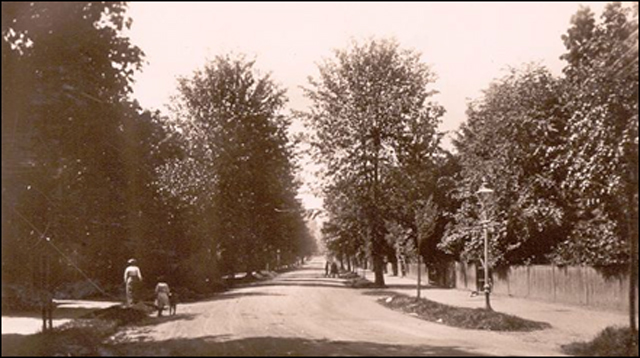 The Avenue (date unknown)
Image courtesy of Bourne Hall Museum
Fortunately, we have the input of David Rymill (a local historian for the Worcester Park area) to shed light on what was happening at Number 35 and I shall quote from him here. This would have been written before the 1939 Register and 1921 census were available online, so, where necessary, I have added explanatory notes at the end. Words in square brackets are elucidation for the reader and it’s assumed that Allen was working in between the diary dates.
At Number 35 [The Avenue] is Eastwood House. For most of the 1920s* Eastwood was the home of Edward and Lilian Smith. In 1922-23** the young Allen Lane, beginning his publishing career in the firm of a distant relative, The Bodley Head, lodged at Eastwood with his uncle and aunt. His diaries give an impression of the life of a young man exploring the scientific inventions of his day:
Mon 30 Jan 1922: “Started my career ‘on the roads’ going rounds with Mr Dent, taking for subscription [offering to booksellers] ‘The Looking Glass’ and ‘History of Art’’.”
Mon 15 May 1922: “I watered the lawn at Eastwood for a couple of hours in the evening.”
Sun 27 Aug 1922: “I spent the whole day in the garden at Eastwood, playing tennis, reading and writing.”
Sun 7 Jan 1923: “Got up after breakfast and took Louie [probably the Smiths’ eldest daughter, Louisa, then aged 11] to church at Cuddington in the morning. In the afternoon I fixed up a wireless aerial in the garden and from then till bedtime Kelvin [no idea who this is] and I taught the rest to dance.”
Tues 9 Jan 1923: “The ‘phone was installed at Eastwood.”
Wed 17 Jan 1923: “… listened in to Dame [Nellie] Melba in La Boheme at Covent Garden from my room at Eastwood. I had a fire in the room and wrote to Dick [his brother, Richard Grenville] at the same time. It [what?] was a great success.”
*The Smiths were there from at least 1921 to 1939.
**Allen was with the Smiths in 1921 and, quite probably, did a stint in the Bodley Head office before being taken out ‘on the roads’.
In passing, I should imagine that Allen’s enthusiasm for the wireless had some connection to Mr Smith’s involvement with precision instruments, but who knows. David Rymill says that in February 1923 Allen moved to live with ‘Uncle’ John Lane, but continued to be a regular visitor at Eastwood. Apparently, even David couldn’t find the precise relationship between Allen and John, but at least we are certain that Allen was Mrs Smith’s nephew.
I shall abandon the Smiths in 1939, as they cannot reliably be found thereafter, dead or alive, and we will follow Allen instead.
Allen
Allen became Managing Director of The Bodley Head when John Lane died in 1925: the firm’s activities after that point are very unclear but he did bring his brothers, Richard Grenville and John, into the business. It seems that there was a huge row between Allen and the Board in about 1935 concerning whether or not the firm should publish ‘Ulysses’ by James Joyce; this work had previously been branded as obscene, but is now recognised as a classic of modernist literature. However, back then, publication of the book was risky. Bodley Head did publish an edition in 1936 (I’ve just seen a beaten-up, second-hand hardback copy on the internet costing £1343.16 plus £55.96 delivery from Oregon, or you can get a brand-new Penguin paperback edition for around £9 if you’re desperate to read it).
This brings us round to Penguin paperbacks, the source of Allen’s fame. The paperback as a concept had been around since the 19th century, and there was a revolution of sorts when several firms produced cheap paperback editions of existing titles, which were typically sold at railway stations as something to read on the journey, W H Smith being a leading purveyor. W H Smith has long since moved away from its original business, which was the sale of books and newspapers, but older readers may well remember when the principal reason for going into one of their shops – whether on the High Street or at a station – was to buy a book or just browse.
Few of us were around at the time but if we had been we might have been rather taken with Penguin paperbacks when they first arrived on the scene in 1935 – courtesy of Allen Lane and his brothers. Legend has it – possibly apocryphally – that Allen had been to stay with Agatha Christie, already a best-selling author, for a weekend (if true, this was probably at her beloved childhood home in Torquay, a house called Ashfield, which she still owned up to 1940) and was hanging around at Exeter Railway Station looking for something to read on the journey home. This claim has been rubbished by some because Allen ‘wasn’t much of a reader’, but presumably he might have noticed what was on offer at the bookstall and formed the germ of an idea – he was a publisher after all. This led, so the story goes, to his idea of producing good-quality paperbacks at affordable prices, featuring ‘proper books’ (i.e. intelligent material, not pulp fiction). The first ten titles from Penguin – still then owned by The Bodley Head – were all ‘re-makes’ of existing hardbacks, featuring Agatha Christie, Dorothy L Sayers, Ernest Hemingway, Compton Mackenzie and others. However, they also needed to be instantly recognisable. Another legend has it that his secretary came up with the Penguin idea, but whether that’s true or not, the books appeared with a simple penguin logo on the cover. The trick was to make a profit on them (17,000 copies apparently being the break-even figure). He needn’t have worried – a week after the launch 150,000 copies had been shifted and they were sold out. At the time they cost just 6d in old money – 2.5 new pence. In one way they were too successful all at once. Woolworths instantly placed a massive order and the race was soon on to produce and distribute the goods. Staff were quickly hired and a makeshift packing/warehousing operation was set up in the crypt of Holy Trinity Church, Marylebone.
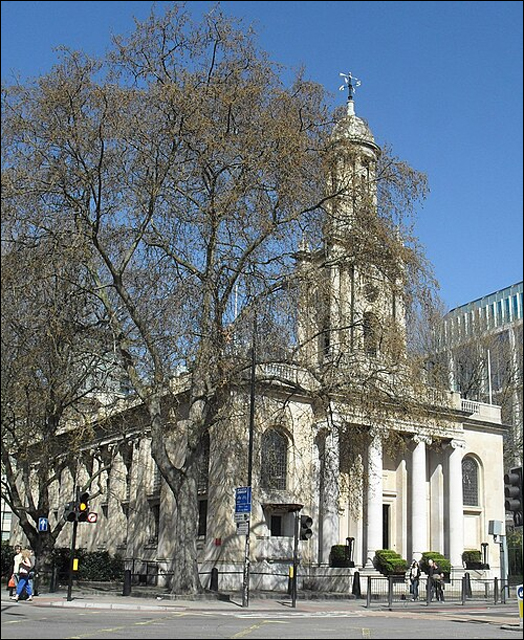 The former Holy Trinity Church, Marylebone
Image source: Wikimedia Commons
.jpg)
One innovation was the Penguincubator, which appeared outside Collet’s bookshop in the Charing Cross Road. You put your 6d in the slot and out came your book. Apparently, it didn’t always work too well as, it is said, a hefty thump on the machine might produce a cascade of books or none at all (much like present-day beverage and chocolate machines, so innovation hasn’t moved on that much in nearly a hundred years). The thinking behind the machine was that in those days people could feel somewhat intimidated by entering a proper bookshop, but the Penguincubator was, if you like, classless.
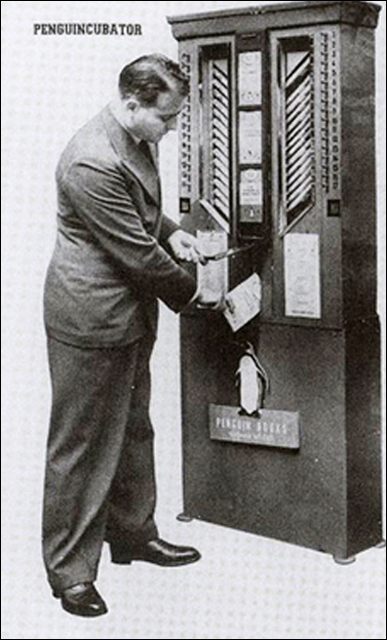
Allen Lane with his Penguincubator
Image source: ‘The Bookseller’ July 1937
A modern version of the Penguincubator has fairly recently been installed at Exeter St David’s railway station. Hopefully it works better than the original.
I remember from my distant youth that there were three(?) types of Penguin. The orange covers were ‘literature’ (more or less), green ones were crime fiction – I had a lot of those – and I seem to recall that there were blue ones, which were non-fiction/educational, but the latter may not have been Penguins. I once had to plough through a blue one to clue myself up on a work-related matter and never read one again.
We need to talk about Allen’s brothers, Richard and John, who were with him in the business. It is thought by many that Richard in particular didn’t get the recognition he deserved. An article in ‘The Guardian’ of 27 October 2015 by Stuart Kells, following publication of his book ‘Penguin and the Lane Brothers: The Untold Story of a Publishing Revolution’, suggested, in a nutshell, that Richard and John had been airbrushed out of the Penguin story by Allen.
John, the youngest brother, saw the success of the enterprise but sadly lost his life during WW2, aged just 34. Up until then he had travelled extensively for the firm, as had Richard. In 1942 John was a Lieutenant RNVR on HMS Avenger (D14), an escort aircraft carrier, which was torpedoed by a U-boat on 15 November 1942 and sank almost immediately off the coast of Portugal – the ship was on its way home from Gibraltar. An excellent description of events can be read here . Only 12 crew members survived out of a complement of 526 officers and men. John is commemorated on the Chatham Naval Memorial.
The Imperial War Museum has a picture of HMS Avenger taken on 27 June 1942.
Richard was also a Lieutenant in the RNVR and the two brothers had survived the demise of HMS Springbank, a fighter catapult ship, which was torpedoed by a U-boat in September 1941 and subsequently scuttled by the British.
Richard emigrated to Australia after the War, having spent time there in his youth as a ‘Barwell Boy’ (these were youths who went to South Australia in the 1920s to work on farms and it’s a fascinating story in its own right, but unfortunately outside the scope of this article – just put ’Barwell Boys’ in your search engine to find out more).
However, he was still very much involved in publishing and died at home in Templestowe, Melbourne on 23 June 1982.Allen’s life is very well-documented on the internet, as is the history of Penguin Books and many associated topics, so there is no point in detailing everything here, except to say that in 1941 he married Lettice (or Letitia) Lucy Orr, daughter of Sir Charles William James Orr and their eldest daughter, Clare, is the wife of children’s author Sir Michael Morpurgo. Allen Lane died on 7 July 1970, his final residence being in West Drayton, Middlesex. His wife lived on until 2003.
The Smith Mystery
Before we go, I would like to know what happened to Mr and Mrs Smith and their whereabouts after 1939, as they are why this article is here. I can’t find any records after the 1939 Register that definitely, or even vaguely, relate to them, but they must have been somewhere and, equally obviously, they can’t still be alive. (Mrs Smith would by now be roughly 155 years old and her husband would be approximately 141). The only unsubstantiated clue we have is that Mrs Smith allegedly died in 1950 in Checkendon, which is near Henley-on-Thames. We have no inkling whatsoever concerning the fate of Mr Smith. So, if you know anything that will help track them down, please contact the webmaster.
Linda Jackson © 2025
From an idea by the late Peter Reed