
War Memorials – WW2 – Surnames J
Back to our main war memorials page
Index
Click on the name to jump to the relevant entry
JACKSON, Eric George (Revised 29/03/2020)
JACKSON, Percy Cecil (Revised 14/02/2019)
JAMES, George Richard * (New 27/11/2018)
JAMES, Henry Walter * (Revised 20/12/2021)
JAMES, Ronald Henry * (Revised 31/03/2020)
JENNINGS, Alice * (Revised 28/08/2018)
JEPPS, Henry Edward (Revised 16/08/2019)
JOBSON, John (Revised 26/05/2021)
JOBSON, Violetta (Revised 26/05/2021)
JOHNSON, Alfred Walter * (Revised 09/04/2020)
JOHNSON, James Edward * (Revised 28/08/2018)
JOHNSON, Kenneth Maurice * (Revised 28/08/2018)
JONES, Anthony Leonard (Revised 03/11/2023)
JONES, Blanche Lucy * & Frederick Leonard * (NEW 03/11/2023)
JONES, Arthur Frederick * (Revised 28/08/2018)
JONES, Edward * (Revised 28/08/2018)
JONES, Llewelyn Greenly * (Revised 06/05/2020)
JOY, Percy Frank (Revised 28/08/2018)
* = Not included in the Book of Remembrance for reasons unknown.
If you are looking for someone whose name starts with a different letter please try:
A B C D E F G H I J K L M N O P Q R S T U V W X Y Z
Content
JACKSON Eric George. Private (5622471)
5th Battalion. Devonshire Regiment
Died 22 June 1941, aged 19
 Eric’s headstone in St Mary’s Churchyard extension
Image courtesy of Clive Gilbert © 2018
Eric’s Q2 1922 birth was registered in the East Grinstead District of Sussex. He was the third of five children born to Samuel H Jackson and Ellen Elizabeth Ada (née Summersby – they married on 8 July 1914 in the church of St Mary, Newington in the Southwark District of London). Although his mother – who was apparently sometimes known by her third Christian name of Ada – had been born in Westminster in 1897 (as was her younger brother a year or so later), she was baptised in the Parish Church of Leatherhead – her father’s home town where, indeed, the growing family were recorded in both the 1901 and 1911 Censuses. (The 1901 census described her father, George, as a “General Labourer”, but he was a “Carter” by 1911.)
While Samuel and Ellen/Ada’s children were variously born in Kent and East Grinstead, the September 1939 Register records most of the family living at 15 Durnford Street, Plymouth. 55 year old Samuel is listed as “Excavating, Public Works” and 42 year old Elizabeth with the conventional “Unpaid Domestic Duties”. Some of their children were living with them, and 17 year old Eric may be behind the currently closed record
Indeed, a Forces’ record noted Plymouth as Eric’s “town of residence”, so it is appropriate that his WW2 service was in the Devonshire Regiment’s 5th Battalion. The Battalion was used mainly for home defence, training or supplying the other battalions of the Regiment with infantry replacement. Sadly, the readily available records specify neither the particular nature of Eric’s duties nor the cause of his death on 22 June 1941, which was registered in the Bath District.
In the early days of WW2, Eric’s parents had moved to the Borough – probably to 19 Bridges Road, West Ewell recorded as their address in the Electoral Rolls of the immediate post-war years. Eric’s body was brought back for burial in the Ewell (St. Mary) Churchyard Extension. The personal inscription added to his headstone on Grave E14 reads,
“He died for King and Country. Gone but not forgotten by loving Mother and all.”
It seems odd that no mention is made of Eric’s father, but the headstone was presumably not finalised until after Samuel’s death in Q4 1952 – registered, incidentally, in the Surrey South Eastern District, adjacent to the local Surrey Mid-Eastern District. The widowed Ellen/Ada subsequently moved further away and, in Weymouth Q2 1961, got married again, to Alexander Miller. She died in Plymouth Q1 1983.
Roger Morgan © 2020
with special thanks to Hazel Ballan for finding the Borough connection.
Please contact us if you have information or pictures that can extend this entry.
JACKSON Percy Cecil. Flying Officer (114298)
Royal Air Force Volunteer Reserve
Died 7 July 1943, aged 36
The Commonwealth War Graves Commission records note that Percy was the “son of Samuel and Elizabeth Jackson”. While these relatively common names make it hard to trace the family background in the readily available records, internet searches of others’ work enable us to say that Percy was born on 31 December 1906 in Old Cumnock, Ayrshire, Scotland – the last of 11 children born to Samuel and Elizabeth Ann (née Yates) Jackson. The 1901 Census records the parents and six children aged between 1 and 16 living at 48 Skares Row, Old Cumnock. These “Rows” were of modest terraced accommodation built by pit owners for their coal miners. This was 38 year old Samuel’s occupation (as an “Under Ground Manager”) and that of his 16 year old son, David (an “Under Ground Manager Roadsman”).
In turn, Samuel had followed his father, David Jackson, into the pits. The 1871 Census records the mid-30s and Irish-born David and Jane Jackson lodging with the widowed Margaret Boyd at 99 Inkermann, Abbey, Renfrewshire. The 7 year old Samuel (Percy’s eventual father) was the third of their eventual seven children, of whom all but the first were born in Scotland. By the 1881 Census, David and Jane’s family were living in Glengyron Row in Old Cumnock. The 46 year old James and 18 year old Samuel are both listed as “Coal Miner”.
By the 1891 Census, Samuel had married English-born Elizabeth Yates, and they are recorded also living in Glengiron Row in Old Cumnock with their first three children, aged between 1 and 6. After his 1906 birth, Percy is recorded in the 1911 Census as part of the family living at Bankend Cottage, Ayr Road, Cumnock. The record notes that his father remained a colliery underground manager and that, of the 11 children born to the couple over they 27 years of marriage, 3 had died.
After leaving Cumnock Academy, Percy worked at the local branch of the Clydesdale Bank. Having made the grade there, he was promoted to be in charge of the branch at Auchinleck. After three years there, he was then for a time in St Andrews but transferred to the London Midland Bank, in which he held responsible office in one of the City branches.
In Q2 1933, Percy married Kathleen M Lamb: they were both aged 26. The marriage was registered in the Wandsworth District, and it seems certain that his bride was the Emma Lamb recorded in the 1911 Census as the 4 year old first child of Joseph (a “Journeyman Carpenter”) living at 59 Wayford Street, Battersea. Neither Percy nor Kathleen can be readily found in the September 1939 Register but, when Kathleen was granted probate on Percy’s £1,404 estate in August 1943, their address was noted as 6 East Dean Avenue, Epsom.
Percy’s WW2 service was in the Royal Air Force Volunteer Reserve. The readily available records provide disappointing little information about his time in uniform but, from his place of death he must have been stationed with the significant RAF presence in Egypt and the Middle East. Thanks to a cutting from a local Cumnock paper we know that Percy had been laid low with an attack of pneumonia and, in spite of all that an RAF hospital in the area could do, he died on 7 July 1943.
He is one of 1,789 Commonwealth WW2 casualties buried in the Heliopolis War Cemetery, in a suburb of Cairo. (This had been opened in October 1941 for burials from the many hospitals in the area coping with the wounded and sick, mainly from the Western Desert campaigns.) The widowed Kathleen took the option of adding a personal inscription to his headstone on Grave 5,E,3,
“His memory is cherished for ever ‘Till all the seas gang dry my dear’. Kath.”
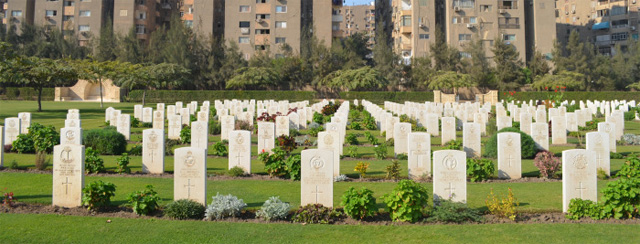 The Heliopolis War Cemetery, Cairo.
Photograph with thanks to Lydia Smith
Roger Morgan © 2019
with special thanks to Brian Bouchard
and the Cumnock History Group
Please contact us if you have information or pictures that can extend this entry.
JAMES George Richard. Corporal (6699527)
1/6th Battalion, East Surrey Regiment
Died between 29 and 31 May 1940, aged 35
While George is not in the Book of Remembrance, he is listed on the memorial in the former Horton Chapel as one on the four staff members of Horton Hospital (one of Epsom’s “cluster” of mental hospitals) killed during WW2.
George was born in Q2 1905 in London’s Poplar, the fourth child of William James and Agnes (née Morgan). The 1911 Census recorded the family living at the now lost 34 Prestige Street, Poplar. 35 year old William was listed as an “Engine Fitter’s Labourer” (annotated to indicate that this was in “Dry Dock Repairs”, doubtless in the nearby docks). As usual for the time, no occupation was given for 34 year old housewife Agnes. The couple’s four children ranged from 6 year old George to 11 year old William junior.
In Q3 1933 and registered in the Poplar District, the 28 year old George married 29 year old Lillian Winifred Wiggins. She had been born in Wandsworth on 9 November 1903, and the 1911 Census recorded her as an 8 year old living with her mid-30s parents – Albert (a “Cheesemonger”) and Jane (née Davies) – at 33 Atheldene Road, Wandsworth, together with three younger siblings. (The parents had had two other children who had died.)
George and Lillian appear to have set up their first home in Stepney, the District in which the birth of their first child, Lillian W junior, was registered in Q3 1934. At some point, George took employment at Epsom’s Horton Hospital: the birth of the couple’s second child, George R junior, was registered in the local Surrey Mid Eastern District in Q1 1937, and there is an entry for George Richard James living at 21 Court Farm Gardens in a 1936 Epsom Directory.
George is not found in the September 1939 Register, presumably because he was already in uniform. And the family had by then moved from the area: the 1939 Register records the 35 year old Lillian (listed with the conventional “Unpaid Domestic Duties”) living at 328 Thrigby Way, Surbiton. Her entry is followed by two currently closed records, doubtless of their two young children.
George’s WW2 service was with the 1/6th Battalion of the East Surrey Regiment. This Territorial Army unit was – as part of the 44th (Home Counties) Infantry Division – sent to France in April 1940, becoming part of the British Expeditionary Force ready to counter the expected German invasion of Belgium and France. As is well known, the German invasion when it came was of an unanticipated speed and ferocity. With the help of French allies, the BEF made a fighting retreat to Dunkirk for evacuation during the 17 May to 4 June 1940 Operation Dynamo. The astonishing success of that evacuation was thanks to many fierce and costly rear-guard actions.
It was during one of these rear-guard actions that George was killed in action but, as noted at the head of this article, the precise date of his death is not known. The 29-31 May 1940 window indicated there is as specified in the Commonwealth War Graves Commission’s main database. However, his headstone (which they commissioned) gives the wider range of 18 May to 4 June 1940. Other records are Casualty List No. 251 of 1 June 1940 which reported him “Missing believed Killed” and Casualty List No. 547 of 24 June which confirmed his being “Killed in Action”.
George is buried in the Oostduinkerke Communal Cemetery, Belgium. This is near the coast about 10 miles east of Dunkirk and holds 149 WW2 Commonwealth casualties, most of whom died in the 1940 fighting retreat to Dunkirk. The widowed Lillian took the option of adding a personal inscription to his headstone on Grave A.19,
“Gone but not forgotten never shall thy memory fade. Wife, Daughter, and Son.”
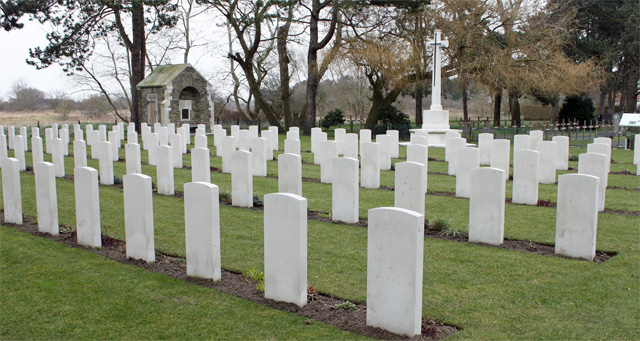 The Commonwealth War Graves section of Oostduinkerke Communal Cemetery
Photograph (77163914) by Frank Vanpaemel via findagrave.com
The Commonwealth War Graves Commission lists the widowed Lillian as being “of Hayes, Middlesex.” In Q1 1946, she got remarried to Edward Benn, registered in the Uxbridge District, and her death in Q2 1985 was registered in the Hillingdon District.
Roger Morgan © 2018
Please contact us if you have information or pictures that can extend this entry.
JAMES Henry Walter. Private (13003015)
Pioneer Corps
Died 7 February 1941, aged 53
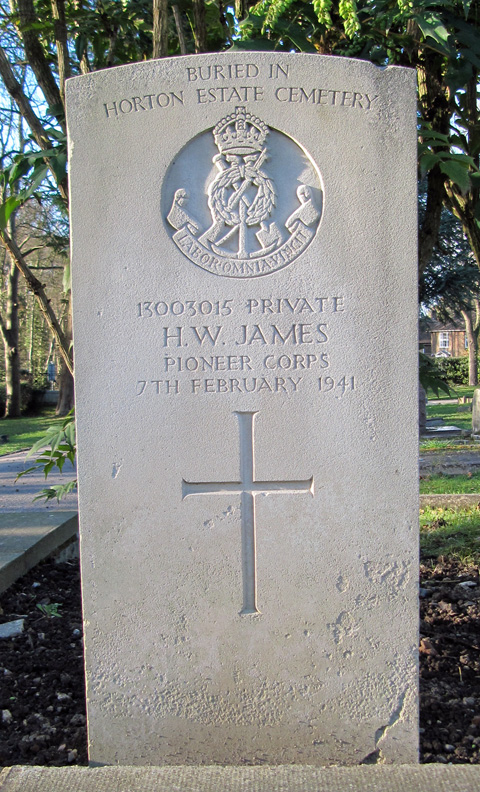 Henry’s “Special Memorial” headstone in Epsom Cemetery
Photograph by Roger Morgan © 2019
Henry is not listed in the Book of Remembrance but is remembered here because he both died and is buried in Epsom.
Apart from his outline Pioneer Corps details and date of death, the Commonwealth War Graves Commission records note only that Henry (of unspecified age) was the “son of Henry and Anne James and husband of Lottie James, of Brixton, London” and is buried in Epsom. Quite a lot of devilling in the readily available records has enabled a fuller – and rather complicated – story to be told.
Henry’s entry in the September 1939 Register (of which more below) notes that he was born on 25 August 1887. The only “Henry Walter James” in the GRO’s birth records for the three years 1886-88 was registered in the St Olave, Southwark District of London in Q4 1887, with the mother’s maiden name recorded as “Cain”. From this, we find the wedding of Henry Walter James senior and Johanna (later, sometimes “Anne” or “Annie) Cain at St James’s Church, Bermondsey on 2o November 1882.
The 1891 Census records the young family living at 70 Bramcote Road, Camberwell. 36 year old Henry senior is listed as a “Printer Compositor). As usual at the time, no occupation is listed for his 28 year old wife (“Annie” here) who was looking after the household which, in addition to 3 year old Henry (whose place of birth is recorded here more specifically as “Rotherhithe”), also included 1 year old Catharine. (Catharine was actually the couple’s fourth child: twins Reginald and Robert were born and died Q1 1889. A subsequent child of theirs also died in infancy. In total, the couple had eleven children – eight of which survived infancy.)
The 1901 Census finds the family – now with seven children, from 13 year Henry junior to new-born Charles (who we’ll meet again later)– living at 16, Sandhurst Gardens, Lewisham. By the time of the 1911 Census, the family (with mother Annie now listed as “Johanna”) had moved again, to 179 Sangley Road, Catford, Lewisham. While 23 year old Henry junior had left home, all the rest of the couple’s surviving children are listed, the youngest being 6 year old “Schoolgirl” Letty.
Henry junior’s absence is, on the face of it, explained by finding a 14 January 1907 record of his signing up at Chatham for 12 years in the Royal Navy as Stoker 2nd Class (311192), initially serving on the base ship HMS Acheron. The record describes him as a former “Wire Worker” and as being 5’5” tall with dark brown hair, grey eyes, a fresh complexion, a scar on the right eyebrow and a tattoo on his left arm.
He did not, however, complete his 12 year term in the Royal Navy. His next appearance in the readily available records is as a passenger on the SS Dominion sailing from Liverpool on 17 March 1910 bound for Halifax, Nova Scotia, Canada. He made his way to the US, specifically to the town of Evanston (in Cook County, Illinois – on the SE corner of Lake Michigan and about 15 miles north of Chicago) where he stayed for at least the next seven years.
On 4 December 1911, the 24 year old Henry married 27 year old Mary Skinner (who was originally from Aberdeen). Their child, Henry Robert, was born on 30 September 1912.
The next available record is dated 6 May 1917 and is of Henry registering, as required by US law, for the draft for WW1 military service. (There can be no doubt that this is our Henry: his full name, date and place of birth, and physical details all match.) In this, he states that he:
• is living at 914 Madison, Evanston;
• has “declared his intention” to seek US citizenship;
• is working as a porter for F E Foster & Co;
• has been married for five years (and, apparently, had a child); and
• has had three years’ experience of military service in England (although saying that this was in “Field Artillery”).
Sadly, Mary died on 17 May 1919 when she was 35 years old. (This was in Elgin, Illinois – about 35 miles due west from Evanston.) The widowed Henry and nearly 7 year old Henry junior quickly sailed back to the UK, arriving in Liverpool on 28 June 1919.
Henry’s next appearance in the readily available records is in Q4 1925 when, as a 38 year old, he married 23 year old Lottie Clifford, registered in Birmingham. (He may have returned to Birmingham because that is where his parents had moved to. They were certainly resident there in 1928 – at 90 Belgrave Road.)
Henry’s second bride, Lottie, had been born in Aston, Birmingham on 11 June 1902 as the first child of George Clifford and Lottie (née Horton), who had married at St Lawrence’s, Aston on 21 December 1901. The 1911 Census had recorded the Clifford household living at 5 Nechells Row, Taylor Street, Aston with 29 year old George listed as a “Wood Dealer”. As usual at the time, no occupation is listed for 25 year old Lottie senior. The couple now had four children (a fifth having died in infancy), from 8 year old “Schoolgirl” Lottie junior to new-born May.
The birth of Henry and Lottie’s first child, Eileen May, was registered in the Birmingham North District in Q4 1927.
It seems that the 15 year old Henry junior left home in 1928: travelling alone, he arrived in Quebec on 3 June. His father, step-mother and half sister quickly followed – presumably to try to find him. The passenger manifest of the SS Doric, which left Liverpool on 29 June 1928 bound for Quebec, notes that Henry was a Farm Labourer and that all three were on their way to Henry’s younger brother, Charles, now at 143 Nelson Street, Brentford, Ontario.
They returned just over a year later, arriving back in Liverpool – minus Henry junior – on 30 August 1930. The ship’s passenger manifest lists the three of them among eight “Deports” – in their case, bound for 5/7 Taylor Street, Birmingham. Lottie was pregnant with the couple’s second child, Marguerite, whose birth was registered in Birmingham Q4 1930. Sadly, she died aged 3, as registered in Birmingham Q4 1933.
A 1935 Electoral Roll records Henry and Lottie living at 75 Clevedon Street, Birmingham but they then moved south. The September 1939 Register finds them living at 149 Denmark Road, Lambeth. 42 year old Henry is listed as a “General Labourer”, and 27 year old Lottie with the conventional “Unpaid Domestic Duties”. There is one currently closed record at the address, doubtless of the now 12 year old Eileen.
Disappointingly, the readily available records provide no useful information about Henry’s WW2 service in – as noted by the Commonwealth War Graves Commission – the Pioneer Corps.
At the age of 53, Henry died on 7 February 1941. He was then buried in the Horton Estate Cemetery (Grave 1724A) which suggests that, either sick or injured, he had been taken to the Emergency Hospital at Horton – one of Epsom’s cluster of mental hospitals that, as for WW1, had been taken over to deal with military and civilian wartime casualties. (The Horton Cemetery records list his death as occurring at Long Grove Hospital, another one of Epsom’s “Cluster”, wards in which were sometimes used for wartime casualties when Horton was full.)
Henry’s recently acquired death certificate both clarifies and confuses things. (It is certainly his as the full name, age, home address – “of 149 Denmark Road, SE5” – and date of death all exactly match.) The certificate records his place of death as “The Grove, Horton Lane, Epsom” – one of the buildings in the grounds of the Long Grove Hospital. The person who reported the death is listed on the certificate as “F G L Barnes”, being the “Occupier” of “The Grove, Horton Lane”. The nearly 50 year old Francis Barnes was actually the Medical Superintendent of the Long Grove Hospital. He is recorded as such in the September 1939 Register and in the Royal College of Psychiatrists’s 1939-40 Register (the latter giving his full details as “Barnes, Francis Gregory Lawson, McB, BSLond, MRCS, LRCP, DPM”.)
Dr Barnes’ medical credentials explain why he was also able (as specified on the certificate) to certify the cause of death, which he gave as “Exhaustion of melancholia”. Poor Henry would appear to have just given up on life.
Oddly, the certificate makes no mention of Henry’s service in the Pioneer Corps, noting only that he had been “a labourer”. If the Hospital was genuinely ignorant of his services connection, that could explain why he was buried in Horton Cemetery, which was intended for only regular patients of the Hospital Cluster.
While Henry’s remains are left in the unmarked grave 1724a of Horton Cemetery, he was later commemorated on a “Special Memorial Headstone” in the Commonwealth War Graves Commission’s reserved area of Epsom Cemetery. As shown at the head of this article, this headstone has a superscription to note that he is “Buried in Horton Estate Cemetery”.
The widowed Lottie never remarried and died, aged 86, in Q4 1988, registered in the Lambeth District – like her 1939 address.
Roger Morgan © 2021
With special thanks to Hazel Ballan & Clive Gilbert
Please contact us if you have information or pictures that can extend this entry.
JAMES Ronald Henry. Gunner (1591479)
390 Battery, 27 Searchlight Regiment, Royal Artillery
Died 2 December 1942, aged 31
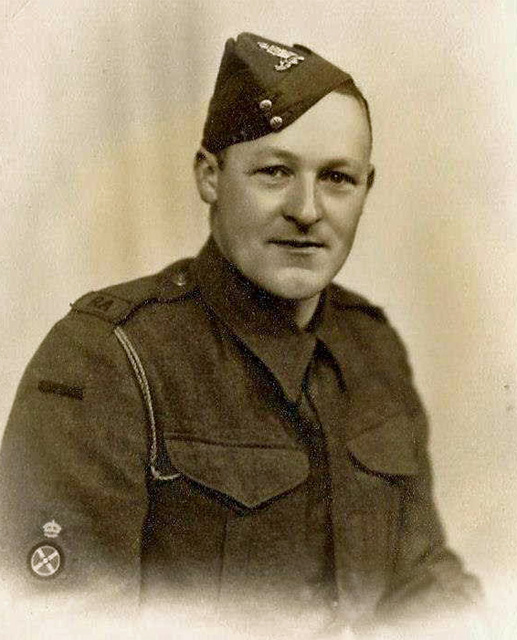
Ronald James
Copyright acknowledged
While, for some unknown reason, Ronald is not listed in the Borough’s Book of Remembrance, he is commemorated on the WW2 memorial in St Martin’s, Epsom.
Most unusually, the Commonwealth War Graves Commission database contains absolutely nothing about Ronald’s family background – and not even his age when he died. Fortunately, other records provide the necessary information.
Ronald was born on 8 April 1911, the last of four children born to Charles James and Annie Elizabeth (née Arnold). The parents had married on 25 August 1895 in Dorking. The 1901 Census records them living with Annie’s apparently widowed mother, 48 year old Annie Marie Arnold, at The Ram Inn, 68 Dorking High Street: Annie senior is listed as the “Licensed Victualler” and Charles as the “Public House Manager”. Charles and Annie junior by then had two children: 5 year old Frederick and 2 year old Annie. The couple’s third child, Reginald, was born there in June 1902.
By 1908, the whole extended family had moved to Fernbank, Walton-on-the-Hill where they were recorded in the 1911 Census. 58 year old Annie senior is now listed as a “Laundress” and Charles as a “Laundryman. The couple’s last child, Ronald (the subject of this article was born very shortly after the Census was taken.
The couple’s oldest child, Frederick, served in Palestine during WW1 as Rifleman (652766) 2nd/21st Battalion of London Regiment (First Surrey Rifles), dying there on 8 April 1918, aged 22. The Commonwealth War Graves Commission’s database records the parents’ address then as 2 Church Green, Walton-on-the-Hill. Father Charles died in Walton-on-the-Hill in February 1927. (The widowed Annie junior continued living there – in 1932 her and young Reginald’s address was 29 Breech Lane,. Indeed, Annie lived in Walton-on-the-Hill until her death in 1963.)
In March 1934 and registered in Epsom, the 23 year old Ronald married 22 year old Edna May Cook. The couple set up home in 27 Middle Lane, Epsom. By 1937, the couple were living at 27 Horsley Close, Epsom.
However, the September 1939 Register records the couple living at 11 Gateley Road, Lambeth. 28 year old Ronald is listed as a “Milk Round Inspector” and 26 year old Edna with the conventional “Unpaid Domestic Duties”. The birth of their daughter, Pamela, was registered Q2 1934 in the local Surrey Mid Eastern District (mother’s maiden name “Cook” – Vol 2A, Page 400). Any lingering doubt from there being no currently closed record – which would be covering her – at 11 Gateley Road in the 1939 Register is removed by finding her, as noted at the end of this article, living with her remarried mother in 1957.
Ronald’s WW2 service was in 390 Battery of the Royal Artillery’s 27th Searchlight Regiment. It may be that he was a member of its Territorial Army precursor, 27th (London Electrical Engineers) Anti-Aircraft Battalion RE (TA). The Regiment was transferred to the Royal Artillery in 1940, with headquarters at Mitcham Lane, Streatham, SW16. In 1941, it was dispatched for service in the Middle East and North Africa and, in 1942, was formally re-designated as 27th Searchlight Regiment RA (London Electrical Engineers (TA)).
In spite of being an Axis Power, Italy was non-belligerent in the early days of WW2. On 10 June, shortly after the Dunkirk evacuation, Italy declared war on the Allies. One of its forces’ first actions was the invasion of British-held Egypt from the Italian colony of Libya. British forces quickly pushed them back and, indeed, advanced into Libya to capture the strategic port of Tobruk. The Germans sent reinforcements, under Rommel, and the combined Axis forces advanced against the British with a view to capturing the prizes of the Suez Canal and access to the Middle East’s oilfields. The Axis advance was halted just short of Cairo by the first Battle of El Alamein (1-27 July 1942) and, under Montgomery, then decisively reversed in the second Battle of El Alamein (23 October – 11 November 1942) – a turning point in the War as a whole.
Ronald’s Battery was closely involved in the Battles of El Alamein and then in pressing the Axis forces westwards in a pincer action with Allied troops advancing eastwards (after an invasion of Morocco and Algeria). There was much hard fighting on both fronts in all this during which (as reported in Casualty List No. 1011) Ronald was killed in action on 2 December 1942 in the Tobruk area. Axis forces in North Africa finally surrendered in Tunis on 12 May 1943.
Ronald is buried in Grave 1.E.6 of the Tobruk War Cemetery, one of 2,272 Commonwealth WW2 casualties there.
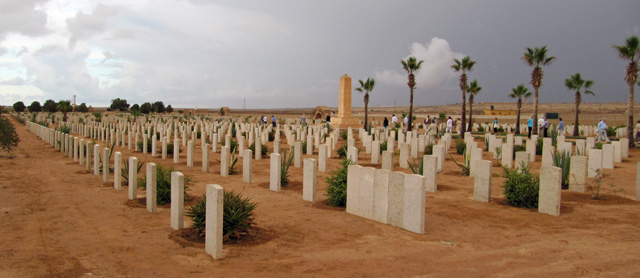 The Tobruk War Cemetery
Photograph by Roger Morgan © 2009
It is not clear at what point Edna returned to Epsom. The 1945 Electoral Roll records her living with Frederick and Ruth Eagles (her older sister and her husband – they had married in Epsom in 1929) at 76 East Street Epsom. She was with them for several years, probably until Q4 1949 when, registered in the local Surrey Mid Eastern District, the widowed Edna – now aged 37 – got married again.
Edna’s second husband was the 41 year old Herbert McCollum. He had been born in County Tyrone, Ulster, and his first appearance in the readily available British records is in the 1939 Register as a 31 year old “American Barman” living with his “Bus Conductor” older brother, Victor, and family at 66 West Hill, Epsom. The 1957 Electoral Roll records Edna and Herbert living at 57 Dirdene Road, Epsom, together with Edna’s now 23 year old daughter from her first marriage, Pamela James.
Roger Morgan © 2019
With special thanks to posts by “walder2” on Ancestry.co.uk
and to Hazel Ballan
Please contact us if you have information or pictures that can extend this entry.
JENNINGS Alice
Civilian
Died 23 May 1941, aged 81
Not listed in the Book of Remembrance
Alice and her twin sister, Charlotte, were born on 31 October 1859 – the third and fourth children of Thomas Atkinson Jennings and Charlotte (née Wisedill) who had married in St Mary’s, Lambeth on 11 December 1854. The 1861 Census records the family living at 15 Bird Street, Lambeth. 31 year old Thomas is listed as a “Printer Compositor”. As usual, no occupation is listed for 28 year old Charlotte – who had her hands full with the 18 month old twins as well as 4 year old Emma and 6 year old Annie.
The family were still at Bird Street at the time of the 1871 Census, with three more children. By the time of the 1881 Census, the family had moved to 9 Sansom Street, Camberwell – and the couple’s last child had arrived. There were now five children at home – these included the 21 year old twins, now both working as “Hat Trimmers”. (Thomas is now listed as a “Printers Pressman”.)
The 1911 Census recorded the 80-ish parents (with Thomas as a “Printers Pressman, Retired”) living at 126 Westmoreland Road, Walworth together with the 51 year old unmarried twins – now listed as “Silk Hat Trimmers”. (The return noted that four of the parents’ eight children had died.)
The Commonwealth War Graves Commission records note that Alice was “of 35 Coleman Road, Camberwell, London”. That is where she and her twin, Charlotte, were recorded in the September 1939 Register – both now nearly 80, still unmarried and listed as “Retired”.
As noted in the Commission’s records, Alice was injured (by enemy action) while at home on 12 May 1941. She was taken to the Emergency Hospital at Horton – one of Epsom’s cluster of mental hospitals that, as for WW1, had been taken over to deal with military and civilian wartime casualties – where she died 11 days later, on 23 May.
(If sister Charlotte was injured in the same attack, she survived – dying, aged 90 in Islington Q1 1950.)
Roger Morgan © 2018
Please contact us if you have information or pictures that can extend this entry.
JEPPS Henry Edward. Serjeant (1487048)
44 Regimental Holding Unit, Royal Artillery
Died 30 June 1945, aged 38
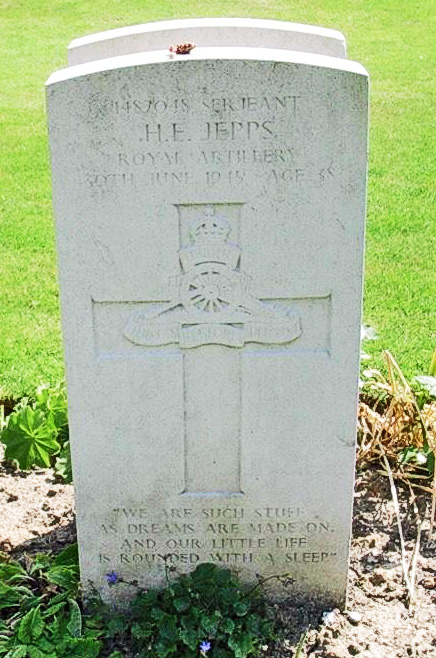 Henry’s headstone in the Town Cemetery, Brussels
Photograph (56433512) by the International War graves Photography Project, via findagrave.com
Henry was born in Hackney Q3 1907, the first of three children born to William Henry Jepps and Edith Maria (née Ager – they had married in the parish church of St Marylebone on 26 August 1906, the record of which notes that William was a “Cheesemonger” and their address was 115 Lisson Grove). Henry was baptised on 28 July 1907 at St Mary’s, Bryanston Square, the record of which notes the family’s address as 7 Buckingham Road, Dalston. The 1911 Census records 3 year old Henry living with his 34 year old father (now a “Cheesemonger Assistant”) and 28 year old mother at 85 de Beauvoir Road, Hackney.
By the mid 1920s. the Jepps family had moved to Sutton, being recorded in the 1924 Electoral Roll at 6 Jevington Gardens, Lenham Road.
In Q3 1936 the 29 year old Henry married local girl 25 year old Vera Ellen Gwyer. She was the first child of Henry George Arthur Gwyer and Emily Mary (née Lowe). They had married in Q1 1907, registered in the Camberwell District and set up home at 22 Strathearn Road, Sutton where they were recorded in the 1911 Census. This lists Henry as “Manager For Chemical Merchant”. As usual for the time, no occupation is listed for Emily, by now pregnant with Vera who was born on 11 September 1911. The birth was registered in the Epsom District which included Sutton.
Henry and Vera’s 1936 marriage was registered in the local Surrey Mid Eastern District (which also includes Sutton) but set up home in the Borough. The September 1939 Register records the 28 year old Vera living alone at 7 Timbercroft, Ewell – listed with the conventional “Unpaid Domestic Duties” but also “(Comptometer)”. Henry was not at home since he had attested for the Royal Artillery in 1938. The couple subsequently had a daughter, Pauline, born Q2 1942 and registered in the local Surrey Mid Eastern District.
(The 1939 Register records Henry’s now-widowed 56 year old mother – his father had died on 27 April that year – living at 76 Lenham Road, Sutton and listed as a “Café Assistant”. Living with her were Henry’s 27 year old brother, Reginald – listed as a “Builder’s Measuring Clerk” – and the 79 year old widowed grandmother, Joanna Ager.)
Disappointingly, the readily available records tell us nothing of Henry’s WW2 service in the Royal Artillery. He is one of the 587 Commonwealth burials in the Brussels Town Cemetery, most of whom died on lines of communication duties after the liberation of Brussels at the beginning of September 1944. Henry’s death – on 30 June 1945 – came nearly 8 weeks after VE Day on 8 May and it is not currently known if this was the result of some wartime injury or a post-war incident.
Drawing from Shakespeare’s The Tempest, the widowed Vera took the option of adding a personal inscription to Henry’s headstone on Grave X.21.30,
“We are such stuff as dreams are made on, and our little life is rounded with a sleep.”
The Probate record of administration of Henry’s £1,624 estate being awarded to his brother Ernest (now a “Quantity Surveyor”) notes that, by the end of WW2, his and Vera’s home address was 407a Kingston Road, Ewell.
In Q4 1952 and registered in the local Surrey Mid Eastern District, the widowed Vera married Robert H Jasper.
Roger Morgan © 2019
With thanks to Hazel Ballan for some of the family background
Please contact us if you have information or pictures that can extend this entry.
JOBSON John
Civilian
Died 15 June 1944, aged 31
&
JOBSON Violetta
Civilian
Died 15 June 1944, aged 32
John Jobson was born on 24 December 1912, the fourth child of James (a “Dock Labourer”) and Kate (née Miller) Jobson who, with their first three children, were recorded in the 1911 Census living at 10 Mason’s Court, High Street Stockton-On-Tees.
In Q4 1937 he married Violetta Jackson. She was born on 31 October 1910, the first child of George Henry (a “Coal Miner, Hewer”) and Isabella Jane Jackson – in the 1911 Census, all living at 3 Monkseaton Terrace, Seaton Hirst, Northumberland.
They had both moved south from their birthplaces. Their marriage was registered in the Surrey Mid-Eastern District, and the September 1939 Register recorded the couple living at 270 Sutton Common Road, Sutton. That listed 26 year old John as a “Lorry Driver, Heavy Worker” and Violetta with the conventional “Unpaid Domestic Duties”.) The couple’s first child, John, was born Q1 1939 but died later in the year. Their second child, Ronald, was born Q2 1940.
John’s older sister, Mary Temple Jobson, had also moved south. In Q2 1933 and registered in the Croydon District, she had married Thomas Edward Boorer. The September 1939 Register records them living at 55 Riverholme Drive, Ewell, with Thomas working as a “Gardener”. It seems they had no children.
The reason for mentioning this other couple is that Thomas saw (and survived) WW2 service as a Gunner and it seems that, while he was away, John and Violetta moved in with Mary at 55 Riverholme Drive. And this is where, as the result of enemy action, John and Violetta were killed on 15 June 1944.
The Commonwealth War Graves Commission records note that the couple died at their home address of 55 Riverholme Drive on 15 June 1944, and the Borough’s Book of Remembrance specifies that this was the result of “Enemy Action”. However, thanks to the recently received reminiscences by Jim Hayton (now in Australia but who, in 1944, was living at the nearby 10 Green Lanes), we now know that the couple – and their neighbours, Walter Page at 57 Riverholme Drive and newborn James Kitts at 2 Sunneymede Avenue – were victims of one of the very first V1 “Doodlebugs” to land in the Borough. (The Germans’ V1 campaign – called Operation Eisbär – had begun only three days earlier, on 12 June 1944.)
If John’s sister Mary and son Ronald were injured in the same incident, they survived. The February 1946 Probate record (which confirmed 55 Riverholme Drive as John’s address at the time of his death) notes that administration of John’s £443 estate was awarded jointly to her and her husband “Thomas Edward Boorer gunner HM Army”. And Ronald, as a 22 year old, married Evelyn M H Salter in Q3 1961, registered in the Surrey South Eastern District
Roger Morgan © 2021
Please contact us if you have information or pictures that can extend this entry.
JOHNSON Alfred Walter. Lance Bombardier (1100090)
Royal Artillery
Died 14 May 1943, aged 33
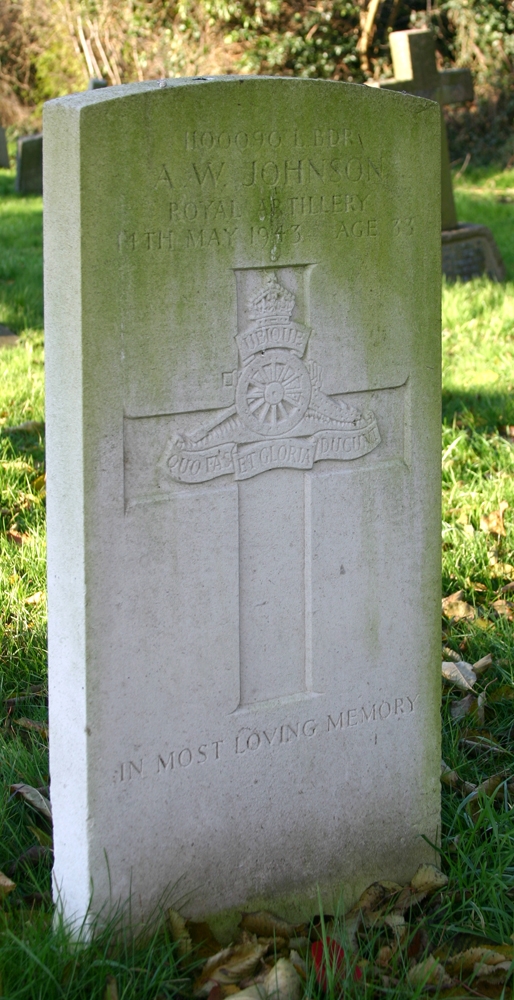 Alfred’s headstone in St. Mary’s Churchyard Extension
Image courtesy of Clive Gilbert © 2018
Alfred is not listed in the Book of Remembrance, and is listed in the Commonwealth War Graves Commission’s post-war records as the “husband of Beatrice Marjorie Johnson, of Tooting“. However, his burial in Ewell clearly indicates some connection with the Borough – and, as outlined below, that has proved to be the case.
The Commission’s records begin by noting that Alfred was the “son of Alfred Thomas & Annie Johnson”. Alfred Thomas and Annie Judge had married at All Saints’ Church, West Ham on 13 February 1909. They set up home at 29 Aldensley Road, Hammersmith where Alfred junior was born in Q1 1910. The 1911 Census recorded the family there, and listed 26 year old Alfred senior as an “Assistant Stoker (Electricity Power Station). As usual, no occupation was given for 21 year old housewife Annie, busy looking after 1 year old Alfred junior – and who would be kept busy with the arrival of some 10 more children over the next 18 years.
The September 1939 Register records the parents living at 25 Longford Avenue, Southall. 55 year old Alfred senior is now listed as a “Crane Driver” and 49 year old Annie with the conventional “Unpaid Domestic Duties”. There are 11 other entries at the address, all but two of which are currently closed. It may be that the 19 year old Alfred junior is behind one of those: he is not currently found elsewhere.
Alfred junior’s next appearance in the readily available records is in Q2 1942, when this 32 year old married 25 year old Beatrice Marjorie Hewett, registered in the local Surrey Mid Eastern District. Beatrice had been born in Wandsworth on 12 June 1916. The September 1939 Register records this 23 year old as a lodger at 46 Spa Road, Melksham, Wiltshire with her occupation listed as “Sec – Shorthand – Typist”. The reason for their wedding being registered in the Surrey Mid Eastern District is doubtless that the 1939 Register recorded Beatrice’s widowed 57 year old mother, also Beatrice, living at 11 Green Lanes, Ewell together with another daughter, 20 year old Olive. (The occupations of mother and that daughter were recorded as, respectively, “Housekeeper” and “Domestic Servant” – presumably working elsewhere.)
The newlyweds appear to have moved in with the widowed Beatrice senior. The 3 September 1943 Probate record of administration of Alfred’s £263 estate being awarded to the widowed Beatrice junior noted that he was “of 11 Green-lane Ewell Surrey”. There is no record of the couple having had any children. Electoral Rolls show that the widowed Beatrice junior was still living with her mother and sister at 11 Green Lanes in 1946. She cannot be confidently traced further in the readily available records, but presumably moved to Tooting by the time the Commonwealth War Graves Commission finalised its records.
At long last, we get to Alfred’s WW2 service. This was with the Royal Artillery, and an annotation in the Commonwealth War Graves Commission’s burial records indicated that this was with the 22nd Anti Tank Regiment. Sadly, this does not lead to any useful information in the readily available records about either Alfred’s experiences or the cause of his death on 14 May 1943. However, as his death was registered in the local Surrey Mid-Eastern District, it seems more likely to be result of injury or illness rather than direct enemy action.
Alfred is buried in St. Mary’s Ewell, Churchyard Extension. The widowed Beatrice took the option of adding a personal inscription to Alfred’s headstone on Grave E.51,
“In most loving memory.”
Roger Morgan © 2020
Please contact us if you have information or pictures that can extend this entry.
JOHNSON James Edward. Pilot Officer (66519)
75 Squadron, Royal Air Force
Died 6 September 1941, Age 21
 James’ headstone in Borculo General Cemetery
Photograph (13857707) by Des Philippet via findagrave.com
Not listed in the Book of Remembrance
James’s birth was registered in Q1 1920. He was the second child of James Johnson and Edith Agnes Mary (née Simpkin) The parents had married on 1 March 1913 at Emmanuel Church, Camberwell. James junior’s Q1 1920 birth was registered in the Camberwell as were the births of his siblings: Edith Q1 1916; Doreen Q2 1924; and Sheila Q1 1927.
The September 1939 Register records the parents still in Camberwell, at 123 Warner Road. 51 year old James Johnson is listed as a “Printer’s Warehouseman” and 47 year old Edith with the conventional “Unpaid Domestic Duties”, (There is one currently closed record at the address, doubtless covering one of their children.)
Not long after this, the parents moved to the Borough, enabling the Commonwealth War Graves Commission records James junior as the son of James and Edith Johnson, “of Ewell, Surrey”. The address is likely to be the one at which the parents are found in 1947 1947 – namely 37 Pams Way, Ewell – together with their daughter Doreen and husband Norman Rickerby, whose marriage was registered in the local Surrey Mid Eastern District in Q2 1946.
To return to James junior, the subject of this article, he enlisted with the RAF during April 1940 at Cardington. He was commissioned Pilot Officer, from the rank of Leading Aircraftman, 16 March 1941. He was posted to 75 Squadron, part of Bomber Command, stationed at RAF Feltwell, Norfolk.
On 6 September 1941, James was the pilot of Wellington Mk 1c, X9767 which took off from RAF Feltwell for an operation against Hüls, the most northerly district of Krefeld, North Rhine-Westphalia.
The crew were:-
P/O James Edward Johnson, RAFVR 66519 – Pilot.
Sgt. Peter Simpson Dickson Johnston, RAFVR 776002 – 2nd Pilot.
Sgt. Robert Michael Minchin, RAFVR 751355 – Navigator.
Sgt. Wilfred Bearne, RAFVR 976174 – Wireless Operator.
Sgt. Ronald Davies, RAFVR 751130 – Front Gunner.
Sgt. William John Barker, RAFVR 1378561 – Rear Gunner.
Around midnight, the aircraft was shot down by a Luftwaffe night-fighter, piloted by Oblt Emil Woltersdorf of II./NJG1. It crashed into the sea near Borculo (Gelderland), 8 km SE of Lochem, Holland, killing all on board.
Their bodies were recovered and, with the crew of another bomber lost in the same raid, were buried in the Borculo General Cemetery, which holds just these 10 WW2 Commonwealth casualties.
James’s family took the option of adding a personal inscription (which suites an old hymn) to his headstone on Collective Grave U.1-5,
“Only a step removed! / We soon again shall meet, / Around the Saviour’s feet.”
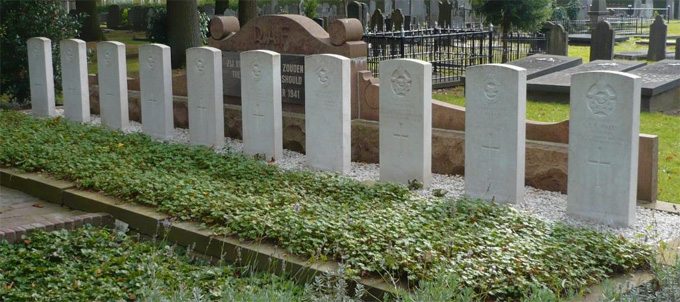 The Commonwealth war graves in the Barcolo General Cemetery.
(James’s headstone is on the far left.)
Photograph with thanks to the Commonwealth War Graves Commission
Brian Bouchard & Roger Morgan © 2018
Please contact us if you have information or pictures that can extend this entry.
JOHNSON Kenneth Maurice. Flying Officer 180244
Royal Air Force Volunteer Reserve
Died 24 March 1945, aged 22
Not listed in the Book of Remembrance
Kenneth’s birth was registered in Q1 1923, apparently the only child of Cecil Maurice Johnson to Winifred Kate (née Warrington).
The parents were both originally from Wimbledon. The 1911 Census recorded the 15 year old Cecil (already at work as a “Shipping Clerk”) living with his widowed father (a “Surveyor”) and two older brothers at 11 South Park Road Wimbledon. The 1901 Census recorded the 7 year old Winifred living with her parents (her father was a “Printer & Linotype operator”) and five siblings at 73, Graham Road, Wimbledon. In the 1911 Census (by which time the 17 year old Winifred was working as a “Clerk”), she and her family were living at 5 Kirkley Road, Merton.
The parents’ Q1 1923 marriage was registered in the Kingston District (which extended to Wimbledon and Merton), but they appear to have made their first home in the Croydon District, where Kenneth’s birth was registered in 1923. They later moved to the Borough, and were living at 78 Seaforth Gardens, Stoneleigh when, aged only 44, Cecil died in the National Hospital for Neurology and Neurosurgery, Queen’s Square, London, on 19 June 1938. Neither the widowed Winifred nor Kenneth is readily found in the September 1939 Register, but that Stoneleigh address may well be the “of Ewell” address noted for Winifred noted in the Commonwealth War Graves Commission’s post-war records.
During September 1941, the 18 year old Kenneth enlisted in the Royal Air force Volunteer Reserve at Euston with a Service Number 1806593. No details are yet to hand about this period of service. On 27 August 1944, whilst still serving as an Aircraftman 2nd Class, he was commissioned as a Pilot Officer (new Service Number 180244) with a group of volunteers for the Glider Pilot Regiment. He became a member of the Glider Pilots Regiment’s No 2 Wing He trained at RAF Tarrant Rushton, Dorset, to fly the General Aircraft GAL.49 Hamilcar glider.
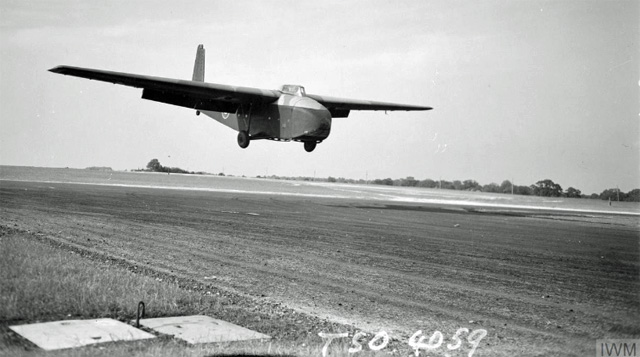 A GAL.49 Hamilcar glider about to land
PImage source © IWM (CH 18849)
WW2 gliders were nothing like the wispy modern recreational aircraft. Instead, they were substantial machines. The smallest could carry a dozen combat-equipped troops and the Hamilcar was designed to carry a light tank. These gliders were towed into the air by heavy bombers and released short of their targets to which their pilots – such as Kenneth – would then make an unpowered (and silent) descent and landing. After landing, the pilots were then expected to fight as infantry.
By March 1945, the Allied armies had advanced into Germany as far as the Rhine which was a formidable natural barrier to progress. The airborne Operation Varsity – dropping paratroops and (with the use of a total of 440 gliders) landing material behind enemy lines to support the amphibious crossing – was part of the answer.
On 24 March 1945, Kenneth was the pilot of one of the 16 Hamilcars involved in the operation, transporting M22 Locust light tanks and other heavy equipment such as anti-tang guns with their vehicles and crews. The operation was an overall success, in which the gliders’ contribution was an important element. Inevitably, there were losses on the way: the gliders’ slow speed and large size made them easy targets for anti-aircraft fire. And some gliders that made it to their destination had difficult landings, in a number of cases making the equipment they had brought unusable.
The following was recorded at RAF Tarrant Rushton on 1 April 1945 :-
“C Sqn – Casualties for Operation ‘VARSITY’ – Lt. Graefe – Lt Kennard, D.C. P/O Hanson, G.B. P/O Johnson, K. Missing. – also N.C.Os (Army) 11 Missing, 1 PW, N.C.O’s (RAF) 9 Missing, 1 PW, 1 Killed.”
Although Kenneth was initially reported missing, it was later established that he had been killed in action. He and a fellow airman were initially buried at Ringeberg, north of Wesel in Nordrhein-Westfalen. On 9 December 1947, they were reinterred in the Reichswald Forest War Cemetery – near the Rhine in the extreme north-west of Germany, just south of Arnhem in The Netherlands. The Cemetery was created after WW2 when burials were brought in from all over western Germany. With some 7,600 servicemen buried or commemorated there, it is the largest Commonwealth cemetery in the country.
Kenneth’s mother took the option of adding a personal inscription to his headstone on Grave 42.D.9,
“Every day the whole time through just awearying for you. Mother.”
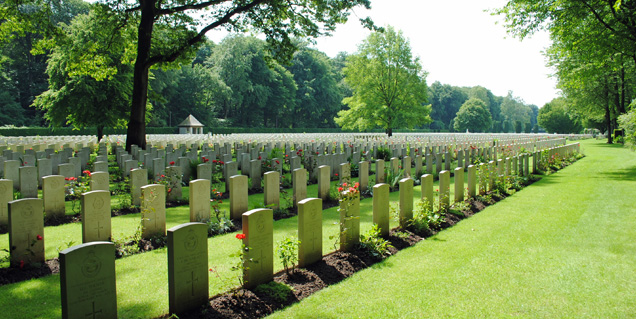 Part of the Reichswald Forest War Cemetery
Photograph by Wouter van Dijken via findagrave.com
Brian Bouchard & Roger Morgan © 2018
Please contact us if you have information or pictures that can extend this entry.
JONES Anthony Leonard. Pilot Officer (42843)
10 Squadron, Royal Air Force.
Died 6 November 1940, aged 20.
 Anthony Leonard Jones.
Photograph (of the uncle he never knew) with thanks to Jonathan Baker.
Anthony’s birth was registered in Erpingham, Norfolk in Q2 1920. He was the second child of ex-patriates Frederick Leonard (editor of the “Malay Mail” in Kuala Lumpur) and Blanche Lucy (née Burrows) Jones – his mother having returned to family in Norfolk for the birth and then returning to Kuala Lumpur.
The complicated family background is set in some detail in the immediately following article about Anthony’s parents, who were also WW2 casualties with some Borough connection.
At some point (probably to do with his schooling in the UK) Anthony was made a ward of Esmond Vavasseur Jarrold, the husband of his maternal aunt, Elsie. Both Elsie and Esmond were originally from Norfolk, where they had married in Q3 1913. They had two children: daughter Vivien J, born in Norwich in February 1915; and son David J E, born in Mutford, Suffolk in Q3 1928. The family subsequently moved to the Borough. There is an early 1930s record of them living at “Ferncote” Woodcote Side, Epsom. By 1936 they had moved to “Roxley” 87 The Green, Ewell.
The historian of Monkton Combe School, near Bath has provided the information that Anthony was educated at the school between 1934 and 1938.
They were recorded at 87 The Green in the September 1939 Register, when 52 year old Esmond was listed as “Leather Goods – Director” and both 44 year old Elsie and their 24 year old daughter were listed with the conventional “Unpaid Domestic Duties”. There is one currently closed record at the address, presumably covering 15 year old David. (Esmond was still at 87 The Green when he died on 30 August 1960.)
Anthony, the subject of this article, is not found in the September 1939 Register, probably because he was already in uniform. The Register recorded his mother (Blanche) and sister (Margaret) recorded in the Register living at 74 Alexandra Road, Epsom – but just missed his father who had returned to Kuala Lumpur a few days before the Register was taken. Blanche remained in Epsom long enough to witness daughter Margaret’s Q2 1940 marriage to Dennis Brent Panting – also to be a WW2 casualty – before she returned to her home and husband in Kuala Lumpur. (Jonathan Baker, who kindly provided the photograph at the head of this article, is the son of the widowed Margaret’s remarriage.)
From 23 October 1939, Anthony was granted a Short Term Commission of 4 years as an Acting Pilot Officer. He advanced to Pilot Officer on probation, 20 April 1940, and that position was confirmed on 14 August 1940. He was posted to 10 Squadron, part of the RAF’s Bomber Command and stationed at RAF Leeming In Yorkshire. The Squadron was equipped with the Armstrong Whitworth AW.38 Whitley – which, as illustrated below, flew in a distinctively nose-down attitude. (Until the arrival of the four-engined Avro Lancaster in February 1942, the Whitley was the RAF’s heaviest bomber.)
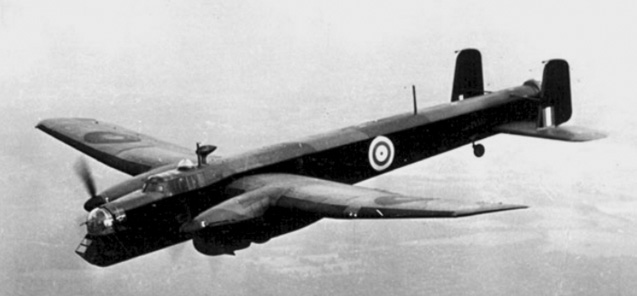 An Armstrong-Whitworth Whitley V bomber, circa 1940
RAF official photograph – public domain
We know of two occasions when Anthony nearly met his end.
On the night of 5/6 August 1940, He was the second pilot aboard Whitley P4952 which took off from RAF Leeming at 20.48 hours on an operation to bomb the Dornier aircraft factory at Wismar. The aircraft was struck by a flak in the front turret, but the pilot was able to take evasive action which saved the aircraft from further damage. None of the crew was injured and the Whitley landed safely at Leeming 04.25 hours.
On the night of 20/21 September 1940, Anthony was the pilot of Whitley P5001 KA-S which, at 21.17 hours, took off from RAF Leeming on an operation to bomb primary targets of Hamm, Soest and Ehrang around Cologne. They dropped their bombs on railway lines at one of the primary targets around 01.00 hours in a series of three attacks. The aircraft’s port wing was hit by anti-aircraft fire, but the damage was relatively slight and, at 05.15 hours, the Whitley landed safely back at Leeming where the flak damage was quickly repaired.
His final flight was on the night of 5/6 November 1940, when 20 year old Anthony was again piloting Whitley P5001 KA-S – on this occasion for an operation to Milan. other members of the crew were:
Sergeant Edgar George Harding (RAFVR 749521), aged 22;
Sergeant Phillip Trevor Harding Smith (RAFVR 754103), aged 22;
Sergeant Watkin Llewellyn Thomas Walker (RAFVR 935524), aged 20; and
Sergeant James Beasley Watt (RAF 647062), aged 18.
The crew reported at 23.59 hours that the operation had been completed, and set off on the return. At 0430, the aircraft asked for a “fix” which placed it near Louvain in Belgium. Three further fixes were sent, the last being at 0554 placing the aircraft just north of Dunkirk. SOS calls were received between 0604 and 0614. Contact was then lost, with the aircraft some 25 miles east of Ramsgate on Kent’s North Foreland.
The bodies of 20 year old Anthony and his crew were never recovered. They are commemorated on the Runnymede Memorial, Surrey, among the more than 20,000 airmen and women who were lost in WW2 operations from bases in the United Kingdom and North and Western Europe, and who have no known grave. Anthony and his crew are also commemorated on the memorial walls of the International Bomber Command Centre at Lincoln.
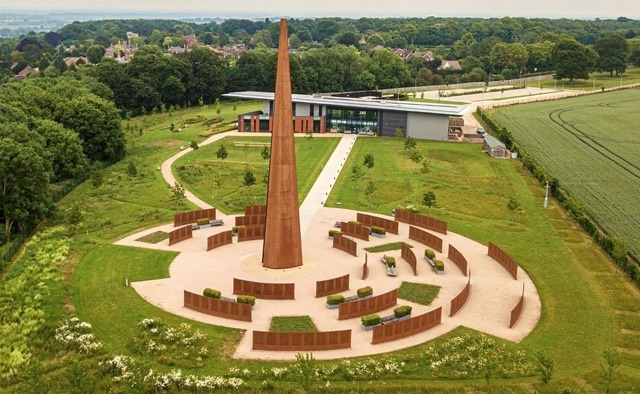 The central spire and memorial walls at the International Bomber Command Centre, Lincoln.
Photograph (copyright acknowledged) with thanks to the Centre.
Brian Bouchard & Roger Morgan © 2018 & 2023
With special thanks to Jonathan Baker.
Please contact us if you have information or pictures that can extend this entry.
Because of its very close connection with the preceding article, the following one is slightly out of alphabetical order.
JONES Blanche Lucy
Civilian
Died 8 December 1944, aged 58
&
JONES Frederick Leonard
Civilian
Died 13 February 1942, aged 52
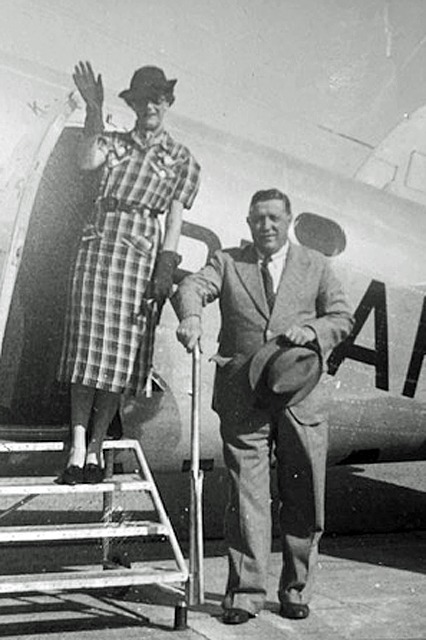 Blanche and Frederick Jones about to board a 1930s passenger aircraft.
Photograph (of the grandparents he never knew) with thanks to Jonathan Baker.
When these WW2 casualty articles were first written in 2017/18, this husband and wife were mentioned only in the margins of the immediately preceding article about their son, Anthony Leonard Jones. In late 2023, a chance contact alerted us to the fact that this couple’s daughter, Margaret, had married another future local WW2 casualty, Dennis Brent Panting. It was already known that Frederick and Blanche were also WW2 casualties, but further research during the updating of Dennis Panting’s entry established their (albeit brief) Borough connection. Accordingly, they merit their own article here.
Frederick was born in 1889, the third of four children born to Frederick and Sarah Jane (née Bluff) Jones of Spalding, Lincolnshire. His father (a Boot shopkeeper) died in 1899, aged 52. the widowed Sarah took on the running of the Boot store, and the 1901 Census records her and her four children living at 22 Hall Place, Spalding. Her oldest child, 16 year old Alice was helping her in the store, andher three younger sons (Kenneth,14; Frederick, 12; and George,6) were all at school – in Frederick’s case, it is known that this was at Spalding Grammar School.
By the time of the 1911 Census, mother Sarah – now 54 and surnamed Goodwin (apparently having remarried and been widowed again) – is recorded living at 18 London Road, Spalding. She is still running the Boot shop, assisted by daughter Alice (now 16) and son George (now 16). Oldest son Kenneth had left home and 22 year old Frederick is listed as a “Journalist Reporter”.
Shortly after the 1911 Census was taken, Frederick moved abroad and, in 1912, became editor of the “Malay Mail” in Kuala Lumpur. On 11 October 1915, at St George’s Church, Penang, Frederick married Blanche Lucy Burrows, who was also aged 26.
Blanche was originally from Norfolk. The 1891 Census records her (then a 2 year old) as the fourth of John Henry and Elizabeth Maria (née Hayhoe) Burrows’ five children. The family lived above The Globe Tavern in Botolph Street, Norwich, John Henry was the publican. By 1911, Blanche had moved to London. That year’s Census records her, now aged with ten other “Drapery Assistants” in lodgings at 8 Hatherley Grove, Paddington. It is not clear whether she knew Frederick in the UK – or quite when she arrived in Penang. However, the 1917 birth of the couple’s first child – Margaret Elizabeth (apparently known within the family as “Muffet”) – was registered in the Federated Malay States.
In early 1920, Blanche and 2 year old daughter Margaret returned to England to stay with family in Norfolk for the birth of the couple’s second child, Anthony Leonard Jones (as previously noted, a WW2 casualty). The birth was registered in Erpingham, Norfolk in Q2 1920. On 3 May 1921, Blanche, now 3 year old Margaret and 7 month old Anthony sailed from London on the Glenluce, returning to Frederick in the Malay States.
Over the next 15 years or so, there appear to have been several trips back and forth between Penang and England, not least to lodge young Anthony with his maternal aunt Elsie (née Burrows) and her husband Esmond Vavasseur Jarrold. Elsie and Esmond were both originally from Norfolk. Having married in Q3 1913, they had two children: daughter Vivien J, born in Norwich in February 1915; and son David J E, born in Mutford, Suffolk in Q3 1928. They subsequently moved to the Borough. There is an early 1930s record of them living at “Ferncote” Woodcote Side, Epsom but, by 1936, they had moved to “Roxley” 87 The Green, Ewell where they were recorded in the September 1939 Register, with 52 year old Esmond being listed as “Leather Goods – Director”. At some point, Esmond took on young Anthony as a ward – presumably during his education in the UK while his parents were back in Penang.
Anyway, by 1939, Frederick, Blanche, Margaret and Anthony were all in the UK, with the parents (and at least Margaret) living at 74 Alexandra Road, Epsom. On 26 September 1939, Frederick is recorded setting sail alone to return to Kuala Lumpur (where the family’s address was 88 Circular Road). Accordingly, he just missed inclusion in the 1939 Register. That was compiled on 29 September and, at 74 Alexandra Road, recorded 51 year old Blanche with the conventional “Unpaid Domestic Duties” and 22 year old Margaret as a “Model”.
At some point, Margaret met Dennis Brent Panting – who, like her brother Anthony, would be a WW2 casualty. They got engaged, and Blanche stayed in England long enough to attend their wedding in Q2 1940, but then returned to Frederick in Kuala Lumpur.
 Blanche Jones (on the right) together with her daughter Margaret and Dennis Panting on their wedding day.
Photograph with thanks to Jonathan Baker.
Frederick and Blanche were in Kuala Lumpur when, on 8 December 1941, the Japanese declared war on the UK and invaded “British Malaya”. Like other civilians, they sought to escape from the advancing Japanese Army, and managed to make their way to Singapore at the south of the Malayan peninsula. By 7 February 1942, the Japanese had advanced to the outskirts of Singapore Island and the civilians there looked for boats to take them away.
Frederick and Blanche found passage on the HMS Giang Bee. This coastal steamer had been completed in Rotterdam in 1908 as the Reijnierz. In 1939, she had been sold to the Chinese-owned Heap Eng Moh SS Co and renamed Giang Bee. In April 1941 she was requisitioned into naval service for use as a patrol vessel, hence the HMS. Captain Lancaster, in command of the ship, initially refused to take civilian passengers because he saw the dangers attached to a craft designated as a warship. However, at 10 pm on Thursday 12 February 1942, the Giang Bee left Singapore Harbour with up to 350 refugees who were mostly women, children and the elderly. All her Malay crew had been ordered ashore in Singapore before she left, so the crew consisted of a handful of RNVR. personnel and some passengers who volunteered to be stokers etc.
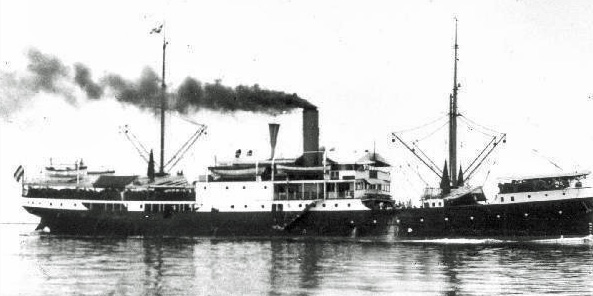 HMS Giang Bee (in her former guise of the “Reijnierz”)
Photograph with thanks to the Muntok Peace Museum
The Giang Bee was bombed and suffered damage during Friday 13 February and in the evening, after a long stand-off in the Banka Strait with a Japanese destroyer, was shelled and sank quickly. The ship had only four lifeboats, with space for barely a tenth of the crowd on board – and two of them had been seriously damaged by the day’s bombing. The 52 year old Frederick was one of the many who died in the sinking.
Although Blanche survived the sinking, she was captured and then interned in the Palembang women’s camp on Sumatra. Circumstances for Japanese-held civilian internees were barely less harsh than those for Prisoners of War. Blanche succumbed to the conditions and died on 8 December 1944, aged 58. With many other casualties from the camp, she is buried at Muntok on nearby Banka Island.
As noted in our article about Dennis Brent Panting, his widow (Margaret – this couple’s daughter) remarried. One of her sons has given us the following photograph of a remarkable embroidery made by his grandmother, Blanche, in the Palembang camp. (Astonishingly, this was kept safe after Blanche’s death and, after the war, found its way back to Margaret who later donated it to a museum.) It would appear to be a large handkerchief. Margaret got her fellow internees to sign the cloth and then embroidered over their signatures as they died. Around the edge of the piece are various aspects of camp life – not least, lots of barbed wire.
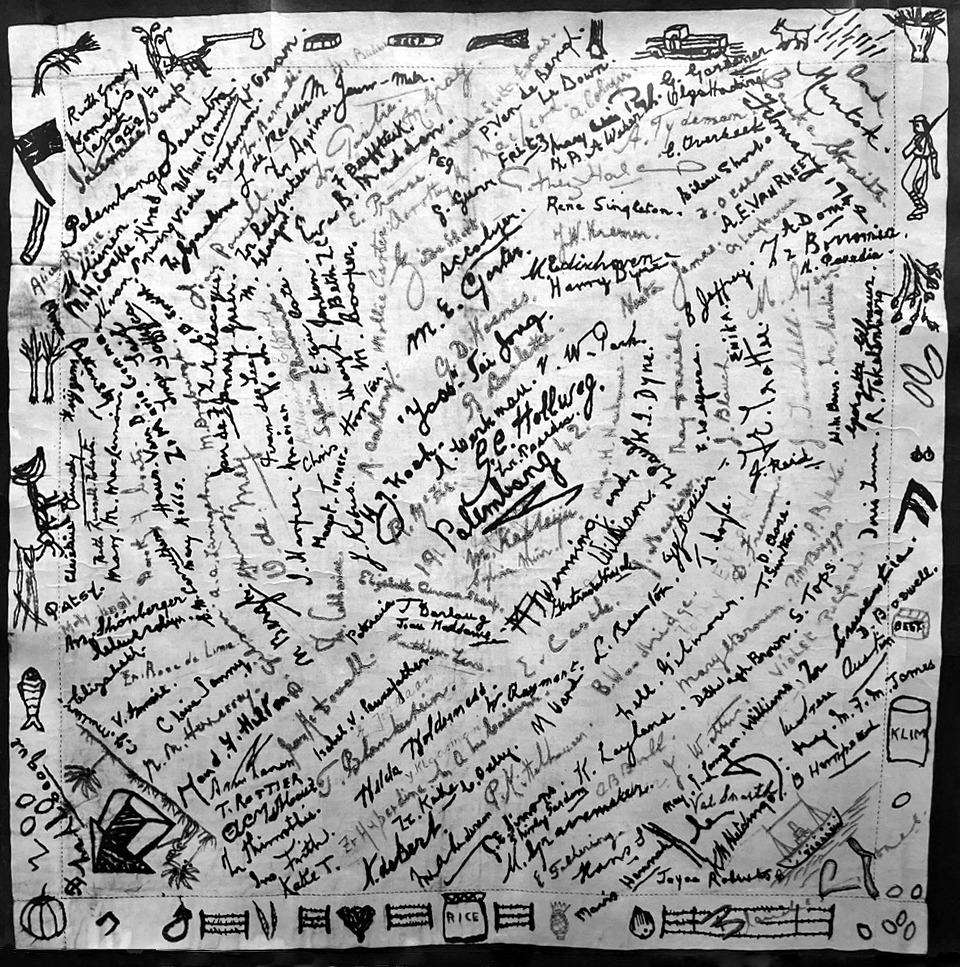 Blanche’s memorial embroidery (Click to enlarge)
Photograph with thanks to Jonathan Baker
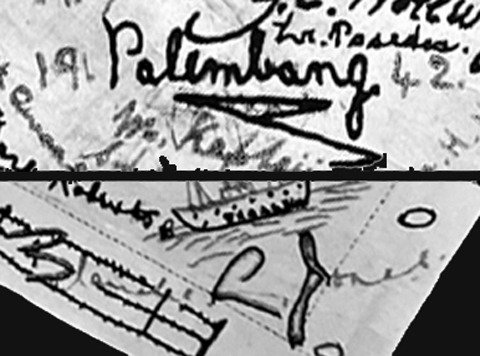 Two details from the above.
Top: from the centre of the piece “Palembang”, the name of the internment camp, in the middle of 1942, the date of their capture.
Bottom: from the bottom right hand corner the piece, Blanche’s own signature (under what is presumably the Giang Bee), of which she had embroidered just her initials B L J.
Roger Morgan © 2023
with special thanks to Jonathan Baker, grandson of Blanche and Frederick Jones.
Please contact us if you have information or pictures that can extend this entry.
JONES Arthur Frederick
Home Guard
Died 27 April 1941, aged 55
Not listed in the Book of Remembrance
Arthur’s common names make it hard to trace his family background with any confidence in the readily available records. The Commonwealth War Graves Commission’s records note that he was “of 11 Cambria Road, Camberwell, London”, and that is where he was recorded in the September 1939 Register. The details in that Register are that he was born on 15 July 1886, was married and that his occupation was “Shopkeeper, Off License Grocery”. Also at the address was Kathleen Mary Jones, also married – presumably to Arthur, notwithstanding the 19 year age difference (she was born on 22 June 1905). Instead of the conventional “Unpaid Domestic Duties”, she is listed with “Paid Domestic Duties”. There is one currently closed record at the address, perhaps their child.
According to the Commonwealth War Graves Commission, Arthur was injured by enemy action on 16 April 1941 while at home (so presumably not in connection with his WW2 Home Guard activities). He was taken to the Emergency Hospital at Horton – one of Epsom’s cluster of mental hospitals that, as for WW1, had been taken over to deal with military and civilian wartime casualties – where he died eleven days later, on 27 April.
If Kathleen was also injured, it was not fatally.
Roger Morgan © 2018
Please contact us if you have information or pictures that can extend this entry.
JONES Edward. 1st Radio Officer
SS Observer, Merchant Navy
Died 16 December 1942, aged 38
Not listed in the Book of Remembrance
Thomas was born on 7 December 1907. The Commonwealth War Graves Commission records note that he was the “son of Thomas and Mary Jones” but, with such common names, his family background cannot be traced with any confidence in the readily available records.
In Q2 1935, the 27 year old Edward married 23 year old Alice Aileen Minor. The marriage was registered in the Barton Upon Irwell District of Lancashire, but the September 1939 Register records the couple living at 25 Portway, East Ewell. Edward is listed as “Departmental Manager Accumulator Maker” (an “accumulator” being a lead-acid battery as used in cars etc) and Alice with the conventional “Unpaid Domestic Duties”. Also at the address were:
• what appears to be their only child, 2 year old Marian (whose 12 February 1937 birth had also been registered in the Barton Upon Irwell District);
• Jessie Minor, being Alice’s 58 year old widowed mother; and
• 30 year old Albert Philips – as “Accounts Department Manager Accumulator Maker”, presumably one of Edward’s colleagues.
(The Commonwealth War Graves Commission’s post-war records note that the widowed Aileen was “of Stoneleigh”, but that address has yet to be established.)
Edward’s WW2 service was in the Merchant Navy, as the 1st Radio Officer on SS Observer, a steam merchant of 5,881 tons. She had been built in Glasgow in 1928 and was owned by T & J Harrison of Liverpool.
 SS Observer
Photograph (and incident details below) courtesy of uboat.net
In late 1942, SS Observer was partway through a voyage from Mersin in Turkey to New York, via Cape Town and Trinidad. Unescorted – but with 9 gunners among her complement of 81 – she left Cape Town on 29 November with her cargo of 3,000 tons of chrome ore. By 16 December, SS Observer was about 350 miles off the most easterly part of Brazil when she was located by U-176 which began pursuit. Observer’s Master took evasive action and U-175 chased her zig-zag course for 9 hours. At 21:27 hours, the U-boat fired two torpedoes. Both scored direct hits and SS Observer sank within 30 seconds.
The Master and 65 others – including Edward – were lost. Only 14 crew members and one gunner survived, landing at Fortelaza in Brazil.
As one of the many thousands of Merchant Seamen who died during WW2 and have no know grave, Edward is commemorated on the Tower Hill Memorial.
Roger Morgan © 2018
Please contact us if you have information or pictures that can extend this entry.
JONES Llewelyn Greenly. Guardsman (2736546)
3rd Battalion, Welsh Guards
Died 8 May 1943, Age 23
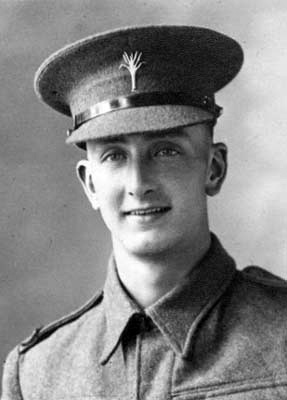 Llewelyn Jones
Photograph (and much of the information below) with thanks to
Keith Greenly-Jones via historypoints.org
Not listed in the Book of Remembrance but remembered here because the Commonwealth War Graves Commission’s post-war records note that his widow was “of Ewell” – a connection which (as set out below) has now been firmly established.
Llewelyn (in some records, “Llewellyn”) was born in June 1920, the third son of Hector Greenly Jones and Edith M (née Williams – they had married on 22 June 1911 in Llandegfan, Anglesey). The family lived at 5 Bryn Difyr, Bangor, and this is where the parents are found in the September 1939 Register. 51 year old Hector is listed as “LMS Railway Parcel Porter” and 50 year old Edith with the conventional “Unpaid Domestic Duties”. (While Hector is recorded as “Hector G Jones”, Edith’s married surname “Jones” was later amended to “Greenley-Jones”, and the family surname is seen as “Greenly-Jones” in many subsequent records.) The 1939 Register also has two currently closed records at the address: one of these may well be the 19 year old Llewelyn.
Llewelyn had attended Bangor’s Central School, after which he was employed as a sales assistant at the Lotus & Delta shoe shop in Bangor High Street. However, well before the outbreak of WW2, he left the job to join the Welsh Guards. He will have been sent to France in 1940 as part of the British Expeditionary Force and, after the German invasion, evacuated from Dunkirk. As part of the subsequent rebuilding and strengthening of British forces, the 3rd Battalion Welsh Guards was formed at Beavers Camp, Hounslow on 24 October 1941 and Llewelyn was assigned to this.
In February 1943 and registered in the local Surrey Mid Eastern District, 22 year old Llewelyn married 19 year old Vera Grace Keen. She was the first of two children born to Charles and Annie (née Bridger) Keen whose Q1 1923 marriage had been registered in the then Epsom District – as was Vera’s birth on 14 August 1923. The September 1939 Register had recorded 16 year old Vera (a “Daily Maid”) living with her parents – 60 year old Charles (a “Hospital Porter”) and 53 year old Annie (a “Charwoman”) – at 28 West Street, Ewell. (There is one currently closed record at the address, likely to be of Vera’s 13 year old sister, Joyce.)
Very shortly after their marriage, Llewelyn’s Battalion set sail for North Africa where they joined Montgomery’s 8th Army, the “Desert Rats”. By mid-April they were fighting on the Enfidaville Line about 60 miles south of Tunis. After the tide of the Desert War had been turned at the Second Battle of El Alamein in November 1942 and the near simultaneous Allied invasion of Algeria, fierce fighting on both flanks was forcing Axis troops towards Tunis. The Allies’ final push for Tunis began on 6 May.
On 8 May, the Battalion was under fire outside Enfidaville. As he went to help others, Llewelyn was shot in the neck by a sniper and killed. He is one of the 1,466 Commonwealth WW2 casualties buried in the Enfidaville War Cemetery near the coast sixty miles south of Tunis.
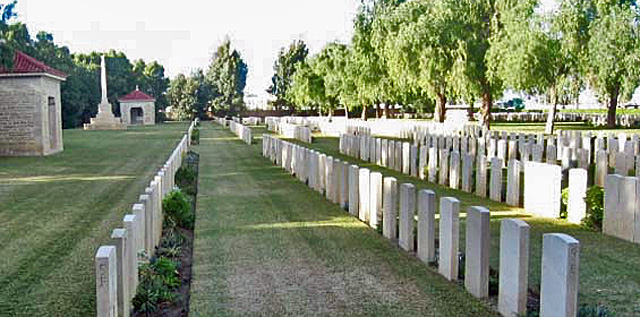
The Enfidaville War Cemetery, Tunisia.
Photograph with thanks to Iain Macfarlane via findagrave.com
The family took the option of adding a personal inscription to Llewelyn’s headstone on Grave VI.B.18,
“Though you lie far away in a land across the sea dear Llew, in our hearts you will ever be.”
It is not surprising that Llewelyn is commemorated on the WW2 memorial in his home town of Bangor, although (as pictured below) he does seem to be there twice: once with the surname “Greenley” and again as a “Jones”.

Left: Bangor War Memorial © Leslie Scarborough, 1990
Right: One of the Memorial’s two WW2 plaques © Nick_2, 2013
Both photographs with thanks to warmemorialsonline.org
Llewelyn is also commemorated on the kerb (as pictured below) of a grave in the Beaumaris Cemetery on Anglesey. However, his relationship to Stewart and Pansy (née Dibben) Owen who were buried in the grave in, respectively, 1945 and 1961 has yet to be established.
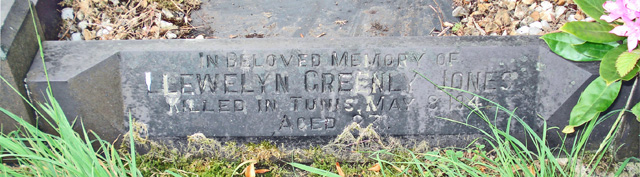
The memorial to Llewelyn on the Owens’ grave in Beaumaris Cemetery, Anglesey
Photograph by Bridget Geoghegan © 2020
Four days after Llewelyn’s death, the Axis forces in North Africa were finally overcome. More than 230,000 men surrendered. As prisoners of war, many were sent to camps in Llewelyn’s home patch of North Wales.
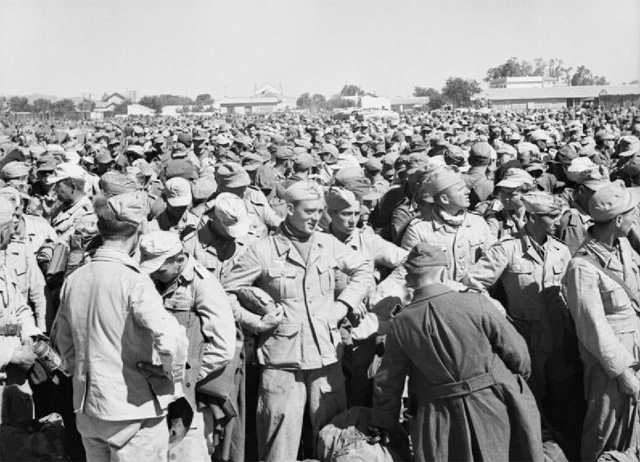 German and Italian Prisoners of War after the fall of Tunis
IWM Photograph NA2866 dated 12 May 1943, Public Domain
On 14 August 1944 and registered in the local Surrey Mid Eastern District, the widowed Vera married American serviceman Kenneth W Griffin. In Q3 1945, their son – also Kenneth W – was born and registered in the local Surrey Mid Eastern District. (There were no children from Vera’s brief marriage to Llewelyn.)
The 1945 Electoral Roll records Vera (now Griffin) still living with her parents at 28 West Street, Ewell. Husband Kenneth had returned to the States and, on 14 December 1946, Vera and the baby emigrated on the SS Washington to join her husband. The ship’s manifest notes that: their UK address had been “28 West Street, Ewell”; the baby was an “American Citizen”; and that both were “Dependants of T5 Kenneth W Griffin, ASM 33552287 US Army, 1017 Beechfield Avenue, Baltimore 29, Maryland.”
Roger Morgan © 2020
Please contact us if you have information or pictures that can extend this entry.
JOY Percy Frank.
Civilian.
Died 16 December 1940, aged 45.
Percy was born on 14 July 1896, the second child of Thomas Henry Joy and Mary Ann (née Cozens – their Q3 1893 marriage was registered in the East Grinstead District). Percy’s birth was registered in Dorset, the county from which Mary and her family came. However, the 1895 birth of his older sister, Hilda, had been registered in Epsom.
The 1901 Census records the family of four living at Stoke Villas, Burgess Road, Basingstoke, and Thomas is listed as a “Railway Clerk”. By the time of the 1911 Census, the four were living in West Street Epsom. 43 year old Thomas is now listed as a “Milk Vendor”, working from home – and 42 year old Mary Ann as “Assisting in the Business”. 16 year old Hilda is listed as “Student Civil Service”, and 14 year old Percy Franck as “School and Errand Boy”. (Living with them were Mary Ann’s widowed father, 73 year old Henry Cozens – listed as a jobbing gardener – and two school girl nieces.)
On 20 January 1916, the 19 year old Percy attested in Kingston for the 10th Battalion of the East Surrey Regiment with the Service Number 7014. He was 5′ 6″ tall and listed as a Chauffeur. While Percy was in uniform, his father died in Q2 1917. His widow continued the Dairy business as 5 West Street – at least for the next decade under her late husband’s name. In the 1930 and 1934 Kelly’s Directories, Mary’s own name is listed as the proprietor.
At some point after WW1 – and, given his father’s death, perhaps sooner rather than later – Percy joined the family Dairy business. In Q3 1925, he married Mary Harris Longhurst, registered in the Easthampstead District of Berkshire. They had two children, both born in Epsom – Mary, born Q1 1927 and Philip, born Q2 1932.
The September 1939 Register records the couple living at 136 Manor Green Road, Epsom. 43 year old Percy is listed as “Dairyman (Master)” – the family business is listed in the 1938 Kelly’s Directory as “Joy’s Dairy”, still at 5 West Street – and 45 year old Mary with the conventional “Unpaid Domestic Duties”. There are two currently closed records at 136 Manor Green Road, doubtless of their teenage children. Also living with them was Percy’s older sister Mary, now-widowed with the surname Dix and listed as “Civil Service Clerk (Inland Revenue)”. (Percy’s mother, Mary, had also lived with them there until her death in Q3 1938.)
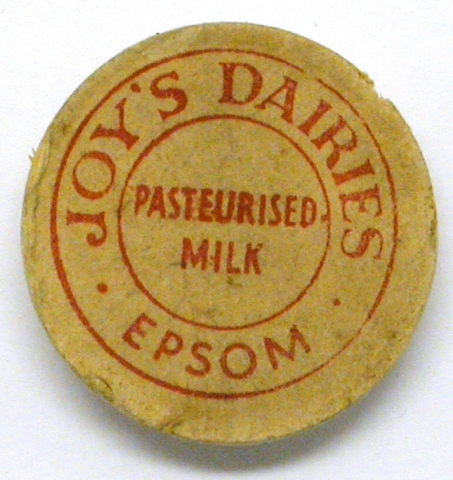 A Joy’s Dairy Cardboard Milk Bottle Top
Image courtesy of Bourne Hall Museum
The Commonwealth War Graves Commission’s records note that, on 16 December 1940, Percy was injured (by enemy action) at Laburnham Road, Epsom, and died later that day at Epsom County Hospital.
Percy was buried in Epsom Cemetery on 19 December 1940, in the same plot (A479) as both his parents.
Roger Morgan © 2018
Please contact us if you have information or pictures that can extend this entry.
Please Note: We believe that the information on this page is accurate however users should satisfy themselves that the information is correct before incurring any expense or undertaking any journeys. This is particularly important when purchasing certificates from other bodies, for example the General Register Office. You might like to use the following links to Freebmd and Find My Past (Links open in a new window).