
War Memorials – WW2 – Surnames I
Back to our main war memorials page
Index
Click on the name to jump to the relevant entry
IEVERS, Eyre Osbourne (Revised 28/08/2018)
IMPEY, Harry * (Revised 24/01/2022)
INGRAM, Rex Sidney Anthony * (Revised 18/10/2023)
IRISH, Cyril Vivian (Revised 29/07/2019)
* = Not included in the Book of Remembrance for reasons unknown.
If you are looking for someone whose name starts with a different letter please try:
A B C D E F G H I J K L M N O P Q R S T U V W X Y Z
Content
IEVERS Eyre Osbourne. Flying Officer (81827)
15 Bomb Disposal Squadron, Royal Air Force Volunteer Reserve
Died 29 April 1942, aged 39.
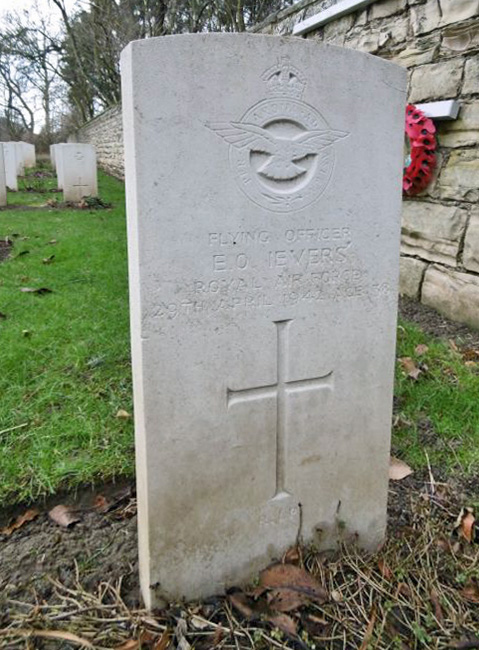 Eyre’s headstone in the St John the Baptist Churchyard Extension,
Kirkby Wharfe, Yorkshire
Photograph with thanks to www.militaryhistories.co.uk
Eyre Osbourne Ievers was born on 29 June 1903. He was reportedly the oldest son of Eyre Francis Wall Ievers and his wife Catherine Lilian (née N/K). The parents have left little trace on the readily available records. This is mainly because they spent a lot of time abroad at the family business in Buenos Aires, Argentina – but also because their unusual Irish surname was frequently mis-transcribed.
Eyre junior’s birth was registered in Tonbridge Kent in Q3 1903 – interestingly, being a manuscript addition to the printed record. Tonbridge is the town to which his the Irish Grandfather, a medical doctor (and also “Eyre Ievers”), had moved from Ireland in the 1870s.
After Eyre junior’s early education at Yardley Court, Somerhill, he followed his father to Tonbridge School from 1917 to 1920. He then trained as an Accountant before joining a family business in Buenos Aires, Argentina, during 1928. At about that time, his parents were resident at “Croft House”, Epsom. In 1936, Eyre returned to England to take employment with Eyre Smelting Co – of which his father, Eyre Francis Ievers, was Managing Director.
The September 1939 Register records the 66 year old Eyre Francis living at “Campana” (later 12), Lynwood Road, Epsom. No trace has yet been found of Catherine at the time – but Eyre senior is listed as “married” rather than widowed. Living with him were the also married 62 year old Ellen Strickland – listed as “Companion” – and their 42 year old cook, Mary Tout. (In Q2 1944, Eyre senior and Ellen got married, registered the local Surrey Mid Eastern District.)
The 26 year old Eyre junior was recorded in the 1939 Register living in lodgings at 15 Collingham Gardens, South Kensington. His surname is currently mis-transcribed as “Levers”, but he is listed as “Sales Manager Metal Manufacturer”.
Eyre junior became a member of the Royal Air force Volunteer Reserve – gazetted on 30 July 1940 with the surname “Levers” (corrected to “Ievers” on 22 October 1940). He was appointed Flying Officer in 1941 and Officer Commanding No 15 Bomb Disposal Squad, with headquarters at Ulleskelf near RAF Church Fenton and a few miles southwest of York.
On 28/29 April 1942 there was a “Baedeker Raid” on the City of York. These raids were the Luftwaffe’s retaliation for the increasing effectiveness of the RAF’s new campaign that had begun with the mass bombing of Lübeck on 28 March 1942. To increase the impact on civilian life, targets were chosen for their cultural and historical significance, rather than for any military value. The raids were referred to on both sides as “Baedeker raids” following the reported comment by a for the German Foreign Office that, “We shall go out and bomb every building in Britain marked with three stars in the Baedeker Guide” – a reference to the popular German travel guides of that name.
The raid had left two unexploded bombs close to RAF Clifton, just over a mile northwest of York. (It is estimated that between 5% and 15% of the many, many WW2 bombs did not detonate as planned.) Eyre’s unit was alerted at about 0800 hours on 29 April and, accompanied by Sergeant H Phoenix and Corporals Bonner and Williams, he travelled the few miles to the site for a reconnaissance to assess the resources needed. The reconnaissance crew found the two German 250kg unexploded bombs and had just examined the size of the holes of entry, when one bomb exploded, setting off the other. A rescue party raced to the site. Eyre was mortally injured and died on the way to hospital. (The other three eventually recovered from their injuries and trauma, and returned to duty with the Bomb Disposal Squadron.)
In a list of casualties, Eyre’s address was given as his father’s “Campana”, Lynwood Road, Epsom. RAF Records again showed his name incorrectly as “Levers” and that he had died of wounds or injuries received on active service.
A week after the incident, Eyre was buried in the nearby St John the Baptist Churchyard Extension, Kirkby Wharfe – one of the 24 WW2 casualties there. His father took the option of adding a personal inscription to his headstone on Grave B.O.
“R.I.P.”
Eyre senior, retired Company Director, died at 12 Lynwood Road, Epsom, on 8 December 1958 – and his second wife, Ellen, also died there on 11 May 1951.
Original text dated March 2014
Updated by Roger Morgan © 2018
Please contact the Webmaster if you have information or pictures that can extend this entry.
IMPEY Harry. 3rd Engineer Officer
SS Winamac, Merchant Navy
Died 31 August 1942, aged 32
Not listed in the Book of Remembrance
Harry was born in 1909, the fourth child of Harry Impey and Jenny (née Cook). The family are recorded in the 1911 Census living at 19 Acorn Place Peckham. 37 Year old Harry senior is listed as a “Carman to Corn Merchants”. 2 year old Harry’s three older siblings (aged 6, 10 and 12) were at school.
In Q3 1937, the 28 year old Harry married Eileen Edith Ruth Mills, registered in the same Camberwell District as his childhood home. Harry was almost certainly already in the Merchant Navy, so it is no surprise that he is not found in the September 1939 Register. The now 24 year old Eileen is recorded in that Register at 99 Rosedale Road, Sutton, visiting or lodging with a Mr & Mrs Fountain – together with 58 year old Mary Mills (like Eileen, married and listed with the conventional “Unpaid Domestic Duties”) and 32 year old Doris Mills, unmarried and listed as a “Gas Burner Ganger”. These were presumably Eileen’s relatives – perhaps her mother and sister.
Eileen was then in the final weeks of pregnancy: the couple’s first child, Roy, was born in Q4 1939. Their second child, Eric, was born in Q2 1942. Both births were registered in the local Surrey Mid-Eastern District but, until 1949, that included Sutton.
Anyway, at some point, Eileen moved to the Borough. The Commonwealth War Graves Commission’s post-war records note that the widowed Eileen was “of Ewell” and the 1945 Electoral Roll records her at 6 Mavis Avenue, West Ewell.
Harry served in the Merchant Navy as 3rd Engineer Officer on the oil tanker SS Winamac. Originally named Pulpit Point, she was built in Glasgow in 1929 for the Vacuum Oil Company. In 1933, she was acquired by the Standard Transportation Co., Hong Kong. In 1934, she was renamed Winamac and, in 1941, she was purchased by Socony-Vacuum Transportation Company of London.
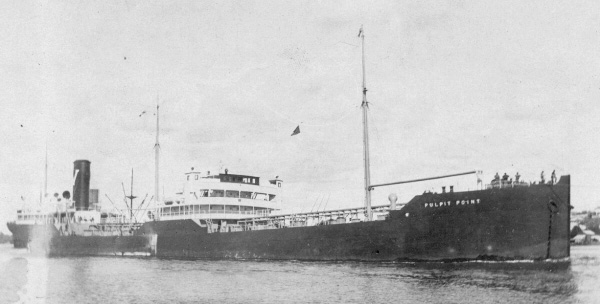 SS Winamac under her original name Pulpit Point.
Photograph courtesy of State Library of New South Wales
(via uboat.net – as is, with thanks, the incident detail below)
On 28 August, SS Winamac – with a cargo of 12,500 tons of fuel oil – sailed from Trinidad as part of Convoy TRIN-3 to the Azores. For some reason, the Convoy got dispersed. At 14:17 hours on 31 August 1942 and about 390 miles east of Trinidad, the now unescorted Winamac was hit in the engine room by one of two torpedoes from U-boat U-66. The tanker burst into flames and sank quickly. The master, 26 crew members – including Harry – and three gunners were lost. 21 crew members were later picked up and returned to Trinidad.
As one of nearly 24,000 WW2 Merchant Seamen with no known grave, Harry is commemorated on the Tower Hill Memorial.
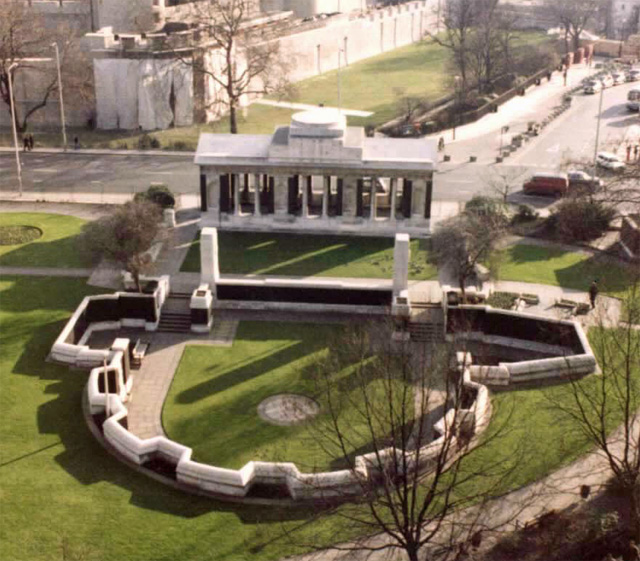 The Tower Hill Memorial (the WW2 section is the sunken garden in the foreground).
Photograph with thanks to Dan Jenkins “lost at sea memorials” blog
Roger Morgan © 2022
Please contact us if you have information or pictures that can extend this entry.
PS: The German U-boat U-66 was famously successful in its WW2 career, sinking 33 Allied ships – aggregating over 200,000 tons. She was hunted and pursued constantly, but survived until May 1944 when she encountered the escort carrier USS Block Island and the destroyer USS Buckley in the Central Atlantic. She did not go quietly. Having failed to make much impression with torpedoes and gunfire, Buckley rammed her and the two vessels locked together. U-66 then caused a diversion by boarding Buckley, whilst the rest of the crew tried to disentangle the submarine. U-66 escaped but was chased and fired upon by Buckley, whereupon the submarine turned and rammed the destroyer. The Germans then scuttled U-66. Nearly two thirds of the 70-strong crew survived and were picked up by the Americans.
INGRAM Rex Sidney Anthony. Lieutenant (304683)
4th County of London Yeomanry (Sharpshooters). Royal Armoured Corps
Died 13 June 1944, aged 19

Rex Ingram
Not listed in the Book of Remembrance
The Commonwealth War Graves Commission records note Rex as the “Son of Bernard William and Ada Lillian Ingram, of Epsom, Surrey”. While, as outlined at the end of this article, the parents’ connection with Epsom has been found, it seems to have been only brief – nor does it appear that Rex himself ever lived in the Borough.
His father, Bernard, was born on 13 May 1882 and, as an 18 year old, was recorded in the 1901 Census as the oldest of three children living with their parents (Frederick W – a “Lime & Cement Merchant”, with Bernard as his “Clerk” – and Eliza A Ingram) at 18 County Grove, Camberwell, supported by a domestic servant.
In Q3 1907, Bernard married Mabel Constance Clark. The 1911 Census records the couple (with Bernard now as a “Lime & Cement Merchant”) living at 35 Calais Gate, Cormont Road, Lambeth, also supported by a domestic servant. During WW1, Bernard served as a Lieutenant (No. 47243) in the Bedfordshire Regiment.
The marriage (in which there were no children) did not last and, in Q2 1925, the 42 year old Bernard married the 25 year old Ada Lilian Scott. She was the last of seven children born to Thomas and Sarah (née Bolitho) Scott. The 1911 Census recorded her as an 11 year old schoolgirl living with her late 40s parents (with Thomas listed as “Salesman / India Rubber Waterproof”) at 51 Victory Road, Wimbledon. For some yet to be discovered reason, the record of their marriage in the Pancras District lists Ada’s maiden name as “Ingram” rather than “Scott”. There is the same anomaly in the Q3 1924 registration of the birth of Rex – their only child, and the subject of this article – in the Camberwell District.
The September 1939 Register, Bernard (now as a “Company Director) and Ada (with the conventional “Unpaid Domestic Duties”) are found living alone at “Daleside”, Banstead Road, in the then Metropolitan Borough of Sutton & Cheam. The 15 year old Rex was at Dauntsey’s School in West Lavington, Wiltshire, where he is noted as a former pupil on the school’s WW2 Roll of Honour.
On leaving school, Rex entered Sandhurst in late 1943 and joined the 4th County of London Yeomanry (CLY) in January 1944 as it prepared for the D-Day invasion of France. (The 4th CLY had returned to the UK only in December 1943 – having played a key part in the battles of El Alamein, the advance into Tunisia and in the Italian campaign.)
As part of the 7th Armoured Division, 4th CLY landed on Normandy’s Gold Beach on D-Day+1, 7 June 1944. 19 year old Lieutenant Rex Ingram was in command of the three Stuart light tanks forming the 4th CLY’s A Company Recce Group. His own tank became bogged down on arrival at Gold Beach, and he commandeered another – understood to be “Calamity Jane 2”.
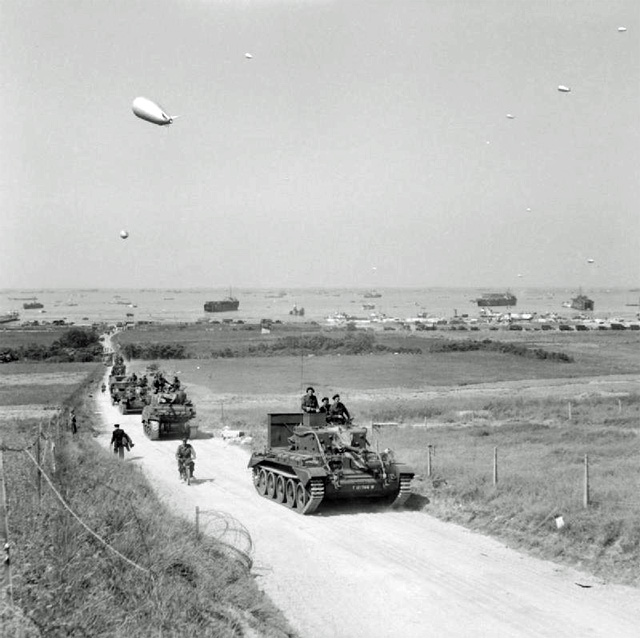 Tanks from the 4th County of London Yeomanry
moving inland from Gold Beach, 7 June 1944.
IWM photograph B 5251, public domain.
The Regiment was immediately engaged in Operation Perch, the aim of which was the capture of the German stronghold of Caen, a few miles inland from the Normandy beaches. This key and early objective of the invasion proved much more difficult than Allied commanders had anticipated and, after a week, Operation Perch was aborted on 14 June.
As an important stage in Operation Perch’s advance on Caen, British troops had captured the small town of Villers-Bocage, about 10 miles from the main objective. On 13 June 1944 (the day before Operation Perch was aborted), the 4th CLY was advancing with the 1st Battalion, Rifle Brigade (Prince Consort’s Own) by road from Villers-Bocage to Caen when, at point 213 it was ambushed by a detachment of German Tiger 1 tanks of the 101st SS Heavy Panzer Battalion. They knocked out the CLY’s lead Cromwell tank and then attacked the rest of the column (26 tanks and four other armoured vehicles) that were trapped behind it in the embanked road.
Rex engaged the Tiger tank that happened to be commanded by “Panzer Ace” SS-Obersturmführer Michael Wittmann. Wittman retaliated with an 88mm shell through the side of Rex’s Stuart tank, disabling it. It is understood that Rex got out of his tank and tried to reach his driver via the front hatch, but was gunned down in the attempt.
There were very heavy British losses in the engagement. In the confusion of battle, Rex was originally reported as missing but later confirmed as killed in action that day.
(The German’s attack on the column was the first stage of their counter-attack which, in the Battle of Villers-Bocage, forced the British out of the small town. This further prolonged the battle for the strategic city of Caen, which was finally taken by the Allies on 6 August.)
Rex was initially buried at Villers-Bocage by a local family, with whom his parents became friends after the war. On 23 February 1945, he and a number of others were reburied in the Tilly-sur-Seilles British Cemetery. On 5 March 1946, he was moved again and now rests as one of the 4,257 Commonwealth WW2 casualties in the nearby Bayeux War Cemetery. His parents took the option of adding a personal inscription (from John 15:13) to his headstone on Grave XV.M.22, doubtless chosen to reflect the particular circumstances of Rex’s death:
“Greater love hath no man than this, that a man lay down his life for his friends.”
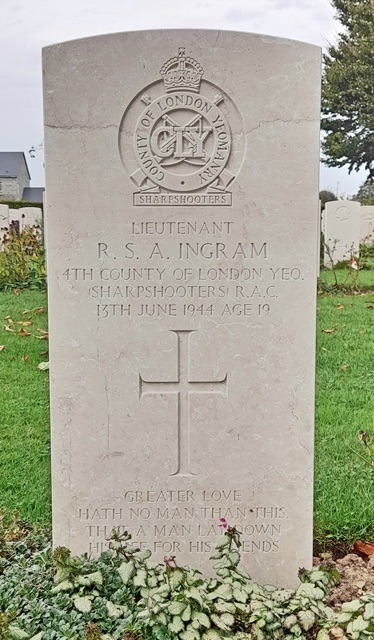 Rex’s headstone in The Bayeux War Cemetery
Photograph by Roger Morgan © 2023
As to the Epsom connection, the 16 February 1945 record of Probate on Rex’s estate (of some £200) states that his address had been 237 Walworth Road, London SE17. However, the Commonwealth War Graves Commission attributes the Borough connection to the parents who, as noted above, were in Sutton & Cheam in 1939. On 17 July 1944, the parents had a death notice published in the local paper which read:
“INGRAM.—LIEUT R.S.A. (REX) INGRAM, 4th County of London Yeomanry, aged 19, previously reported missing, now killed in action. Buried at Villers-Bocage, Normandy, June 13. Dearest only child of Mr. and Mrs. Ingram, at Spread Eagle Hotel, Epsom.”
The 1945 Electoral Roll lists the Ingrams still at Epsom’s Spread Eagle Hotel but, having moved from Sutton & Cheam, they later moved to Ashtead. When Ada died on 10 March 1951, their address was “Charnwood”, The Marld, Ashtead. The widowed Bernard remarried and moved to Worthing, where he died in 1975.
Roger Morgan © 2020
with thanks to Hazel Ballan for finding the Epsom connection.
Please contact us if you have information or pictures that can extend this entry.
IRISH Cyril Vivian. Sergeant (934541)
Royal Air Force Volunteer Reserve
Died 18 October 1941, aged 20
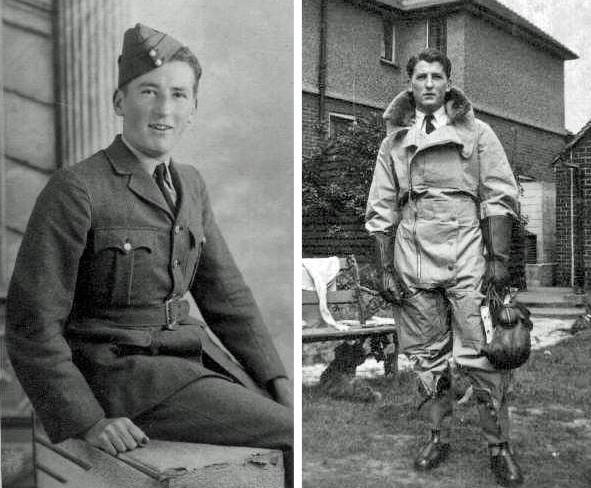
Cyril Irish in uniform and flying gear
Copyright acknowledged
Cyril was born in Epsom on 2 December 1920, the last of Charles George and Dora Lilian Irish’s five children.
His father, Charles, had been born in Devon but moved to Epsom in the early 1900s, and the 1911 Census recorded this 26 year-old lodging with Police Constable Robert Rounce and family at 57 Miles Road. Charles’s occupation is listed as “Clerk” – which other records show was at the “Asylums & Mental Deficiency Department, Horton Mental Hospital”.
The residents of 57 Miles Road on Census Day did not include the family’s 27 year old daughter, Dora Lilian: she was at “Pendennes”, Bridge Road, Epsom working as “cook domestic” for widowed Frances Kent and his 7 year old daughter. Charles and Dora married in Epsom Q3 1915, shortly before Charles began his WW1 service as a Private in the Lovat Scouts, during which he saw action in France.
Charles and Dora had three of their children baptised at Christ Church Epsom Common. In the case of first-born Ernest John (born 9 June 1916 and baptised 11 July – the day before he died) and second-born Cynthia Winifred (born 31 May 1918 and baptised 23 June) the family address is noted in the parish records as “Woodcote Place, Epsom” and Charles’s occupation as “Soldier”. It would seem that they were away from Epsom for the birth of their next two children but, by the time of last-born Cyril’s baptism at Christ Church on 2 January 1921, the address is recorded as “The Haven, Pound Lane” and Charles’s occupation as “LCC Clerk” – doubtless back at one of Epsom’s “cluster” of Mental Hospitals.
In due course, the family moved to their long-term home at 7 West Hill, Epsom. In his teens, Cyril attended Epsom County (now Glyn) School and was a member of the Scouts – almost certainly the 2nd Epsom Group, attached to Christ Church. As he is remembered on the Epsom Brotherhood’s WW2 memorial, he must also have been active in that organisation.
Cyril had attested in the Royal Air Force Volunteer Reserve, and his RAF career took him to No. 27 Operational Training Unit RAF (27 OTU). This had been formed at RAF Lichfield in April 1941 as part of No. 6 Group RAF Bomber Command with the purpose of training night bomber crews.
On 18 October 1941, Cyril (who was training as a Wireless Operator/Air Gunner) was one of a training crew flying a Vickers Wellington Ic (X9821). It crashed while turning to the north of the Aerodrome and all four of the crew were killed.
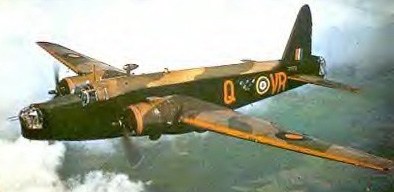 A Vickers Wellington
Picture courtesy of www.pilotfriend.com
Cyril’s body was brought back to Epsom for burial. On 25 October, he joined his brother, Ernest John (who, as noted above, had died aged only one month in 1916 – four years before Cyril was born) in grave A384 of Epsom cemetery. In 1947, these two were joined by their father. The grave also now carries memorials to their mother (who died in 1987) and their sister, Cynthia Irish MBE (1918-2011).
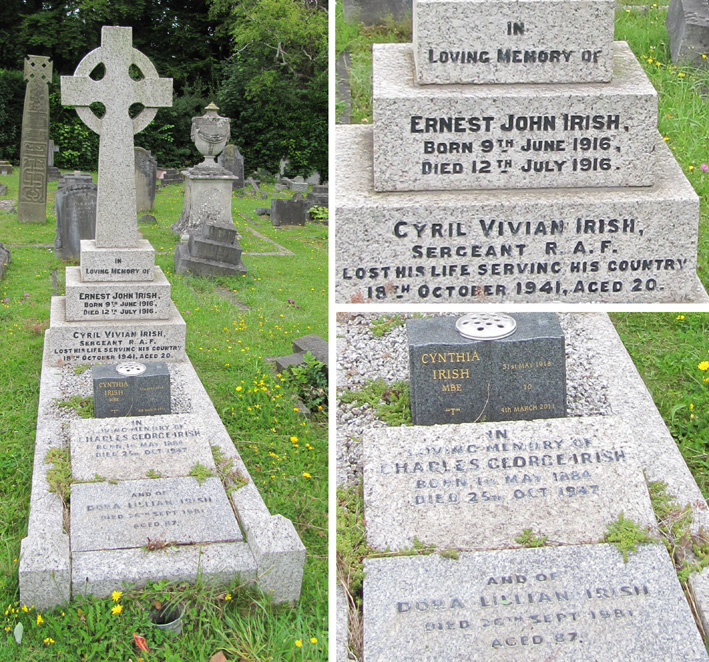 The Irish family grave in Epsom Cemetery
Photograph by Roger Morgan © 2017
Roger Morgan © 2019
Please contact us if you have information or pictures that can extend this entry.
Please Note: We believe that the information on this page is accurate however users should satisfy themselves that the information is correct before incurring any expense or undertaking any journeys. This is particularly important when purchasing certificates from other bodies, for example the General Register Office. You might like to use the following links to Freebmd and Find My Past (Links open in a new window).