
HORTON CEMETERY – THE HISTORY
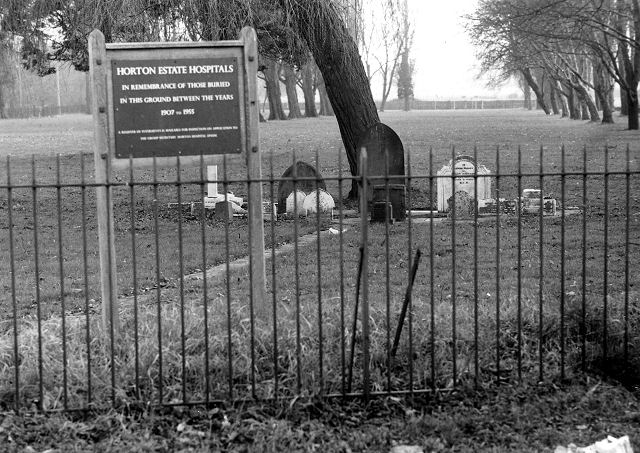 Horton Cemetery
photographed on 28 February 1971 by L R James.
Image courtesy of Epsom & Ewell Local & Family History Centre
INTRODUCTION
The now derelict Horton Cemetery – occupying some 4½ acres at the junction of Hook Road and Horton Lane (and just across the roundabout from the Hook Road Arena) – was established in 1899 for the pauper burial of inmates who died in the Epsom Cluster of mental hospitals and who had no relatives to reclaim them for other burial. Originally intended for 900 burials, it eventually received some 8,500!
The main part of this article sets out the background to its late 1890s establishment, its use, the closure and sale in 1983, and its decline to the present dereliction. It ends with two tailpieces about the monument erected in 2004 to commemorate all those buried in the cemetery and the important work of the independent Friends of Horton Cemetery.
The companion article sets out what is known about the individual burials there – but, for convenience, we repeat here that article’s links to details of the Cemetery’s burial records (ordered by surname as below).
A B C D E F G H I J K L M N O P Q R S T U V W [x] Y Z
For more information (including an ever-increasing list of biographies of those interred) – or to help with further research – please visit the independent website of The Friends of Horton Cemetery, about whom there is more in the final section of this article.
CREATION OF HORTON CEMETERY
On its formation in 1888, the London County Council took over responsibility for thousands of the mentally ill. Their families could no longer look after them, or had never done so. Many of these people were elderly, and some had been living in workhouses. The LCC needed new buildings to house them and, in 1896, its Asylum Committee bought some land at Horton. It was a large area of land, capable of supporting five or six mental hospitals – the largest concentration of them in the country.
By 1898, it was clear that the Asylums Committee meant business. The hospital at the old Manor was almost finished, and plans were under way for another at Horton. The Epsom Council was most alarmed at this. The asylums were growing much faster than they had expected – soon there would be up to ten thousand people, a second town almost the size of Epsom itself. Some of them would be discharged after a short stay, but the hospital regime was set up to look after people rather than cure them. Many – perhaps most – would remain at Horton until they died. And then?
It was not long before that – 1871, in fact – that the council had opened its own cemetery in Ashley road. This replaced the parish graveyard at St. Martin’s church, where generations of the dead had been laid, ever since the days when Epsom was a Saxon village. Now it was a thriving Surrey town with a growing population, and room was running out. Conditions at St. Martin’s had never reached the squalid state of London’s overcrowded churchyards, but it had been touch and go, and the land at Ashley Road was purchased just in time. Besides, the councillors were rather proud of their new cemetery. It had a porter’s lodge beside wrought iron gates, and the architect had given it two fine chapels, one for the Church of England and one for dissenters. In thirty years, the cedar and pine trees had grown to shade the curving walks, and already there were citizens of Epsom resting under dignified monuments of white marble and rose granite.
In short, Epsom did not want the peace and dignity of its cemetery to be spoilt by an influx of pauper lunatics. For the winter of 1898, the councillors allowed a few burials on the uphill side, away from the gates, charging the usual fee of £1 per burial which was made for people who came from outside the town. But the Asylums Committee were told, firmly but politely, that they would need a cemetery of their own. And in the following spring Mr. Clifford Brown, the Asylums Engineer, came down to find a site.
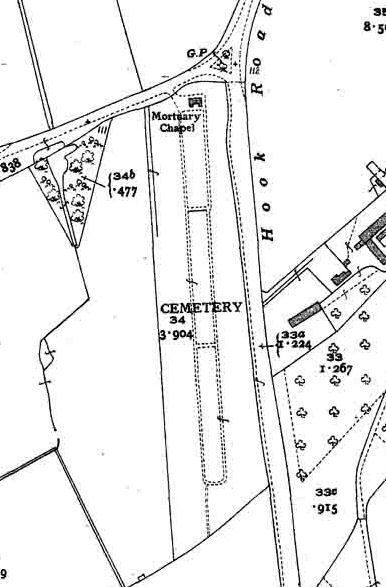 Extract from the 1933 Ordnance Survey Map.
He was looking for a small plot of land, away from the hospitals themselves, but easy to get to. The corner of Hook Road and Horton Lane seemed to fit the bill; it was already owned by the LCC, and stood at some distance from the existing asylums at the Manor and Horton, as well as the proposed site of Long Grove. There was only one problem – unlike the Ashley Road cemetery, which was on a chalk slope, this site rested on the sticky clay soil of Horton. Water bubbled up in holes almost as soon as they were dug. The Borough Surveyor and the Medical Officer insisted that drains should be laid below the level of the graves to clear the water. It could run off into a holding pond on the other side of Horton Lane.
Throughout 1899, Brown was kept busy planning the new cemetery. It would hold 900 graves in rows on either side of a central path. Like the hospital grounds, it was to be marked off from the road by an iron fence, behind which there would be a raised bank planted with a privet hedge. Works cost £869, rather less than half what was originally budgeted, and the cost included £252 for a chapel provided by Messrs. William Harbrow. This was what used to be called a tin tabernacle: it had a wooden framework fitted with corrugated iron sheets to keep off the rain, and was lined on the inside with felt and match boarding. Pointed windows and a little turret gave it an ecclesiastical character, but it was still a marked contrast to the detailed Gothic stonework of the Ashley Road chapels.
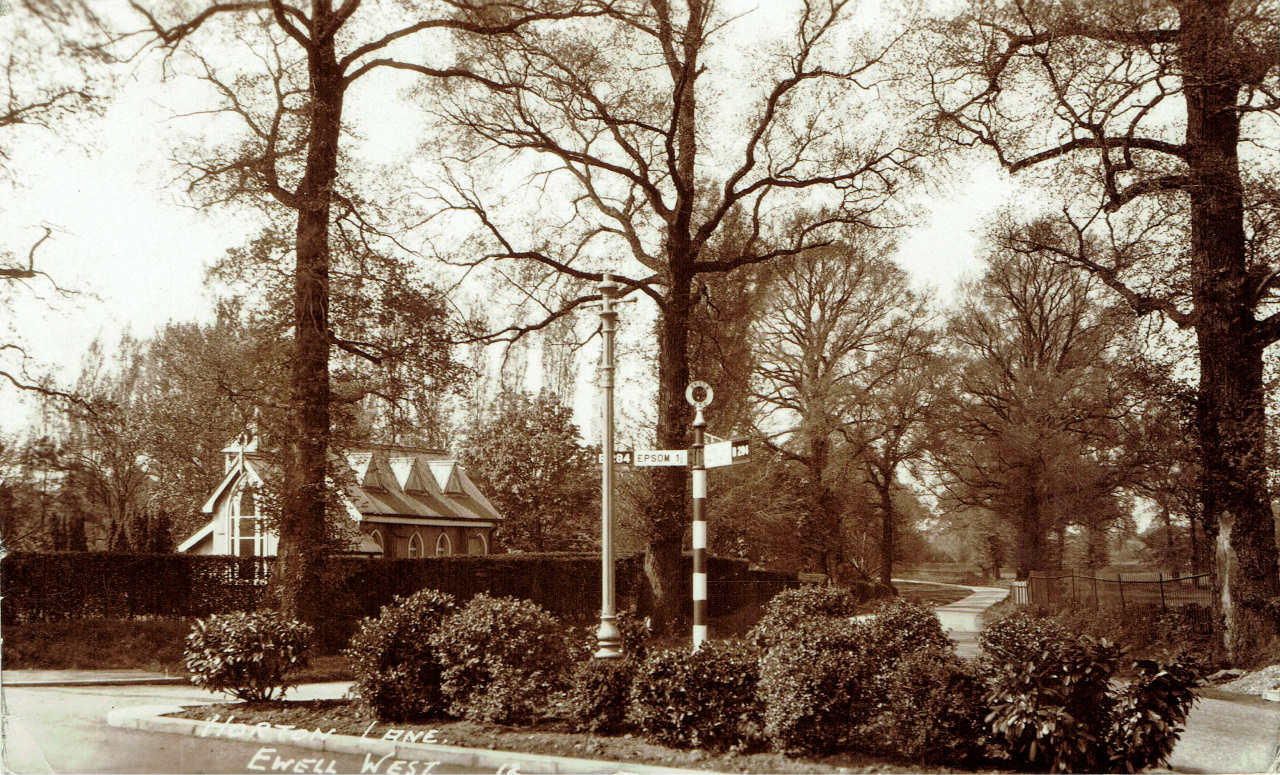
The Horton Cemetery Chapel also known as the Tin Tabernacle c.1938.
Image courtesy of Bourne Hall Museum
USE OF THE CEMETERY
On 31st July the cemetery received its first burial – Annie James, who had been at the Manor. Her shroud cost 8d, the gravediggers were paid 10/6d, and James Ockenden the undertaker received £1/12/6d. The Asylums Committee were anxious to keep down costs. They did not put up memorials, although they had no objections to these if they were provided by relatives. Sarah Hubbard was admitted to the Manor in August 1901, and died a month later; her brother put up a headstone shortly afterwards. Others were to follow, perhaps thirty or forty over the next five decades. This was a tiny proportion of those buried there, but most families were too poor to afford a memorial, or had lost touch altogether with their relatives at Horton.
The building of the Epsom Cluster of mental hospitals went on apace – the Epileptic Colony (afterwards St. Ebba’s) in 1902, Long Grove in 1907 and West Park at last in 1924. The Manor continued to manage the cemetery, supported financially by the other hospitals. They were quite conscientious about its upkeep; double rows of poplar trees were planted in 1901, and two years later the cemetery was enlarged. When the chapel became dirty or untidy, the Asylums Engineer was told to sort it out. But things were still being done on the cheap. Several funerals were in the hands of Simpsons of Walworth, who sent down their hearse in charge of a shabby and unwashed driver. In 1906 he turned up with his two small children riding on the hearse. It was all rather lax, and not what one expected for a funeral.
Then there were problems with the drainage. More than a thousand grave spaces were available, each one ticketed with a metal marker, but more room was needed and by the 1920s up to three burials were being made in each grave. The coffins were wood, of course, and wood floats; if the grave filled with water, there could be distressing scenes. Alfred Hillier, who turned in his job as farm labourer in 1925 and applied for cemetery keeper (58/6d for a 47 hour week) had a tough time ahead of him.
If the Asylums Committee economised on graves, they were positively lavish when it came to places of worship. Each of the hospitals had a commanding chapel, large enough to accommodate most of the patients each Sunday. Church attendance was to be a soothing and orderly part of their routine, with the music of the hymns bringing back memories of a time before they were hospitalised. But funerals were held at the tin tabernacle, and were much smaller affairs. The chaplain or the free church minister would walk over – it was agreed that on wet days he could be driven, at the asylum’s expense – and would conduct a brief service. The coffin would already be waiting in the chapel, having been wheeled down the lane on a small bier. Normally each individual received their own funeral service, but sometimes they were buried in batches.
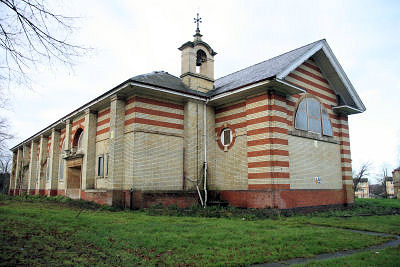
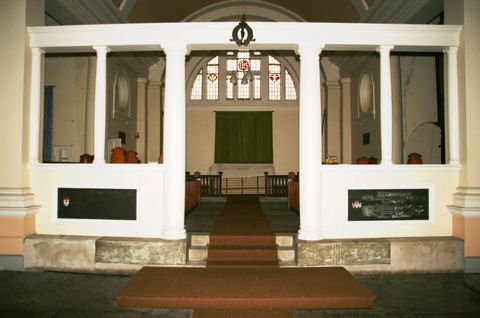 The disused Horton Asylum Chapel in 2008
(after renovation, reopened in 2021 as “The Horton” – a not-for-profit venue for arts and culture.)
Images courtesy of Clive Gilbert © 2008
Before this, the dead would have been resting in the mortuary chapel which was attached to each hospital. These had begun as annexes to the post-mortem rooms. It was part of a nurse’s job to go round the wards in the morning and see if any patients had died during the night; then they could be removed with minimal fuss from their neighbours on either side. But later these buildings were fitted up as chapels of rest, with their own lying-in coffins. People who had no friends outside the hospital could be passed on for dissection – one shilling per body was the going rate in 1903 – although at the request of their community, the bodies of Jewish patients were not sold.
THE GREAT WAR (1914-18)
The First World War saw an upheaval in the life of the Epsom Cluster. Horton Hospital was closed, and its 2,100 patients were transferred to other institutions. In 1915, Horton reopened as a war hospital, treating wounded soldiers who had been brought back from the horrors of the Front. The hospital was run by Lieutenant-Colonel Lord – Dr. Lord, as he had been when he was in charge of the asylum. One of his many duties was the burial of soldiers who had died of their wounds.

Lt Col John Robert Lord.
Photograph with thanks to the Imperial War Museum © IWM HU 124317
Epsom Council were approached, as they had been in 1898, but this time the response was much more sympathetic and a small area within Epsom Cemetery, Ashley Road, was set aside for such burials. Soldiers who died of their wounds in Epsom’s War Hospitals were buried there rather than in Horton’s cemetery for asylum inmates. The Ashley Road plot was and still is maintained to a very high standard by the Commonwealth War Graves Commission (formerly the Imperial War Graves Commission). Of the 148 men named, 59 are Canadian, six are Australian, two are Gurkhas, one is from Burma and one is from India. The other 79 are from a variety of units from the UK, mainly army but there are three from naval forces and two from the RAF.
It is interesting to note that all the 59 Canadian and the six Australian burials are in individual plots – as are the two Gurkhas, the two from Burma and the one from India. (Note: Initially not all the Canadian and Australian burials were in individual plots. Their Governments objected to multiple burials and some were exhumed and reburied in individual plots.)
However, of the 79 from the UK, only four are buried individually, the other 75 being buried in 12 plots with up to nine in a single plot. There are two special memorials in the CWGC plot to men buried in Horton cemetery, WW1 casualty Peter McMahon and WW2 casualty Henry James. Why they were buried at Horton rather than in Epsom Cemetery is a mystery.
WORLD WAR II (1939-45)
During WW2, Horton was once again made into a war hospital. In addition, the other hospitals catered for a number of soldiers, mostly foreign nationals, whose mental health had suffered under the stress of war. Those who died at Epsom were buried at the Hook Road cemetery, their graves marked by wooden crosses. There were other patients like George Saunders, an ambulance driver who worked through the Blitz until he was injured and had to be hospitalised; he was buried in 1942 with a small headstone.
POST-WAR DECLINE AND CLOSURE
The 1950s transformed the Epsom Cluster of hospitals. They were no longer supposed to be isolated, self-sufficient communities; now it was hoped that patients would stay for shorter periods, and that there would be fewer of them. Numbers fell from the thousands to the hundreds, and in 1955 the Hook Road cemetery was closed. The grounds continued to be maintained as a garden of rest, although the tin chapel disappeared. In its place was a small paved area, where the few headstones were set under a weeping willow tree, after being removed from their proper graves. The rest of the cemetery was maintained as a lawn under the trees.
It continued in good order until the 1970s, but meanwhile national attitudes to the great mental hospitals were undergoing a change. They were no longer seen as the answer to mental health problems, and a regional working party recommended that the Horton property should be sold to defray the expenses of care. The authorities had already lost interest in the cemetery and the remaining headstones were being vandalised. In 1983 the Regional Health Authority sold the land to Michael Heighes of Marque Securities in Kingswood. Mr. Heighes had no interest in maintaining the land as a cemetery; he was a property developer. Proposals to use it as a market garden or a car park came to nothing. The condition of the grounds grew worse with time. In 1996, when redevelopment of the hospital cluster was imminent, the first attempts were made to bring Hook Road cemetery back into the public memory.
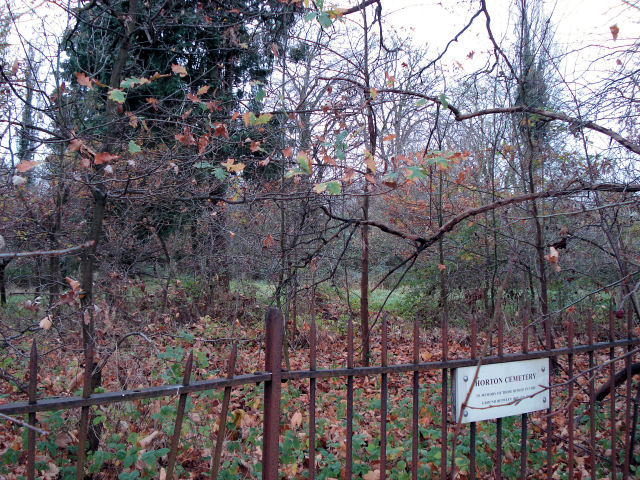
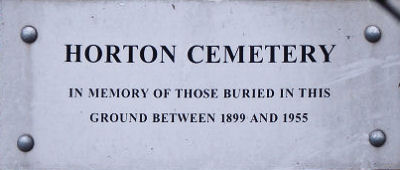 The Horton Cemetery in November 2008
Images courtesy of Hazel Ballan © 2008
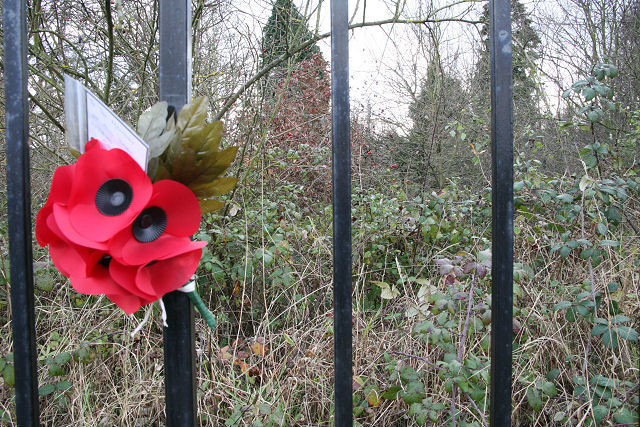 Another view of Horton Cemetery in November 2008
Image courtesy of Clive Gilbert © 2008
Text courtesy of Jeremy Harte
Curator Bourne Hall Museum
THE HORTON MEMORIAL
Incensed by the continuing decay of the Cemetery, in 2001 (during his term as Mayor of of Epsom & Ewell) Cllr Alan Carson began a campaign for the erection of a memorial for all those buried in Horton Cemetery. That came to fruition in 2004 with the unveiling of the granite obelisk (pictured below) at the north east end of Horton Lane.
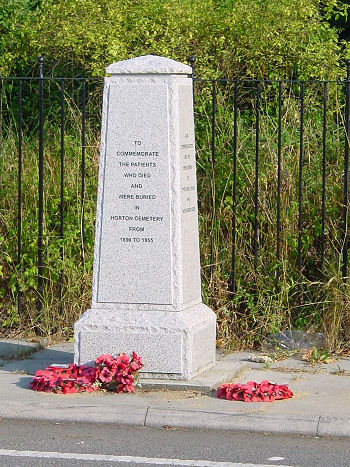
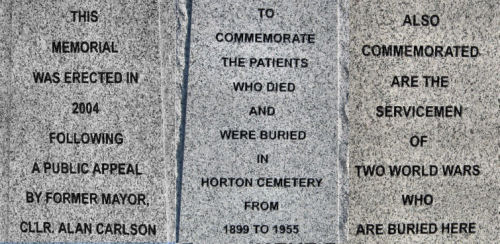 The Horton Memorial with close up of text.
Photographs courtesy of Peter Reed © 2008
On Wednesday 28 November 2007, the Epsom Post carried the following report of Mr Carlson’s remarks at a Remembrance Service held earlier in the month.
A former Epsom councillor has spoken of his disgust with the continuing neglect of Horton Hospital Cemetery.
Alan Carlson, who for years was one of the town’s most popular Labour councillors was speaking at a special remembrance service at the Horton memorial monument, for which he campaigned when Mayor of Epsom and Ewell in 2001.
The generosity of the public concerned at the neglect of the privately owned Hook Road graveyard enabled Mr Carlson to arrange for an engraved granite memorial to be placed just outside the iron-railed cemetery.
Since its erection and its dedication in 2002 the monument has attracted a steady stream of floral tributes. Mr Carlson said: “It is hardly ever without flowers or wreaths, surely a testament to how much this cemetery means to local people. However the conditions within the grounds remain a shocking insult to those laid to rest within and are an indictment of a system that allows such public land to get into the hands of property speculators who wish to create land banks against the prospect of future development opportunities, with no regard to the sensitivity of the site.”
Up to as many as 9,000 patients, war casualty soldiers and children lie buried within the old Cemetery but, since the 1980s when the North West Thames Regional Authority sold it off, it has been owned by Marque Securities a development company in Kingswood. Director Michael Heighes bought the land for commercial purposes and future investment. But his bids to develop the site have met with refusal from Epsom and Ewell Council.
For his part Mr Heighes is still hoping to get permission one day to concrete over the graves and use the site for leisure development “suitable to that area”. At one time he asked if he would need special permission to turn the land into a pet cemetery. Mr Heighes offered the council “a useful chunk” of the cemetery ground where they could have put the memorial, but in return wanted the go-ahead for developing the rest of the site, which the council refused.
At the remembrance service on November 10, wreaths and flowers were laid. A two-minute silence was observed and then 12 white doves were released to fly over the cemetery. “This brought a sense of awe and wonder to the event, but the state of this derelict, untended former cemetery remains an insult to all of us who care. Some of us have not forgotten.” added Mr Carlson.
When asked if he would be tidying up the cemetery or selling it on to someone who would, Michael Heights declined to comment.
THE FRIENDS OF HORTON CEMETERY

The Friends’ logo features the Cemetery’s now-lost “Tin Tabernacle”.
Horton Cemetery is the largest derelict hospital cemetery in the UK, and the site is currently owned by a developer. While Epsom & Ewell Borough have so far refused permission to build on the land, the developer presumably hopes the ever-increasing demand for new housing will eventually end that resistance to development. Other hospital cemeteries have been built on.
A group of local residents is trying to get the ground protected from development in perpetuity and cleaned up so that the cemetery occupants, most of whom may still have relatives alive today, are shown the respect they deserve. As part of this, the group is working to bring the occupants “back to life” by researching and writing up their lives (about which there is more in our companion “burials” article). By telling the stories of the people buried there they hope that, when the time comes, they will have the stories of enough cemetery occupants to be able to rally mass public support for the protection of the ground. For more details of their work – and, if possible, to offer welcome help – visit their independent website, The Friends of Horton Cemetery.
Please click this link to read what is known about the many burials in the Cemetery.
The above (like the companion “burials” article) is a 2023 reordering of the original 2008 article and its various subsequent additions.
For convenience, we repeat here the links (ordered by surname as below) to details of the Cemetery’s burial records.