
Dr JOHN ROBERT LORD (1874-1931)
CBE MD FRCPE Lt Col RAMC
Medical Superintendent of Horton Hospital 1907-31
(and Officer Commanding during its 1915-19 use as a War Hospital)
 Dr Lord, shortly before his death in 1931.
Photograph from his obituary in the Journal of Mental Science.
Dr John Robert Lord has, hitherto, been mentioned only briefly in these pages in connection with his time as Officer Commanding during Horton Hospital’s use as a War Hospital from 1915 to 1919 – see, for example, the WW1 section of our Horton Hospital article. There is, however, a great deal more that needs to be said about this interesting man and his significant contributions to the development of mental healthcare.
John Lord was born in Blackburn, Lancashire, on 14 August 1874, the fourth child of Samuel and Agnes (née Barrow) Lord. The 1881 Census records the family – parents and four children (including 6 year old John), supported by a domestic servant – living at 31 King Street, Blackburn. This was a medical household: John’s father, Samuel, is recorded as a “Dental Surgeon”; and his elder brother, 17 year old Richard, is listed as “medical student”.
As a teenager, John showed some literary flair and had several articles – on broad-ranging subjects such as “The Temperance Question” and “Our free libraries and museums, and their uses” – published by the Blackburn Standard. After his initial education in Blackburn, he studied in nearby Manchester – at Owen’s College (which, in 1904, became the core of today’s University of Manchester). John followed his father and elder brother into medicine. His professional education was at Edinburgh University: the 1891 Census records the now 16 year old John as a “medical student” boarding at 40 Princes Street. He continued to show his literary abilities by contributing to the University’s Science Gossip. He appears to have specialised in general pathology, and passed his final MB examinations in 1896 “with distinction”.
John’s introduction to psychiatry took place in 1897 when he took the post of Clinical Assistant at the Joint Counties’ Mental Hospital in Carmarthen, also becoming a member of the (subsequently, Royal) Medico-Psychological Association. He quickly made his mark on the national scene, being awarded the Association’s Bronze Medal for his work. In 1898, John went (with a strong recommendation) to St Bernard’s Mental Hospital in Hanwell, thus beginning his long career in the service of London County Council. He was a voracious and thoughtful reader of contemporary psychiatric literature and, in 1900, became an assistant editor of the Royal Medico-Psychological Association’s Journal of Mental Science. (In 1911, he was made one of the journal’s Co-Editors and was then Senior Editor from 1914 until his death in 1931.)
After only a short time at St Bernard’s, John was moved to Bexley (on Dartford Heath), the newest of the LCC’s mental hospitals. The 1901 Census records the now 27 year old John as one of the four Assistant Medical Officers there. He continued to make his mark and, in 1903, was promoted to become the Hospital’s Deputy Superintendent. John’s health, however, was far from robust: it was noted that although he was “by no means an invalid, he was glad at times to seek the seclusion of his senior colleague’s house, and to do some of his work on the sofa in the latter’s study“. He was not, however, antisocial: indeed, he was glad to attend various social functions although would not participate in anything that required physical exertion.
John’s cutting-edge work continued to attract the most positive attention and, in February 1907, he was appointed as Superintendent of Horton Hospital, one of Epsom’s “cluster“of mental hospitals. Under his unusually enlightened and inclusive leadership, Horton quickly became known for the excellence of its medical administration, and as one of the most progressive hospitals in the country.
Then came what we now call the First World War, for which the Government quickly realised that Britain needed substantial additional medical facilities to tend for servicemen physically and mentally damaged in the fierce fighting. Twenty four mental hospitals were designated to become War Hospitals, with present patients sent elsewhere. Horton was one of these, and John was kept in charge, being commissioned for this purposes as a Lieutenant-Colonel in the Royal Army Medical Corps. (Both his health and profession would have ruled John out for ordinary military service, and it seems he was pleased to be able to play his part in the war effort in this way.)
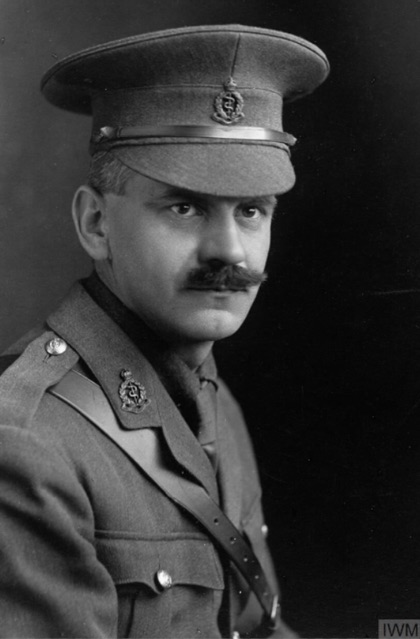 John Lord in his WW1 role as Lt Col RAMC, Officer Commanding Horton War Hospital.
Photograph with thanks to the Imperial War Museum © IWM HU 124317
It was a change in role and style that defeated a number of his contemporaries. In spite of the significant and novel demands (and his continuing poor health – which some saw as bordering on invalidity), John rose to the challenge and Horton War Hospital – which, over its four years, cared for nearly 45,000 patients – became known as one of the best and most efficient in the country. In 1918, John was awarded the CBE (Military Division) in recognition of his work.
In 1919, Horton ceased as a War Hospital and began to get ready for return to its original use in caring for mental patients, the first of which were readmitted in February 1920. In the meantime, John used his writing skills to set down “The story of the Horton (County of London) War Hospital: Epsom“, the 264 pages (with 7 plates and a plan) of which were published by Heinemann (Medical Books) in 1920 at 12s. 6d. (62½p). [The complete text is available at this link.]
A contemporaneous review noted:
“It is not a particularly easy task to present such a mass of administrative detail as this book contains and at the same time make it interesting to the general reader. Col. Lord has managed, however, to achieve this task, and has written an essentially human and readable book. He tells us of his difficulties and how he met them; he records his doubts, fears and trepidations; he gives in a few happy paragraphs his impressions of the numerous distinguished visitors to the hospital; and he lets us into various little secrets. . . .
“It is quite certain that such a large undertaking could only have been carried through successfully by the loyal co-operation of the staff with their commanding officer. The magnitude of the work is apparent from the fact that 44,613 patients were treated in the hospital, and that at one time there were as many as 2,507 occupied beds.”
The 1921 Census records the 47 year old John as “Physician & Surgeon / Medical Superintendent” in his on-site residence of Horton House, supported by two domestic servants. (Also there on Census day was one of his nieces.)
Postwar, it was not “business as usual”. The wartime experience helped bring about a broadening of approach, aiming to make “hospital” in Horton’s title a reality rather than a euphemism for “asylum”. One of John’s publications was “Mental Hospitals and the Public – a Plea for Closer Co-operation”, and this became the keynote of much of his work. Horton was among the first – if not the first – to appoint a social worker to set about enlightening the community on the problems of mental disease. Another initiative in the same direction was the establishment of a firm link between Horton and London’s Royal Free Hospital and its School of Medicine for Women. From 1928, John lectured in Clinical Psychiatry to the School, and organised associated courses of instruction at Horton.
Notwithstanding his poor health and the demands of his work at Horton, John was (in addition to his editorial role on its journal) highly active in the Medico-Psychological Association. He helped prepare evidence for the Royal Commission on Lunacy and is credited as providing the main effort in securing its charter of incorporation and the designation “Royal”. His peers rewarded him by electing him as the Association’s President for 1926-27. They had been concerned that his clearly failing general health might lead him to decline. Instead, he accepted gladly and, in the same way that he had been reinvigorated by his wartime role, the additional responsibilities unleashed new reserves of energy. He seemed to welcome the fact that he needed less sleep than average as an opportunity to get on with more work. An article in the 22 August 1930 edition of the British Medical Journal praising John’s great contribution to the development of mental healthcare noted:
“Every evening, however, after his official duties for the day were over, he began a second day’s work for the [Medico-Psychological] Association, working on till all hours of the morning of the next day. The amount of work, mainly of a literary and organising kind, that he did during these undisturbed hours in the evening and night-time was colossal.“
During his year preparing to take on the Association’s Presidency, John proceeded to his MD degree and to membership of the Royal College of Physicians of Edinburgh – which immediately conferred their Fellowship on him. His Presidential address on “The Clinical Study of Mental Disorders” set in train a number of beneficial developments within the Association to develop and pursue new practices. John also devoted much energy to the training of mental nurses and, in 1929, was appointed as a member of the General Nursing Council. He was actively involved in preparations for the Mental Treatment Act of 1930 – being “An Act to amend the Lunacy Acts, 1890 to 1922, and such of the provisions of the Mental Deficiency Acts, 1913 to 1927, as relate to the constitution and organisation of the work of the Board of Control, the exercise of the powers of the Board and the protection of persons putting those Acts into operation” – and which also formally replaced the term “asylum” with “mental hospital”.
In 1930, John went to Washington DC to represent the LCC and his Association at the first International Congress of Mental Hygiene. He made his mark there and was elected a permanent member of the Committee.
Friends and colleagues – who had always thought John too driven to care about romantic love – were delighted when he married Dr Ruby Thornton Carr at St Mary’s, Chessington on 21 March 1931. It is not clear how the couple first met. The 1930 Electoral Roll (compiled in 1929) records her at Horton Hospital. But had she come there from the School of Medicine for Women at London’s Royal Free Hospital with which, as noted above, John had forged a link? As will be seen, she later went – or returned – there.
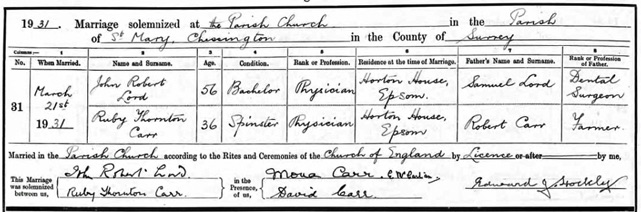
The Register entry of John and Ruby’s 1931 marriage.
Their marriage was, however, tragically short. Just 20 weeks later, John’s long-standing health issues finally got the better of him and he died in post on 9 August 1931. The memorial pictured below was placed in Horton Hospital’s chapel (and remains in place in what is now “The Horton”) “in affectionate remembrance and esteem by his widow, colleagues, friends and members of the Horton Hospital staff.”
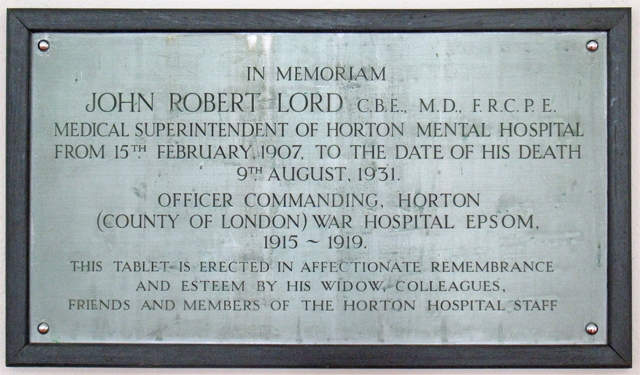 Memorial plaque in “The Horton”, formerly the chapel of Horton Hospital.
Photograph by Roger Morgan © 2023
The sadly widowed Ruby moved (back?) to the Royal Free Hospital in Gray’s Inn Road, London – but her life was then cut tragically short: she died there on 21 January 1935, aged only 39. Her body was brought back to Epsom for burial alongside her husband in Plot K112/115 of Epsom Cemetery.
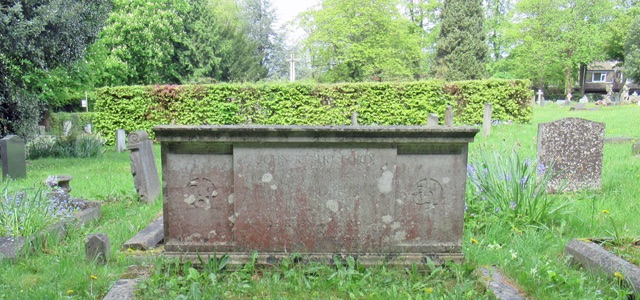 The headstone over the graves of John and Ruby Lord in Epsom Cemetery.
Photograph by Roger Morgan © 2023
The engraving on the headstone is now hard to decipher, but the text is:
JOHN ROBERT LORD
C.B.E. M.D. F.R.C.P.E
MED. SUP. OF HORTON MENTAL
HOSPITAL 1907-1931 O.C. OF
HORTON (COUNTY OF LONDON)
WAR HOSPITAL 1915-1919
ALSO HIS WIFE
DR. RUBY T. LORD
WHO DIED ON JANUARY 21st 1935
AGED 39 YEARS
The roundels to left and right of the headstone are, as pictured below, the years of John Lord’s birth (1874) and death (1931).
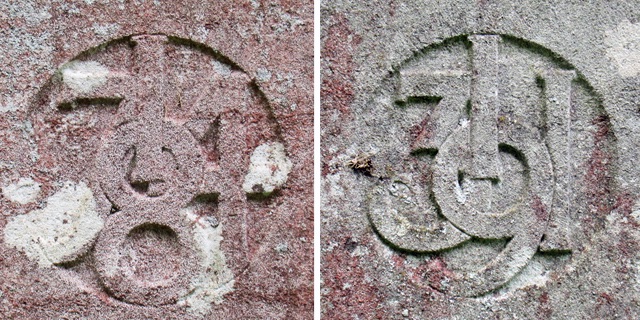 The stylised 1874 and 1931 dates on the left and right of John’s headstone.
Photographs by Roger Morgan © 2023
As I noted at the outset, the life and service of the quite remarkable Dr John Robert Lord deserve to be better remembered – and, indeed, celebrated for the many advances in the care of mental patients that he helped pioneer.
Roger Morgan © 2023
(written with great help from the detailed obituary in the October 1931 Journal of Mental Science, )