
HARRY THOMAS FARR AND GERTRUDE LYDIA YOUNG
 Harry Farr in uniform
Image from ‘HE WAS NO COWARD The Harry Farr Story’.
Image courtesy of Granddaughter Janet Booth
Harry Thomas Farr was born on 15 December 1890 in Kensington, London, the second son of William Thomas and Alice Farr née Grant, and was baptised on 13 May 1891 in St. Augustine’s Church, Kilburn. Harry’s parents had married in 1883 in the Oxford Registry Office, Oxfordshire.
The 1891 census records Harry aged 3 months, living with his parents and two older siblings at 116 Wornington Road, Kensington. Harry’s 30-year-old father was a ‘Railway Platelayer’ who had previously been a regular soldier, serving 12 years as a private in the Oxford and Bucks Light Infantry.
Harry’s future wife, Gertrude Lydia Young, was born on 22 May 1894, the daughter of Daniel and Charlotte Young née Gowing. She was baptised on 25 July 1894 in Christ Church, Notting Hill, whilst the family were living in cramped rented rooms at 105 Southam Street.
By 1901 Harry’s family had moved to 75 Swinbrook Road, North Kensington. Harry’s 40-year-old father was now described as a ‘General Labourer’. Meanwhile, Gertrude, aged 6, was living with her parents and five siblings at 105 Southam Street. Her father Daniel was a ‘General Labourer’. Gertrude was one of 13 children, but only nine survived into their teenage years. Gertrude’s father died in 1908.
On 11 June 1908 Harry aged 18, enlisted in Aldershot, as a regular soldier, into the West Yorkshire Regiment.
Around 1910 Harry, aged 20, met 16-year-old Gertrude and they started a relationship – one that her family disapproved of, believing he was too old and experienced for her, especially as he had served in the army.
The Police Gazette dated 7 March 1911 records that Harry deserted at Colchester on 24 February 1911. It stated that Harry was aged 20 years and six months, that he was 5 feet 7 inches tall, with a brown complexion, brown hair and green eyes, and that he had previously worked as a shoemaker. It confirmed that he had enrolled into the 2nd Battalion West Yorkshire Regiment with service number 8871 in Aldershot. The ‘Marks and Remarks’ column noted that Harry had ‘sc inside rt leg cross letters bk rt wrt’. The outcome of his desertion is unknown but after just over 2 years 8 months service, he was probably discharged from the army.
Thirty-seven days after he had deserted, on the night of 2nd April, the 1911 census recorded Harry, an ‘Iron Worker’, living at 27 Wornington Road with his parents and seven siblings. His father was now described as a ‘Sailmaker’. His mother recorded that she had been married for 27 years and had 13 children but that three had died. Gertrude was living a 10-minute walk away from Harry at 6 St. Charles Square, North Kensington, and worked as a ‘General Servant’ for 83-year-old widow Margaret Jones and her daughter, Helena Grace Jones, a portrait artist. Gertrude had started working for Margaret Jones two years previously at the age of 14. Gertrude’s widowed mother was living an 18-minute walk away from her at 111 Southam Street.
By April 1913 Gertrude realised that she was pregnant. At that time, to be pregnant and unmarried would bring shame and disgrace on the family. Harry and Gertrude married in the summer of 1913 and their daughter Gertrude Nellie, known as Gertie, was born on 29 October 1913.
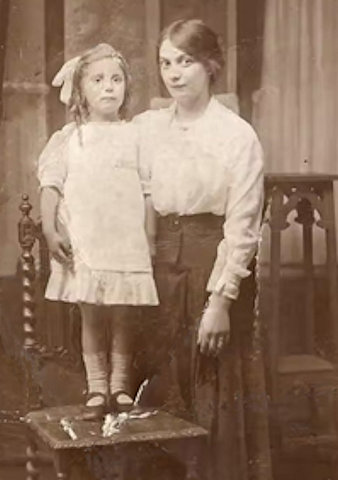 Image: Gertrude and Gertie
Gertrude and Gertie c1919
Image from ‘HE WAS NO COWARD The Harry Farr Story’.
Image courtesy of Granddaughter Janet Booth
In response to Germany invading Belgium, Britain declared war on Germany on 4 August 1914. The Great War or First World War had commenced.
Even though he had previously been a deserter, Harry as a reservist was immediately recalled, serving again with the West Yorkshire Regiment and on 5 November 1914 sailed aboard SS Mount Temple to Le Havre, France with the 2nd Battalion West Yorkshire Regiment, no doubt believing, as many others did, that the war would be over by Christmas.
The 2nd Battalion West Yorkshire Regiment was in the 23rd Brigade, 8th Division. On 14 November 1914, a very cold day with snow falling, the battalion had its first experience of being in trenches and fired on by the enemy. The first fatality occurred on 19 November, the victim of a sniper. A great many more men would be killed or wounded before the war ended.
Note:
The Soldiers Died CD tells us that the number of other ranks killed each year from the 2nd Battalion West Yorkshire Regiment was: 1914, 67: 1915, 168: 1916, 289: 1917, 312: 1918, 379. Just one battalion suffering 1,215 deaths.
Harry would have fought with the 2nd Battalion West Yorkshire Regiment in the Battle of Neuve Chapelle (10–12 March 1915). The battalion losses were two officers killed, five wounded, 55 other ranks killed, 162 wounded and 18 posted as missing: about a quarter of its strength. Overall British losses in the battle were about 3,500 dead and 8,533 wounded.
Harry and Gertrude’s 18-month-old daughter Gertie was baptised on 11 April 1915 in St. Columb’s Church, Notting Hill, London. The family address was recorded as being 113 Southam Street, which was next door to Gertrude’s grandmother. Harry’s occupation was recorded as ‘Soldier’. Gertie later married Frank E. Harris in the June quarter of 1935 in the district of Kensington.
During the period after the Battle of Neuve Chapelle and before the next battle commenced on 9 May 1915, the West Yorkshires typically spent their time in and out of the line, sustaining casualties from shelling and sniping. The Battle of Aubers Ridge (9–10 May 1915) was fought by the British to support a major offensive by the French at Vimy Ridge. Both attacks failed.
Harry was withdrawn from the front line on 9 May suffering from shellshock. Unfortunately, no record of Harry’s treatment has survived but typically he would have been received by a Casualty Clearing Station near the front line before being sent back to a base hospital run by the Royal Army Medical Corps (RAMC). Some severely shell-shocked soldiers were sent back to the UK but probably not Harry. Treatment was mainly rest away from the front line and counselling, although experimental electric shock treatment was used in some cases.
Professor David Stevenson wrote:
Post-traumatic stress disorder…. was exacerbated by the special conditions of static warfare in which soldiers endured repeated bombardments in confined spaces with little control over their fate, and lived in day-by-day close proximity to their comrades’ decomposing remains.
During the summer of 1915 Gertrude received a letter from Harry but she didn’t recognise the handwriting. Harry was in hospital and his hands had been shaking so much he could not hold a pencil, so a nurse had written the letter for him. It was the last letter Gertrude received from him. Harry, certified as fit, was returned to the front in the Ypres salient on 21 October 1915, but to the first battalion West Yorkshire Regiment, not the 2nd. Soon after, the Germans launched a huge barrage, the noise of which caused Harry’s shellshock to return. From then until Christmas 1915 the battalion was either in or near the front line during which time heavy rain fell causing trenches and dugouts to collapse. Casualties were incurred from shelling, gas and rifle fire and carrying out trench raids.
For Harry’s battalion, 1916 carried on much the same as 1915, in and out of the line, muddy trenches, shell and rifle fire, gas, and trench raids. During April Harry reported sick with nerves and was treated at a dressing station for two weeks. His problems were worsening.
The Battle of the Somme commenced on 1 July 1916 with some 60,000 British casualties on that first day, with about a third of them fatal. Harry’s battalion entered Somme trenches on 6 August and commenced the usual routine of several days in the front line, then several days behind the lines, sustaining casualties on most days. On 18 September the first West Yorkshires attacked in the battle of Flers-Courcelette, the third phase of the Battle of the Somme.
Harry did not take part in the attack as he had fallen out sick on 16 September and made his way to a dressing station. But because he had no obvious physical wound he was turned away. On 17 September he disobeyed an order to go to the front with a ration party. His Regimental Sergeant Major is reported to have said:
‘You are a f…..g coward and you will go to the trenches. I give f..k all for my life and I give f..k all for yours and I’ll get you f…..g well shot’.
He was later sent to the front with an escort but struggled with the guards and was released after refusing to see a medical office further forward. He then ran back towards the rear and was placed under arrest on 18 September and later charged with the military crime of cowardice.
On 2 October 1916 Harry was tried by Field General Court Marshal at Ville-Sur-Ancre, France, in front of three officers. Harry was charged under section 4 (7) of the Army Act 1881, viz:
misbehaving before the enemy in such a manner as to show cowardice.
Harry pleaded not guilty, did not have a ‘prisoner’s friend’ and thus defended himself. Away from the noise of the guns Harry’s behaviour was normal but near the guns the noise caused him to tremble with shellshock. Despite having previously been officially diagnosed as suffering from shellshock, Harry was found guilty, sentenced to death, and executed by firing squad on 18 October 1916. Harry declined to wear a blindfold, a fact, according to Gertrude’s local vicar, that showed that Harry was actually a very brave man. Harry has no known grave and is commemorated on the Thiepval memorial, France.
In late 1916 Harry’s wife, now a widow with a three-year-old child to care for, received a telegram telling her that Harry had been shot for cowardice. Gertrude had lost her husband and three-year-old little Gertie had lost her father.
Separation allowances were paid to all dependents for 26 weeks after a soldier died and the allowance was sufficient to pay for Gertrude and Gertie’s basic needs but stopped after 26 weeks. In line with government policy, pensions were not paid to war widows whose husbands had been shot for military offences.
Having no income, Gertrude was unable to pay her rent and was evicted by her landlord. Fortunately she was taken in by her friend Alice. Gertrude sought help from the Soldiers’ and Sailors’ Families Association (later the SSAFA charity), who advised her to tell her family of the execution. Overcome with shame, Harry’s father took the news very badly. He never spoke to Gertrude or his granddaughter Gertie again and forbade mention of Harry’s name by anyone else in the family.
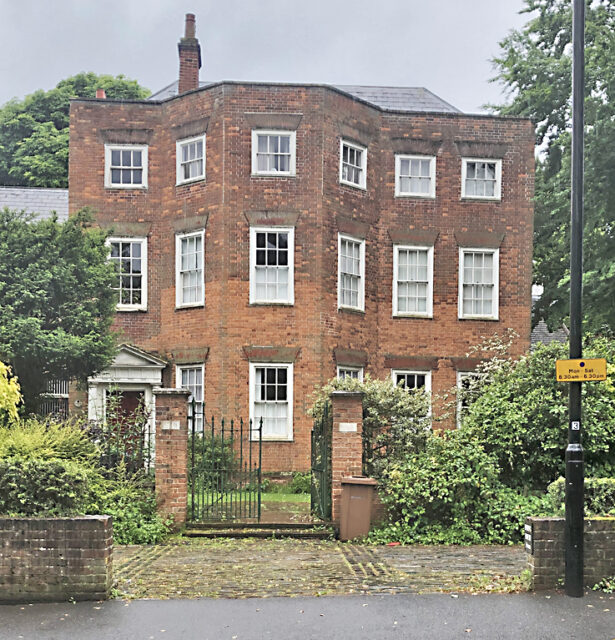
According to He Was No Coward, Gertrude was eventually offered work as a kitchen maid by the Scottish owner of Spring House, Ewell. Rather than put Gertie into a home, Gertrude’s employer allowed Gertie to stay with her mother. Despite their father’s insistence, Harry’s brothers visited Gertrude and Gertie there. Spring House was occupied at this time by Andrew Tilston Dudgeon, from the Scottish family of naval architects.[1]
 :
:
Spring House, Ewell in 2024
Image courtesy Clive Gilbert 2024
Gertrude felt isolated living in Ewell and longed to return to her native London. After a year she took up a position as a general maid in a grand house in Hampstead, the home of Lord and Lady Arkwright.
The widowed Gertrude Lydia Farr, aged 25, married William Henry Batstone, also aged 25, on 25 April 1920 in Christ Church, Notting Hill.
Gertrude died 22 July 1993 in Northampton aged 99.
———————————-
In 2001 a memorial to all 306 men who were ‘shot at dawn’ (SAD) was opened at the National Memorial Arboretum, Staffordshire.
 Statue marking the SAD plot at the National Memorial Arboretum
and Harry Farr’s memorial post
Image courtesy Clive Gilbert 2022
Clive Gilbert 2024
Sources:
Booth, Janet, and James White, He Was No Coward: The Harry Farr Story (Privately, 2017).
Soldiers Died in the Great War 1914–1919 (CD).
1891 Census
1901 Census
1911 Census
Free BMD website
References:
[1] https://eehe.org.uk/wp-content/uploads/2019/05/Kellys-1918.pdf; https://heatonhistorygroup.org/2021/02/05/rothbury-terrace-the-magpies-nest/; https://www.gracesguide.co.uk/J._and_W._Dudgeon).