
EPSOM & EWELL CEMETERY
Between Ashley Road and Downs Road, Epsom, KT18 5JT
 Drawing of the Anglican Cemetery Chapel
Reproduced from Picturesque Architectural studies and Practical designs by William Young 1872.
Background
Until the early nineteenth century the church had a monopoly on the interment of human remains in the UK. The rapidly increasing urban population and the constrained space in churchyards meant that existing graveyards were overcrowded and unhygienic, and could not cope with the number of bodies. The Government passed a number of Burial Acts including the Burial (Beyond the Metropolis) Act in 1853 which allowed local councils to establish Burial Boards to provide alternative solutions. Epsom established its Burial Board on 31 May 1869 with George White as its Clerk.
Epsom Gets Its Cemetery
Early in 1870, the Epsom Burial Board purchased five acres of land from the Trustees of the late Alexander Wood between the roads now known as Downs Road and Ashley Road. This land had been part of the former Common Fields. The site was not the Board’s first choice. In 1869 it had been negotiating with the Lord of the Manor, John Briscoe to buy four acres of land to the north of Dorking Road. It soon became clear that the site was too small to accommodate the planned chapels and to allow for expansion. Briscoe was unwilling to sell any more land and the more flexible site was chosen.
The Board issued invitations in 1870 to tender for the contract to enclose the site and decided to hold a competition for the actual design. They provided a statement of requirement which included details of the geographical location and the hard, chalk sub-soil, proximity to Epsom’s two railway stations and to gratuitous water supply. It also specified that the site was to be enclosed with four foot wall, which would have to be over a thousand feet in length, in which there were to be two gateways with gates. Inside two chapels were required, one Anglican and the other Nonconformist, each to be 30 ft by 20 ft in size. A lodge was also required with two reception rooms, two bedrooms, domestic offices and water closet all on the ground floor. The cost of all this was not to exceed £3,300.
There were five competitors and in August 1870 William Young, a partner of Robert Milton, an architect in Crooked Lane , London was declared the winner. His designs were reproduced in his book “Picturesque Architectural Studies and Practical Designs”, published in 1872.
 Drawing of the Nonconformist Cemetery Chapel that was demolished in 1981.
(Although appearing larger, it was about the same size as the Anglican chapel in the background.)
Reproduced from Picturesque Architectural studies and Practical designs by William Young 1872.
The building contract was awarded to Thomas Nye of Ealing and the landscaping to Joseph Tanton Rawnsley of Epsom Nurseries. All the external construction was to be in Kentish Ragstone and it is estimated that sixty thousand tons of stone had to be transported from Epsom railway station in Station Road up to the site. The landscaping was to be simple with gently curving roads, and a yew and beech hedge in front of the wall with horse chestnut trees in front of that. Dark, evergreen trees such as yews, pines and cedars much favoured by the Victorians for their sombre appearance were planted near the chapels and paths.
The 1898 postcard view below shows the two chapels, nearly 30 years after they were built, from about the same viewpoint as the architect’s drawing above.

The Anglican and Nonconformist Chapels in 1898.
Image with thanks to Bourne Hall Museum.
A clearer impression of the chapels’ sizes is gained from the following picture taken from a different vantage point.
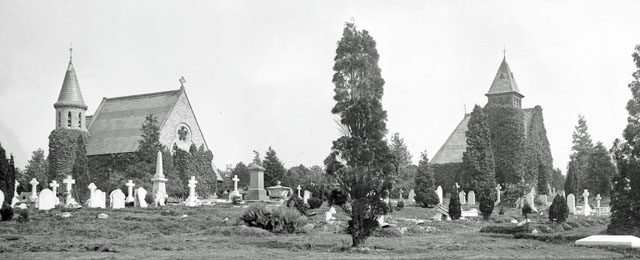
The Anglican and Nonconformist Chapels in 1898.
Image with thanks to Bourne Hall Museum.
The following extract from the 1936 Ordnance Survey map shows the location of the two chapels in the centre of the cemetery.

The central section of Epsom Cemetery in the 1936 OS map.
The Anglican Chapel is shaded green and the subsequently demolished Nonconformist Chapel is shaded blue.
A Lodge Keeper was appointed shortly before the Cemetery opened in 1871. The advertisement specified that he: needed to be literate and a competent gardener; would be paid £50 pa; and would live rent free in the Lodge. Edward Northey of Woodcote house recommended Francis Kentfield for the post with the following reference:
“His respectable parents live in Epsom; he is 30 years old, married but no children; he is well educated and understands gardening, and having served his country as a soldier for ten years, qualifies him for this situation.“
Francis Kentfield got the job!
Who Can Use It
Like all public cemeteries, Epsom’s has catered for all denominations and for all sectors of society – from titled gentry to the poorest pauper.
For this reason, some land had to remain unconsecrated; some was set aside for Roman Catholics and, later on, some for Muslims too. Provision also had to be made for the inmates of the Epsom Workhouse. A small section near the Downs Road entrance was reserved as a deep, seventeen feet, mass grave where paupers could be buried.
The Board recognised that many could not afford a funeral coach to get to the cemetery and they provided a “Shillibeer” combined hearse and coach and a harness, to be kept in a shed at the waterworks, that could be hired for five shillings (25p). Hirers had to provide their own horse.
Gypsies have long been associated with Epsom Downs and the Derby meeting, and they have adopted Epsom Cemetery as their burial ground. Their burials are conducted to traditional rites: no soil must be spilt on the coffin when it is placed inside, so the back-fill is steeply built up, and then possessions are placed around it. A family member has to stand at the graveside and watch the soil fall naturally onto the coffin before the grave can be closed. The floral tributes are colourful and families come to tend the graves during race weeks.
The Opening
The Bishop of Winchester was invited to consecrate the “protestant” areas and the chapels in June 1871, and shortly afterward the first interment took place. This was Mrs. Elizabeth Dorling, wife of Henry Dorling who was chairman of the Burial Board in its first year and Clerk to the Racecourse. Her substantial grave can (as below) be seen today.
 The tomb of Elizabeth Dorling, the first person to be interred
in Epsom and Ewell Cemetery, Ashley Road, Epsom June 1871.
Copyright image courtesy of Carol Hill, 2006
 Photo of the Anglican Cemetery Chapel tower
Image courtesy of Carol Hill © 2006
 Chapel Interior
Image courtesy of Clive Gilbert © 2011
Remembering the War Dead
A number of buildings around Epsom were converted into emergency military hospitals in 1914-1918, for example the new grandstand (built 1914 demolished 2007) at the Racecourse, the Army camp at Woodcote Park and Horton Hospital. Some of the patients who died were buried in a section of Epsom Cemetery.
After the War, the Imperial War Graves Commission (later called the Commonwealth War Graves Commission) set about consolidating and standardizing war burials. A representative visited in 1921 to advise on the layout and maintenance and his plans were implemented following their receipt in September 1922. Epsom was also asked to maintain 62 Canadian War Graves. This Commonwealth War Graves Commission plot is a rectangular site enclosed by a beech hedge. On the northern side a white stone screen was erected with bronze panels listing the eighty nine commonwealth service men who had died of wounds. The temporary grave markers were removed and replaced with tablets set into the lawn. The War Cross is in the centre of the lawn approached by paved steps. The War Graves Commission’s horticultural concept was to create an environment where visitors could experience a sense of peace in a beautiful and serene setting akin to a country garden. When they inspected in 1926, the grass looked coarse, and Epsom Council had to cut it more frequently to improve the quality.
War Memorials in the Cemetery
Lord Rosebery proposed having a “Great War” (WW1) Memorial for fallen Epsom men in the market place but many families objected to such an obvious reminder of their loss. Epsom’s WW1 memorial was instead erected in the north west corner of the Ashley Road cemetery and unveiled on 13 December 1921. The names of 264 fallen Epsom men and one woman were recorded on the screening stone wall and this was unveiled by Maj Gen Sir Edward Northey at the Remembrance Day Ceremony in November 1923.
The now Borough of Epsom & Ewell’s WW2 casualties were not added to the memorial (although the memorial’s inscription was amended to include them in the general dedication). Instead a Book of Remembrance was produced, and is on display in the foyer of the Town Hall.
White decorative railings with two gates separate the war memorial from the rest of the cemetery as a memorial to the members of the “Royal Fusiliers (City of London Regt ) 18, 19, 20 and 21 Btns who fell in the Great War”. The centre of each railing contains the insignia of the University & Public Schools Brigade who were stationed at Woodcote Camp.
(Reference has already been made to the Commonwealth War Graves Commission plot within the Cemetery.)
There are also a number of WW1 casualties buried around the Cemetery, as are some WW2 casualties.
Cemetery Expansion
By 1923 it was clear that the cemetery required space, even though from 1880 it had been possible to buy the right to bury a number of bodies in a particular plot. (A register of these can be consulted at the EELHC, Bourne Hall, Ewell). Epsom council purchased five acres of land from Lord Rosebery to the south of the existing cemetery, part of field 567 on the Ordnance Survey (OS) map at 25 inches to a mile. Local tradition has it that Lord Rosebery would have given the land for free, but decided to charge £2,000 after the Council agreed to games being played in Rosebery Park, against his stipulation on making the gift. (He donated the money he received to charity.) The new area had to be suitably enclosed with walls and a screen of shrubs and trees, and the adjoining land had to be suitably drained.
Further extensions were made subsequently taking in the remainder of field 657 and 561 on the OS map and there is still room for expansion.
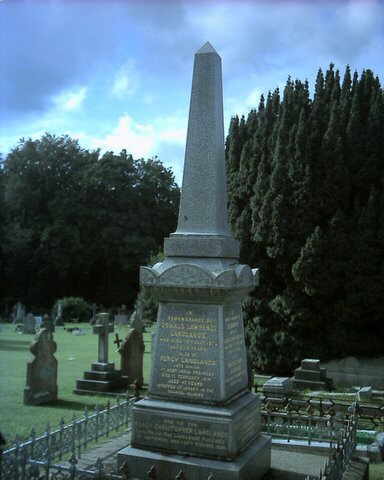 The Langlands family monument
Copyright image courtesy of Carol Hill, 2006
The Cemetery today
The original Non-Conformist chapel was demolished in 1981 when the denominational distinction was abandoned. Its plot (“O/C” on the map immediately below – which is the central section of the map obtained by clicking the thumbnail at the end of this article) was then used for some new burials.
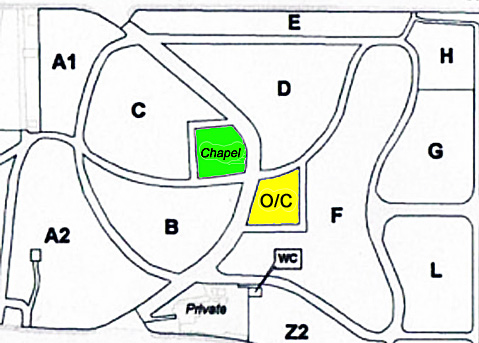
The green shaded area is the site of the remaining chapel. The site of the original Nonconformist chapel demolished in 1981 is the yellow-shaded area “O/C”, since filled with new burials.
Today, the Cemetery remains the responsibility of Epsom Borough Council and is looked after by the Superintendent and Registrar. It remains an oasis of peace and tranquillity, its many headstones and memorials (though some are now lost or damaged) bearing testament to the many lives that have helped shape the life of the Borough.
Researched by Carol Hill, 2004
and updated in both 2006 & 2020.
 Click Image to go to plan of the Cemetery
Other cemetery pages:
1871-1950 burials A B C D E F G H I J K L M N O P Q R S T U V W X Y Z
1951-1967 burials
Scattered Ashes 1955 to 1995
Notable Residents
References:
- Ordnance Survey maps at 25 inches to 1 mile, 1896,1913, and 1933.
- Ordnance Survey maps at 1:2500, 2003.
- Plan of Epsom cemetery S Yates Superintendent and Registrar.
- Minutes of the Epsom Burial Board 1869-1895.
- Minutes of Epsom Urban District council 1895-1933.
- Extracts from Picturesque Architectural Studies and Practical Design by W. Young, published by E and FN Spon, London 1872.
- Church of England Chapel, 1968.
- Photographs of Epsom Cemetery C. Hill 2003 and 2004.
- Interview with a former grave digger 2004.
When a person died in one of the local mental hospitals and no one was prepared to take responsibility for funeral arrangements then they were usually buried in hospital grounds – see our separate page on Horton Cemetery.