
THE 1930 DERBY
(with nearly a sting in the tail!)
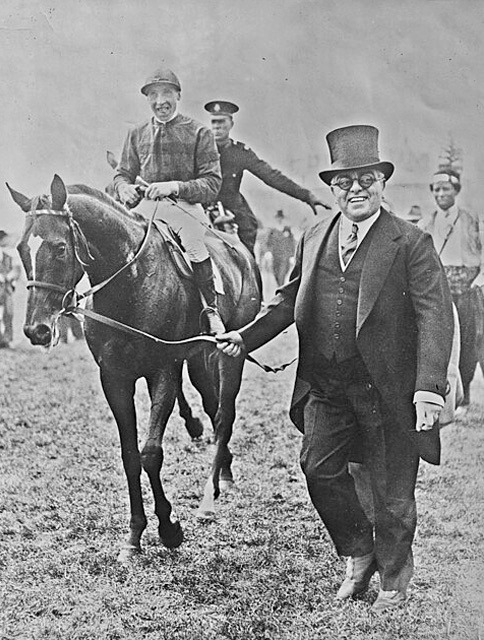 The Aga Khan leads in his horse “Blenheim”, winner of the 1930 Derby
(The person on the right with the plumed headdress is the well-known racing tipster “Prince Monolulu”.)
Public domain image via Wikimedia.

Before getting to the tease in the sub-heading, I’ll briefly describe the 1930 Derby, held on Wednesday 4 June. As usual at that time, this came in the middle of a whole week’s racing, and the meeting was attended by royalty – in this case, King George V and Queen Mary.
 King George V and Queen Mary being welcomed on arrival at the grandstand.
Screenshot from the British Pathé newsreel.
 The royal party watching the racing.
Screenshot from the British Pathé newsreel.
Notwithstanding some fairly miserable weather, the usual massive crowds – from all levels of society – assembled to watch the iconic race. There were seventeen runners, the favourite being Diolite at 11/4. The third Aga Khan, a prominent racehorse owner, entered two horses, the first of which was Rustom Pasha – at 9/4, the second favourite. His other horse was Blenheim. As a two year old, Blenheim had won four of his seven races in 1929. In 1930, however, he had been beaten in his first two races and, with odds of 18/1, started The Derby – his third race of the year – as the sixth favourite.
However, ridden by Harry Wragg, Blenheim ran a textbook race, in the last furlong bursting out of the pack to beat second place Iliad (little fancied at 25/1) by a length. (The favourite, Diolite, came third, three lengths behind Blenheim, and the Aga Khan’s other horse – second favourite Rustom Pasha – came in eleventh.) The Aga Khan’s first prize was the bizarrely precise £10,036 5s (£10,036.25).
Now . . .
. . . to the tease in the sub-heading of this article.
I recently acquired a second-hand local history book, out of which fell the following press cutting from the Epsom Herald of 23 January 1931. This, as transcribed below, must have intrigued the book’s unknown original owner.
“An amusing story was told of a beekeeper whose bees swarm every Derby Day, on this last occasion nearly holding His Majesty King George.” (This from a report of a beekeepers meeting held in Epsom last week.) A cat may have a right to look at a king, but bees could not be forgiven for barring the progress of Royalty, and I [being the anonymous 1931 journalist] was interested enough to find out what really did happen last Derby Day.
What happened was this. Just a few minutes before the King was due to leave the Downs after the Derby, there was a swarm of bees right across Fir Tree Road, which road formed part of the Royal route, at a point where this road, which leads on to the Downs at Buckles Gap, touches the grounds of Dr. Thompson. The bees that were swarming were Dr. Thompson’s. He got a swarm on a Derby Day, and each Derby Day – explain it how you will – they do this swarming business. Is it because they get infected with the prevailing excitement?
On this occasion they chose to do so just before the King’s carriage [it would surely have been a limousine] was due to pass off the Downs into Fir Tree Road, and what would have happened if Dr. Thompson had gone to the races with Mr. I. A. E. Mottram instead of preferring to spend the afternoon at the apiary at the “Old Thatch” one hardly likes to think. But Dr. Thompson and Mr. Mottram, two very well known members of the Surrey Beekeepers’ Association, preferred to be among the bees than be members of the human hive less than a mile away.
This was fortunate, for they saw the mass of bees making a barricade in the road, and took immediate steps to remove the barricade before the King’s carriage came along. But they had only just time in which to do it. It is to be hoped that this year the bees will do no swarming, either on the roads leading to the course or on the racecourse.
The “Old Thatch” must surely be the thatched house at what is now 338 Fir Tree Road, as pictured below.
 Fir Tree Road as it leads off Epsom Downs (on the right) past the thatched No 338 on the left.
Photograph by Roger Morgan © 2023
As to the two local individuals mentioned in the cutting, the initials given make it easy to trace Ivan Albert Evans Mottram as the 56 year old Foreman Engineer of the Electricity Generating Station for the Epsom Cluster of Mental Hospitals. (Until the National Grid reached the hospitals in the late 1930s, all their electricity had to be generated on site – the generators’ prodigious appetite for coal being fed by the Horton Light Railway.) Mr Mottram – together with wife (and, until they left home, their two daughters) – lived in hospital property on Horton Lane. By the time of the 1939 Register, Mr Mottram and his wife were living in the village of Maresfield in East Sussex, with his “personal occupation” noted as “Engineer Power Station Retired”.
“Dr Thompson” is harder to pin down. A Google search for “Thompson Epsom beekeeper” found the report of a 1934 conference at Rothamstead Experimental Station about “Brood Diseases of Bees” in which there was a contribution from a “Dr. F. Thompson (Epsom)”. That seems certain to be our man, and I was pleased to find that the 1930 Kelly’s Directory records “Francis Thompson M.R.C.S., L.R.C.P. Lond.” on the staff of the Epsom & Ewell Cottage Hospital in Alexandra Road, Epsom. However, among the Private Residents, the Directory notes him as living at 5 Ashley Avenue. I have failed to find Dr Thompson’s connection with the “Old Thatch”, which the press cutting clearly notes was on “Dr Thompson’s grounds” – but that does not really detract from the interesting anecdote.
And finally . . .
. . . one of the joys of digging into local history is stumbling across random connections. In the present case, two come via the Revd Lionel Mylrea, Vicar of Christ Church Epsom Common from 1926 to 1936. The first is his enjoyment at occasionally being mistaken, when in London, for the physically similar Aga Khan – a key figure at the 1930 Derby.
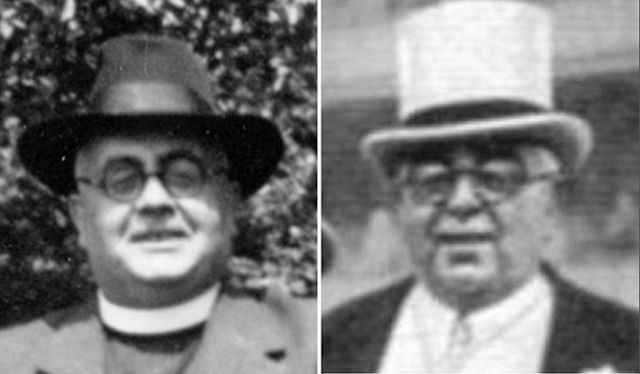 Lionel Mylrea and the then Aga Khan
Images – Left: from the Christ Church archive & Right: via Wikipedia
The second random connection comes from Lionel Mylrea’s being a keen bee-keeper – who therefore seems certain to have known fellow bee-keepers Dr Thompson and Mr Mottram (the latter’s Horton address also making him a parishioner). While at his previous parish of St John’s, Boldre (on the edge of the New Forest), Lionel Mylrea was instrumental in establishing the New Forest Bee-Keepers’ Association and was its founder Chairman. Indeed, he was elected to the Council of the British Bee-Keepers’ Association in 1917.
Roger Morgan © 2023