
PEDDIE, Arthur Richard (1913-95)
As Private 4756005 in the 1/5th Sherwood Foresters, he survived his
time as a Far East Prisoner of War 1942-45
 Arthur Richard Peddie in uniform
Image courtesy of Linda Martin ©2020
Arthur was born on 3rd December 1913 to Robert and Emily Peddie, nee Risbridger. He was the last of 5 children from Church Side, Epsom Common. Arthur worked as a postman in Epsom. He married Jessie Taylor from West Street, Ewell, at St Marys Church in Ewell on 19th February 1939. They moved in to 6 Cottage Road, West Ewell, ready to start married life.
War broke out in September that same year, and eight months later, on 27th June 1940, Arthur was conscripted at Cheam and sent to Crown Hill Barracks, Plymouth, for training with the York and Lancaster Infantry. He was transferred to the 1/5th Sherwood Foresters Mechanical Transport Company and was posted to several sites in Derbyshire as a driver to Major Robinson.
Arthur’s brother, Thomas John Peddie, was killed on 9th January 1941 and his mother Emily died later that year on 18th October. Nine days after her death, on 27th October, which was also his wife Jessie’s birthday, Arthur and his Company were in Liverpool where they boarded the SS Orcades (which had been requisitioned as a troopship) and set sail to Halifax, Nova Scotia. (Almost exactly a year later, the Orcades was torpedoed and sunk off South Africa, when one of the casualties was the ship’s butcher, William MacDonald.)
 SS Orcades
Source not known
On arrival he was transferred to the USA’s USS Westpoint. They set sail for the Persian Gulf via Trinidad heading for Cape Town when on 7th December, news of the bombing of Pearl Harbour reached them. They were diverted to Bombay and had two weeks jungle training as part of the 18th Army, arriving in Singapore on 29th January 1942. Years later, Arthur would tell his children that he was a driver and told them stories of going to the Raffles Hotel with messages.
 USS West Point in 1942
Image source Wikimedia
On 15th February, following the fall of Singapore, found Arthur as a prisoner of war [POW] in Changi. On 1st November he and 32 men were herded into a metal cattle truck, with space for only 15 men to sleep. He was in “D” force under Colonel Lilley and Major Robinson, being sent to Bangkok, Thailand, then Kanchanaburi to start the construction of the Thai-Burma railway.
Arthur worked on the second pillar of the infamous bridge over the River Kwai. Working their way upriver to the Wampo Viaduct (known as the ‘Pack of Cards’ because of its construction), they lived in different camps along the way. The work was hard labour and for long hours with very little food that consisted of a small amount of rice and watery soup. Pits were dug for toilets. Very soon the men became infected with diseases such as cholera, beriberi, dysentery, and malaria to name a few.
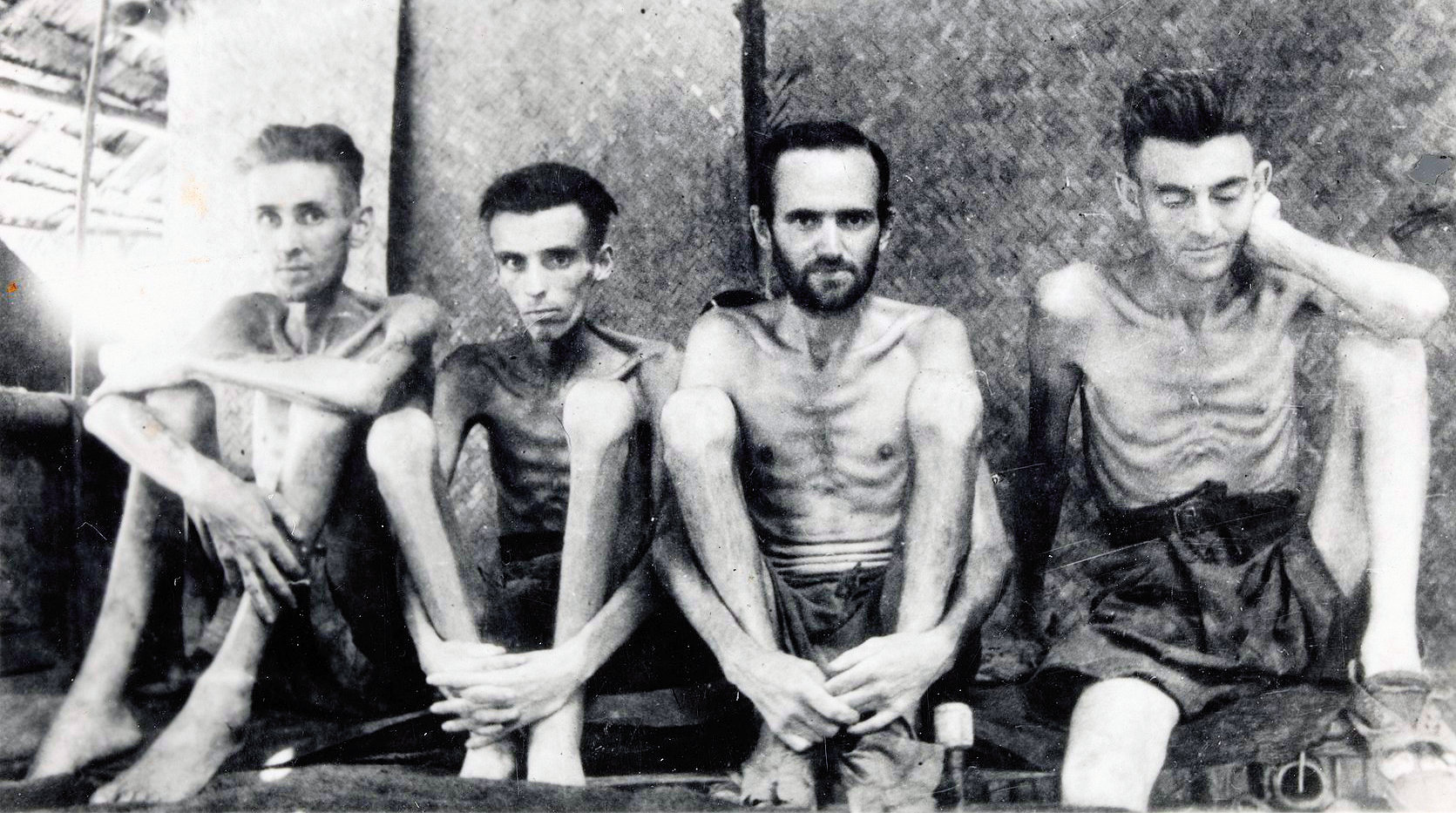 Australian and Dutch prisoners of war suffering from beri beri.
Image source: Wikimedia
Due to this hard work and little food, the POW’s body weights soon were low but still they had to work 12 hours a day and if they collapsed, they were struck by the guards – “Speedo” was the word they heard.
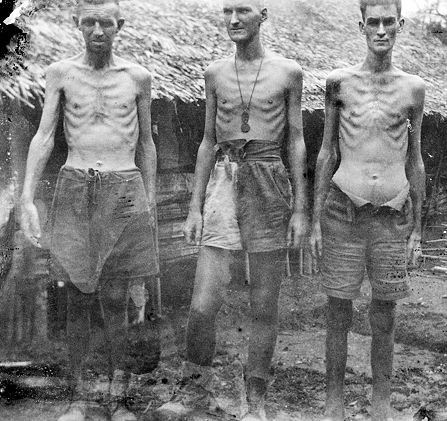 Three “fit” workers at Shimo Sonkurai No 1 Camp, standing outside the camp hospital
Image Source The Australian War Memorial
On 5th June 1944 Arthur, although barely weighing 7 stone, was pronounced fit and was transferred back to the Valley Road Camp in Singapore under Captain J E P Peirce. They marched 3 miles on 4th September to the docks where he boarded the SS Kachidoki Maru, part of a convoy including 1317 British and Australians POWs aboard the SS Rakuyo Maru, that were heading to Formosa to work the mines. On the 12th September, the convoy was attack by the USA, sadly no flags were flown to show that POWs were being transported. At 22.40 hours, the USS Pampanito torpedoed the SS Kachidoki Maru, with between 430-480 (numbers vary) POW’s losing their lives (one of whom was Harry Blackman), and over 1000 POWs from the SS Rakuyo Maru. For 16 hours in the oil burning, shark infested South China Sea, Arthur managed to stay alive before being rescued by the Japanese and taken to mainland Japan.
 SS Wolverine State before being renamed the SS Kachidoki Maru
Image source Wikipedia
Along with Captain J E P Peirce, they were moved to Sendai, in the northern Japan camp Sakata 9B. Arthur was in work party 75 with Captain J E P Peirce, working for the Nippon Express on the docks loading and unloading logs and coal dressed only in a loin cloth during the worst winter Japan had known.
On 6th August 1945, the Atom bomb was dropped on Hiroshima – the POWs were made to start digging their graves by the Korean guards.
Arthur saw a silver plane high in the sky, which he said was like a silver bird, and watched it proceed to drop the next Atom bomb on Nagasaki. The Japanese surrendered and the POWs were liberated by the USA troops.
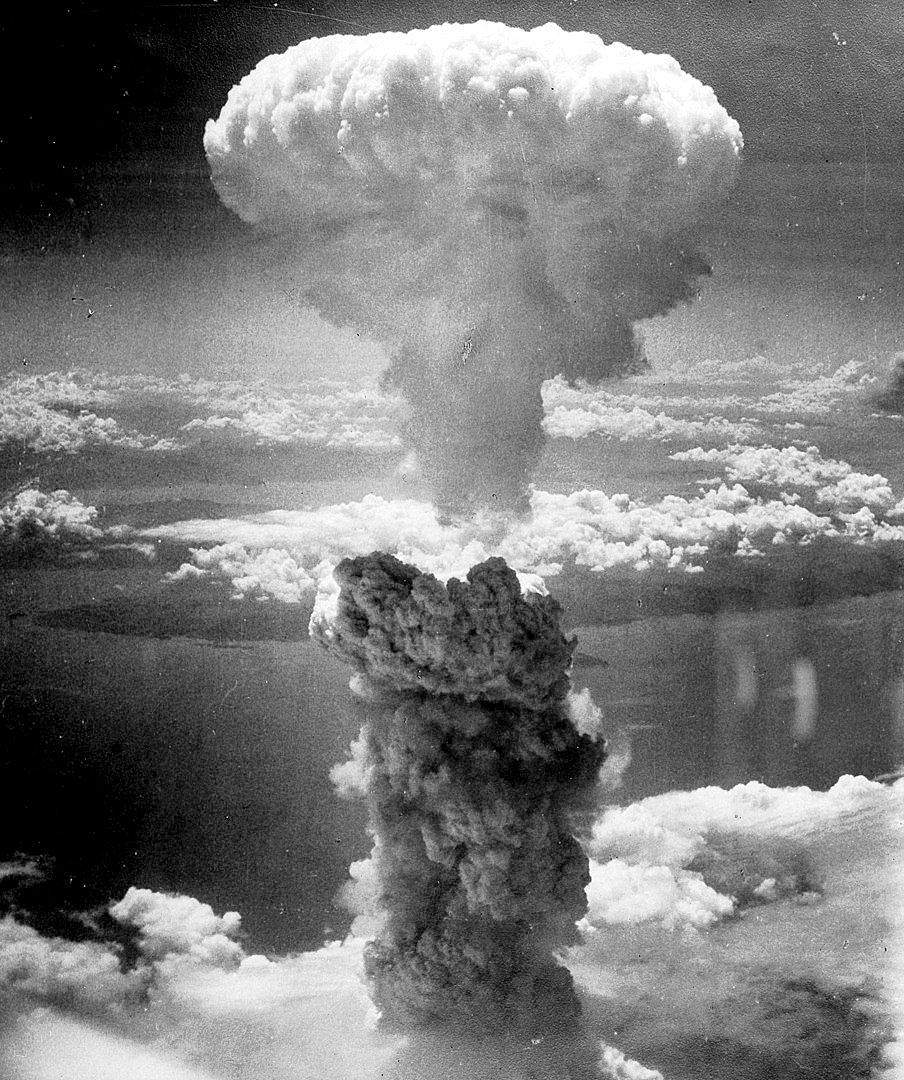 The mushroom cloud from the nuclear explosion over Nagasaki
Image source Wikipedia
Arthur travelled back to Tokyo via Nagasaki and saw first-hand the devastation. He was taken by a British destroyer to Yokohama and from there in a bomber plane to Okinawa, where he had to stay for 5 days due to a hurricane. He flew on to Manilla where he received a USA medical and boarded the aircraft carrier Implacable to Vancouver via a stop-over at Pearl Harbour. Here they were treated to tea and flower garlands. From Vancouver on the Canadian Pacific Railway, he travelled to Halifax where he stayed for two weeks, fattening up as he put it, with powdered milk.
The Ile De France brought him back to Southampton. He was given another medical, a train ticket to Waterloo and a letter (see footnote) stating that he was not to disclose his treatment while prisoner so as not to upset the families of those not returning.
He sent a telegram to his wife Jessie to tell her he was home. His best friend and Jessie went and collected him on 31st October 1945, 4 years after leaving home. Jessie had had very little information about Arthur with only the odd letter to say he was missing, another to say he was a POW then a telegram from Arthur to say he was coming home.
Arthur spent time in Horton Military Hospital for rehab on his return and had surgery to have a kidney stone removed while suffering reoccurring bouts of malaria. He had scars from leg ulcers cause by the bamboo in the jungle but fortunately his were not infected by strongyloidiasis [an infection caused by a round-worm parasite]. He also suffered mental stress now known as Post Trauma Stress Disorder, not recognised at that time. His doctor used to visit him on Sunday afternoons with his medical bills being met by all of Jessie’s savings as there was no National Health Service until 1948. Jessie had worked in the aircraft parts factory Swifts on the Ewell Downs motor site throughout the war.
Arthur returned to the post office at a higher grade and served 42 years. His hobbies were fishing, snooker and watching sport. He died on 23rd October 1995 in the 50th Victory in Japan anniversary year. He was cremated 31st October 1995, exactly 50 years to the day of him coming home.
 Arthur Richard Peddie in 1989
Image courtesy of Linda Martin ©2020
Written by Linda Martin 2020
With thanks to Hazel Ballan
Click here for brief details of some of the Borough’s other WW2 survivors
FOOTNOTE: The “Order of Silence” issued to all newly-released Far-East Allied Prisoners of War:
“You are news now and anything you say in public or to press reporters is liable to be published in the press of the whole world. You will have direct or indirect knowledge of the fate of many of your comrades who died in enemy hands as a result of brutality or neglect. Your story if published in the more lurid and sensational press will cause much unnecessary unhappiness to relatives and friends. If you have not been lucky enough to have been recovered and died any form of unpleasant death at the hands of the Japanese you would not have wished your family and friends to have been harrowed by lurid details of that death in the sensational press. That is just what will happen to the families of your comrades who died in that way if you start talking to all and sundry about your experiences. It is felt certain that now you know the reason for this Order that you will take pains to share the feelings of others. Arrangements have been made for you to tell your story to interrogating officers who will get you to write it down. You are not to say anything to anyone until after you have written out your statement and handed it in.”