
Back to our main war memorials page
War Memorials: CWGC (Commonwealth War Graves Commission) Graves – Epsom
All but two of the CWGC’s graves in Epsom are in Epsom Cemetery – at the Ashley Road corner with Treadwell Road of which is found the Borough’s WW1 & WW2 memorial.
Most (a total of 148 – and all from the Great War) are burials in the Commonwealth War Graves Commission plot in the North-East corner of the Cemetery, just behind the main Borough War Memorial.
Another 34 Great War burials are scattered around the main cemetery – as are 49 WW2 burials.
Two servicemen – one from the Great War and another of WW2 – died in Longrove Hospital (one of Epsom’s “cluster” of mental hospitals that, for both Wars, helped provide medical services for war casualties). Unusually, they were both buried in Horton Cemetery, which was the main cemetery for mental patients – in unmarked graves. Each of these men now has, in addition, a special memorial headstone in the CWGC Plot of Epsom Cemetery.
More details of all these burials are Sections 1. to 5. below.
And details of all the Borough’s wartime casualties are available via the following links
The Great War, by surname A B C D E F G H I J K L M N O P Q R S T U V W X Y Z
WW2, by surname A B C D E F G H I J K L M N O P Q R S T U V W X Y Z
- The ‘CWGC Plot’
- Private Peter McMahon memorial
- Private Henry James memorial
- Scattered Great War burials
- Scattered Second World War burials
The ‘CWGC Plot’
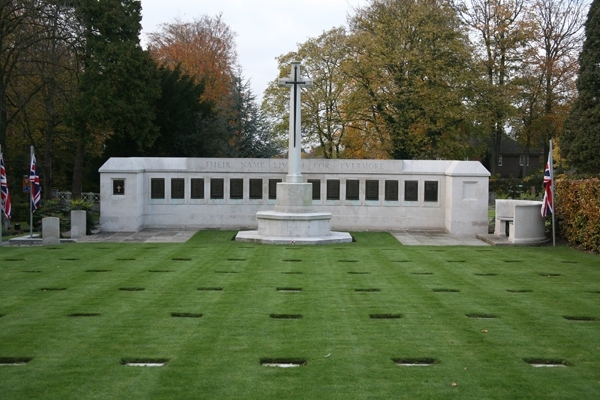
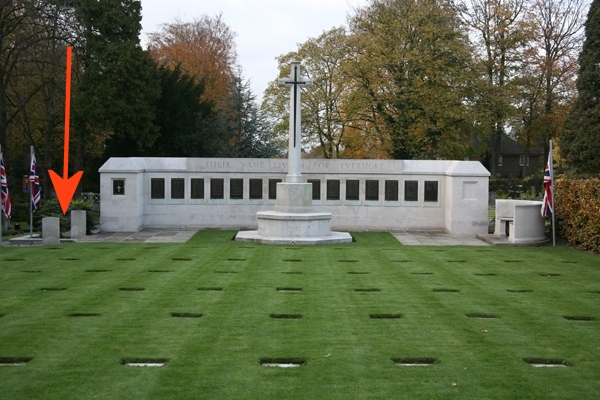
The CWGC Plot in Ashley Road, Cemetery, Epsom
Image courtesy of Clive Gilbert © 2009
J R Lord, (Superintendent of the Horton Mental Hospital and Officer Commanding during its use as a War Hospital) wrote as below about the early need to make arrangements for burials and the consequent selection of the Epsom Cemetery plot in his 1920 book, “The story of the Horton (County of London) War Hospital: Epsom“.
[from page 37] “Soldiers’ Final Resting Place. – It was necessary to make arrangements for laying to rest the remains of those patients for whom medical science had proved unavailing. It was anticipated that this would be a frequent occurrence, owing to the severity of the wounds. As regards the actual funeral there were precise military directions which could be carried out in proper manner without difficulty. In the absence of any specific instructions regarding a place of burial for those whom it was necessary to bury locally, the Sub-Committee took the matter up, and certain steps were taken. Regarding the military funerals the Army Service Corps arranged contracts for the supply of coffins, and firing parties and bearers were to be obtained from neighbouring camps and depots. There only remained the cemetery arrangements and the provision of a gun carriage.
“On 9th June [1915], I visited the Epsom District Cemetery and saw the sites proposed by Mr. Capon, the Epsom Council Surveyor, as suitable for the interment of soldiers. I selected an excellent situation, which could be seen from the public road leading up to the Race Course, and thus suitable for the possible erection later of a soldiers’ memorial. It was impossible to estimate the amount of land which would be required, but the Epsom Authorities agreed to reserve, for soldiers only, a large area in case of need. The expenses allowed by the Army Council for the burial of troops was very limited, but we were considerably helped in this respect by the patriotic action of the Rev. Henry A. Bowles, the Vicar of the Parish, who remitted his fees. It was also necessary to bury several soldiers in one, grave, but considering the comradeship, which existed among soldiers during life, this did not appear to me to be objectionable. In any case no other arrangement could be made at this time.
“Lord Kitchener kindly interested himself in the provision of a thirteen-pounder gun carriage and limber, which arrived here on 24th June, 1915.”
At 3pm on 17 May 1925 the Lord Lieutenant of Surrey, Henry Cubitt, 2nd Baron Ashcombe, who lost three of his six sons in the war, unveiled the ‘War Cross’ and Memorial in the special plot within Epsom Cemetery. (As can be seen from the above extract, Dr. Lord foresaw the need for such a plot – and the likely memorial – as early as June 1915.) A small booklet was produced for the occasion. The Bishop of Winchester then dedicated the Cross and Memorial. Behind the Cross of Sacrifice is a screen wall, on which are inscribed the names of 148 men. Their deaths occurred in the following places:
| Horton War Hospital | 94 |
| Manor War Hospital | 30 |
| Long Grove Asylum | 19 |
| Old Rifle Range Chalk Pit, Epsom | 2 |
| Dr Copes Surgery, Ewell | 1 |
| Military Hospital Newport, Monmouth | 1 |
| Military Hospital Brighton | 1 |
| Total | 148 |

Left: Lord Ashcombe unveiling the Cross of Sacrifice
Right: The Bishop of Winchester addressing the congregation
Source of images believed to be the Epsom Herald Newspaper.
The CWGC plot has space for 88 graves but only 86 have been used. To accommodate 148 bodies some of the graves have multiple burials, and in some cases up to nine. Instead of individual headstones a rectangular stone measuring approximately 12 inches by 9 inches with a number engraved marks the site of the grave. The example below marks the grave numbered 654 which holds the remains of 4 men:
Gunner A Howard died 17 July 1919
Airman FW Woodward died 29 July 1919
Sergeant WA Cooper died 8 August 1919
Signaller AJ Wells died 7 October 1919.
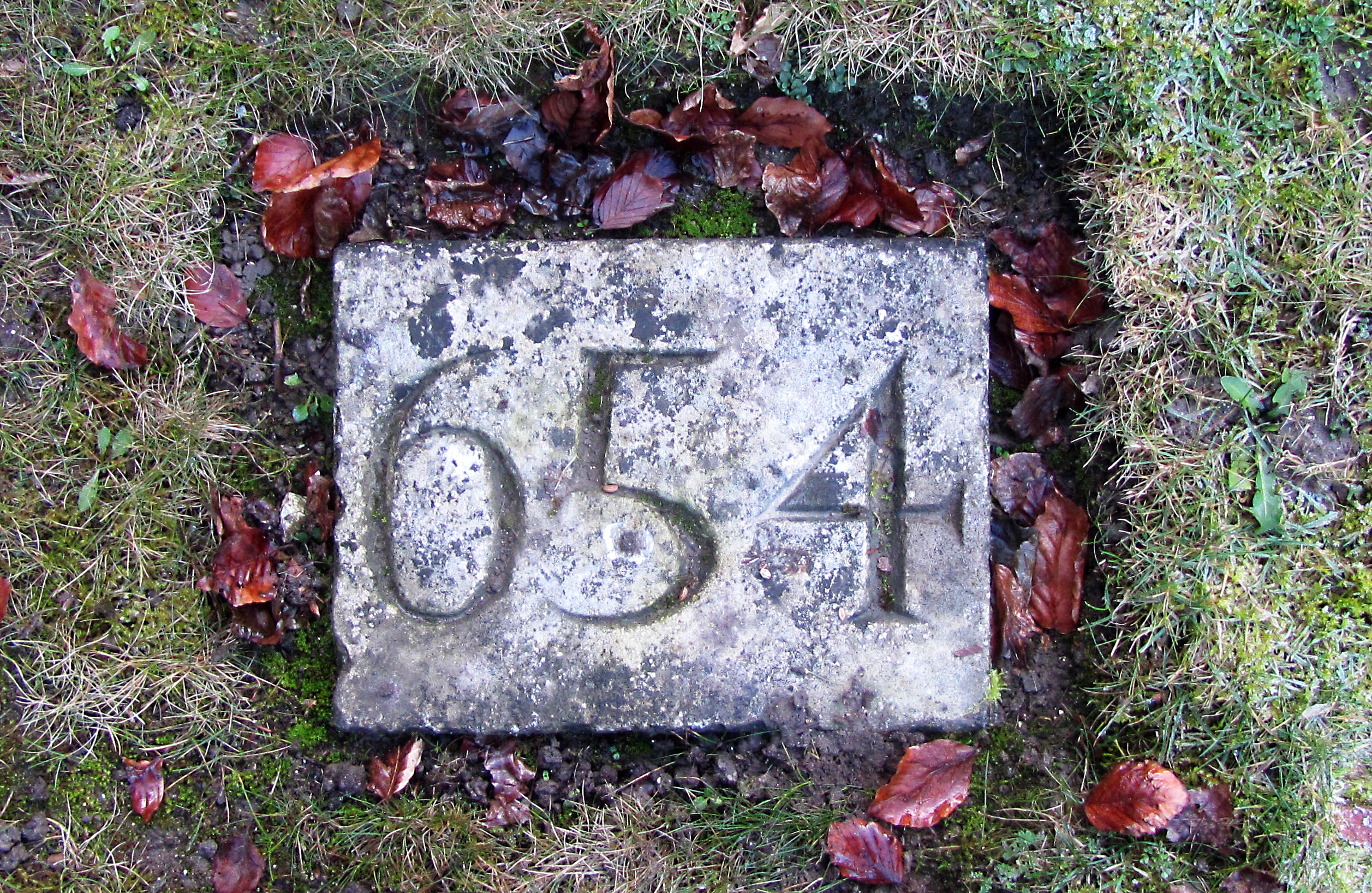
The grave marker for grave 654 in the CWGC Plot in Ashley Road Cemetery
Image courtesy of Clive Gilbert © 2021
Details of the men buried in the CWGC plot are displayed on bronze panels on the Screen Wall behind the Cross of Sacrifice. Click on one of the following names to see what has been discovered about the men buried in the CWGC plot.
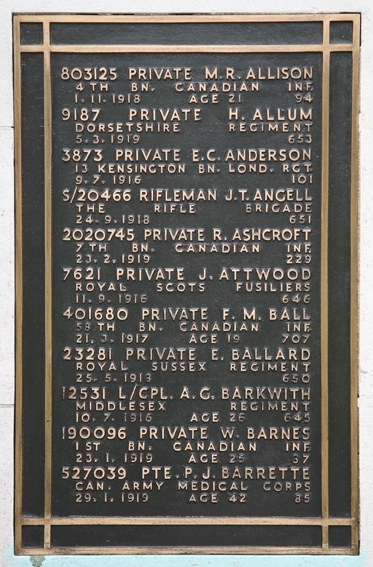

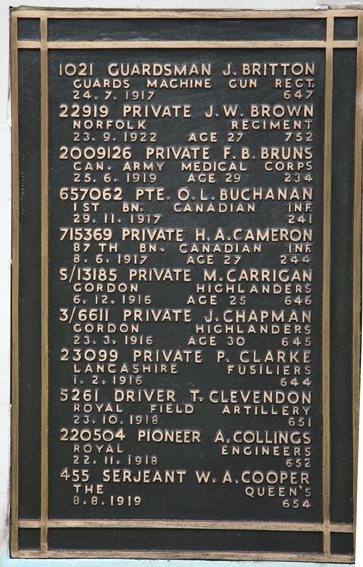
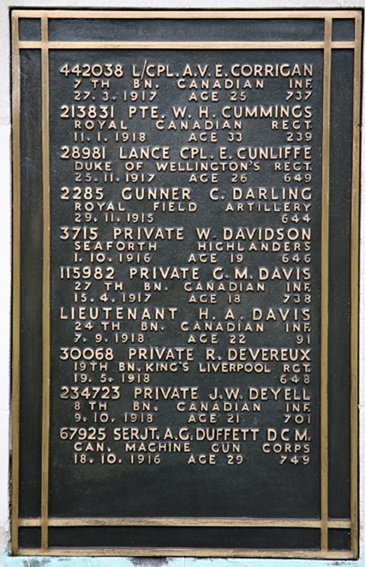
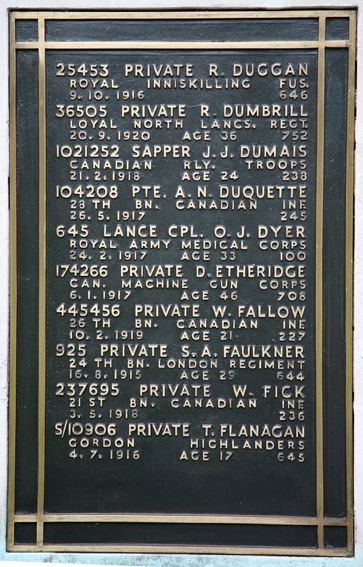
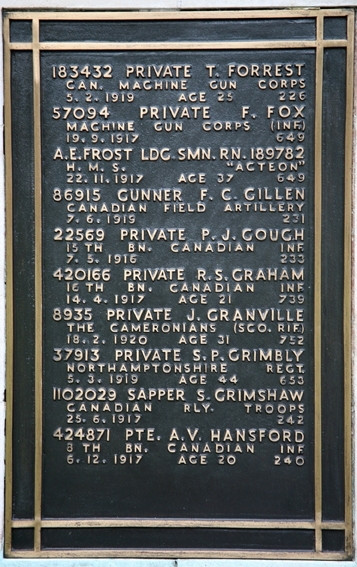
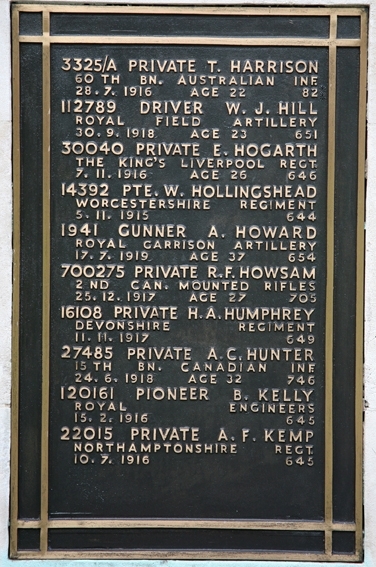
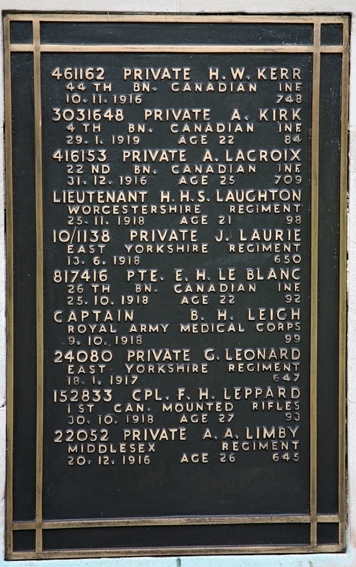
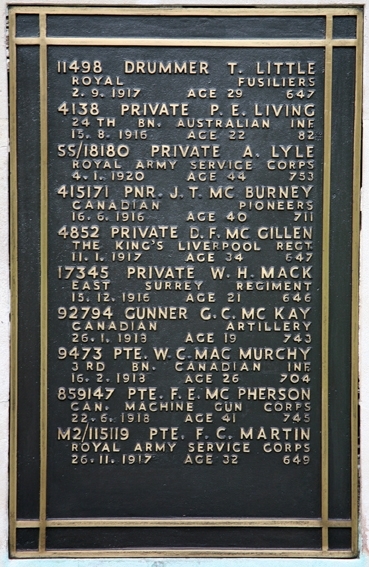
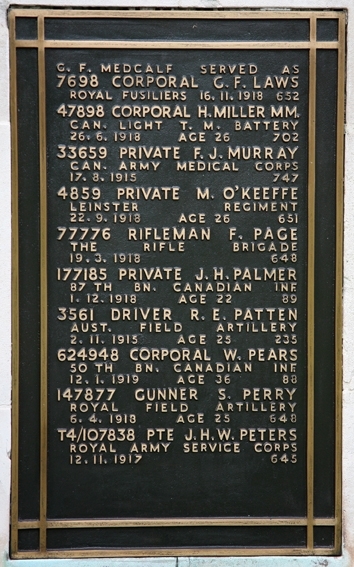
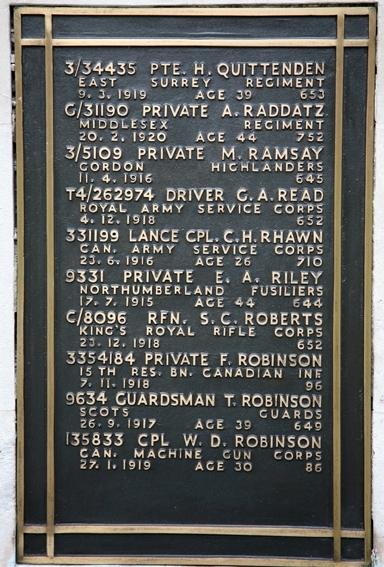
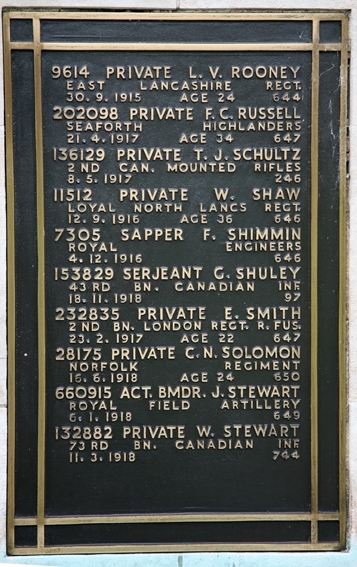
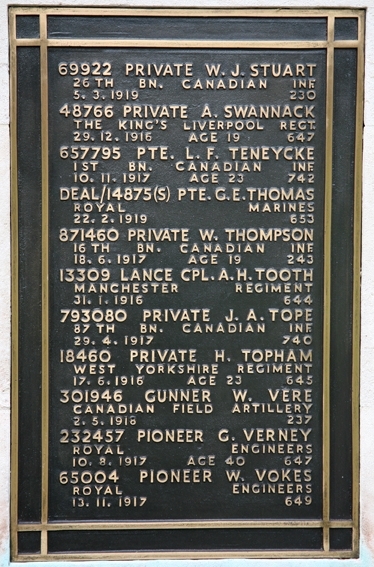
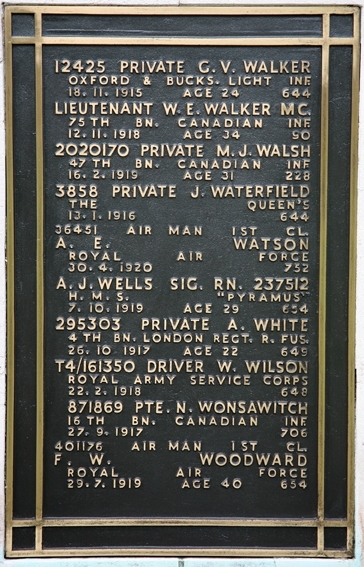
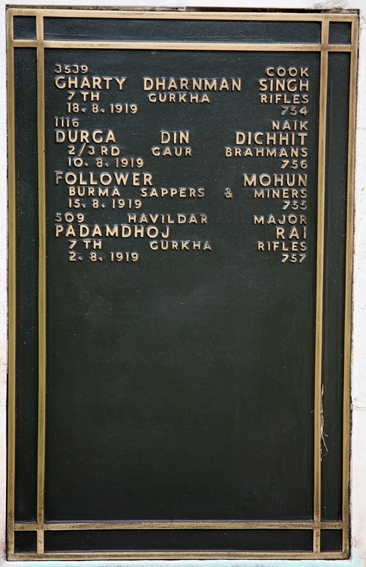
Caution some names are out of order on the memorial.
To read more about an individual please click on their name. Also please note that ALL the names are from the Great War.
Photographs courtesy of Clive Gilbert
Of the 148 men named on the bronze panels 59 are Canadian, 6 are Australian, 2 are Ghurkhas, 1 is from Burma and 1 from India. The other 79 are from a variety of units from the UK, mainly army but there are 3 from naval forces. Some of the graves were dug to a depth of 22 feet, deep enough to take 12 bodies. However the maximum number of bodies held in each grave is nine.
The remains of the 59 Canadians, six Australians and the four from Asia are now all buried in individual graves. But initially this was not the case. Originally 32 of the Canadians and five of the Australians were buried in multiple graves. The Canadian and Australian Governments were not satisfied with this situation and, in 1919, paid £2 10s for each of their servicemen to have individual graves.
The 37 men were duly exhumed from their multiple graves and re-interred into individual graves. Council minute 830 of 9 November 1920 read as follows:
“Exhumation and re-interment of 37 bodies of Colonial soldiers had been completed.
In some cases the coffins were very much decayed, and in one case special arrangements had to be made to exhume and re-inter same.”
Being local, two of these men (William Herbert Mack and Arthur White) are also commemorated on the Ashley Road memorial.
Private Peter McMahon memorial
One man, Private Peter McMahon who died in the Long Grove Asylum and was buried within the Horton Estate Cemetery is commemorated within the CWGC plot, with a special memorial. See picture. Why Private P. McMahon was the only Great War soldier to be buried in the Horton Estate cemetery is a mystery. [Note: The Horton Estate cemetery holds the remains of over 8,000 people who passed away whilst they were inmates at one of Epsom’s asylums. The site, now privately owned, is overgrown and not obviously recognisable as a cemetery.]
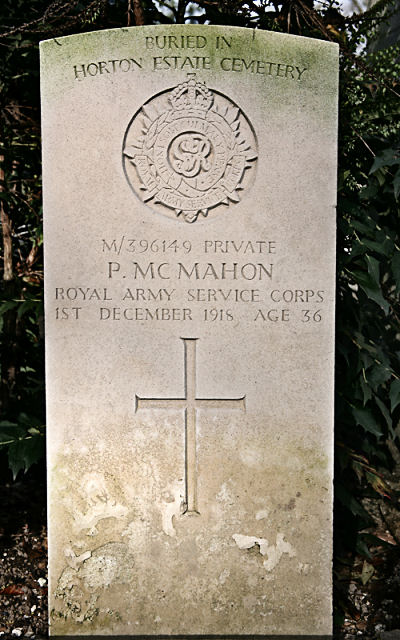
Great War soldier P. McMahon’s Headstone in the CWGC Plot
although he is buried in an unmarked grave in Horton Cemetery
Image courtesy of Clive Gilbert © 2010
Private Henry W James memorial
A Second World War casualty, Private Henry James, who died in the Long Grove Asylum and was buried in the Horton Estate cemetery, is also commemorated in the CWGC plot. See picture.
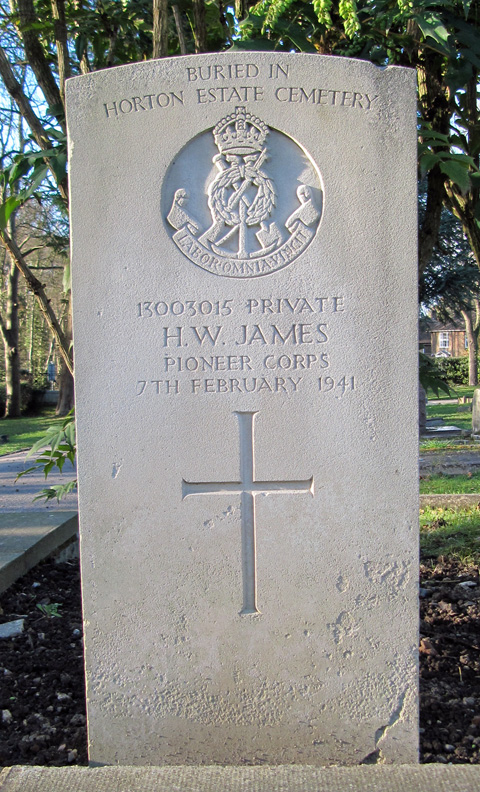 WW2 soldier Private HW Jones’s Headstone in the CWGC Plot
although he is buried in an unmarked grave in Horton Cemetery
Image courtesy of Clive Gilbert © 2012
The 34 Great War CWGC burials scattered throughout the cemetery
In addition to the 148 men buried in the CWGC plot and commemorated on the Screen Wall, another 34 men who died in the Great War are buried in scattered graves throughout Epsom cemetery.
 Click Image to go to plan of the Cemetery
| SURNAME | NAME | BURIED |
|---|---|---|
| ANDREWARTHA | William | D. 220A |
| BATES | John Thomas George | A. 336 |
| BROWN | Alfred Llewellyn | A. 339. |
| BUCHANAN | Edmond | D. 220A |
| CALDWELL | John | B. 180A |
| CHANDLER | Dorothy Maud | A. 277 |
| COULSON | William Eugene | D. 317. |
| DALEY | James | H. 138A. |
| ELLIS | Henry David | B. 185A |
| FERGUSON | Philip | D. 559A. |
| GIRLING | Charles Norman | D. 336 |
| GOREY | Fred | C. 251 |
| GRINTER | George Henry | H. 139A |
| HARVEY | Clement | V. 337 |
| HEFFERN | William | K. 721 |
| HYDE | George | F. 327 |
| JOHNSON | John William | D. 332 |
| JOHNSTON | Jonathan Locke | D. 531 |
| KITCHERSIDE | Edwin | A. 397 |
| MARSHALL | Harry Cecil | D. 339 |
| MASKELL | Albert Edward | A. 447 |
| MATTHEWS | William James | A. 309 |
| PERKINS | Frank Percival Cox | D. 338 |
| PIRIE | George Laurence | A. 404. |
| POTTERTON | Ted | D. 481 |
| PROSSER | John | D. 482 |
| RASEY | Frederick | A. 437 |
| RATCLIFFE | Frederick Harold | A. 391 |
| SIMMONDS | Alfred Montague | A. 398 |
| SIMMS | Thomas | D. 220A |
| SPENCE | Colin George | D. 368 |
| STURT | Reginald Philip | D. 312 |
| THORNTON | William John | F. 256A |
| TREAYS | John | K. 639 |
The 48 Second World War CWGC burials scattered throughout the cemetery
Click Image to go to plan of the Cemetery