
The Story of Horton War Hospital
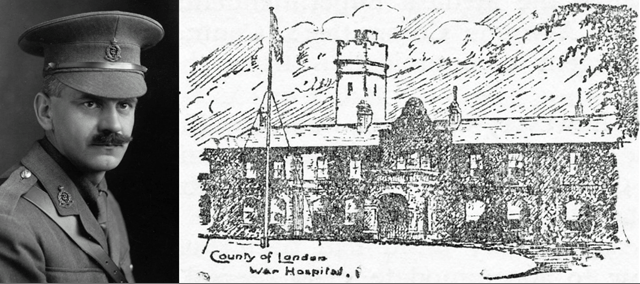 Left: The Officer Commanding and author, Lt.Col. J R Lord
Photograph with thanks to the Imperial War Museum © IWM HU 124317
Right: The postcard illustration he chose for the top of page 1 in his book.
As noted in our article about the remarkable Dr John Robert Lord, his 1907-1931 term as Superintendent of Horton Mental Hospital was interrupted by the hospital’s 1915-1919 use as a War Hospital, of which (as Lt.Col. RAMC) he was Officer Commanding.
Dr Lord was already an accomplished writer, and 1920 saw the publication of his 264 page Story of the Horton (County of London) War Hospital: Epsom, about which a contemporaneous review noted:
“It is not a particularly easy task to present such a mass of administrative detail as this book contains and at the same time make it interesting to the general reader. Col. Lord has managed, however, to achieve this task, and has written an essentially human and readable book. He tells us of his difficulties and how he met them; he records his doubts, fears and trepidations; he gives in a few happy paragraphs his impressions of the numerous distinguished visitors to the hospital; and he lets us into various little secrets.”
The book has long been out of print, and we are pleased to make its invaluable record available through the various links below.
To speed up download times, we have divided the 300+ megabytes of the whole book into six about equally sized PDFs (Sections A to F), the coverage of each of which is shown in the contents listed below.
The final Section, F, concludes with an alphabetical index, which it may be convenient to access directly by clicking this link.
Roger Morgan & Peter Reed 2023
The Story of the Horton (County of London) War Hospital: Epsom
Its Inception and Work and some Reflections
By Lieut.Colonel J. R. Lord, C.B.E., M.B.
Officer Commanding
SECTION A <click to access
TITLE & INTRODUCTORY PAGES
[Note: In his preface, Dr Lord noted that: “Any profits which accrue from the sale of the book will be devoted to the erection of a memorial in the hospital chapel, testifying to the high purpose and noble use the Institution was put to during the Great War, and also recording the names of many of the hospital staff who died both at home and abroad in the service of their King and country.” Details of those memorials are at this link.]
PART I: GENERAL HISTORY.
I. Horton Asylum and the Genesis of the War Hospital. (Page 1)
[Note: On page 37, Dr Lord described arrangements for the burial in Epsom Cemetery of those soldiers the hospital could not save.We have an article about this Commonwealth War Graves Commission plot at this link, which includes Dr Lord’s text.]
SECTION B <click to access
II. Reception of Military Patients and the Development of the Hospital, 1915. (Page 36)
[Note: On pages 54-56, Dr Lord described the arrival of survivors from the sinking of the hospital ship Anglia. We have an article about that tragedy and its aftermath at this link, which includes Dr Lord’s text.]
III (part a). General History of the Hospital, 1916-18. (Pages 65-79)
SECTION C <click to access
III (part b). General History of the Hospital, 1916-18. (Pages 80-115)
IV. General History of the Hospital, 1919 and Demobilisation. (Page 116).
SECTION D <click to access
PART II: SOME SPECIAL SECTIONS OF THE HOSPITAL’S WORK.
I. Officers’ Clinique and Special Surgical Treatment Centre. (Page 125)
II. Some Statistical Matters. (Page 134)
Ill. Department of Surgery. (Page 146)
IV. Department of Medicine. (Page 153)
V. Eye Department. (Page 164)
VI. Ear, Nose and Throat Department. (Page 167)
SECTION E <click to access
VII. Mental Department. (Page 170)
VIII. Dental Department. (Page 174)
IX. X-Ray Department. (Page 177)
X. Electrotherapy and Massage. (Page 180)
XI. Pathological Department. (Page 185)
XII. Department of the Dispensing Chemist. (Page 190)
XIII. The Medical Board. (Page 195)
XIV. Chaplains’ Department. (Page 197)
XV. Army Education. (Page 201)
XVI. The Auxiliary Hospitals. (Page 207)
XVII. Transport of the Sick and Wounded. (Page 215)
XVIII. Enquiry Department for Missing Soldiers. (Page 217)
SECTION F <click to access
XIX. Almoner’s Work, Soldiers’ Recreation and the Tea Room. (Page 220)
XX. Quartermaster’s Department. (Page 233)
XXI. House Steward’s Department. (Page 236)
XXII. Finance, Cost Accounting and Economies. (Page 241)
XXIII. Honours and Awards granted to Members of the Hospital Staff. (Page 251)
APPENDIX: Memorandum regarding the Duties of M.O’s in charge of wards. (Page 254)
INDEX