
War Memorials – WW1 Introduction
Back to our main war memorials page
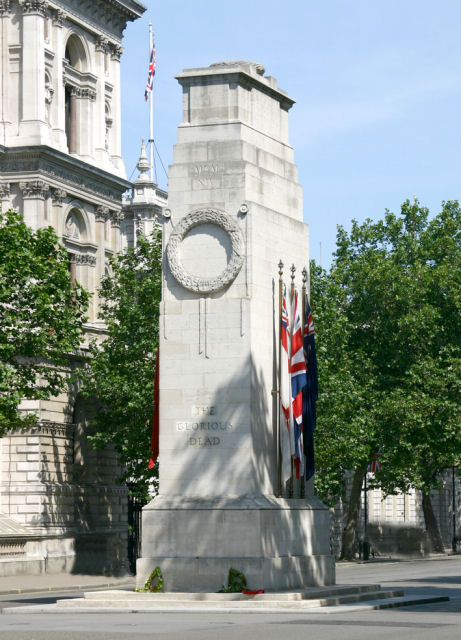 The Cenotaph, London is the National War Memorial
Copyright image courtesy of Clive Gilbert
Memorials of The Great War of 1914-1918
The war in Afghanistan (2001-2014) claimed the lives of 451 British service personnel – each one a tragedy, and our hearts go out to the bereaved families. That sadness was magnified a thousandfold by the sheer scale of the carnage of the two world wars, especially the Great War of 1914-1918. It is a sobering thought to realise that throughout that war, on average, 480 men from the UK were killed every day. On the worst day, Saturday July 1 1916 some 20,000 British soldiers were killed. What devastation must have been felt back home by the mothers, fathers, wives, brothers, sisters, sons, daughters, as well as friends and other family members.
According to the Oxford English Dictionary, a memorial, is “a sign of remembrance; preserving or intended to preserve the memory of a person or thing“. War Memorials commemorate those killed as a result of conflict or military service. In one way, such memorials help those who never had a grave to mourn over, nor leave flowers at; they helped those left behind to grieve. In another way, they represent society saying “thank you” to the locals (mainly young men) who lost their lives trying to protect the community’s way of life.
The desire to commemorate the fallen was intense during the years following the First World War, especially when repatriation of bodies was not allowed or possible. Indeed, even before the war ended many communities had erected “shrines”, recording the names of men who had died as well as those who were serving, had been wounded, taken prisoner or had received a medal. There were no Government rules to decide which names should appear on which memorials, each local community did the best that it could to gather together the names for inclusion on their memorial. No doubt word of mouth, newspaper articles, church announcements and door-to-door enquiries all played their part. The lack of rules has lead to many inconsistencies and inaccuracies, but this should not diminish the value of war memorials.
War memorials are part of our heritage and deserve to be preserved, respected and brought to the attention of each new generation. Whilst Local Authorities can maintain, repair and protect war memorials there is no obligation to do so. There is a group called “The War Memorials Trust” dedicated to preserving this emotive national asset. Their web site is http://www.warmemorials.org/.
The centre of National remembrance is, of course, the Cenotaph in London’s Whitehall, as pictures above. But every city, every town and almost every village in the UK erected some form of memorial to their dead. Of the 16,000 or so villages in England only 42 (Daily Telegraph 10 November 2007) or 46 (according to www.hellfirecorner.co.uk/thankful.htm) did not have any men killed in the Great War.
All the War Memorials in the Borough of Epsom and Ewell of which we are aware are listed in the table below. (Please let is know if you are aware of any others.) These include the WW1 memorials for the then separately administered areas of Epsom (at Ashley Road) and Ewell (at the Dipping Well).
Click on the links to read about each memorial and the individuals they commemorate. (A further click may be needed at the indexed page to reach that location’s WW1 memorial.)
All the WW1 casualties have been researched, and the resulting information for each individual can be found by clicking on the first letter of the surname:
A B C D E F G H I J K L M N O P Q R S T U V W X Y Z
We have plotted most of the fallen on a map which shows their last Epsom and Ewell address. Click here to view the map.
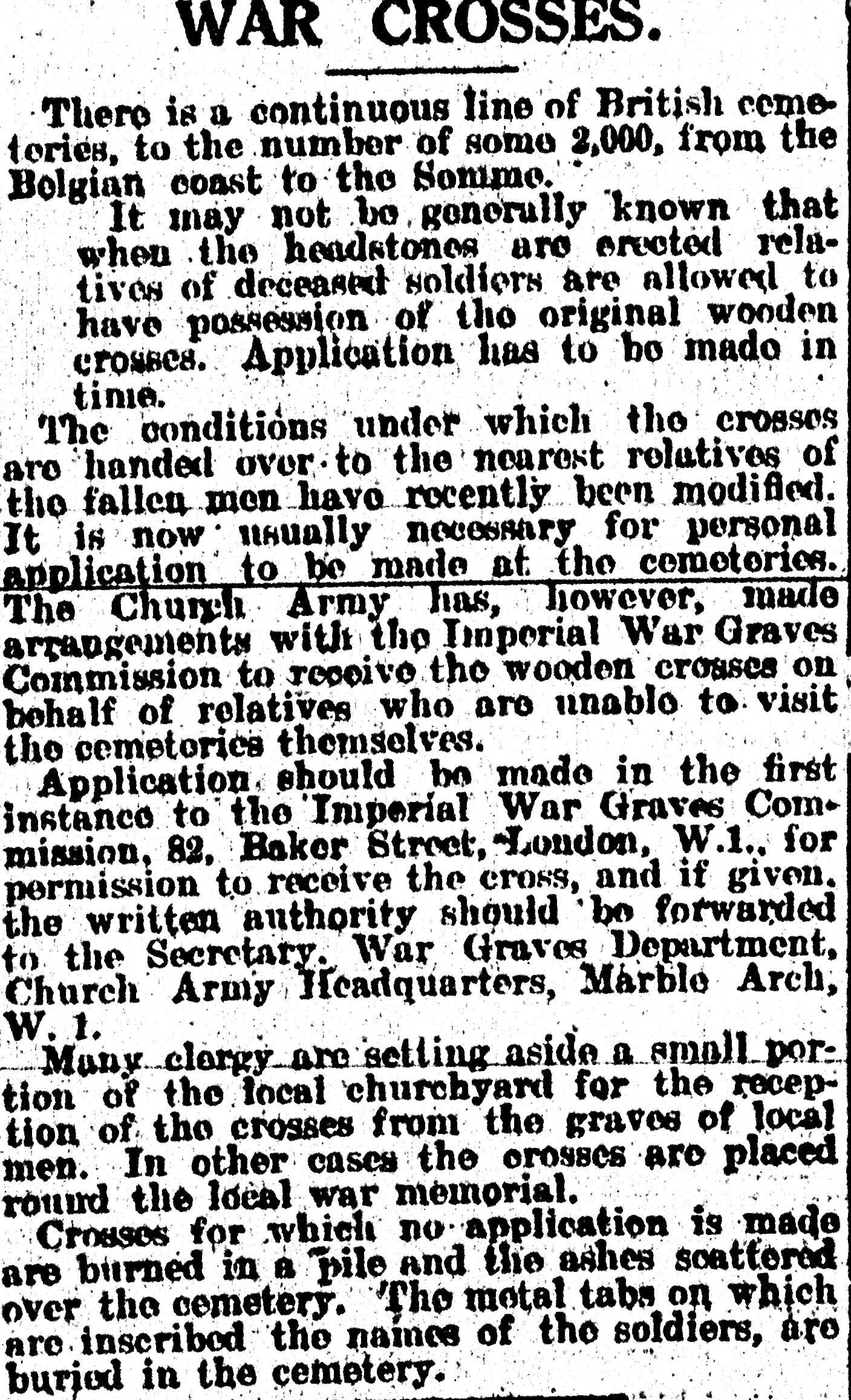 This item on Wooden Crosses appeared in the
Epsom Advertiser of 8-4-1923
Sources of information:
• Commonwealth War Graves Commission.
• Soldiers Died in the Great War 1914-19. CD
• National Archives General Register Office Indexes.
• BMD Index http://freebmd.rootsweb.com/
• Census returns. (www.Ancestry.co.uk)
• Surrey recruitment registers. (Surrey History Centre).
• The Epsom and Ewell Advertiser. (Local History Centre Bourne Hall).
• National Archives ‘burnt records’.
• National Archives, War Diaries WO/95 Series.
• Parish Magazines. (Surrey History Centre).
• Parish Council minutes. (Surrey History Centre).
• National Archives Medal Rolls.
• The Times Digital Archive
• The Long, Long Trail.
• Imperial War Museum Trench Map Archive on CD-ROM.
• Electoral rolls. (Local History Centre Bourne Hall).
• Kelly’s Directories. (Local History Centre Bourne Hall).
• London Gazette.
• The London Scottish in the Great War by Lt-Col J.H. Lindsay
• School Records (Surrey History Centre).
• Baptism Records. (Local History Centre Bourne Hall).
• Canadian War Records. (Canadian Virtual War Memorial.).
• Lambeth Palace Library
You may also be interested in the following related pages:
• The Somme
• Taunts no Excuse.
• A clickable map of West Ewell in 1913 showing the homes of some of the men who died in WW1.
• Background items page.
• Soldiers Penny page.
Links to other local war memorial websites:
• Ashtead War Memorials
• Banstead War Memorials
• Fetcham War Memorials
• Leatherhead War Memorials
Useful Links:
• www.exploringsurreyspast.org.uk
• www.surreycc.gov.uk/surreyhistorycentre
Sutton Archives Past on Glass Project has many portraits of WW1 soldiers and others but not everyone has been identified – if you can supply any information please contact the project direct.
If you want to visit the battlefields of the Somme, and are in need of B&B accommodation, you could do no better than stay with Bryan and Christine Lightbody. Their hospitality is second to none and is administered from a large old farmhouse in the village of Combles. Their web site can be found at www.orchardfarmsomme.com.