
WW2: The Home Front in Epsom & Ewell
Part 7: Days of Rejoicing
[Click here to return to the Introduction]
Victory in Europe (VE) Day on the 8th May, 1945 saw Epsom and Ewell festooned with red, white and blue in shops, private houses and public buildings. Young children wore patriotic colours in their hair and dogs’ collars were adorned with ribbons. Thanksgiving services were held in most churches that evening with the King’s speech broadcast at a service in Epsom Parish Church. A thanksgiving service was held at the Woodcote (Epsom) Social Club tennis courts attended by more than 400 local residents followed later by a bonfire and a torchlight procession.
Although there was no official lead in the organisation of festivities, street parties sprung up under warm sunshine throughout the town for children and adults alike. Where much of the food came from at such short notice remained a mystery. Chairs, tables and pianos were brought out and impromptu concerts given. Burgh Heath Road held their street party in the grounds of Epsom College, courtesy of the Headmaster, and it lasted for three days. Public Houses stayed open to midnight on VE Day, the main streets becoming livelier throughout the evening.
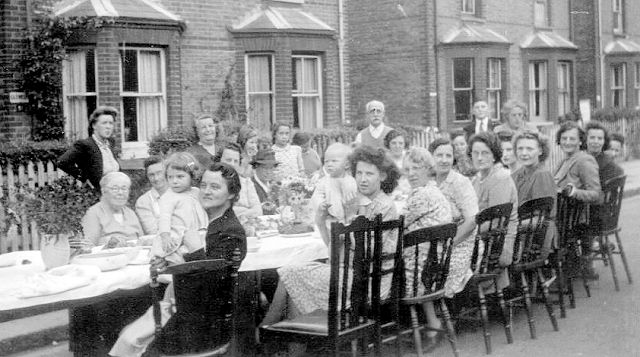 VE celebrations in Upper Court Road, Epsom
Image courtesy of Epsom & Ewell Local & Family History Centre
Children from Ebbisham Road, Tunstall Road and Dirdene Gardens experienced a special treat. Donations from parents, together with the children’s fund raising activities, meant there was surplus money remaining after the street parties. It was decided to take the children to the seaside and the following weekend a group of very excited children, with parents, boarded a train at Epsom, destination Bognor.
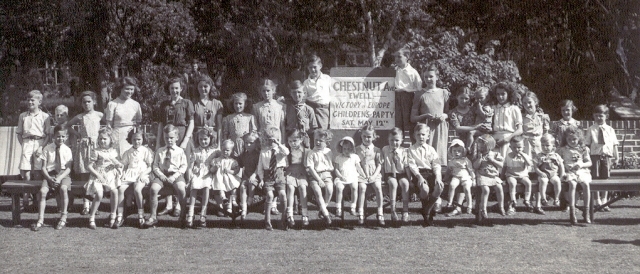 VE celebrations in Chestnut Avenue, Ewell
Image courtesy of Bourne Hall Museum
On a damp, blustery Sunday following VE day, a mass thanksgiving service was held at Court Recreation Ground attended by the Mayor, representatives from all military and non-military services and over 3,000 local residents. The service was preceded by a parade including Home Guard, Civil Defence, Women’s Land Army, Red Cross, St. John Ambulance and several youth organisations.
A message from the Mayor was published in the Epsom Advertiser on 17th May 1945. In addition to offering his gratitude to the armed forces, he recognised the contribution made by all on the Home Front. “Nor must we forget those at home, the Civil Defence Services, whose constant help, courage and sympathy mitigated the worst effects of the terror raids, the housewife and the shopkeepers, whose perseverance and hard work have made most of the available supplies of food in spite of intricate and baffling regulations”. The Council decided to defer organised victory celebrations until the war with Japan had ended. A special committee was set up to consider what form those celebrations would take.
A general election was held in July 1945, just two months after VE Day. Although Clement Atlee’s Labour party won a landslide victory, Epsom and Ewell returned Sir Archibald Southby (Conservative) with a majority of 6,584 over Wing Commander E. Shackleton (Labour).
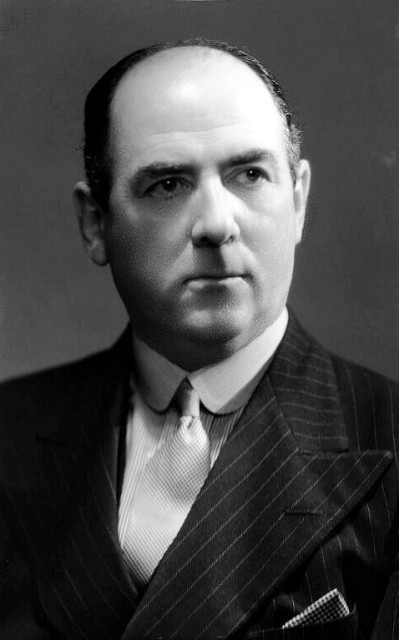 Sir Archibald Southby, MP for Epsom during the war years
Image source: © National Portrait Gallery, London (CC BY-NC-ND 3.0)
Victory in Japan (VJ) day on Wednesday 15th August, 1945 was quietly received. Rumours of peace had been circulating for some days but residents were reluctant to believe that war in the Far East had ended until there was an official announcement. When it did come, the announcement caught people by surprise, resulting in a rush on food shops with queues longer than ever before.
The highlight of the VJ celebrations was a torchlight procession from Epsom town centre to Epsom Downs attended by thousands of residents. Families on foot and in cars could be seen making their way from miles around. The streets of Epsom were packed with people waiting for the start of the procession which made its way past the Spread Eagle junction and up Ashley Road. A huge bonfire, well over 30ft in height, composed of waste material mainly from bomb sites, was lit by the Mayor on the Downs. Effigies of Hitler, Mussolini and Hirohito were thrown onto the flames. Dances were planned in Rosebery Park and at Ewell Court for the evening of the second VJ day but these were abandoned due to wet weather.
The Lower Court and Hook Road areas celebrated on the following weekend with games for children and dancing in the streets attended by 100 adults and over 80 children. Residents had contributed a penny per adult every week since VE Day to pay for the festivities. The Horton Estate also celebrated that weekend with games, a tug-of-war and a bonfire. In Ewell, a special thanksgiving service was held in St Mary’s Church after which residents returned home to take part in various forms of celebration. Crowds began to gather in the streets and before long gramophones and radios were brought out and dancing continued into the early hours of the morning.
The war-related efforts of local residents didn’t end after the defeat of Germany and Japan. In November 1945, 70 Dutch children were welcomed to Epsom from a rehabilitation camp in Doncaster. The children stayed with foster-parents in the town for eight weeks before returning to their home country.
One year later, on Saturday 8th June 1946, victory celebrations were held in honour of the people of Epsom and Ewell and the part they played in the victory.
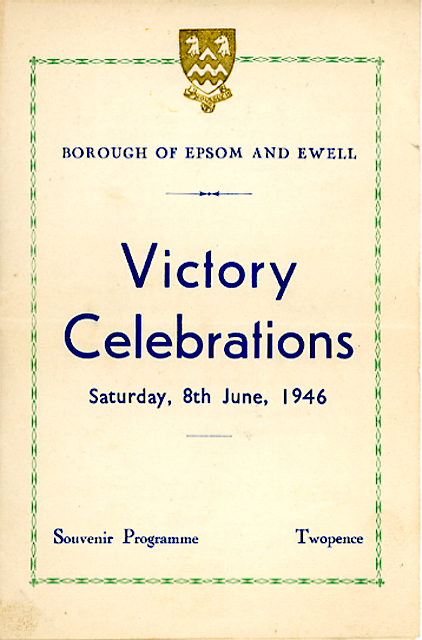 Victory Celebrations Souvenir Programme 1946
Click the above to read the programme.
Programme courtesy of Alan Holmes
Post-war planning had begun long before the end of hostilities. As Alderman Littlejohns of the Borough Council put it, “While we should be prepared for victory, we have got to be prepared for peace”. Housing, town planning, recreation grounds, agriculture, health centres, highways and unemployment were among the subjects discussed. The Council recommended the development of approved light industry as part of its post-war policy and that suitable areas should be identified for that purpose.
The repair of war-damaged houses had been progressing well, yet at the beginning of 1945 there were still nearly 500 outstanding applications for housing in the Borough, half of which came from members of the armed forces. At a meeting of the Borough Council, the Chief Surveyor reported that the majority of uninhabitable and seriously damaged houses would be repaired by the end of March 1945.
Factory-made temporary houses were erected as a solution to the housing problem, although this was unpopular with some Councillors, one of whom claimed “The pre-fabricated houses which are going to be constructed are the potential slums of the future”. A proposal from the Housing Committee to erect 500 temporary bungalows on Epsom Common, albeit for a period not exceeding ten years, was met with fierce resistance from local residents as well as opposition from the Minister of Health. The Housing Committee thought that the provision of housing, both temporary and permanent, was far more important than the maintenance of open spaces. On the other side were local residents who formed a protest group threatening legal action to stop the proposal. In the end, the Council decided that they could not overcome the legal and other difficulties relating to the scheme and the proposal was withdrawn.
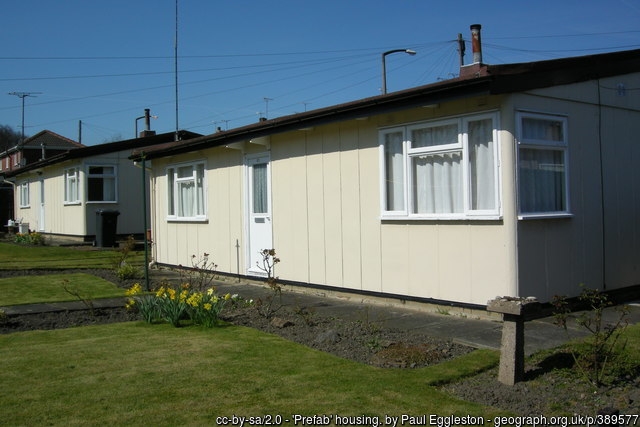 Prefab houses were used to solve post-war housing shortages
Image source: © Paul Eggleston – geograph.org.uk/p/389577 (cc-by-sa/2.0)
The Cox Lane area of Epsom, the only potential housing site owned by the Council at the time, was identified as being suitable for building of around 265 permanent houses Other areas under consideration for development were Ruxley Lane (147 houses) and the Wells Estate (150 houses). The housing problem facing the Council was to increase further. By the end of December 1945, there were 1,710 applications for housing including 1,137 applications from those recently discharged or still serving. A contract was awarded to C.H. Coates Ltd to build houses at Cox Lane for a total of £105,348. House prices ranged from £917 for a two-bedroomed house through to £1,210 for four bedrooms.
Life for Epsom and Ewell residents, as in the rest of the country, would never be the same following the war. By necessity the Government had become far more involved in the population’s lives and the Home Front had brought people together with a common purpose. And health and social welfare was to go through significant reform. The Emergency Hospital Service, under central government control, laid the foundations for the National Health Service. The Beveridge report, commissioned by the Government during the years, made wide ranging recommendations for post-war Britain. This report, published at the end of 1942, was to become the basis of the welfare state as we know it today.
Paul Le Messurier © February, 2018