
WW2: The Home Front in Epsom & Ewell
Part 3: Look Out in the Blackout
[Click here to return to the Introduction]
One of the most immediate, noticeable consequences of the outbreak of war was the introduction of blackout regulations. A blackout test had been undertaken in the London area, including Epsom and Ewell, from midnight to 4 a.m. on the 9th/10th August 1939. Co-operation was sought from the general public although there was no legal requirement to participate. As a result the trial was met with a degree of public apathy with the Epsom & Ewell Herald observing that “The black-out, as regards the part taken in it by the general public, was, it must be confessed, something of a wash-out”.
Blackout regulations came into effect on 1st September 1939. Illuminated signs were switched off and no lights were allowed from buildings. Drivers had to mask headlights and screen interior lights on their vehicles. Unsurprisingly, this led to an increase in the number of road accidents with a particularly high number of fatal accidents recorded in December 1939.
 Road fatalities increased significantly during the blackout
Image source: © Imperial War Museum (Art.IWM PST 15157)
Not all train carriages were supplied with modified lighting and unless a passenger possessed a torch, for which batteries were in short supply, they might quite likely end up sitting on an already seated passenger.
At first blackout regulations were not strictly enforced and one could walk down Epsom High Street without too much trouble since there were usually some small amounts of light emanating from the majority of premises. As time passed, fines for contravention of blackout regulations became a welcome source of revenue for the police courts and the blackout of commercial and residential premises became more strictly enforced. A shop proprietor appeared before Epsom Police Court for leaving lights switched on at night in premises in Epsom High Street. The standard fine for such an offence was 40 shillings.
Several motorists would appear at each sitting of Epsom magistrates for driving with lights that did not comply with the regulations. A motorist from West Ewell was fined five shillings for not having white paint on his bumpers and running boards. An Epsom motorist was fined for dangerous driving when he drove on to the wrong side of the road one night during the blackout and collided with another vehicle and then hit a pillbox.
An unexpected consequence of the blackout was that the number of day time motoring accidents also increased. This was attributed to motorists speeding in the afternoon as well as accelerating through traffic lights to get home before blackout.
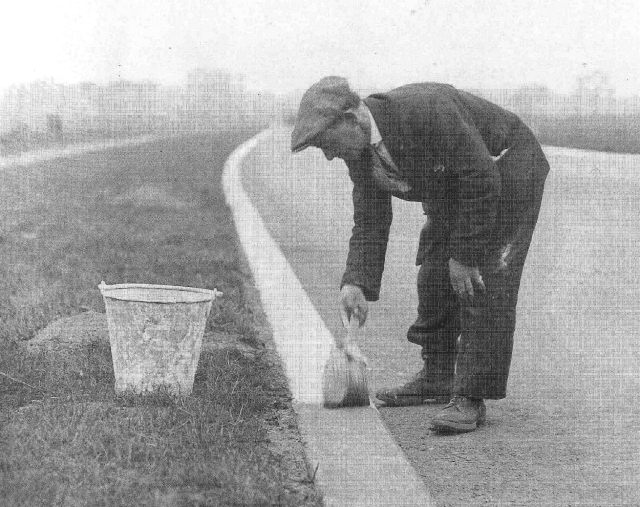 Kerb painting on Kingston Road
Image source: “Surrey at War” by Bob Ogley via Bourne Hall Museum
By August 1940, local magistrates had decided it was time to stop being too lenient. At one sitting, the Chairman of Epsom Magistrates, Judge Tudor Rees said “Magistrates were very much surprised to find that although blackout regulations have been in force for over a year there are still those who failed to observe them”. Fines were increased with a threat that harsher penalties would follow if things didn’t improve. Judge Rees continued with “After this warning we hope that we will not have any more of these offences before us”. In most cases the offences were due to negligence rather than deliberate acts.
A greengrocer with premises in the High Street, Epsom appeared in court charged with allowing a light to be visible from his shop. “We have seriously considered whether or not the defendant ought to go to prison in view of the gravity of the offence and the previous convictions” said the Chairman of Epsom Police Court. The defendant had previous convictions related to his shop and car lighting. There had been other convictions against staff and his wife. He was fined £30, a considerable sum in those days, especially since typical fines for blackout offences were by then around £2.
Although it was the responsibility of ARP wardens and the police to enforce the blackout regulations, the public played its part, in some cases perhaps a case of neighbours settling old scores. On one occasion two neighbours appeared in court. When one of the them shouted “put that light out” the other replied “I’ll put your lights out” and a fight broke out. Another resident wrote into the Epsom & Ewell Herald complaining that “When passing through the town last Monday evening after 5.30 p.m. I was astounded to see so many larger shops with brilliant illumination. I admit that the black-out time was not until 5.45 p.m. but surely those offenders could use a little more common sense … by using a restricted amount of lighting, instead of making our main thoroughfare a beacon”.
Following a Government announcement in September 1944, the Council relaxed the blackout regulations and street lighting was re-introduced. The blackout of windows was no longer required and residents were able to revert to ordinary peace-time curtains or blinds.
Paul Le Messurier © February, 2018
Other pages in this series
- Keep Calm and Carry On
- Air Raid Shelter This Way
- Look Out in the Blackout (this page)
- Rationing is Sharing
- The Home Guard Wants You
- Save for the Brave
- Days of Rejoicing
- References