
WW2: The Home Front in Epsom & Ewell
Part 1: Keep Calm and Carry On
[Click here to return to the Introduction]
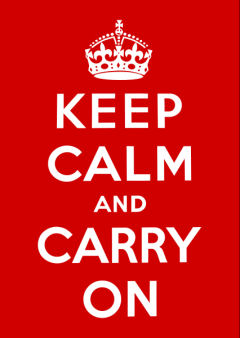 The Government’s 1939 motivational poster, actually little used during WW2
There was still hope that a peaceful solution could be found even after Germany had invaded Poland on the 1st September 1939. The Epsom & Ewell Herald remarked that “With thoughts concentrated on the all-important issue of the crisis – whether there will be war or peace – people in Epsom and Ewell, as everywhere else, were in a calm and quiet mood this week”. The Government had passed the Emergency Powers (Defence) Act 1939 the previous month enabling it do whatever was necessary to protect the public and maintain supplies and services. The Act resulted in wide-ranging measures being swiftly introduced on the declaration of war.
All cinemas, dance halls and places of public entertainment were immediately closed as a safety precaution and football matches and outdoor meetings were prohibited until further notice. Only pubs remained open. The Epsom Advertiser encouraged readers to get down to their local pub “For beer makes good talkers and good listeners. It puts men at their ease at once. Go into a pub these evenings – if you would see and enjoy the freedom we are defending”.
It was not long, in fact within a week, before the Government realised that entertainment was important to morale and indoor entertainment was resumed and some outdoor events were allowed as long as people trained in aircraft recognition were present. Residents queued up at the re-opening of the two wartime cinemas in Epsom, The Capital in Church Street and The Odeon in the High Street as well as the Rembrandt in Ewell. The Epsom & Ewell Herald quoted an elderly lady who had not missed her Saturday afternoon pictures for 20 years and was very happy when she knew the cinemas were re-opening. “We want something to keep our spirits up”, she said, “and going to the pictures helps us to forget our worries. After all it is no good sitting at home moping”. Dances were held at Ebbisham Hall, some Church Halls, Epsom hospitals and other locations.
A National Registration Day took place on September 29th, 1939. Forms were issued to residents and every household was visited to collect names, addresses, marital status and other details. Identity cards were issued and it was the duty of all to produce them on request or present them at a police station within 48 hours.
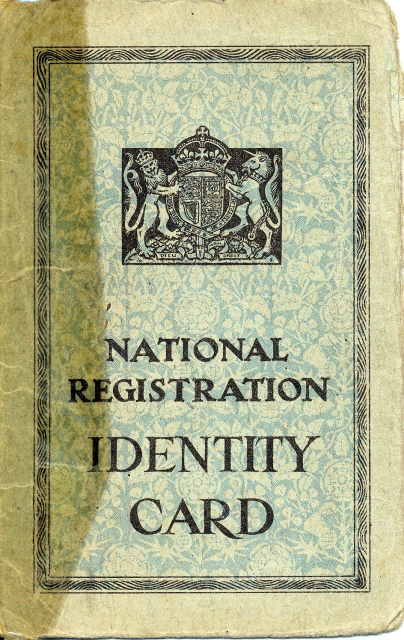 Identity cards were issued to all residents
Image courtesy of Bourne Hall Museum
At the outbreak of war, Horton Psychiatric Hospital in Epsom was evacuated when it became part of the centralised, government-run, Emergency Hospital Service. Patients were transported by a fleet of London Transport buses to Long Grove and other local hospitals. Some were moved to hospitals in Caterham and further afield. Local residents were asked if they would be willing to provide accommodation for the 600 doctors and nurses that would be drafted into Epsom to work at local hospitals. Horton Emergency Hospital was divided into two sections for military and civilian casualties. The early months were quiet but that was soon to change with the arrival of casualties following the evacuation of Dunkirk.
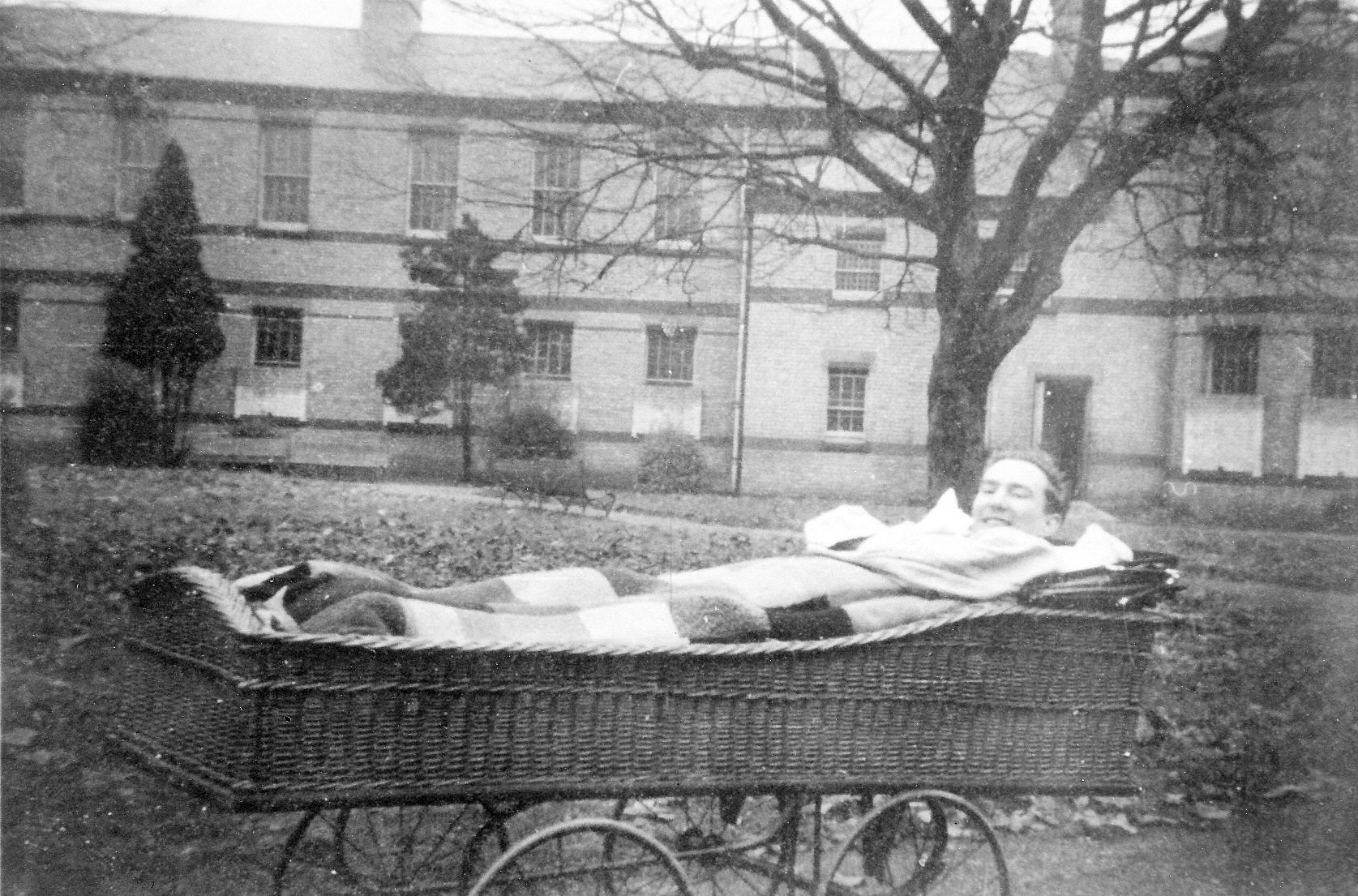 A wounded soldier outside Horton Emergency Hospital
Image courtesy of Bourne Hall Museum
During the early part of the war, a sense of optimism and hope was still evident. Sir Archibald Southby, MP for Epsom, told a meeting in April 1940 that the war would be won and quickly. At another meeting in Epsom, he expressed a similar opinion that “The war would not be as long as many people believed” and continued with how much they loathed Hitler for interfering with such a beautiful summer.
Of the children evacuated from Epsom in 1939, many had returned by early 1940, against the advice of the Government, when the expected bombing campaign did not take place. Overseas evacuations were halted in 1940 when a U-boat sank an evacuee ship on route to Canada killing more than 70 children.
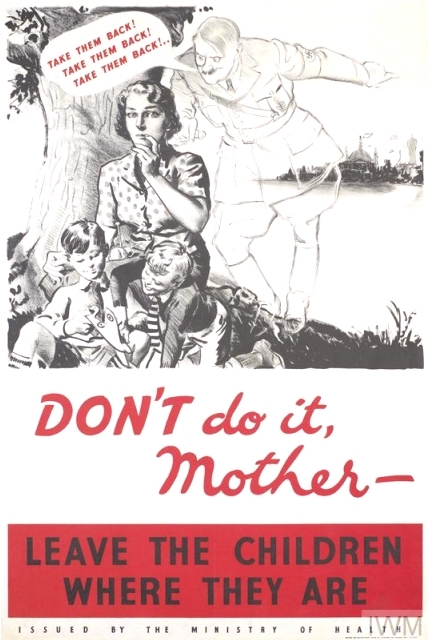 The Ministry of Health advised parents not to bring evacuated children back home
Image source: © Imperial War Museum (Art.IWM PST 8235)
Easter 1940 was an enjoyable holiday for many, with the number of residents travelling on the roads and by train not far below normal. The mood, however, quickly changed in May 1940 with the invasion of Belgium and the Netherlands. The Epsom Advertiser reported that “The surrender of the King of Belgium was a great shock to those who had been fighting … as well as us at home”. In contrast, a Surrey Constabulary report stated “When the news of the German invasions of the Low Countries came through, it was accepted calmly”. There were reports that local sympathisers known as “Fifth Columnists” had assisted German forces in Belgium and the Netherlands. Precautions were taken to prevent Fifth Columnist activities at local government centres and identity checks were introduced for those entering Epsom Town Hall.
Arrangements were made in the Borough to receive around 10,000 persons under the Coastal Evacuation Scheme but fortunately this never took place. The Borough did receive refugees following the invasion of Belgium and Holland. The initial contingent arrived in May 1940 including Belgian, Dutch and French refugees. The refugees were registered, given ration books and a subsistence allowance and were medically examined. The Borough Council took over Christchurch Hall, West Hill as a reception and dispersal centre from where the refugees were taken to St Andrews School in Downs Road where they stayed during the early stages.
With the enemy drawing nearer, an official circular was distributed giving advice on what to do in the event of an invasion. The authorities had been alarmed by the images of thousands of refugees on the move during the invasion of the Low Countries. Residents were advised to “Stay where you are unless a commanding officer tells you to evacuate”. “Don’t tell a German anything; hide your food, bicycles, maps, make your car or motorcycle useless”, continued the instructions.
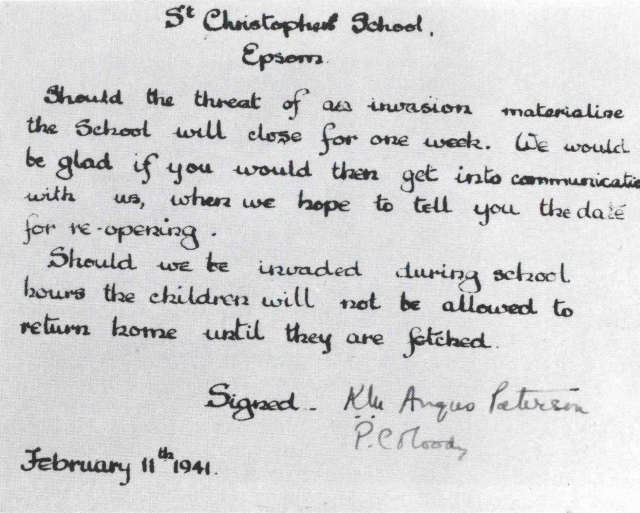 Schools issued instructions to parents in case of invasion
Image courtesy of Bourne Hall Museum
Local civil defence organisations were rapidly strengthened with a call for more volunteers. With a significant number of men being called up to the armed services, women began to take on an increasing role on the Home Front. The Women’s Voluntary Services (WVS) played a major part in organising evacuations, clothing distribution and mobile canteens amongst other duties. Many women joined the Air Raid Precautions (ARP) service and by 1942 over 70,000 women had enrolled in the National Fire Service (NFS) in the United Kingdom. They were not involved directly in fighting fires but provided important support in communication centres and as drivers and dispatch riders. In addition to civil defence, “Land Girls” were recruited into the Women’s Land Army (WLA) to work in agriculture and many women took up other occupations such as working in factories.
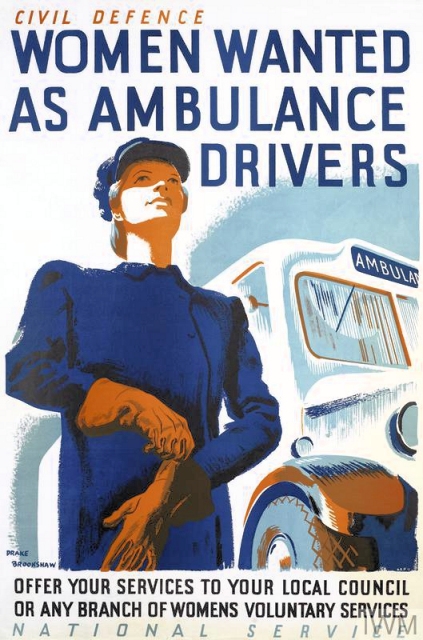 Women played an important role in civil defence
Image source: © Imperial War Museum (Art.IWM PST 13864)
The racing industry in Epsom was badly hit when all horse racing in the country was abandoned in July 1940. Horses were given away, turned out or destroyed while some were shipped out to the US and Canada. At the time there were around 600 horses in Epsom stables and the cessation of racing meant that 300 men were out of work, although many joined the Armed Forces.
The August bank holiday of 1940 was described as a “working holiday” with many going to work on the Monday. Even so, the early part of the weekend found Epsom station to be very busy with hundreds of additional passengers coming into or leaving town. The trains to Box Hill, Dorking and other Surrey beauty spots were particularly busy. In September 1940, Epsom’s first free library was opened in Waterloo Road holding 6,000 books. This was celebrated as quite an achievement in wartime.
By 1942, there was concern about how the war was progressing. Sir Archibald Southby addressed a meeting in Epsom where he criticised Government strategy following reverses, particularly in North Africa. “Unless changes are made in our war strategy we are headed for disaster”, he explained, continuing with “Our reverses are due to lack of foresight, lack of equipment in the right place, failure to profit from lessons of the past, and as I believe, a war strategy which is fundamentally wrong”.
In order to keep up morale, the Council organised “Holidays at Home” programmes during the summer months of 1942, 1943 and 1944. Amongst the activities in 1942 were swimming galas, band performances in Roseberry Park and Ewell Court, and the staging of plays. The programme for 1943 ran from 13th June to the 21st September with a budget of £1,500 and included events such as dramatic shows, athletic meetings organised by Epsom and Ewell Harriers, swimming galas and special events for children.
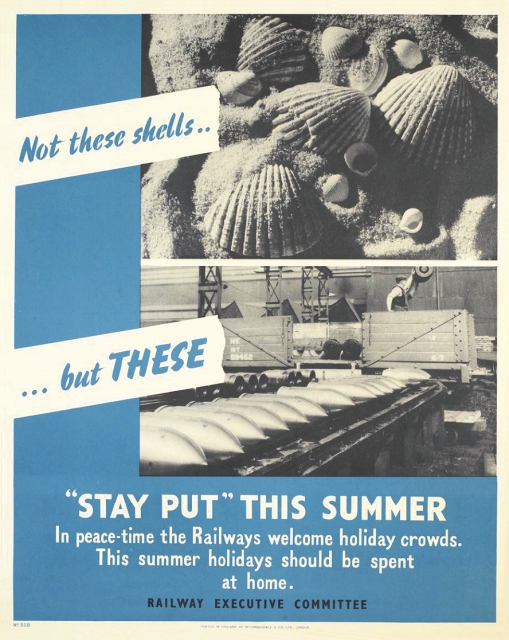 Railway Executive poster advising people to holiday at home
Image source: National Railway Museum
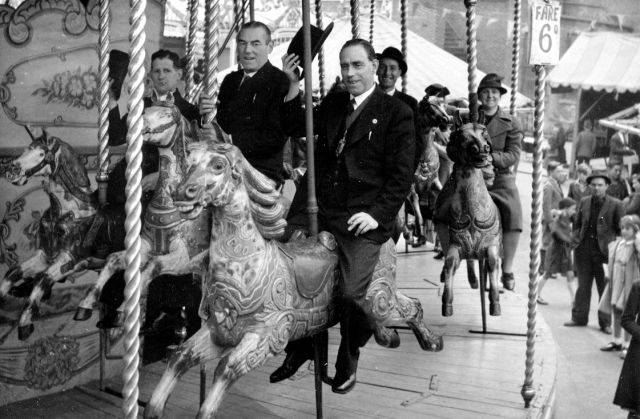 Residents enjoying “Holidays at Home” in Epsom town centre
Image courtesy of Bourne Hall Museum
Canadian soldiers were billeted in Epsom and troops became a common sight throughout the town. The Canadians were particularly popular amongst local children with gifts of chocolate and sweets. Relationships developed between soldiers and local girls. There were occasional problems in the town centre. A Canadian soldier appeared at Epsom Police Court charged with being drunk and disorderly after smashing a shop window. At the trial his commanding officer commented that “It is men like this that get the Canadian Army a bad name” going on to suggest that the civilian authorities should try to prevent the sale of wine and spirits to soldiers. On another occasion, three Canadian soldiers were charged with stealing a car to return to their barracks after a night out. Graffiti from Canadian troops can still be seen on the wall next to the gates of The Durdans in Chalk Lane, Epsom.
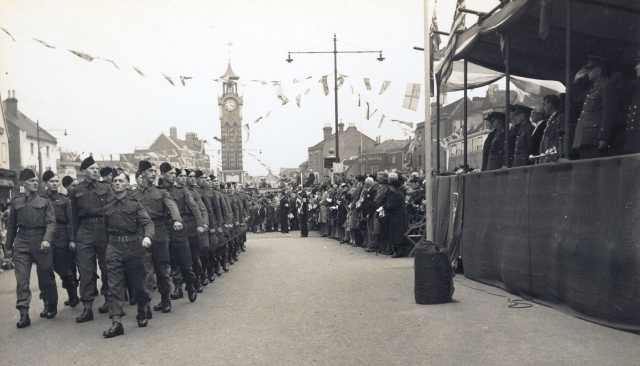 A parade in Epsom town centre
Image courtesy of Bourne Hall Museum
The German defeat at the Battle of Stalingrad, the Allied victory in North Africa and the surrender of Italy in 1943 led to a sense of optimism on the Home Front. In his end of year message in December 1943, Sir Southby wrote that “victory, which no-one doubted would crown our endeavours, is at last in sight”. At the same time he considered that too much optimism and complacency was unjustifiable, warning that “we may have many more downs before we have ups” and “too much easy optimism may result in the slackening of our war effort”. The Mayor of Epsom and Ewell, Ald. J. A. Larby, issued a similar message, “We enter 1944 conscious that victory is within the grasp of the United Nations” but “do not rest on your laurels”.
Their concern proved to be founded when the first V1 flying bombs landed in June of 1944. This led to a further evacuation. Around 200 children were billeted in the Camelford district in Cornwall, the Chief Billeting Officer from the area praising the “niceness” of the Epsom school children in a letter to the Epsom & Ewell Herald.
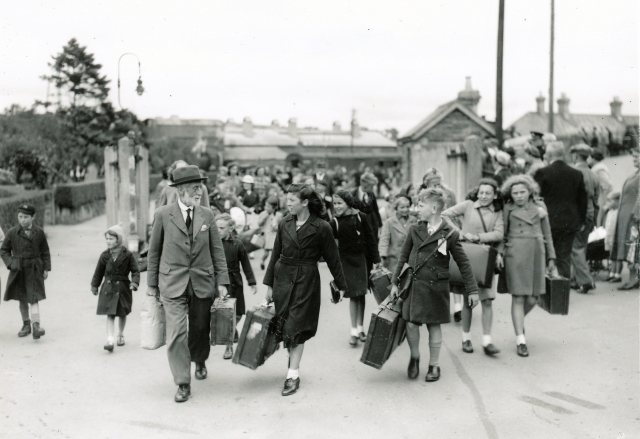 Ewell evacuees arriving at Wadebridge, Cornwall
Image courtesy of Bourne Hall Museum
Evacuation was suspended in September 1944, by which time the number of persons evacuated from the Borough was 7,237. Cheap travel was introduced for visits to evacuees. By July, 1945, the many children evacuated from Epsom and Ewell during the flying bomb campaign had returned home.
Paul Le Messurier © February, 2018
Other pages in this series
- Keep Calm and Carry On (this page)
- Air Raid Shelter This Way
- Look Out in the Blackout
- Rationing is Sharing
- The Home Guard Wants You
- Save for the Brave
- Days of Rejoicing
- References