
WW2: The Home Front in Epsom & Ewell
Part 4: Rationing is Sharing
[Click here to return to the Introduction]
By 1939, Britain was importing around sixty percent of its food and on the outbreak of war German U-boats began to target merchant shipping in an attempt to disrupt the supply of provisions. In September 1939, the Government set up a Ministry of Food which soon announced that rationing would be introduced. Prices for the most important foods, e.g. eggs, butter, milk and sugar, were to be controlled. Each Local Authority appointed a Food Control Committee which was responsible for distribution of ration books, issuing licences to traders and enforcing regulations.
Ration books were issued in November 1939 and initially rationing applied to foodstuffs like bacon and butter (4 ounces per head per week of each). Epsom residents were given until the 8th January 1940 to register for meat rations although meat rationing did not actually begin until March 1940.
 Wartime Ration Book
Image courtesy of Bourne Hall Museum
In general, it was reported that the majority of households accepted the announcement of rationing without too much protest. In contrast, there was concern amongst local butchers who were expecting many complaints from customers about the quality and quantity of meat available. Epsom and Ewell Food Control issued a circular to retailers providing advice on how to deal with customers and explaining that there would be no hesitation in taking action against those who hoarded food. “Hoarding is a crime of sabotage, of damaging the machine of food distribution. People are urged to stock a week’s supply of food so as to be ready for any emergency”.
Meat supply centres were set up around London, one of which was based in a converted garage in Dorking Road, Epsom. Complaints about the condition of meat stored there led to Epsom butchers going “on strike” and refusing to accept meat until conditions improved. As a result, the system for distributing meat was modified significantly.
Food Control employed undercover inspectors to ensure regulations were being followed. One of the tactics used by inspectors was to enter shops and attempt to purchase provisions. There were several cases of butchers appearing before Epsom magistrates for selling meat without coupons. Fines were typically around £ 2 plus costs. Following a complaint from a customer, a firm of butchers in Epsom High Street was fined £ 27 for several offences including possessing an unjust scale; selling an unauthorised cut of meat; selling meat in excess of maximum price and permitted ration. For one of the offences, a leg of lamb was produced as evidence in court!
The introduction of rationing led to a growing black market – the illegal trade in provisions – and thefts of produce were harshly treated. A meat porter from Epsom appeared in court for stealing two tins of corned beef from the meat distribution centre in Dorking Road. At the trial, Judge Tudor Rees remarked that the beef had been brought from South America at great risk to sailors and others to feed the population of this country. The gravity of the offence led to a sentence of three months hard labour. In March 1942, it was announced that the maximum penalty for black market activities would be increased to one year in prison for small scale offences and fourteen years for organised large scale offences.
Several schemes were initiated to stimulate local food production. The Vicar of Epsom initiated an “Unemployed Pig Scheme” where unemployed men in the area were given work rearing pigs. A Young Farmers Club was started for those aged under 20 and land rented to keep poultry, goats and rabbits. The rationing of meat meant that residents had to consider alternatives, with Epsom and Ewell Food Control Committee granting licences to retailers to sell horse meat.
In response to the “Dig for Victory” campaign, the Council provided around 2,300 war-time allotments. Residents rushed to rent an allotment and join allotment societies to buy seeds at lower prices. Parts of Woodcote Park (now the RAC Club), Epsom Common, Nonsuch Park and Horton Park were given over to horticulture and farmed by the Woman’s Land Army with help from school children during their summer holidays. In January 1942, three acres of land purchased for the extension of the cemetery was given over to agriculture.
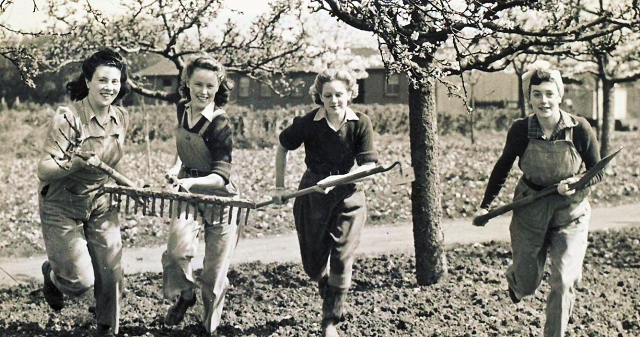 Land Army Girls at Long Grove and Horton Estate
Image courtesy of Epsom & Ewell Local & Family History Centre
Other attempts to turn land over to agriculture were not so successful. There was a disagreement between the Surrey War Agricultural Committee and the Epsom and Walton Downs Conservators over a proposal to cultivate land at Middle Hill and Six Mile Gallops on Epsom Race Course. The Conservators claimed that this would ruin the racing industry in Epsom for years to come. The use of alternative land on the golf course north of the Grandstand was offered but was rejected by the Agricultural Committee as not being suitable for cultivation. In June 1943, a deputation from the Conservators went to the House of Commons for a meeting with the local M.P, requesting his support in the protest against the Agricultural Committee. Soon after, it was announced that the requisitioning of Middle Hill and Six Mile Gallops had been abandoned.
In 1941, the Government announced the introduction of British Restaurants, primarily to provide cheap meals to those who could not cater for themselves because of work or due to bomb damage. The Council set up four British Restaurants serving meals for one shilling without coupons. All vegetables served in these restaurants came from farms owned by the Borough. The first restaurant was established in early 1942 at Ewell Congregational Church Hall with seating for 84 people.
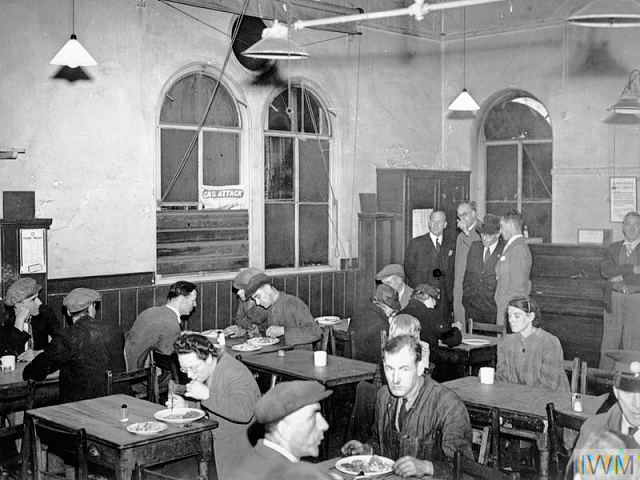 A typical British Restaurant in London
Image source: © Imperial War Museum (Art.IWM V 151)
The second opened at the Ebbisham Sports Club in September, 1942 with a capacity for 400 people. The cost to equip and adapt the premises was around £ 1,500. At the opening ceremony, the Mayor said “In war the upkeep of the morale of the people is of paramount importance and if we as a nation are to win through to victory we must see that the people are properly fed”.
Further restaurants were established in the Church Hall, Plough Road and on the site of two adjoining shops in Kingston Road, Ewell. In early 1944, the restaurants in the Borough came under review, as the operation at Kingston Road was making a loss since the average attendance was insufficient to cover costs. Problems persisted even after prices had been increased and by the end of 1944 all British Restaurants in Epsom and Ewell had been closed due to financial problems.
In addition to food, rationing of petrol was introduced in late 1939 limiting use of cars to at most 200 miles a month. This came to an end in March 1942 when only those who could prove they needed petrol for the war effort were given permits. Penalties for improper use of petrol appear to have been rather inconsistent. An Epsom resident was fined £ 5 for taking her dogs out in her car whilst another motorist was fined £15 for driving to Epsom County Hospital. In another case, a member of the Home Guard from West Ewell was fined £2 for using his motorcycle to return home for lunch.
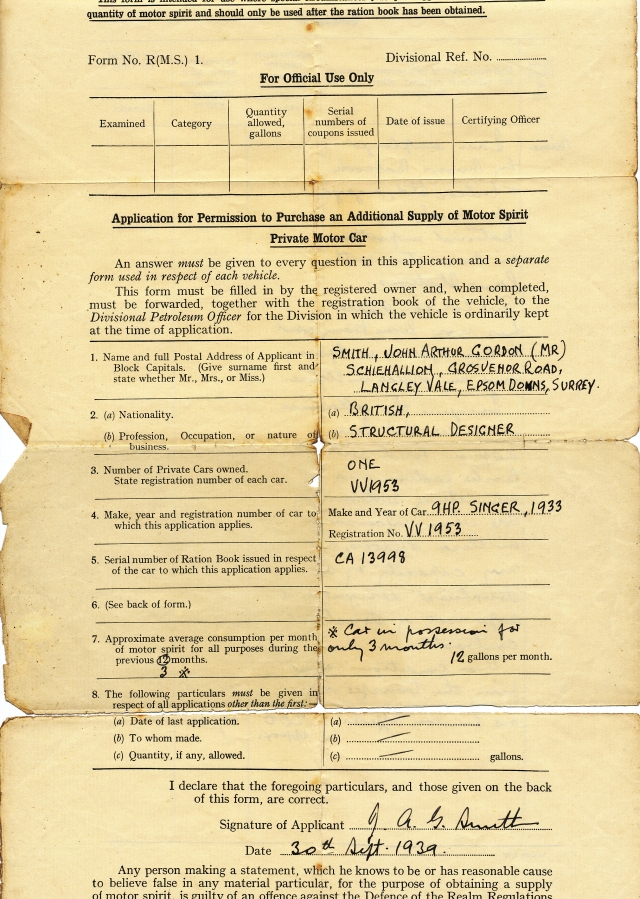 Petrol Allocation form
Image courtesy of Bourne Hall Museum
Coal was also rationed especially during the particularly harsh winter at the end of 1940, the coldest since 1894, when residents could be seen making their way up to Epsom Downs with skis over their shoulders during heavy snow. The coal was rationed at a flat rate per household although an application could be made to Epsom and Ewell Fuel Office for an extra allocation with good reason.
Clothes rationing was introduced in 1941 and came as a complete surprise to residents since, unlike some other districts, Epsom and Ewell was not notified that clothing was to be controlled. And just as contraventions of food rationing regulations was penalised, the same applied to clothes rationing. The owner of a gent’s outfitters in Epsom appeared in court for a number of offences of selling handkerchiefs and other items in excess of the maximum price.
The shortage of goods and provisions led to salvage campaigns where residents were asked to save and collect items like paper, food waste and scrap metal. Lord Beaverbrook had launched the “Saucepans for Spitfires” campaign with the announcement that “We will turn your pots and pans into Spitfires and Hurricanes”. In reality the scrap metal was not of sufficient quality, yet people felt they were supporting the war effort.
“Waste material is raw material and raw material is war material” was the slogan of Epsom and Ewell’s salvage campaign which included local councillors riding around in refuge collection trucks encouraging residents to save what they could. A recruitment drive in 1942 sought to appoint 600 salvage stewards in the Borough whose main purpose was to make contact with residents to stimulate interest in the salvage of household waste.
 Anti-Waste Campaign Leaflet
Image courtesy of Bourne Hall Museum
The salvage campaign included the removal of railings and gates. But an attempt to remove the railings from Epsom racecourse ended in court in 1942 when Epsom Grandstand Association sought an injunction to prevent damage during removal. After two court sessions, the plaintiff eventually decided not to pursue the matter further and the railings were removed.
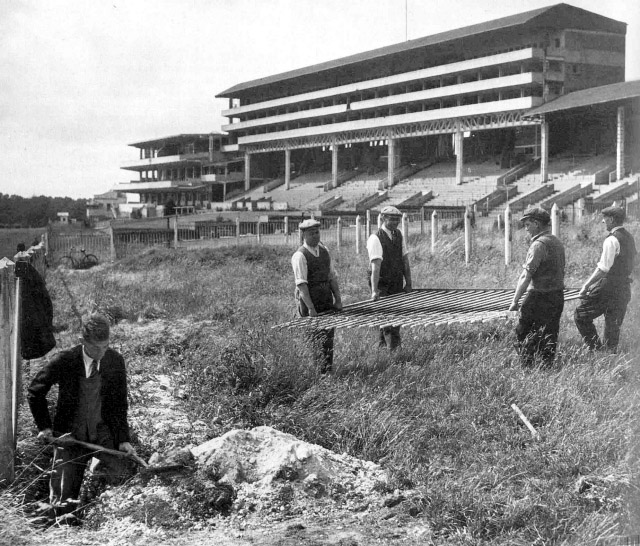 Removing railings at Epsom racecourse
Image source: “Britain at War” by Benny Green via Bourne Hall Museum
It would take some time for normal life to resume after the war had ended and rationing continued for several years. In 1946, there were still many cases of rationing offences against local residents. In one court sitting, two men were sent to prison and one woman was fined £1,215.
Paul Le Messurier © February, 2018