
WW2: The Home Front in Epsom & Ewell
Part 5: The Home Guard Wants You
[Click here to return to the Introduction]
In May 1940, the Local Defence Volunteers (LDV) was established when a German invasion seemed imminent. It was open to men between the ages of 17 and 65 who were not involved in active service. Initially they were poorly equipped, wearing armbands with the letters LDV and their weapons consisted of privately owned guns, rifles and knives. In July 1940, at Churchill’s insistence, the LDV was renamed to the Home Guard. And since the official view was that the Home Guard should be considered as an important part of the armed forces, in the following months volunteers were gradually issued with uniforms, helmets and weapons with an initial focus on the most threatened parts of the country.
The 56th Surrey (Epsom and Banstead) Battalion of the Home Guard was created under the command of Lt. Col. Hartigan, C.M.O, D.S.O. who was subsequently replaced by Lt. Col. Eggar due to ill-health. The total strength of the battalion, at its highest point, reached over 2,800 men. Recruits initially came from Epsom and Ewell, but in July 1940 it was amalgamated with the Banstead unit. Each of the five hospitals at Horton had a platoon made up of male attendants and workmen, mainly old soldiers, and a unit was created from Council electricity workers to protect its facilities.
 A Platoon from the Epsom and Banstead Battalion
Click image to enlarge
Image courtesy of Bourne Hall Museum
The battalion received training in the summer of 1940 from a Company of Welsh Guards stationed nearby and from Canadian soldiers. The battalion was one of the first to shoot at Bisley and by the end of the summer, 90% of the men had received firearms training. Even so, assembling men for training proved to be a major difficulty for Platoon Commanders. As a result, a Home Guard training manual was published covering organisation, training and administration; weapons training; fire control; map reading and use of a compass and field signals. The cost of the manual was one shilling.
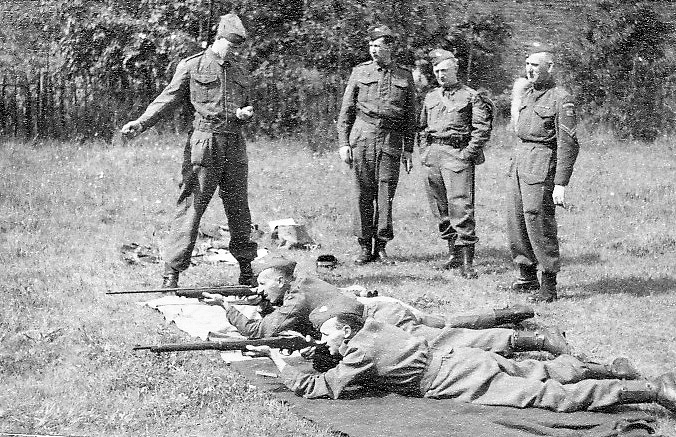 Home Guard firearm training
Image courtesy of Bourne Hall Museum
A week-end training school was eventually established in the Grandstand at Epsom race course in the summer of 1941 to train Home Guard from throughout the South West London area. The school was opened with an elaborate ceremony attended by senior officers from the armed forces and civilian services. A large number of Home Guard paraded at the ceremony, a tactical exercise by dispatch riders took place and this was followed in the evening by a “smoking concert”. In his address to the troops, Sir Bertram Sergison-Brooke, General Officer commanding the London Region, said that the Home Guard might have to wait before it was called upon but in his view an invasion would come because Hitler would have to make a last desperate effort.
The grandstand at Epsom was used for thirteen training weekends (Friday evenings to Sunday evenings) during that summer. The annexe at the back was used for men’s dormitories while officers were accommodated in the Members’ Room. The 56th Battalion provided instructors and administration staff for this training school. Around 33 battalions attended the courses and all told some 130 officers and 3,500 other ranks undertook training at the school. Subjects covered included drills, tactics and grenade practice. In 1941, 5,000 Home Guard from the South-West London area participated in a “tank battle” on Epsom Downs where the Royal Tank Corps played the part of the enemy. As one of the Home Guard put it, “They (the tanks) would leave this country only in the form of scrap metal”.
The Home Guard also played its part in the community. In September 1941, “E” company of the 56th Surrey Battalion organised an inter-platoon sports competition at Long Grove Hospital attended by around 2,000 people. The Battalion also took part in a parade and demonstration in the Court Recreation Ground in Epsom, attended by several thousand spectators.
The Grandstand was again the venue for weekend training in 1943. Home Guard companies from different battalions would take it in turn to set-up defensive positions in the Warren Wood – Langley Vale area. Men from the 56th Battalion would often play the part of the “enemy”.
The Battalion manned much of the Epsom section of the Outer London Defence Line which ran through Epsom to Drift Bridge. Since London would have been a major objective of any invasion, a system of defence lines was established around the capital. The outer line through Epsom was known as Line A running 121 miles around London using rivers, canals and ditches and anti-tank traps with roadblocks covered by pillboxes and fortified houses. Improvisation and scrounging resulted in some interesting approaches to creating roadblocks in the early days. Old cars and barrels filled with stones were often used and the Commanding Officer reported once seeing three prams filled with earth and stones across the road.
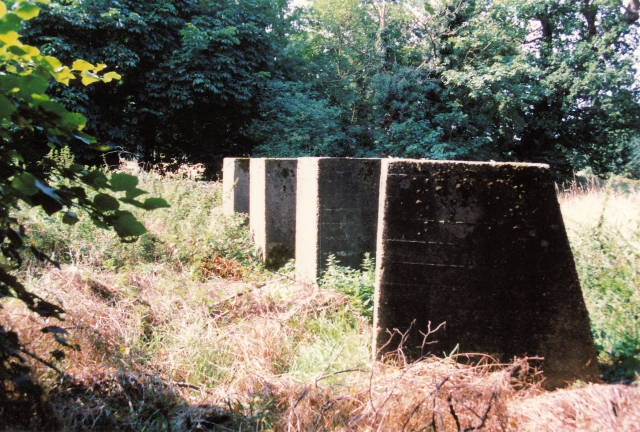 Anti-tank traps at Manor Hospital, Epsom
Image courtesy of Bourne Hall Museum
Training continued for the duration of the war, even with victory in sight. In April 1944, the Epsom Advertiser reported that “German Paratroops” had landed on Epsom Downs and fought a fierce battle with the 56th Surrey Battalion. The raiders made their way to a number of railway bridges and thousands of rounds of blank ammunition were fired. A team of adjudicators declared that the “enemy” had succeeded in their mission of destroying vital communications but they had an advantage of knowing the area well!
Although the Home Guard never saw action, sadly they did suffer casualties. An officer died in Horton Emergency Hospital from pneumonia as a result of inhaling smoke and tear gas during a training exercise.
Compulsory drills and training were discontinued in September 1944 and those operational duties still required were carried out by volunteers only. Over 1,000 men from the 56th Battalion assembled in Epsom College in October 1944 in what was to be their last big parade. The battalion was inspected by Brigadier Copland-Griffiths, commander of South West London Sub-District, accompanied by Brigadier Major Dickens, grandson of Charles Dickens. The battalion then marched through Epsom and the parade concluded in Market Square.
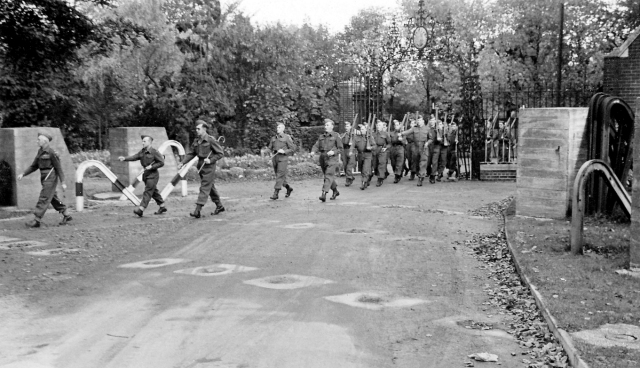 Home Guard marching through Epsom College
Image courtesy of Bourne Hall Museum
The Home Guard was finally disbanded in November 1944 when any likelihood of a German invasion had passed. The Home Guard of Epsom and Ewell celebrated, although with some sadness, their stand down with a dinner in the Kings Head Hotel and a dance at the Drill Hall, Ewell.
Paul Le Messurier © February, 2018
Other pages in this series
- Keep Calm and Carry On
- Air Raid Shelter This Way
- Look Out in the Blackout
- Rationing is Sharing
- The Home Guard Wants You (this page)
- Save for the Brave
- Days of Rejoicing
- References