
WW2: The Home Front in Epsom & Ewell
Part 6: Save for the Brave
[Click here to return to the Introduction]
The cost of the war meant the British Government had to borrow heavily and was left with a significant deficit. The National Savings Movement played a part in raising funds to support the war effort and included a series of fund raising events throughout the country. Although it never made a significant impact on the nation’s war finances, it left people feeling as though they were making an important contribution to the war effort.
By December 1940 Epsom and Ewell had raised £3,300 for the Spitfire fund, yet this was still short of the target of £5,000. There was concern that sending a cheque for a lower amount would be a bad reflection on the Borough compared to less wealthy districts that had raised more. A Spitfire Fund shop was established in Ashley road with donated articles sold to raise funds.
In January 1941, Epsom and Ewell launched “War Weapons” week aiming to raise £200,000 in National Savings. It started with a public meeting attended by a former Prime Minister of Canada. There was a rush at the end of the week and the Post Office needed to extend hours. A total of £266,566 was raised.
Epsom and Ewell “Warship Week” took place in January 1942 with a target of £250,000 to sponsor a destroyer. Events included a snooker competition at the Stoneleigh Hotel, an Armed Services parade from the Ewell By-pass to the Market Square in Epsom, a dance and cabaret at the Municipal baths and a five mile road race. The target had been reached by the Tuesday and contributions continued to pour in. On the last day of fundraising, the head post office had to stay open past normal Saturday closing time due to the queue of residents wishing to make a contribution. The total amount raised by the end of the week was an astonishing £705,435. As a result, the Borough adopted the destroyer, HMS Foxhound. In 1944 the Foxhound was transferred to the Canadian Navy, and another ship, the HMS Inman, was adopted as a replacement.
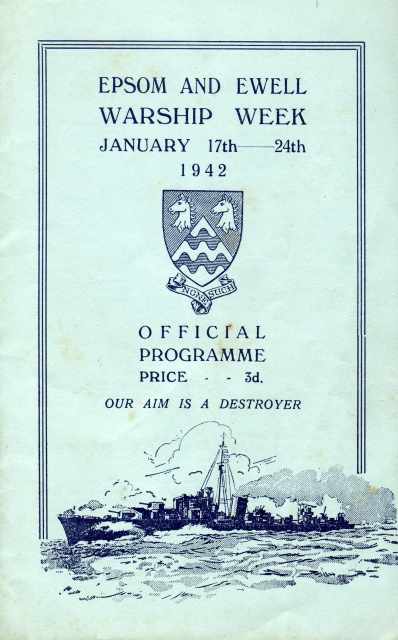 Epsom & Ewell Warship Week programme
Image courtesy of Bourne Hall Museum
 HMS Foxhound – Adopted by Epsom and Ewell following “Warship Week”
Image source: © Imperial War Museum (Art.IWM FL 13264)
An “Aid to Russia” Week in March 1942 raised money for the provision of medical supplies for Russian civilians. The Mayor, Alderman Littlejohns, gave an address at the inaugural meeting, saying “The courageous and epic heroism of the Russian people in resisting the invader has captured the imagination. There is on all sides an earnest desire to render the Russian people all aid possible”.
The Epsom & Ewell “Wings for Victory” Week at the end of May 1943 had a target of £300,000, the cost of nine bombers. The programme of events commenced with a parade from the Organ Inn, Ewell to the Market Square, Epsom. Other events included a miniature Derby using ponies and a baseball match between the Canadian and American soldiers, won easily by the Canadians. The amount raised was £475,000, enough for the nine bombers and a further five more.
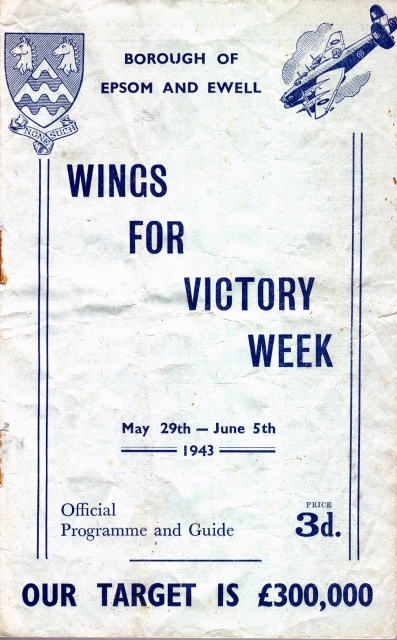 Epsom & Ewell Wings for Victory Week programme
Image courtesy of Bourne Hall Museum
Planning for a nationwide “Salute the Soldier” Week started in early 1944. The local National Savings Committee set a target of £400,000 for Epsom and Ewell, which some thought rather ambitious. The Mayor of Epsom and Ewell pronounced that the best way to achieve victory quickly was “by refraining from all expenditure on ourselves except the bare necessities and lending every pound and shilling that we can spare to the nation”. Various events included a dance at the Capitol Café, Epsom and Biddall’s Fun Fair at the Corporation Car Park, High Street, Epsom. An all-services procession took place with eight bands and 1,500 personnel. The highlight of the week was the Pony Derby held at Court recreation ground attended by a crowd of around 12,000. The horse racing community played an important part with well-known jockeys and trainers lending their support. An Oaks race was ridden by ladies from a local pony club. A performance was given by the Khaki Kabaret Concert Party at the Court Recreation Ground, having just returned from a tour of North Africa. The total amount raised during the week amounted to nearly £440,000.
Fund raising didn’t stop following the end of hostilities. At the end of September 1945, a “Thanksgiving Week” was organised with a target of £300,000. The first event was a fun fair at which the Mayor, Councillor A.W. Nicholls, said that the week would be a thanksgiving for the victories gained and enable all to show their gratitude by lending money to the Government and so prevent inflation. Money was also required for the purposes of reconstruction. The events continued later the same day in the warm autumn sunshine with an All Services procession attended by the Home Secretary. As with previous fund raising weeks, a Pony Derby was held at Court Recreation Ground, in what was to be the last before the real Derby would return to Epsom Downs.
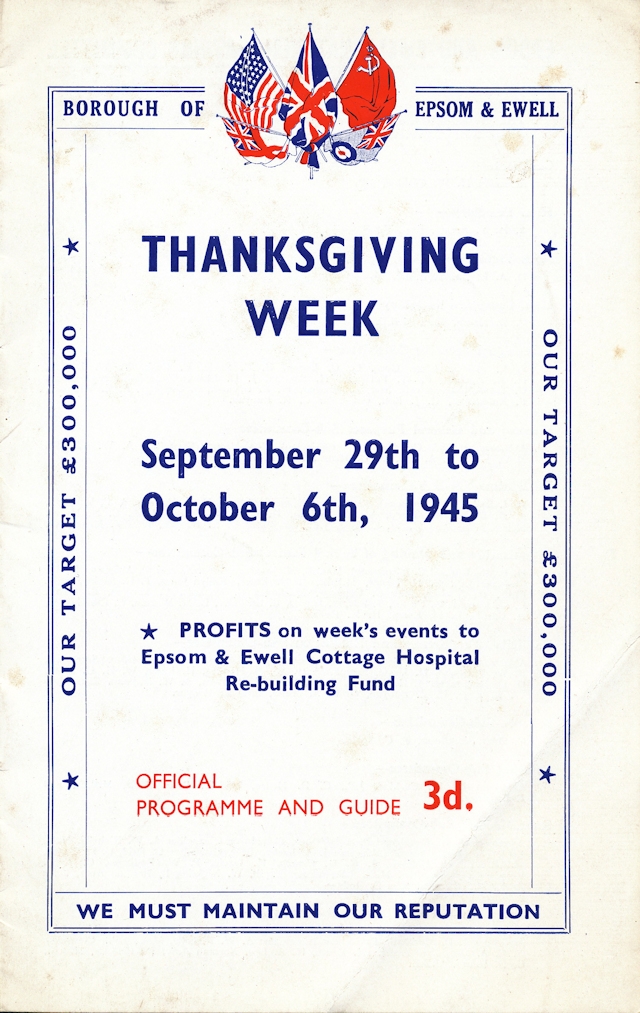 Thanksgiving Week programme
Image courtesy of Bourne Hall Museum
Paul Le Messurier © February, 2018
Other pages in this series
- Keep Calm and Carry On
- Air Raid Shelter This Way
- Look Out in the Blackout
- Rationing is Sharing
- The Home Guard Wants You
- Save for the Brave (this page)
- Days of Rejoicing
- References