
War Memorials – WW2 – Surnames S
Back to our main war memorials page
Index
Click on the name to jump to the relevant entry
SALT, Gordon Geoffrey (Revised 14/08/2019)
SALT, Lionel Eric Sydney (Revised 14/08/2019)
SALTER, Henry * (Revised 18/07/2025)
SANDALL, Jack Francis (Revised 10/10/2018)
SAUNDERS, Alfred (Revised 10/10/2018)
SAUNDERS, Bertram Eric (Revised 11/10/2018)
SAUNDERS, Charles Henry (Revised 11/10/2018)
SAUNDERS, Glyn Tremlett (Revised 27/04/2024)
SAUNDERS, Victor Lewis (Revised 27/03/2018)
SAVAGE, Basil Oswald (Revised 12/10/2018)
SAVAGE, Eric John (Revised 25/07/2020)
SCOFFIN, John Sidney (Revised 12/10/2018)
SELBY, William Edward (Revised 14/08/2019)
SELMAN, Harry William (Revised 02/08/2019)
SEXTONE, Mary * (Revised 14/10/2018)
SEYMOUR, Noel Arthur (Revised 14/10/2018)
SEYMOUR, Stanley (Revised 06/03/2020)
SHAW, Charles * (Revised 14/10/2018)
SHEPPARD, Leslie Bernard (Revised 14/10/2018)
SHERRIFF, James Thomas Roy (Revised 14/10/2018)
SHORT, Eric (Revised 15/10/201)8
SHORT, Harold Edgar (Revised 15/10/2018)
SHRUBB, Leonard Charles (Revised 02/10/2021)
SIMMONDS, Hunter Edward (Revised 15/10/2018)
SIMNER, Kenneth Nugent (Revised 03/03/2020)
SIMONS, John Frederick (Revised 15/10/2018)
SIMPSON, Lancelot (Revised 16/10/2018)
SISSON, William * (Revised 16/10/2018)
SKELTON, Walter Allen (Revised 28/10/2023)
SKONE, Alan Raymond * (New 07/03/2021)
SMEDLEY, Denis Edward (Revised 16/10/2018)
SMITH, Arthur H C (Revised 16/10/2018)
SMITH, George Albert * (Revised 17/10/2018)
SMITH, George Bainbridge (Revised 02/03/2020)
SMITH, Hector Frank * (Revised 04/03/2020)
SMITH, John Arthur (Revised 21/10/2023)
SMITH, James Bruce (Revised 06/03/2020)
SMITH, John Frederick (Revised 18/10/2023)
SMITH, Michael Arnold (Revised 17/10/2018)
SNEATH, Ronald Ernest (Revised 18/10/2018)
SNELLING, Alfred Victor (Revised 14/11/2019)
SPARK, Basil Douglas (Revised 12/07/2021)
SPARKE, Philip Donald Julian * (Revised 07/05/2018)
STANLEY, George Haynes (Revised 02/11/2018)
STEEL, George Robert (Revised 15/02/2019)
STEELE, Frederick Robert Ellis (Revised 18/10/2018)
STEPHENS, Geoffrey John * (Revised 19/10/2018)
STEPHENSON, Thomas (Revised 15/02/2019)
STEVENS, James William (Revised 03/03/2020)
STEVENSON, Ada Mary Pat * (Revised 19/10/2018)
STEWART, Donald John (Revised 28/02/2021)
STONE, Arthur John * (Revised 20/10/2018)
STONE, Frank James (Revised 20/10/2018)
STONE, Lewis Oliver * (Revised 20/10/2018)
STONE, Reginald (Revised 20/10/2018)
STURT, George Stanford (Revised 20/10/2018)
STURT, John Edward (Revised 09/05/2018)
SUTTON, Frank Charles (Revised 16/03/2020)
SUTTON, George Frederick Thomas (Revised 20/10/2018)
SWAINSTON, William Hopper * (Revised 09/05/2018)
SWAN, Mrs Annie Elizabeth (Revised 04/11/2022)
* = Not included in the Book of Remembrance for reasons unknown.
If you are looking for someone whose name starts with a different letter please try:
A B C D E F G H I J K L M N O P Q R S T U V W X Y Z
Content
SALT, Gordon Geoffrey. Pilot Officer/Air Bomber (149344)
619 Squadron, Royal Air Force Volunteer Reserve
Died 27 November 1943, aged 30
 Gordon’s headstone in the Harrogate Stonefall Cemetery.
Photograph (51027853) by Peter Lucas via findagrave.com
Gordon was born on 8 April 1913, the third of four children born to Charles Henry Salt and Amy (née Montgomery) who had married Q3 1905, registered in the Camberwell District.
The 1911 Census records the parents living at “St Louis”, Abbs Cross Lane, Hornchurch. 30 year old Charles Henry (originally from Wolverhampton) is listed as a “Traveller for firm of Lock and Safe Makers”. 28 year old Amy (originally from Orpington) had her hands full with two children: 2 year old Winifred (born in Westcliff); and new-born Donald (born in Hornchurch, as were Gordon in April 1913 and the couple’s last child, Lionel Salt – another WW2 casualty – in Q2 1921).
The September 1939 Register records Gordon and his mother, Amy, as two of the residents at 8 Amblecote Close, Lewisham. The entry for Amy (listing her with the conventional “Unpaid Domestic Duties”) is the second entry at the address, the first being currently closed. However, the redaction of that first entry is not quite complete and enough of the text is visible to show that the obscured individual had the occupation of “[eng]ineers representative”. That entry, as is logical, would thus seem to be that for father, Charles.
The entry following Amy’s is for 26 year old Gordon. No occupation is shown for him (although a later annotation, which is partially obscured by redaction of the fourth and currently closed entry, starts “Aircraft…”) but Gordon’s entry does say that he is married – a fact not mentioned in the Commonwealth War Graves Commission’s database. Indeed, the Q4 1938 marriage of the 25 year old Gordon and the 22 year old Ingrid Wagnsson is found to have been registered in both Bromma, Stockholm, Sweden (dated 21 December 1938) and in London’s Marylebone District.
It would be logical for the currently closed fourth entry to be of the now 23 year old Ingrid. However, the redaction is again not quite complete, and part of the later annotation – being “…(2nd Class) 90290…” – can be read, so the entry is clearly for 18 year old Lionel, whose RAF Service No was 902909. Ingrid is not found elsewhere in the 1939 Register and, indeed, is not found again in the readily available records. It is also the case that no record has been found of the couple having any children.
None of that is of any help in substantiating the Commonwealth War Graves Commission’s record that Gordon’s parents were “of Epsom” – and there must have been a Borough connection to merit Charles (and brother Lionel) being included in the Borough’s Book of Remembrance. That connection is found in the 1942 Probate record of administration of brother Lionel’s estate being awarded to his father (a “commercial representative”) which notes that the address was 40 Hazon Way, Epsom.
Gordon’s WW2 service was in 619 Squadron, part of the RAF’s Bomber Command. He was part of the seven-strong crew of Lancaster DV336 which, at 1710 hours on 26 November 1943, took off from RAF Woodhall Spa, Lincolnshire, to participate in a bombing raid on Berlin.
While they were away, the weather and visibility over Lincolnshire deteriorated badly. After a few crashes among the early returners, Lincolnshire-based squadrons instructed their returning aircraft to divert north to land in Yorkshire. However, the visibility over Yorkshire was not much better and a number of the bombers would also crashed there. One of these was Gordon’s Lancaster DV336, piloted by 22 year old Pilot Officer Kenneth James Mears (156086).
The aircraft made two attempts at landing at RAF Elvington (about 80 miles north of Woodhall Spa). The second was made on completely the wrong line and at low altitude. The pilot opened up the throttles to try to fly another circuit of the airfield but, as it turned left, the aircraft lost height and crashed at around 0150 hours near Noah’s Ark Farm, between Elvington and Wheldrake.
It appears that there were still bombs on board when it crashed as witnesses stated that the hole made by the crashing aircraft was “as big as a house”. Unsurprisingly, there were no survivors among the seven-strong crew. An investigation believed that fatigue of the crew was a contributory cause of the crash: the aircraft had been in the air for over eight and a half hours – for most of the time flying through poor weather.
Gordon is one of 998 WW2 burials in the Harrogate Stonefall Cemetery, almost all of whom were airmen. His family took the option of adding a personal inscription (drawn from Psalm 107:30) to his headstone on Grave C.F.1,
“He bringeth them / to the haven / then are they glad / because they are at rest.”
Roger Morgan © 2019
With thanks to Hazel Ballan for help with the family background and
to http://www.yorkshire-aircraft.co.uk for the mission information above.
Please contact us if you have information or pictures that can extend this entry.
SALT, Lionel Eric Sydney. Sergeant/Pilot (902909)
603 Squadron, Royal Air Force Volunteer Reserve
Died 30 June, 1941, aged 20
 Lionel’s headstone in Pihen-les-Guines Communal Cemetery.
Photograph (24182070) by “Len” via findagrave.com
Lionel was born Q2 1921, the fourth and last child of Charles Henry Salt and Amy (née Montgomery – they had married Q3 1905, registered in the Camberwell District).
The 1911 Census records the parents living at “St Louis”, Abbs Cross Lane, Hornchurch. 30 year old Charles Henry (originally from Wolverhampton) is listed as a “Traveller for firm of Lock and Safe Makers”. 28 year old Amy (originally from Orpington) had her hands full with two children: 2 year old Winifred (born in Westcliff); and new-born Donald (born in Hornchurch, as were Gordon – another WW2 casualty – in April 1913 and Lionel in Q2 1921).
The September 1939 Register records Lionel’s mother, Amy, and older brother Gordon as the second and third of the four residents at 8 Amblecote Close, Lewisham. For some reason, the first and fourth entries at the address are currently closed, but (as discussed in the immediately preceding article about Gordon) their incomplete redaction leaves sufficient clues to be sure that father Charles is behind the first and 18 year old Lionel behind the last.
None of that is of any help in substantiating the Commonwealth War Graves Commission’s record that that Lionel’s parents were were “of Epsom” – and there must have been a Borough connection to merit Lionel (and brother Charles) being included in the Borough’s Book of Remembrance. That connection is found in the 1942 Probate record of administration of Lionel’s £330 estate being awarded to his father (a “commercial representative”) which notes that the address was 40 Hazon Way, Epsom.
Lionel’s WW2 service was in 603 Squadron, part of Fighter Command. On 30 June 1941, he (flying his Spitfire R7270) and others took off from RAF Hornchurch, Essex to form part of a “Big Wing” sweep over France. 603 Squadron was assigned to “top cover” for the wing. Five miles after crossing the French coast, flying at 18,000 feet, the Squadron was attacked from above by enemy fighters. In the ensuing dogfight, they lost contact with the overall formation. It was not long before others registered that Lionel was missing, and it was later confirmed that he had been killed.
Lionel is one of 33 Commonwealth WW2 casualties buried in Pihen-les-Guines Communal Cemetery, Calais. His parents took the took the option of adding a personal inscription to his headstone on Grave A.10,
“He trusted in God / He did his duty / His salvation is sure.”
Roger Morgan © 2019
With thanks to Hazel Ballan for help with the family background
Please contact us if you have information or pictures that can extend this entry.
SALTER (born Smuklerz), Henry. Ordinary Seaman (P/JX 276570.)
HMS Jaguar, Royal Navy
Died 26 March 1942, aged 36
 Henry’s inscription on Panel 66, Column 1 of the Portsmouth Naval Memorial.
Henry is not listed in the Book of Remembrance but is commemorated here because the Commonwealth War Graves Commission notes that he was the “husband of Eileen Caroline Salter, of Epsom, Surrey”. As noted at the end of this article, an Epsom address has been established for his widow, but it does not seem that Henry – who has an interesting family background – ever lived in the Borough.
Henry was born on 25 May 1905 in Rochester Road, London NW1, the fifth of six children born to Adolph Smuklerz and Rose (née Hopfenberg – they had married in about 1899). The 1911 Census records them living at 117 Brecknock Road, London NW (Tufnell Park). 34 year old Adolph is listed as trading on his own account as a Costume Manufacturer. Like 33 year old Rose, he is shown as having been born in “Russia Poland”. Their six children – all born in London – were aged between 2 and 11. This was a prosperous household: they were supported by two live-in domestic servants.
Adolph was the son of Michel and Rebecca Smuklerz who had fled to England in the wake of one of the “pogroms” the large-scale wave of anti-Jewish riots that swept through south-western Imperial Russia (present-day Ukraine and Poland) from 1881 to 1884. They brought Adolph with them, and records show that he had been born on 13 November 1877 in “Nowykorczin Kele Powiat Stopnie, elsewhere stated to be “Kielce, Kielce County, Swietokrzyskie, Poland”.
On 22 December 1912, Adolph made an oath of allegiance under the name by which he had become commonly known – “Adolph Salter” – and was granted naturalisation by Certificate No. 21344.
Adolph’s son, Henry (the subject of this article and now Henry Salter) married Eileen Caroline Hart in the Marylebone District in Q1 1933: he was 27 and she was 25. The couple were recorded (with their surname mistranscribed as “Slater”) in the September 1939 Register living at 35 Hillcrest Gardens, Esher living with the apparently unrelated Benjamin and Alice Hart. The now 34 year old Henry is listed as a “Commercial Traveller” and 32 year old Eileen with the conventional “Unpaid Domestic Duties”. Their names are followed by a currently closed record. Could be a child of theirs? The records list two possible Salters whose mother’s maiden name was Hart: David, born Q2 1936 in Willesden; and Maureen, born Q2 1937 in Romford.
Henry’s WW2 service was as an Ordinary Seaman on HMS Jaguar. This 1,690 ton destroyer had been completed in September 1939 and was first used for anti-submarine patrols and escort duties off the East Coast. It is not clear just when Henry joined the ship. This may have been in time to participate in the 28 May 1940 evacuation of 700 troops from Dunkirk. On her way back to Dunkirk for another rescue, she was attached by 17 Stuka dive bombers. Badly damaged she was returned home for repair, after which she served in home waters until being sent Gibraltar in November 1940.
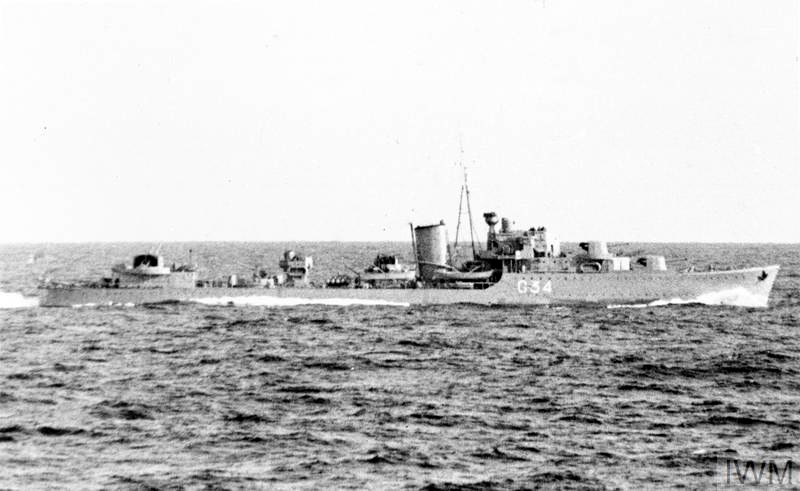 HMS Jaguar taking up her station.
IWM Photograph (A 696) – Public Domain.
During 1941, HMS Jaguar saw much action around the Mediterranean. Some particular ones were: the late January “Operation Ration” to intercept Vichy French ships; in late February, covering the landing of troops at Castelorizo, in the Dodecanese; participation in the May Battle for Crete (one of the few ships which escaped damage; during June, serving with Force H during the Syrian campaign; in July, participation in Operation Guillotine taking RAF personnel from Port Said to Cyprus; during the Autumn, operating off the Libyan coast; and, on 20 December, picking up eight officers and 17 ratings from HMS Kandahar which had struck a mine off Tripoli and finishing off the badly damaged destroyer by a coup de grâce. HMS Jaguar was then assigned to the 14th Destroyer Flotilla and, during the first three months of 1942, carried out escort duties in the Mediterranean.
On 26 March 1942, HMS Jaguar was part of the escort for the Fleet oiler HMS Slavol en route from Alexandria to Allied-held Tobruk with fuel for the 5th Destroyer Flotilla when, northeast of Sidi Barrani, Egypt, it was torpedoed by the German submarine U-652. Two torpedoes struck forward, set the ship on fire and caused her to sink in a short time. The commander, 2 officers and 190 ratings were lost. (8 officers and 45 ratings were picked up by HMS Klo.)
Those lost in the incident included Henry, and he is one of nearly 15,000 WW2 naval personnel commemorated on the Portsmouth Naval who were lost or buried at sea.
As to the Borough connection in this case, in Q3 1945 and registered in the Hampstead District, the 38 year old widowed Eileen got remarried to 40 year old Herbert Kempner. They set up home at 13 Maidenshaw Road, Epsom – where where Herbert had been recorded in the 1939 Register as a single man whose occupation was listed as “Assistant Superintendent Assurance & National Health”. (Living/staying with him at the time was what seems to be his divorced sister in law Margaret.) Herbert’s death in Q3 1989 was registered in the local Surrey Mid Eastern District. Eileen seems then to have moved away: her death in Q4 1999 was registered in the Hastings and Rother District.
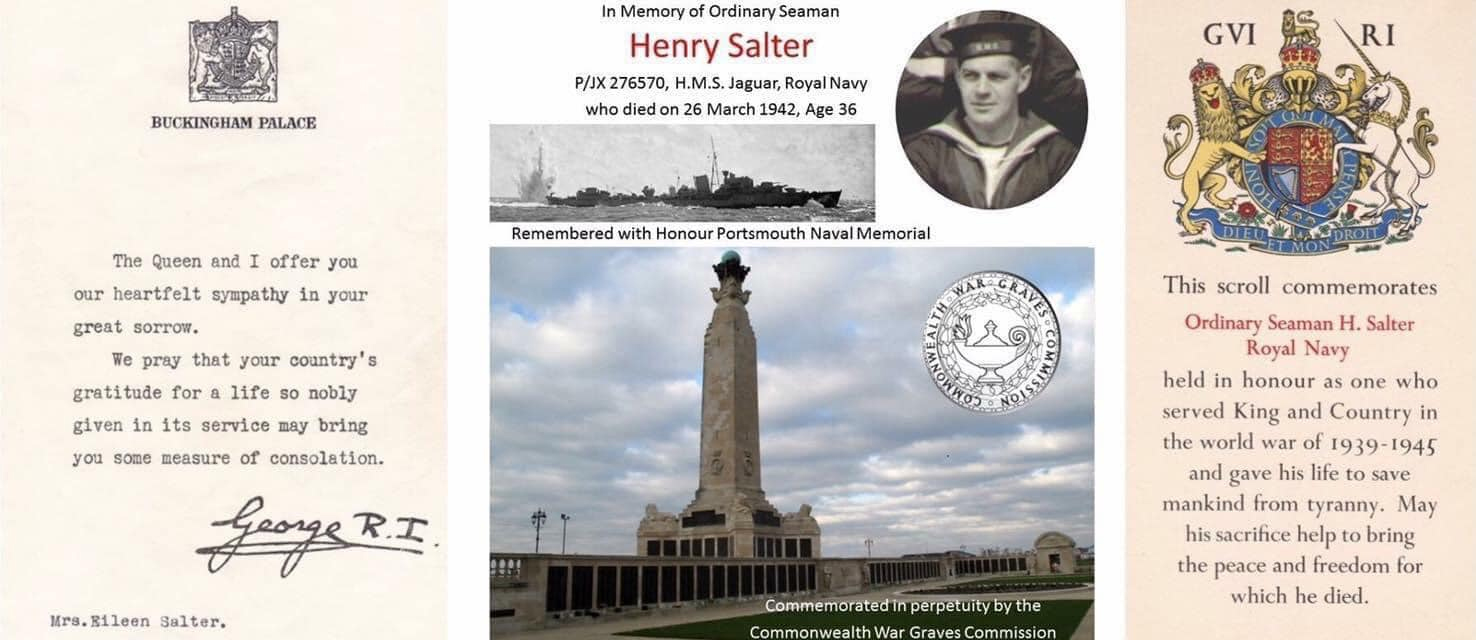
Photograph and Commemoration of Henry Salter. Provided by Henry’s great nephew Mark Goldsmith
Brian Bouchard & Roger Morgan © 2018
Please contact us if you have information or pictures that can extend this entry.
SANDALL, Jack Francis. Sergeant (516159)
44 Squadron, Royal Air Force,
Died 12 June 1940, aged 28.
Jack was born Q2 1912, the first child of Francis John Sandall and Louise Kate (née Cane). The parents’ Q3 1911 marriage was registered in Fulham, as was Jack’s birth. While that marriage was Louise’s first it was Francis’s second. His first had been to Amelia Simmonds on 2 January 1890 when they were both aged 25.
Amelia had been born in Brentford but, in the 1881 Census was the 15 year old domestic servant of the Harris family in Victoria Road Sutton. Her 1890 marriage was registered in the Epsom District which, at the time, extended to Sutton. The couple made their home in London. Francis had been born in Southwark and joined the Metropolitan Police as Police Constable 76216 on 18 June 1888. They had three children (one of whom died) at various London addresses.
Amelia died in Q2 1910, registered in the Chelsea District. The 1911 Census records the widowed 45 year old (“Police Constable”) Francis living at 76 Sandilands Road, Fulham with his two surviving children (16 year old Leonard and 2 year old Frank) supported by live-in “Housekeeper”, the unmarried 30 year old Louisa Kate Cane.
Francis and Louisa married in Q3 1911 and their first child, Jack Francis (the subject of this article), was born in Q2 1912. Both the marriage and that birth were registered the Fulham District. Francis left the Police on 23 June 1913 and the family moved to the Borough, living at 114 Hook Road, Epsom – the address at which Francis’s parents (John & Ether) had been living at the time of their deaths in 1907 and 1908. The 25 November 1913 birth of Francis and Louisa’s daughter, Winfred Eileen, was registered in Epsom (and she was later baptised in St Barnabas), and the Q1 1921 birth of another son, Ronald Ernest, was also registered in Epsom.
Jack (but as “John”) signed up at Avonmouth on 3 May 1930 as a Deck Boy aboard an Elders and Fyffes’ banana boat, the SS Greenbrier. He was described as being 5ft. 8ins. tall with blue eyes, light brown hair and a fair complexion. There is no evidence that he sailed on more than one voyage but not long afterwards joined the Royal Air Force.
Jack’s father, Francis, died on 18 September 1933, in the Metropolitan Free Hospital, 376 Kingsland Road, Hackney, which had developed specialist services, including expertise in treating tuberculosis. He was brought back to Epsom Cemetery for interment alongside his parents in Plot F145A, three days later. The widowed Louisa continued living at 114 Hook Road. As a 59 year old, she was recorded there in the September 1939 Register (listed with the conventional “Unpaid Domestic Duties”) together with: her 30 year old Stepson Stanley (a “Carpenter”); 18 year old son Ronald (“Electrical Instrument ???”); and now married 26 year old daughter Winifred, her husband, 28 year old Henry Harvey (a “Sheet Metal Worker, Aircraft”) and their new-born daughter Ann. Louisa died in Q9 1957, registered in the local Surrey Mid Eastern District.
To return to Jack, his WW2 service was in 44 Squadron, part of Bomber Command, stationed at RAF Waddington, Lincolnshire. It was equipped with the Handley Page Hampden, one of the trio of medium bombers available to the RAF at the outbreak of war. (The others were the Armstrong Whitworth Whitley and Vickers Wellington.) The Hampden was the fastest of the three and had good flying characteristics. However, its unusually narrow fuselage provided very cramped conditions for the four-man crew – attracting nick-names such as “the flying suitcase”.
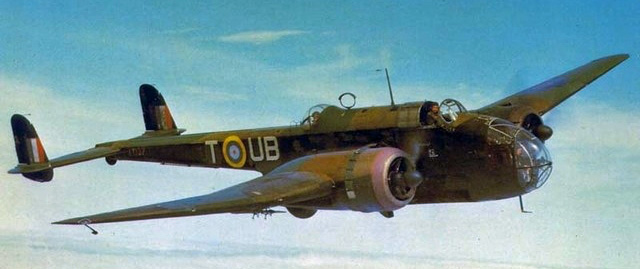 A Handley Page HP52 Hampden Mark I, May 1942
IWM Photograph (COL182) – Public Domain.
The Squadron was in action from the first day of the War, attempting to bomb the German Navy at Keil.
We pick up the story after Dunkirk. The 27 May to 4 June 1940 “Operation Dynamo” had been astonishingly successful in evacuating over a third of a million soldiers after the British Expeditionary Force and allies had been overwhelmed by the unexpected ferocity of the anticipated German invasion of the Low Countries and France. Even so, many surviving soldiers had not been able to make it to Dunkirk and, pursued by the Germans, retreated westwards across northern France trying to find a route home. (Indeed, there were other lesser known large scale evacuations, “Operation Cycle” was the evacuation of Allied troops from Le Havre, at the mouth of the Seine from 10 to 13 June 1940. Further west, the 15 to 25 June “Operation Ariel” saw the evacuation of Allied forces and civilians from a number of France’s Atlantic ports, particularly from St Nazaire and Nantes on the Loire. There were also a number of ad hoc evacuations. For example, on 12 June 1940, the very day that Jack died, the Royal Navy was aiming to evacuate the cut-off 51st Highland Division from the small port of St Valery-en-Caux, a little to the west of Dieppe – an operation thwarted at almost the last moment by the German capture of the troops.)
On 12 June 1940, Jack was the Observer aboard Hampden Mk.B1 P1325 KM-? which had taken off from RAF Waddington for action in “Battle Area F”, presumably with the aim of assisting the retreating Allied troops. In circumstances that remain unclear, the aircraft was brought down over the Pas de Calais. It crashed to the ground near the hamlet of Le Paradis killing the four-man crew from 44 Squadron, namely:
• Flight Sergeant (Pilot) Cyril L SUMPSTER (564422), age 26;
• Sergeant (Pilot) William JEFFREY (564866), age 27;
• Sergeant (Observer) Jack F. SANDALL (516159), age 28; &
• Sergeant (W/Op, Air Gunner) James SIMPSON (526079), age 25.
The four are buried among the 150+ WW2 Commonwealth casualties in Le Paradis War Cemetery about 40 miles south of Dunkirk. Jack’s widowed mother took the option of adding a personal inscription to his headstone on Joint Grave 2.A.6,
“To live in the hearts of those who love you is not to die”
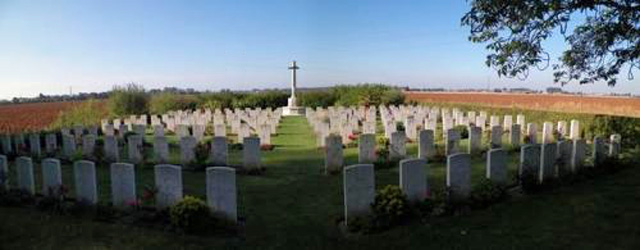 Le Paradis War Cemetery.
Photograph with thanks to www.tracesofwar.com
(Nearly a hundred of those buried in Le Paradis War Cemetery were members of the 2nd Battalion of the Royal Norfolk Regiment. On 27 May 1940, they were stubbornly holding Le Paradis and the neighbouring hamlets of Le-Cornet Malo and Riez-du-Vinage against overwhelmingly superior forces, trying to block the enemy’s road to Dunkirk. Completely cut off, they ran out of ammunition and then surrendered to No. 4 Company of the 1st Battalion of the 2nd SS Totenkopf (Deathshead) Regiment. As ordered by Hauptsturmführer Fritz Knoechlein, the disarmed Battalion was marched into a field, mowed down by machine-guns, finished off by revolver shots and bayonet thrusts and left for dead. Miraculously, two survived and, after the War, were instrumental in bringing now Obersturmführer Knoechlein to justice. He was executed for his war crimes in January 1949.)
Brian Bouchard & Roger Morgan © 2018
Please contact us if you have information or pictures that can extend this entry.
SAUNDERS, Alfred. Lance Corporal (K/74697)
28th Armoured Regiment, British Columbia Regiment, Royal Canadian Armoured Corps.
Died 21 January 1945, aged 34.
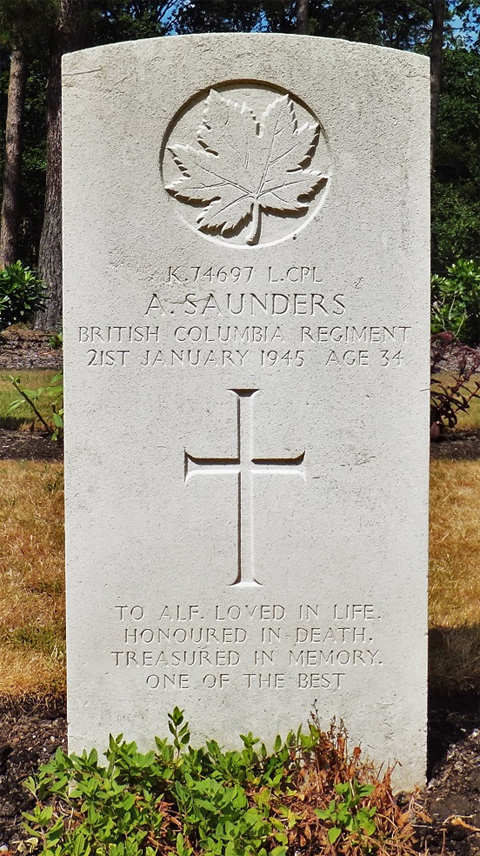 Alfred’s headstone in the Bergen-op-Zoom Canadian War Cemetery.
Photograph (12724820) by “Astrid” via findagrave.com
Alfred was born Q4 1910, the first of six children born to Alfred Harold Saunders and Lydia (née Dowling – they had married Q1 1910, registered in the Barnet District). Alfred junior’s birth (like that of his five siblings, William, Robert, Avis, Betty and Lydia, between 1913 and 1922) was registered in the Edmonton District and probably happened at 7 South Road, New Southgate where 5 month old Alfred and his parents (30 year old Alfred and 25 year old Lydia) were recorded in the 1911 Census. Alfred senior (“Alfred Harold Hotspur” in full) is listed as an “Asylum Attendant”, and almost certainly worked at the Friern Barnet Hospital which was just down the road.
By 1925 Alfred senior was listed (working) in the West Park Mental Hospital in the Horton polling district of Epsom. Between 1927 and 1945, he and his wife Lydia are recorded on the electoral rolls as living at ‘Toronto’, Ruxley Lane, West Ewell. (The burial on 13 October 1934 in grave K174 of Avis Mary Saunders, spinster, of the same address is recorded in the Epsom Cemetery records. Alfred senior, aged 82, following his death at Ewell Park Hospital on 17 August 1963 was buried in the same grave on 26 August 1963.) The September 1939 Register records only Alfred’s parents and sisters Betty (born 1920) and Lydia J. (born 1922) living in ‘Toronto’, Ruxley Lane, West Ewell.
The explanation of why Alfred junior’s WW2 service was with the Canadian 28th Armoured Regiment, British Columbia Regiment begins with the record of the 24 year old “Fred Saunders” leaving Southampton on 21 April 1934 on the Aquitania. The ship’s manifest records: his last UK address as 17 Henderson Road, Sunderland; his occupation as farming; and his intended “country of future permanent residence” as Canada.
On 27 January 1941, Alfred enlisted in Vancouver into the Canadian 28th Armoured Regiment, British Columbia Regiment. He gave his birth as 3 November 1910, his religion as Church of England and his last address as Lanning Apartments, Main Street, Vancouver. Alfred made his will out the following day leaving his estate to his brother, William Saunders of Jubilee Hotel, Victoria, British Columbia. William, also known as Bill, was noted as Alfred’s next of kin but this was later changed on 22 January 1944 to their mother Lydia.
(Alfred’s war records contains information that his brother Bill also enlisted into the same regiment and given the service number K38528. Should he die, William left all of his estate to his brother Alfred. However, a letter from their father records that William did survive the war but was badly wounded and burnt in France in 1944. He apparently received treatment in the Canadian Plastic Surgery Hospital in Basingstoke, Hampshire before returning to Canada.)
From September 1942, Alfred was stationed in the UK – certainly, in the latter stages, preparing for the invasion of France. The British Columbia Regiment (Duke of Connaught’s Own), affectionately known as ‘The Dukes’, arrived in Normandy on 26 & 27 July 1944. The unit’s first major action, on 9 & 10 August, saw it practically wiped out in an heroic stand on Hill 140: in the course of a night move, the Dukes had become lost and ended up, along with two companies of the Algonquin Regiment, cut off behind enemy lines.
The unit was rebuilt and, following the Normandy campaign, fought on into Belgium, the Netherlands and, finally, Germany itself. It was during action in the Netherlands that Alfred was killed on 21 January 1945, aged 34.
Alfred’s war records state he died accidentally of multiple injuries caused by an explosion of a mine. Two other servicemen were also killed and nine others injured. Witnesses reported that they had been assembled at the Direct Fire Tank Range to have a demonstration of Troop Tactics. Before this commenced, a group of soldiers including Alfred, lit a fire using some wooden crates and empty cardboard shell containers twenty yards to the rear of the last tank. Half-an-hour later, at 1315, a loud explosion was heard by Lieutenant D I Gilbert, the officer who was due to give the demonstration. He inspected the area and in his opinion said there had been either a buried explosive or mine under the sand where the fire had been lit. Other statements were taken from witnesses, all of whom were sure that there had been no live ammunition left in the containers. The findings of the Court were that the fire had been built on top of some sort of buried unexploded projectile.
There are several letters in Alfred’s military file from his family in England, and from his brother Bill in Canada, who believed that it was only right that the Canada Government should pay the cost for an inscription to be added to the family headstone on grave K174 in Epsom Cemetery. (That was to no avail: the headstone still mentions only those buried there.) There are also letters from Alfred’s father asking why his son’s wrist watch was not amongst the other personal articles that were eventually returned them. There are no replies on record from the Canadian War Office but one can imagine that, due to the accident, the watch was not recovered.
Alfred is one of 1,008 WW2 casualties buried in the Bergen-op-Zoom Canadian War Cemetery in the Dutch province of Noord-Brabant, about 25 miles north-west of Antwerp (Belgium). His parents took the option of adding a personal inscription to his headstone on Grave 7.F.9,
“To Alf. Loved in life / honoured in death / treasured in memory / one of the best.”
As noted above, Alfred’s father died aged 82 in 1963. His mother, Lydia, died in 1974 aged 88, registered in the Sutton District.
Roger Morgan & Hazel Ballan © 2018
Please contact us if you have information or pictures that can extend this entry.
SAUNDERS, Bertram Eric. Sergeant (943666)
Royal Air Force Volunteer Reserve
Died 15 November 1944, aged 26
Bertram is not listed in the Book of Remembrance but is commemorated here because the Commonwealth War Graves Commission’s post-war records note that he was the “son of Bertram and Mabel Marie Saunders, of Ewell”. As noted below, a Ewell address has been found for them, but it seems unlikely that Bertram junior ever lived in the Borough.
Bertram Eric Saunders’ birth on 9 September 1918 was registered in the Lambeth District. He was the first and probably only child of Bertram Lewis Saunders and Mabel Marie (née Ward) whose Q3 1917 marriage was registered in the St George, Hanover Square District of London.
In Q2 1938 and registered in the Wandsworth District, Bertram junior married Winifred Eileen Howard. They were both aged 19. No record has been found of their ever having any children.
The September 1939 Register records the 21 year old relatively newly-weds living with the apparently unrelated Freeman family at 117 Trentham Street, Wandsworth. Bertram is listed as an “Electrical Engineer” and Winifred as a “Shorthand Typist”. The Register records Bertram senior and Mabel living with the apparently unrelated John and Rose Garlick at 34 Blakes Lane, Motspur Park. 48 year old Bertram senior is listed as a “Works Manager, Electrical Engineers” (perhaps this was where his son was employed) and 46 year old Mabel with the conventional “Unpaid Domestic Duties”.
Disappointingly, the readily available records provide no information about the early years of Bertram junior’s WW2 service in the RAF. These first find him in late 1944 at 1666 Heavy Conversion Unit based at RAF Wombleton on North Yorkshire. As their name indicates, HCUs’ purpose was to convert crews trained on medium bombers to operate heavy bombers before final posting to the operational squadrons, so Bertram seems bound previously to have seen operational service.
HCUs tended to be equipped with bombers – in the case of 166 HCU, Handley Page Halifaxes – that, for one reason or another had been retired from front-line operations.. On 15 November 1944, Bertram was one of the six-man crew flying in Halifax Mk.II JP201 – pictured below in its operational days.
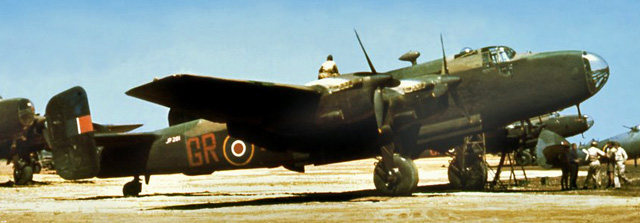 Handley Page Halifax JP201 at dispersal (at an unspecified location) earlier in WW2
Undated official RAF photograph, Public Domain
JP201 was one of five Halifaxes which took off RAF Wombleton at about 1730 hours on 15 November 1944, to carry out a night cross-country and bombing exercise. While flying over Devon at 18,000 feet, JP201 and Halifax Mk.V LL137 (of 1664 HCU at RAF Dishforth, also in North Yorkshire, and with an RCAF crew) collided, and both aircraft crashed – in the case of JP201, at Crookstock Farm, about a mile east of the village of Morchard Bishop in mid-Devon. 13 crewmen – including Bertram – were killed in the accident. The only survivor was the pilot of JP201 – Pilot Officer Harold Kenneth Pugh RAAF – who, astonishingly, somehow survived uninjured. (He was, however, lost during an operation on 18 April 1945.)
P/O Pugh’s report of the accident was:-
“An aircraft collided with our aircraft at approx 2145 hours at 18,000 feet. At the time of the collision the Navigator was standing by me, and the others were in their positions. The aircraft appeared to strike my aircraft underneath the nose on the starboard side. It shuddered badly and started to turn to starboard in a flat spiral attitude. Thinking the aircraft was stalled, I pushed the nose forward to try and regain flying speed. This had zero effect on the aircraft. With the collision, all the lights went out and the intercom cut. I called to the navigator to put on his chute, and warn the crew in the nose to jump. He told me the crew in the nose had already jumped, and he was going back for his chute. The Engineer asked if I was OK and I gave him the same order as the navigator. At the time of the accident the windscreen had iced up on the inside, and I could not see out. A fire started in the starboard side of the fuselage. I think the starboard inner fell off in the crash. The aircraft did not explode, but was burning badly when I left.”
It was subsequently considered that Halifax LL137 might have been dog-legging in order to lose time, and that the accident was due to poor visibility from the aircraft due to frost and possibly the lack of alertness by the crews concerned.
Bertram was brought home for burial at Streatham Park Cemetery. His family took the option of adding a personal inscription to his headstone on Grave 21.2605,
“In loving memory of a dearly loved husband, son and brother. Forever in our hearts.”
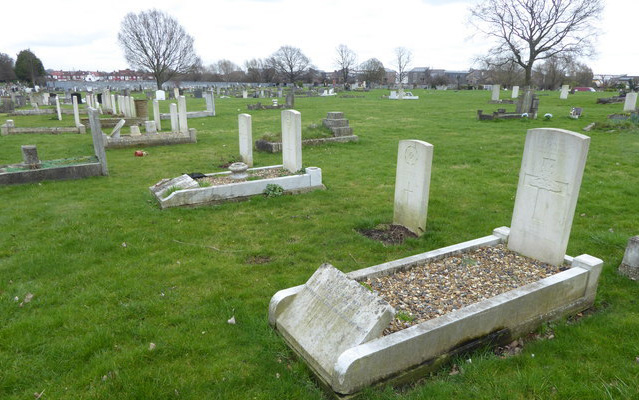 WW2 war graves in Streatham Park Cemetery
Photograph with thanks to Marathon, (CC-BY-SA/2.0)
As to the Borough connection, Bertram’s parents appear to have arrived locally by about 1945 to live at 50 Manor Drive, Ewell. (That was also the address given for Bertram’s mother, Mabel, when she died on 9 March 1954.)
In Q3 1947 and registered in the Wandsworth District, Bertram junior’s widow, Winifred, got remarried to John H Brant. She died in Liverpool Q4 1973.
On 6 November 1994, almost 50 years after the tragedy, the villagers of Morchard Bishop erected, next to their war memorial, the memorial pictured below to honour the crews of both aircraft.
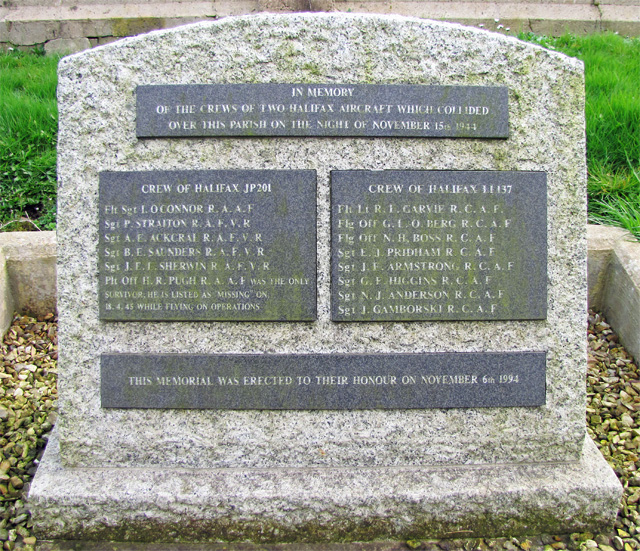 The Morchard Bishop memorial
Photograph with thanks to warmemorialsonline.org.uk
Brian Bouchard & Roger Morgan © 2018
Please contact us if you have information or pictures that can extend this entry.
SAUNDERS, Charles Henry. Flying Officer/Navigator (154588)
61 Squadron, Royal Air Force Volunteer Reserve
Died 21 March 1945, aged 32
Charles’s birth on 4 August 1913 was registered in the Camberwell District. Unusually, the Commonwealth War Graves Commission’s database contains nothing about his parentage, so some devilling in the records is needed.
The birth record notes that Charles’s mother’s maiden name was Forster. The only relevant marriage found in the readily available records is the one in Q3 1904 between Frederick Saunders and Maud Forster registered in the Fulham District. The mid-20s Frederick (a “House Painter”) and Maud are found in the 1911 Census living at 130 Portobello Road, London with three children from 4 year old Maud to a new-born Charles. However, the return clearly states that the parents had been married for only 5 years – i.e. two years later than the marriage record. And, as no record has yet been found of this new-born Charles dying in infancy, it seems unlikely that the parents would have named another child Charles only 3 years later. And “our” Charles’s birth was registered in Camberwell, diagonally across the Greater London area. All this raises a number of question marks about Charles’s actual family background and things will remain unclear until either his detailed Birth Certificate is obtained or the 1921 Census is released in 2022.
The only bit of Charles’s family background noted by the Commonwealth War Graves Commission is that he was the husband of Queenie Saunders. We get onto more solid ground by finding the record of their Q3 1937 marriage registered in the Lewisham District. (Confusingly, however, Queenie’s maiden name was also Saunders.)
The couple set up home in the Borough, with the September 1939 Register recording them at 32 Salisbury Road, Worcester Park. 26 year old Charles is listed as a “Commercial Artist, Design Creation Draughtsman” and 24 year old Queenie with the conventional “Unpaid Domestic Duties” – but supplemented with “Formerly Commercial Artist”. (The original record, but not the transcription, is annotated to show that Charles was also involved with the Epsom & Ewell Auxiliary Fire Service, and Queenie was an ARP telephonist at the Epsom Report Centre.)
Charles enlisted with the Royal Air Force, probably at Uxbridge, during May 1940 with a Service Number 1283809. As a Leading Aircraftman he was commissioned Pilot Officer with effect from 10 December 1943 and promoted to Flying Officer on 10 June 1944.
There is little in the readily available records about the details of Charles’s RAF career before he is found on 20 March 1945 as the Navigator aboard Lancaster RA560 DX-K of 61 Squadron, the full crew of which was:-
• RAAF 422989 FO Swales, J F Captain (Pilot)
• RAF Sgt A J M Davies, (Flight Engineer)
• RAF FO C H Saunders, (Navigator)
• RAF Flt Sgt R Taylor, (Air Bomber)
• RAAF 432498 Flt Sgt D M Easton, (Wireless Operator Air Gunner)
• RAF Sgt W Lane, (Mid Upper Gunner)
• RAF Sgt T Torney, (Rear Gunner).
The aircraft took off from RAF Skellingthorpe, Lincolnshire at 23.34 hours as part of a mission to bomb a synthetic oil plant at Böhlen, a few miles south of Leipzig in eastern Germany. In the early hours of 21 March 1945 and presumably as the result of enemy action, the aircraft exploded in mid-air. It crashed near Kirch-Göns, about 30 miles north of Frankfurt, killing all on board.
The casualties were initially buried in the local Kirch-Goens Civilian Cemetery. On 27 September 1947, they were reinterred among the 2,879 WW2 Commonwealth casualties in the Durnbach War Cemetery, about 25 miles south of Munich. The widowed Queenie took the option of adding a personal inscription to his headstone on Grave 5.C.20,
“He combats no more, strives nor weeps; all is as before, only he sleeps.”
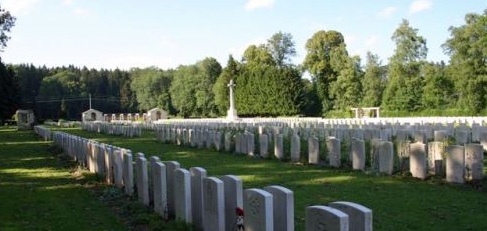 The Durnbach War Cemetery
Photograph by Bert Deelman with thanks to tracesofwar.com
The Commonwealth War Graves Commission’s post-war records refer to the widowed Queenie as being “of West Chiltington Common, Sussex”. However, the Probate record of her being awarded administration of Charles’s £ 1,437 estate notes that the address was the pre-war 32 Salisbury Road, Worcester Park. She did, though, move away from the Borough. In Q3 1959 and registered in Worthing, she married John H Shennan; and her Q4 1990 death was registered in Chichester.
Brian Bouchard & Roger Morgan © 2018
Please contact us if you have information or pictures that can extend this entry.
SAUNDERS, Glyn Tremlett. Gunner (1144026)
140 Field Regiment, Royal Artillery.
Died 7 March 1943, aged 37.
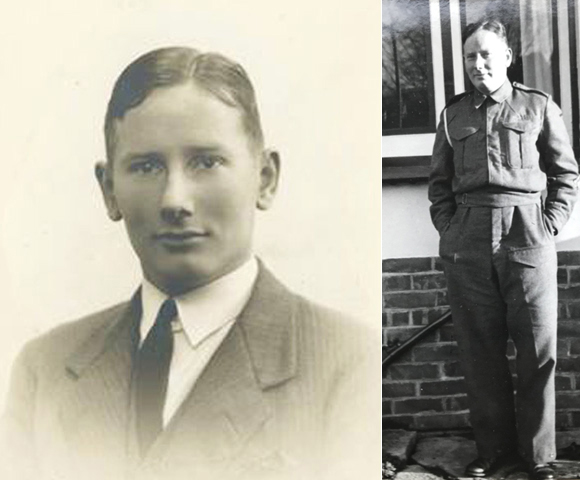
Left: Glyn in his late teens.
Right: The 37 year old Glyn in uniform outside his house in Ewell on (as noted on its back) 31 December 1942 – a few days before his despatch to Tunisia and just ten weeks before his death in action.
Both photographs with thanks to his grandson, Chris Saunders.
Glyn was born on 27 August 1905, the first child of William Henry and Edith Jane Saunders. His mother’s maiden name was Tremlett – doubtless the source of Glyn’s middle name. The parents had married Q3 1904, registered in the London City District, and set up home at 47 Ravenslea Road, Wandsworth where the family (now with a 3 year old Evelyn as well as 5 year old Glyn) were recorded in the 1911 Census. 35 year old William Henry is listed as a “Life Insurance Clerk”. Also living with them was 38 year old Edith’s widowed 66 year old mother, Amy Tremlett who is listed as being of “Private Means”.
Glyn first attended Highfield School, Wandsworth. On 7 December 1920, he was one of 27 young people from the parish of St Mary’s Balham Confirmed in the Church of England, the record of which gives his address still as 47 Ravenslea Road. His secondary education was at Dulwich College. On leaving Dulwich in 1923, he followed his father into the insurance business, taking employment in the head office of the Alliance Assurance Co Ltd.
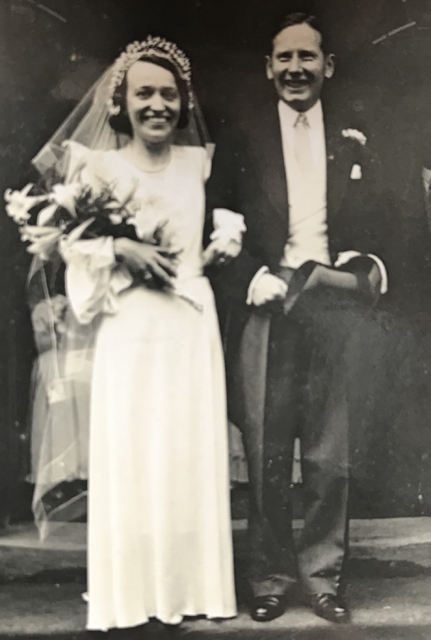 Glyn and Lillian on their wedding day.
Photograph courtesy of Glyn’s grandson Chris Saunders.
The 1934 Electoral Roll recorded Glyn still living in the family home of 47 Ravenslea Road. In Q2 1935, the now 29 year old married 23 year old Lilian Agnes Nason, registered in the Wandsworth District. They set up home in Ewell (hence Glyn’s entry in the Borough’s Book of Remembrance): the 1936 and 1938 Electoral Rolls record the couple at 155 Stoneleigh Park Road, Ewell. By the time the 1939 Electoral Roll was compiled, the couple had moved a hundred yards or so to 58 Stoneleigh Crescent. The move may have been connected with the birth of the couple’s first child, Mervyn, on 19 September 1938 – as registered in the local Surrey Mid Eastern District. (Although the Commonwealth War Graves Commission’s post-war records note that the widowed Lilian was “of Carshalton Beeches, Surrey”, the 1943 Probate record of her being awarded administration of Glyn’s £2,716 estate lists the address still as 58 Stoneleigh Crescent, Ewell.)
However, none of this young family was resident in the Borough at the time of the September 1939 Register. 33 year old Glyn is listed as one of about 40 “Assurance Company” employees (in his case, a “Clerk”) at Volvens Farm and Cottages deep in the Surrey countryside, a couple of miles south of Leith Hill. This seems certain to be an arrangement made by his employer which, like many others in anticipation of hostilities, moved operations from their London offices to safer areas.
In the meantime, the 1939 Register recorded the 30 year old Lilian and 1 year old Mervyn living with her parents-in-law and Glyn’s unmarried 32 year old sister, Evelyn, at “Ravenslea” (presumably named after their Wandsworth address), Meadway, Sidmouth in Devon. (Lilian and Glyn had a second child, Alan, whose Q4 1940 birth was registered in the Honiton District, into which Sidmouth falls.)
In March 1942, Glyn joined up in the Royal Artillery as a Gunner. He qualified as a specialist driver, gaining the secondary rank of “Driver in Charge”. He was posted to the 140 Field Regiment in September 1942. The Regiment’s first WW2 action had been in France as part of the British Expeditionary Force. After evacuation from Dunkirk, it spent some time in home defence awaiting the expected German invasion, and it was in this phase that Glyn joined them.
As the threat of invasion waned, the Regiment – now with Glyn amongst its number – was sent to North Africa in January 1943. It was then closely involved in the final stages of defeating the Axis powers there. Victory came with the capture of Tunis in May 1943, but the end game involved much fierce fighting and it was during preparations for the final push to Tunis that, as noted in Casualty List No. 1151, Glyn was killed in action on 7 March 1943, aged 37. In a subsequent letter to Glyn’s mother, his Sergeant (and friend), Eddie Lampon, wrote that Glyn had put himself in danger to help a wounded comrade when he met his death, and that it was typical that he was always thinking of others over himself.
Glyn is one of 1,576 Commonwealth WW2 casualties buried in the Massicault War Cemetery, about 20 miles southwest of Tunis. The widowed Lilian took the option of adding a personal inscription to his headstone on Grave IV.B.6,
“To me to live is Christ and to die is gain Phil.1.21”
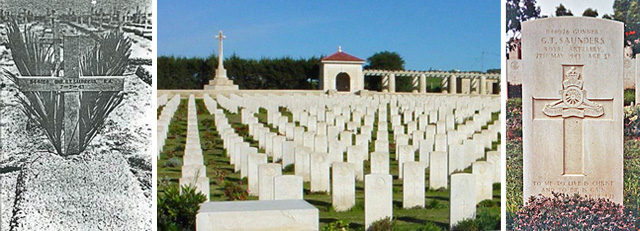
Left: Glyn’s original grave marker & Right: the present headstone.
Both photographs with thanks to his grandson, Chris Saunders.
Centre: The Massicault War Cemetery, Tunisia.
Photograph with thanks to the Commonwealth War Graves Commission.
In addition to his entry in the Borough’s Book of Remembrance, Glyn is commemorated on the WW2 memorial at his secondary school, Dulwich College.
On 14 September 1948 and registered in the Wandsworth District, the widowed Lilian married again – to the also widowed Leslie W Cole.
Roger Morgan © 2020
Please contact us if you have information or pictures that can extend this entry.
SAUNDERS, Victor Lewis. Able Seaman (P/JX199232)
HMS Argus, Royal Navy.
Died 24 January 1942, aged 23.
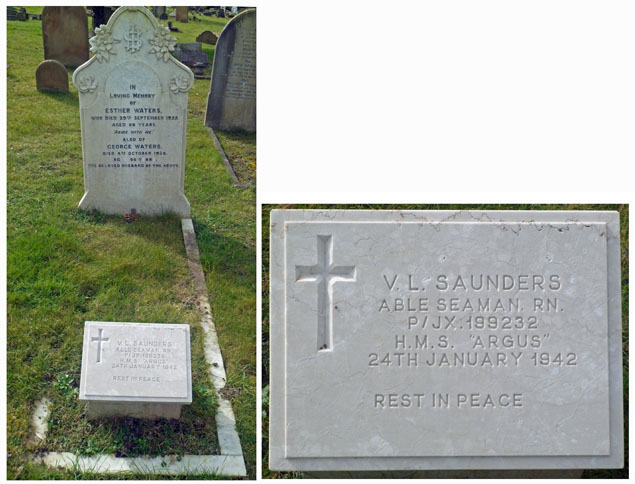 Victor’s grave marker and his grandparents’ headstone in Epsom Cemetery
Photographs (158740797) by Lawrence Hennessy via findagrave.com
Victor was born on 16 April 1918, the first child of Joseph William Saunders and Elizabeth Lewin (née Waters – marriage not found in the readily available records). Joseph was a Londoner: the 1911 Census records him, then aged 24, as the oldest of six children living with their mother at 40 North Street, Hackney. His occupation was listed as a “Warehouseman”. Elizabeth – the third of nine children – had been born in Ewell on 19 October 1887 (baptised in St Mary’s on 4 December that year) and, until the family moved to New Malden for a spell, spent her early years there. More of her family background is set out in the article about immediately older brother Albert, a WW1 soldier who died of influenza in 1918. (Her immediately younger brother Lewis had been killed in action in the early days of WW1.)
Joseph and Elizabeth set up home in Epsom: Victor’s birth and that of his three siblings (Doris in Q4 1919, Joan on 2 June 1922 and Mary on 5 February 1930) were all registered locally. Their address may well have been in Middle Lane Epsom from the outset: this is where Elizabeth’s parents were (at No. 29) when her mother, Grace Waters (née Martin), died in 1925. (Her father, George Waters, had been living at Middle House, Dorking Road – Epsom Workhouse – when he died the following year.)
It is certainly known that, by 1932, Victor’s family lived at 35 Middle Lane, Epsom and then, between 1935 and 1938, at No. 34. By the time of the 1939 Register, they had moved to 25 Oakhill Road, Ashtead. Joseph (now aged 52) and 21 year old Victor are both listed as Builders Labourers. 49 year old Elizabeth is listed with the conventional “Unpaid Domestic Duties”. Also recorded at the address were 17 year old Joan (a “Laundry Maid”) and 9 year old schoolgirl Mary. (The currently closed record between Victor and Joan seems certain to be the other sister, 19/20 year old Doris.)
Victor’s WW2 service was as an Able Seaman aboard HMS Argus. This was one of the Royal Navy’s earliest aircraft carriers which, other than a period out of commission between 1929 and 1938, saw service from 1918 until being scrapped in 1946. Like her contemporaries, she was converted from an ocean liner that, in her case, was under construction when the First World War began. She became the first example of what is now the standard pattern of aircraft carrier, with a full-length flight deck that allowed wheeled aircraft to take off and land – which earned her the nickname “Flatiron”. After her commissioning in 1918, HMS Argus was heavily involved for several years in the development of the optimum design for other aircraft carriers and was also the test bed for developing equipment, general procedures and fleet tactics.
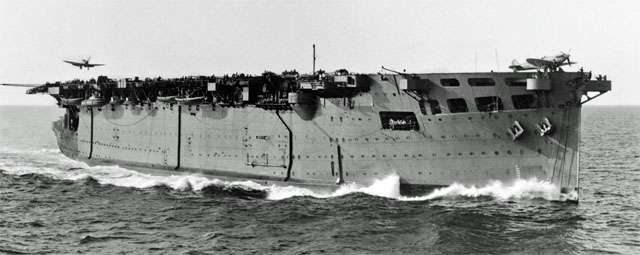 HMS Argus in action (during Operation Torch) off North Africa in November 1942.
IWM Photograph (A 12882) – Public Domain.
After her 1938 recommissioning, Argus first served as a training carrier to allow pilots to practice their deck-landing skills. After WW2 hostilities began, she was active in convoy escort duty, ferrying aircraft (including the first consignment of part-assembled fighters to Takoradi in the then Gold Coast – as described in the article about Roy Hutchings, the starting point for the Allies’ crucial West African Reinforcement Route), and supporting various operations.
It is not currently known when Victor joined HMS Argus, but he must have been involved in at least some of these various operations. His death, however, was not the result of enemy action but of acute meningitis and osteomyelitis of the frontal bone. He died on 24 January 1942 in the EMS Hospital, Whitchurch, Cardiff, Glamorgan, Wales. This was part of Cardiff City Asylum turned over to the military to become the largest emergency service hospital in South Wales.
His body was brought home. On 30 January 1942, he was buried in Epsom Cemetery in the same grave (F178) as his maternal grandparents.
In addition to his entry in Epsom & Ewell’s WW2 Book of Remembrance, Victor is commemorated (as “V F Saunders”) on the War Memorial outside St George’s, Ashtead.
Roger Morgan © 2018
with special thanks to Brian Bouchard for additional material.
Please contact us if you have information or pictures that can extend this entry.
SAVAGE, Basil Oswald. Flight Sergeant/Wireless Op./Air Gunner (1393629)
158 Squadron, Royal Air Force Volunteer Reserve.
Died 22 March 1944, aged 20.
Basil Oswald Savage was born in Q3 1923, registered in the Reigate District. He was the first child of Frederick Charles and Lily May Savage (née Moss).
The parents had married on 24 January 1923 in St Barnabas Church, Epsom. Lily had been born in Epsom on 28 August 1901 and was baptised at Christ Church Epsom Common on 30 September 1901 whilst the family was living at Ellison Cottage, Miles Road, Epsom. By the time of the 1911 Census, the family – parents William (a “Bricklayer”), wife Mary and children Hugh and Lily – were living at 94 Hook Road. As to Basil’s father, Frederick’s 4 October 1899 birth had been registered in the Farnham District. His father was a policeman and, in 1911, the family were living at 2 Police Station Cottage, High Street, Dorking, Surrey. In 1919, they were living in the Reigate Police Station and by 1923 at 44 Hart Road, Dorking.
As noted at the head of this article, Basil’s birth was registered in the Reigate District. That seems to have been only a temporary absence from the Borough. Electoral registers record that, between 1929 and 1932, Basil’s parents were living with Lily’s parents at 94 Hook Road. The 30 April 1933 birth of Basil’s brother Robert was registered in the Epsom District – barely a month after Lily’s father died in Epsom Hospital. The September 1939 Register records Lily’s 63 year old mother still as head of the household at 94 Hook Road. She and 38 year old Lily are listed with the conventional “Unpaid Domestic Duties”, and 39 year old Frederick as a “Clothing Salesman, Retail”. There is then one currently closed record at the address, presumably of 15 year old Basil. That is foillowed by the entry for 6 year old schoolboy Robert.
Sometime after August 1940, Basil Oswald Savage enlisted at Euston with the Royal Air Force Volunteer Reserve for air crew duty and was allocated the Service No. 1393629. He would have sat an entrance exam which involved Maths and English and had a thorough medical. With an interview, the process took a day and a half before he was accepted for training as wireless operator/air gunner. From induction, his training would have taken about 18 months from learning Morse code (probably at Blackpool), through radio maintenance and air gunnery to the rank of Sergeant and an Operational Training Unit.
Eventually he was posted to 158 Squadron, Bomber Command, based at RAF Lissett, Yorkshire. He was detailed to take part in a raid against Frankfurt in Halifax Mark III, serial number, HX 342, call-sign NP-F, one of 846 aircraft to take part in the raid. The aircraft took off at 18:58hrs on 22 March 1944 from base but sadly nothing further was heard and it failed to return. The crew were: –
• 132792 F/Lt Kenneth Thomas Shaw Holmes – Captain
• 152077 F/0 John de Riemer Morgan – 2nd pilot
• 172995 P/0 Horace James Worthing Smith – Navigator
• 138895 F/0 Kenneth Alexander Leonard -Air Bomber
• 171684 P/0 Bernard Silverius Harrison – Flight Engineer
• 1393629 F/Sgt Basil Oswald Savage – Wireless Operator/Air Gunner.
• 2200275 F/Sgt Herbert Weston Phillips – Mid Upper Gunner
• 1239323 F/Sgt Leslie Victor Moran – Rear Gunner
The Gendarmes at Marbais confirmed that, at about 23.15 hours on 22 March 1944, Halifax HX342 came down there and one member of the crew, who was injured (F/0 Morgan), had been taken prisoner whilst all the others were killed. On 25 March, the dead were all buried in the Parish Cemetery, Gosselles, near Charleroi, Belgium. This holds 102 Commonwealth WW2 casualties – all airmen shot down by fighters from the Luftwaffe base that was then stationed at the town.
The 20 year old Basil’s parents took the option of adding a personal inscription to his headstone on Grave 2.24,
“At the rising and setting of the sun we will remember thee.”
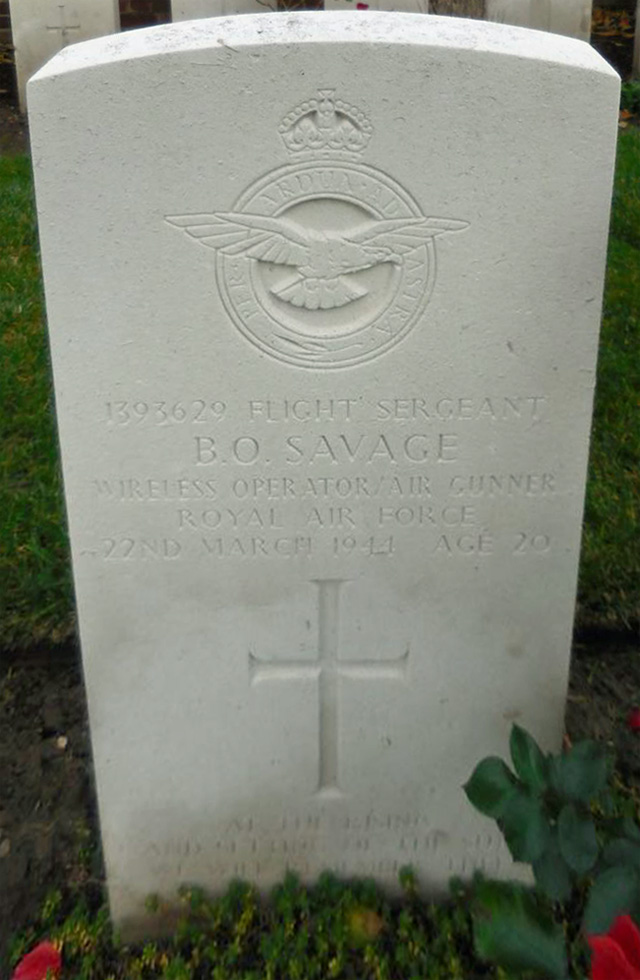 Basil’s Headstone in Gosselies Communal Cemetery
Image source https://halifaxjd371kno.com
A tablet has been erected in the grounds of St. James of Compostela Church in Lissett Village to members of 158 Squadron, who had been based at RAF Lissett. In addition, Basil’s name appears, engraved on figures of men, a memorial sculpture in steel, at former RAF Station Lissett, also commemorating the 851 men of 158 Squadron lost when flying out of the base.
Basil is commemorated in the Book of Remembrance in the foyer of the Town Hall and on the St. Barnabas Roll of Honour.
The death of Basil’s father was registered in the December quarter of 1955 in the Surrey South Eastern district, and his mother’s death was registered in the March quarter of 1966 in the Surrey Mid Eastern district.
Brian Bouchard & Clive Gilbert © 2017
Census & burial information extended by Roger Morgan, 2018
Please contact us if you have information or pictures that can extend this entry.
SAVAGE, Eric John. Lance Corporal (7686646)
Corps of Military Police
Died 21 September 1940, aged 27
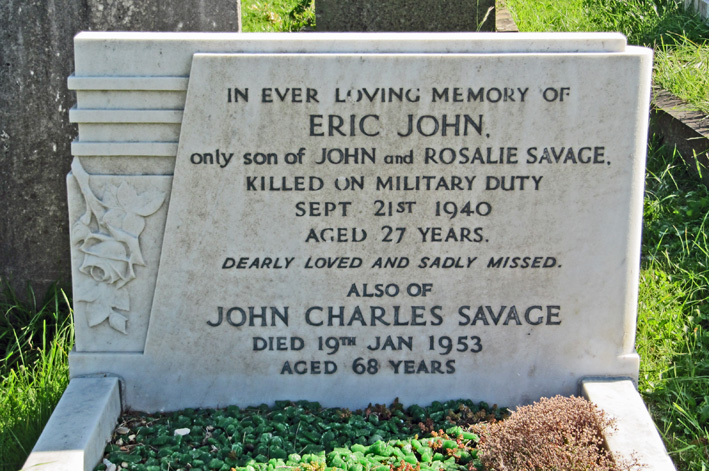 The headstone of Eric Savage’s (and his father’s) grave in Epsom Cemetery (plot M623)
Image courtesy of Roger Morgan ©2017.
Eric was born in Bromley, Kent Q3 1913, the only child of John Charles Savage and Rosalie Jane (née Hide – they had married in Bromley Q2 1912). The September 1939 Register records the parents living at 38a West Hill, Epsom with 55 year old John listed as a “Metropolitan Police Sergeant” and 53 year old Rosalie as a “Housewife, semi invalid”. The 26 year old Eric is not found in the 1939 Register, probably because he was already in uniform: indeed, there is a record of him as one of the British Expeditionary Force evacuated from Dunkirk in mid-1940.
Given his father’s occupation, it is not a particular surprise to find that Eric’s WW2 service was in the Military Police – the “Royal” prefix was not granted until November 1946. (Military policemen are often known as ‘Redcaps’ because of the scarlet covers on their peaked caps, or scarlet coloured berets.) Of the Corps’ various branches, Eric was – according to Epsom Cemetery records – in the Provost Wing (responsible for general policing) and, specifically, the 103 Provosts Company.
The readily available records provide no information about Eric’s particular work. In addition to records him as “A Lance Corporal in the Corps of Military police”, his Death Certificate records that he was “stationed at Townsend Cottages, Cambridge Road, Dullingham.” The two Townsend Cottages are, in fact, about three miles north of the centre of the small village of Dullingham – and sufficiently remote to have their own postcode. As illustrated below, they are on an arrow-straight section of Cambridge Road (the A1303) about four miles from the centre of Newmarket and about eight to Cambridge in the opposite direction.
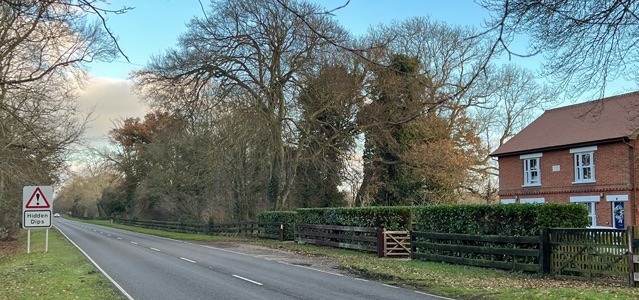 Townsend Cottages, Cambridge Road, Dullingham.
Photograph by Christopher Morgan © 2023
Eric’s Death Certificate also records that died on the evening of 21 September at “The White Lodge, Exning Road, Newmarket” – being the former workhouse, set up as an emergency hospital in 1939. (It then became Newmarket General Hospital – a Grade II listed building, now converted to apartments having been replaced by the modern Newmarket Community Hospital built next door.) The cause of his death is described as “injuries received when the motor bicycle which was riding accidentally collided with a motor car on the highway at Dullingham there on that day.” (His headstone says that he was “Killed on military duty”.)
A report of the inquest (in the 28 September 1940 edition of the Bury Free Press – the local paper for nearby Bury St Edmunds) provides more detail. Eric was on his motor bike returning from overnight duty. About half a mile from home and at about 6.30 am it appears that, in a lapse of concentration, he was turning in front of a following car. The driver (a Corporal Robert Dick) swerved but the car’s front nearside wing clipped the bike in the middle of the road. Out of control, the bike travelled another 100 feet before crashing into the hedge, with Eric falling off 10 feet before that. (It may also be that the “Hidden Dips” – as in the modern warning sign seen across the road in the image above – were a factor.)
A Dr Jones saw Eric at the Hospital in Newmarket at 7.10 am (about three quarters of an hour after the incident) and found that Eric had died about 10 minutes earlier. There were indications of a fracture at the base of Eric’s skull. The coroner returned a verdict of “Accidental Death”.
Eric was brought back to Epsom for burial in Grave M623 of Cemetery on 26 September 1940. As shown on the headstone, his father (who, aged 68, died at the family home of 38a West Hill, Epsom on 19 January 1953) was later buried alongside him. With increasing visual and hearing impairment, Eric’s widowed mother, Rosalie, later moved to Caterham where, aged, 97, she died on 27 November 1983.
Roger Morgan © 2020
Please contact us if you have information or pictures that can extend this entry.
SCOFFIN, John Sidney. Leading Aircraftman (1811330)
Royal Air Force Volunteer Reserve
Died 24 June 1944 Age 19
Not listed in the Book of Remembrance.
John was born Q3 1924, apparently the only child of Sidney North Scoffin and Kathleen Annie (née Mann). Sidney (who was on the clerical staff of the Cunard Shipping Company and had served with the Royal Fying Corps as an Air Mechanic 2nd Class in the Great War) and Kathleen’s Q2 1923 marriage was registered in the Romford District, as was John’s birth.
The September 1939 Register records the parents living at 249 Coventry Road, Ilford. 42 year old Sidney is listed as a “Shipping Clerk (Stocktaker on Ships)” and 39 year old Kathleen with the conventional “Unpaid Household Duties”. There is no currently closed record at the address so John was not at home, and this 15 year old is not found elsewhere.
The family then moved to the Borough. The Commonwealth War Graves Commission post-war records describe the parents as being “of East Ewell, Surrey”, and the January 1945 Probate record of Sidney (a “Shipowner’s accountant”) being awarded administration of John’s £ 288 estate gives the address as Hillside Road, East Ewell.
There is nothing in the readily available records about the details of the initial period of John’s WW2 service in the RAF. It appears that he was sent to No 20 Service Flying Training School at Cranborne in Southern Rhodesia (modern-day Zimbabwe). These Schools were for pilots who showed promise after 50 hours of basic aviation instruction (on a simple trainer like the Tiger Moth) at an Elementary Flying Training School. SFTSs were equipped with advanced trainers – in the case of No 20 SFTS, the Harvard IIA, as pictured below.
 Harvard trainer EX490 flying from No 20 SFTS
Photograph with thanks to the blog by “Galgos”
John is thought to have been killed whilst flying in either EX490 (the very aircraft illustrated above) or EX512 which collided with each other near Inkomo in Southern Rhodesia. He is one of 224 WW2 Commonwealth casualties buried in the Harare (Pioneer) Cemetery. His parents took the option of adding a personal inscription to his headstone on Grave 137,
“In proud and glorious memory”
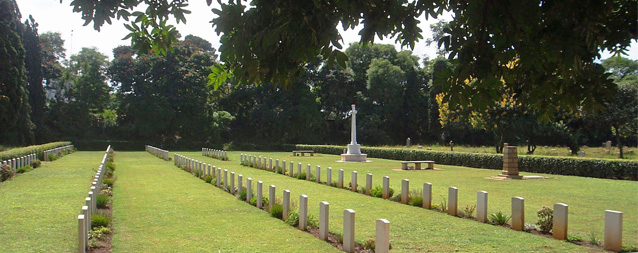 The Commonwealth War Graves section of the Harare (Pioneer) Cemetery
Photograph with thanks to the Commonwealth War Graves Commission
Brian Bouchard & Roger Morgan © 2018
Please contact us if you have information or pictures that can extend this entry.
SELBY, William Edward. Gunner (974252)
11 Field Regiment, Royal Artillery
Died 20 July 1942, aged 22
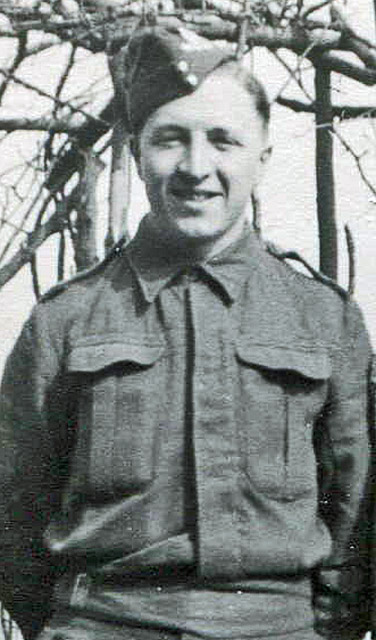 William in uniform
Copyright acknowledged
William is not listed in the Borough’s Book of Remembrance, but is commemorated here because the Commonwealth War Graves Commission’s record note him as the “son of Walter George and Elizabeth Selby, of Epsom, Surrey”. An address in the Borough has yet to be established and, indeed, may not exist since there is a strong possibility that a Tattenham Corner address has been taken as falling within Epsom rather than Banstead.
William was born Q1 1920, apparently the only child of Walter George Selby and Elizabeth (née Josiah). They married on 5 June 1917 in the Kennington parish church. William’s subsequent birth was registered in the same Lambeth District. Walter (whose occupation listed on the marriage certificate was “Motor Transport Driver”) died on 26 July 1924, aged only 36. His address at the time was 84 Elystan Street, Chelsea.
The widowed 50 year old Elizabeth is recorded in September 1939 Register living at ‘Jasmine’, Tattenham Grove with her 42 year old sister, Dorothy, and her husband, 42 year old William J Gordon, a “Bank Messenger”. Dorothy is listed with the conventional “Unpaid Domestic Duties”, but Elizabeth is shown as an “Envelope Hand Folder”. (That is the same occupation as was shown for her in the 1911 Census when she was an unmarried 22-year-old, the second of eight children living with their late-40s parents, “Taxi Driver” Charles and Caroline Josiah, at 31 Richmond Street, Lambeth.)
There is one currently closed record at ‘Jasmine” in the 1939 Register. This probably conceals the 19-year-old William: the Probate record of the administration of William’s estate being awarded to his mother gives his address as “39 (presumably the now numbered ‘Jasmine’) Tattenham Grove, Epsom” – and that is perhaps the source of confusion in this case.
There is disappointingly little information in the readily available records about William’s WW2 service in the 11 Field Regiment, Royal Artillery. From the 20 July 1942 date of his being killed in action and that the location of his burial, it is clear that he was in the thick of the action during the first Battle of El Alamein (1-27 July 1942) – the famous battle in which Commonwealth troops managed at last to halt Axis forces’ apparently inexorable advance to the Suez Canal. (It was the 23 October to 11 November 1942 second Battle of El Alamein that started pushing the Axis troops back again – a turning point in the North African campaign and, indeed, WW2 as a whole.)
William is one of the 7,240 Commonwealth WW2 casualties buried in the El Alamein War Cemetery. His mother took the option of adding a personal inscription to his headstone on Grave XXI.F.19,
“Deep in our hearts there is a memory of one we will never forget. Mother.”
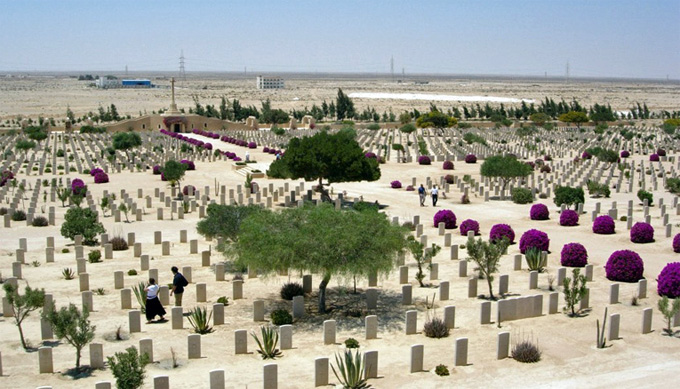 The El Alamein War Cemetery, Egypt.
Photograph with thanks to the Commonwealth War Graves Commission.
Roger Morgan © 2019
Please contact us if you have information or pictures that can extend this entry.
SELMAN, Harry William. Leading Aircraftman (330930)
Royal Air Force
Died 20 June 1941, aged 39
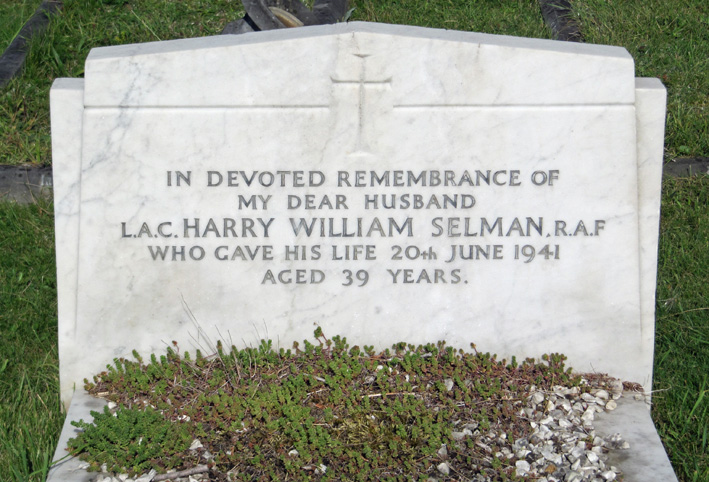 The headstone of Harry Selman’s grave in Epsom Cemetery (plot F410A)
Image courtesy of Roger Morgan © 2017.
Harry was born on 15 May 1902, the third child of William Henry Selman (a “Carpenter”) and Louisa (née Jeffries – they had married in Merstham, Surrey on 19 March 1891). After various addresses in the Brentford area, the 1911 Census finds the mid-40s couple living at 1 Juniper Colts, College Road, Epsom together with 8 year old Harry – whose two older siblings, Nellie and Margaret (now aged 18 and 15 respectively), seem to have left home.
In due course, Harry took up employment as a male nurse at West Park Hospital, one of Epsom’s “cluster” of mental hospitals – and that was recorded as his address in the 1928 Electoral Register.
On 18 October 1932, the 30 year old Harry married 25 year old Enid Elizabeth Leyshon at St Martin’s Church, Epsom. Enid had been born on 24 January 1907 in Aberavon, Glamorgan. The 1911 Census records her as one of five children of the late 30s John Edward Leyshon (a “Dock Labourer”) and Mary Ann (née Heddin) living at 19 Victoria Road, Aberavon. Henry and Enid’s marriage certificate records Henry as a “Male Nurse” living at 28 College Road, Epsom (the address at which his parents were recorded in the September 1939 Register – and perhaps the 1911 address, renumbered) and Enid’s address as Long Grove Hospital, another of Epsom’s “cluster”. No occupation is listed for her, but the presumption must be that she worked at the hospital and that this is how the two of them met.
The couple’s only child, Brian Roger, was born locally on 28 November 1934. The 1939 Register finds the family of three living at 36 Wheelers Lane, Epsom. (That was also where Harry was “of” in the September 1941 Probate records.) In the Register, 37 year old Harry is listed as a “Mental Nurse (LCC)” (presumably still at West Park Hospital – and certainly not Horton or Manor, as he is not mentioned on their WW2 memorials), 32 year old Enid with the conventional “Unpaid Domestic Duties”, and nearly 5 year old Brian as “Under School Age”. The original Register is annotated to show that Harry was “RAF Reservist 330930, rejoining 2-10-39”.
What Harry rejoined was the RAF’s 49 Maintenance Unit (formerly RAF Henlow’s “1 Salvage Centre”) and now stationed at Faygate to support nearby Gatwick, the early commercial airport that had been requisitioned by the Air Ministry for wartime use as a fighter base. Thanks to a post on the Sussex History Forum, we know that, at about midday on 20 June 1941, Harry and two other members of the Maintenance Unit were operating a truck-mounted “Coles crane” as part of a salvage operation at Gatwick. A Curtiss-Wright Tomahawk collided with the crane, injuring the three operators, but not the pilot. (It appears that the Tomahawk AH858 – a single-seat fighter/ground attack aircraft – was returning from a mission as the pilot’s view was obscured by oil, presumably from some in-flight damage.)
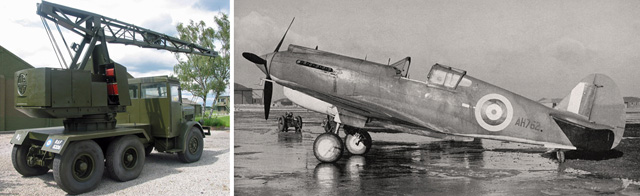 Left: a Coles Crane (photograph with thanks to The Yorkshire Air Museum)
Right: a Curtiss-Wright Tomahawk (photograph with thanks to The Hawk’s Nest)
Unlike his two colleagues, Harry’s injuries necessitated admission to the nearby Redhill County Hospital with “severe bruising to walls of chest”. However, he could not be saved and died there at about 7pm, some 6½ hours after the accident.
Harry’s Death Certificate states only that, as informed by “C H Grey, Commanding Officer”, the cause of death was the somewhat cryptic “Due to War Operations”. His body was brought home for burial in Epsom Cemetery (Grave F410A) on 25 June.
The widowed Enid, who never remarried, remained in the Borough for some years after the war. In due course, she returned to her native Wales where, aged 78, she died on 8 June 1985. Son Brian also moved there. He appears never to have married and died there in February 2006, aged 72.
Roger Morgan © 2019
With special thanks to Hazel Ballan
Please contact us if you have information or pictures that can extend this entry.
PS. It may be of interest that the “C H Grey, Commanding Officer” in the last paragraph above seems certain to be Flight Lieutenant Charles Hervey Grey of the RAF’s Administrative and Special Duties Branch who, by 1944, had risen to the rank of Wing Commander. He was born in December 1875, the son of the Rt Revd Charles Hoare (Bishop of Bath & Wells from 1869 to 1894) and Katherine Georgina (née Hervey – hence Charles’s second name). After leaving Eton College in 1894, he joined the Army. He served with the Imperial Yeomanry during the Boer War, initially enlisting as a Trooper (7981) with the 40th (Oxfordshire) Company, 10th Imperial Yeomanry (raised in 1900) before gaining a commission and the rank of Captain by the end of the conflict. He earned the Queen’s South Africa Medal for his services. He served with distinction in France during WW1, being awarded the DSO and Bar. He married in 1919 and, as Lieutenant Colonel in the West Kent (Queen’s Own) Yeomanry, relinquished his commission in 1921. In 1927, he changed his surname to Grey and became well known as a botanist and ecologist before taking up RAF duties in November 1939. He died, aged 80. in 1955.
SEXTONE, Mary Cottingham
Civilian
Died 26 September 1940, aged 64
Not listed in the Book of Remembrance.
Mary was born in Deptford, the fourth of five children born to Thomas Sexstone and Fanny (née Cottingham – they had married in 21 August 1867 in Fanny’s home town of Plumpton, Sussex). Thomas had been born in Deptford and, on his father’s death, took over the family dairy business.
The 1911 Census records Thomas and Fanny living at 153 Evelyn Street, Deptford. The now 68 year old Thomas is still listed as a “Dairyman”. Living with the couple are three of their children, all unmarried: 42 year old Thomas (“Assisting in the Business”); 35 year old Mary (“Dressmaker”); and 32 year old Harriet (“Domestic Servant”).
The September 1939 Register records the three unmarried siblings still living together, now at 36 Shere Road, Deptford. Thomas junior is now listed as “Dairyman (Retail)”, Mary still as a “Dressmaker” and Harriet now as “Shop Assistant Dairy”.
During the afternoon of 11 September 1940 – four days into the Luftwaffe’s 8 month “Blitz” bombing campaign – the 64 year old Mary took shelter from a raid in the basement of the Deptford Methodist Central Mission Hall. This received a direct hit. About 50 people were buried in the rubble, of whom 26 were killed. Mary was one of the injured survivors and was taken to Horton Emergency Hospital, one of Epsom’s “cluster” of mental hospitals that, as for WW1, had been taken over for dealing with wartime casualties. She died there from her injuries a couple of weeks later, on 26 September 1940.
The 1 November 1940 Probate records confirm Mary as being of 36 Shere Road (as in the 1939 Register) and note that administration of her £ 508 estate had been awarded to her brother Thomas, “Dairyman”.
Roger Morgan © 2018
Please contact us if you have information or pictures that can extend this entry.
SEYMOUR, Noel Arthur. Corporal (552186)
Royal Air Force.
Died 14 October 1943, aged 21.
Noel (who, within the family, became known as “Nobby”) was born in Q1 1922, the last of four children born to James Seymour to Margaret (née Widnall). The parents’ Q3 1908 marriage was registered in the Tonbridge District of Kent as were the births of all their children, namely: Kathleen, Q2 1910 ; Robert, Q1 1912; Margaret, 27 July 1915; and Noel, Q1 1922.
The 1911 Census records the parents and first child Margaret living at “Collingham”, Hastings Road, Pembury, Kent. 31 year old James is listed as a “Professional Cricketer” (who – see his Wikipedia article – was of some standing). As usual, no occupation is recorded for 29 year old housewife Margaret, busy with 1 year old Kathleen.
James died aged 50 in Q4 1930, registered in the Maidstone District of Kent and, at some point, Margaret and family moved to the Borough. The September 1939 Register records the widowed 57 year old Margaret living at 5 Grove Road, Epsom and listed with the conventional “Unpaid Domestic Duties”. Still living with her were her two middle (and unmarried) children: 27 year old Robert was listed as an “Athletic Outfitter (Shopkeeper)”; and 24 year old Margaret junior as “Assisting Secretary” (sic) – with the original record annotated to show her involvement in the local ARP Ambulance Service.
The 17 year old Noel was not at home in the 1939 Register because, at RAF Cranwell in 1938, he had joined the RAF’s boy entrant scheme. Established in the mid-1930s, this provided for boys to enlist between the ages of 15 to 17 for training in various occupations or trades which fitted them for service in the Royal Air Force. Noel’s instruction was in No 2 Wing of the Electrical & Wireless School to become a Wireless Operator. After qualifying, he was sent to bolster the British presence in Malaya and Singapore where he rose to the rank of Corporal.
Commonwealth troops in that theatre were, notwithstanding fierce fighting, unable to halt the Japanese invasion from the north of Malaya which began on 8 December 1941. Survivors retreated to Singapore which, with some 80,000 troops, was surrendered to the Japanese on 15 February 1942. The Japanese, who had already taken about 50,000 prisoners on their progress through Malaya and Singapore, then set about processing these people for, as is now well-known, extremely harsh imprisonment.
Noel was among this number. He was first interned at the Changi prison and may be found rostered on Cards V9569 & J9952 as “Norman” Arthur Seymour. He was subsequently sent to Thailand in F (Death) Force which comprised 7,000 POWs (3,400 British and 3,600 Australians.) On 16 April 1943, the group set off for Thailand in about 10 train loads, 30 men crammed into the steel rail trucks which measured about 18 feet by 7 feet. The journey took 4 nights, 5 days with spasmodic meal and toilet stops. On arrival at Banpong (the disembarkation point in Thailand), F Force was then force-marched nearly 200 miles over 18 nights to northern Thailand where, from the Kanchanaburi Base, they were put to work building the notorious Burma-Siam railway and an adjacent service road.
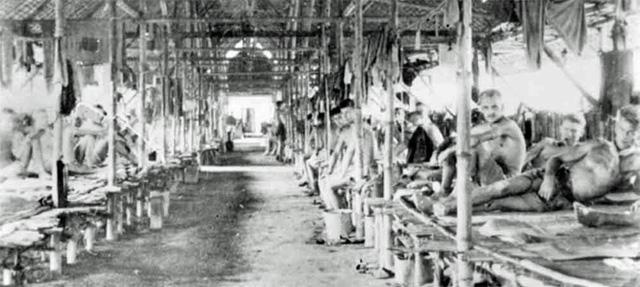 Inside one of the huts at the Kanchanaburi PoW Camp
Photograph with thanks to ww2today.com
Reportedly (and from a distressingly low base), Kanchanaburi was regarded as one of the better camps, where there was a relatively regular supply of food although drinking water had to be purchased from a privately owned well. While most men somehow eked out a living, malnourishment and associated diseases was rife. Between August and December 1943, deaths in the Camp’s hospital, averaged about 30 a day. The 21 year old Noel died there on 14 October 1943.
Noel is buried in Grave 2.A.40 the Kanchanaburi War Cemetery (about 75 northwest of Bangkok in modern-day Thailand) – one of the 6,858 Commonwealth WW2 casualties buried there.
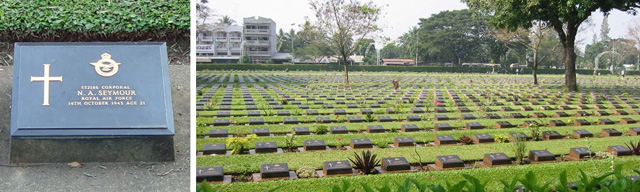 Noel’s grave marker and the Kanchanaburi War Cemetery
Photographs with thanks to (left) B&J Cross and (right) RDSmith4, CC BY-SA 2.5
The Commonwealth War Graves Commission records have Noel as the “son of James and Margaret Seymour of Epsom, Surrey”. As noted above, his father died in Kent in 1930. His widowed mother was still at 5 Grove Road, Epsom when, as in the 20 April 1946 Probate records, she was granted administration of Noel’s £395 estate.
Brian Bouchard & Roger Morgan © 2018
Please contact us if you have information or pictures that can extend this entry.
SEYMOUR, Stanley Philip William. Gunner (1801673)
49 Battery, 48 Light Anti Aircraft Regiment, Royal Artillery
Died 29 November 1942, aged 26
Not listed in the Book of Remembrance.
The Commonwealth War Graves Commission’s usual helpful sketch of a casualty’s family background is, in Stanley’s case, that he was the “son of Sidney and Eliza Seymour, of Ewell, Epsom, Surrey”. It is, however, unusual in making no mention of his wife, Doreen – of whom (and his parents’ move to the Borough) more below.
Stanley was born on 23 January 1916, the second of two children born to Sidney Philip Seymour and Eliza Sara (née Silor). Their Q3 1912 marriage was registered in the Hackney District, as was the Q4 1914 birth of their first child, Sidney. Stanley junior’s birth was registered in the West Ham District.
The September 1939 Register records the parents still living at 89 Swinnerton Street, Hackney with 53 year old Sidney listed as a “Ladies’ Handsewn Shoe Maker” and 52 year old Eliza with the conventional “Unpaid Domestic Duties”. 23 year old Stanley was still living with them, and is listed as a “Laboratory Assistant, (Brewer)”.
Shortly after this, Stanley went into the Army and joined 49 Battery of the Royal Artillery’s 48 Light Anti Aircraft Regiment. This was initially stationed in East Anglia, which is presumably how Stanley came to meet Doreen Olive Marchington. The September 1939 Register records this 23 year old “Shop Assistant (General Store)” living with her 50 year old parents George (“Agent & Collector Clothing Club”) and Olive (the conventional “Unpaid Domestic Duties”) at 27 Croft Street, Ipswich. In Q1 1940, Stanley and Doreen (both now aged 24) married in Ipswich.
On 7 December 1941 (by chance the day that Japan declared war with attacks the United States at Pearl Harbor and Commonwealth forces in Malaysia), Stanley’s 49 Battery (together with 95 and 242 Battery) sailed from Gourock on the River Clyde bound (via the Cape of Good Hope) for Basra in Iraq. However, on reaching Durban, the Batteries were redirected to Singapore to bolster the defences against the Japanese invasion now approaching through Malaya. Singapore fell shortly before they arrived and they were then diverted to Batavia (now Jakarta) on the jungle-covered island of Java, then part of the Dutch East Indies (now Indonesia).
Fighting against the Japanese was just getting under way there. Notwithstanding much fierce fighting – with heavy casualties on both sides – the Allies were overcome and surrendered to the Japanese in February 1942. Stanley was among those then taken prisoner.
Readily available records do not provide any information about his time as a Japanese PoW but, like his fellow prisoners, he will have experienced dreadful conditions and harsh treatment. These led to his death on 29 November 1942, as formally recorded in Casualty List No. 2032.
Stanley was buried locally in the first instance but, after the war, was reinterred as one of the 1,138 Commonwealth WW2 casualties in the Sai Wan War Cemetery, in the NE corner of Hong Kong Island. His parents and widow took the option of adding a personal inscription to his headstone on collective grave IV.A.9-11,
“Peace, perfect peace. In God’s own keeping we are safe and they.”
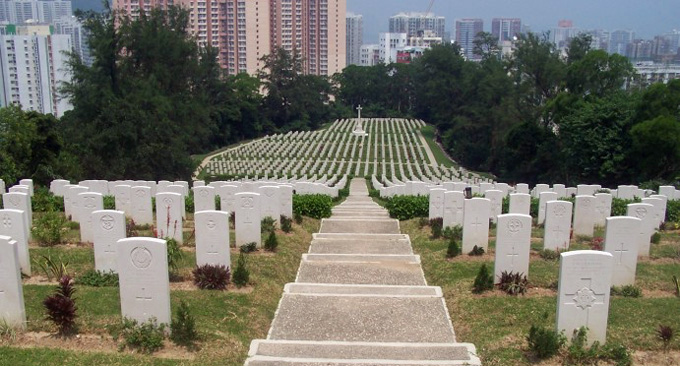 The Sai Wan War Cemetery, Hong Kong.
Photograph by Chris Nelson via findagrave.com
At some point during WW2, Stanley’s parents moved to the Borough and were joined by their widowed daughter in law, Doreen. The 1945 Electoral Roll records them at 42 Bridle Close, Ewell, and they were at No 16 (perhaps the same house, but renumbered) in 1947. In Q3 1947 and registered in the local Surrey Mid Eastern District, Doreen got married again – to Peter R Breeze.
Roger Morgan © 2020
with special thanks to Hazel Ballan for finding Stanley’s marriage and the family move to Ewell
Please contact us if you have information or pictures that can extend this entry.
SHAW, Charles
Civilian
Died 11 July 1944, aged 53
Not listed in the Book of Remembrance.
The Commonwealth War Graves Commission gives a rather terser summary of Charles’s family background than usual, stating only that he was the “son of Mary Shaw, of 31 Tate Street, Vauxhall, London; husband of S. Shaw, of 36 Geneva Road, Brixton, London.” (NB: no mention of a father.) Sadly, these names (and initial!) are far to common to trace with any confidence in the readily available records.
The addresses were potentially more helpful, but the 1939 Register records the residents of 31 Tate Street as only William H Shaw (a married “Printer’s Warehouseman” born on 21 February 1876 – and presumably a relative of some sort) and one currently closed record. As to 36 Geneva Road, the only resident recorded in the September 1939 Register was Ivy E M Greybrook, a divorced “Daily Cleaner Domestic” born on 25 September 1894.
The Commonwealth War Graves Commission notes that Charles was injured on 28 June 1944, at Acre Lane, Brixton. His injuries were doubtless the result of the V-1 “Doodlebug” that fell on Acre lane at about lunchtime that day. The explosion demolished “Jaxsnax” and a large part of the 8th Church of Christ, Scientist; it also caused serious damage to the Lambeth Town Hall across the road. 72 people were killed and many more were injured.
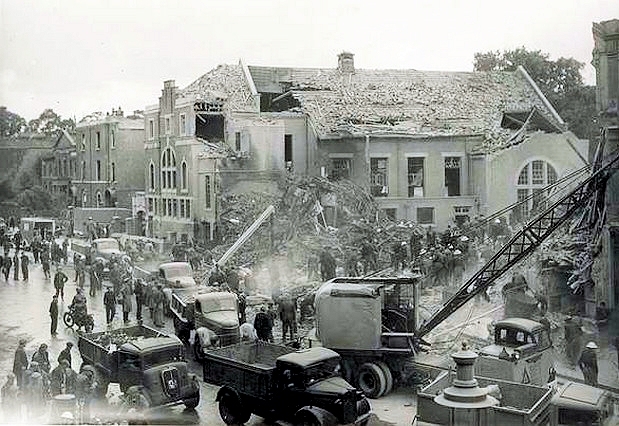 Clearing up after the Acre Lane “Doodlebug”.
Picture courtesy of the Lambeth Archives via Brixtonbuzz.com
The injured Charles was taken to Horton Emergency Hospital, one of Epsom’s “cluster” of mental hospitals that, as for WW1, had been taken over for dealing with wartime casualties. He died there a fortnight later, on 11 July 1944. He was buried in Epsom Cemetery (Grave O395) on 17 July. Unusually, the Cemetery Records say nothing about his background or occupation.
Roger Morgan © 2018
Please contact us if you have information or pictures that can extend this entry.
SHEPPARD, Leslie Bernard. Gunner (1462619)
11 Field Regiment, Royal Artillery.
Died 30 June 1942, aged 22.
Leslie was born Q1 1920, at least the second child of James Sheppard and Ada (née Cooper – they had married Q4 1913, registered in Melksham, Wiltshire). The birth of their first child, Irene, was registered in Leeds, but Leslie’s in Camberwell.
At some point, the parents moved to Worcester Park. The September 1939 Register records these 48 year olds living at 67 Vale Road. James is listed as a “Railway Goods Loader” and Ada as “incapacitated”. Their 25 year old daughter, Irene, was still living with them, and is listed as a “Telephonist”. Leslie was not at home, having attested into the Royal Artillery in 1938.
Leslie’s WW2 service was in the Royal Artillery’s 11 Field Regiment. No information is found in the readily available records about the Regiment in the early days of the war. Between 2 August 1941 and 15 June 1942, it was stationed in in Iraq as part of 8th Indian Division and was then posted to North Africa as reinforcements for the British Eighth Army which was being pressed, in some disarray, further and further east by Axis forces under Rommel. Almost as soon as the Regiment arrived it was engaged in the three-day Battle of Mersa Matruh (from 26 to 29 June 1942) during which Leslie was injured. He died of his wounds on 30 June.
While Axis forces were again the victors in that Battle, it was not the complete triumph for which Rommel had hoped. The fighting continued at El Alamein (about 100 miles east of Mersa Matruh). Although that first Battle of El Alamein ended on 27 July 1942 in something of a stalemate, at least the Axis forces’ progress to the prizes of the Suez Canal and the oilfields of the Middle East was finally halted. The Allies, now under General Montgomery, finally gained the upper hand in the second Battle of El Alamein from 23 October to 11 November 1942 – a turning point in the war as a whole.
Leslie is one of the 7,240 Commonwealth WW2 casualties buried in the El Alamein War Cemetery. His parents took the option of adding a personal inscription to his headstone on Grave XXXI.J.13,
“Time passes but memory lingers on. Sadly missed by your loving Mum and Dad.”
The El Alamein War Cemetery, Egypt.
Photograph with thanks to the Commonwealth War Graves Commission.
Roger Morgan © 2018
Please contact us if you have information or pictures that can extend this entry.
SHERRIFF, James Thomas Roy. Acting Lieutenant.
Fleet Air Arm, Royal Navy
Died 8 June 1942, aged 24
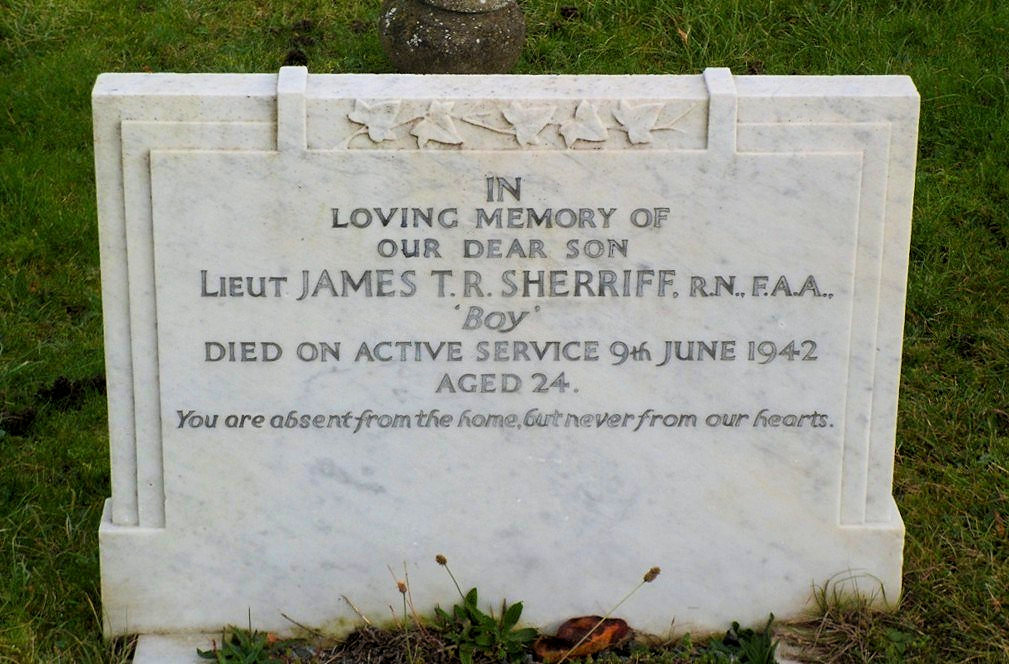 James’ headstone in Epsom Cemetery
Photograph (100825575) by Lawrence Hennessy via findagrave.com
James was born in in Q1 1918, apparently the only child of James Sherriff and May Olive (née Terry), whose Q3 1909 marriage was registered in the Medway District. (It seems that, to avoid confusion with his father, the family referred to James junior as “Boy”.)
The 1911 Census records the parents living at 36 Balmoral Road, Gillingham – the town in which both had been born. 24 year old James is listed as “Assistant Draughtsman Constructive Dept, Government Dockyard” (obviously at Chatham, a mile and half away). As usual at the time, no occupation is listed for 21 year old housewife May. Living with May’s mid-50s parents, Thomas (a “House Painter”) and Ellen Terry.
Some time after James junior’s 1918 birth – which, like his parents’ marriage, was registered in the Medway District – and certainly by 1927, the family had arrived locally to live at 39 Church Street, Epsom, then 44 Worple Road between 1928 and 1930. From 1931, they resided at “Romahla”, 19 Dorking Road, at least until 1956, although apparently with some Liverpool interlude – the Commonwealth War Graves Commission’s post-war records have the parents as being “of” that city.
The September 1939 Register records the parents living alone at 19 Dorking Road. 53 year old James senior is listed as a “Ship Surveyor, Board of Trade” (perhaps the reason for the time in Liverpool mentioned above) and 50 year old May with the conventional “Unpaid Domestic Duties”.
James junior was not at home (and, indeed, is not found in the 1939 Register). It seems he may have entered an apprenticeship to train as a Merchant Navy officer with the Commonwealth and Dominion Line. An 18 year old James Sherriff served in the crew of SS Port Brisbane in 1936, described as 5’11” in height and weighing 145 lb.
 SS Port Brisbane
Source not known
He then entered the Royal Navy’s Fleet Air Arm as a probationary Sub-lieutenant and was confirmed in the rank with effect from 9 March 1939. James was promoted Lieutenant a year later.
In Q1 1941, the 23 year old James married 24 year old Violet Eugenie Murdock. The marriage was registered in the Yeovil District, and it is surely not a coincidence that Yeovilton is one of the Royal Naval Air Service’s two principal bases. (Violet had been recorded in the September 1939 Register living with her parents at 4 Rose Hill, Newton Abbot, Devon with her occupation described as “Doctor’s Secretary & Assistant Dispenser”.)
In early June 1942, James was involved in a flying accident off “Burnow Head”. The reference gives the location as Cumberland, but this seems bound to Burrow Head off Galloway, to the north. (Cumberland – modern-day Cumbria – is rather further to the east.) The probability is that James was on a training flight from RNAS Inskip (HMS Nightjar) in Lancashire. Anyway, he was recovered injured from the sea and taken to a camp for 500 imported munitions workers at Wellbank (near Bootle Station which later became HMS Macaw, RNAS Bootle) and died there from his injuries on 8 June 1942. (A report on this incident is held by the National Archives under reference ADM358/749.)
James’s body was brought back to Epsom for burial on 13 June 1942 in Grave O243 of Epsom Cemetery. The Cemetery records show that the plot was purchased by his father, James Sherriff, described as a Surveyor of Transport, from 31 Rangemoor Road. Liverpool 18.
No record has been found of James and Violet having any children. In Q1 1943 and registered in her home town of Newton Abbott, the widowed Violet got married again, to Alexander J Wright.
Brian Bouchard & Roger Morgan © 2018
Please contact us if you have information or pictures that can extend this entry.
SHORT, Eric. Sergeant (1319336)
100 Squadron, Royal Air Force Volunteer Reserve
Died 28 May 1943, aged 20
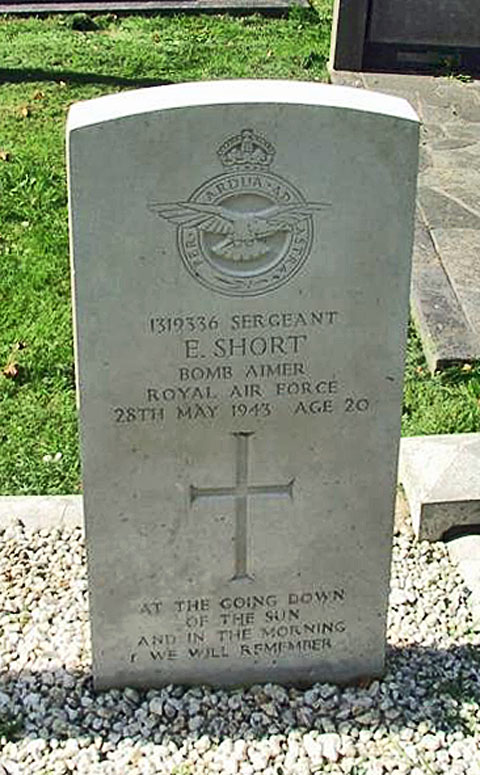 Eric’s headstone in Wonseradeel (Witmarsum) Protestant Churchyard
Photograph (13833796) by the International Wargraves Photography Project via findagrave.com
Not listed in the Book of Remembrance
Eric’s Q2 1923 birth was registered in the Croydon District. He was apparently the second and last child of Bertie Charles Short and Mabel Edith (née Way).
For some reason, the parents have left a disappointingly light trace in the readily available records. The first confident sighting of them is in the September 1939 Register as a mid-50s married couple living at 3 White Horse Drive, Epsom. 53 year old Bertie (born 22 December 1885) is listed as a “Commercial Traveller Travelling” – where the underlining is in the original record, perhaps explaining his elusiveness. 54 year old Mabel (born 29 August 1885) is listed with the conventional “Unpaid Domestic Duties”. Living with them were their unmarried 26 year old daughter Dorothy Mabel (whose 19 May 1913 birth was registered in the Alton District of Hampshire) listed as “Shop Assistant Electrical”, and one currently closed record, likely to be the 16 year old Eric.
Eric enlisted with the Royal Air Force at Blackpool during June 1940. After training, he was assigned as a Sergeant to 100 Squadron, part of the RAF’s Bomber Command. In early 1943, the Squadron was re-equipped with the relatively new Lancaster heavy bomber.
On 27 May 1943, Eric was the Bomb Aimer aboard Lancaster ED821 HW-A which took off from RAF Grimsby at 22.32 hours to participate in a bombing raid on Essen. The full crew were:
• Pilot: F/Sgt L A Townrow (415041) RNzAF
• Flight engineer: Sgt J P Fitchett (1150600) RAF
• Navigator: F/O S A Bishop (J/13118) RCAF
• Bomb aimer: Sgt E Short (1319336) RAF
• Wireless Operator/Air gunner: F/Lt J Bolderson (129941) RAF
• Air gunner: F/Sgt A E Chapman (414764) RAAF
• Air gunner: Sgt P M Cosgrove (1585898) RAF
In the early hours of 28 May 1943, the Lancaster was attacked over the Netherlands (by night fighter pilot Hauptmann Rudolf Sigmund of the 10./NJG 1, flying a Bf 110 G-4 from Leeuwarden airfield) and, at 01.45 hours, crashed in a field near the village of Witmarsum killing Eric and four other members of the crew. (The pilot, F/Sgt Len Townrow was severely injured and was taken to the Sint Bonifatius Hospital in Leeuwarden – where, over a year later (on 24 April 1944), he finally succumbed to his injuries. The Wireless Operator/Air gunner, F/Lt J Bolderson, was less severely wounded and survived the war as a PoW.)
The five crewmates who were killed on crashing were buried in the local Wonseradeel (Witmarsum) Protestant Churchyard, where they are the only Commonwealth WW2 casualties. Eric’s parents took the option of adding a personal inscription to his headstone on Grave 36.19,
“At the going down / of the sun / and in the morning / we will remember.”
Brian Bouchard & Roger Morgan © 2018
Please contact us if you have information or pictures that can extend this entry.
SHORT, Harold Edgar. Sergeant (1806043)
61 Squadron, Royal Air Force
Died 24 March 1944, aged 19
 Harold’s headstone in the Berlin 1939-1945 War Cemetery
Photograph (18404996) by “Uwe” via findagrave.com
Harold was born in Q4 1924, the first child of Henry George Short and Lucy Henrietta (née Weston). His birth was registered in Wandsworth District – which is where his parents had married in Q2 1921 and their second child Geoffrey was born on 1 April 1928.
By 1936, the family had arrived to live locally at 11 Stoneleigh Park Avenue, Stoneleigh – where they were recorded in the September 1939 Register. 43 year old Henry is listed in the Register as “Director and Secretary, Paper Merchants” (with an annotation on the original record that he was also a local ARP Warden) and 40 year old Lucy with the conventional “Unpaid Domestic Duties”. Her entry is followed by one that is currently closed, and likely to be of the 13 year old Harold. That entry is followed by 11 year old schoolboy Geoffrey.
Harold enlisted with the Royal Air Force at Euston during December 1941. By 1944, he was serving with 61 Squadron, part of the RAF’s Bomber Command and equipped with the Avro Lancaster heavy bomber, based at RAF Coningsby, Lincolnshire.
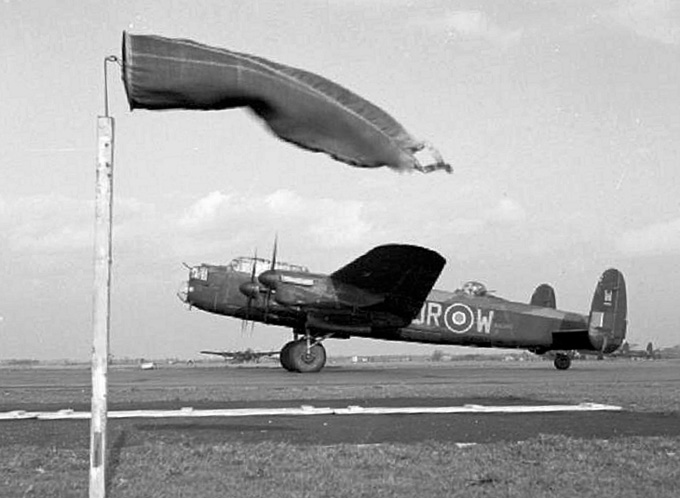 Avro Lancaster B Mark I, DV397 at Coningsby, Lincolnshire
Public Domain Image
At 18.27 hours on 24 March 1944, the 19 year old Harold was a Gunner aboard Lancaster DV397 – the very aircraft pictured above – which took off from RAF Coningsby as part of a mission to bomb Berlin. The full crew was:-
• RAF PO Carbutt, D Captain (Pilot)
• RAF Sgt J McCrevey, (Flight Engineer)
• RAAF 422257 FO Palmer, J M (Navigator)
• RAF Sgt A A Fulker, (Air Bomber)
• RAF Sgt A W Sherwood, (Wireless Operator Air)
• RAF Sgt H E Short, (Mid Upper Gunner)
• RAF Sgt R N Cunningham, (Rear Gunner)
Nothing was heard from the aircraft after take off and it failed to return to base. A Missing Research and Enquiry Team subsequently found that the aircraft was hit by ack-ack and exploded in the air, crashing to the ground near the village of Gehrden, about 15 miles south east of Magdeburg, Germany.
Flight Sergeant Fulker (the Air Bomber) managed to parachute to safety but was captured and survived the war as PoW 3990 in Stalag Luft 1, Barth Vogelsang. The other six of the crew, including Harold, were killed in the explosion and crash. They were initially buried in the local Gehrden Cemetery. On 19 July 1947 they were re-interred in the Berlin 1939-1945 War Cemetery (about 10 miles west of the City centre) which holds 3,595 previously scattered Commonwealth WW2 casualties.
Harold’s parents took the option of adding a personal inscription to his headstone on Grave 6.H.13,
“Remembering his affection / may we be worthy / of his greatest sacrifice.”
Brian Bouchard & Roger Morgan © 2018
Please contact us if you have information or pictures that can extend this entry.
SHRUBB, Leonard Charles. Private (13112572)
Royal Army Ordnance Corps
Died 13 March 1947, aged 40
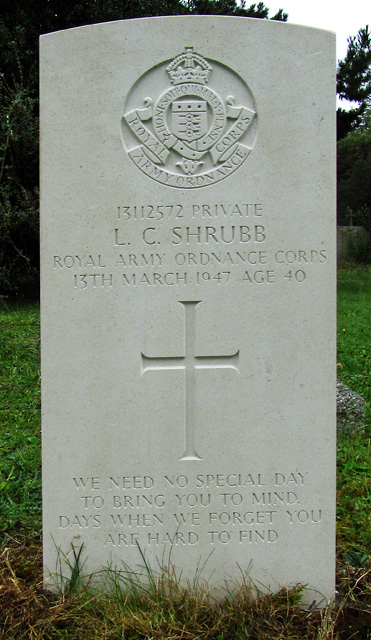
Leonard’s headstone in Epsom Cemetery
Image courtesy of Clive Gilbert © 2021
Not listed in the Book of Remembrance
Leonard was born on 3 September 1905, the son of Epsom-born Arthur Shrubb and Lilian Rose (née Spratt and whose name is erroneously noted by the Commonwealth War Graves Commission as “Louisa”). His parents’ Q1 1897 marriage was registered in the Kingston-upon-Thames District) and, as recorded in the 1901 Census, they initially lived with Arthur’s parents at 29 Providence Place, Epsom.
Leonard was baptised in St Martin of Tours, Epsom on 15 October 1905, where the records show that his parents had by then moved to 1a Providence Place. By 1911, the family had moved to 18 Beaconsfield Place, Epsom. That year’s Census records the 36 year old Arthur (a “Brickworks Labourer”) and 38 year old Lily living with their four Epsom-born children: 11 year old Lilly Eliza; 5 year old Leonard Charles; 2 year old Arthur; and new-born Louisa Emily. Sadly, the original return notes that the couple had had four other children who had died.)
The Commonwealth War Graves Commission also notes that Leonard was the “husband of Mary Frances Shrubb, of Epsom.” However, she was Leonard’s second wife. He had first married Ellen Barrett in Q1 1929 registered in the Epsom District. They had two children, both born locally: Leonard, whose birth and, sadly, death were both registered in Q2 1929; and Mary who was born in Q2 1934. The 1934 Electoral Roll records Leonard and Ellen living at 5 Brickfield Cottages, Ewell.
No record has yet been found of what happened to Ellen but, in Q2 1936, the 31 year old Leonard got married again – to 21 year old Mary Frances Barrett. (Was she a relative of his first wife – also a Barrett?) Their marriage was registered in the local Surrey Mid Eastern District as was, in Q3 1938, the birth of their son – like Leonard’s late first child, also called Leonard.
The September 1939 Register records Leonard and Mary living at 6 Portland Place, Epsom. The now 34 year old Leonard is listed as “Labourer, Waterworks” and 24 year old Mary with the conventional “unpaid domestic duties”. Underneath their entries are three currently closed records. Two of these are doubtless Mary and the second Leonard.
(In passing, it is worth noting that the 1939 Register recorded Leonard senior’s parents – now in their 60s – still living at 18 Beaconsfield Place. Arthur is now listed as a “Kiln Setter, Brickyard” and Lily with the conventional “Unpaid Domestic Duties”. Their 18 year old daughter, Louisa, was still at home and listed as a “Greengrocer’s Assistant”. Lily died at home in May 1946 and buried in Grave Q151 of Epsom Cemetery. Arthur died in November 1949 and was buried with Lily: the Cemetery records note that he was a “Night Watchman” and had died in the watchman’s shed of Longhurst’s timber yard in Church Road, Epsom.)
Sadly, the readily available records provide no useful information about Leonard’s WW2 service in the Royal Army Ordnance Corps.
Anyway, Leonard survived the hostilities and the 1946 Electoral Roll records him and Mary still at 6 Portland Place. Leonard was subsequently admitted to Epsom General Hospital, where he died on 13 March 1947 (nearly two years after the end of the war – but within the period that the Commonwealth War Graves Commission counts deaths as WW2 casualties).
Leonard was buried in Epsom Cemetery on 18 March 1947, where the records note him as a “Labourer”. The widowed Mary took the option of adding a personal inscription to his headstone on Grave G.28,
“We need no special day / to bring you to mind, / days when we forget you / are hard to find.”
Over the years, the original headstone suffered what appeared to be frost damage to the inscription. In 2021, the Commonwealth War Graves Commission installed a replacement, as illustrated at the head of this article.
In Q3 1949 (and registered in the local Surrey Mid Eastern District), the widowed Mary got remarried, to a William Bissett.
Roger Morgan © 2021
Please contact us if you have information or pictures that can extend this entry.
SIMMONDS, Hunter Edward. Flying Officer/Pilot (180156)
Royal Air Force Volunteer Reserve.
Died 6 September 1945, aged 22.
 Hunter’s grave in Epsom Cemetery
Photograph (114617524) by Laurence Hennessy via findagrave.com
Most unusually, the Commonwealth War Graves Commission’s database contains neither the usual brief family background for this airman nor his age when he died. Fortunately, this and more is found in the readily available records.
The birth of Hunter Edward Simmonds (who came to be known within the family as “Ginty”) was registered Q2 1923 in the Islington District. He was the first child of Charles Hunter Dewart Simmonds and Victoria (née Morris) whose marriage had been registered at Rochford in Q3 1922. The Q3 1929 birth of what appears to be their daughter, Moira A Simmonds, was (like her brothers) registered in the Islington District.
By 1938, Charles had arrived locally to reside at “Chasanhil”, Epsom Road, Ewell. The 39 year old married Charles (a “Director Turf Accountant”) was recorded at that address together with Richard and Jessie Walker, respectively Chauffeur/Valet and Cook. Victoria was not at home and, perhaps because of transcription errors has not yet been found elsewhere. We know, however, that 16 year old Hunter was at Epsom College (where the records describe him as “son of C H Simmonds, bookmaker of Epsom”) and it seems likely that 10 year old Moira was also away at school).
Hunter left Epsom College in 1940 and, in December 1941, enlisted with the Royal Air Force at Euston with a Service Number 1814142. He was commissioned from the rank of Aircraftman, Class 2, to Pilot Officer on 27 May 1944 and was then posted to No 4 Radio School at RAF Madley in Herefordshire. (The airfield had been created in late 1940 for RAF radio signals training.)
On 6 September 1945, Hunter was piloting a Percival Proctor Mk. 4, NP402, Radio Trainer, accompanied by:-
• Sergeant 1677707 John Robinson, WoP/AG , RAFVR
• LACW 2112290 Dorothy Cowen.
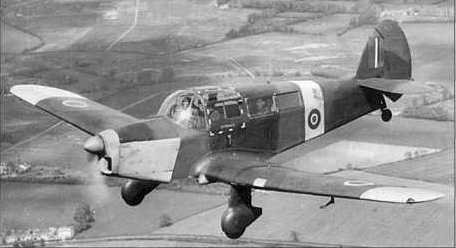 A RAF Percival Proctor Mk.I (similar to the Mk.4)
Image source wikipedia
Some sources have characterised this as a “joy ride” but, by this late stage of the war, WAAF Aircraftwomen were training as Wireless Operators, if not Wop/Air Gunners, at RS 4. LACW Dorothy Cowen had enlisted in August 1942 and was probably under instruction converting from another trade.
Unfortunately the flight terminated with a crash at Aconbury (near Lower Bullingham, Herefordshire) which killed all three on board. [National Archives AVIA 5/26/W2260]. Hunter’s body was brought home for burial, and he was interred in Grave K123 of Epsom Cemetery on 11 September 1945.
Hunter is commemorated on the of Epsom College’s Forest House WW2 memorial, but, oddly, not on the College’s main WW2 memorial in its Chapel of St Luke.
It may be that Hunter’s mother, Victoria, pre-deceased him because, in Q4 1946 and registered in Westminster, his father married secondly Vivienne Hedwig Lafone, otherwise Scott, née Schotz.
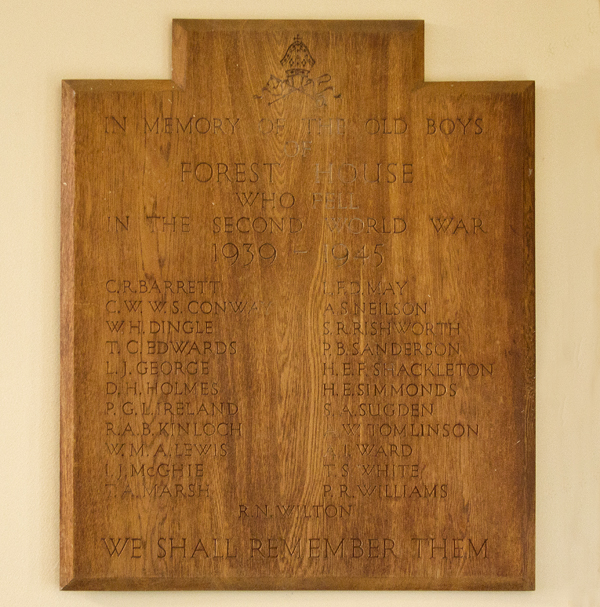
Hunter’s father, Charles, died aged 73 on 14 August 1976 in the Middlesex Hospital, London. Having been cremated at Golders Green, his ashes were scattered on his son’s grave in Epsom Cemetery. When the 92 year old Vivienne died on 28 November 2005 in St Albans, her body was brought back to Epsom for burial in Grave K122, alongside Hunter’s grave. (Part of her headstone can be seen on the left of the photograph at the head of this article.)
Roger Morgan & Brian Bouchard © 2018
Please contact us if you have information or pictures that can extend this entry.
SIMNER, Kenneth Nugent. Brigadier. OBE MiD
Royal Engineers
Died 27 December 1946, aged 48

Brigadier Kenneth Simner
Photograph and much of the career information below taken,
with thanks, from the obituary in the Royal Engineers Journal of July 1947
Not listed in the Book of Remembrance
Kenneth was born on 5 September 1898, the first child of Nugent Charles Simner and Alice Maud (née Simons – they had married Q4 1896). Their marriage was registered in the Barnet District, as was Kenneth’s birth. The 1901 Census records the parents (supported by a domestic servant) living at “Ingleby”, Effingham Road, Long Ditton. 32 year old Nugent is listed as a “District Auditor, Local Government Board” and 30 year old Alice as a “(Barrister at Law)” – the brackets perhaps indicating that she was no longer practising. Meanwhile, 2 year old Kenneth was staying with his maternal grandparents at “Elmhurst”, Station Road, New Barnet.
By the time of the 1911 Census, the 12 year old Kenneth was a boarder at a 33-pupil preparatory school at 8 Clifton Crescent, Folkestone. His now early 40s parents had taken four rooms at 38 Old Elvet, Durham. Nugent’s work as a District Auditor seems to have required him to be quite mobile: living with them was their 5 year old daughter, Dorothy, who had been born in Doncaster. (The return notes that the couple had had a third child who had died.) Also living with them was a 23 year old “Governess”.
Kenneth completed his schooling at Oundle School, from which he moved to the Royal Military Academy in Woolwich. He was commissioned as a Second Lieutenant in the Royal Engineers on 19 February 1916. He was then stationed at Aldershot until old enough to be sent abroad, going to France on 15 September 1917 to serve in the Royal Engineers’ 83rd Field Company. On 24 March 1918, he received a severe leg wound – perhaps in the incident that earned him a mention in Field Marshal Haig’s Despatch of 8 November 1918 as one of many members of WW1 forces “deserving of special mention” (London Gazette Issue 31080, page 15039). On recovering from his wounds, he went to India to join the 2nd Queen Victoria’s Own Madras Sappers and Miners, later serving in Iraq with the 96 and 12 Field Companies of that Corps until March 1921 when he was recalled to the UK for a supplementary course.
On 5 September 1922, Kenneth married Hazel Laura May Lillie. The wedding was in Portsmouth, but the couple had met in India. Hazel was born in Mussoorie, Bengal on 22 June 1902, the daughter of ex-patriates George Ernest (of the Indian Public Works Department) and Alice Mary Lillie. The couple returned to India in January 1924 where Kenneth joined the North Western Railway as an executive engineer in the Way & Works Department. On 21 April 1924, their first child, Ernest Joseph (but apparently known by his second name), was born in Kasauli, Bengal. Their second (and last) child, Rosemary, was also born in Bengal, on 13 December 1925. While Kenneth’s job was essentially civilian, he retained military rank, receiving substantive promotions to Captain on 13 December 1925, and to Major on 31 December 1934.
In 1929, Kenneth suffered serious internal injuries when his trolley was derailed. He made a remarkable recovery from the major surgery required and, at the outbreak of WW2 was serving as the Divisional Rail Engineer in Delhi. The parents returned to the UK (both children were already in the UK, at school) and Kenneth to active military service.
Kenneth and Hazel arrived back in the UK in January 1940 and thus missed being counted in the September 1939 Register. However, they – or, given Kenneth’s military duties, principally Hazel – set up home at 70 Woodcote Hurst, Epsom. Kenneth is recorded at this address in the 1946 Electoral Roll, and it is also the address given for Hazel in the 1947 Probate record of her being awarded joint administration of he husband’s £13,380 estate.
As an acting Lieutenant Colonel, was posted to France in March 1940 with the British Expeditionary Force. He commanded the Royal Engineers’ No 2 Railway Construction Group and was one of the last to be evacuated from Calais on 27 May 1940. His was one of the many names (as noted in the London Gazette of 20 December 1940, issue 35020, page 7180) having been “brought to notice in recognition of distinguished services in connection with operations in the field March-June, 1940”.
(In passing, it is worth noting that Kenneth’s son, Joseph, had followed him into the Royal Engineers. As an Acting Lieutenant with the Service No 273481, he was reported as being wounded in action on 2 December 1943, during the Italian Campaign. He recovered from his injuries, married in Q4 1945 and died in 2008.)
Kenneth was next posted to the “Middle East” (an area for these purposes including Egypt, East Africa, Western Desert, Sudan, Greece, Crete, Syria & Tobruk) as an Acting Colonel. He brought his considerable railway expertise to bear in optimising crucial transport links in Egypt. On 9 September 1942, he was one of a number appointed as an Officer of the Military Division of the Most Excellent Order of the British Empire “in recognition of gallant and distinguished services in the Middle East during the period November 1941 to April 1942” (London Gazette issue 35697, page 3946)
Next, as an Acting Brigadier, he was posted to Persia/Iraq in 1943 as Deputy Director of Transportation. As noted in the London Gazette for 23 December 1943 (Issue 36297, page 5577) was noted as one of those “mentioned in recognition of distinguished services in Persia and Iraq”.
For some time, Kenneth’s eyesight had been failing and medical opinion was against his remaining in an area of such extreme heat. He returned to the UK in February 1944 to the post of Deputy Director Transportation (Railways) for 21 Army Group. The following month, March 1944, he underwent a cataract operation. While the operation was successful, it seemed doubtful whether he could accompany 21 Group to mainland Europe. But he was determined to take part in the planned offensive and, a few weeks after the D-Day landings, crossed to Normandy at the beginning of July 1940. He tackled the rehabilitation of the liberated railways with his usual energy. In late 1944 he was recalled to London to assist in planning for the rehabilitation of railways in Germany. On 10 May 1945, he was among the many noted as “mentioned in recognition of gallant and distinguished services in North West Europe” (London Gazette, issue 37072, page 2459).
Shortly after VE Day, Kenneth joined the War Office as Inspector of Transportation – later moving to become Deputy Director. In December 1946, Kenneth contracted an “infection of the blood”. He was admitted to the Queen Alexandra Military Hospital, Millbank where, despite best medical efforts, this became full-blown septicaemia from which Kenneth died on 27 December 1946.
Kenneth is one of the 5,626 burials in the Brookwood Military Cemetery. His widow took the option of adding a personal inscription to his headstone on Grave 34A.D.10,
“Forever remembered by those who love him.”
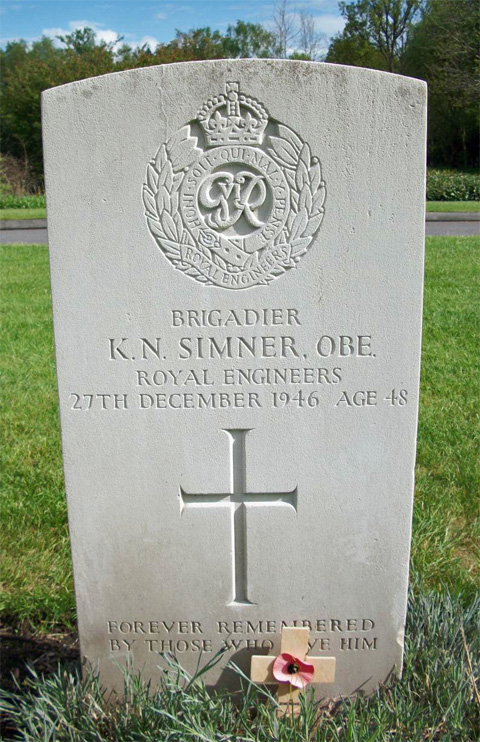 Kenneth’s headstone in Brookwood Military Cemetery
Photograph (17666367) by “Charlie” via findagrave.com
The widowed Hazel moved away from Epsom and, in Q3 1949, got married again – to Alan I G McConkey, registered in the Hampstead District.
Roger Morgan © 2020
Please contact us if you have information or pictures that can extend this entry.
SIMONS, John Frederick. Able Seaman (P/JX 337513)
SS Vojvoda Putnik, Royal Navy
Died 8 March 1943, aged 31.
John was born in Q3 1912, the first child of John Simons and Elizabeth (née Warwick – they had married Q2 1909). The 1911 Census records the parents living in Myrtle Cottage, Woodlands Road, Epsom Common. 32 year old John, originally from Tolworth, is listed as a “General Labourer, Building Trade”. 40 year old Epsom-born Elizabeth is listed as a “Laundress”. Living with them is 14 year old Albert Warwick (a “Garden Boy, Domestic”), listed as Elizabeth’s son before marriage. After John in 1912, the couple had a second child, Elsie, born Q1 1914.
In Q2 1936 and registered in the local Surrey Mid Eastern District, John married Phyllis Winifred Barker. Their first child, Peter, was both born and died Q1 1938. (The second child, also called Peter, was born Q2 1942.) The couple are not found in the September 1939 Register, but the Probate record of Phyllis being awarded administration of John’s £ 294 estate notes their address as 37A Upper High Street, Epsom.
John is recorded by the Commonwealth War Graves Commission’s as serving on HMS President III, a shore establishment. Actually, he was a DEMS (Defensively Equipped Merchant Ship) gunner on the SS Vojvoda Putnik, a Yugoslavian steam merchant of 5,900 tons.
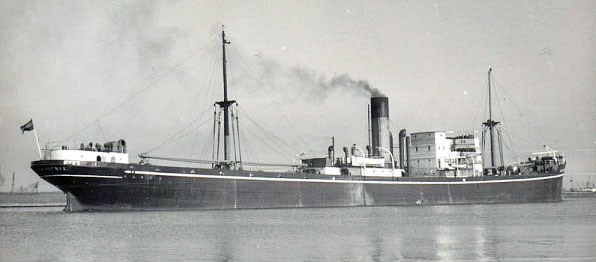 The SS Vojvoda Putnik
Image courtesy of the Paul Johnson Collection,
via uboat.net – as is, with thanks, the mission information below.
In March 1943, the Vojvoda Putnik was part of Convoy 121S from New York to London. Her cargo was 7,900 tons of wheat and, as deck cargo, tanks. On the morning of 8 March, she had straggled from the convoy with steering trouble and, by afternoon was alone and stationary in mid-Atlantic. In the early evening she was hit by torpedoes fired by U-boat U-591. She radioed that she was sinking. The 44 on board were never seen again.
John is one of the almost 15,000 naval WW2 personnel commemorated on the Portsmouth Naval Memorial as having no known grave.
Roger Morgan © 2018
Please contact us if you have information or pictures that can extend this entry.
SIMPSON, Lancelot. Guardsman (2610918)
5th Battalion, Grenadier Guards.
Died 27 April 1943, aged 37
While, as discussed below, Lancelot’s early family background is something of a mystery, we have firmly established the subsequent link with the Borough which led to his inclusion in the Book of Remembrance.
The Commonwealth War Graves Commission’s records note that Lancelot was the “son of Samuel and Annie Simpson” and the Army’s Roll of Honour records that he was both born and resident in Nottinghamshire. At first glance, this is plausible: there was a Lancelot Simpson born in Nottingham, the fourth child of Samuel Simpson and Annie (née Cherry – they had married Q4 1889, registered in the Basford District of Nottinghamshire. The 1911 Census records the recently widowed Samuel (a “Coal Miner, Hewer”) living at 54 Wollaton Road, Beeston, together with five children – all boys – the youngest of which is a Lancelot.
However, he is not the right Lancelot. Apart from being two years too young (having been born on 1 December 1907, he would have been 35 rather than 37 at his death in April 1943) he was, crucially, not a WW2 casualty – living until Q4 1980, when he died in Nottingham. In addition, the September 1939 Register records this Lancelot as an unmarried 31 year old living with his remarried father at 110 Dennis Avenue, Beeston – whereas our Lancelot had moved to Epsom in the early 1930s and, as also noted by the Commonwealth War Graves Commission, was the “husband of Letitia Simpson, of Epsom, Surrey”.
Whatever his early family background, the Lancelot Simpson needed for our purposes is recorded in the 1932 Electoral Roll records as living/working in Long Grove Hospital, one of Epsom’s “cluster” of mental hospitals. Two years later, the 1934 Electoral Roll records him as living in Epsom College. On 2 April 1934, Lancelot married Letitia Lily Osborne in Christ Church, Epsom Common. In the records of that, Lancelot is listed as working as a waiter and Letitia as an assistant cook – and their fathers as Samuel Simpson (a “retired policeman” – so not the Nottinghamshire coal miner) and Frederick Osborne (a “laundry engineer”).
Both Lancelot and Letitia gave Clares Cottage, Epsom Common as their address. That was Letitia’s childhood home. She was the sixth child (two of whom had died) born to Frederick Osborne and Letitia (née Newberry). The 1911 Census had recorded the 33 year old parents (with Frederick listed as a “Laundryman”) living in Clares Cottage with their four children – all born in Epsom – from 1 year old Letitia (born on 21 November 1909) to 12 year old Frederick junior.
In subsequent Electoral Rolls, Lancelot and Letitia are recorded living at 31 College Road, Epsom – and that is where the 1939 Register recorded the married 29 year old Letitia living alone, and listed with the conventional “unpaid domestic duties”. The couple had a child, another Lancelot, born Q2 1941 and registered in the local Surrey Mid-Eastern District. He and his mother were still living at number 31 in 1962, as recorded in that year’s Electoral Roll.
The 33 year old Lancelot is not found in the September 1939 Register, and it seems likely that he was already in uniform. If that was the case, however, it would initially have been in other than the 5th Battalion of the Grenadier Guards as that was not raised until 1941.
The 5th Battalion served in North Africa and was involved in the 16 – 27 March 1943 Battle of the Mareth Line – the Eighth Army’s last major set piece battle in North Africa, which successfully forced the Axis troops to retreat from their last significant defensive position in southern Tunisia. Further north, the Anglo-US force that had landed in Vichy-held Morocco and Algeria and attacked Axis forces from the west (the other half of the pincer to Montgomery’s Eighth Army’s advancing west after the turning point of El Alamein in late 1942) had reached Medjez-El-Bab to the west of Tunis in December 1942, and this strongly defended position remained the front line for the first few months of 1943.
The line was finally breached after fierce fighting in late April 1943, during which Lancelot was killed in action. The breakthrough was decisive. Axis forces were cornered in Tunis and surrendered on 13 May 1943.
Lancelot was initially buried near where he fell, being later reinterred (in Grave V.N.4) as one of 1,576 Commonwealth WW2 casualties buried in the Massicault War Cemetery, about 20 miles southwest of Tunis.
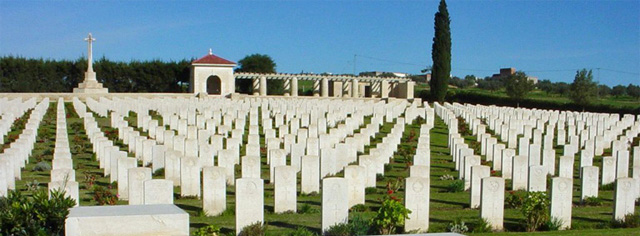 The Massicault War Cemetery, Tunisia.
Photograph with thanks to the Commonwealth War Graves Commission.
Roger Morgan © 2018
With special thanks to Hazel Ballan
Please contact us if you have information or pictures that can extend this entry.
SISSON, William. Fire Guard
Lewisham Fire Guards
Died 17 April 1941, aged 32
Not listed in the Book of Remembrance
William was born in Renishaw, Derbyshire on 5 November 1908, the third child of Titus Sisson and Bertha Eliza (née Wilson). The 1911 Census records the 36 year old parents (with Titus listed as a “Police Sergeant”) living at 53 Sheffield Road, Stonegravels, Chesterfield together with their three children from 2 year old William to 6 year old Bernard.
The family moved to the London area – where, in Q2 1929 and registered in the Camberwell District, Bertha died aged 54. In Q2 1930, registered in the Lewisham District, the widowed 55 year old Titus married again, to apparent spinster 57 year old Agnes E Martin.
In Q1 1931, Titus’s son, William (the subject of this article and now aged 22) married 20 year old Muriel G Quick. Their marriage was registered in the Lewisham District, as were the births of their two children, William (Q3 1931) and Audrey (Q1 1934). The September 1939 Register records the parents living at 197 Dartmouth Road, Sydenham (within the Lewisham District). 30 year old William is listed as a “Cycle Dealer & Assembler etc” and 28 year old Muriel with the conventional “Unpaid Domestic Duties”. (The children were not at home, perhaps being among the first wave of evacuees.)
(Meanwhile, William’s father had retired from the Police. The 1939 Register records the 64 year old Titus and 61 year old Agnes living at 19 Westfield Road, Birchington-On-Sea, Kent.)
William’s WW2 service was as a Fire Guard, the second tier of the UK’s war-time fire defences. The first tier was the Fire Service proper (originally the local authorities’ fire services and the volunteer Auxiliary Fire Service, later merged into the National Fire Service) which tackled major fires. The bombs dropped – by both sides – during WW2 were a mix of high-explosive and incendiaries. HE bombs caused instant structural damage but were heavy. Incendiaries were individually much lighter, so many more could be dropped per raid to start fires over a large area. Assisted by the third tier Fire Watchers, it was the Fire Guards’ role to spot and then tackle such fires before they took hold. A key part of their kit was a portable “stirrup pump”, as illustrated below.
 A female Fire Guard using a stirrup pump on the roof of a building in London, 1941
A Ministry of Information photograph (IWM D 5007), Public Domain.
The Commonwealth War Graves Commission notes that William was injured in Sydenham on 16 April 1941, presumably on duty in those closing weeks of the Luftwaffe’s “Blitz” bombing campaign. He was taken to Horton Emergency Hospital, one of Epsom’s “cluster” of mental hospitals that, as for WW1, had been taken over for dealing with wartime casualties, but died there the following day.
Roger Morgan © 2018
Please contact us if you have information or pictures that can extend this entry.
SKELTON, Walter Allen. Flying Officer (45435)
Royal Air Force Volunteer Reserve, 115 Squadron
Died 28 August 1942, aged 23
Walter was born on 22 September 1918, to Harry Skelton and his second wife, Annie (née Rhodes). They had married Q3 1913 in Horsham – Harry’s first wife, Isabel Agnes (née Foster) having died in 1911. Like his significantly older half-siblings, Walter was baptised at Christ Church Epsom Common, where the records list Harry as a builder and the family’s home as “Clematis”, South Street, Epsom.
That is also where the 2¾ year old Walter is recorded in the 1921 Census, together with his new-born sister, Phyllis. The return notes his 49 year old father, Harry, as a “Builder” and “Employer” (working from 67 South Street). The young children’s now 41 year old mother, Annie, is recorded with the conventional “Home Duties”. Also still at home were two daughters from Walter’s first marriage: 19 year old Fanny (“Shorthand typist with Shell-Mex Ltd, Victory House, Kingsway”; and 18 year old Christine (“Teacher student”).
In due course, Walter attended Ewell Castle School but he has not yet been found in the 1939 Register. However, that records parents, Harry and Annie, at 44 South Street, Epsom – which seems certain to be the now-numbered “Clematis” of earlier records – together with now 19 year old daughter, Phyllis, recorded as “Showroom Assistant (Gown)”. (44 South Street was also noted as Walter’s address in the Probate record of administration of his £331 estate being awarded to his father.)
Indeed, Walter has left a disappointingly light trace in the readily available records. In terms of his RAF career, we first pick him up in 1942 as a pilot in 115 Squadron – a typical WW2 Bomber Command squadron which operated from various airfields in East Anglia. At 20:38 on 27 August 1942, he took off from RAF Marham (just outside King’s Lynn) in a Wellington Mk III (JB710 / KO-L) to join a major attack (involving a total of 306 aircraft from various squadrons) on Kassel, in central Germany. The city was home to a number of important military-industrial sites: the Fieseler aircraft plant, the Henschel tank-making facilities, railway works and engine works were all based there. These attracted Allied bombing raids from early in 1942 until almost the end of the war.
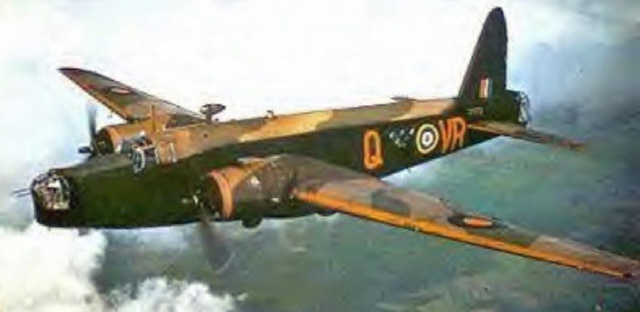 A Vickers Wellington
Picture courtesy of www.pilotfriend.com
The particular target on 27/28 August 1942 was the Henschel tank plant, and the attack was held to be a success. Almost inevitably, a number of aircraft were lost, mainly as a result of night fighter action. The losses included Walter’s aircraft, in which he and all but one of his crew were killed. (The survivor, F/S J W Middleton, was one of the gunners and taken prisoner of war.)
Walter and others were initially buried in Dusseldorf North Cemetery. On 3 December 1946, they were re-interred in the Reichswald Forest War Cemetery in the extreme north-west of Germany, just south of Arnhem in The Netherlands. The Cemetery was created after WW2 when burials were brought in from all over western Germany. With some 7,600 Commonwealth servicemen of the Second World War buried or commemorated there, it is the largest Commonwealth cemetery in the country. Walter’s parents took the option of adding a personal inscription to his headstone on Grave 9.H.12,
“Always in our thoughts.”
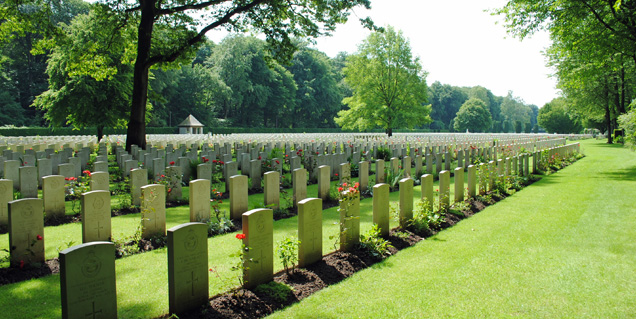 Part of the Reichswald Forest War Cemetery
Photograph by Wouter van Dijken via findagrave.com
In addition to Walter’s entry in the Borough’s Book of Remembrance, he is also remembered locally on the WW2 memorials at Christ Church Epsom Common and Ewell Castle School.
Roger Morgan © 2018 & 2023
Please contact us if you have information or pictures that can extend this entry.
SKONE, Alan Raymond. Flying Officer (68186)
214 Squadron, Royal Air Force Volunteer Reserve
Died 27 August 1942, aged 22
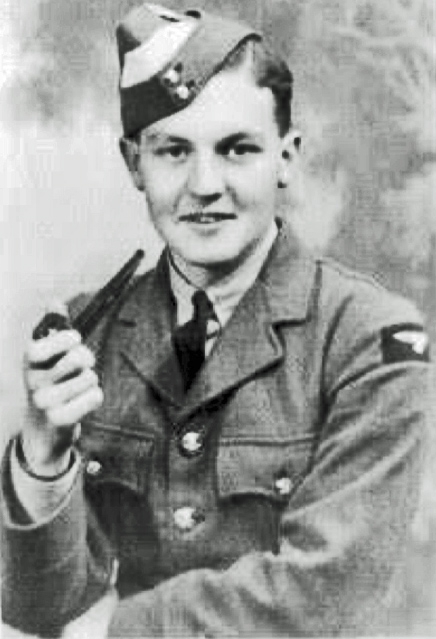
Alan Skone in 1940, aged 20.
This photograph and much of the background below is, with great thanks, drawn from Arthur Skone’s “A Peaceful View”.
Alan was born on 18 August 1920, the first child of Sidney Walter and Edith Collier Skone. The parents had married on 7 February 1920 in the parish church of St Stephen, Hounslow. The Register records 31 year old Sidney as a “Master Boot-maker” – like his deceased father, William. They were part of the prestigious Poulton, Skone & Co firm of bespoke shoemakers, with their main premises at 12 Duke Street. 28 year old Edith (née Mills) had also lost her father, another William, listed as a “Printer”.
At the time of their marriage, the couple were living at 68 St Stephen’s Road Hounslow. Electoral Rolls for the rest of the 1920s record them living at “Hurst” (later numbered 235), Jersey Road, Osterley Park. The couple’s second child, Gerald, was born on 2 October 1926.
In about 1930, the family moved to “Amroth” (later numbered 65), The Green, Ewell. Alan attended the County School in Sutton until, in January 1934, the 13 year old was admitted to Epsom College. During his two years there, he joined the College branch of the Officer Training Corps (OTC).
At the end of the Summer Term 1936, the nearly 16 year old Alan left Epsom College and was enrolled in London’s Cordwainer’s Technical College – a specialist school for leather-working, shoemaking and saddlery (now merged with the London College of Fashion).
The September 1939 Register records the family still at 65 The Green, Ewell. 50 year old Sidney is listed as a “Master Bootmaker”; 49 year old Edith with the conventional “Unpaid Domestic Duties”; 19 year old Alan as “Assistant Cutter (Boot)” – obviously, in his father’s business; while 11 year old Gerald was still at school.
Alan enlisted in 1940, reporting to No 2 Reception Centre, Cardington on 25 July. He was assessed for aircrew training and posted to No 1 Reception Wing in Torquay. Within a fortnight, Alan was accepted as suitable for Pilot Training and, on 14 September, he joined No 5 Initial Training Wing in Hastings – which then relocated to Torquay. By mid November 1940, this Leading Aircraftman (with a Grade A proficiency and very good character references) was found suitable for training as a pilot.
On 11 December 1940, Alan was posted to No 51 Group Pool based at Yeadon (now Leeds/Bradford Airport), where he began his basic pilot flying training in the single-engine de Havilland Tiger Moth. His potential as an Officer was recognised and, on 3 March 1941, he was posted to Cranwell in Lincolnshire – the Royal Air Force College Flying Training School – to continue his pilot training on Airspeed Oxford twin-engine aircraft.
On 28 May 1941, Alan qualified as a fully trained pilot, was promoted to Sergeant and then re-engaged as a Probationary Pilot Officer in the RAF Volunteer Reserve with the new service number 68186. His first post was as an Instructor for Elementary Flying for “Learner” pilots at No 2 Central Flying School, also based at Cranwell. After a month, he was assigned to No 2 Service Flying Training School at Brize Norton, Oxfordshire, continuing as a flying instructor but now with operational Bristol Blenheims rather than Airspeed Oxford trainers.
On 7 January 1942, Alan was posted to No 11 OTU (Operational Training Unit) at RAF Bassingbourn, Cambridgeshire. On June 1942, he finally arrived at the front line by joining 214 Squadron at RAF Stradishall, Suffolk as a pilot for its Short Stirling bombers. Full details of Alan’s nine missions with the Squadron during his eight weeks there are set out in Arthur Skone’s “A Peaceful View”. These were a mix of bombing raids over enemy territory and less hazardous “Gardening” missions to lay mines in enemy waters.
Alan’s final mission came on 27 August 1942 when 214 Squadron provided twelve aircraft to the 306 sent by Bomber Command to attack aircraft factories at the German city of Kassel. Alan’s Stirling Mark 1 R9155 Q-BU took off from RAF Stradishall at 2029 hours with the following crew:
Pilot: Flying Officer: A R Skone
Flight Engineer: Sergeant J King
Navigator: Pilot Officer R H Dunckley
Air Gunner/Bomb Aimer: Sergeant A C Lyle
Wireless Operator: Flight Sergeant R A Colehan
Air Gunner: Sergeant R R Gray
Air Gunner: Sergeant W J Bushell
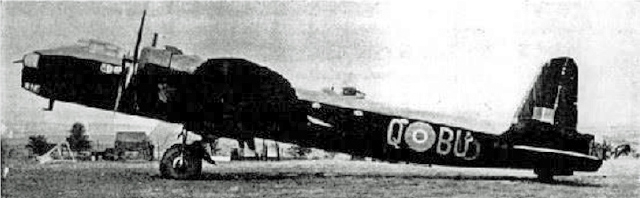
Alan’s Stirling R9155 Q-BU of 214 Squadron
Photograph with thanks to Cartmel War Memorials and Priory Church
The raid was deemed a success, helped by the minimal cloud cover over the target. But that also assisted the Luftwaffe and, of the 31 bombers (10% of those despatched) lost on the raid, 25 were shot down by night fighters. One of the losses was Alan’s Stirling R9155 Q-BU. It had bombed the target and was well on the way back when it shot down by a night fighter. The aircraft crashed at Issum – some 140 miles on return from the target and 30 miles northwest of Dusseldorf. There were no survivors.
Alan and his crew were initially buried in the local cemetery at Krefeld. On 9 June 1947, they were reinterred in the Reichswald Forest War Cemetery – where they share collective grave 28.H.8-13. This cemetery – in the extreme north-west of Germany, about 10 miles west of Esserden and just south of Arnhem in The Netherlands – was created after WW2 when burials were brought in from all over Western Germany. With some 7,600 Commonwealth servicemen of the Second World War buried or commemorated there, it is the largest Commonwealth cemetery in the country.
Part of the Reichswald Forest War Cemetery
Photograph by Wouter van Dijken via findagrave.com
Roger Morgan © 2021
SMEDLEY, Denis Edward. Sub-Lieutenant
HMS Dunvegan Castle, Royal Naval Reserve.
Died 28 August 1940, aged 26.
The above has to be the individual intended by the “Smedley, Dennis – Royal Navy” commemorated in the Borough’s Book of Remembrance. Indeed, he is the is the only seaman with the surname Smedley in the Commonwealth War Graves Commission’s database of WW2 casualties.
 The entry in the Borough’s Book of Remembrance
Image courtesy of Clive Gilbert © 2014
Denis was born Q4 1913, registered in the Wandsworth District, the first child of merchant seaman Edward Postill Smedley and Susan Edith (née May – they had married in Calcutta on 6 September 1912). The couple had two more children – Peter in Q3 1919 and Paul in Q3 1921 – also registered in the Wandsworth District.
Denis followed in his father’s footsteps and became a merchant seaman, and also joined the Royal Naval Reserve. In Q4 1939 he married Elizabeth Mary Bricknell, registered in the Brentford District. No record has been found of their having any children. The Commonwealth War Graves Commission post-war records note that Elizabeth was “of New Malden, Surrey”. To merit Denis’s inclusion in the Borough’s Book of Remembrance, there must at some stage have been some link with Epsom & Ewell, and that is found in the 1937 Electoral Register which lists Denis living with his parents at No 45 (also known as “Three Buoys”, acknowledging the maritime connection), Westways, Ewell – where his parents were also recorded in the September 1939 Register.
Called from the Reserve, Denis’s WW2 service was aboard HMS Dunvegan Castle. This 15,000 ton vessel had been completed (in the yards of Harland & Wolff Ltd, Belfast) in August 1936 as motor passenger ship for Union-Castle Mail SS Co Ltd, London. She was requisitioned by the Admiralty on 7 September 1939, and converted into an Armed Merchant Cruiser.
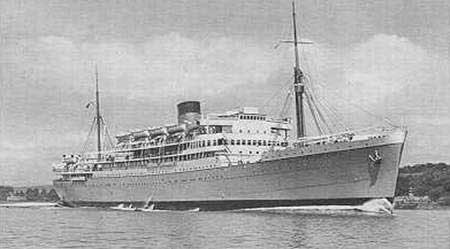 HMS Dunvegan Castle
Image and incident details below courtesy of uboat.net
On 11 August, HMS Dunvegan Castle left Freetown, Sierra Leone, part of the escort for convoy SL-43 to Belfast. At 2147 hours on 27 August, nearing home off northwest Ireland, the ship was hit aft of the bridge by one torpedo from U-boat U-46. As the ship continued, the U-boat fired two further torpedoes at 2212 and 2251 hours, which hit the engine room and just before the bridge. The vessel stopped, caught fire and foundered the next day. 250 of the complement were rescued by HMS Harvester (H 19) and HMS Primrose (K 91) and, together with those of the 27 dead who were not lost at sea, landed in Scotland.
Denis was initially lost but his body (and that of crewmate Leading Seaman Thomas Ambrose) subsequently came to shore on nearby Arranmore Island, County Donegal, Ireland. They were buried in the island’s Chapel Strand Cemetery which holds only one other WW2 Commonwealth casualty, also a seaman (Marine Ernest Aspin) washed ashore after the U-boat sinking of SS Manchester Brigade the following month.
The widowed Elizabeth took the option of adding a personal inscription to Denis’s headstone on Grave 7,
“Upon them hath the light shined.”
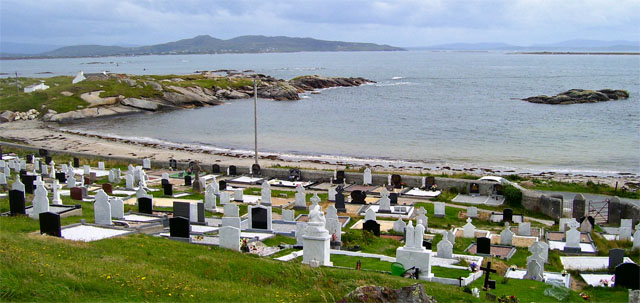 The Chapel Strand Cemetery, Arranmore
Photograph with thanks to donegalgenealogy.com
In Q2 1944, the widowed Elizabeth married again, to Michael J Tomlinson. Like her marriage to Denis, this was registered in the Brentford District.
Roger Morgan © 2018
Please contact the Webmaster if you have information (particularly about Denis’s link to the Borough) or pictures that can extend this entry..
SMITH, Arthur H C. Rifleman (14359742)
2nd Battalion, The London Irish Rifles, Royal Ulster Rifles
Died 23 May 1944, aged 19
Not listed in the Book of Remembrance.
Arthur was born Q2 1924, the first of probably four children born to John Clifford Smith and Alice Lilian (née Phillips). The couple’s Q3 1923 marriage was registered in Epsom, as was the birth of Arthur and other children.
The September 1939 Register records the family living at 21 Beech Road, Epsom. 39 year old John is listed as a “Warehouse Foreman (Solvents) in Chemical Works” and 38 year old Alice with the conventional “Unpaid Domestic Duties”. The 15 year old Arthur is doubtless behind one of the currently closed records at the address.
Arthur’s WW2 service was in the 2nd Battalion, The London Irish Rifles, Royal Ulster Rifles. This was in front line service from November 1942 to May 1945 throughout Tunisia and Italy. Given his age, Arthur probably joined the action around the time of the Allies’ invasion of mainland Italy in September 1943.
The invasion coincided with an armistice made with the Italians who then re-entered the war on the Allied side. After the initial landings, the Allies made relatively rapid progress northwards – although with much hard fighting against German forces – until approaching their defensive “Winter Line” south of Rome.
This took months of hard fighting to break. The best known of a series of actions along the Line were the several Battles of Monte Cassino between 17 January and 18 May 1944.
Casualty List No. 1466 notes that Arthur died of wounds on 23 May 1944, and it seems likely that his injuries were sustained in the action that finally drove the Germans from Monte Cassino. He is buried in the Cassino War Cemetery, one of the 4,280 Commonwealth WW2 casualties there. His parents took the option of adding a personal inscription to his headstone on Grave I.E.3,
“In loving memory of our dear son Arthur.”
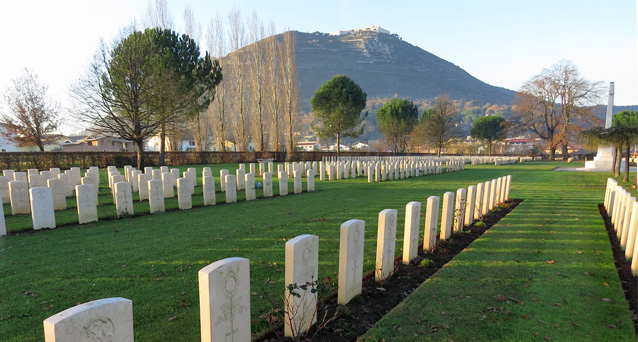 The Cassino War Cemetery
Photograph (56059499) courtesy of Iain MacFarlaine via findagrave.com
Roger Morgan © 2018
Please contact us if you have information or pictures that can extend this entry.
SMITH, George Albert
Civilian
Died 17 January 1941, aged 30
Not listed in the Book of Remembrance
The Commonwealth War Graves Commission records note that George was the “son of Mr and Mrs G J Smith, of 21 Netherby House, Clapham, London.” Thanks to the address, this couple is readily found in the September 1939 Register. The father, George, was born on 6 December 1893 and is listed as an “Electric Motorman, Southern Railway”. His wife, Ellen was born on 15 December 1894 and is listed with the conventional “Unpaid Domestic Duties”.
Having the parents’ birth dates and fuller names enables their marriage to be found. It was in Q4 1913 (registered in the Wandsworth District) and Ellen’s maiden name was “Blake”. To be aged 30 on his death in January 1941, George junior would have been born in 1910 (or very early 1911). The readily available records do not have a crystal clear trace of this (perhaps to do with his birth being several years before the parents’ marriage – when, indeed, Ellen was barely aged 16), but he may be the plain “George Smith” (mother’s maiden name Blake) whose birth was registered in the Hackney District Q2 1911.
The couple had other children. Two of them – Sidney (born May 1921) and Albert (born August 1923) are listed in the 1939 Register living with their parents at 21 Netherby House, Clapham. There are also four currently closed records at the address. It is unlikely that one of those would be concealing the 28/29 year old George, but he cannot be found with confidence elsewhere.
The Commonwealth War Graves Commission notes that George was injured on 12 November 1940 while in the Wandsworth Road Shelter, a couple of months into the Luftwaffe’s “Blitz” bombing campaign. He was taken to Horton Emergency Hospital, one of Epsom’s “cluster” of mental hospitals that, as for WW1, had been taken over for dealing with wartime casualties and, after two months, died there on 17 January 1941. He was buried in Grave M422 of Epsom Cemetery, apparently on the same day.
Epsom Cemetery records normally include a one word description of an individual’s occupation or circumstance. Disappointingly, George’s record just says “(See entry No. 10715)”. That entry is for the burial in the same grave on 4 February 1941 (just over a fortnight later) of 33 year old George Thomas Smith, described as a “Baker”, who had died in Long Grove Hospital, Epsom. It would be an extraordinary coincidence if these two were related in some way, so this seems likely to do with maximising burial space, and it just happened that they shared a very common surname.
Roger Morgan © 2018
Please contact us if you have information or pictures that can extend this entry.
SMITH, George Bainbridge. Sapper (1991023)
505 Field Company, Royal Engineers.
Died 3 November 1942, aged 31.
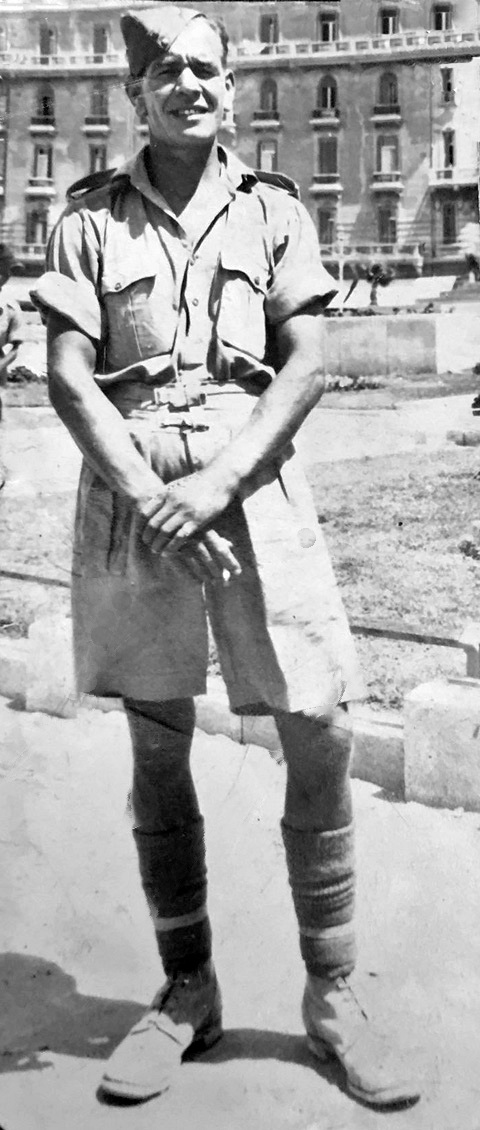 George in tropical kit
Photograph courtesy of his grandson, David Pearson © 2019
The Commonwealth War Graves Commission notes that George was the “son of George and Mary Smith”. Thanks to his unusual second name, George junior is readily traced: he was born in South Shields, County Durham on 9 July 1911, the record of which gives his mother’s maiden name as Bainbridge. (His date of birth means that he was aged 31 when he died, not 29 as in the Commission’s records.)
With this information, one can find not only the parents’ Q2 1904 marriage registered in South Shields but also the couple living at 30 Bedford Street, South Shields in the 1911 Census. In that Census, 38 year old George is listed as an “Insurance Agent, Royal Liver Friendly Society). As usual at the time, no occupation is shown for 29 year old housewife Mary – who, in addition to dealing with the house and 4 year old daughter, Margaret, was some 5 months pregnant with George junior.
Sadly, the 1911 Census return records that the couple had had two more children who had died. One of these seems certain to be the George Bainbridge Smith who was born and died in South Shields Q4 1909. The parents used the same names (his father’s forename and his mother’s maiden name) for the boy who is the subject of this article.
At some point, the family moved south. The September 1939 Register records the parents (and widowed grandfather – another George Bainbridge Smith) living at 52 Tonstall Road, Epsom. The same Register records George junior as a Nurse at West Park Hospital, one of Epsom’s “cluster” of mental hospitals presumably where he first met Edith Mary Collins, recorded in the Register as one of the Hospital’s Assistant Cooks. (Edith had been born on 4 February 1914 in the Neath District of South Wales, and her mother’s maiden name was Jones.) They became a couple and their only child, Ann Elizabeth, was born on 31 March 1939. In Q4 1939, very shortly the 29 September 1939 Register was taken, the couple got married – registered Q4 1939 in the local Surrey Mid Eastern District.
But what of their 6 month old Ann Elizabeth in the September 1939 Register? There is a strong possibility that she is behind the currently closed record at the family home of 52 Tonstall Road.
It was shortly after George junior and Edith got married that Ann’s birth was belatedly registered – on 26 January 1940. The Registration was done in the Isleworth Sub-District of the Brentford District. This noted that the birth had been at 30 Twickenham Road, Isleworth on 31 March 1939. And, while it confirms George junior’s address as 52 Tonstall Road, Epsom, it specifies his occupation as “Road Labourer”.
There is greater clarity in the records of George’s WW2 service. This was as a Sapper in the 505 Field Company, Royal Engineers. It seems unlikely that he was enlisted in time to be sent to France in early 1940 as part of the British Expeditionary Force and its evacuation from Dunkirk in early June. More probably, and like many others, he was part of the rebuilding of the Army as it prepared for what seemed the inevitable German invasion of the UK mainland.
As the invasion threat receded, the Company was sent for service in the Middle East. In May 1941, It sailed from Glasgow in Convoy WS.8 and, by the Cape route, arrived in Egypt in mid-July 1941. They continued on to Cyprus and Palestine before entering Iraq in November 1941. The very cold winter at Eskilich made the ground hard, making the burying of mines on the border with Turkey very difficult.
In February 1942, the Company was moved to the Western Desert at the Front near Tobuk in Libya. Italy had declared war on the UK in June 1940 and began by advancing into British-held Egypt from its colony in Libya. The invasion was quickly repelled and, indeed, reversed with British forces taking large parts of Libya, including the valuable port of Tobruk. German forces, under Rommel, were sent to reinforce their Italian allies and the combined Axis forces began to push the British forces back with the aim of capturing the prize of the Suez Canal and then the oilfields beyond.
The Company was first engaged mainly in laying mines around various defensive “Boxes”. Notwithstanding these and other preparations, Axis forces had the upper hand and pressed the British back and back. It was not until the 1-27 July 1942 first Battle of El Alamein – barely a hundred miles from Cairo – that the Axis advance was, in something of a stalemate, at least halted. The tide was finally turned with the British victory in the second battle of El Alamein from 23 October to 11 November 1942 – seen, indeed, a key turning point in the war as whole. It was during this fierce fighting that, as recorded in Casualty List No. 985, George was killed in action on 3 November.
George is one of the 7,240 Commonwealth WW2 casualties buried in the El Alamein War Cemetery. The widowed Edith took the option of adding a personal inscription to his headstone on Grave XXV.D.23,
“Gone but not forgotten.”
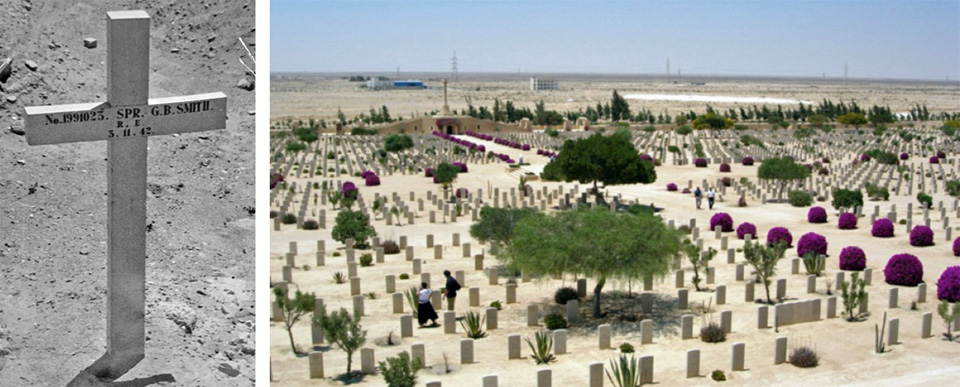 Left: George’s original grave marker
Photograph courtesy of his grandson, David Pearson © 2019
Right: The El Alamein War Cemetery, Egypt.
Photograph with thanks to the Commonwealth War Graves Commission.
It is not known how long the widowed Edith remained in Epsom: the Commonwealth War Graves Commission’s post-war records note that she was “of Taibach, Port Talbot, Glamorgan” – her original home patch. Indeed, her daughter recalls them being in Wales when the news came of her father’s death.
Roger Morgan © 2020
Please contact us if you have information or pictures that can extend this entry.
SMITH, Hector Frank. Private (14709957)
2nd Battalion, The Glasgow Highlanders, Highland Light Infantry (City of Glasgow Regiment)
Died 24 September 1944, aged 35.
Unusually, the Commonwealth War Graves Commission’s database contains nothing about Hector’s parentage, noting only that he was the “Husband of Hilda Beatrice Smith, of Balham, London”.
The very common surname of Smith can be something of a nightmare for family research purposes, but some hard work in the records has enabled us to fill in the gaps here. Hector’s parents were William and Annie Jane (née Haywood) Smith who had married in St Martin’s Church, Epsom on 4 December 1890.
The 1891 Census finds the newlyweds living at 6 Lemon’s Lane, Epsom. (This is the road running between Epsom’s East Street and Upper High Street that took its name from William Lemon’s popular but now long-lost bakery. It was subsequently renamed Church Road – being the continuation of the road on the other side of Upper High Street running to St Martin’s.)
28 year old William (originally from Scotland) is listed in that Census return as a “General Labourer” and, as usual, no occupation is shown for the 23 year old housewife Annie Jane (who was originally from Ireland). Living with them were Annie’s 45 year old widowed mother, Ann (a “Laundress”) and two of Annie’s siblings – 11 year old William and 9 year old Harriett, both “Scholars”. By the time of the 1901 Census, William (now a “Railway Carter”) Annie had moved to 16 Victoria Place, Epsom – and had had five children.
Hector, the subject of this article, was born on 11 June 1909 (and baptised in St Martin’s on 3 October that year and, in the 1911 Census, is listed as the youngest of the couple’s 11 children (one of whom had died), when the family was still at 16 Victoria Place.
We leap forward to Q3 1939 when, registered in the local Surrey Mid Eastern District, Hector married the divorced Hilda Beatrice Ross (née McKenzie). A few weeks after that, the September 1939 Register records the newlyweds living at 1 Burnell Cottage, Godstone, Surrey. 30 year old Hector is listed as a “Bus Driver LPTB” [the London Passenger Transport Board]; and 34 year old Hilda (born on 6 March 1905) with the conventional “Unpaid Domestic Duties”. The only other occupant was the apparently unrelated 29 year old Henry M Wilson, listed as a “Bus Driver” so presumably one of Hector’s colleagues. It is not clear whether the couple had any children during their five year marriage.
At some point, Hector signed up for wartime service with the 2nd Battalion of City of Glasgow Regiment – perhaps a nod to his father’s Scottish roots. This Territorial Army unit was created in early 1939 as a double of the 1st Battalion, in line with the Government’s requirement for the Territorial Army to be doubled in size in anticipation of the threat from Nazi Germany.
The 2nd Battalion served in the UK until being sent to France in June 1944 as part of the Allied forces in Operation Overlord – the “D-Day” Normandy landings. While the initial landings and establishment of the beachhead went according to plan, breaking past the German’s strategic stronghold of Caen proved much harder than anticipated. The 2nd Battalion was heavily involved in these actions and then with action as the Allies moved east from France into Belgium, the Netherlands and, eventually into Germany itself.
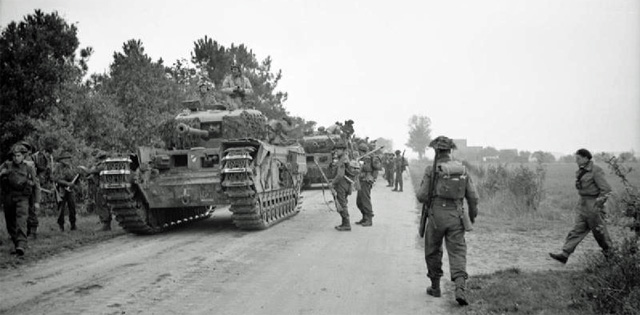 Infantrymen of the 2nd Battalion, Glasgow Highlanders, with Churchill tanks
of the 6th Guards Tank Brigade, near Moergestel, 26 October 1944
Photograph (B 11358) from the Imperial War Museum’s collections, Public Domain.
Hector got only as far as the Netherlands. The Battalion was part of the ground forces in the 17 to 25 September 1944 Operation Market Garden aiming to relieve the airborne troops at the “bridge too far” at Arnhem. As reported in Casualty List No. 1583, Hector was killed in action on 24 September.
With many others lost in that fierce fighting, Hector is buries in the Mierlo War Cemetery, on the outskirts of Eindhoven in the southern Netherlands, which holds 658 Commonwealth WW2 casualties. The widowed Hilda took the option of adding a personal inscription to his headstone on Grave IV.B.3,
“Greater love hath no man.”
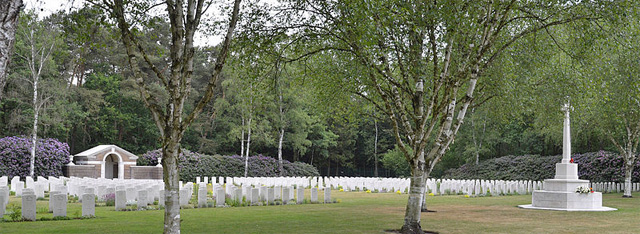 The Mierlo War Cemetery
Photograph with thanks to the Commonwealth War Graves Commission
As noted at the head of this article, the widowed Hilda was “of Balham, London” so it was probably members of Hector’s family remaining in Epsom that secured his entry on the WW2 memorial at St Martin’s Church. (He is not listed in the Borough’s Book of Remembrance.)
Roger Morgan © 2020
With special thanks to Hazel Ballan for establishing Hector’s family background
Please contact us if you have information or pictures that can extend this entry.
SMITH, John Arthur. Flying Officer/Air Bomber (153826)
106 Squadron, Royal Air Force Volunteer Reserve
Died 1 November 1944, aged 20.
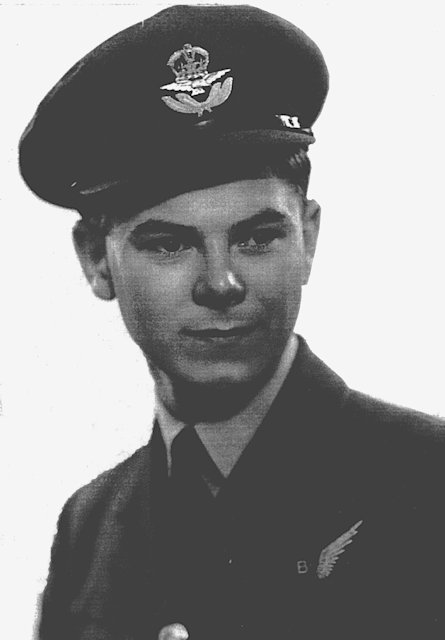 John Smith
Image courtesy of Gordon Smith and Ben Goossens
John was born Q2 1924, the first child of Arthur Patrick Smith and Lilian (née Bandy). Their Q2 1920 marriage had been registered in the Barnet District, and john’s birth in Edmonton. The Q3 1934 birth of their other child, Heather, was registered in Islington.
The family moved to the Borough, first at 18 Corbet Road, Ewell, but then to 59 Sunnymede Avenue, West Ewell, where the 42 year old parents were recorded in the September 1939 Register together with two currently closed records, doubtless of the 15 year old John and 5 year old Heather. Arthur is listed as a “Shipping Office Manager” and Lilian with the conventional “Unpaid Domestic Duties”.
In 1942 (at about the time of his 18th birthday), John enlisted in the RAFVR and was inducted at Euston with a Service Number 1803953. He rose from the rank of LAC to Pilot Officer on probation (emergency), 153826, by 15 October 1943 and Flying Officer (war sub.) on 15 April 1944. After training, he was assigned to 106 Squadron, part of the RAF’s Bomber Command. As an Air Bomber, John became a member of the crew of Avro Lancaster PB303, call sign ZN-R, which had been delivered to the squadron on 18 July 1944.
At 14.05 hours on 1 November 1944, this bomber (together with 19 other aircraft) took off from RAF Metheringham near Lincoln, for a daytime raid on Homburg in the Saar region of Germany. Lancaster PB303’s crew were:-
• Pilot: F/O George Jeffrey Symes J/28570 RCAF, aged 27
• Flt Eng: Sgt Alfred Harris 900315 RAFVR, aged 24
• Nav: F/S Cyril Ernest Bayliss 1580230 RAFVR, aged 22
• AB: F/O 1 John Arthur Smith 53826 RAFVR , aged 20
• Wop/AG: F/O Leslie W Perry 160761 RAFVR, aged 22
• AG: Sgt John Anthony Crisp 1814423 RAFVR, aged 19
• AG: F/S Clifford Eugene Leroy Cook R/251484 RCAF, aged 19
Over the target area, PB303 was seen to leave the formation. Before it dived into the clouds, the photograph below was taken from whoch it can be seen that its bomb doors are open, the port outer engine is missing and there is damage to the fuselage.
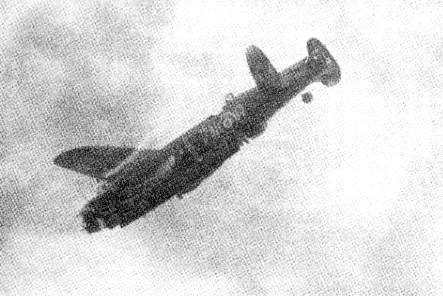 Lancaster PB 303 leaving the formation
Image courtesy of Ben Goossens
The crew must have dropped their bombs and turned back to base. About three quarters of an hour later, the Lancaster was observed near the town of Bergen op Zoom and seen to be on fire. At about 17.00 hours local time, it crashed near the small village of Lepelstraat in the Southern Netherlands.
All seven on board were killed in the crash. They were buried locally but, on 20 December 1945, were re-interred in Collective grave 6.G.5-9 of the Bergen op Zoom Canadian War Cemetery. The Cemetery is about 30 miles south of Rotterdam, and holds 1,118 Commonwealth WW2 casualties. After the War, Dutch people were invited to adopt local war graves. As shown in the Certificate below, John’s grave was among those adopted by Mrs Jane Goossens, and it is from her contacts with the families that her son, Ben Goossens, had the material to inform his (sadly, now lost) PB303 blog on which we drew heavily when writing most of this this article in 2018.
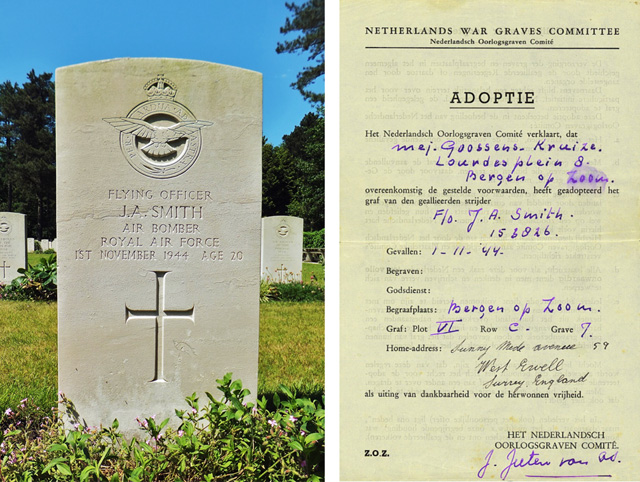 John’s headstone in Bergen op Zoom Cemetery and the Certificate of Adoption of his Grave
Left: Photograph (12724864) by “Astrid” via findagrave.com
Right: Image courtesy of Ben Goossens
In preparation for the 75th anniversary of the tragedy, local resident Peter van den Eijnden raised funds to build a memorial on the exact spot of the crash – as below. This was unveiled on 1 November 2019 by Ben Goossens (who had done so much to record the details of the crash and the plane’s crew), in the presence of 32 relatives of the casualties and many local residents. Bad weather thwarted the plan for an English war plane to fly over the site but, in spite of the then Covid constraints, that happened on 1 November 2020.
 Rinus van Wezel, Ben Goossens (who has since died) and Peter van den Eijnden at the monument.
Photograph (copyright acknowledged) with thanks to the Dutch journal Bode.
The first item on the memorial is a photograph of the seven-man crew, whose names and details are the main part of the memorial plaque. The heading of the plaque reads “They gave their lives for our freedom”, and the final paragraph notes “All lost their lives when their bomber crashed on this location on November 1st 1944“.
Brian Bouchard & Roger Morgan © 2018 &2023
With special thanks to the late Ben Goossens
Please contact us if you have information or pictures that can extend this entry.
SMITH, James Bruce. Petty Officer Stoker (P/K 18322)
HMS Medway, Royal Navy
Died 30 June 1942, aged 48
James was born on 19 September 1894 in Sunderland, the fifth child – of an eventual at least twelve children – of William Smith and Mary Ellen (née Pinkney – they had married in about 1885). The 1911 Census records the parents and six of their children living at 42 Southwick Road, Monkwearmouth, Sunderland. The 55 year old William is listed as a “Deputy Overman Miner” and 16 year old James – the subject of this article – working as an “Apprentice Joiner, Shipyard”.
In March 1913, James signed up for 12 years in the Royal Navy and served as a Stoker with the Service Number 25453. He, of course, saw action during WW1 – not least in the 1916 Battle of Jutland when he was serving on the dreadnought battleship HMS Iron Duke.
On 29 October 1919, James married Mary Rogerson Jones, registered in South Hetton, County Durham. The couple appear to have had only one child, Gwendoline (“Gwen”) Rogerson Smith, whose 28 July 1926 birth was registered in the Easington Distruict of County Durham. James had, by then, completing his 12 years of Naval service and, at some point, the family moved south. The 1935 Electoral Roll has them living at 37 Chapel Way, Banstead. By 1936, they were in the Borough – at “South View”, Bracken Path, Epsom Common.
The September 1939 Register records the 45 year old couple living at 97 Church Side, Epsom Common. James is listed as a “Postman (RN Pensioner Stoker Petty Officer)” and Mary with the conventional “Unpaid Domestic Duties”. There is a currently closed record at the address which seems certain to cover 13 year old daughter Gwen.
James subsequently rejoined the Navy, and his WW2 service was on HMS Medway. This had been completed in 1929 as the Royal Navy’s first purpose-built submarine depot ship. With a crew of 400 and space for just over 1,300 additional men, the ship was designed to support up to 21 submarines. Following pre-war service in the China Station and a refit in Singapore, the ship arrived in Alexandria, Egypt in May 1940 May and thereafter supported the 1st Submarine Flotilla, which operated in the Eastern Mediterranean.
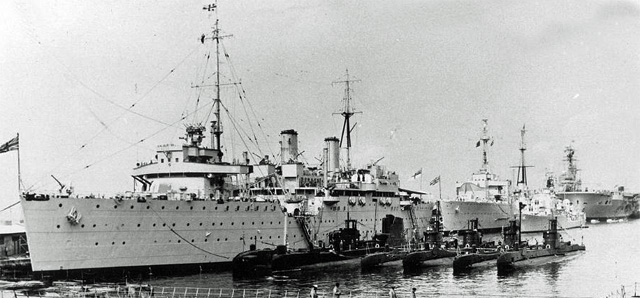 HMS Medway, in port with submarines alongside
Picture with thanks to naval-history.net
In June 1942, Vice-Admiral Henry Harwood, Commander-in-Chief, Mediterranean Fleet, ordered all non-essential ships to leave Alexandria as he was preparing to demolish its port facilities to prevent their capture by the Axis forces advancing eastwards along the North African coast. (That advance was halted by the first Battle of El Alamein – only 50 miles from Alexandria – in July, and then reversed in the October/November Second Battle.) HMS Medway loaded stores and 1,135 personnel to establish a new base at Beirut, and sailed later on 29 June that day for The Lebanon.
Notwithstanding an escort of a light cruiser and seven destroyers, the German U-372 targeted and sank HMS Medway with two torpedoes off Port Said the next day. Thanks to the escort, 1,105 of those on board were rescued. However, 30 men – including James – were lost, together with much valuable equipment.
James is one of nearly 15,000 WW2 naval personnel commemorated on the Portsmouth Naval Memorial as lost or buried at sea.
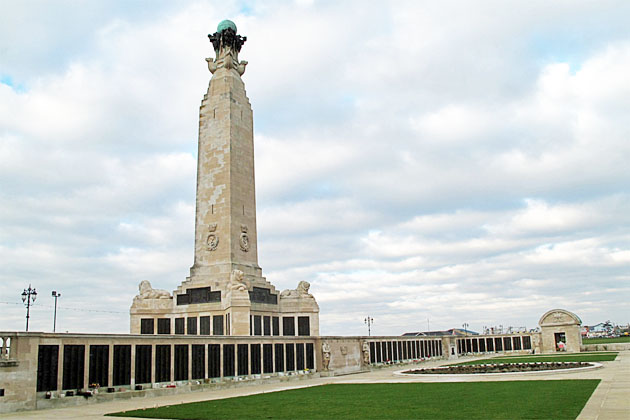 The Portsmouth Naval Memorial
Photograph with thanks to ww2cemeteries.com
Although the Commonwealth War Graves Commission’s post-war records list the widowed Mary as being “of Toronto, Ontario, Canada”, she was still at 97 Church Side, Epsom Common when, in January 1943, she was granted administration of James’s £843 estate.
Roger Morgan © 2020
With special thanks to Hazel Ballan for tracing James’s marriage and arrival in the Borough.
Please contact us if you have information or pictures that can extend this entry.
SMITH, John Frederick. Flight Sergeant/Navigator (1161856)
487 (NZ) Squadron, Royal Air Force Volunteer Reserve
Died 12 June 1943, aged 22.
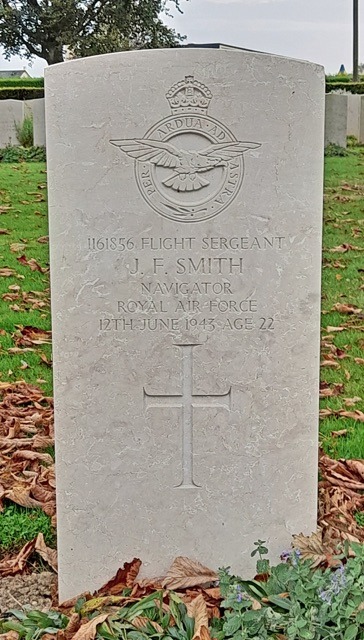 John’s headstone in the Bayeux War Cemetery
Photograph by Roger Morgan © 2023
John was the son of Frederick and Margaret Smith. They are noted in the Commonwealth War Graves Commission’s post-war database as being “of Worcester Park, Surrey.” However, the family’s background is rather more complicated than this implies.
John’s father, Frederick, is recorded in the 1911 Census as an 18 year old “Shipping Federation Clerk” living with his parents at 27 Three Fields Lane, Southampton – the town where he was born. Presumably in connection with his employment, he then went to Antofagusta, the major port in northern Chile. On 28 January 1915, he returned to the UK on the SS Oriana, the manifest of which records this 22 year old “clerk” having been a “permanent resident” of Chile and intending to be a “permanent resident” in England.
In Q3 1915, the 22 year old Frederick married 23 year old Margaret Geraldine Allen. He presumably knew her from his youth in Southampton (the 1911 Census records Margaret living with her parents at 161 St Mary’s Road, Southampton), but the marriage was registered in the Croydon District. No records have yet been found about the couple until the birth of their first child, Elsie, in Q4 1917, registered in Southampton. They were probably living at Frederick’s parents’ home of 27 Three Fields Lane as that was the last UK address they gave when noted on the manifest for the SS Mexico as she arrived in New York in September 1919 having sailed from Liverpool. The parents (and nearly 2 year old Dorothy) are listed as being on their way to (in Frederick’s case, back to) Antofagusta, Chile.
We know from the September 1939 Register that John (the subject of this article), the second of the couple’s four children, was born on 29 December 1920 and it seems certain that the birth was in Chile.
The records (which are not exhaustive) show various comings and goings between Chile and the UK. By the mid-1930s, Frederick is giving his last UK address as “The Pebbles”, Stoneleigh Drive, Worcester Park.
By the time of the September 1939 Register, the family is recorded living at 2 The Warren, Worcester Park (although John’s father, Frederick, was away from home – perhaps still in Chile, to which the manifest of the SS Orbita which sailed from Liverpool on 8 February 1940 records him returning – now as a “Railway Servant”). Anyway, the Register has 49 year old Margaret listed with the conventional “Unpaid Domestic Duties”; 19 year old John, the oldest of three children at home, is listed as “Student 1st Year London University, Statistics”; and the other children were 17 year old Lionel (“Seeking Work, Not Previously Employed”) and 14 year old schoolgirl June.
John’s WW2 service was in 487 (NZ) Squadron. This was formed at RAF Feltwell, Norfolk, on 15 August 1942 under Article XV of the Empire Air Training Scheme, as a light day-bomber unit, equipped with Lockheed Venturas flown by Royal New Zealand Air Force pilots and crewed with RNZAF and RAF personnel. The Lockheed Ventura was not well thought of: its rather bulbous shape and mediocre performance led to it being nicknamed “the flying pig”.
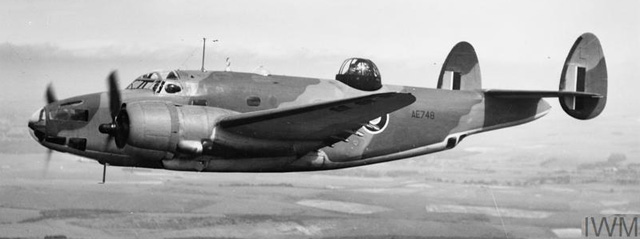 A Lockheed Ventura over Boscombe Down
Photograph © IWM (CH 8038)
The Squadron began operations on 6 December 1942, when it contributed sixteen Venturas to the famous low-level raid on the Philips radio and valve factory at Eindhoven. On 3 May 1943, the Squadron suffered a severe blow when ten out of eleven its aircraft were shot down during a “Ramrod raid” – one to be continued regardless of losses – on Amsterdam. The bombers had just crossed the Dutch coast when they encountered a large group of German fighters which, bursting through the Spitfire escort, shot up the bombers (one of which managed to return to base).
On 1 June 1943, 487 Squadron left Bomber Command to become part of the newly-formed “2nd Tactical Air Force”. Quickly re-equipped, the Squadron’s first mission in this role was on 12 June when 12 Venturas set off to attack the Luftwaffe’s airfield at Caen, Normandy. One of the aircraft was Ventura AE797 with the following crew:-
• Pilot – F/O. Gordon William BREWER, DFC (412196) RNZAF, aged 28;
• Navigator – Flt. Sgt. John Frederick SMITH, (1161856) RAF, aged 22;
• Wireless Operator/Air Gunner – W/O. Ronald William SECORD, (404098) RNZAF, aged 21; &
• Air Gunner – Sgt. Robert Ferguson EDMONDS, (413254) RNZAF, aged 28
It is known that the three New Zealanders had been on the single Ventura that survived the 3 May raid on Amsterdam, and it’s quite likely that our RAF man John had been the fourth member of the crew on that occasion. It’s also though that their aircraft on 3 May was Ventura AE797 which, after repair, they were flying on this mission.
Near the target, Ventura AE797 was seen to be hit by flak, setting fire to its port engine. It was last seen going down in what appeared to be a controlled dive, but it then crashed to the ground killing all on board. They are buried in Collective Grave. XXVIII.J.16-19 of the Bayeux War Cemetery which is about 20 miles northwest of Caen and holds 4,144 Commonwealth WW2 casualties.
Brian Bouchard & Roger Morgan © 2020
with special thanks to Hazel Ballan for tracing the family background.
Please contact us if you have information or pictures that can extend this entry.
SMITH, Michael Arnold. Second Lieutenant (143725)
2nd Battalion, Royal Sussex Regiment and No. 50 Commando.
Died 28 February 1941, aged 19.
Michael was born on 14 April 1921, at least the second child of Harry Neville Smith and of Winifred Mary (née Cooper – their Q3 1915 marriage was registered in the Blean District of Kent).
The September 1939 Register records the family living at 7 Higher Green, Ewell. 54 year old Harry is listed as a Bank Clerk; 55 year old Winifred with the conventional ” Domestic Duties (Unpaid)”; and 18 year Michael (who had attended Epsom College, where the records describe his father as a “Bank Official”) as “Clerk, Asiatic Petroleum Co”. Some time over the next few years, the parents moved to Sutton – which is where the Commonwealth War Graves Commission’s post-war records note them as being “of”.
Michael’s WW2 service was initially in the 2nd Battalion of the Royal Sussex Regiment, but he was soon recruited into No. 50 Commando, based in Egypt. After training, the Unit was ready for action. For various reasons, the first couple of missions were aborted at the last moment and the first to get under way was Operation Abstention, a combined operation with the Royal Navy aiming to seize Kastelorizzo, a small Greek island about eighty miles east of Rhodes and just three miles off the Turkish coast. The initiative for the operation came from Admiral of the Fleet, Sir Andrew Cunningham, Commander-in-Chief Mediterranean. He wanted a secure motor torpedo boat base to support future operations against the Italians (who had invaded Greece at the end of October 1940) in the rest of the Dodecanese, to the west of Kastelorizzo.
On the evening of 23/24 February 1941, 200 men set off for Kastelorizzo aboard HMS Decoy and HMS Hereward, accompanied by escorts. They took an indirect course, heading initially for the Palestinian coast before steaming on to Kastelorizzo. The aim was to reach the island by 0300 hours on 25 February, where a Royal Naval submarine would guide them into their final position south-west of the island.
Although it was a combined operation, the Commandos had not been closely involved in the planning. Things did not go well. Instead of the hoped-for surgical operation, tempo was lost in the initially successful assault and the Italians were able to respond with unanticipated vigour from their base in Rhodes – not only by bombing and shelling the invading force but also precluding the planned landing of further reinforcements. The Allies’ response was hindered by various communications and supplies issues.
With fierce fighting over the next few days (during which Michael was killed on the beach during an air raid, and his body never recovered), the Allies had to accept defeat. Although many of the surviving troops were successfully evacuated, a good number were taken prisoner. One of the SOE operatives embedded with the troops called the operation “confused, incompetent, inept and a mess”. The debacle brought scathing comments from Admiral Cunningham who described the operation as “A rotten business and reflected little credit to everyone”.
Michael is commemorated on the Athens Memorial. This stands within Phaleron War Cemetery (on the coast a few miles to the south east of Athens) and commemorates nearly 3,000 members of the land forces of the Commonwealth who lost their lives during the campaigns in Greece and Crete in 1941 and 1944-1945, in the Dodecanese Islands in 1943-1945 and in Yugoslavia in 1943-1945, and who have no known grave.
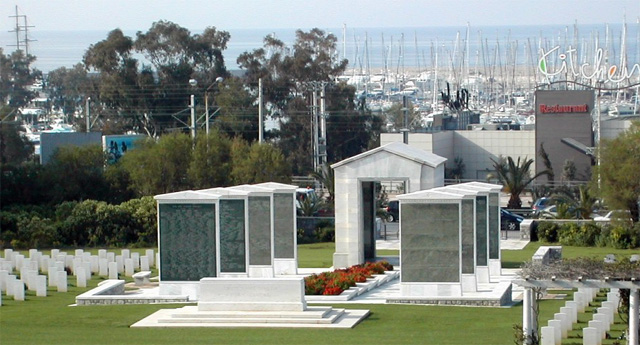 The Athens Memorial
Picture with thanks to the Commonwealth War Graves Commission
Roger Morgan © 2018
With thanks to combinedops.com for detailed mission information summarised above.
Please contact us if you have information or pictures that can extend this entry.
SNEATH, Ronald Ernest. Petty Officer (P/J 112654)
HMS Culver, Royal Navy
Died 31 January 1942, aged 32.
Ronald Ernest Sneath was born on 11 September 1909 in Bourne, Lincolnshire (GRO reference: Sep 1909 Bourne 7a 359). He was the first child of William Gordon Sneath and Clara Winifred (née Foskett) who had married at 8.30 on Wednesday 14 March 1909 at St John’s Church, Walham Green in Clara’s home area of Fulham. (They had been living at 28 Portland Street at the time.)
Notwithstanding Ronald junior’s birth in Bourne (and it is probably not a coincidence that this was his father’s birthplace), the 1911 Census records the young family (now also with 6 month old daughter Winifred) living in two rooms at 29 Elric Street, Hammersmith. 22 year old Ronald senior was working as a maintenance fitter and, as usual at the time, no occupation is listed for 21 year old housewife Clara. (Incidentally, Ronald junior is recorded with only his second name of Ernest.)
The couple had more children. The births of Charles William in 1912, Dorothy May in 1913 and Lilian in 1917 were all registered in the Fulham area. By 1924, the family had moved to Great Bowden in Leicestershire, and the 1927 birth of what appears to be the couple’s last child, Barbara, was registered in the Market Harborough district.
Ronald junior had already left home by then. Aged 15, he is reported to have trained for the Royal Navy at HMS Ganges before service on HMS Coventry, HMS Renown & HMS Dauntless before his eventual assignment to HMS Culver.
At some point in his travels, Ronald met Agnes Louise Hayball. They married in Q1 1937 and in the Bournemouth registration district. Ronald was aged 27 and Agnes 35. There is no record of the couple having any children. The September 1939 Register records Agnes (listed with the conventional “Unpaid Domestic Duties”) living with her 70 year old widowed mother, Annie (of “Private Means”), at 25 Northcote Road, Bournemouth.
Ronald’s final WW2 service was as a Petty Officer on HMS Culver (Y87). This Lake Class cutter had been built in the USA for the US Coat Guard in the late 1920s. As part of the Lend-Lease Act she was transferred to the Royal Navy where, as a Banff Class sloop, she was renamed HMS Culver (Y87) and commissioned on 30 Apr 1941.
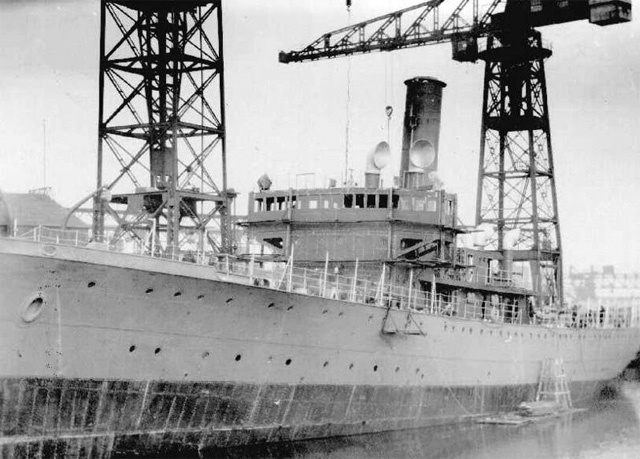 HMS Culver under construction (as USCGS Mendota), circa 1928
US Coast Guard picture, Public Domain
In January 1942, HMS Culver was part of the escort for Convoy SL-98 from Bathurst in the Gambia to Londonderry. At 23.31 hours on 31 January, U105 fired a salvo of four torpedoes at the convoy. The U-boat commander (Heinrich Schuch) observed two hits followed by a large explosion and thought that he had hit an ammunition freighter. The victim was, in fact, HMS Culver. She was hit on the port side in the forward boiler room and further aft, probably detonating the after magazine. The sloop heeled 45° to starboard, broke in two and, within a minute, sank ay 48°43′ N, 20°14′ W – about 600 miles southwest of Ireland.
On the 140 on board, 127 – including Ronald – were lost. (The 13 survivors were rescued by HMS Londonderry and landed at Londonderry on 5 February.)
Ronald is one of the 15,000 WW2 Naval personnel commemorated on the Portsmouth Naval Memorial as those with no grave but the sea. He is also remembered in the Leicestershire village of Great Bowden on a memorial on the village green and within Great Bowden parish church.
At some point, Ronald’s wife had moved to the Borough. The Surrey Electoral Registers for 1945 record the widowed Agnes living at 104 Horton Hill, Epsom. She had her husband’s name commemorated in the Borough’s Book of Remembrance and on the Roll of Honour in St Barnabas Church, Epsom. She later moved from the area – indeed, the Commonwealth War Graves Commission’s post-war records note her as being “of Bournemouth.” Agnes never remarried, and died in 1967 in the Hatfield area.
Clive Gilbert & Hazel Ballan 2014
Please contact us if you have information or pictures that can extend this entry.
SNELLING, (Alfred) Victor. Pilot Officer (89600)
78 Squadron, Royal Air Force Volunteer Reserve
Died 9 June 1941, aged 21
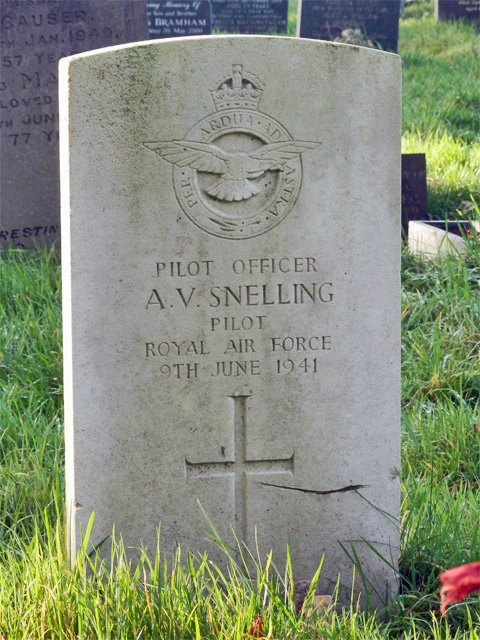 Alfred’s headstone in Middleton St. George Churchyard, Durham
Photograph (139442593) by Dimitrios Corcodilos via findagrave.com
Not listed in the Book of Remembrance
Alfred Victor Snelling’s birth in Q3 1919 was registered in the Epsom District. He appears to be the second and last child born to Alfred Snelling and Emma (née Orton). Presumably to avoid confusion with his father, the boy was known by his second name of Victor (he is so commemorated on St Stephen’s WW2 memorial), and we follow suit here.
Alfred senior was originally from East London and Emma from Ewell, but they had married in the Edmonton District. Their first child, Alexandra Irene, was born in Penge on 16 August 1903. The 1911 Census records the family living at 28 Tamworth Road, West Croydon, with 32 year old Alfred senior working as a “Compositor, Printing”.
As noted above, Victor’s birth was registered in Epsom and, in 1920, the family appear to have been resident at 69 East Street, Epsom. By the time of the September 1939 Register, the early 60s parents were back in Croydon, living at 96 Denning Holme. Alfred senior is listed as a “Civil Service Clerk” and Emma with the conventional “Unpaid Domestic Duties”. While the unmarried 36 year old Alexandra was still at home (listed as a “Post Office Telephonist”), the 20 year old Alfred junior is not found in the Register, probably because he was already in uniform.
The Commonwealth War Graves Commission’s post-war records note that Alfred’s parents were “of Epsom Downs, Surrey”. In 1945, they were living at “Amethyst”, Grosvenor Road, Langley Vale, Epsom – and, when Alfred died in Q3 1969, his death was recorded in the local Surrey Mid Eastern District.
To return to Victor, the subject of this article, he is recorded in a 1936 London Gazette as joining the Air Ministry to be employed as a Clerical Officer. He then enlisted with the Royal Air Force at Cardington during September 1939 with a Service Number 957979 before being commissioned as a Leading Aircraftman to the rank of Pilot Officer, with effect from 15 December 1940 (later corrected to 8 January 1941).
He was assigned to 78 Squadron, based at RAF Middleton St George in County Durham, about five miles east of Darlington. The Squadron was part of the RAF’s Bomber Command and equipped with Armstrong Whitworth Whitleys. These flew in a distinctively nose-down attitude and, until the arrival of the Avro Lancaster, was the RAF’s heaviest bomber.
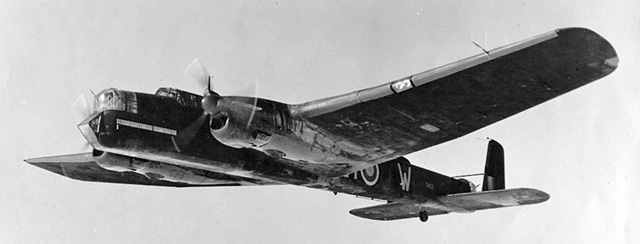 A 78 Squadron Whitley Mk.V bomber in flight, circa 1940
Official RAF photograph – Public Domain
Late on 8 June 1941, Alfred was the navigator on Whitley Z6571 which, with others from 78 Squadron, took off from RAF Middleton St George to undertake a bombing raid on Dortmund. The weather over North Yorkshire deteriorated during the night and 78 Squadron aircraft had initially been sent instructions to divert to land at Prestwick The weather over Middleton St. George later improved slightly and the diversion order was cancelled. However, the weather was still poor at dawn Z6571 was heading towards base.
It appears that the aircraft had drifted too far west and, when the descended through the clouds (probably to help the crew locate their position), the Whitley flew into a hilltop near Ellingstring. It crashed at around 05.20 hours, killing all five on board, namely:-
• Pilot – Sgt Dennis Russell Simm RAFVR (1150677), aged 27;
• Navigator – Sgt John Staley Tomkinson RAFVR (969697), aged 28;
• Observer – P/O Alfred Victor Snelling RAFVR (89600), aged 21;
• Wireless Operator/Air Gunner – Sgt John Bernard Stevens RAFVR (972788), aged 21; and
• Wireless Operator/Air Gunner – F/Sgt Gordon Elliot Chiswell Billing RAFVR (967253), aged 24.
Of the crew, only Victor was buried in the local Middleton St. George (St. George) Churchyard, one of the three Commonwealth WW2 casualties it holds. His parents took the option of adding a personal inscription to his headstone on Grave 294,
“Until the dawn break and we meet again.”
Brian Bouchard & Roger Morgan © 2019
Please contact us if you have information or pictures that can extend this entry.
SPARK, Basil Douglas. Flight Lieutenant/Pilot (128904)
Royal Air Force Volunteer Reserve.
Died 5 July 1945, aged 24.
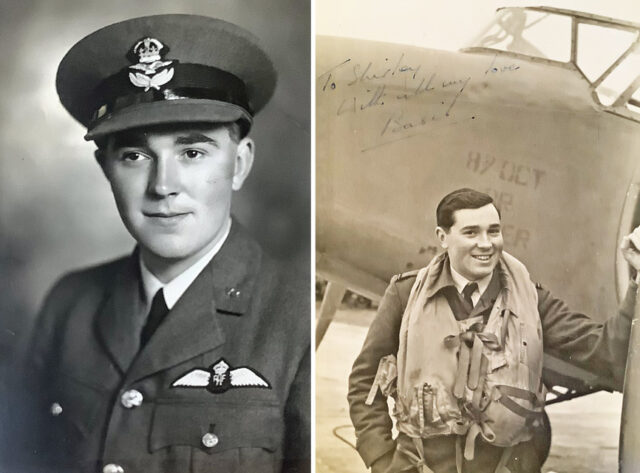
Basil, in formal and flying modes.
(The inscription on the right hand picture is “To Shirley [his wife]/ With all my love / Basil”.)
Photographs with thanks to Basil’s daughter, Penny © 2021
Basil was born in Epsom on 14 October 1920, the only child of Edwin Frank Spark and Constance Alice (née Moodie – they had married Q3 1914, registered in the Lambeth District). The September 1939 Register records the parents living at 23 Copse Edge Avenue, Epsom. 51 year old Edwin is listed as a “Clerk (MWB) Services Revenue Cashier” [MWB being the Metropolitan Water Board] and 55 year old Constance with the conventional “Unpaid Domestic Duties”. There is one currently closed record at the address, doubtless concealing the 18 year old Basil.
Basil enlisted in April/May 1942 and, as a Leading Aircraftman (presumably on completion of his flying training) was commissioned as a Flight Lieutenant/Pilot on 5 September 1942.
On 5 August 1943, the 22 year old Basil married 21 year old Shirley Phyllis Fleet in Epsom’s Congregational Church (now URC). Shirley lived at 107 Hookfield, Epsom with her parents Rufus and Clarrie Fleet, and is sure to be the person behind the currently closed record at that address in the 1939 Register. That listed her 46 year old father as “HM Inspector of Taxes” (later annotated to record that he was involved in Air Raid Precautions as a First Aider) and her 47 year old mother with the conventional “Unpaid Domestic Duties” (later annotated to record that she was involved with British Red Cross activities). It is understood that Basil and Shirley had first met on their daily commute to London – Basil to a job at the Metropolitan Water Board (where his father also worked) and Shirley to one in the Bank of England.
Sadly, the readily available records provide no details of Basil’s WW2 service. The family’s understanding is that he learnt to fly in Canada (under the British Commonwealth Air Training Plan) including time at the Service Flying Training School No 8 at Moncton, New Brunswick. After that, he was posted to RAF Montrose on the east coast of Scotland between Dundee and Aberdeen and served as a flying instructor. (One of the photographs at the head of this article shows Basil in front of an Airspeed Oxford twin-engined training aircraft.) Certainly, the couple’s home in 1945 was in Montrose – and their only child, Penelope, was born on 5 April 1945 in nearby Arbroath.
The circumstances of Basil’s death (on 5 July 1945, a couple of months after the cessation of hostilities in Europe) are unclear: his death certificate gives the cause of death as the opaque “on war duties”. His death was registered in the Howden District of Yorkshire, and the Epsom Cemetery records note the place of death as “near Holme on Spalding Moor”. There is speculation on some internet sites that Basil was piloting Halifax VI RG651 of No 78 Squadron on a short ferry flight to RAF Holme on Spalding Moor, Yorkshire. That aircraft landed too far up the runway and, having swung to avoid some workmen, the aircraft ran off the end and into a ditch. The undercarriage collapsed and the pilot was killed in the crash.
That, however, did not accord with his daughter’s understanding of the circumstances of Basil’s death. As a close relative, she was able to obtain a copy of his still generally confidential service records and these state baldly that he was “Killed in accident to aircraft, Spitfire MkV AR 386” – with no indication as to the nature of the accident. An internet search for “Spitfire AR 386” shows that it was a Mk Vb, and had been in service with 91 Squadron which, in mid-1945, was based at RAF Ludham, near Great Yarmouth in Norfolk – about 115 miles southeast of RAF Holme.
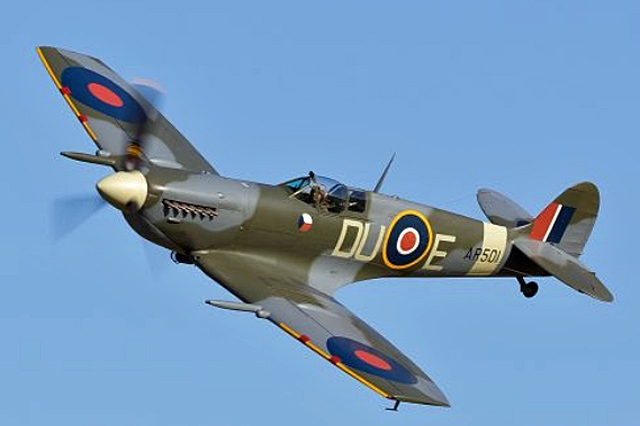
A restored Supermarine Spitfire Mk V (AR501) from the Shuttleworth Collection.
Photograph by Mark Rutley, copyright acknowledged.
Basil’s body was brought back to Epsom for burial in the Cemetery on 11 July 1945. The widowed Shirley added the following personal inscription to the headstone on Grave N.595:
“Greater love / hath no man than this / that a man lay down / his life for his friends.”
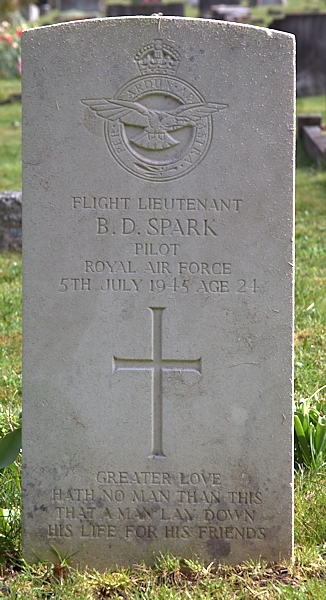 Basil’s headstone in Epsom Cemetery
Image courtesy of Clive Gilbert © 2018
Shirley and daughter moved back to Epsom and lived with her parents at 107 Hookfield until, in Q1 1956 and registered in the local Surrey South Eastern District, Shirley got married again – to Alan D Gibbins.(For some reason, the address given for Shirley in the 23 November 1945 Probate Record of her being awarded administration of Basil’s £799 estate was that of his parents, 23 Copse Edge Avenue.)
Roger Morgan © 2021
with thanks to Basil’s daughter, Penny.
Please contact us if you have information or pictures that can extend this entry.
SPARKE, Philip Donald Julian. DSC and 2 Bars. Pilot Lieutenant (Acting)
Royal Navy Fleet Air Arm – 815 & 806 Squadron
Died 11 May 1941, aged 21
Philip is not listed in the Borough’s Book of Remembrance, but is included here because the Commonwealth War Graves Commission’s post-war records note that he was the “son of James Donald and Mary Virginia Sparke, of Epsom”. However, details of that link have yet to be established.
Philip was born on 21 May 1918, apparently the only child of James Donald Sparke and Mary Virginia (née Jefferson – they had married on 8 August 1914). Philip’s birth, like his parent’s marriage, was registered in the West Ham District.
James was born in Isleham, Cambridgeshire on 16 December 1887. He is found in the 1911 Census as a 23 year old “Joiner” living in Isleham with his parents (52 year old Joseph, a “House Painter” and 59 year old Jane, a “Schoolmistress”) and two younger siblings. During WW1, James served in the Royal Naval Air Service as an Air Mechanic and then with the newly formed RAF.
Philip followed his father’s lead and was commissioned into the Royal Navy on 4 July 1938, qualifying as a pilot (Midshipman (Air Branch)) at No. 1 Flying Training School, Netheravon, on 10 September 1938. He was promoted to Acting Sub-Lieutenant on 29 November 1939 and to Sub-Lieutenant on 14 March 1940.
All that explains why Philip is not found in the 1939 Register. However, this recorded his parents living at 40b Albion Villas, Hove. 51 year old James is listed as a “Wood Worker” and 39 year old Mary with the conventional “Unpaid Domestic Duties”. (There are three other entries at the address whose relationship to James and Mary is not yet established.)
In the early stages of WW2, Philip (in a play on his surname, known to his colleagues as “Spike”) served with 815 Naval Air Squadron and, flying off HMS Formidable, was engaged in operations in the Channel during the Battle of France and the Dunkirk operation, for which he earned his first Distinguished Service Cross “for daring, endurance and resource in the conduct of hazardous and successful operations by the Fleet Air Arm working with the Coastal Command in France and over the Channel” (London Gazette, Issue 34890 of 5 July 1940, page 4152).
On the night of 11-12 November 1940, with his observer Sub-Lieutenant J W Neale in torpedo carrying Fairey Swordfish L4C (nicknamed ‘Cleo’) and flying from from HMS Illustrious, he took part in Operation Judgement, attacking the Italian fleet at anchor in Taranto harbour. He was awarded a Bar to his DSC “for outstanding courage and skill in a brilliant and wholly successful night attack by the Fleet Air Arm on the Italian Fleet at Taranto” (London Gazette, Issue 35166 of 20 May 1941, page 2870).
In the spring of 1941, he joined 806 Naval Air Squadron, flying Fairey Fulmars – again off HMS Formidable. On 11 May, while providing air cover for Operation Tiger, a resupply run from Gibraltar to Alexandria, his Fulmar crashed into the sea after an engagement at very close range with an enemy Ju88, which also crashed. Both he and his observer, Leading Airman Rush, were lost. Philip was posthumously awarded a second Bar to his DSC for “courage, resolution and devotion to duty in operations in the Mediterranean” (London Gazette, Issue 35365 of 2 December 1941, page 6890).
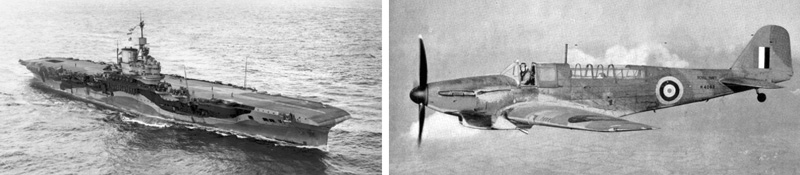 Left: HMS Illustrious under way in 1942 – IWM photo A11660, Public Domain
Right: A Fairey Fulmar – Public Domain
In Philip’s brief but spectacular career, his wartime tally was four aircraft destroyed – two Ju52 (off Tripoli) and two Ju88 (off Alexandria) – and two Ju88 shared (near Sicily and Malta). He is commemorated on the Fleet Air Arm Memorial at Lee-on-Solent, one of almost 2,000 men of that service who died during WW2 and who have no known grave.
Roger Morgan © 2018
With great thanks to Nick Metcalfe’s blog
Please contact us if you have information or pictures that can extend this entry.
STANLEY, George Haynes. Lance Serjeant 1075198
85 Anti-Tank Regiment, Royal Artillery
Died 8 September 1943, aged 30
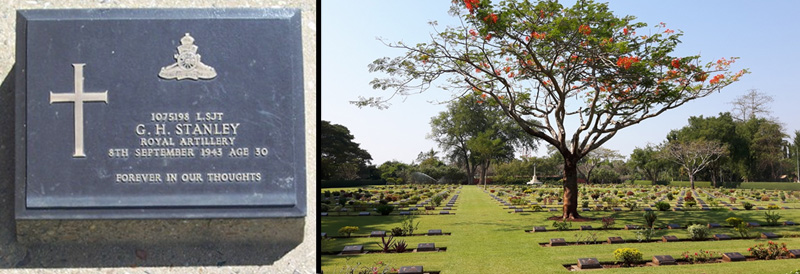 George’s headstone and the Chungkai War Cemetery
Left: Photograph (18898136) by “GulfportBob” via findagrave.com
Right: Photograph with thanks to the Commonwealth War Graves Commission
George is not listed in the Borough’s Book of Remembrance, but is included here because the Commonwealth War Graves Commission’s post-war records note that he was the “husband of Constance Marjorie Stanley, of Epsom”. The only clue so far found here is from George’s Japanese PoW record card which clearly states that the address of his wife, as next of kin, was “36 Shaldeford Road, West Ewell”. While Shaldeford Road is found in the 1945 Electoral Roll for the Ewell Court Ward, it subsequently disappears and it seems likely that it was a temporary arrangement of wartime “prefabs” in the Shawford Road area (“Shawford” being a derivative of “Shaldeford”, a name with historic roots in Ewell) hastily erected to provide accommodation for those bombed out of their homes. (There were prefabs in many other locations, including the nearby Gadesden Road.)
Anyway, George was born on 27 February 1913, the first of four children (one of whom died) born to George Haynes Stanley and Mary Elizabeth (née Mann – they had married Q3 1910). The parent’s marriage and all the children’s births were registered in the Wandsworth District.
The September 1939 Register records them all living at 60 Shelgate Road, Battersea. 44 year old George senior is listed as a “General Labourer”, and 40 year old Mary with the conventional “Unpaid Domestic Duties”. 26 year old George junior is listed as an “Assistant Company Secretary” and his two sisters (aged 25 and 17) are both “Book Keepers”.
In Q1 1940, and registered in the Battersea District, the 27 year old George married 22 year old Constance Marjorie Allaker. The 1939 Register had recorded her (a “Secretary to a Motor Dealer”) as the youngest of three children living with their parents, Frederick (a “Motor Bus Driver”) and Margaret Allaker at 10 Burland Road, Battersea – about a quarter of a mile from where George was living. No record is found of the couple having any children. Was Constance bombed out home in Battersea being temporarily rehoused in Ewell prefabs? (In any event, the widowed Constance never remarried, dying in Kingston-upon Thames in Q2 1998.)
George’s WW2 service was in the Royal Artillery’s 85 Anti-Tank Regiment. This was raised in 1941 and sent to Malaya in anticipation of a Japanese invasion. (Japan did not declare war on the UK until December 1941, but was already at war with China.) When the Japanese invasion came, it was – in spite of fierce fighting – of a ferocity beyond the capacity of Commonwealth forces to withstand. The action culminated in the British surrender of Singapore on 15 February 1942, when the Japanese took almost 80,000 Commonwealth troops as prisoners of war, to add to the 50,000 or so captured during their advance through Malaya.
Like many other PoWs, George was used as forced labour in building the notorious Burma-Siam railway which, because of the almost unspeakably harsh conditions, was aptly nicknamed “the Death Railway”: about 13,000 PoWs and some 90,000 civilian prisoners died and were buried along the railway. One of those deaths was George’s on 8 September 1943.
After the war, those in camp burial grounds and isolated sites along the railway were reinterred in three larger cemeteries. In George’s case, this was at the Chungkai War Cemetery, just outside the town of Kanchanaburi which is about 75 miles north-west of Bangkok, at the point where the river Kwai divides into two separate rivers.
His widow took the option of adding a personal inscription to his headstone on Grave 4.C.3,
“Forever in our thoughts”.
Roger Morgan © 2018
Please contact us if you have information or pictures that can extend this entry.
STEEL, George Robert. Able Seaman (P/JX 296878)
Royal Navy HMMTB 82
Died 16 July 1943, aged 21
George was born on 23 May 1922, the second and last child of William Alexander Robert Steel and Edith May (née Ferris). The parents’ Q2 1915 marriage was registered in Hartley Wintney, Hampshire. The 18 September 1918 birth of their first child, May Edith (the mother’s names in reverse order), was registered in Farnham. George’s birth was registered in the Epsom District but, from a Forces record, was actually in Sutton (which came within the Epsom District at the time).
The family subsequently moved to the Borough. The September 1939 Register records them living at 94 Ebbisham Road, Epsom. 48 year old William is listed as a “Decorator” and 47 year old Edith with the conventional “Unpaid Domestic Duties”. Living with them were 21 year old daughter May (“Home Duties”) and her husband, 24 year old Thomas Warren (an “Engineer”): they had married in Q4 1938, registered in the local Surrey Mid Eastern District. There is one currently closed record at the address, likely to be of the 17 year old George.
The readily available records do not show when George went into uniform but, by 1943, he was serving in the Mediterranean as an Able Seamanon HM Motor Torpedo Boat 82 – a Vosper 72 foot model, two of which are illustrated below. MTBs were small and fast attack vessels, the principal armaments of which – as the name indicates – were torpedoes. They also carried some offensive guns and defensive cannons.
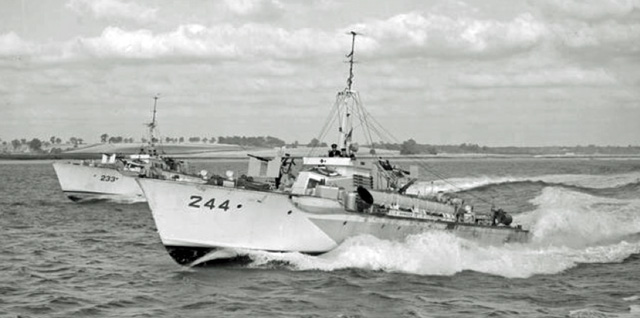 Two Vosper 72 foot Motor Torpedo Boats
Photograph A25856 courtesy of the Imperial War Museum
George’s MTB 82 waspart of the naval support for the Allies’ invasion of Sicily. On 16 July, in the waters between Sicily and the “toe” of mainland Italy, some German E-Boats (their navy’s fast attack boats) were sighted and engaged by four MTBs, including George’s MTB 82. During the melee, the MTBs were also engaged by shore batteries, during which MTB 82 suffered a near miss. This wounded both its Commanding Officer (T/Lt R A Johnson, RNZNVR) and George – in the latter case, so severely that he died of his wounds.
George is commemorated on the Portsmouth Naval Memorial as one of the nearly 15,000 naval personnel of WW2 with no known grave. As it is known he died of his wounds, it must be that he was then buried at sea.
Roger Morgan © 2019
Please contact us if you have information or pictures that can extend this entry.
STEELE, Frederick Robert Ellis. Signalman (2328600)
Royal Corps of Signals.
Died 13 August 1941, aged 20
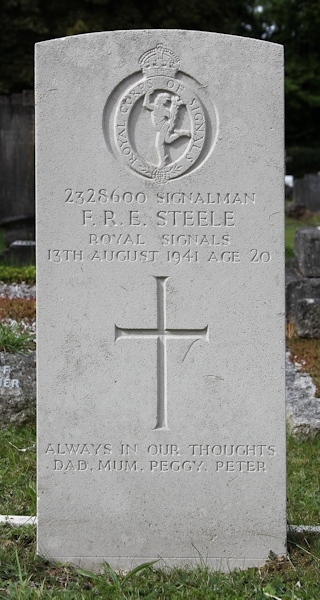 Frederick’s headstone in Epsom Cemetery
Image courtesy of Clive Gilbert © 2018
Frederick was born in Q2 1921, the second of three children born to William Ernest Steele and Ada (née Ellis). Their Q3 1918 marriage had been registered in the Fareham District of Hampshire – as were Frederick’s birth and that of his older sister Constance P in Q4 1919. The birth of the couple’s third child, Peter, was registered in Dorking Q3 1927.
The September 1939 Register recorded the parents living at the “Epsom County Institution & Hospital” – presumably what became Epsom General Hospital in Dorking Road, but still feeling its origins as the Workhouse. 50 year old William is listed as the “Master & Steward, Epsom County Institution & Hospital” and 51 year old Ada as “Matron, Epsom County Institution”. Immediately following their entries is a currently closed record which could be covering either the 19 year old Constance or the 18 year old Frederick. Not closed is the next record, for 11 year old schoolboy Peter.
The Commonwealth War Graves Commission records note that Frederick’s WW2 service was in the Royal Corps of Signals but, disappointingly, the readily available records provide no details about either the nature or location of this.
Frederick’s death on 13 August 1941 was registered in the Surrey South Western District. His body was brought home for burial on 16 August in Epsom Cemetery, where the records note that he had been “Discharged from HM Forces” and had died in the Surrey County Sanatorium (a TB hospital), Busbridge, near Godalming.
His family took the option of adding a personal inscription to his headstone on Grave K.30,
“Always in our thoughts. Dad, Mum, Peggy, Peter”
Roger Morgan © 2018
Please contact us if you have information or pictures that can extend this entry.
STEPHENS, Geoffrey John. Able Seaman (P/JX 329166)
HMS Penelope, Royal Navy
Died 18 February 1944, aged 19
Not listed in the Book of Remembrance
Geoffrey was born Q3 1924, the third and last child of Alfred Horton Stephens and Alice Mary (née Marfell). The parents’ Q1 1914 marriage had been registered in the Hampstead District. The birth of all three children – Geoffrey and his older sisters Dorothy (born Q2 1915) and Margaret (born Q4 1920) – were registered in the Pancras District of London.
Perhaps because of transcription errors, the family is not readily found in the September 1939 Register. The Commonwealth War Graves Commission records note that the parents were “of Epsom, Surrey” but this may be the common misunderstanding of Tattenham Corner being in the Borough rather than just over the border into Banstead: when Alfred died on 13 November 1960, the Probate records note that his address was 15 Garlichill Road, Tattenham Corner. In any event, the 19 May 1944 Probate record of administration of Geoffrey’s £ 132 estate being awarded to his (“Fire Insurance Clerk”) father, lists the family address as 151 Headstone Lane, Harrow.
Anyway, Geoffrey’s WW2 service was as a Stoker on HMS Penelope – an Arethusa-class light cruiser commissioned in November 1936. Most of this ship’s illustrious WW2 career is described in the article on Herbert Knight who was killed on 8 October 1943 in the aftermath of yet another successful action, this time off Rhodes.
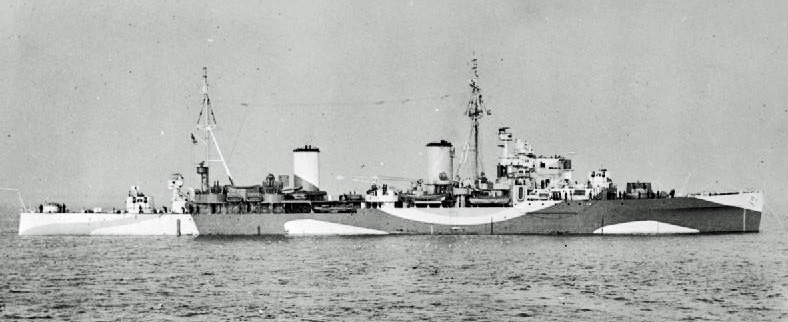 HMS Penelope at Spithead, 23 December 1942
IWM Photograph FL4822 – Public Domain
After the repairs (carried out in Alexandria) necessary after that action HMS Penelope was back in action by February 1944 when she was involved in helping operations at the Anzio beachhead by bombarding the enemy’s positions. The Anzio landings were intended to outflank the German forces that, at their well-prepared defensive “Winter Line”, were holding the Allies advancing north from the “foot” of Italy. The initial landings were the intended surprise but, instead of capitalising on this and advancing to the high ground, the local commander took time to prepare for the expected counter-attack. When this came, the Allies were pinned down in the marshy area round Anzio. The operation was nearly as disastrous as WW1’s Gallipoli landings and it was only with very heavy casualties over the next four and half months that the Allies prevailed.
However, HMS Penelope’s demise was not the result of fighting in the Battle of Anzio. On 18 February 1944, she was heading for Allied-held Naples some 90 miles south of Anzio to re-stock on ammunition when, at 0658 hours, she was hit in the after engine room by a T5 acoustic torpedo fired by U-Boat U-410. (The acoustic torpedo was a fairly new development and used sophisticated electronics to home in on the distinctive noise “signature” of the selected target.) When first hit, the cruiser was making 26 knots or 30 mph – understood to be the first and only time during WW2 that a ship running at such speed was successfully attacked by a U-boat. At 0716 hours, U-410 fired another torpedo. This hit HMS Penelope in the after boiler room, causing a massive explosion and the cruiser sank immediately. She was 35 miles west of Naples.
415 of the crew, including the captain, Geoffrey and Leslie Marsh went down with the ship. There were 206 survivors.
Geoffrey is one of the nearly 15,000 Commonwealth WW2 sailors with no know grave commemorated on the Portsmouth Naval Memorial.
Roger Morgan © 2018
Please contact us if you have information or pictures that can extend this entry.
STEPHENSON, Thomas. Gunner (1788700)
78 Battery, 35 Light AA Regiment, Royal Artillery
Died 14 March 1944, aged 39
The Commonwealth War Graves Commission’s information about Thomas and his family background is simply that he was the “son of Mr and Mrs Edward Stephenson; and husband of Martha Stephenson, of Epsom, Surrey.”
However, Thomas seems certain to be the child whose birth was registered Q4 1904 in Chester Le Street, Durham. He was at least the second child of Edward Stephenson and Elizabeth J (née Simm) who had married, also in Chester Le Street, in Q4 1899. The family were recorded in the 1911 Census living in two rooms at 17 Elm Street, Chester Moor, Chester Le Street. 39 year old Edward is listed as a “Colliery Engineman Stationary Above Ground”. As usual for the time, no occupation is listed for 33 year old housewife Elizabeth who had her hands full with three children: 7 year old William; our 5 year old Thomas; and new-born Ernest. (The return notes that the couple had had two more children who had died.)
Thomas is next found in the readily available records in Bradford as a nearly 23 year old marrying 21 year old Martha A Johnson, Q3 1927. Martha’s background and how either came to be in Bradford has so far proved elusive. Nor has any reason yet been found for their (or at least Martha’s) move to the Borough. However, by the time of the September 1939 Register, the married Martha Stephenson (born on 1 April 1906) is found at 45 Woodlands Road, Epsom and working as a “Laundry Ironer”. (She was the third entry at that address, the first two of which are currently closed ones, so was presumably a lodger there.)
Thomas is not found in the Register, presumably because he was already in uniform. His WW2 service was in 78 Battery of the Royal Artillery’s 35th Light Anti-Aircraft Regiment. In the early days of WW2, the Battery was stationed in the Reading area. In November 1941, the Regiment was kitted out for service in Iraq and, with others, set off in a convoy bound for Basra in the Persian Gulf.
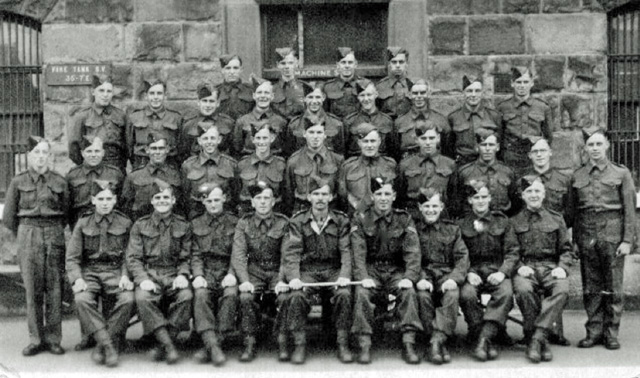 Understood to be 78 Battery – of which the 35 year old Thomas
would be one – before its 1941 move abroad.
Picture with thanks to Rob Baxter, via www.wartimememoriesproject.com
In view of the Japanese advances in the Far East, the Regiment and some others were diverted to Singapore. Just before Singapore fell to the Japanese on 15 February 1942, 78 Battery and some others were withdrawn to defend the allied bases in Borneo. Notwithstanding stout resistance there, the Japanese forces again proved unstoppable. Members of 78 Battery were among those ordered to capitulate by noon on 9 March 1942 and then taken Prisoners of War.
Doubtless after some intermediate stages, Thomas finished up in the Kuching PoW Camp (Also known as the Batu Lintang Camp) on Borneo’s north-west coast. The camp was unusual in that it also housed civilian internees – although this does not seem to have led to any relaxation in the extremely harsh conditions that were standard in Japanese camps.
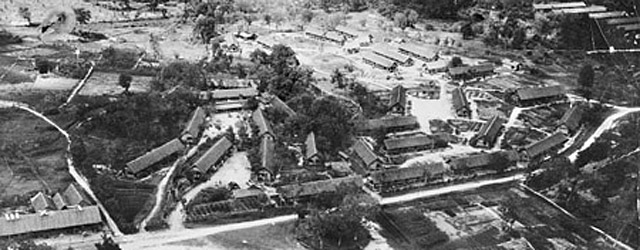 The Kuching (or Batu Lintang) PoW Camp on Borneo, in late August 1945
Photograph 044152 from the Australian War Memorial Collections, Public Domain
The cause of Thomas’s death on 14 March 1944 was recorded as Malaria – and the record card notes his “Place of Domicile” as Epsom Downs, Surrey. Thomas was initially buried in Grave C.14 of the Kuching CofE Cemetery. On 13 June 1946, he was re-interred in Grave J.D.2 of the new Labuan War Cemetery. This is sited on an island off northern Borneo, now part of Malaysia, and holds 1,791 Commonwealth WW2 casualties.
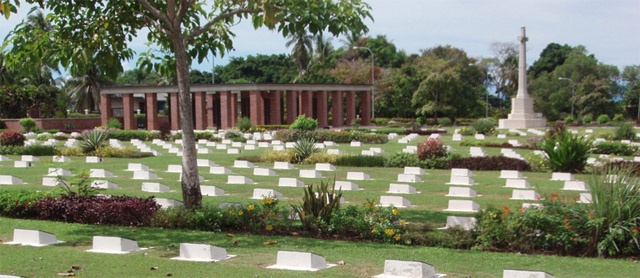 Part of the Labuan War Cemetery
Photograph with thanks to the Commonwealth War Graves Commission
Roger Morgan © 2019
Please contact us if you have information or pictures that can extend this entry.
STEVENS, James William. Private (6138872)
1st Battalion, East Surrey Regiment.
Died 22 May 1940, aged 25.
The family background given by the Commonwealth War Graves Commission for James is not only unusually brief (being only “Son of John and Doris Stevens”) but also incorrect. While he was the son of John Stevens, his mother was Ada (née Kitcherside). Untangling this requires quite a lot of explanation, so it will be a few paragraphs before we get to James’s WW2 service.
Parents John and Ada had married in Q1 1897, registered in the Croydon District, and are found in the 1901 Census with two children (new-born Annie and 3 year old Frederick) living at 7 Station Road, Carshalton. 28 year old John is listed as a “General Labourer” and born in Carshalton. As usual at the time, no occupation is listed for 24 year old housewife Ada. She is shown as having been born in Epsom, and was one of the well-established Epsom Kitcherside family: the 1881 Census records her as one of four children living with their parents, Thomas (a “Bricklayer”) and Emily Kitcherside, in 2 Smarts Cottages, Epsom Common.
By the time of the 1911 Census, the family (with 38 year old John now listed as a “Farm Labourer”) were living at the now lost 29 Wandle Mount in Central Carshalton with their six surviving children (two having died in infancy). The Census return shows all the children as having been born in Carshalton, and it is important to note that, until the 1934 introduction of the larger “Surrey Mid-Eastern” District, Carshalton fell within the “Epsom” Registration District (which stretched as far as Leatherhead and Oxshott in the opposite direction). It therefore seems certain that the births of the couple’s last two children – Ellen in Q1 1912 and James (the main subject of this article) in Q2 1914 – were, although registered in the Epsom District, also in Carshalton.
James’s mother, Ada, died aged 40 in Q4 1916. In Q2 1918, his father, John, married the widowed Mary Ann Emily Clauson (née Faulkner). Mary was originally from Carshalton, but it was in Plaistow that she married Joseph William Clauson on 25 November 1901. This couple settled in the East Ham area and had five children (one of whom died in infancy). On 6 November 1914, Joseph (a “Labourer”) signed up for the duration of WW1. The attestation papers note the family address as 145 Katherine Road, East Ham. With the service number 42244, he served as a Gunner in D Battery of the Royal Field Artillery’s 103rd Brigade. He was killed in action on 12 November 1916 and is buried in the Martinpuich British Cemetery, Pas de Calais, France. (The Commonwealth War Graves Commission database has his surname slightly wrong, giving it as “Clanson”.)
Anyway, John and Mary’s Q2 1918 marriage was in Carshalton, and the Electoral Roll taken later that year records their address as “Ferndale”, Butter Hill, Carshalton. They had three children together, the last of whom was born on 8 August 1922 and named Doris. With reference to the confusion noted at the head of this article, might it be that she was involved in post-war exchanges with the Commonwealth War Graves Commission about her half-brother’s death, and the Commission took her as John’s mother? (The couple – with John as a “Night Watchman” – and two of their children were still at that address in the September 1939 Register.)
Given all this hard-won background, it is frustrating not to be able to have found the link with the Borough there must have been for James to be commemorated in the Epsom & Ewell Book of Remembrance. One possibility comes from the fact that one of James’s sisters, Daisy Violet, had, in Q1 1928, married Edward Grove. The September 1939 Register records that couple living at 62 West Street, Epsom (with 30 year old Edward as a “General Labourer, Road Repairs” and 32 year old Daisy with the conventional “Unpaid Domestic Duties”). Was it Daisy who secured her brother’s mention in the Borough’s Book of Remembrance?
At long last, we turn to James’s sadly short WW2 service – which was in the 1st Battalion of the East Surrey Regiment. This was sent to France in early 1940 as part of the British Expeditionary Force ready to repel the expected German invasion. However, when that invasion came on 10 May 1940, it was of unanticipated speed and ferocity and the BEF was pushed back, with survivors being evacuated mainly from Dunkirk in early June.
Many men were killed or captured during that fighting retreat, and James was one of the casualties – as recorded in Casualty List No. 242, being killed in action on 22 May 1940. Sadly, his body was lost and never recovered – or, if it was, he could not be identified. He is one of 4,513 members of the BEF commemorated on the Dunkirk Memorial as having no known grave.
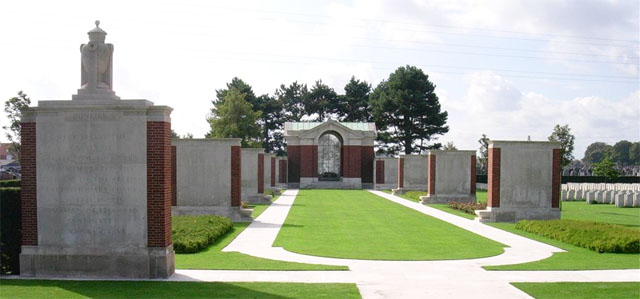 The Dunkirk Memorial
Photograph by the International War Graves Project via findagrave.com
Roger Morgan © 2020
With special thanks to Hazel Ballan for her help in
unpicking the complicated family background here.
Please contact us if you have information or pictures that can extend this entry.
STEVENSON, Ada Mary Pat
Civilian
Died 22 June 1944, aged 28
Ada is not listed in the Borough’s Book of Remembrance, but is included here because the Commonwealth War Graves Commission’s post-war records note that she was “of 19 The Drive, Ewell, Surrey.” While the Commission also notes that she was the “daughter of Mr and Mrs Waller”, knowing her maiden name has not proved enough to trace her 1916/17 birth or family background in the readily available records.
Of more use is the Commission’s additional note that she was the “wife of Frederick Leefe Stevenson”. Their Q2 1942 marriage was registered in the Wandsworth District. While the yet to be married Ada is not readily found in the September 1939 Register, Frederick (born 5 September 1916 and now working as an “Engineers draughtsman) was recorded living with his parents – Frederick senior (an “Analytical Chemist”) and Henrietta – and several siblings at 125 Pendle Road, Wandsworth. As noted above, the married Ada and Frederick junior set up home at 19 The Drive, Ewell. There is no record of their having any children.
The Commonwealth War Graves Commission’s final note on Ada is that, on 22 June 1944, she was killed by enemy action while at 27 Woodmansterne Road, Wandsworth. It is not known why she was there, and the 1939 Register is of no help in establishing the possible occupants as the property vacant when the Register was taken.
Ada was buried in Wandsworth cemetery. In Q3 1946, The widowed Frederick married again – to Audrey M Churchman, registered in the Surrey North Eastern District.
Roger Morgan © 2018
Please contact us if you have information or pictures that can extend this entry.
STEWART, Donald John. Flying Officer (172377)
Royal Air Force Volunteer Reserve.
Died 23 July 1944, aged 31.
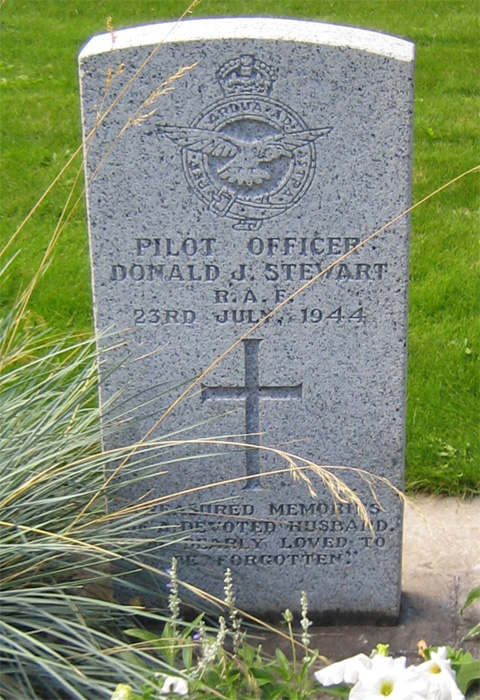 Donald’s headstone in the Red Deer Cemetery, Alberta, Canada
Photograph (109655241) by Maureen Klingenberg via findagrave.com
Donald was born in Epsom on 14 February 1914, apparently the only child of Allan and Gertrude Stewart. The parents had married in Epsom in Q4 1912 having doubtless met during their work in the “Epsom Cluster” of mental hospitals – to which they had moved a few years before.
His father, Allan Lachlan Stewart had been born in Glenelg on the west coast of Scotland (with Skye just across the strait) on 25 May 1876 and is found in the 1901 Census as a 24 year old Warder in HM Prison, Perth. By the time of the 1911 Census he is recorded as a 34 year old “Attendant” at the Long Grove Asylum, Epsom.
Donald’s mother was born as Gertrude Maria Etheridge in Belvedere, Kent on 13 August 1884. The 1891 Census finds her as a 7 year old “scholar” living with her now-widowed mother (“Own Means – No Occupation”) mother, Frances, and two older siblings in nearby Erith. By the time of the 1911 Census, she is recorded as a 27 year old “Asylum Nurse” also at the Long Grove Asylum.
The couple later made their home at 3 Tonstall Road, Epsom and are found there in the September 1939 Register – in which 63 year old Allan is listed as “Gate Porter, Hospital”. (55 year old Gertrude is listed with the conventional “Unpaid Domestic Duties”.)
Donald followed his parents into work in the “Epsom Cluster” and it seems likely (from her post-war emigration records – of which more below) that this is where he met Ada Louvain Armitage. She had been born in Middlesborough on 9 February 1915.
Donald and Ada married in Q2 1938 (registered in the local Surrey Mid-Eastern District), and the couple are found in the September 1939 Register living alone at 13 Chessington Close, Ewell. 25 year old Donald’s occupation is shown as “Mental Nurse (R M P A Qualified)” and 24 year old Ada with the conventional “unpaid domestic duties”.
Donald enlisted in the RAF at Blackpool in June 1940 with a Service Number 1320884. In Q4 1940, the couple’s only child was born – named Donald John, like his father.
Donald rose to the rank of Sergeant before being commissioned as a Pilot Officer on 18 November 1943. In mid 1944, He is then found attending the No. 36 Service Flying Training School (SFTS), Penhold – about halfway between Edmonton and Calgary in Alberta, Canada – where he is likely to have been on conversion training in the School’s Airspeed Oxfords. As illustrated below, these were twin-engine light transport aircraft, designed for all aspects of aircrew training.
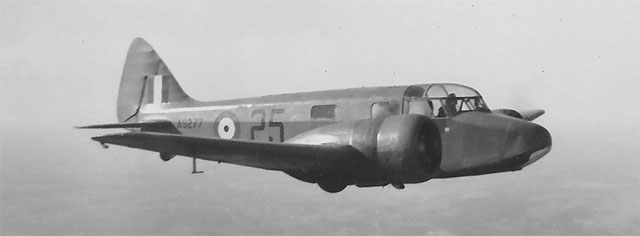 An Airspeed Oxford trainer.
Photograph By Bob Brown via Wikimedia Commons
Training new flight crew was an urgent and essential task to make up horrendous operational losses. During the Battle of Britain, the average life expectancy of a Spitfire pilot was 4 weeks. In Bomber Command, 51% of aircrew were killed on operations, 12% were killed or wounded in non-operational accidents and 13% became prisoners of war: only 24% surviving the war unscathed.
Although away from the front line, flight training was also a risky business. Only three days before Donald’s death, two of the School’s aircraft had collided in mid-air. A number of the casualties recorded on these pages were in flight training accidents. During WW2, Bomber Command lost 8,000 men in training accidents or other non-operational flying.
When Donald’s death came, however, it had nothing to do with flying. The official record notes that this “occurred at Sylvan Lake, Alberta, at 23:25 hours on the 23rd July 1944, as a result of accidental drowning while bathing.” The town of Sylvan Lake is some 20 miles from the SFTS at Penhold and borders the 10-mile long lake from which it gets its name. Swimming in the lake at about midnight would be out of the ordinary, even in July. It may be relevant that there was a pub/bar nearby.
Donald was buried in the Red Deer Cemetery about 10 miles north of the Training School – one of 39 Commonwealth WW2 casualties there. His widow took the option of adding a personal inscription to his headstone on Grave F.7,
“Treasured memories / of a devoted husband. / ‘Too dearly loved to / be forgotten.’ “
He had been promoted to Flying Officer on 18 July 1944, less than a week before his death. However, this seems not yet to have caught up with him in Canada: his death certificate, headstone (as at the head of this article) and other local monuments (see below) all record his rank as “Pilot Officer”.
On 23 December 1948, the widowed Ada and son Donald sailed from London on the P&O liner Mooltan to emigrate to Australia, aiming for an address in Toowoomba Road, Oakey, Queensland. The ship’s passenger manifest lists her as a “hospital worker” – hence the suspicion noted above that she had met her late husband as a fellow worker in the Epsom “cluster”.
While the Commonwealth War Graves Commission’s post-war database notes that Ada was “of Ewell” – consistent with the 13 Chessington Close address at which the couple was found in the 1939 Register (which was also noted as Donald’s home address in the 15 March 1945 Probate records) – the 1948 manifest notes that her last address in the UK had been that of her parents-in-law at 3 Tonstall Road, Epsom.
Left: the British Commonwealth Air Training Plan Monument in the Red Deer Cemetery to those who lost their lives while at 36 SFTS RAF Penhold.
Photograph with thanks to 703 (Central Alberta) Wing of the RCAF Association.
Right: Memorial at the former RAF Penhold to Donald and other 36 SFTS casualties .
Photograph with thanks to the Harvard Historical Aviation Association.
As illustrated above, Donald is commemorated on two memorials local to what was RAF Penhold (since decommissioned and now known as Springbrook) in central Alberta. On the left is a memorial (on which Donald’s name is arrowed) that stands in front of the RAF graves in the Red Deer Cemetery. It was dedicated in 1989 by the 703 (Central Alberta) Wing of the Royal Canadian Air Force Association, ex-Royal Air Force members and friends to mark the 50th anniversary of the agreement that made Canada the main training area for Commonwealth airmen.
On the right is a memorial (as arrowed) to Donald and others at both the former RAF Penhold and the 32 EFTS at RAF Bowden. It was dedicated by the Harvard Historical Aviation Society on 3 October 2015. (The photograph above was taken on Remembrance Day 2019.) It joined other memorials there – including the RCAF Harvard advanced single-engine training aircraft that was used when the former 36 SFTS became the RCAF’s No. 4 FTS in early 1951, training pilots from NATO countries until its closure in 1965.
Roger Morgan © 2021
with thanks to Hazel Ballan for tracing the couple’s marriage and the birth of their son,
to Brian Bouchard for tracking down some career details, and
to Bill Mackay of the Harvard Historical Aviation Society for the incident and local memorial details.
Please contact us if you have information or pictures that can extend this entry.
STONE, Arthur John.
Civilian
Died 17 May 1941, aged 51
Not listed in the Book of Remembrance
The Commonwealth War Graves Commission gives no family background for Arthur, noting only that he was injured in 1941 at the Queen’s Road Homes, Croydon. He is found there in the September 1939 Register – as an unmarried and “incapacitated” inmate, born on 12 September 1890. Even equipped with that birth date, however, it has so far proved impossible to trace more of his background in the readily available records.
The Queen’s Road Homes were originally the Croydon Workhouse, built in 1865/66 to replace two workhouses which were proving to small to serve the growing area.
 The new Croydon Workhouse in 1866.
(The central part of the building still stands, now converted for residential use.)
Photograph with thanks to workhouses.org.uk
The workhouse was taken over by Croydon Borough Council in 1930 and were renamed the “Queen’s Road Homes” after their location. In many ways, little else changed for the inmates who, according to new rules issued in 1930, were prohibited from possessing alcohol, knives, razors, heavy belts, dice, or playing cards. Everyone was searched on admission, and any money or valuables were taken away for safe keeping. Inmates had to rise at 7am, then work from 8am until 5pm. Bedtime was 8pm in winter and 9pm in summer. Miscreants would be placed in solitary confinement for up to 12 hours.
It is not known at what point John was admitted to the institution, but he could well have been a long term resident rather than someone admitted in the mid-30s when the emphasis began to shift to the care of the elderly – or, indeed, someone admitted as a chronic sick case after the outbreak of WW2, when the Homes were reclassified as a Class 2 Hospital under the Emergency Hospital Scheme.
On 16 April 1941, the main part of the building was severely damaged by a German land mine. The northern wing and the chapel were completely destroyed. Many were killed or, like Arthur, injured. He was taken to Horton Emergency Hospital, one of Epsom’s “cluster” of mental hospitals that, as for WW1, had been taken over for dealing with wartime casualties, but died there a month later, on 17 May 1941.
John was buried in Grave M427 of Epsom Cemetery on 22 May 1941.
Roger Morgan © 2018
Please contact us if you have information or pictures that can extend this entry.
STONE, Frank James. Private (6147768)
1st Battalion, East Surrey Regiment
Died 24 April 1943, aged 29
Frank was born in Epsom on 10 April 1914, the fifth child of “Platelayer” Albert Leonard Stone and Lucy Fanny (née Bishop – they had married in Christ Church Epsom Common on 14 September 1901). Like his many siblings, Frank was baptised at Christ Church.
Three years before Frank’s birth, the 1911 Census recorded the 30 year old parents and five children – from 2 year old twins Ellen and Kathleen to 9 year old William – living at 1 Yew Tree Cottage, Dorking Road, Epsom. Albert is listed as a “Platelayer on Railway”. As usual at the time, no occupation is shown for housewife Lucy. The return shows that the couple had had seven children, but two had died.
By the time of Frank’s baptism, the family was living at 17 Woodlands Road on Epsom Common. His father, Albert, died in 1936 and the September 1939 Register records the widowed Lucy (a “laundress”) still at 17 Woodlands Road with two of her children: the 25 year old Frank (a “timber stacker”); and 21 year old Bessie (a “Probation Nurse”).
Frank’s WW2 service was in the 1st Battalion of the East Surrey Regiment. It is not clear from the readily available records if he if was involved in the April 1940 deployment to France as part of the British Expeditionary Force (BEF), its subsequent action in the Battle of Belgium, and the evacuation of its survivors from Dunkirk in June 1940. After Dunkirk, the Battalion was reformed – and was assigned to 11th Infantry Brigade, part of 78th Infantry Division, with which it remained for the rest of the war.
However, it is certain that Frank was involved in the extensive preparations for “Operation Torch” in late 1942 – the first Anglo-American operation of the War. These Allied landings in Morocco and Algeria on 8 November 1942 aimed to move along the North African coast as a pincer movement against German forces which, thanks to Allied success at El Alamein, were held in the east. Frank’s Battalion landed at Algiers, the easternmost of the three landings. (Unlike the landings at Oran in Algeria and on the Atlantic coast of Morocco, the Vichy French forces in Algiers were quickly overcome.)
The Germans responded immediately by sending a force from Sicily to northern Tunisia, which checked the Allied advance east in early December. In the south, the Axis forces that had been defeated at El Alamein withdrew into Tunisia along the coast through Libya, pursued by the Allied Eighth Army.
 Frank’s Battalion moving up to the front line at Recce Ridge, April 1943.
Photograph 106276 from the National Army Museum Collection
By mid April 1943, the combined Axis force was hemmed into a small corner of north-eastern Tunisia and the Allies were grouped for their final offensive. That assault against Tunis and Medjez-el-Bab began in April 1943. It involved much fierce fighting during which Frank was killed on 24 April. The Axis forces finally surrendered in early May.
All these actions were alongside the East Surrey’s 1/6th Battalion, so it may be that Frank knew fellow Christ Church parishioner Arthur Weston who was killed 10 days later, just before Tunis was finally taken.
Frank is one of the 2,525 Commonwealth WW2 burials in Medjez-El-Bab War Cemetery, about 35 miles west of Tunis. His mother took the option of adding a personal inscription to his headstone on Grave 4.G.15,
“He fought a good fight, he finished his course, he kept the faith.”
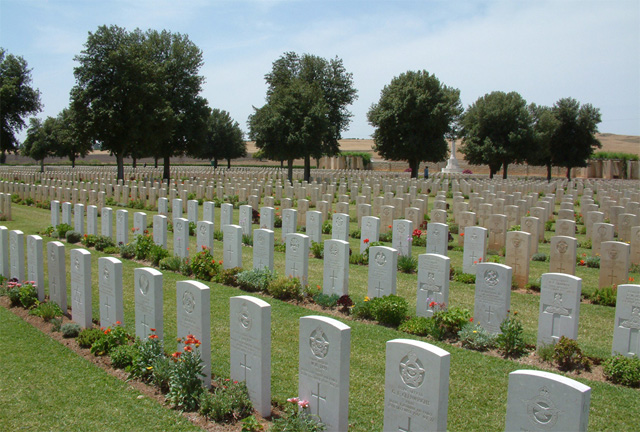 The Medjez-El-Bab War Cemetery, Tunisia
Photograph with thanks to the Commonwealth War Graves Commission
Roger Morgan © 2017
Please contact us if you have information or pictures that can extend this entry.
STONE, Lewis Oliver
Civilian
Died 7 November 1940, aged 52
Not listed in the Book of Remembrance
Lewis was born in Epsom on 21 June 1888, about the middle of 11 children (two of whom died in infancy) of William Benjamin Stone and Eliza (née Bowles – they had married in Christ Church Epsom Common on 3 January 1989).
The 1911 Census records the 22 year old Lewis (a “Jobbing Gardener”) as the oldest of the three children still living with their parents, 59 year old William (a “Bricklayer”) and 52 year old Eliza. Eliza died in 1917 and William in 1921. Both are buried in Grave 224A in Epsom Cemetery where the records note their address as “4 Mill Road, The Common, Epsom.”
In Q3 1911, 23 year old Lewis married 21 year old Daisy W Sparrow (she had been born in Ewell on 18 December 1891). The marriage was registered in Epsom, as were the births of their four children between 1913 and 1931.
By the time of the September 1939 Register, the family (minus the oldest child, Winifred, who had married Archibald D J Hill Q3 1936, registered in the Surrey Mid Eastern District) were living at 67 Cheam Common Road, Worcester Park. 51 year old Lewis is listed as a “Gardener” and 47 year old Daisy with the conventional “Unpaid Domestic Duties”. 19 year old daughter Margaret was working as a “Shop Assistant Librarian” and both 10 year old Anthony and 7 year old Barbara were at school.
The Commonwealth War Graves Commission notes that Lewis died at 67 Cheam Common Road – his home – on 7 November 1940, presumably in one of the bombing raids of the Luftwaffe’s “Blitz” campaign. (If others of the family were injured in the attack, they survived.) Lewis is buried in the churchyard of St Dunstan’s, Cheam.
Roger Morgan © 2018
Please contact us if you have information or pictures that can extend this entry.
STONE, Reginald. Sergeant/Air Gunner (1585207)
106 Squadron, Royal Air Force Volunteer Reserve
Died 31 January 1943, aged 20
Reginald (known in the family as “Reg”) was born on 22 December 1922, registered in the Wandsworth District Q1 1923. The Commonwealth War Graves Commission’s usual brief sketch of his family background is “Son of Rose Mary Stone, of West Ewell, Surrey”. The reality is more than a little complicated.
His mother, Rose Mary (née Fox) had, when she was aged 28, first married the 39 year old James Sullivan in Q1 1919, registered in Wandsworth. James had served as a Private during WW1 (initially with the Service No. 8649 in the RASC and then, with the Service No. 301361, in 719 Company of the Labour Corps). Their marriage was only a few weeks before James died on 19 February 1919 in No. 30 General Hospital, Calais.
He was buried in Les Baraques Military Cemetery, Sangatte. By the time his long-term headstone was being made, the widowed Rose (noted in the Commonwealth War Graves Commission’s records as being of 38 Chatham Street, Orkney Street, Battersea) had given birth to their daughter, Rosemary, on 25 June 1919, also registered in the Wandsworth District. Rose took the option of adding a personal inscription to James’s headstone on Grave VII.D,4,
“Deeply missed by his wife & daughter.”
Rose had not married again but her second child, Reginald (born, as noted above, on 22 December 1922) was registered with the surname Stone. By 1935, she was in a relationship with Geoffrey Reynolds Mason and living at 100 Revelstoke Road, Southfields.
The couple (with Rose coming to this as “Rose Mary Sullivan”) married in Q2 1939, registered in the local Surrey Mid Eastern District, and the September 1939 Register recorded them living at 53 Green Lanes, West Ewell. In the order on the return, the seven at the address were as below.
• 49 year old Rose Mary Mason, recorded as “Housewife Unpaid Domestic Duties” – and with her entry annotated to record that she was “known as Mrs Sullivan”.
• Her husband, 39 year old Geoffrey Reynolds Mason, listed as “Hall Porter (Hospital)”.
• Rose’s first child, 20 year old Rosemary Sullivan, listed as “Window Dresser & Shop Assistant, Woolworths Ltd”.
• Her other child, nearly 17 year old Reginald Stone, listed as “Shop Assistant (Florist & Gardener’s).
• Rose’s widowed 77 year old mother Charlotte Fox, listed with the conventional “Unpaid Domestic Duties”.
• 41 year old Joseph Vernon Malet, listed as a “Representative, Wholesale Groceries”.
• Joseph’s nearly 24 year old wife, Doris Muriel Malet (Geoffrey’s younger sister and thus Rose’s sister-in-law), listed as a “Private Secretary” – and with her entry annotated to record that she was “working under her maiden name – Mason, Miss”.
During September 1941, Reginald enlisted with the Royal Air Force at Weston super Mare. After training, he was assigned to 106 Squadron, part of the RAF’s Bomber Command, stationed at RAF Syerston, near Newark in Nottinghamshire, and equipped with Avro Lancaster heavy bombers.
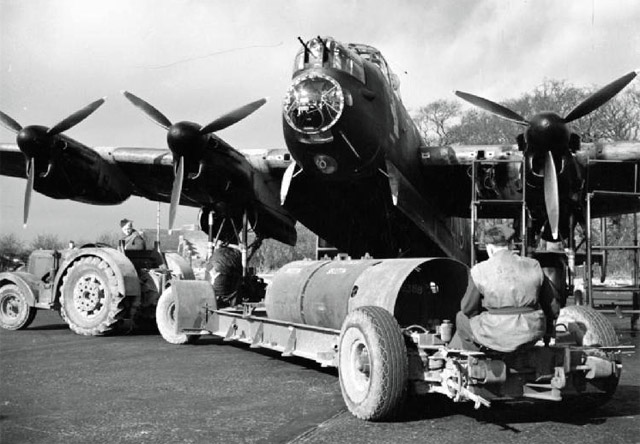 An 8,000-lb HC bomb (‘super cookie’) being brought to an Avro Lancaster
of 106 Squadron at RAF Syerston, for an attack on Stuttgart.
Official RAF photograph, CH 12595 in the IWM Collections, Public Domain
On 31 January 1943, Reginald was an Air Gunner aboard 106 Squadron’s Lancaster W4826 ZN-D which took off from RAF Syerston at 00.10 hours to participate in a bombing raid on Hamburg.
The aircraft is reported to have been hit by Flak – of “M. Flak Abt. 222 (Flak Ugruko Süd), 1./schw. Flak Abt. 117 (o), 4./schw. Flak Abt. 531 (o), 2. & 3./schw. Flak Abt. 615 (v), 1./schw. Flak Abt. 231 (o) and 2./schw. Flak Abt. 223”. The damage caused the aircraft to crash in flames. One report was of this occurring at the railway station of Imsum at 03.20 hours. However, in the Marine Flak Abschussmeldung, the time of crash was noted as 02.58 hours, and the crash location as “near Neuenwalde”. These two named locations are only about 5 miles apart, so there is not necessarily a discrepancy here and both are about 50 miles east of Hamburg.
In either event, the crash killed all the crew who were:-
• P/O Christopher J J Gill
• Sgt. Howard E Johnson
• Sgt. Norman Marshal
• Sgt. James Langrell
• Sgt Willie Cotton
• Sgt. Donald Coy
• Sgt. Reginald Stone.
They were initially buried in the local Geestemunde Cemetery, on the outskirts of Bremerhaven. On 5 November 1946, their remains were re-interred at the Becklingen War Cemetery, Niedersachsen, about 40 miles south of Hamburg. (The cemetery is on a hillside overlooking Luneburg Heath where, on 4 May 1945, Field-Marshal Montgomery accepted the German surrender from Admiral Doenitz.) It contains 2,374 Commonwealth WW2 burials of the Second World War.
Reginald’s mother took the option of adding a personal inscription to his headstone on Grave 20.B.12,
“In proud and loving memory of Reg, my only son, brother of Rosemary. Mum.”
 The Becklingen War Cemetery
Photograph courtesy of “hajotthu” via Wikimedia Commons
Rose Mary Mason died aged 67 in Q4 1957, registered in the local Surrey Mid Eastern District.
Brian Bouchard & Roger Morgan © 2018
Please contact us if you have information or pictures that can extend this entry.
STURT, George Stanford. Captain (156965)
Royal Artillery
Died 8 August 1944, aged 32
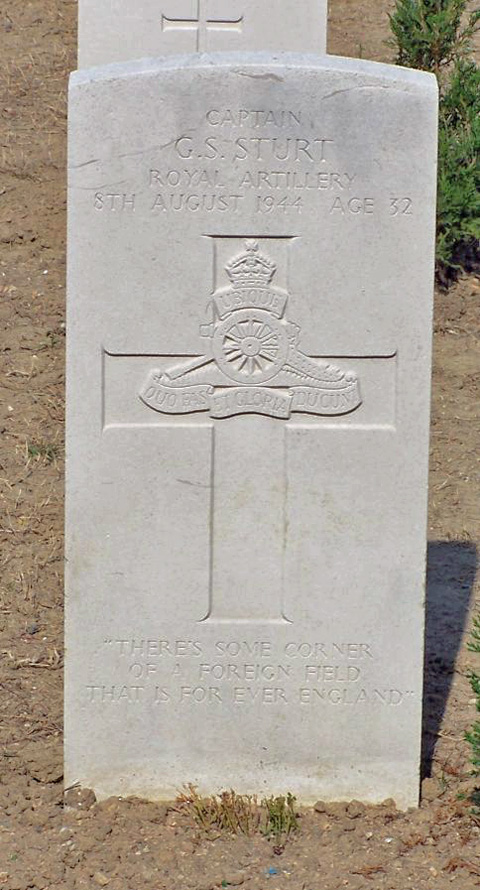 George’s headstone in the Sai Wan War Cemetery, Hong Kong.
Photograph (15218015) by Chris Nelson via findagrave.com
George was born in Epsom Q2 1912, the fifth and last child (one of whom had died) of Francis Edward Sturt (known as “Frank”) and Zara Beatrice Irene (née Alcock). They had married Q3 1902 in the now lost Hanover Chapel in Regent Street.) Frank’s and Zara’s families were from Leatherhead, but the couple made their home in Epsom. The 1911 Census Records the 47 year old Frank (a “Jobber London Stock Exchange”) living at Longdown Lodge, College Road, Epsom, with two of his children (4 year old Molly and new-born John – also a WW2 casualty), supported by four servants. On that Census night, however, the 34 year old Zara and the couple’s first child, 7 year old Frank, were visiting Zara’s late 60s parents – George (a “Retired Schoolmaster”) and Lucy Sophia Alcock at “Quandon”, Highlands Road, Leatherhead.
George’s secondary education was at Haileybury School in Hertfordshire. Following in the footsteps of his father, he became a stockbroker. (His father died aged 74 in Q2 1938. There is an early 1940s record of the widowed Zara living at 13 Bridge Road, Epsom.) In Q2 1939 and registered in the local Surrey Mid-Eastern District, 27 year old George married 21 year old Ann Watney. (Ships’ manifests of her travelling first class with her mother on visits to Toulon in 1927 and Rio de Janiero in 1936 list her home address as “Treetops”, Highlands Road, Leatherhead – and they were thus near neighbours of George’s maternal grandparents. And the Commonwealth War Graves Commission’s post-war records list the widowed Ann as being “of Leatherhead, Surrey”.) Their only child, Susan, was born in Leatherhead on 14 July 1940. She became the noted writer, Susan Howatch.
George’s WW2 service was in the Royal Artillery, into which he (alongside brother John) was commissioned as a 2nd Lieutenant on 16 November 1940. He was posted to India and became a qualified Armourer-Gunner-Observer. In that capacity, he was, on 8 August 1944, a member of the team aboard USAF Consolidated B-24 “Liberator” heavy bomber (44-40846). The aircraft was of the 9th Bombardment Squadron (of the 7th Bombardment Group, 10th Air Force), which was being used to fly fuel and supplies from India over the Himalayas to the Chinese and United States Army Air Forces based in China. About 20 miles south of Luliang in NE China, the plane crashed and all aboard were killed.
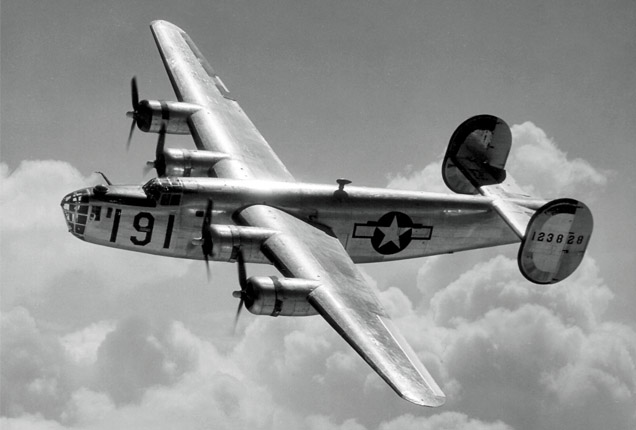 A USAF Consolidated B-24 “Liberator”
USAF official photograph, Public Domain
George is buried in the Sai Wan War Cemetery on the island of Hong Kong. The widowed Ann took the option of adding a personal inscription (taken from Rupert Brooke’s WW1 poem, “The Soldier”) to his headstone on Grave I.C.10,
“There’s some corner of a foreign field that is for ever England.”
Roger Morgan © 2018
Please contact us if you have information or pictures that can extend this entry.
STURT, John Edward. Lieutenant (156870)
Royal Artillery
Died 5 March 1943, aged 33
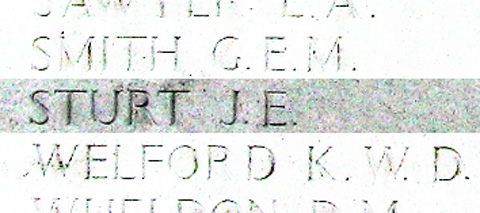 John’s name on Column 3 of the Singapore memorial
Part of photograph (56236244) by “stombell” via findagrave.com
John was born in Epsom Q3 1910, the fourth of five children (one of whom had died) of Francis Edward Sturt (known as “Frank”) and Zara Beatrice Irene (née Alcock). They had married Q3 1902 in the now lost Hanover Chapel in Regent Street.) Frank’s and Zara’s families were from Leatherhead, but the couple made their home in Epsom. The 1911 Census Records the 47 year old Frank (a “Jobber London Stock Exchange”) living at Longdown Lodge, College Road, Epsom, with two of his children (4 year old Molly and new-born John), supported by four servants. On that Census night, however, the 34 year old Zara and the couple’s first child, 7 year old Frank, were visiting Zara’s late 60s parents – George (a “Retired Schoolmaster”) and Lucy Sophia Alcock at “Quandon”, Highlands Road, Leatherhead. The couple’s fifth child, George – also a WW2 casualty – was also born in Epsom Q2 1912.
John’s secondary education was at Haileybury School in Hertfordshire. John followed his stockbroker father into the finance sector, but worked in banking. (His father died aged 74 in Q2 1938. There is an early 1940s record of the widowed Zara living at 13 Bridge Road, Epsom.)
John’s WW2 service was in the Royal Artillery, into which he (alongside brother George) was commissioned as a 2nd Lieutenant on 16 November 1940. As part of an Anti-Aircraft unit, he was sent to Singapore to help defend against the expected Japanese invasion. As is well-known, Singapore was captured by Japanese forces in early February 1942. That was immediately followed by the negotiated mass surrender of the surviving Commonwealth forces – including John.
After processing in the Changi PoW camp, John was one of the 600 or so prisoners – all artillerymen or “Gunners” – loaded into the Kenkon Maru, one of the prisoner transports justifiably called “hell ships” by the prisoners. This left Singapore on 18 October and, after a number of intermediate stops, arrived at Rabaul (on New Britain, one of the Solomon Islands) on 5 November 1942. The prisoners were disembarked and marched to the Kokopo Camp where, as for other Japanese PoW camps, the regime and conditions were extremely harsh. On 15 November, the prisoners were paraded. About 80 were already too weak from hunger and disease to work, but the fittest 517 were sent – via another “hellship” – to build an airstrip on Ballali (one of the Shortland group of islands just south of Bougainville). Not one of them survived, but their story can be told thanks to native islanders briefing the Australian forces when the islands were subsequently liberated.
The extremely harsh treatment and conditions continued. Over the next few months, a good number of prisoners died from beatings, illness and from Allied bombing. In April 1943, the Japanese on Ballali were told by their headquarters that the US Navy was preparing for an attack and that, if this happened, all prisoners were to be disposed of by whatever means was available.
On 29 June 1943, an American warship bombarded the island. The next day, the surviving 400 or so prisoners were lined up and killed by sword or bayonet. The bodies were stripped of their identity tags and dumped in a large pit. In November 1945, this mass grave, containing 436 bodies, was uncovered. The remains of these British servicemen were recovered by 3 Division of the War Graves Unit of the Australian Army and, in December 1945, were finally interred in graves in the Port Moresby (Bomana) War Cemetery, in Papua New Guinea. As the bodies could not be identified, each one has all individual grave marked “A Soldier of the 1939-1945 War known only to God”.
It is not known precisely when, in this appalling series of events, John died. The official records still give 5 March 1943 as the date of death for all 600 Gunners who left Singapore on 18 October aboard the Kenkon Maru – a date appearing to originate in the Japanese untruth that the PoWs were still aboard when the Kenkon Maru was sunk some time after they had been disembarked at Rabaul.
It is quite likely that John is one of the many “known only to God” among the 3,138 WW2 casualties buried in the Port Moresby cemetery. However – and as illustrated at the head of this article – he is commemorated on the Singapore Memorial (which stands in Kranji War Cemetery on Singapore Island) as one of the more than 24,000 casualties of the land and air forces of the Commonwealth who died during the campaigns in Malaya and Indonesia or in subsequent captivity and have no known grave.
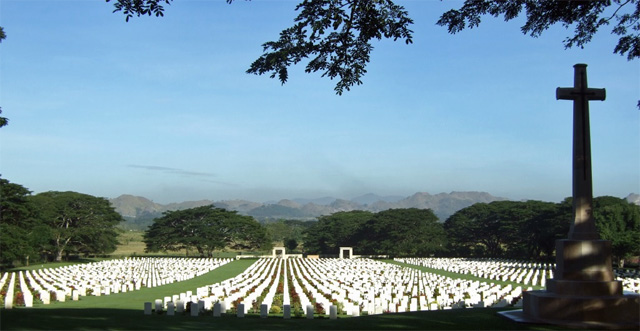 The Port Moresby (Bomana) War Cemetery, Papua New Guinea.
Picture with thanks to the Commonwealth War Graves Commission.
Roger Morgan © 2018
Please contact us if you have information or pictures that can extend this entry.
SUTTON, Frank Charles. Signalman (2333278)
Royal Corps of Signals
Died 16 September 1940, aged 22
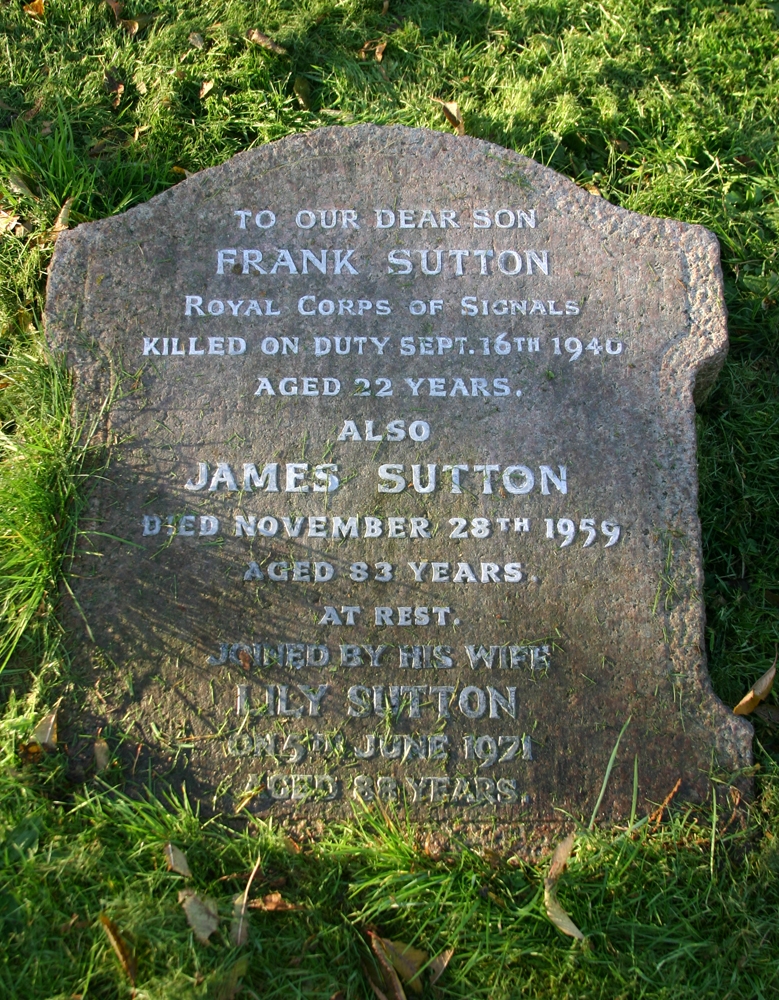 Frank’s headstone in St. Mary’s Cemetery Extension
Image courtesy of Clive Gilbert © 2018
The Commonwealth War Graves Commission notes that Frank was the “son of James and Lily Adelaide Sutton of West Ewell” but, as set out below, it seems that things were more complicated that this suggests.
James Sutton and Lily Adelaide Smith had married on 7 June 1904 in the church of St Mary the Virgin, Woodford, Essex. The 1911 Census records the couple living at 1 Home Cottages, West Grove, Woodford Green. 34 year old James is listed as an employee of the London County Council working as a “Fitters Labourer and Stoker (Stationary)”. 28 year old Lily was looking after their children, 5 year old Lillian and 3 year old Robert. (The Census return notes that they had had a third child who had died.)
Very shortly after that, the family moved to 65 Lower Court Road, Epsom where another daughter, Bessie Mary, was born on 24 November 1911. She was baptised at Epsom’s St Barnabas Church on 3 March 1912, the record of which notes father James’s occupation as “Stoker” – perhaps working in the boiler room of one of the LCC’s Epsom “cluster” of mental hospitals.
By the time of the 1935 Electoral Roll, the parents had moved to “Chez Nous” in Chessington Road and are listed there together with the mid-20s Bessie Mary who, shortly afterwards (in Q3 1935) married Edward J Powell.
The parents then moved to 7 Heatherside Road, West Ewell, where they were recorded in the 1939 Electoral Roll – together with the just 21 year old Frank Charles Sutton. That is the first appearance of “Frank Charles Sutton” in the readily available records. There is certainly no record of Lily’s giving birth to this child in around 1918. It would therefore seem that Frank was adopted – and a probable candidate is the Frank C Brackpool whose Q1 1918 birth was registered in the Epsom District. He was clearly born out of wedlock since his surname is the same as the maiden name of his mother.
“Brackpool” is an unusual surname, and the only Brackpools in Surrey recorded in the 1911 Census were a family in Lingfield . The parents had a number of daughters who would have been in their teenage years and early 20s in 1918. These include Laura, who the 1911 Census records as a 19 year old in service in the household of the wealthy and unmarried 45 year old Frank Morley in South Norwood. It may be significant that she emigrated to Western Australia, where she married in 1921.
Like that year’s Electoral Roll, the September 1939 Register records the parents at 7 Heatherside Road, West Ewell. 63 year old James is listed as “Stoker LCC service, retired” and 57 year old Lily with the conventional “unpaid domestic duties”. (A subsequent annotation on the original record indicates that James served as an air raid warden during WW2.) The currently closed record at the address is doubtless of the 21 year old Frank.
Against that unusual background, Frank’s WW2 service is straightforward. He was a Signalman in the Royal Corps of Signals. His unit was on Home duties when he was killed in action on 16 September 1940. His death was registered in the Chichester District, and the working assumption is that he was the victim of a bombing raid in those early days of the Luftwaffe’s “Blitz” bombing campaign.
His body was brought home for burial in the Ewell (St. Mary) Churchyard Extension, in Grave D.92. His (apparently, adoptive) parents were, in due course, buried with him.
Roger Morgan © 2020
with special thanks to Hazel Ballan for tracing the complicated family background
Please contact us if you have information or pictures that can extend this entry.
SUTTON, George Frederick Thomas. Private (14215470)
5th Battalion, The Buffs (Royal East Kent Regiment).
Died 9 April 1943, aged 19
 George’s headstone and the Oued Zarga War Cemetery, Tunisia
Left: photograph (56797799) by “Lauren” via findagrave.com
Right: picture with thanks to the Commonwealth War Graves Commission
George was born in Epsom Q4 1923, the only child of Epsom-born George Frederick Sutton and Jessie (née Scotchman). Their Q2 1920 marriage was registered in Jessie’s original home patch of Chelmsford: she was the third of four children born to Thomas (an “Agricultural Labourer”) and Elizabeth Scotchman in the village of Little Baddow, about 5 miles to the east of Chelmsford. As a teenager, she had gone into “service”: the 1901 Census records her as the junior of three servants supporting the wealthy spinster Marion Langton at 2 Percy Villas, Kensington; and, by the time of the 1911 Census, she was a domestic cook, the senior of two servants in the Gibson household at “Courtlands”, Mayfield Road, Carshalton.
The September 1939 Register records the couple living at 17 Church Road, Epsom. 52 year old George senior is listed as a “General Labourer” and 54 year old Jessie with the conventional “Unpaid Domestic Duties”. Also in the household is one currently closed record – doubtless of the 15/16 year old George junior – and Jessie’s unmarried 55 year old sister, still “in service”.
George’s WW2 service was in the 5th Battalion of “The Buffs” (the Royal East Kent Regiment). Given his age, he would not have been with them as part of the British Expeditionary Force sent to France in in early 1940, but would have been part of the rebuilding of the Battalion after the June 1940 evacuation from Dunkirk.
After a spell of home duty preparing the for the anticipated German invasion following the fall of France, the Battalion was sent to North Africa to help “pincer” Axis forces that were being pushed back after the key tuning point of the Second Battle of El Alamein in late 1942. Axis troops were being pressed towards Tunis, and the fighting got more and more intense before they surrendered to the Allies in Tunis on 13 May 1943.
George was, as noted in Casualty List No. 1126, killed in action on 9 April 1943, shortly before the Allies’ final advance to Tunis. He is one of 247 Commonwealth WW2 burials in the Oued Zarga War Cemetery, about 60 miles west of Tunis. His parents took the option of adding a personal inscription to his headstone on Grave 1.J.3,
“Only to see his face again, just to see him smile. Mum and Dad.”
Roger Morgan © 2018
Please contact us if you have information or pictures that can extend this entry.
SWAINSTON, William Hopper
Civilian
Died 13 October 1940, aged 81
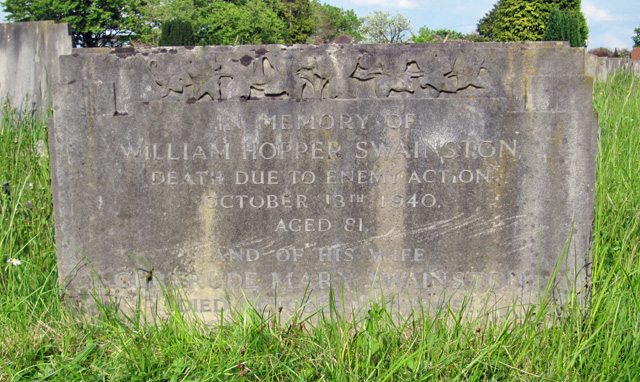 William’s and Gertrude’s joint headstone in Epsom Cemetery.
Photograph © Roger Morgan 2018
Not listed in the Book of Remembrance
William was born in County Durham on 8 February 1859. The 1861 Census records him as the third of four children of George and Christiane Swainston at 42 West Sunniside, Bishopwearmouth. This was a prosperous household, supported by two domestic servants.
In Q4 1909 and registered in the London City District, the 50 year old William married 35 year old Sutton-born Gertrude Mary Houlder. (Some records erroneously give her surname as “Flintoff”.) She came from an even more prosperous family: the 1891 Census records this 15 year old as the fourth of five children in the household of Edwin Lavory Houlder and his wife Mary Elizabeth at “The Grange”, Mulgrave Road, Sutton. The family was supported by six domestic servants.
The 1911 Register records the couple living at the newly refurbished “Rose Bank” (or “Reston House”), South Street, Epsom. Theirs was also a prosperous household: the couple were supported by three domestic servants. The 51 year old William is listed as a “Consulting Marine Engineer and Naval Architect” – a career path probably influenced by his father’s work as a “Ship Broker”. And his work was doubtless a factor in the courtship of Gertrude: her father was a “Shipowner” and her oldest brother a “Ship Broker”.
 “Rose Bank”, South Street, Epsom in 1907.
Photograph by A.E. Long courtesy of Bourne Hall Museum.
There is no record of the couple’s having any children, and they were still at “Rose Bank” (by then, numbered 32) in South Street for the 1939 Register, and still supported by three domestic servants. At the time of the Register, they were the hosts of a couple of apparently unrelated Nursing Sisters.
On 30 September 1940, in the first few weeks of the Luftwaffe’s “Blitz” bombing campaign, the 81 year old William was injured while at home on South Street. According to the Commonwealth War Graves Commission, he was taken to the Leatherhead Cottage Hospital where he died two weeks later, on 13 October 1940. (The Probate record of administration of his £ 15,088 estate jointly to his widow and her younger brother, Lt Colonel Alec Guy Houlder, states that, in addition to “Rose Bank”, William was also of 22 Billiter Street in London’s financial district.) On 16 October 1940, he was buried in Grave M103 of Epsom Cemetery.
If Gertrude was injured in the same attack, she recovered. It appears that “Rose Bank” was damaged beyond repair: its site was later used as part of Mounthill Gardens. Gertrude moved to 4 College Avenue, Epsom, where, aged 75, she died on 19 October 1949. On 22 October, she was buried in Grave M102 of Epsom Cemetery, alongside William. As shown at the head of this article, their two graves share a headstone. Gertrude’s estate was valued for Probate purposes as £30,435. (Her brother Alec had died in 1947 and his widow, Muriel, was appointed an executor.)
Roger Morgan © 2018
Please contact us if you have information or pictures that can extend this entry.
SWAN, Annie Elizabeth
Civilian
Died 1 February 1945, aged 43
 Mrs Annie Elizabeth Swan
Image Source Epsom and Ewell Advertiser 08 February 1945
Annie was born in Wandsworth on 4 October 1901. The Commonwealth War Graves Commission post-war records note her as the daughter of Mr and Mrs G H Mathews, of 113 Honeywell Road, Wandsworth Common, London.
She married George Douglas Swan in Wandsworth Q2 1927. They appear to have had two children – Alan and Margaret, both born in Croydon in, respectively, Q2 1930 and Q2 1933. However, the 1939 Register records the couple living at 22 Abbey Road, Torquay. George is listed as an Insurance Clerk and there are two currently closed records – presumably their children. At the time of her death in early 1945, Annie was living at 14 Ruxley Lane, Ewell.
Anyway, and as described in the article Tragedy on the Home Front, Edith was killed when a new variant (Mark V) of the Vickers Warwick twin-engined bomber under test crashed on her home at 14 Ruxley Lane – where she and her local friend Edith Connor (who was also killed) were about to have lunch.
(Their deaths were thus not the result of “Enemy action” as attributed in the Borough’s WW2 Book of Remembrance.)
 14 Ruxley Lane (on the right above) as it is today.
(The rebuilt house has a claim to fame as the early 1960s home of international singing star Matt Monro.)
Photograph by Roger Morgan © 2022
Roger Morgan © 2022
Please contact us if you have information or pictures that can extend this entry.
Please Note: We believe that the information on this page is accurate however users should satisfy themselves that the information is correct before incurring any expense or undertaking any journeys. This is particularly important when purchasing certificates from other bodies, for example the General Register Office. You might like to use the following links to Freebmd and Find My Past (Links open in a new window).