
WW2: The Home Front in Epsom & Ewell
Part 2: Air Raid Shelter This Way
[Click here to return to the Introduction]

Bomb damage to 45 Northcoft Road, West Ewell c.13/10/1940
Image courtesy of Carole Davies © 2020
Preparations, including the construction of defences against air raid attacks, had already begun in Epsom and Ewell before the outbreak of war. The Borough of Epsom and Ewell had published a booklet titled ‘Air Raid Precautions Scheme‘ as early as November 1938. In those early days, a certain amount of confusion and frustration was apparent as the authorities struggled to finalise plans. In January 1939 the Borough Air Raid Precautions (ARP) Committee had complained about the lack of policy and guidance from the Government and felt that they had wasted a considerable amount of time and effort since instructions kept changing.
The Epsom Advertiser advised its readers in April 1939 that it was “a matter of urgent public interest that there should be a clear realisation of the necessity for every household to take steps without delay to provide adequate shelter against the consequences of a hostile air raid”.
The Civil Defence Act, 1939 gave powers to Local Authorities to construct underground shelters and other premises required for civil defence purposes and emphasised the need to prepare for air raids in towns around the fringe of Greater London. At the time the population of Borough was 52,000 and trenches had to be provided that would hold 10% of the population.
A recruitment meeting was held in Ebbisham Hall convened by the Mayor of Epsom and Ewell to appeal for volunteers. Younger men were encouraged to enlist in the fighting forces and older men to take part in the various services of civil defence. By the outbreak of war, over 600 men and women from Epsom and Ewell had joined the ARP service.
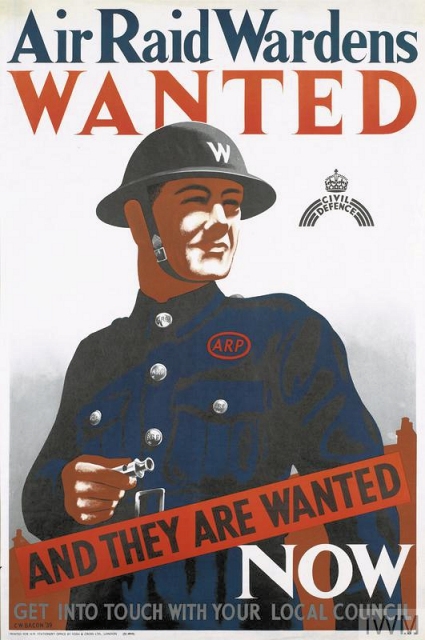 Recruitment poster for Air Raid Wardens
Image source: © Imperial War Museum (Art.IWM PST 13850)
In September 1939, several local building firms were busy constructing ARP wardens’ posts throughout the Borough. Altogether 55 posts were established in Epsom and Ewell, 44 being specially built and the remainder established in existing buildings. Where possible some of the posts were partially sunk below ground level, although in the end most were above ground and were blast and shrapnel proof against heavy high explosives at a distance greater than 50 feet. All wardens’ posts were connected directly to the “nerve centre” at Epsom Town Hall which was manned 24 hours a day.
The first air raid shelters were built in Rosebery Park (1,440 persons), Park Avenue (540 persons), Chessington Road, Ewell (180 persons) Clay Hill Green, West Hill (180 persons) and Ruxley Lane (180 persons). These trenches were only for use by those caught outside during an air raid, not for people leaving their homes. Signs attached to lamp-posts pointing to the nearest air raid shelter became a familiar feature in the streets.
In September 1940, a large air raid shelter was constructed at the rear of the High Street for those that would not have time to reach Rosebery Park. Businesses, hospitals and factories had to provide shelters for employees. Woolworths in Epsom High Street had an air raid shelter built in the basement. Schools also had air raid shelters specifically for teachers and children. School gates were locked during school hours to prevent the public using these shelters but unlocked at other times so that the public could use them if necessary.
For all their efforts, by the end of 1940 the Council had come under pressure to increase the number of public air raid shelters in the Borough. A complaint had been received from West Ewell residents about overcrowding at night in the Chessington Road shelter and that it was being used by persons from other parts of the Borough. Various options were considered: keeping all public shelters open day and night, opening private shelters in factories and commercial premises to the public outside of working hours and converting empty shops into temporary shelters. Plans for additional shelters to accommodate a further 2,500 persons at a cost of £6,715 were submitted to the Ministry of Home Security.
As Germany escalated bombing raids during the second half of 1940, the ARP organisation in the Borough experienced difficulties in staffing levels. Although nights were well covered, it was found that during daylight raids ARP volunteers were in short supply. Many volunteers were at work during the day outside the Borough and had difficulty returning to the district during aerial attacks. The problem was made worse since volunteers were increasingly being called up to the armed forces and it was estimated that Epsom and Ewell would lose around 800 wardens. As a result the ARP service became more dependent on those over military age.
ARP wardens worked alongside permanent and volunteer fire fighters. In 1937, the Auxiliary Fire Service (AFS) had been formed and was staffed by volunteers. Their purpose was to support the regular fire brigades in case of war. However, the many different, smaller fire brigades had difficulty in co-ordinating their efforts during the Blitz and in 1941 the regular fire service and the AFS were combined into the National Fire Service (NFS).
 Epsom Fire Brigade during the 1940’s
Image courtesy of Bourne Hall Museum
A fire watching scheme was in introduced by the Council in February 1941. Volunteer fire watchers had to endure freezing winter nights without the necessary equipment or training, although this was addressed in due course. By 1943, there were 2,200 fire watchers covering business premises in the Borough. Even so there were occasional shortages of volunteers with penalties for non-attendance. Two Ewell men appeared in court for failing to arrive on duty and were fined.
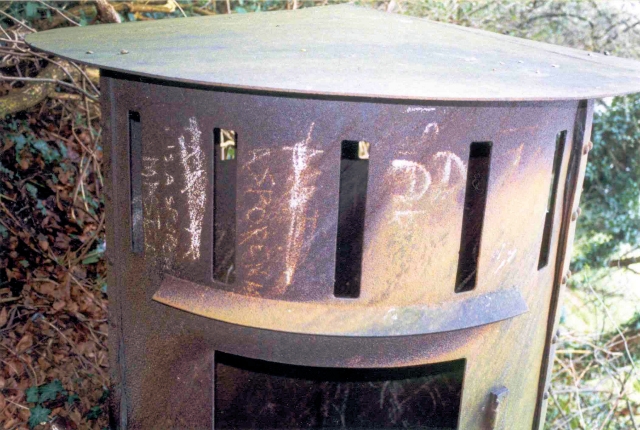 Fire Watcher’s shelter in Banstead Road, Epsom
Image courtesy of Bourne Hall Museum
Fire Guards did not have a uniform but were issued with a helmet, armband, torch, a stirrup pump, a scoop for picking up incendiaries and a bucket of sand.
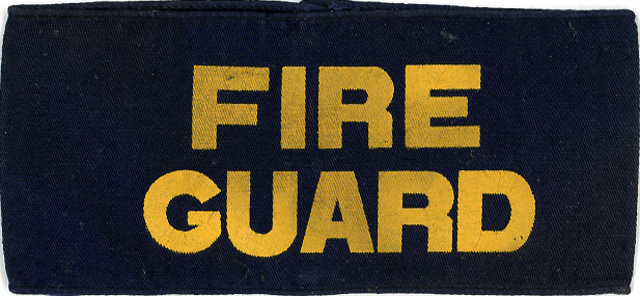
Fire Guard armband
Image courtesy of Clive Gilbert
Fire Guards were also issued with an Identity Card
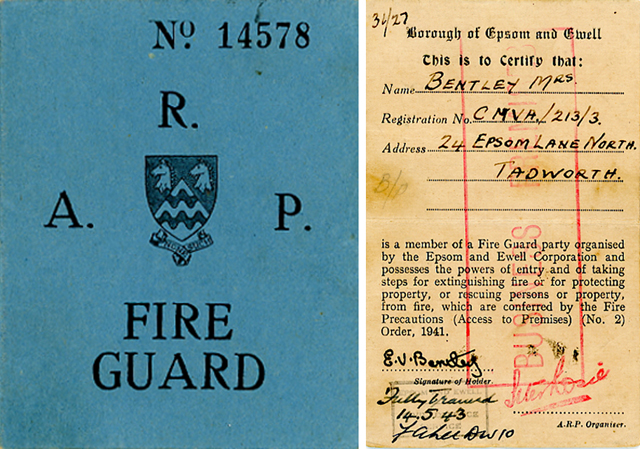 ID card for Mrs Bentley
Courtesy of Alan Holmes
Click this link to read a history of the Fire Guard Organisation during WW2.
A deep-raid shelter was constructed and opened in January 1942 to the west of Ashley Road with a capacity of 1,500 people. The shelter was considered to be impregnable against air attack and consisted of three main corridors of 270ft and four cross corridors of 200ft under a minimum 40ft of chalk. Facilities included water sanitation, a canteen, and a medical aide post. A further deep-raid shelter, also accommodating 1,500 persons, was built at Epsom Downs opposite the old railway station. These shelters accommodated residents from South West London as well as those from Epsom.
For protection at home, prefabricated corrugated Andersen shelters were provided – designed to be sunk partially or entirely in the ground. They were free of charge to those earning less than £ 250 per annum, and to others at a cost of £ 6 to £ 10. By April 1940, 3,773 of these shelters had been delivered to householders in the Borough, yet only 1,400 had been erected and there were still many shelters lying in parts in front and back gardens.
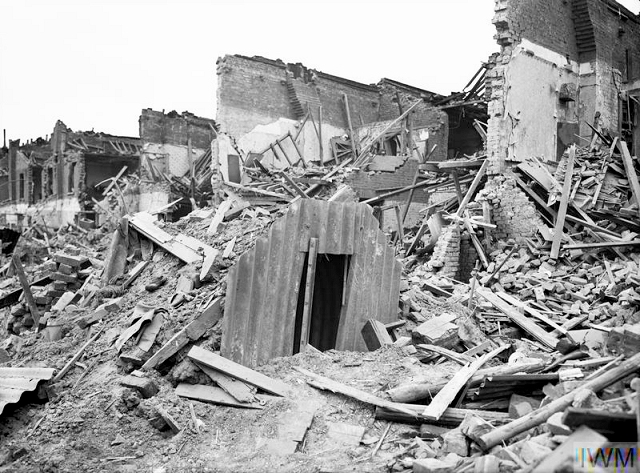 An Andersen shelter remains intact
Image source: © Imperial War Museum (Art.IWM D 5949)
Andersen shelters became easily waterlogged and expert advice was required to prevent flooding. Some cancelled their orders or refused delivery when they discovered they had to pay around £ 4 for the shelters to be assembled and installed. By the end of 1940, numerous complaints had been received by the Council regarding flooding of shelters to such an extent that the Borough Engineer considered that the majority of shelters would be practically useless during the winter unless watertight concrete boxes were constructed.
Eventually, local authorities decided that the erection of Andersen shelters should not be encouraged now that the new Morrison shelters – internal, steel-framed structures able to support piles of masonry – were becoming available. Andersen shelters remained unpopular and the Council received over 1,000 applications for Morrison shelters. They remained in demand well into 1944.
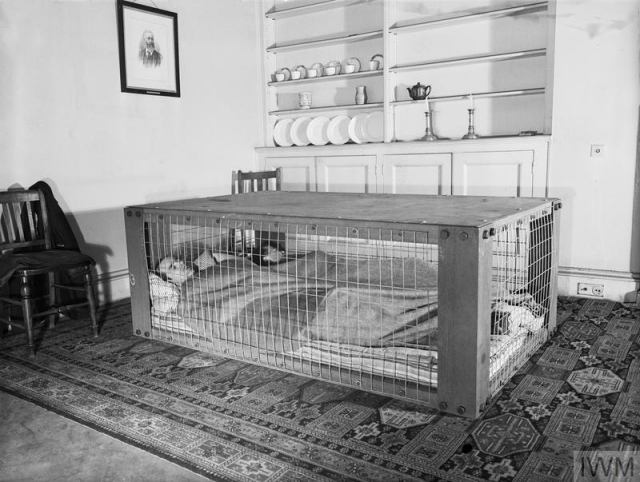 A Morrison shelter in use
Image source: © Imperial War Museum (Art.IWM D 2055)
Local newspapers would frequently report that bombs had fallen “on a Surrey town”, “a Surrey district” or “a town on the outskirts of London” including details of casualties, damage and near misses. One such report explained how a local resident had “risked life for bottle of beer”. A delayed action bomb had fallen close to his home and after his family had been evacuated, he returned to rescue a bottle of beer he was about to open. The bomb exploded and destroyed the house a few minutes after he had left the premises, beer in hand. In another incident, a man was shaving in his bathroom when an incendiary bomb came in through an open window. He quickly picked up the incendiary bomb and put it in the bath which was full of water, burning his hands but extinguishing the device.
Not everybody was sympathetic to the plight of the public when air raid sirens sounded. A resident wrote to the Epsom & Ewell Herald observing that “The air raid position is becoming ludicrous. Although it has been officially stated that air raid warnings do not mean people stop working … quite half the business of this town ceases completely during every raid”. Another complained that they could not understand why shops in Epsom would close when air raid sirens sounded while in Dover, which had suffered far more, businesses stayed open.
As incendiary bombing increased towards the end of 1940, lectures were held in a number of Epsom and Ewell schools on types of incendiary devices and how to use stirrup pumps (portable hand water pumps). Residents were advised to approach such devices with a dustbin lid in front of their face. Bags of sand were placed against lamp posts in streets in the Borough to be used to extinguish fires. Everyone was encouraged to carry their gas masks wherever they went. Gas tests were carried out in three places in the Borough one Sunday in February 1941 using tear gas. Hand rattles were used to warn residents of gas attacks.
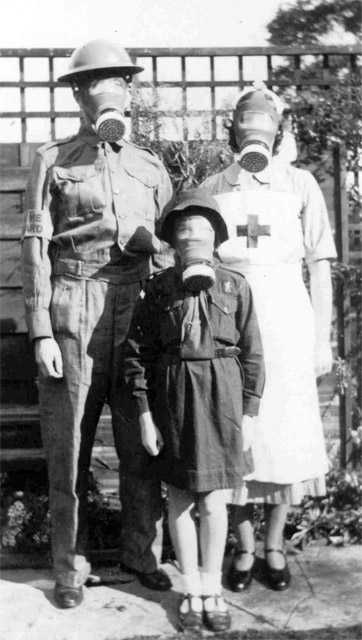 A family in wartime – gas masks were supposed to be carried at all times
Image courtesy of Bourne Hall Museum
Those who were bombed out of their homes and had no relatives or friends to stay with were accommodated at Rest Centres which provided food and temporary shelter. These Centres were established in St Barnabas Church Hall and Ebbisham Sports Club in Epsom and in St. John’s Church Hall in Stoneleigh. These would provide a temporary home for a few days only until other arrangements could be made. Accommodation would then be provided in billets or in houses taken over by the Council. The Town Hall remained open seven days a week to deal with residents who became homeless as a result of enemy action at weekends. In July 1941, the Council introduced a scheme called “Blitz Feeding” based at local schools. Unlike Rest Centres, this provided simple and cheap meals not necessarily for residents that had been completely bombed out, but for those who were not able to cook at home. After a bombing raid there was frequent disruption to electricity, gas or water.
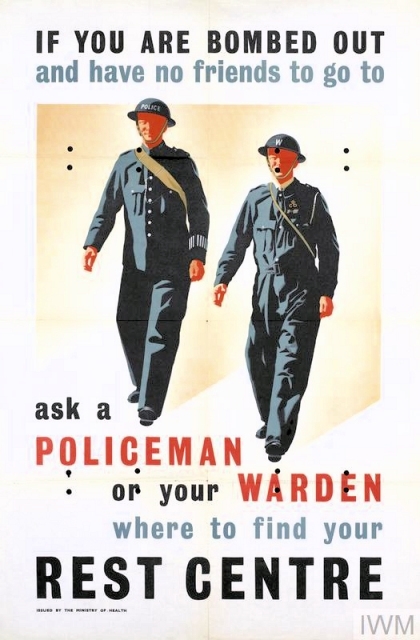 Rest Centres were set up for those who were bombed out of their homes
Image source: © Imperial War Museum (Art.IWM PST 13871)
There was great concern that crowds of on-lookers would congregate at bomb sites to watch rescue workers trying to release trapped residents from the rubble. In some cases this would hamper rescue work and the police had to issue strong warnings to those taking part in such practices. A local Police Inspector made things quite clear, “We have wide powers, under Defence Regulations, including those of arrest, and in future should there be such an occurrence again we shall not hesitate to use them”. The photographing of bomb sites by the public was not allowed without a permit from the Secretary of State for War. A resident was fined £ 5 with £ 3 costs for taking photographs of a parade of shops that had been damaged. Following his arrest, the police found an album at his home containing numerous photos of bomb damage.
 Air Raid Warden at a bomb site near Green Lanes, Ewell
Image courtesy of Bourne Hall Museum
Even in such difficult times there were still those who persisted in carrying out criminal activities. Posters were attached to bomb damaged houses showing the severity of penalties for theft and looting. In a neighbouring town, six members of an ARP rescue squad were charged with stealing from a bombed house. “It is an appalling thing to find a body of men so callous as to rob the dead in this way” declared the magistrate at the trial.
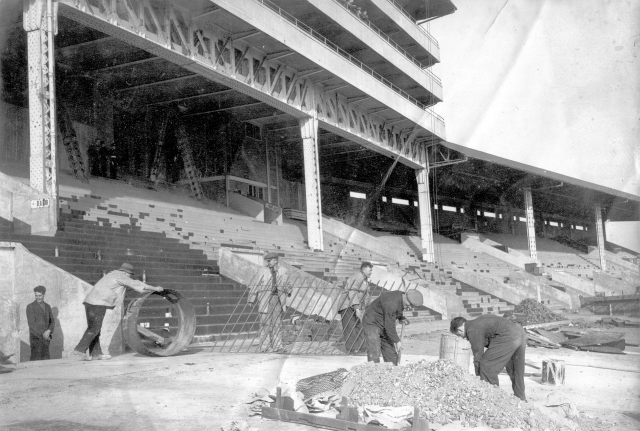 Repairing bomb damage at Epsom racecourse
Image courtesy of Bourne Hall Museum
At the end of the war, a report was compiled outlining the number of casualties in Surrey from bombing. In total there were 2,300 residents killed, 5,216 seriously injured and 8.965 slightly injured. In Epsom and Ewell, there were 2,348 bombs of all types that fell on the Borough, including 440 high explosives, 1,613 incendiaries and 28 flying bombs. Casualties totalled 457, including 38 killed, 78 seriously injured and 341 with minor injuries. Over 16,000 houses were damaged during the war, of which 8,913 by flying bombs.
The 28 flying bombs that fell on the Borough claimed 13 lives with 251 injured. There were 36 houses completely destroyed, 200 buildings seriously damaged and approximately 4,300 buildings slightly damaged. The worst of these was an attack on a block of flats at Ashley Court, Epsom where four were killed and three seriously injured. Amongst other buildings damaged by flying bombs were Epsom Police Station, Epsom County Court and Police Court, Epsom Methodist Church, Manor Hospital and St Ebba’s Hospital.
Although of little consolation to those in the Borough who suffered as a result of flying bombs, Epsom and Ewell was less affected than other neighbouring areas. Kent, Sussex and parts of Surrey became known as “Bomb Alley”. The Borough of Croydon, which was in north-east Surrey at the time, suffered more damage than any other district during Hitler’s flying bomb campaign.
Paul Le Messurier © February, 2018
Other pages in this series
- Keep Calm and Carry On
- Air Raid Shelter This Way (this page)
- Look Out in the Blackout
- Rationing is Sharing
- The Home Guard Wants You
- Save for the Brave
- Days of Rejoicing
- References