
Ernest Richard CHAPMAN (1883-1969)
(Organist at Christ Church Epsom Common 1941-63)

Ernest Chapman at the organ console in about 1960, when he was in his late 70s.
Photograph from the Christ Church archives.
Ernest was born in Southwark on 23 May 1883. He was the second of five children (two of whom – including his older sister – died in infancy) born to Richard and Martha Anna Chapman. Richard and Martha (née Sparkes) had married on 27 August 1979 in Martha’s parish church of All Saints, South Lynn (part of Kings Lynn, Norfolk). Richard was originally from West Dereham Norfolk, but had left home “to seek wealth in the big City”. The marriage register records him as a “Brewer’s Servant” living in Southwark Street, Borough, London.
The 1881 Census recorded the early-30s couple at 3 Peabody Buildings, Southwark St Saviour, with Richard now listed as a “Brewers Labourer”. Shortly after that – probably about the time of the birth of their short-lived first child, Kate – they moved to 55 Castle Street, Southwark which is where Ernest and his subsequent siblings were born.
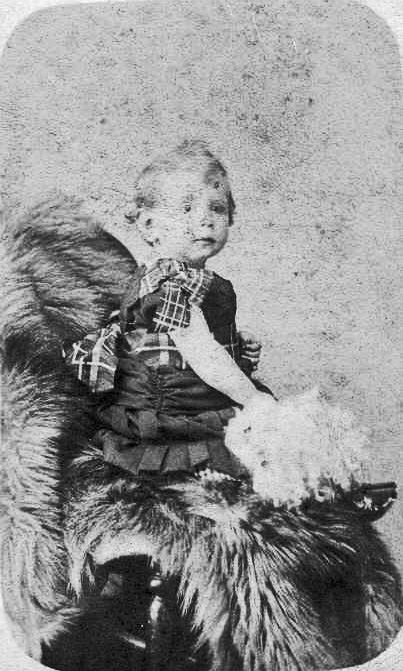
Ernest on his first birthday, 23 May 1884.
Photograph with thanks to Bourne Hall Museum.
Some years back, the above photograph (a small “carte de visite“) of Ernest on his first birthday was found in the street and found its way to Bourne Hall Museum. We know it is of him because the back is annotated “Ernest Richard Chapman – his first birthday 23/5/84″.
The back also has the studio’s stamp “W. Sottern Dexter, Atterneum Parade, Kings Lynn. Views of Lynn and Neighbourhood“. The presumption must be that Ernest and his parents were visiting their families remaining in Norfolk at the time. Indeed, the 1891 Census records the 7 year old Ernest staying with his maternal grandparents (Richard and Eliza Sparkes) in Kings Lynn, while his parents (with his father now a “Brewer’s Foreman”) and two surviving siblings were back in Castle Street, Southwark.
Ernest followed his father into the brewing industry. The 1901 Census lists him as a 17 year old “Brewer’s Clerk” living with parents and surviving siblings (13 year old Elsie and 7 year old Richard – to avoid confusion with his father, known as “Dick”) in 55 Castle Street, Southwark.
There was clearly some musical gene in the family. Ernest had a great love of church music and was disappointed that his voice was not up to joining the choir at Southwark Cathedral – which his brother Dick was able to do. Instead, Ernest turned to the organ. He studied under Dr Richardson who played at Southwark, and sat with him during services. Ernest then found a junior position playing the organ at St Clement’s, Barnsbury (near Islington).
At some point, Ernest struck up a relationship with Maude Eleanor Trebeck. She was recorded in the 1901 Census living with her widowed mother and five siblings at 100 Sibley Grove, East Ham and listed as “Clerk, Shaftesbury Mission” (probably a reference to the London City Mission, of which Lord Shaftesbury was an ardent supporter).
On 29 August 1907, the couple – now both aged 24 – got married at their parish church of St Saviour with St Thomas in Southwark. (The Register entry has both their addresses as Ernest’s 55 Castle Street.) Presumably reflecting Ernest’s organ playing at St Clement’s, Barnsbury, the Southwark ceremony was conducted by the vicar of that parish. The couple then made their home in Barnsbury: the 1911 Census records them (with Ernest still as a “Brewer’s Clerk”) living at 33 Arundel Square, Barnsbury.
Later that year, on 31 October 1911, Maude have birth to their only child. He was formally named “Ernest Richard” – like his father – but, to avoid confusion, was always known as “Jack”. (Given Ernest’s thwarted ambition to be a cathedral chorister, he was delighted when Jack was later accepted as a boy chorister at Westminster Abbey.)
In November 1915, Ernest attested for service during WW1. He was mobilised in June 1916 and assigned to the 1st Reserve Mechanical Transport Depot, 606th Mechanical Transport Company of the Army Service Corps based at Grove Park, Lewisham. After this service on the Home Front, Ernest returned to work in the brewery trade – eventually working in the property department of what became Watney Combe Reid, from which he retired in 1948.
However, his real life was in church music. He continued as one of the organists at St Clement’s Barnsbury, and later became its Director of Music, serving there for a good number of years. He would also take every opportunity to attend choral evensong at St Paul’s Cathedral.
In the 1930s, the family moved to Epsom, living first at 2 Christchurch Mount. They then moved to 47 Hookfield, where they were recorded in the September 1939 Register. The parents were now aged 58. Ernest is still listed as a “Brewer’s Clerk” and Maude with the conventional “Unpaid Domestic Duties”. 17 year old Ernest junior (“Jack”) is listed as an “Insurance Clerk”.
After the 1935 death in post of George Good, Christ Church’s founder Director of Music (who had served for an astonishing 59 years), Dr Thomas George O’Feely was appointed to the post. He left after 2 years, to be succeeded by Mr Leslie Brown – but only as organist. The usual twinned roll of Choirmaster was taken by the then Vicar, the Revd John Matthews until his untimely death in post in 1940 and then by senior chorister George Jeans.
Reading between the lines of the Church Council minutes, Mr Brown was a rather prickly character. He also lived some distance from Christ Church, presumably causing some problems with punctuality. There seems to have been no great sorrow when he was called up in 1941. Stressing the need for a “local person” the new Vicar of Christ Church (the Revd Hugh McMullan) proposed Ernest as both organist and choirmaster “for the duration of the war”. (His appointment eventually lasted 22 years!)
Before coming to Epsom, Ernest and Maude had – through a somewhat distant family (but closer musical) connection – struck up a particular friendship with Raymond and Winifred Softly. When Raymond died, in his 40s, the widowed Winifred and her children moved to Epsom, living at 91 Hookfield, near the Chapmans. Ernest’s son “Jack” had long known Winifred’s eldest daughter, Edith (known as “Bunty”) and they married at Christ Church in Q4 1940. Bunty and Jack had two children, Peter and Mary, both of whom inherited the musical gene. Given Ernest’s great affection for St Paul’s Cathedral, he was ecstatic when grandson Peter became a boy chorister there in 1951.
At the end of September 1963, aged 80, Ernest stepped down as Christ Church’s organist and choirmaster. That, however, was not the end of his organ playing: he continued as organist at Kingston Crematorium (a post he had held since 1955) and, indeed, took up a new appointment as organist at the then West Park Hospital.
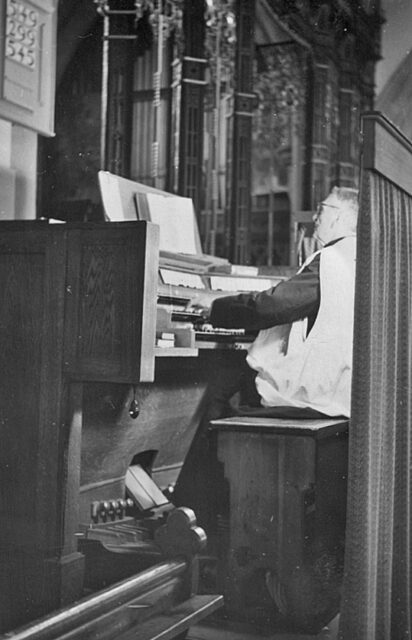
Ernest (in his late 60s) at the wandering console of the Christ Church organ in the early 1950s.
Photograph with thanks to the Robins family.
In the spring of 1969, the 85 year old Ernest collapsed in Epsom High Street. He was taken to the Cottage Hospital where he died shortly afterwards, on 16 March. After his funeral at Christ Church – at which his favourite hymn, “All things bright and beautiful” was sung – the committal was in the chapel of Kingston Crematorium where he had played only a week before his death.
The affectionate tribute to “Chappie” – as he was known locally – in the May 1969 Parish Magazine remembered: this “great character’s . . . simple virtues of kindliness, tolerance and good humour”; his oft-quoted dictum “As long as everybody’s happy”; and the mythical “Mrs. Popplewell” who apparently chose all the music! He was clearly one of nature’s true gentle-men.
Roger Morgan © 2020
with special thanks to Ernest’s grandson, Peter Chapman.