
THE ORGAN OF CHRIST CHURCH EPSOM COMMON
and its wandering console

A few of Christ Church’s organ’s many pipes.
Photograph © Nishi Sharma of Light & Shade Photography, 2015
At the October 1876 service to consecrate the new Christ Church Epsom Common, the congregation took particular pleasure in the organ music. The instrument – built by the great Victorian organ builders, William Hill & Sons and funded by a £1,000 donation from William Trotter – was indeed good, but part of the pleasure was the contrast with music in the just-vacated first Christ Church. In his 1903 “Reminiscences of Epsom”, James Andrews recalled:
“For music we had to be content with a barrel organ, and strange were the sounds which sometimes issued from that wonderful instrument. It was old fashioned, and would only play four well-known tunes such as the ‘Old Hundredth’, and on one occasion when this Hymn was used, the mechanism got out of order, and the organ would not cease playing; the tune was gone through some eight or ten times, and with the vicar in the pulpit ready to deliver his sermon, the congregation began to giggle. There was still no sign of a cessation of the music, and at last two well known members of the congregation, the late Mr. Renwick and the late Mr. Maurice Puckle got up and carried the organ out of the church and placed it on the open common. The doors were then shut, and the Vicar delivered his sermon to a muffled accompaniment from the organ outside”
Christ Church’s new organ was a 2-manual (Great and Swell) & pedal instrument, with a mechanical “tracker” action and integral console – marked “1” in the plan below – under the pipes (as were the manually-operated bellows).

The organ console’s various positions are marked 1-5.
Notwithstanding its William Hill pedigree, the sharp ear of Christ Church’s founder organist, George Good, heard the need for improvement: the parish magazine for March 1883 listed among the “wants” “New stop for organ”. This paid off: according to Gordon Home’s 1901 book “Epsom – its history and its surroundings”, the organ’s “fine quality, together with the ability of the organist and the choir, . . . made the music at Christ Church a synonym for excellence throughout the neighbourhood.”
The youngest son of the then Vicar, Canon Archer Hunter, died just short of his fourth birthday in 1891. As noted on the brass plaque between the organ pipes and the pulpit, the organ was decorated in the child’s memory. However, following the various changes outlined below, only a trace of this remains on the coving under the organ pipes. (The illustrated side panels were removed at the request of a 1970s organist as they muffled the sound.)
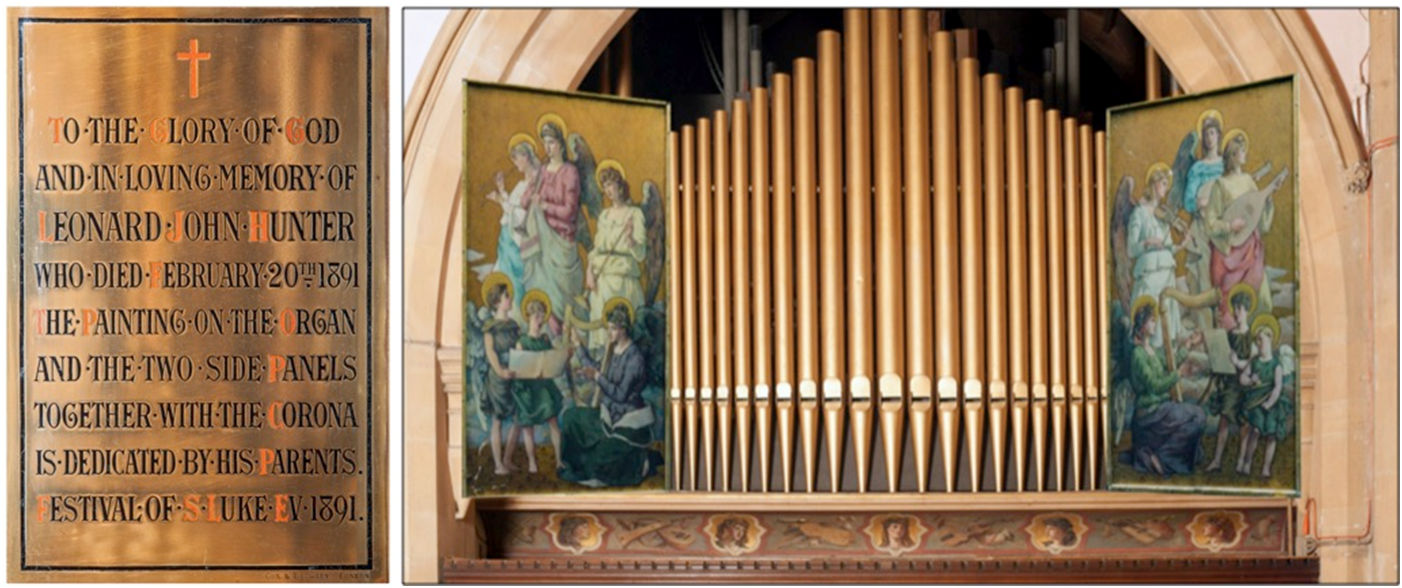 The 1891 Leonard John Hunter memorial plaque and organ decoration.
Montage of photographs from various sources
After a probably record-breaking 59 years’ service, Christ Church’s founder organist, George Good, died in 1937. In his memory – and thanks to a donation from Peter Miles – the organ was rebuilt by Percy Beard of Epsom. Electric action consoles were now available and, to enable the organist to hear better, this was sited on the Chancel side of the Memorial Chapel (marked 2 on the plan earlier in this article.) Much to relief of the Verger and his assistants, the manually-operated bellows were replaced by an electric blower. The new console had a third manual for a quieter “Choir Organ”. The pipes for 26 speaking stops remained in the organ loft over the vestry.
When, in the late 1940s, plans were being made to install a WW2 memorial in the Memorial Chapel, it was decided that the Chapel should be de-cluttered by moving the organ console to the Nave (position 3 on the plan earlier in this article) where the organist – behind a screen, to conceal him from the congregation – would have a good view of his choristers in the Chancel. This move was during Ernest Chapman’s time as Christ Church’s Organist. He had been recruited in 1941 as a stop-gap when his predecessor was “called up” for WW2 service. In the event, he served for 22 years, retiring at the age of 80 in 1963!
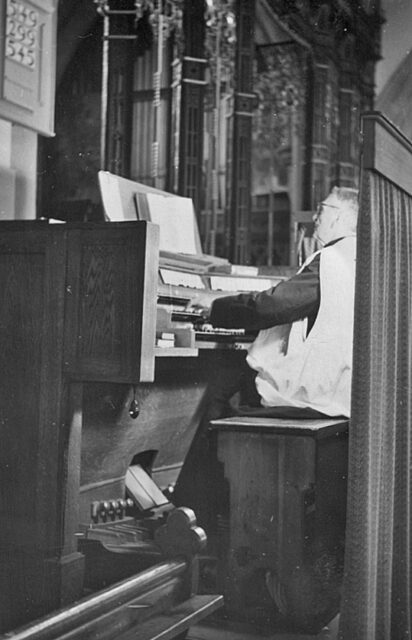
An early 1950s photograph of Ernest Chapman at the organ console after its move to the Nave.
Image with thanks to the Robins family.
In the early 1960s, under the then Vicar (the Revd Richard Falkner), first steps were made to “re-order” Christ Church’s Victorian interior. This involved erecting a dais in front of the Rood Screen so that, in a move from increasingly outdated practice, Holy Communion could be celebrated from an altar among the congregation in the Nave rather than at the High Altar at the East End. (Re-ordering was finally completed in the mid 1990s, at the end of the Revd Mark Wilson’s incumbency) To make room for the dais, the organ console had to be moved a few feet sideways – to position 4 on the plan earlier in this article – and given a new curtained surround.
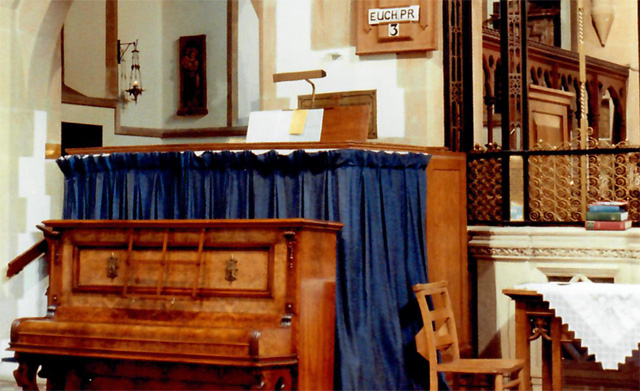 The curtained organ console in its fourth position.
The 1937 organ rebuild had not been a particular success. The pipes were not optimally placed in their chamber. In addition, the now three-times moved console was of an unconventional design. Its main dimensions varied from the Royal College of Organists’ recommendations, making it uncomfortable to play.

The only known image of the 1937 three-manual console.
Early 1950s photograph (the original of which is slightly out of focus) with thanks to the Robins family.
Accordingly, in 1973, B C Shepherd & Sons were called in to give an estimate for another rebuild. Instead of taking that up, however, Christ Church experimented with an electronic organ, the speakers for which are arrowed in the picture below of a 1982 wedding.
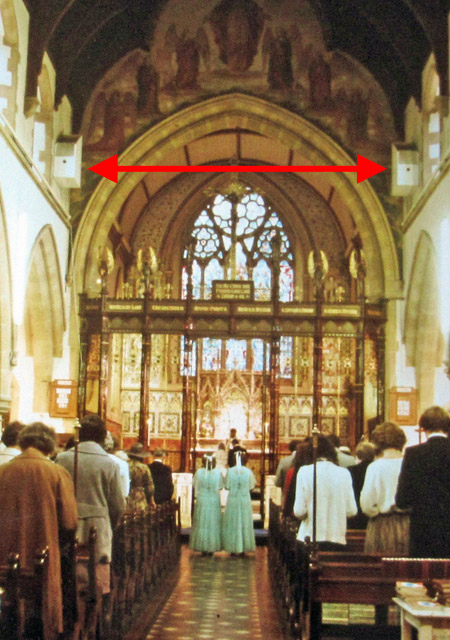
A 1982 Christ Church wedding, where the main points of interest here are
the arrowed speakers for the experimental electronic organ.
After a few years, however, that was abandoned and the pipe organ brought back into use. It received some running repairs by local organ builder, Dennis Coffin.
In 1989, it was clear that an organ rebuild could not be further deferred. Plans for a larger dais as part of the major “re-ordering” (eventually launched in 1991 by the Revd Mark Wilson) meant that the console had to be moved again. All this came together with a scheme for a new standardised console sited on the south of the Nave (position 5 on the plan earlier in this article) with the instrument itself reverting to the original 2 manual and pedals configuration.
The chosen contractor got off to a good start, the new console was quickly installed and, before long, was at least partly functional. Progress then slowed to the point where B C Shepherd & Sons were called in to complete the job. Their work began in late 1996 and, by the Millennium, the organ was a very complete 2-manual & pedal instrument with most, if not all, of the original William Hill pipes still in use.
(The Great Bourdon, however, only went down to Tenor C. Shepherds had kindly sourced 12 pipes for the bottom octave but, unfortunately, funds were not available at the time for their installation. With a view to not only completing the instrument but also decluttering the Chancel where these large pipes were stored, a donor subsequently provided the necessary funds and the Great Bourdon’s bottom octave was installed in January 2019.)

Christ Church’s current 2 manual and pedal organ console.
Photograph © Nishi Sharma of Light & Shade Photography, 2015
A current technical specification of the instrument is in the annex below.
The original architect of Christ Church, Sir Arthur Blomfield, was well known for his churches. He appears, however to have known little about organs. Instead of providing an open gallery to enable the pipes’ sound to spread round Christ Church, the organ loft had three solid walls. These projected the sound across the Chancel where it would then ricochet round the church. And playing at a volume to fill the church would overwhelm the choristers in the Chancel. To help alleviate this design flaw, part of the 1990s reordering was to create an opening (coloured green on the plan earlier in this article) in the south wall of the organ loft to let some of the sound directly into the church – and, usefully, to the person playing the instrument.
Roger Morgan © 2020
ANNEX: TECHNICAL SPECIFICATION OF THE CHRIST CHURCH ORGAN
Great
Bourdon 16
Open Diapason 8
Spitz Flöte 8
Stopped Diapason 8
Dulciana 8
Principal 4
Twelfth 2⅔
Fifteenth 2
Mixture 3 Ranks
Trumpet 8
Swell
Open Diapason 8
Hohl Flute 8
Salicional 8
Voix Celeste 8
Principal 4
Harmonic Flute 4
Fifteenth 2
Larigot 1⅓
Mixture 3 Ranks
Double Clarinet 16
Horn 8
Oboe 8
Clarion 4
Pedal
Acoustic Bass AB 32
Open Diapason A 16
Bourdon B 16
Octave A 8
Bass Flute 8
Trombone 16
Composition of Great Mixture
17,19,22. Bottom C (1) to Tenor F (19)
15,19,22. Tenor G (20) to Mid B♭ (35)
8,12,15. Mid B (36) to Top A (58)
Composition of Swell Mixture
As Great except from Treble B♭ (46)
to Top A (58), it is 8,12 only.
Couplers
Swell Tremulant
Swell Octave
Swell Sub Octave
Swell to Great
Swell to Pedal
Great to Pedal
Pistons
Swell:
4 thumb pistons
Reversible Swell to Great
4 toe pistons
Great (With Pedal):
4 thumb pistons
Reversible Great to Pedal
4 toe pistons
Reversible toe piston for Great to Pedal
Other Features
Balanced Swell Pedal
Discus Blower
Wind pressures:
Great – 3⅝”
Swell – 3½”
Pedal: Open Diapason & Octave – 3½”
Bourdon, Bass Flute & Trombone – 5½”