
Brian Owen Walpole OBE
(Captain Concorde)
This biography is based on an interview Brian Walpole gave to TBN.UK
 Captain Brian Walpole
Image Source: a screen grab from
Captain Concorde with Captain Brian Walpole OBE
a documentary on TBN.UK network
Brian Owen Walpole was born on 1 January 1934, the first child of Robert A. and Winifred V. (nee Bamford) Walpole. The parents had married in Q2 1926, registered in Hampstead. Brian’s 1934 birth was registered in Hendon – as was the 11 June 1936 birth of the couple’s other child, Colin.
In the late 1930s, the family moved to Ewell and the September 1939 Register records them at Fairview, 67 Banstead Road, Ewell. 40 year old Robert is listed as a Chartered Accountant and 37 year old Winifred with the conventional “Unpaid Domestic Duties”. 5 year old Brian had just started school, and younger brother Colin was now 3. In due course, both sons attended Epsom College as day pupils. Brian enjoyed his time there, appreciating both the quality of the teaching and the extracurricular activities, especially cricket and Air Training Corps.
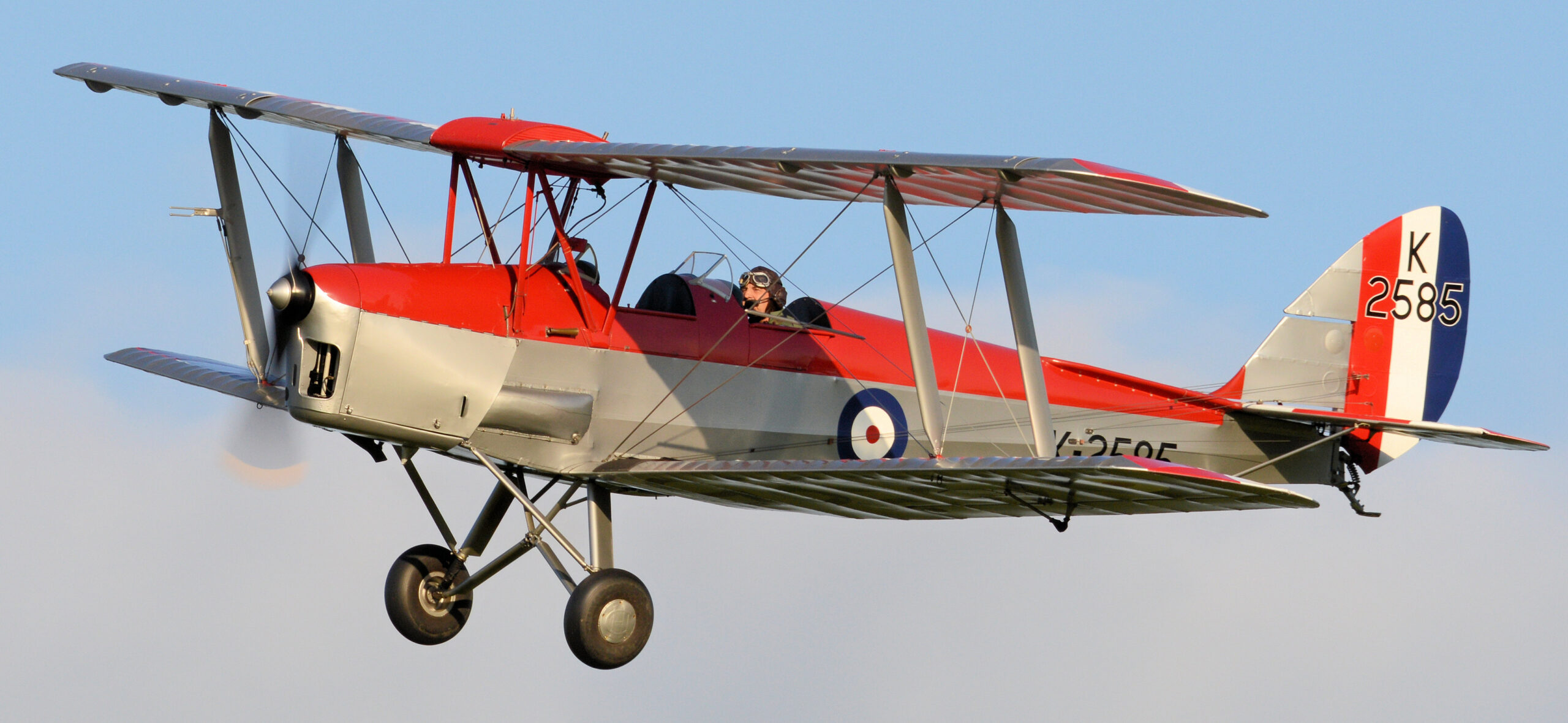
de Havilland DH82A Tiger Moth ‘K2585’ (G-ANKT)
Photo by Alan Wilson Via Wikimedia (CC BY-SA 2.0)
On leaving school, Brian worked for six months in a firm of stockbrokers but, on being called up for National Service, his time in the Air Training Corp led to him being assigned to the RAF. During his National Service he applied for and was selected for training as a pilot. Initially he trained on the de Havilland DH.82 Tiger Moths, then de Havilland Canada DHC-1 Chipmunk, followed by Airspeed AS.10 Oxfords.
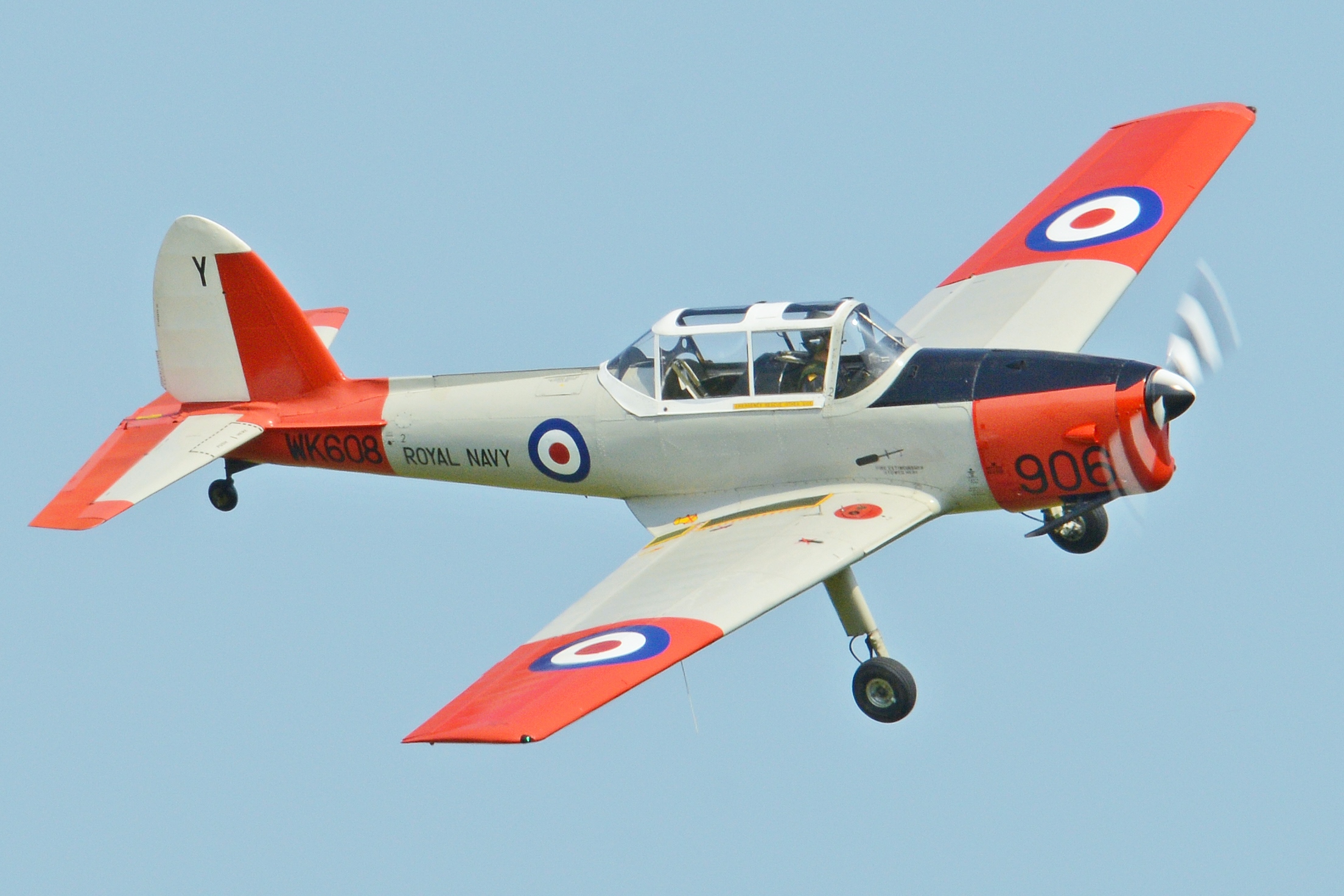
DHC1 Chipmunk T.10 ‘WK608 – 906 – Y
Photo by Alan Wilson Via Wikimedia (CC BY-SA 2.0)
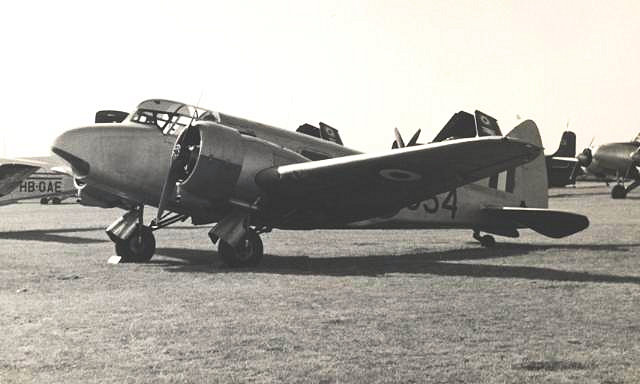 Airspeed AS.10 Oxford HM954 of RAF Marham station flight at Blackbushe
Photo by RuthAS via Wikimedia (CC BY 3.0)
He studied flying at RAF Dalcross Airport (Inverness, Scotland) passing top of the class to become a fully-fledged pilot. Then he converted to flying Jets, Gloster Meteor F8 at RAF Full Sutton York.
 74 Squadron Gloster Meteor F.8 based at RAF Horsham St Faith, Norfolk,
visiting RAF Hooton Park, Cheshire
Photo by RuthAS via Wikimedia (CC BY 3.0)
When his National Service ended he signed on with the RAF for a period of two years and was posted to RAF Fighter Squadron 74 Squadron, Horsham St Faith in Norfolk. While there he joined the newly created Formation Acrobatic team (a precursor to the Black Arrows, which later become the Red Arrows), which involved flying at 350 mph at 4 ft apart.
 The Meteorites – The RAF Formation Acrobatic team
Image courtesy of the Central Flying School History
On leaving the RAF in 1956, he joined British Overseas Airways Corporation (BOAC, which later merged with British European Airways, or BEA, to become British Airways) as a junior co-pilot. In 1960 he started flying Boeing 707s and after flying them for about 11 years he was promoted to a full Captain. Shortly afterwards his role was expanded to include being an Assistant 707 Instructor.
 BOAC Boeing 707 at Manchester Airport 1964
Photo by David Johnson via Flickr (CC BY-ND 2.0)
He continued to fly 707s until 1976 when he undertook intensive Concorde training, which lasted about a year, before becoming a Concorde Captain. Only BOACs most experienced pilots could undergo this training but it was still a very tough course and had a surprisingly high failure rate (25%). Perhaps this goes some way to explain why being a Concorde pilot had very high status in the aviation industry.

British Airways Concorde; G-BOAD at LHR on 15.05.2003
Image Aero Icarus via Wikimedia (CC BY-SA 2.0)
Flying at Mach 2.04 (2,500 km/h or 1,550 mph) at an altitude of 60,000 ft (18.3 km) needs plenty of forward thinking and full concentration so it’s not surprising that Brian describes Concorde as a magnificent aircraft which was exciting, demanding & rewarding to fly.
 Concorde Flight Deck
Photo by dmytrok via Flickr (CC BY-ND 2.0)
After one year flying Concorde, Brian was given extra responsibility as the Technical Manager for flying.
Although Concorde was a stunningly beautiful and very technologically advanced plane, commercial viability was not at the top of its designer’s brief. Although it was initially thought that the market was likely to want about 350 planes, in the end only 20 were built (including six non-commercial or test aircraft). The narrow body and low cabin headroom only permitted rows of four seats with a centre aisle, so the total number of passengers that could be carried was limited to a maximum of 128. Fears of damage caused by the sonic boom when the plane hit the speed of sound limited routes to those with long stretches flying over water or areas with very low population density. These considerations limited profitability and by 1982 the Concorde Flights were losing BA money. Lord King, then head of British Airways, asked Walpole to become General Manager of the newly formed Concorde Division and gave him two years to turn it round. Brian introduced many initiatives and it took just over two and a half years for the division to become profitable. Brian remained General Manager from 1982 until his retirement from BA in 1997. He was awarded the OBE in 1988 for services to aviation.
 Concorde Interior
Photo by Timo Newton-Syms via Wikimedia (CC BY-SA 2.0)
Brian flew Queen Elizabeth II, other royalty and numerous VIPs in Concorde. Prime Minister Mrs Thatcher was reluctant to use Concorde as she didn’t want to be seen as being profligate with public funds but Brian’s offer to fly her at cost was accepted and she used it when opening the British Pavilion during Vancouver Expo 86 – she was most impressed that she could stand a £1 coin on edge while travelling at Mach 2.
Brian had several notable flights in Concorde including:
- Landing with no front undercarriage wheels due to flat/burst tyres
- Making a Barrel Roll (flying upside down at supersonic speeds – he was the first British pilot to do so in a civilian plane)
- Losing power to an engine whilst in the toilet
- A hydraulic fault midway across the Atlantic (May 1988)
Brian first met his wife Rosemary Blake when he was aged seven and she three. She was the daughter of a family friend. Things started to get serious when he was studying for his commercial licence. By this time, she was a well-regarded Royal College of Music trained piano teacher. They married on 31 January 1959 and went on to have three children Julie (1961), Graham (1962) and Shelly (1965). Both Brian and Rosemary found Christianity in later life and were both baptised in 1986. Rosemary died on 29 November 2017.
After retiring from BA in 1997, Brian has worked as a consultant and motivational speaker.
 Captain Brian Walpole
Image Source: a screen grab from
Captain Concorde with Captain Brian Walpole OBE
a documentary on TBN.UK network