
The Parade Chapel, Epsom (1857-78)
& its Pastors
Each of our two articles about the 300+ year history of the recently closed United Reformed Church in Epsom’s Church Street (the first covering 1688 up to the 1904 rebuilding and the second, after a brief summary of that earlier history, covering 1904 to 2022) touched on the 1855 fracture of the congregation. Those in the dissident faction went various ways, and this article looks at the subset which established itself in January 1857 as Epsom’s “Protestant Evangelical Church”.
The group initially met in the Assembly Room of Epsom’s Spread Eagle Inn but, in the second half of 1857, erected its own wooden “Independent Chapel” on The Parade – specifically, that part of The Parade that doubles as the footpath to Heathcote Road, emerging there alongside The Rising Sun, see the following map.
 Extract from the 1866 Ordnance Survey map.
The parent Congregational Church is coloured red; the Spread Eagle, green; and the Parade Chapel, blue.
The Chapel was opened in November 1857 by the prominent Free Church minister the Revd. Baptist W Noel – a detail gleaned from appeals (as below) in the weekly editions of The British Standard during April 1858. The wooden structure is explicitly “temporary”, implying an (unrealised) intention to progress to a permanent building.
EPSOM
“THE PROTESTANT EVANGELICAL CHURCH,” which is a union of believers in the Lord Jesus Christ, whether Baptists or Pæodaptists, was formed in January, 1857, and for a time met in the Assembly Room at the Spread Eagle Inn.
The temporary chapel, cost £453, was opened by the Hon. and Revd. Baptist W. Noel, A.M., in November last.
The Lord has already graciously owned the efforts of his servants; the church members have more than trebled; and every sitting in the new chapel is now occupied.
Towards the cost of the erection £273 15s. 1d. have been already subscribed. – £160 paid and £113 15s. 1d. promised, by the members and a few kind friends.
Contributions towards the debt thus incurred are earnestly solicited, and may be paid, in Epsom, to the Revd. William Elliott, Pastor, or to Mr. Robert Burn, Treasurer; in London, to Mr. Wm Gundry, 1 Soho-square, W.; to Mr. Robert Kenneth, 24, Orchard-villas, Holloway, N.; or to Mr. Pratt, at the Office of this Paper; by any of whom they will be thankfully acknowledged.
The Revd. William Elliott (of whom, more below) mentioned there was the first formally appointed pastor of the breakaway congregation; and Robert Burn was doubtless the proprietor of the ironmongers etc in Epsom’s High Street.
 A contemporary advertisement for Robert Burn’s business
We should, in passing, say something about The British Standard. This was a weekly newspaper run by the controversial independent preacher Doctor John Campbell. The paper’s title was inspired by Jeremiah 50:2 – “Set up a standard; publish and conceal not” – as repeated under the paper’s front page title.
Dr Campbell and the Revd. Elliott were clearly of like minds: the 9 July 1858 edition of The British Standard carried the following encomium.
AT a MEETING OF THE “PROTESTANT EVANGELICAL CHURCH.” EPSOM, held on THURSDAY EVENING JUNE 17, 1858,
It was unanimously resolved,-
“That the best thanks of this Church are justly due, and that they be, on our behalf, and by the Revd. William Elliott, presented to the Revd. JOHN CAMPBELL D.D., of London, for his uniform kindness to this Church, from the period of our union as pastor and people; and that, in transmitting a copy of this Resolution, our pastor be requested to inform the venerable doctor, that in every department of his labour for God, and in the cause of his unadulterated Gospel truth, BUT ESPECIALLY AS EDITOR OF “THE BRITISH STANDARD,” he has our entire and warm sympathies; and that he and his work often and always affectionately remembered by us at the Throne of the Heavenly Grace.”
WILLIAM ELLIOTT, Chairman.
To the Revd. John Campbell, D.D.,
&c., &c., &c.
Pastors of the Chapel
1855 – 1863 The previously-mentioned Revd. William Elliott was born of Protestant parents in Fermanagh, 11 July 1829. He attended Trinity College, Dublin and, while he “took no high degree”, left as a thorough theologian and “controversialist”. Having vehemently attacked Roman Catholicism, and declined ordination in the Protestant Church of Ireland on doctrinal grounds, he moved to London and where he reportedly devoted his whole time to “lecturing and expounding Biblical truths”. This got him noticed, and he was appointed minister at Epsom during 1855.
In addition to work among his congregation, the Revd. Elliott actively sought to engage his fellow clergy and the wider community. As reported (by “a correspondent”) in the 29 July 1859 edition of The British Standard, he had convened on Wednesday 24 July an all-day meeting of more than 20 local clergy (including the Revd. Bradney Bockett, Vicar of Epsom) in the following terms.
On Wednesday, July 24, a most interesting and, we do hope, really useful meeting of pastors and deacons for prayer and conference was held at Epsom, and, as the weather was extremely hot, in a marquee erected in the garden of Mr. Burn, who has been for years one of our most ardent and steady supporters and who is treasurer and an elder in the church of our young friend the Rev. William Elliott.
After a lengthy summary of the day’s worship and discussion of six topics relating to more effective evangelism, the report noted that, after a dinner for the delegates hosted by Mr Burn, the day concluded with an open-air service held at Epsom’s Clock Tower attended by some 500 people.
The 1861 Census records the 31 year old William (“Independent Minister of the Protestant Evangelical Chapel, Epsom”), together with his 30 year old wife, Sarah, and their 5 year old daughter, Marjorie, living in South Street, Epsom.
On 11 June 1863, the Grand Stand at Epsom presented a novel appearance on the occasion of the celebrated Baptist preacher, the Revd. Charles Haddon Spurgeon, preaching to crowds there two sermons in aid of Epsom’s Protestant Evangelical Church. The text selected for a discourse on The Heavenly Race was “So run, that ye may obtain” (1 Corinthians 9:24) – and, in the afternoon, A Free Salvation, “Yea, come, buy wine and milk without money and without price.” (Isaiah 55:1).
On 21 January 1863, the Revd. Elliott was invited to move to the Evangelical Protestant Church, Compton Street Chapel, Plymouth, and accepted the following day. He was instituted there on 4 March 1863, and the extensive “Confession of Faith and other papers connected with the settlement” may be viewed at this link.
The Revd. William Elliott died in Plymouth on 4 September 1904. Click here to read his obituary in The Gospel Magazine of October 1904.
1864-66 The Revd. Elliott’s successor in Epsom was Rev. Josiah Redford. He had attended Highbury/Hoxton College before being ordained to The Independent Church at Stansted, Essex. In February 1822, he had resigned as minister of the ‘Old Meeting’ and formed the ‘New Meeting’ which assembled at Stansted Independent Chapel until c.1855.
At the time of the Revd. Redford’s Ordination, he was reported to be living ‘in fornication’ although he maintained that he was legally married. Nevertheless, he had been suspended. The congregation became split in two, with the result that, after considerable disorder, the New Meeting, with Redford as Minister, was established at a purpose-built chapel in Silver Street. He was invited to the Union Chapel, Clevedon, Somerset during 1835 but seems to have been back in Stansted Mountfitchet in 1840 to remain there for another eight years. By 1851, Josiah Redford was serving as Minister of the New Tabernacle, Broadwater, Worthing – another small independent or Congregational chapel.
The Revd. Josiah Redford was appointed to the Parade Independent Chapel, Epsom in 1864 and appears to have presided over a meeting of Spurgeon’s Metropolitan Tabernacle, London, in September 1865. His time in Epsom was short and unremarked upon.
1866-1874 The next pastor was the Revd. William Coleman Boardman (born 14 October 1821) who had a previous connection to a chapel in Rawstorne Street, Orchard Street, Camden Town. He contracted a second marriage to Louisa Oldchurch Reynolds, which was registered in Clerkenwell, 3/1852 and, by 1861, had a total of six surviving children.
Another daughter, Harriett Burdett Boardman, came to be born in Church Street, West Ham, on 4 April 1863. She lived only until 14 April 1875 and, the following year, her father published a “loving tribute to her memory”, Safe in the arms of Jesus, the text of which is available at this link. (In his introduction to that tribute, the Revd. Boardman mentioned that he was a minister of the gospel “for some years at The Parade Chapel, Epsom”.)
The death of his wife, Louisa, was registered in Camberwell, 12/1879 and the widowed William went on to marry for a third time during 1886 at Islington. He died on 13 December 1898.
1875 – 1878 The last pastor of the Parade Chapel, appointed in 1875, was the Revd. Charles Harrison. As noted in Phyllis & Winifred Cary’s 1988 tercentenary history of the main church, his career began at a Lawyer’s office in the Temple but, feeling a call to the ministry, he entered Hackney College in 1837. He had four pastorates between 1842 and 1864 and engaged in social and supply work in London, Somerset, Croydon and Newmarket.
At Epsom’s Parade Chapel, he was much esteemed for his uniform kindness of spirit, unselfishness and faithful friendship. To quote from Mr Harrison’s obituary in the Congregational Year Book, “He was a man of high principle, scrupulous of honour and fortitude. He always had a special liking for the young, and all through his life succeeded in attracting them to himself. His preaching made a faithful appeal to the heart and conscience“.
The differences that had led to the 1855 fracture of the main Church Street congregation had dissipated. In 1868, new Trustees had been appointed to replace the 1813 body, and a special Committee of Deacons and members had been appointed to look after Church affairs. (It was wound up in 1882.) As agreed, the Revd. Charles Harrison took over the pastorate of the re-united Church, but did so for only one year: he resigned the pastorate at the end of 1878 “with characteristic self-sacrifice” probably believing that a fresh minister was needed to finally heal the split.
The Revd. Charles Harrison, who had never married, remained in Epsom, living alone at 1 Morden Villas, East Street (a property owned by Harry Longhurst). He died there on 21 September 1889, aged 75, leaving personal effects of £281 1s. On 27 September, he was buried in Plot F62A of Epsom Cemetery, where there is no visible grave marker.
And finally . . .
It is understood that, for some years, the main church used the old chapel as an additional meeting space. It later took on other uses, among other things being rented in 1900 by the newly-formed Baptist congregation (the records of which refer to it as “The Gymnasium Hall”) and used by them until the 1907 opening of the Baptist Church in Church Street. As shown below, the structure is anonymous in the Ordnance Survey map for 1896. However, for 1913 and 1932 respectively, it is labelled as a “Gymnasium” and “Club”.
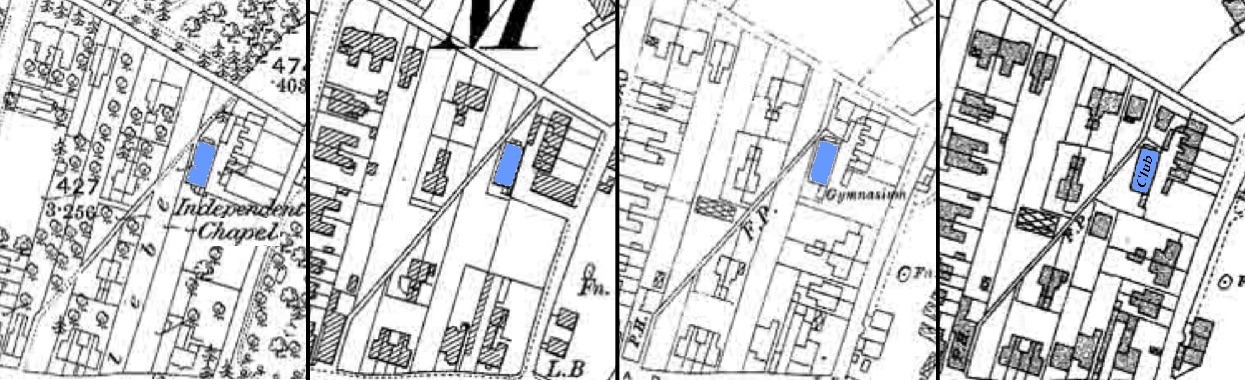 Extracts from the Ordnance Survey maps for, from left to right, 1866,1896,1913 & 1932.
(Click to enlarge.)
After some 90 years, the “temporary” wooden structure reached the end of its useful life, and the house numbered 48 The Parade was erected on its site.
Roger Morgan & Brian Bouchard © 2024