
WALTER WESTON
1860-1940
Vicar of St Mary’s, Ewell 1906-11
Mountaineer and missionary
 Reverend Walter Weston
Walter Weston was born on 25 December 1860 in Derby, the sixth son of John Weston, an elastic manufacturer, and his wife Emma. He showed early signs of athleticism when he broke the record for the mile run at Derby School, attending from 1876 to 1880, and he also played a handful of games for the embryo Derby County Football Club. Following his graduation from Clare College, Cambridge in 1883 he studied theology at Ridley Hall, Cambridge and became the curate of St John’s, Reading in 1885.
You would think, so far, that he was a fairly conventional clergyman, but he wasn’t. Walter, short, stocky and blind in one eye, had a passion for climbing and, having done so extensively in the Alps (Swiss variety), in 1888 he took up a post with the Church Missionary Society at Kumamoto, Japan and was the British Chaplain in Kobe from 1889 to 1895. Japan is, of course, famous for its mountains, which have long held deep spiritual significance for many, Mount Fuji being the best known. Kobe, where Walter spent so many years, is close to the Rokko mountain range – a hugely popular area ‘with attractions’ now, but it wasn’t like that in his time. There are thousands of beautiful colour images of Japanese mountains on the internet but perhaps this next picture will give you an idea of how it was in the late 19th century.

People on a street near Mount Nunobiki near Kobe, approx.1870-91
Image source: Rijksmuseum via Wikimedia Commons
Although Walter had extended spells in England as a parish priest (the Ewell stint being one of them), the mountains, customs and culture of Japan were a magnet, so for a while we’ll go on a journey with him, which is described in his 1896 book called Mountaineering and Exploration in the Japanese Alps, online or still available in paper form. There are in fact four books in this series, the other three being The Playground of the Far East (1918), A Wayfarer in Unfamiliar Japan (1925) and Japan (1926).
 Map of the Central Japanese Alps from Walter’s first book
Speaking of his journeying in Japan and, having raised several eyebrows at tourists who visited ‘the big sights’ very briefly and returned home professing to be experts on the country, Walter said this:
The traveller is nowhere so struck with this extraordinary contrast, or combination of ancient and modern, as when he leaves behind the great capital and busy treaty ports, with their reproductions of our own British navy, or of the military system of our Teutonic neighbours, and penetrates into the interior of Central Japan. For it is there, amongst the great mountains, in close intercourse with the simple, kindly country-folk who dwell beneath their shadows, that we seem to feel ourselves transported into almost another world. Our intellectual surroundings, at any rate, are rather those of the ninth century than of the nineteenth.
The travels of Walter and his companions were no picnic but the rewards were spectacular:
For fourteen miles the steep pathway climbed over almost treeless hills, winding in and out of bald grassy slopes formed of volcanic scoriae* and exposed to the full blaze of the afternoon sun. At 6 o’clock the summit, 4,500 feet, was reached and then from a little knoll on the left of a gap in the ridge we suddenly found ourselves for the first time in full view of the great mountain range on which our hearts were set.
Coming unexpectedly as the prospect did, we were almost startled by its magnificence. The whole of the central and southern part of the chain rose up before us westwards like a great barrier between the broad plain of Matsumoto which lay at our feet and the lonely province of Hida beyond. Snow-seamed ridges and noble peaks of 10,000 feet and more in height stand up in dark sharp outline against the opalescent sky of the dying day.
*fragments of balsatic lava ejected from a volcano
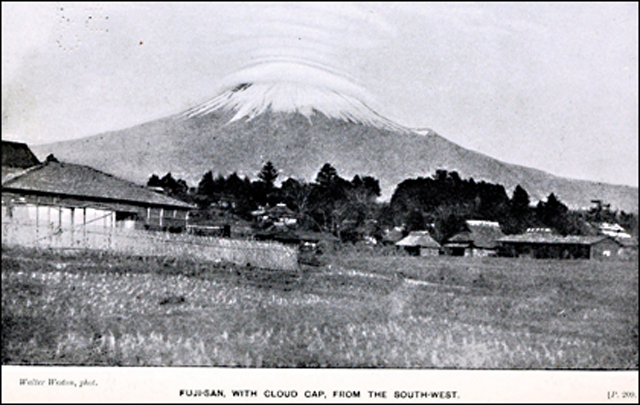 Mount Fuji (Fuji-san), which Walter climbed in 1890, from Walter’s first book
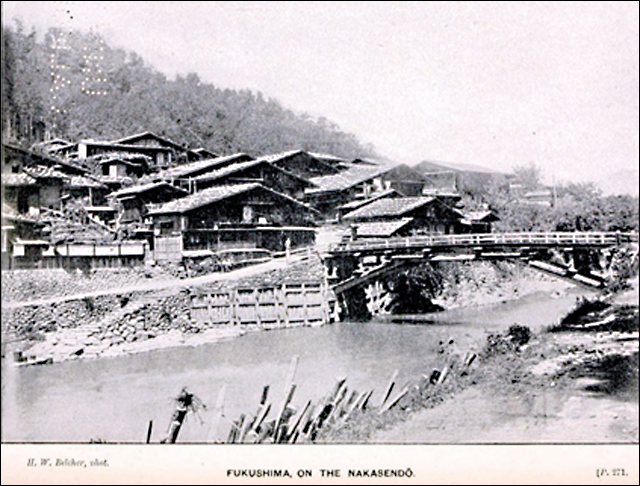 Tranquil and picturesque Fukushima in the late 19th century, now very sadly better known
for the major nuclear accident that occurred in 2011, following an earthquake and tsunami.
Image source: Walter’s first book
There are many delightful descriptions in the book of commonplace activities which have rituals attached – for example, taking a bath on the gruelling mountain hikes:
Immediately on our arrival, as we sat down on the edge of the polished verandah floor to take off our boots before stepping up on to the smooth mats of our room, we were informed that the ‘honourable hot bath’ was ready and invited to ‘honourably deign to get in’. A kindly consideration often breaks through the usual rule of letting guests occupy the bath in order of arrival at the inn and ‘the foreigner’ is generally given the first dip.
Odd as it may seem to English ideas, one bath does duty for the whole establishment, without change of water. All the guests having taken their turn at parboiling in the oval wooden tub (which is heated by a charcoal fire at the bottom of an iron pipe that passes through the water), the male members of the household follow; for in this land of frequent topsy-turvydom it is place aux messieurs, not aux dames. The ladies of the family generally follow later on, then the domestics and it is seldom before midnight that the splashing and chattering ceases and peace is restored. No one uses soap in the water and the towels are simply pieces of soft cotton about 20 inches by 10, stamped with some pretty pattern. Sometimes a pair of wooden clappers are provided, by rapping which together each departing bather announces to the next that his turn has now arrived. In the above circumstances it is needless to add that the appearance of the overnight’s water before the bath is emptied in the morning leaves much to be desired.
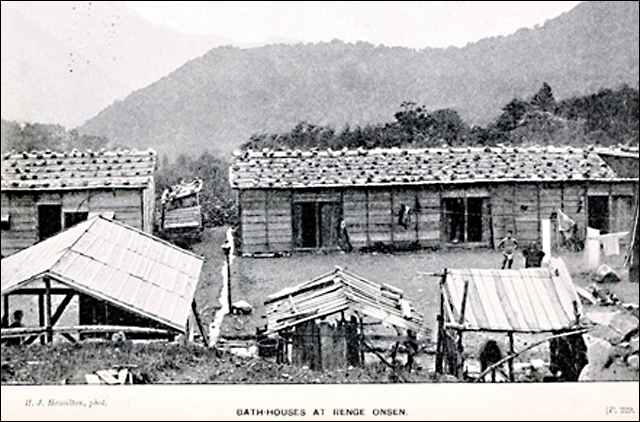 Bath-houses at Renge Onsen, from Walter’s first book
There is much more to the book than the snippets appearing here, but the reason it’s still available after well over a century, and a copy resides in the Royal Collection Trust, is that it’s regarded as culturally important (as well as being written with a deep affection for the subject matter).
We shall return to Japan anon.
Back in the UK
Having returned to England to write his book (and presumably to earn some money to finance his frequent excursions to and in Japan), Walter spent a year as assistant chaplain with the missions for seamen at the port of London and also served five years as priest in charge at Christ Church, Wimbledon.
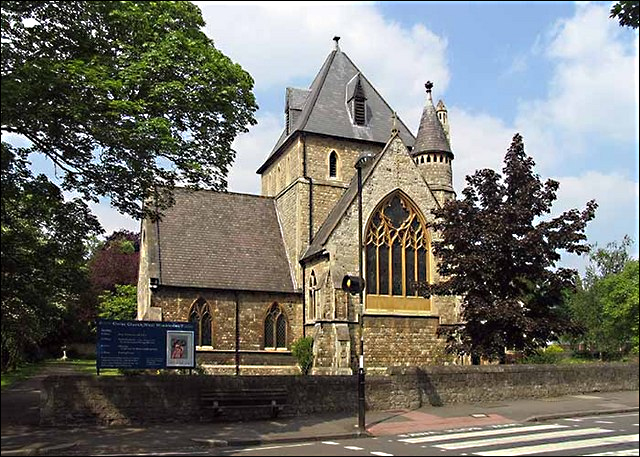 Christ Church, Copse Hill, West Wimbledon, London SW20
In 1902 he married Frances Emily Fox (born 1872) and she was very much a kindred spirit in terms of overseas exploration, which probably owed something to her eminent father, civil engineer Sir Francis Fox . The Foxes were a dynasty, the patriarch being Sir Charles Fox (1810-74), who, along with Sir Joseph Paxton and Sir William Cubittt, was responsible for the original Crystal Palace, built in Hyde Park for the Great Exhibition of 1851. All three men were knighted for their work on the project (click here for more details on this amazing achievement). Broadly speaking, Sir Francis Fox and his brother, Sir Charles Douglas Fox, were titans in railways and built bridges far and wide, in Britain and overseas. Perhaps significantly, some of the Foxes came from Derby, as did Walter Weston, so this may be how he and Frances Emily knew each other; she became a notable climber in her own right.
Ewell
We must move on to the reason why Walter is on this website. Much of the information about his time in Ewell comes from an article entitled Edwardian Vicars in the Ewell Parish News, written by Alick Lewer in 1973. (This article also serves to remind us of an age long gone.) Alick wrote:
The Reverend Walter Weston came to St Mary’s in May 1906 from Christ Church, Wimbledon. Previously he and his wife had served three years in Japan. His first action in Ewell was to broaden the appeal of the Parochial Magazine. The cover of the new Ewell Monthly Magazine carried photographs of the two churches as they then were, St Mary’s without west porch and lych gate, and All Saints, West Ewell, standing amidst corn stooks. Advertisements in the magazine showed changing times. W Shapland of West Street installed electric lighting and built motorcycles and R A Revell of Epsom Road made ‘Nonsuch’ bicycles. However, C I Curtis , with farms at Horton, Fitznells and Reigate Road, continued to deliver milk three times a day.
Holidays
Mr and Mrs Weston went each year to Switzerland for their holidays but they were keen to help the less fortunate have a change. Through their efforts thirty poor children came for a fortnight each summer from London to benefit from the country air in Ewell. Local cottagers received 5/- (25p) per week for each child boarded.
The senior curate, Rev E V Bond, who had been of such help to the previous vicar* left Ewell in June 1907 to become Vicar of Edwinstowe, Notts. He retained his connection here, however, as shortly after he married Miss Bridges of Ewell Court, daughter of the benefactor of All Saints.
Walter Weston was Vicar at a time when British power was supreme in the world. Empire Day was celebrated in style on May 24th. Children marched from school to church behind flags and emblems of the Empire. Union Jack buttons inscribed “The Flag that Rules” were worn. Prayers in church were followed by an address by the Vicar on “The Flag of England” or “The Red, White and Blue”. The singing of “Land of Hope and Glory” and the National Anthem ended the service and the children dispersed for a half-day holiday.
Scouts
 Crystal Palace Scout Rally 1909, showing how the Scouts looked at that time
Image source: Wikipedia
The Boy Scout movement came to Ewell in 1909**, the local troop having Mr Hutchinson as its first Scout Master. Walter Weston wondered if this movement would be a nine-days wonder, but gave the Scouts every support, took many local and district Church Parades and visited the boys in camp. The Vicarage Stables were the Scout Headquarters all his time here.
Restoration work on the old tower was carried out by Goodship & Saunders in 1907. The total bill then was £118 and it was said that the tower would defy the ravages of time for a considerable period! A year later Mr E W Martin , who some years earlier had given the present pulpit, had the west porch built. This was dedicated to the memory of Mrs Martin at a service on October 28th 1908, taken by the Bishop of Dorking.
Coronation
In 1910 came the death of King Edward V11 and, in the summer of 1911, the celebrations to mark the coronation of George V. In Ewell there were parades of the children, the Scouts band, the Territorials, the Oddfellows, Ewell School Old Boys and the village band. Two services were held in church, two cedar trees were planted, Coronation mugs were presented to 550 children, the old folk had a dinner and 1,500 people sat down to dinner in the grounds of Ewell Grove. Athletic sports preceded the grand firework display which ended the day.
 The 1911 souvenir coronation mug
Image courtesy of Bourne Hall Museum
A few months later, in October 1911, Walter Weston and his wife left Ewell to return to Japan, where he became Chaplain to the British community in Yokohama***. It was truly the end of an era. For hundreds of years Ewell had developed gradually and changes had come slowly. In less than three years the First World War was to break out. Most of the men and boys at the 1911 Coronation festivities in Ewell Grove were to join up, many never to return. Life in Ewell could never be the same.
* Rev Reginald Coombs Hunt
** See the article by David Brooks on Ewell Scouts.
*** the Westons had previously served in Yokohama from 1902 to 1905
Back to Japan
 Probably Frances and Walter on a bridge in Japan (so 1902 or after)
Original source unknown, but almost certainly one of his books
Before we continue with Walter Weston, I should make mention of Edward Bramwell Clarke , who is also credited with bringing recreational mountaineering to Japan, but perhaps his greater claim to fame was starting up rugby in the country. The extent of his contributions to the latter is disputed by some but it seems to be generally agreed that he was highly influential, having been born in Yokohama and spent most of his life in Japan as an educator. Come what may, unlikely as the idea of the Japanese playing serious rugby may once have been, their international rugby team is now firmly on the map!
 Edward Bramwell Clarke
Image source: Wikipedia

Earlier on we mentioned three other books by Walter; another one of these, The Playground of the Far East, published in 1918, is also online and mainly covers the period when he returned to Japan between 1911 and 1915, revisiting some of the areas where he had previously climbed. You can, of course, read it for yourselves, but it is well worth referring to here – particularly the Foreword, which emphasises Walter’s importance in the mountaineering world:
FOREWORD
BY
PROFESSOR SHIGETAKA (JUKO) SHIGA
To the Members of the Japanese Alpine Club
Whosoever residing in Japan or in other lands studies mountains or mountaineering in the Japanese Empire can hardly pass without noticing, or referring to, something written by the Rev. Walter Weston; for he has climbed almost all the prominent peaks in the islands, and has written on these subjects for a quarter of a century continuously. Through the energetic and enterprising spirit of our intrepid climber, that is, Rev. Weston, so-called ‘Japanese Alps’ have become known world-wide, and by the influences of his ardent exploitation the Nippon Sangaku-Kwai, or ‘Japanese Alpine Club’, had been founded some twelve years ago. The organisation is the first club of the kind ever formed in Japan, and is now the most authoritative source on the subject. It was only proper that Rev. Weston had been elected the first Honorary Member of the society, he being the only foreign-born member. There are at present only two Honorary Members in the club, Rev. Weston being one and the other my humble self, although the society has in its rolls some seven hundred members and may, according to its constitution, and by-laws, elect any deserving person to such honour, not only amongst its members but outside of it.
Apart from these, the name of Rev. Walter Weston is well-known amongst the educated class in Japan from the fact that he is not only the first foreign climber of the most prominent Japanese mountains, numbering at least fifteen, but he has trodden many a path on these mountains entirely unbeaten, even by the native Japanese themselves.
We are convinced thus that his new work on Japanese mountains, to be published at his home place, London, will be so instructive as well as so popular that the ‘price of paper in the capital’ will be enhanced owing to immense circulation of the book.
Prof. SHIGETAKA (JUKO) SHIGA
Hon.Mem.the Japanese Alpine Club, Tokyo; Hon.Cor. Mem. The Royal Geographical Society, London; Hon. Cor. Mem. The Geographical Society, Rio de Janeiro
TOKYO 1918
Note: Odd though it may seem, given the events of WW2, Japan assisted the Allies during WW1, although it did have some ulterior motivation.
It would be easy to go on ad infinitum about Walter’s activities in Japan (and some of you may well think I’ve done that already), but his books, for their time, were amazing. He wrote with erudition and humour and some of his descriptive prose is poetic. Additionally, he gave us photographic evidence of how it all was back then, something that can never be recreated. Sadly, however, I must move on.
Home
Walter left Japan for the last time with infinite sadness, but he was getting on in years and so he settled down to life in England: however, he wasn’t idle by any means. He wrote and published the three later books mentioned above, and was Cambridge University Extension lecturer and lecturer for the Gilchrist Educational Trust (this was established in 1865 and still exists today). Perhaps the most significant and tangible testaments to him were the Japanese Order of the Sacred Treasure (fourth class) awarded in 1937 by Emperor Hirohito and a memorial plaque erected at Kamikochi, Japan by the Japanese Alpine Club.
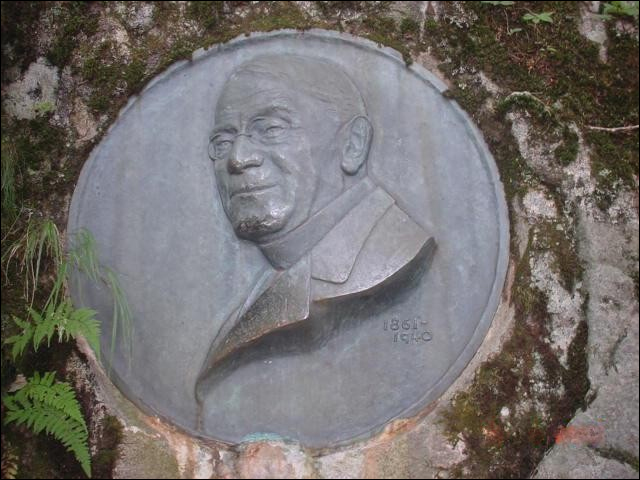 The memorial plaque at Kamikochi
Image source: Wikipedia

There is also now a Weston Park at Mount Ena, Japan, which features a statue of Walter. I’m not sure he would be too happy about that, as it seems to be a resort/attraction – something that he wasn’t keen on. Kamikochi, however, seems to have stayed relatively unspoiled.
At the end of his life Walter lived in Kensington and died there on 27 March 1940. His ashes were interred at Putney Vale Cemetery. Frances had predeceased him, aged 64, on 17 May 1937.
Linda Jackson © 2025
With grateful thanks to the late Peter Reed, who suggested and helped with this article
Main source not mentioned in the text:
Peter H Hansen, Oxford Dictionary of National Biography.