
EPSOM BAPTIST CHURCH
 Epsom Baptist Church & Hall today.
Photograph by Roger Morgan © 2024
Introduction
Epsom’s Baptist Church was, after about a year’s preparatory work, formally founded in 1900. It is now one of nearly 2,000 in membership of the Baptist Union of Great Britain. Baptists are a major branch of evangelical Protestantism, their name reflecting the practice of baptising only professing Christian believers (“believer’s baptism”) – rather than other churches’ general practice of infant baptism – and doing so by complete immersion.
This article concentrates on the physical history of the Epsom Church, and draws heavily on David Jenkins’ history, written to mark the Church’s Centenary in 2000. His 22,000 word text is at this link and, in addition to physical matters, surveys the wide-ranging life of the congregation over the century. Details of Epsom Baptist Church’s current activities may be found on its website.
Early days
In April 1899, a group of like-minded individuals set themselves up as a Committee to plan the establishment of the Church – making their presence felt by arranging, from the beginning of October 1899, for advertisements and posters to appear with the heading, “A BAPTIST CHURCH FOR EPSOM!“.
By that stage, a legal agreement had been entered into to rent the “Gymnasium Hall” in the Parade (the former Congregational Parade Chapel) for the initially modest congregation’s services and meetings – and a plot in Hook Road had been purchased with a view to building their own place of worship. In addition to all this, an “organ” (probably a pedal-driven harmonium), chairs, hymnbooks etc. had all been purchased and fully paid for at a cost of some £70. To put this into perspective, accounts to 31 December 1899 show “Sunday Collections to date: £11.13s. 2d” and a total income of £82. 7s. 6d.
 Extract from the 1895 Ordnance Survey map showing:
A The Gymnasium Hall (the former Parade Chapel); &
B the Church Street site on which the Baptist Church would be built in 1907.
(The “Sun Sch” – meaning – Sunday School – at the top of this extract was set up by the then Congregational Chapel, just below halfway down on the right.)
All this was quite an achievement by the original membership of only 19, namely:
Robert Boon; Lottie Bignall; Sarah, Jessie & H T Boothman; Louisa Etherington; Amelia Fox; Annie & William Lock; Alfred Matthews; A G Ozler; Richard Parkhouse; William Pearce; William Reeve, Ellen & H W Sanders; A H Stockwell; Effie Turner; and Sarah Ann Warner.
With a view to having a proper church building, these founders then acquired a site in Hook Road – although, perhaps reflecting financial pressures, this was sold towards the end of 1900 for £225.
Matters began to be properly formalised at a special meeting on Sunday 8 April 1900 (held following the evening service), at which the following resolution was agreed:
“That we, a number of Baptists residing in Epsom, Surrey, and the neighbourhood, organise a Baptist Church in this town, at as early date as can be conveniently arranged, and that the prospective members be requested to hand in their names, and to mutually arrange the date for the necessary Meeting to organise the proposed Church“.
That proposed Meeting was held two weeks later, on 22 April, when the following formal resolution was unanimously agreed:
“That we hereby agree to form ourselves into a Christian Church which shall have as its essential condition of membership a sincere profession of ‘repentance’ towards God, and faith towards our ‘Lord Jesus Christ’, to be publicly witnessed by immersion into the name of the ‘Father and of the Son and of the Holy Ghost’, and evidenced by a godly life; and that, relying on Divine aid we now covenant with each other to faithfully fulfil all the duties of Church members as we shall discover them by a reverent study of the ‘Word of God’ “.
The founders had been steered through all this by the Rev John Tuckwell. There seems to have been some expectation that this would translate into a longer term involvement but the 22 April meeting instead invited the Rev Arthur Charles Hodgson to the pastorate for at least one year. Accordingly, he has the privilege of being the first official Pastor of Epsom Baptist Church. (See the Annex for a list of all the Church’s pastors.)
Early finances were tight, and this may have been the reason for the sale of the Hook Road site towards the end of 1900, generating £225. Lack of progress towards the young church having its own purpose-built premises was the basic reason behind Pastor Hodgson’s departure in mid-1902. In his letter of resignation, he said, “I do not consider that there is a prospect of the cause developing to any very material extent, either numerically or otherwise, while the church continues to assemble in the present obscure, dilapidated, and uninviting structure, which you have decided to do for at least another twelvemonth“.
This galvanised the leadership team and, in late 1902, they purchased land at the corner of East Street and Hook Road for some £1,500, borrowing two thirds of the price against a mortgage. A Building Fund Committee was set up in February 1903, and an early item of business was to agree the Council’s request to purchase part of that site. By March 1904 plans for building on this East Street/Hook Road site were well under way. The intention was first to build a 300-seat hall (at an estimated cost of not more than £1,200), adding a 450-seat church in due course.
After a nearly three-year interregnum, the April 1905 Church Meeting appointed Mr R French as a Student Pastor. At about this time, the possibility arose of exchanging the East Street/Hook Road site for one in Church Street (apparently part of the old Fern Beech estate), and that was completed before the end of 1905. Planning began anew for building what became the present church – with a slight wobble when the Council said it might want some of the site for proposed road widening. (That was not carried through but, as we shall see, these issues rumbled on over the years – becoming an existential threat in the closing decades of the century.)
The Church building
 A postcard of Epsom Baptist Church shortly after the 1907 opening.
Image with thanks to Bourne Hall Museum.
Plans were scaled back from the ambitious East Street/Hook Road scheme, and it was decided to prioritise the building of the church, leaving the Hall for a later date. Progress was not disrupted by the resignation of Mr French at the end of 1906. Building began and, on Wednesday 14 August 1907, four foundation stones were laid – on the Church Street frontage – to set the seal on the venture. Although a couple of the stones are now badly weathered, those laying them were:
Mr Samuel Sparks on behalf of the Trustees;
(Mr Sparks’ day job appears to have been Station Master at Epsom Downs.)
Mr R Hayward Moderator on behalf of the Home Counties Baptist Association;
Mrs George Turner on behalf of Sutton Baptist Church; and
Mrs Jasper on behalf of Wallington Baptist Church.
 The least and most weathered foundation stones.
Photographs by Roger Morgan © 2024
Building continued apace and the new church opened in November 1907. As can be seen below, the Church’s original plot was about square and the building took up about a third of that, leaving space (the current car parking area) for a Hall in due course.
 Extracts from the 1895 and 1913 Ordnance Survey maps showing the arrival of the Baptist Church.
The main part of the church is built of red brick, but its ancillary rooms at the rear use (doubtless local) yellow brick. As shown below, these ancillary rooms have a rather quirky roofline.
 Rooms at the rear of the Church.
Photograph by Roger Morgan © 2024
As to the main Church, entrance via the main doors is not direct: the porch requires people to turn left or right to enter the worship space – which is thus not visible from the street. A modern view of the interior is below.
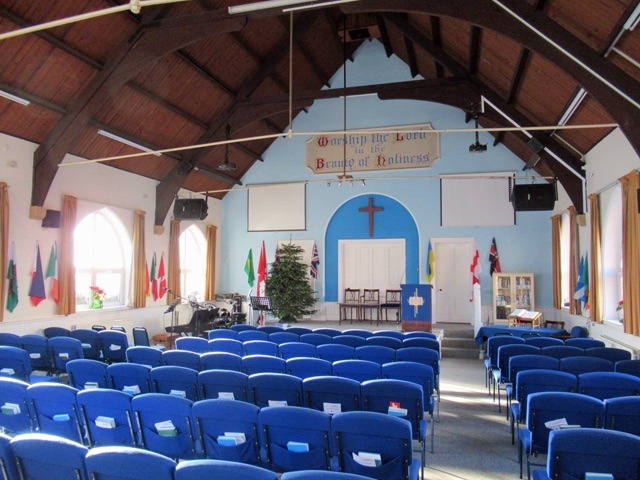 The Church interior today.
Photograph by Roger Morgan © 2024
What cannot be seen in the photograph above is the baptistry (for baptism by total immersion) which, when needed, is revealed by removing the central part of the platform. After their baptism, candidates pass through the double doors to dry off and get changed. Another original feature is the text over those doors – “Worship the Lord in the Beauty of Holiness” (Psalm 96:9). The cross under that is one of a series of changes made from the mid-1980s onwards which include:
- replacing the pipe organ with an electronic instrument;
- replacing the original pews with chairs (both for comfort and to allow different seating configurations when needed);
- replacing the pulpit with a movable lectern;
- installing digital projectors and other modern electronics; and
- replacing the original windows with double glazed units.
The Great War
David Jenkins (whose Centenary history of the Church is the main quarry for this article), found that what is now known as the First World War had left surprisingly few traces in the records he surveyed. Among the handful that he found were:
• 1915 discussions with other local churches about providing a meeting place for soldiers billeted in Epsom, which led to no collective action (although the Methodist Church established a Soldiers’ Institute on its Ashley Road site); and
• a 1916 decision to insure the church building against air raids.
These war years saw some turbulence in the Pastorate.
• In 1916, the Revd Edward William Tarbox resigned after five well-regarded years in post. This appears to have been triggered mainly by ill health – he died two years later, aged 66. He is commemorated in the Church’s only memorial plaque.
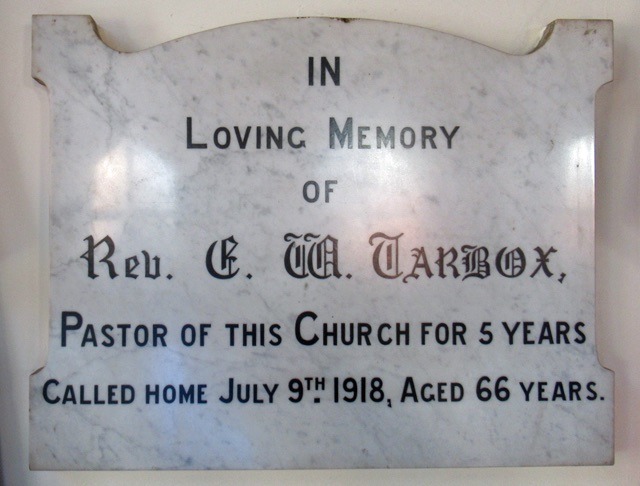 Revd. Edwin Tarbox’s memorial in Epsom Baptist Church.
Photograph by Roger Morgan © 2024
• The search for a new Pastor led to Mr Bevan, a student at Pastors College, accepting the call to become a Student Pastor. He began his ministry on 1 January 1917 with a stipend of 15 shillings (75p) a week. The Army Authorities then announced that all Divinity students leaving college had four options: join the army; relieve a minister who had been made a Chaplain to the Forces; join the Reserve and await a Forces Chaplaincy post; or become a resident Minister. Mr Bevan – who it seems was about to get married – opted for the fourth, and his stipend was increased to £1 a week. Later in 1917, he succumbed to ill health and resigned at short notice.
• In July 1918 (the month in which the Revd. Tarbox died), the Revd. Henry Benson accepted the call to the pastorate. He was inducted in October 1918 but, within a month, this 41-year-old died at his home in Bow.
The interwar years
1919 saw the appointment of the Revd. Ernest Peskett as Pastor and, after the previous few years’ turbulence, there must have been all round relief that he served at Epsom for the next ten years – setting the pattern for his successors (see the Annex), all of whom served for good terms.
It appears that, until this point, Pastors had secured their own living accommodation. The Church now purchased “Westfield” in Bridge Road as a manse, and owned it for many years – although it is not clear how many Pastors actually lived there. When not needed for the Pastor, the property was rented out for useful income. (During the 1971 interregnum, the Bridge Road Manse was sold, and another bought in Hazon Way.)
 A postcard view of the Church in the early 1920s, showing the fence that marked the rear of the original site.
Image with thanks to Bourne Hall Museum.
In the late 1920s, the opportunity arose to acquire the plot adjoining the rear of the site’s rear, about doubling the overall area. This coincided with a revival of the Council’s 1905 consideration of widening Church Street, for which it would need a slice of the Church’s site. Again, this went unrealised.
The purchase of the site extension was completed in 1929 at a cost of £140. Thoughts ebbed and flowed how to develop the now-larger site – not least to accommodate the intended Hall – but, as we shall see, these did not crystallise until the 1950s.
In the meantime (and following the 1926 replacement of the original Victorian era hymn books), thoughts turned to enhancing the musical side of Church life by buying a new organ. (It seems that the organ/harmonium bought in 1899 was still in use.) An Organ Fund was launched. This grew quickly and, in May 1928, it was agreed to buy a new two-manual pipe organ for £245. In the event, this purchase did not proceed as the opportunity was taken to purchase a second-hand but superior instrument from St George’s Chapel, Windsor, at a total cost of £277. This instrument was hand-pumped, and the boys of the Bible Class were asked to form a rota to undertake this task Sunday by Sunday. Volunteers (for what is hard work) seem to have been in short supply as, only a few weeks later, a “Blower for the Organ” was appointed in August 1928 with the pay of 13 shillings (65p) per quarter – plus extra payments for special services. In 1930, the rate was increased to £1 per quarter.
Church life prospered during the 1930s and, by 1937, a Building Committee was set up with a view to erecting the long-intended Hall needed to accommodate the wider range of activities. Counter-pressure came from the Council’s continuing threat to the Church with the proposed widening of Church Street. Indeed, serious thought was given to the possibility of selling the site and moving elsewhere.
World War 2
While the outbreak and conduct of WW2 would have had a great impact on the life of Church members, the Church’s formal records (as for WW1) concentrate on local matters. An early impact was the suspension of the Building Committee for the duration of the hostilities. In early 1940, mention is made of “gifts and comforts” being sent to Church members serving in the forces. The threat of air raids led to the suspension of all weeknight activities. Arrangements were made for the congregation to use, as necessary, the air raid shelter at the Police garage on the adjoining site. The Church contents were valued at £300 for the purposes of insuring them under the Government’s War Risks Compensation Scheme.
1945 onwards
With the ending of the war, thoughts returned to building the much-needed Hall. It was agreed to erect a wooden structure, but that soon ran into planning difficulties with the Council. When those were resolved, the plan fell foul of the tight post-war licensing arrangements for any new building – the national priority being reconstruction of wartime damage. Planning restarted in 1951, and the original “wooden hut” proposal became a brick-built Hall. In October 1952 an estimate of £3,828 was accepted for the work. Construction began in January 1953, and the Hall was opened in October that year.
The Hall (with the usual ancillary facilities) was put to good use for various activities, to the point where yet further accommodation was needed on site. Planning permission for the extension to the rear of the Hall was granted in 1958. What are known as the Bannister and Russell Rooms (named after prominent Church members) were erected by members and friends on a DIY basis and came into use in 1959.
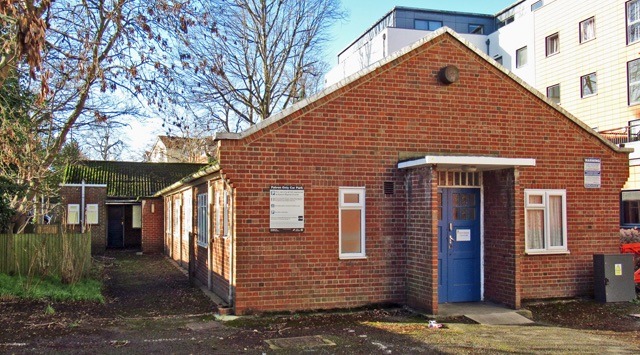 The 1953 Hall, behind which can be seen the 1959 extension.
Photograph by Roger Morgan © 2024
 The 1959 Bannister and Russell Rooms at the rear of the Hall.
Photograph by Roger Morgan © 2024
All this was during the 1950-61 pastorship of Ernest Sharpe who was unusual in combining the pastorship with running an accountancy business. A highlight of his ministry was the service held on 7 December 1956 to bid farewell to his son and daughter-in-law, Ian and Audrey Sharpe, as they set off for missionary work in the Congo. That ended in tragedy when the couple – together with their children – Julian, Alison and Andrew – were among the many missionary families massacred in the November 1964 Simba rebellion.
The Church Street widening proposal continued to rumble on. In the early 1960s, the possibility of moving to another site was explored with significant (but ultimately fruitless) work being done on options in Temple Road, on the new Longmead Estate and at 18 Church Street (the former St Martin’s vicarage) – the last getting as far as planning permission being sought (and rejected) for a new church. As the possibility of widening Church Street remained in play, the opportunity was taken in October 1965 to purchase (for £1,850) some land to the rear of the Bannister and Russell Rooms, apparently with a view to allowing room to redevelop the Church buildings on site even if the Church Street widening proposal was implemented.
It may be helpful at this stage to see the following sketch plan of the overall site, as it remains today.
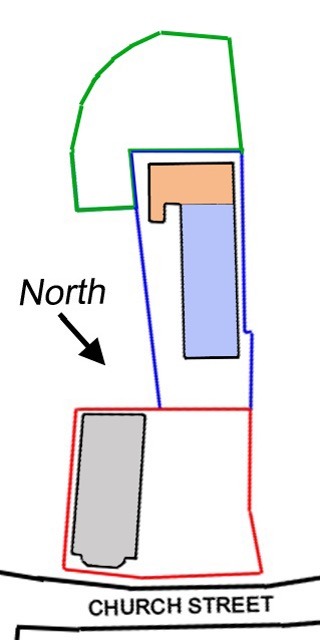 Outline plan of the Baptist Church site.
The original plot is outlined in red, with the 1907 Church building shaded grey.
The area outlined in blue is the 1929 plot extension, within which the 1953 Hall is shaded pale blue, and the 1959 Bannister and Russell Rooms are shaded pale orange.
The 1965 further plot extension is outlined in green.
Drawing by Roger Morgan © 2024
The site issue rumbled on and on. In 1967, the possibility arose of acquiring an alternative site in Upper High Street and, with Council encouragement, that was pursued for a while. In January 1968, the Council gave the first definitive indication of how much of the Church Street site would be needed for the long-projected road widening scheme that had now grown into the ambitious Southern Link Road proposal to relieve the town centre. (This scheme also threatened Epsom Methodist Church.) As the Church felt the remainder of the site would now be insufficient for its purposes, they asked the Council to buy the whole site and help it find a new home. A move to the site of the crumbling late Stuart West Hill House was jointly considered but fell through. The possibility of taking a site on Longmead was also considered, but with little enthusiasm for moving so far from the Town Centre. Potential sites in both The Parade and Laburnum Road were also mooted. Several commercial offers to redevelop the Church Street site (within the reduced boundary) to include sufficient space for the Church and its activities within the new build were received but came to nothing.
It seems that weariness with all this eventually resulted in a decision to wait and see what would be possible as and when the long-threatened road scheme became a definite and scheduled scheme. It never did, being formally abandoned in 1998.
In the meantime, Epsom Baptist Church carried on its wide-ranging activities, which continue today.
Roger Morgan © 2024
with special thanks to David Jenkins (for his Centenary History) and to Handley Hammond
PS For completeness, mention should be made of the Grace Baptist Church on the Dorking Road (part of the Association of Grace Baptist Churches). That strict Baptist congregation has its roots in the old Salem Chapel in Prospect Place.
ANNEX: Pastors of Epsom Baptist Church
All the photographs below are taken from David Jenkins’ 2000 centenary history.
[1900: John Tuckwell]
 The Revd John Tuckwell, who led the Founding Fathers of Epsom Baptist Church.
1900-1902: Arthur Charles Hodgson (the Church’s first official pastor)
1902-1905: Interregnum
1905-1906: R French
1907: Interregnum
1908-1910: Charles W Townsend
1911-1916: Edward William Tarbox
 The Revd Edward William Tarbox
Image courtesy of Bourne Hall Museum
1917-1918: (first name?) Bevan
1918: Henry Benson
1919-1929: Ernest Edwin Peskett
1929-1936: Arthur George Edgerton
1936-1940: Harold T Barrow
1941-1949: Francis C White
 The Revd Francis White.
1950-1961: Ernest J Sharpe
 The Revd Ernest Sharpe.
1961-1970: Albert E Allen
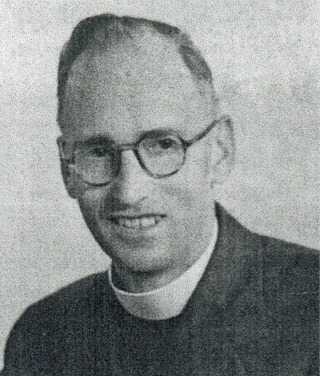 The Revd Albert E Allen
1971: Interregnum
1972-1982: John Tall
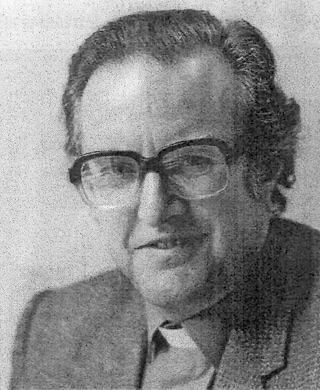 The Revd John Tall
(During his 1980 Sabbatical, Mr Tall worked for the national Baptist Times. On returning to duties in Epsom, he continued to work for the paper one day a week and, on standing down in 1982, returned to full-time work there.)
1983-2000: Peter Lewis

The Revd Peter Lewis
2001-2003: Interregnum (assisted by Moderator Peter Birchinall)
2003-2012: Colin Holmes
2013-2014: Interregnum (assisted by Moderator Peter Nodding)
2014- : Mike Thornton