
War Memorials – WW2 – Surnames F
Back to our main war memorials page
Index
Click on the name to jump to the relevant entry
FALCK, Rudolph Julian (Revised 16/03/2020)
FARNFIELD, Alice Marshall (Revised 17/07/2018)
FARNFIELD, Henry John (Revised 17/07/2018)
FEDERMANN, Herbert (Revised 17/07/2018)
FENNELL, John Grenville (Revised 15/12/2021)
FERGUSON, Douglas Arthur (Revised 17/07/2018)
FIELDING, Kathleen Elizabeth (Revised 29/12/2017)
FISHER, Patrick Robert Cosby (Revised 23/03/2020)
FLETCHER, Dennis Howard (Revised 17/07/2018)
FLETCHER, Frederick Edward (Revised 22/08/2018)
FLOWER, Peter John (Revised 17/07/2018)
FOLEY, Herbert Onslow (Revised 29/12/2017)
FORD, Leslie Arthur (Revised 17/07/2018)
FOSTER, Frank Joseph * (Revised 02/11/2021)
FOURNIER, Bernard Maurice (Revised 08/10/2022)
FOWLER, Leslie Gordon (Revised 20/07/2018)
FOX, Stafford Harry John * (Revised 16/10/2020)
FRANCK, Douglas George * (Revised 10/05/2022)
FRANTIŠEK, Josef * (Linked to a separate page)
FREAKES, Kenneth (Revised 20/07/2018)
FRECKER, Peter Farrow (Revised 18/12/2020)
FREEMAN, Henry Alfred (Revised 23/07/2018)
FROST, Rupert Chatham (Revised 08/02/2018)
FRYER, Herbert Arthur (Revised 22/07/2018)
FURNELL, Harry Leonard (Revised 22/07/2018)
* = Not included in the Book of Remembrance for reasons unknown.
If you are looking for someone whose name starts with a different letter please try:
A B C D E F G H I J K L M N O P Q R S T U V W X Y Z
Content
FALCK, Rudolph Julian. Lieutenant (237410)
The Parachute Regiment, Army Air Corps
Died 26 September 1944, aged 24
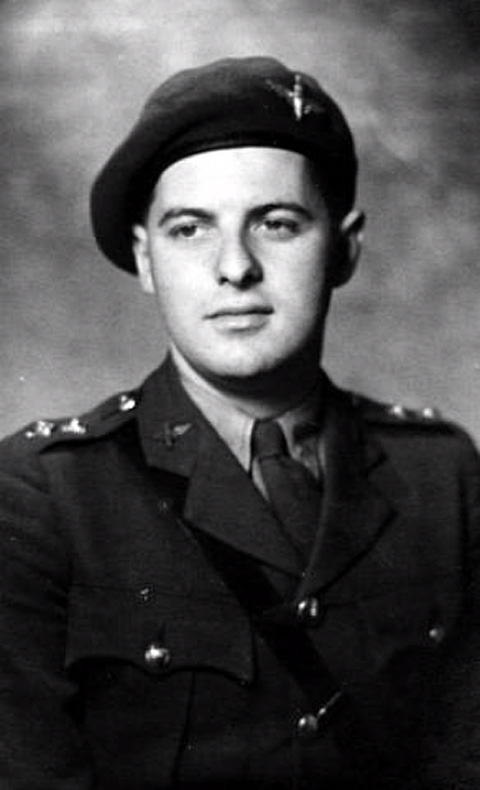
Rudolph Falck.
Photograph (and much of the career and incident detail below) with thanks to paradata.org.uk
Rudolph Julian (originally Rudolf Julius) Falck is not listed in the Borough’s Book of Remembrance but is remembered here because the Commonwealth War Graves Commission’s post-war records note that his wife was “of Epsom, Surrey”. As noted below, that Borough connection has been confirmed – although it seems unlikely that Rudolph himself ever lived in the Borough.
Rudolph Falck was born in Cologne, Germany on 29 April 1920 – as detailed in the “Index of Jews whose German nationality was annulled by Nazi Regime, 1935-44“. He was the son of Georg – a distinguished Jewish Architect – and Elisabeth Falck. The parents, together with “Rudi” and his twin sisters, left Germany when the Nazis came to power and settled in Amsterdam. Rudolph came to Britain in 1937 to study law at Balliol College, Oxford, where he later gained his BA. (His parents and sisters remained in Amsterdam and, after the outbreak of WW2, Rudolph was never to see them again.)
As a German national, Rudolph was interned on the Isle of Man in 1940 as an “enemy alien”. He was released after processing and, on 8 October 1940, joined the Pioneer Corps as a Private, rising to Corporal. He was commissioned as a Second Lieutenant in the Corps on 6 July 1942, and promoted to War Substantive Lieutenant on 6 January 1943.
In Q2 1942, shortly before being commissioned, he married the 20 year old Pauline Mary Duvall Davies at St George’s, Hanover Square, London. The couple had one child, Christa Elizabeth Mary, born in December 1944, a couple of months after Rudolph’s death. That birth was registered in the Chelsea District, and their address is likely to have been 87 Cadogan Gardens, Chelsea – as attributed to Rudolph in the May 1945 Probate record of administration of his £4,073 estate being awarded to the widowed Pauline.
To return to Rudolph’s service career, in July 1943 he was sent to North Africa with the 337th Alien Company Pioneer Corps. But that was only for a few weeks. In August 1943, he was posted back to the UK to join the Pioneer Corps’ 144th Company which was preparing for the invasion of Europe.
Towards the end of 1943, Rudolph volunteered for Airborne Forces, and was commissioned into the Parachute Regiment, Army Air Corps, on 1 January 1944. After induction at Hardwick Hall, near Chesterfield, he attended parachute course No 101 at RAF Ringway, near Manchester, which he completed on 13 February with praise from his Parachute Instructor who commented, “Has been a good example, jumped very well”. Via the Airborne Forces Holding Unit, he was posted to the Headquarters, 5th Parachute Brigade on 29 February. However, just two months later, on 3 April 1944, he was posted to the 1st Airborne Division Provost Company, Corps of Military Police (stationed at Stubton Hall in Lincolnshire) where, no doubt because of his language skills, he was appointed Intelligence Officer.
By September 1944, he was Officer Commanding, 4 Provost Section (which, in action, would be mainly responsible for handling prisoners of war), 1st Airborne Division – and in the thick of the mid-September Operation Market Garden, the aim of which was to clear a path for the Allies’ continuing advance into Germany through the Netherlands, circumventing the defensive Siegfried Line. The operation had two limbs: “Market” (the largest airborne operation up to that point) to capture bridges at Nijmegen and Arnhem before they could be destroyed by the enemy; and “Garden”, a major advance of ground troops to relieve the airborne troops holding the bridges.
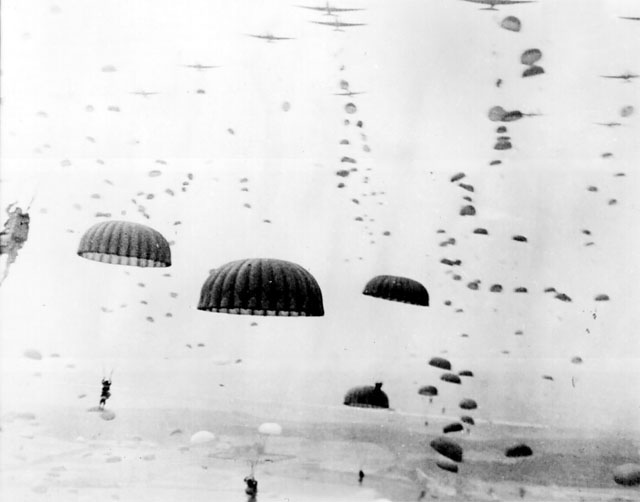 Paratroops landing at Arnhem – Public Domain
The airborne part of the operation went to plan. On Sunday 17 September 1944. Rudolph jumped in with second lift to Arnhem, surviving the intense fire from the ground, and was part of the initially successful capture of the bridge. A number of Germans were captured, and Rudolph’s Section was holding these PoWs in cages improvised from the tennis courts at the Hartenstein Hotel near Oosterbeek.
However, the ground forces’ advance was far more difficult than anticipated: while they reached Nijmegen in time to relieve the paratroops there and consolidate the advance to that point, Arnhem proved to be “a bridge too far”. In spite of stout resistance and heavy losses, the paratroops there were unable to withstand the German forces’ fierce retaliation. Plans were drawn up for the paratroops to withdraw in small groups of 12-15 under cover of darkness late on Monday 25 September. The group of which Rudolf was part stumbled into a well-armed German position and came under machine-gun fire. Rudolf was among those killed in the early hours of Tuesday 26 September. The remainder of the group was taken prisoner. The Germans allowed the prisoners to bury their dead, and Rudolph (who, because of his German name, was not wearing his dog tags) was buried by Lance Corporal Stan Reast.
Despite extensive post-war searches, Rudolph’s grave was never confidently found. (It may be that his anonymous body was recovered in a more general recovery of scattered graves and reburied in one of the 244 sadly anonymous graves among the 1,526 Commonwealth WW2 casualties in the Oosterbeek War Cemetery on the outskirts of Arnhem.) As someone who is known to have died in the area but has no known grave, he is one of the 1,021 Commonwealth WW2 casualties commemorated on the Groesbeek Memorial which stands within Groesbeek Canadian War Cemetery about 6 miles southeast of Nijmegen.
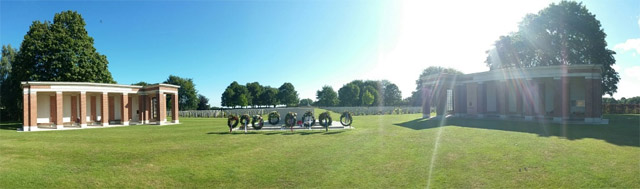 The Groesbeek Memorial.
Photograph with thanks to the Commonwealth War Graves Commission
In Q1 1946 and registered in the Chelsea District, the widowed Pauline got remarried – to “Jo W Linford or Loewenfeld”. For some reason, that marriage did not last and, in Q1 1950 registered in Westminster, Pauline got married yet again – this time to Oswald Martin Timms. The 1951 Electoral Roll records Pauline and Oswald Timms living in Flat 5 of No 8, Downs Road, Epsom – the “of Epsom” connection noted by the Commonwealth War Graves Commission.
Roger Morgan © 2020
With special thanks to Hazel Ballan for tracing the Borough connection
Please contact us if you have information or pictures that can extend this entry.
FARNFIELD, Alice Marshall.
Civilian.
Died 6 November 1940, aged 64.
&
FARNFIELD, Henry John.
Civilian.
Died 6 November 1940, aged 74.
Henry John Farnfield was born in Pimlico, London on 9 December 1865. He was the second son of William (a “Carman Carrier”) and Sarah Farnfield’s at least eight children. By the time of the 1881 Census, the family were living at 26 Rock Avenue, Fulham and the 15 year old Henry was working as a harness maker.
In Fulham, Q1 1888, Henry married Bessie Catherine (née Larcombe), and this couple were recorded in the 1891 Census living at 284 Edmunds Place, Fulham, with Henry working as a “Postman 1st Class”. By the time of the 1901 Census, they were living at 9 Margravine Road, Fulham. Henry was still working as a postman, and they had a 12 year old daughter, Alice.
During WW1, Henry served as a Red Cross Orderly (Certificate no. 8772). At some point after that, the family moved to Croydon and, presumably capitalising on his teenage leather-working skills, Henry took up shoe-making. It was in Croydon that Bessie, aged 70, died Q4 1936. So, Henry was into his 70s when, also in Croydon, he married the 61-year old Alice Marshall Allaway Q2 1937.
That appears to have been Alice’s first marriage. (She had been born in Trowbridge, Wiltshire on 10 March 1876. By the time of the 1891 Census, the 15 year old Alice was living with her unmarried 23 year old sister, Elizabeth, and both were working in a cloth factory.)
Anyway, Henry (a “master shoe maker”) and Alice were recorded in the September 1939 Register living at 36 Waterloo Road, Epsom. On 6 November 1940 – a couple of months into the Lufwaffe’s “Blitz” bombing campaign – they were at home there when, at 22.45 (and as recorded in Hilda Andrews’ war diary), a bomb fell on Waterloo Road. Their house took a direct hit and they would have been killed instantly.
The following day – from above his shop, Stevens Musical Service, across the road at No. 35 – Fred Stevens photographed the damage, as below. (The site of No. 36 is now covered by the Wellington Court retirement apartments.)
 What was left of No 36 Waterloo Road after the bomb fell.
Copyright acknowledged.
After their joint funeral on 12 November 1940, Henry and Alice were buried together in plot M358 of Epsom Cemetery, for which there is no longer any headstone or visible grave marker.
Roger Morgan © 2017
Please contact us if you have information or pictures that can extend this entry.
FEDERMANN, Herbert. Gunner (PAL/8363)
Royal Artillery
Died 24 October 1943, aged 22
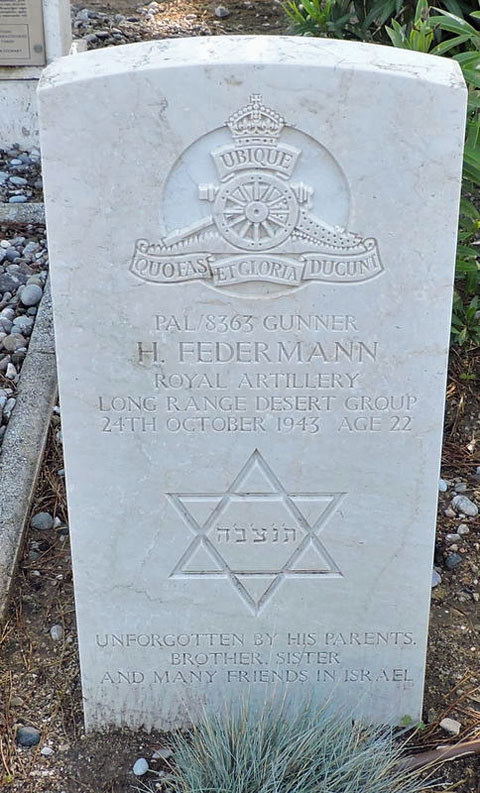 Herbert’s headstone in Rhodes War Cemetery
Photograph (21414551) by Bob Boston via findagrave.com
Not listed in the Book of Remembrance
The Commonwealth War Graves Commission records note that Herbert was the “son of Siegfried and Eleanor Federmann, of Epsom, Surrey”. The readily available records provide no information about the family background and it would seem that the family (it is known from Herbert’s headstone that he had a brother and sister) came to Britain as pre-war Jewish refugees from Hitler’s Germany: the only Siegfried Federmann in the September 1939 Register is recorded at what looks like settlement or internment arrangements at Hoylake, Lancashire. He is listed as married and with a birth date of 27 April 1884.
The parents’ “Epsom” address has yet to be established. It was a hopeful sign that their deaths (Siegfried’s in Q3 1955 aged 71 – consistent with the birth date in the 1939 Register – and Eleanor’s in Q1 1983 aged 91) were both registered in the local Surrey Mid Eastern District. However, Siegfried is found in the 1955 Phone Book living at 35 Merland Rise, Tattenham Corner. This is often thought of as “Epsom” but is just over the Borough’s border with Banstead. (They may, of course, have lived actually in Epsom before 1956.) Eleanor continued to live at 35 Merland Rise until about 1981. She then moved to “The Links House”, The Warren, Ashtead where – according to the Probate records – she died on 26 March 1983. Both Tattenham Corner and Ashtead come within the local Surrey Mid Eastern District.
Herbert’s WW2 service began in the Royal Artillery. This seems bound to have been in North Africa where he was then recruited in the elite Long Range Desert Group. This was an elite force (on the lines of the later and better-known SAS) initially established as “pirates of the desert”. It has been described as “arguably the most dashing and successful irregular formation on either side in the entire war” and “probably one of the most cost-effective special forces in the history of warfare.” It carried out some 200 missions across a desert the size of India, then through the Mediterranean, the Balkans, and the Adriatic. In its five years of existence, there were only five months when an LRDG patrol was not on an operation.
Herbert – known to his comrades as “Sam” – almost certainly met his death during an LRDG operation on the island of Kos during the overall Dodecanese campaign of 8 September to 22 November 1943.
After the Allies’ capture of Sicily in early September 1943, the Italians capitulated and after the armistice rejoined the war on the side of the Allies. German forces in the Balkans and the Mediterranean moved to take over the Italian-held areas. At the same time, the Allies endeavoured to occupy the Dodecanese islands (or which Rhodes is the largest) which had been under Italian control since the Italo-Turkish War in 1911. The aim was to use these strategically located islands in the south-eastern Aegean Sea as a base against German positions in the Balkans.
The main target was Rhodes, the largest island of the group, but this fell to a swift attack by a German mechanized brigade. Nevertheless, British forces successfully took several other islands, most notably Kos (with its valuable airfield) and Leros (with its valuable port). The Germans acted quickly to neutralize the Kos airfield and stormed the island in early October, capturing 1,388 British and 3,145 Italian prisoners. (They committed a war crime on 3 October by executing the captured Italian commander of the island nearly 100 of his officers.) Allied action in the islands continued until 22 November.
Herbert’s death on 24 October was nearly three weeks after Kos had fallen, lending force to the idea of some covert operation. He was one of 65 Commonwealth WW2 casualties initially buried in the small war cemetery on Kos. That cemetery closed in 1957, and the bodies reinterred in the War Cemetery on Rhodes, about doubling its size. The family had taken the option of adding a personal inscription to Herbert’s headstone which was re-erected on his new Grave 1.A.12,
“Unforgotten by his parents, brother, sister and many friends in Israel.”
Roger Morgan © 2018
Please contact us if you have information or pictures that can extend this entry.
FENNELL, John Grenville. Private (6347372)
1st Battalion, Queen’s Own Royal West Kent Regiment.
Died 27 April 1943, aged 23.
John was born in Epsom on 2 July 1919. He was the fourth of seven children born to William James Grenville Fennell (born in Shepherd’s Bush, London Q4 1887) and Annie (née Tickner – born in Wotton, Surrey Q4 1888).
John’s parents had married on 24 April 1912 in the church of St. Barnabas, Battersea – where the records list his 24 year old father as a police constable living at Ambrosden House, Ashley Gardens, Westminster; and his 23 year old mother living at 77 Elspeth Road, Clapham. (The 1911 Census, the previous year had recorded William as a Metropolitan Police officer, lodging at 16 Tenter Street, London E. and Annie as a “Housemaid” working at “The Priory”, Licensed House for Persons of Unsound Mind (Private), Roehampton.)
With their first couple of children, the parents moved to Epsom where their third child was born in January 1917 – as was fourth child John (the subject of this article) on 2 July 1919. Certainly between 1918 and 1938, the family lived at 261 Hook Road, Epsom – and that was the family address on the record of John’s baptism on 31 August 1919, although that was held in St. Barnabas, Battersea where (as noted above) his parents had married in 1912. They then moved to 17 Maidenshaw Road, Epsom. That is where they were recorded in the September 1939 Register. 51 year old William is still listed as a “Policeman” and 50 year old Annie with the conventional “Unpaid Domestic Duties”. Also living with them was William’s widowed 84 year old father, William G Fennell, listed as “Official Attendant, Royal Courts of Justice (Retired)”. (He died there on 18 January 1942 aged 88.)
Details for the seven children are set out in the table below.
| JOHN GRENVILLE FENNELL AND HIS SIBLINGS | ||
| Name…………….. | Born – Died | Occupation recorded in the Sept 1939 Register |
|---|---|---|
| William J G | Born: 21/3/1913 Pancras | Chauffeur & Mechanic |
| Ethel M | Born: 12/61915 Wandsworth | The conventional “Unpaid Domestic Duties”, having just (Q3 1939) married “Assistant Research Chemist” George O Warren, and living with him at 8 St Leonards Road, Banstead. |
| Myrtle | Born: 18/1/1917 Epsom | Hospital Duties |
| John Grenville | Born: 2/7/1919 Epsom Died: 27 April 1943 |
Gas Works Fitter |
| Stanley E | Born: 8/8/1921 Epsom | Gas Works Collector |
| Alfred | Born: 23/7/1924 Epsom | Office Clerk |
| Joan | Born: 9/3/1926 Epsom | At School |
On Tuesday 27 October 1942, 23 year old John married 19 year old Ann Stewart Goodman (“Goodwin” in some records) Kerray in St Barnabas, Temple Road, Epsom – the parish church for John’s family home at 17 Maidenshaw Road, quarter of a mile away. Ann had been born in Edinburgh on 4 May 1923, the daughter of William and Emma Jane (née Ratcliffe) Kerray. The marriage certificate records Ann’s address as that of her future parents in law in Maidenshaw Road, doubtless staying with them during the week’s leave from the ATS she had granted for the wedding. John’s address is noted as “Serving in the Army”, and the services connection seems likely to be how the couple first met.
John’s WW2 service was in the 1st Battalion Queen’s Own Royal West Kent Regiment. This had returned to England after Dunkirk and remained in here until 1943, when it was sent to fight in the Tunisia Campaign, arriving in North Africa during March.
The V Corps attack went in on the evening of 22 April 1943 and U.S. II Corps launched their offensive in the early hours of 23 April capturing Hill 609, a key hill position which opened the way to Bizerte. In grim hand-to hand fighting against the Hermann Göring, 334th Infantry and 15th Panzer Divisions, it took V Corps’ 1st, 4th and 78th Infantry Divisions, supported by Army tanks and heavy artillery concentrations, eight days to penetrate 9.7km (6 miles) and capture most of the Axis defensive positions. Casualties were heavy on both sides but the dominating hill of Longstop was captured which opened the way to Tunis.
The Queen’s Own Royal West Kent Regiment’s casualties were 16 officers and 317 other ranks. John was among these, having been killed in action on 27 April 1943 (Casualty List No. 1177).
John is one of the 1,147 Commonwealth WW2 casualties buried in the Massicault War Cemetery, about 20 miles south-west of Tunis. His family took the option of adding a personal inscription to his headstone on Grave II.G.5
“In loving memory of a dear husband, son and brother. Those he loved remember.”
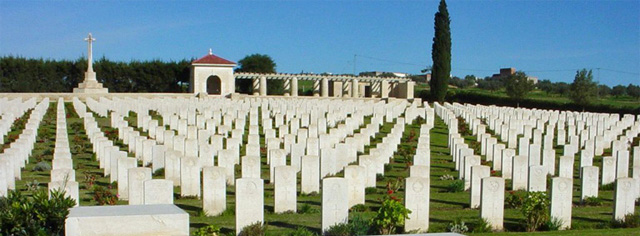 The Massicault War Cemetery, Tunisia.
Photograph with thanks to the Commonwealth War Graves Commission.
In due course, the widowed Ann returned to Scotland. On 26 March 1960, she married John Gibson Borthwick in St Giles, Edinburgh, and it appears that they had a child together. The family moved to Hawick, Roxburghshire where John died in 1995 and the doubly widowed Ann died on 2 May 2009.
John Fennell’s father died aged 72, on 13 June 1960 in Epsom District Hospital. His mother was aged 77 when she died in their home at 17 Maidenshaw Road, Epsom on Christmas Eve 1965.
In addition to his entry in the Borough’s Book of Remembrance, John is commemorated on the Epsom St. Barnabas Roll of Honour.
Clive Gilbert & Hazel Ballan 2014
Updated by Roger Morgan 2021
Please contact us if you have information or pictures that can extend this entry.
FERGUSON, Douglas Arthur. Sergeant (921752)
50 Squadron, Royal Air Force Volunteer Reserve
Died 15 December 1941, aged 22
Douglas is not listed in the Book of Remembrance, but is remembered here because the Commonwealth War Graves Commission’s post ward records note that his widowed mother, Edith Ferguson, was “of Stoneleigh, Epsom, Surrey”. That address has yet to be established but, given the details set our below, it seems unlikely that Douglas ever lived in the Borough.
Douglas was born Q3 1919, the second and last child of Arthur William Ferguson and Edith (née Folkes). Their Q3 1913 marriage had been registered in Edmonton – as were the births of their first child, Joan M M, in Q2 1916 and of Douglas three years later. The death of Arthur Ferguson, aged only 43, was also registered in Edmonton Q3 1924.
The September 1939 Register records the widowed 55 year old Edith – listed with the conventional “Unpaid Domestic Duties” – living at 4A Crown Parade, Southgate (within the Edmonton District). Living with her was 22 year old daughter Joan M M, listed as a “Shorthand Typist, Bookkeeper”. There is one currently closed record at the address, likely to be of 20 year old Douglas.
Shortly after that Register was taken, Douglas enlisted in the Royal Air Force at Uxbridge. He was assigned to 50 Squadron, part of the RAF’s Bomber Command that, at the time, was equipped with the Handley Page HP52 Hampden medium bomber.
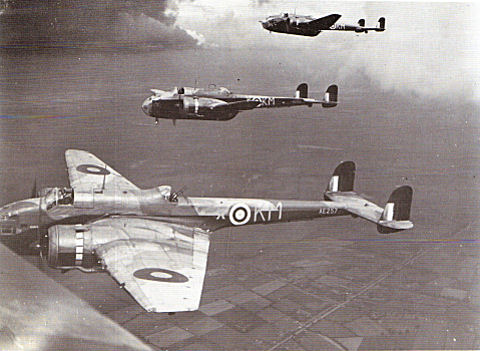 A Flight of Hampdens
Image source The Hampden File by Harry Moyle
At 17:50 hours on 15 December 1941, two Hampdens from 50 Squadron took off from RAF Skellingthorpe in Lincolnshire to attack ships at Ostend. Hampden AT125 suffered engine trouble soon after take off and returned to base.
The second Hampden, AE380 with Douglas as part of the crew, continued on the mission. When around the target, it was caught in a searchlight and hit by Flak from Stabsbatterie MAA 204. At about 20:45 hours, AE380 crashed into the sea in front of the Military Hospital.
Next day a crew member picked up at sea and brought into Ostend was found to be the 20 year-old pilot Sergeant. William Young (778478) from Rhodesia. Dressed in leather trousers and jacket, he was carrying the following currency in a rubber bag:- 1,000 French francs, 350 Belgian francs, 20 Dutch guilders and 16 British pounds plus 10 shillings. He is buried in the Ostend New Communal Cemetery.
The rest of the crew were posted as missing and later confirmed killed. They were:-
1375391 Sgt. Edward William Armer, RAFVR,
921752 Sgt. Douglas Arthur Ferguson, RAFVR,
946158 Sgt. Frederick Alexander White, RAFVR
Neither the wreckage of AE380 nor the missing crew were ever found. Their names are commemorated on the Runnymede Memorial, Surrey, which commemorates more than 20,000 airmen and women who were lost in WW2 operations from bases in the United Kingdom and North and Western Europe, and who have no known grave.
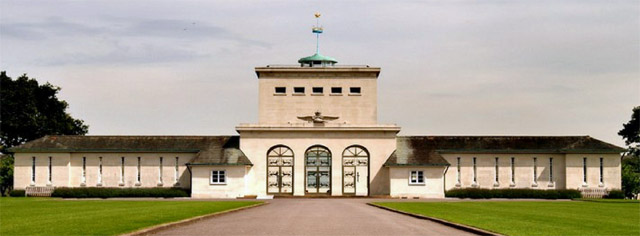 The RAF’s Runneymede Memorial
Photograph with thanks to the Commonwealth War Graves Commission
The Probate record of administration of Douglas’s £190 estate being awarded to his mother noted his address as 4a Crown Parade, Southgate, London N14 – the same as the 1939 Register entry.
Brian Bouchard & Roger Morgan © 2018
Please contact us if you have information or pictures that can extend this entry.
FIELDING, Kathleen Elizabeth. Wren (45315)
HMS Bherunda, Women’s Royal Naval Service.
Died 13 April 1944, aged 19.
 Kathleen’s headstone in Colombo, Sri Lanka.
Photograph (47263164) by “Deb” via findagrave.com
Kathleen was born on 2 May 1924, the third and last child of John Osborn Fielding and Blanche Evelyn Ruth (née Collard – they had married Q3 1917). The marriage and all three births were registered in the Croydon District.
Up to 1928, the family lived at 65 Ross Road, Wallington, but then moved to “Elmstead”, 12 Hillside Road, Ewell, which is where they were recorded in the 1939 Register. This listed father John as a “Clerk Insurance Industry (Lloyds)” and Blanche with the conventional “Unpaid Domestic Duties”. Of the children:
• 21 year old John C was registered unemployable on psychological grounds;
• 20 year old Joan had only just married 22 year old Howard V M McDowell (also, like her a, “Bank Clerk”) and both were living there; and
• 15 year old Kathleen was still at school.
Given her age, Kathleen would not have joined the Women’s Royal Naval Service until WW2 was well under way. Her service was at HMS Bherunda which was not a ship, but the name given to the Royal Naval Air Station established at the Racecourse of Colombo in Ceylon (now Sri Lanka). The RAF also had a couple of squadrons based at this temporary airstrip. The readily available records provide no information about which of the many possible roles Kathleen may have played at the base.
Her death was not the result of enemy action but the acute viral disease of Anterior Polio Myelitis – which, thanks to vaccines developed in the 1950s and the WHO immunisation campaign of recent years, is now almost entirely eliminated. The disease causes inflammation of the motor neurons of the brain stem and spinal cord, typically resulting in motor paralysis followed by muscular atrophy.
She succumbed to this disease in the RNA Hospital, Colombo, on 13 April 1944 and is one of the 610 WW1 & WW2 casualties buried in the Colombo (Liveramentu) Cemetery, Sri Lanka. The family took the option of adding a personal inscription to her headstone on Grave 2,L,14,
“R.I.P. / Always in our thoughts”.
Roger Morgan © 2017
With thanks to Brian Bouchard
Please contact us if you have information or pictures that can extend this entry.
FISHER, Patrick Robert Cosby. Major (64428) MiD
Officer Commanding, 9 Battery, 13 Medium Regiment, Royal Artillery
Died 1 December 1942, aged 28
Not listed in the Book of Remembrance
The Commonwealth War Graves Commission notes that Patrick was the son of Luke Patrick Knight Fisher and his wife Margaret. Luke was born on 5 June 1875 in Cootehill, County Cavan, Ireland (now Ulster). On 13 May 1903, he married Margaret Young Osborne in the Bovevagh District of County Londonderry, the record of which records his residence place as “Altmover, London, Englandderry”. While there is a record of the 32 year old Luke sailing from Liverpool to New York in 1908, he clearly returned. Son Patrick, the subject of this article, was born on 28 February 1914 – almost certainly the Patrick P C Fisher whose birth was registered in the Ballycastle District in Q2 1914. It is also known that father Luke served with the Royal Engineers during WW1.
In Q2 1938, the 24 year old Patrick – who was already in uniform – married the 23 year old Rosemary Ellen Gertrude Banon. It seems she also had Irish roots, almost certainly being the Rose M E G Bannon, whose Q1 1915 birth was registered in Birr, County Offaly in what is now Eire. The marriage was registered in the Surrey North Eastern District, but they set up home in Hampshire. The September 1939 Register records the 24 year old Rosemary (born on 5 February 1915) living alone at 52 Stour Road, Christchurch. The couple appear to have had two children – Robert (born Q1 1940) and Richard (born Q2 1942), registered in the Bournemouth and Blandford Districts respectively. She then moved to the Borough: the Commonwealth War Graves Commission’s post-war records note that the widowed Rosemary was “of Ewell, Surrey”, doubtless at 45 Bradford Drive recorded as her address in the 1945 Electoral Roll.
Patrick’s first taste of WW2 action was in France as part of the British Expeditionary Force. As is well known, the BEF was overwhelmed by the ferocity of the expected German invasion and, after significant losses, was evacuated from Dunkirk in late May and early June 1940. Patrick had distinguished himself in the BEF’s fighting retreat and was Mentioned in Despatches.
After his unit was re-equipped, it was part of the Commonwealth and US forces sent to North Africa in November 1942, landing in Algeria and Morocco with the main aim of tackling the rear of the Axis forces that were being driven westwards after Allied victory at El Alamein. By the time the newly arrived forces arrive in Tunisia, the Germans had brought in reinforcements from Sicily. There was much fierce fighting, not least from 29 November to 4 December against the Axis counterattack on the hard-won and highly strategic town of Tebourba about 15 miles west of Tunis. Patrick was killed in action on 1 December, one of the many casualties of the ultimately successful action: he received another Mention in Despatches for his part in this. (The war in North Africa came to an end in May 1943, paving the way for the Allies’ invasion of Sicily and Italy.)
Patrick is one of 1,576 Commonwealth WW2 casualties buried in the Massicault War Cemetery about 20 miles southwest of Tunis – and a few miles to the south of Tebourba. His widow took the option of adding a personal inscription to his headstone on Grave II.N.20,
“Killed in action at Tebourba. ‘Rest in peace’ “
The Massicault War Cemetery, Tunisia.
Photograph with thanks to the Commonwealth War Graves Commission.
The widowed Rosemary never remarried and, having moved away from the Borough, died at 1 Oak Way, Feltham, on 26 July 1976. She was aged 61.
Roger Morgan © 2020
With special thanks to Hazel Ballan for tracing the Irish roots here.
Please contact us if you have information or pictures that can extend this entry.
FLETCHER, Dennis Howard. Sergeant (1252492)
Royal Air Force Volunteer Reserve
Died 31 May 1942 Age 21
 Dennis’s headstone and the Uden War Cemetery.
Left: Photograph (18429472) by Des Philippet via findagrave.com
Right: Photograph with thanks to the Commonwealth War Graves Commission
Not listed in the Book of Remembrance.
Dennis, born Q4 1920, was the first of four children of Ernest William Fletcher and Daisy Isabelle (née Dewson). The parents’ Q1 1918 marriage was registered in the West Ham District. The parents seem to have been quite mobile: their children’s births were registered:
• Dennis Q4 1920, Fulham;
• Alan P Q1 1925, Brentford;
• Harold L (b. 28 December 1927) Q1 1928, Hatfield; &
• Keith D (b 27 August 1930) Q4 1930, West Ham.
The 19 year old Dennis is not readily found in the September 1939 Register. This records the parents and their two youngest children at what looks like a small boarding house run by Grace Clement at “The Lodge”, Harold Road, Frinton on Sea. 43 year old Ernest is listed as a “Grain Brokers Market Clerk”; 44 year old Daisy with the conventional “Unpaid Domestic Duties”; and the two children “At School”.
By the time of Dennis’s death in 1942, the family were living in 124, Reigate Road, Ewell. This was stated as Dennis’s address in the Probate record of administration of his £ 21 estate being awarded to his father. It was Daisy’s address when she died in 1952 and it was still Ernest’s address in the phone book for 1955.
Having joined the Royal Air Force Volunteer Reserve, Dennis Fletcher was selected for aircrew. When he was killed, it was as a Sergeant ‘Observer’ a category that was subsequently split into two main trades – Navigator and Air Bomber (bomb aimer). It is possible that he was originally selected for pilot training but after being evaluated was transferred into Observer school.
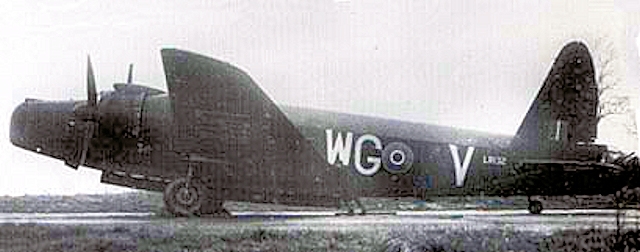 Wellington, LR132 WG-V of 26 OTU
Photographs of 26 OTU aircraft are hard to find. The unit’s aircraft
used three different unit fuselage codes – EU, PB and WG, almost certainly
to differentiate between flights, or aircraft based at the satellite
airfield of Little Horwood. This Wellington, LR132 WG-V of 26 OTU was based at RAF Wing.
Image source – RAF Bomber Airfields of WW2 by Jonathan Falconer
After completing his specialist training and receiving his Observer ‘Wings’, Dennis was posted to RAF Wing near Milton Keynes in early 1942 as part of 26 OTU (Operational Training Unit) which also operated from a satellite airfield at Little Horwood. Here, he was crewed with four others to make up the standard crew of the RAF’s main twin-engined bomber of the time, the Vickers Wellington.
26 OTU’s purpose was specifically to train crews for RAF Bomber Command’s night offensive. Here they would fly practise missions; navigation exercises and generally to get to know their aircraft, their functions and to work as a close-knit team. When fully proficient they would be posted to an operational Wellington Squadron. However, fate was to take a hand and Dennis and his crew would never complete their training.
Sir Arthur Harris had taken over as Chief of Bomber Command in February 1942. This controversial figure had no qualms about taking the war to Germany and knew that, in Bomber Command ,he controlled the only substantial military force then capable of going on the offensive. There was considerable doubt as to whether the strategic bomber was a worthwhile weapon at this point and he was determined to reverse the ineffective performance that the bomber force had delivered up to that point in the war. He knew that concentrating bombs on a target was the only way to cause meaningful destruction of the target area and began his tenure by targeting the cities of Lubeck and Rostock on the Baltic coast. Easily found and identifiable by their coastal location, these old cities with a high proportion of wooden buildings were destroyed more comprehensively than any previous targets. The British Press at last had something to report and opinions within the war cabinet were turning in his favour.
But Harris knew that the future of Bomber Command was still in doubt and he approached both Winston Churchill and Sir Charles Portal with the bold idea of assembling a force of 1,000 bombers and sending them out in one massive raid on a German city. Churchill and Portal were both impressed and they agreed. Although Harris had only a little over 400 aircraft with trained crews which were regularly used for front-line operational work, he did have a considerable number of further aircraft in the conversion units attached to groups with four engined aircraft and in Bomber Command’s own operational training units 91 and 92 Groups. This secondary Bomber Command strength could be crewed by a combination of instructors, many of them ex-operational, and by men in the later stages of their training. To complete the 1,000 aircraft required, Harris asked for the help of his fellow commanders in chief in Coastal Command and Flying Training Command. Both officers were willing to help. Sir Philip Joubert of Coastal Command immediately offered to provide 250 bombers, many of them being from squadrons which had once served in Bomber Command. Flying Training Command offered fifty aircraft but many of these were later found to be insufficiently equipped for night bombing and only four Wellingtons were eventually provided from this source.
Bad weather over Hamburg, the first choice target, caused Harris to select Cologne as the target, the third largest German city. ‘Operation Millennium’ was scheduled for May 30th 1942.
At Wing, W/O F.G.Hillyer, P/O A.C.White, Sgt D.S.B.Vincent, Sgt H.L.Smith and Sgt Dennis H.Fletcher, all of whom were nearing the end of their training were told that they were to fly together as a crew on their first operation – the night of May 30th/31st as part of this ambitious plan.
The Wellingtons from 26 OTU flew to RAF Gravely in Huntingdon. This airfield was in the process of being upgraded from a special duties base to a standard bomber airfield. By August, 35 Squadron would operate from the airfield as part of the new ‘Pathfinder’ force. Perhaps the transfer was to ensure that these aircraft would be closer to the operational bases and ensure a compact bomber stream on the way to the target.
At 23.05 in the late evening of May 30th 1942, Wellington 1C – serial DV740, coded EU-O, piloted by Warrant Officer F.G Hillyer, took off from RAF Gravely in Huntingdon and headed out over the North Sea towards occupied Europe. The operational career of the crew was to be almost as short as was possible. German radar detected the unusually large force approaching and the Luftwaffe scrambled its night fighters to wait for the incoming bombers.
Airborne from Gilze Rijen airfield in the Netherlands was a Junkers 88C night fighter of NJG2 (Night fighter group 2). In the pilots seat was one of the group’s rising stars, Hauptmann Horst Patuschka. A former bomber pilot, he joined the Luftwaffe night fighter force in the summer of 1941 and quickly rose to command 7 staffel NJG2. By October 1942 he was promoted to lead a newly reformed II gruppe NJG2 and took the unit to the Middle East after the Allied invasion. He crashed on the night of March 6th 1943 and was killed, being awarded the ‘Knights Cross’ posthumously. In his brief career he had amassed a total of 23 enemy aircraft destroyed.
 Hauptmann Horst Patuschka
(The German pilot who shot down Dennis’ Aircraft)
Image source – Simon Parry – Red Kite Publications
On the night of May 30/31st 1942, Patuschka shot down two outbound Wellingtons, one at 00.17hrs and the second, just 11 minutes later at 00.28hrs. The latter, Wellington DV740 of 26 OTU with Dennis amongst its crew, crashed at Alem (Gelderland), 14 km WNW of Oss (Noord Brabant), Holland. Four of the crew were killed –
• Sgt D.H.Fletcher,
• P/O A.C.White,
• Sgt D.S.B.Vincent,
• Sgt H.L.Smith.
They are buried among the 701 Commonwealth WW2 casualties in the Uden War Cemetery, about 20 miles north east of Eindhoven. Dennis’s parents took the option of adding a personal inscription to his headstone on Grave 4.A.7,
“The memory of his radiant smile gives us courage through passing years.”
The Pilot, W/O F.G.Hillyer was captured and was interned in Camps L3/L6/L4, as PoW No.508.
Forty-one RAF bombers were lost that night, an ‘acceptable’ 3.9% of the force dispatched. Of those four Wellingtons, DV740, DV707, DV709 and WS704 were all lost from 26 OTU.
Dennis Fletcher had played a minor role in the first 1,000 bomber raid of the war. It was sadly his first and last operation.
Most of the text and images kindly supplied by the Banstead History Research Group
Family background extended by Roger Morgan 2018
Please contact us if you have information or pictures that can extend this entry.
FLETCHER, Frederick Edward. Lance Corporal (1892938)
159 Railway Construction Company, Royal Engineers
Died 17 June 1940, age 20
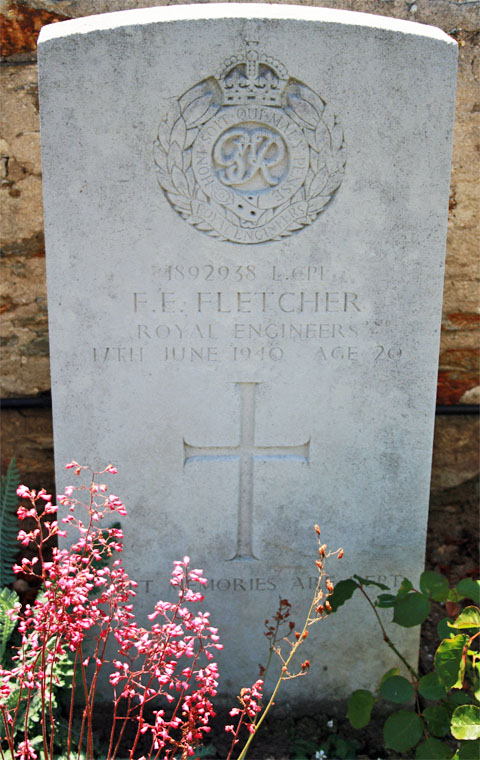 Frederick’s headstone in La Plaine-Sur-Mer Communal Cemetery
Photograph (68023120) by “kernowmaid” via findagrave.com
Frederick Edward (and the first half of this article uses both his names to avoid confusion with his father) is not listed in the Borough’s Book of Remembrance, but is remembered here because the Commonwealth War Graves Commission’s post-war records note him as “Son of the late Frederick and Rose Fletcher; of Epsom, Surrey” and, without mentioning a wife, as “Father of Tessa Pamela Fletcher”.
The Commission’s original records stated that Frederick Edward was “Son of Frederick Fletcher and Rose Fletcher; husband of Tessa Pamela Fletcher, of Epsom, Surrey.” In correcting Frederick Edward’s relationship to Tessa, the Commission erroneously transferred the “of Epsom” to his parents. No records have been found of his parents (or, indeed, Frederick Edward himself) ever living in Epsom – they were all solidly Kent-based. There is, however, a Borough connection through his wife and daughter. But, before getting to that, there is some complicated family background to be set out.
Frederick Edward’s father – who, for clarity, is referred to here as Frederick senior – had first married Daisy Alice Brooker in Q4 1913. They had two children – Doris Daisy in Q2 1914 and William Henry in Q4 1916. Sadly, within weeks of William’s birth, Daisy died on 4 December 1916 from scarlet fever. The marriage, births and death were all registered in the Malling District of Kent.
The widowed Frederick senior struck up a relationship with Rose King – and the birth of Frederick Edward, their first child, was registered Q3 1919. At the time, Rose (née Ovenden) was married to Herbert E King. Their Q1 1916 marriage had been registered in the Malling District, and the birth of their only child, Agnes, was registered in the Strood District Q3 1916.
Frederick senior and Rose had two more children. The next was Violet Marjory whose birth was registered Q2 1921 – apparently as both a “Fletcher” and a “King”.
In Q3 1922, the now 28 year old Frederick senior and 26 year old Rose got married. While it is not impossible that Rose’s first husband had divorced her, a more likely explanation is that he had died. Was he the Herbert E King whose death was registered in the Wycombe District of Buckinghamshire in Q1 1922? He had been born in Q4 1886, so would have been aged 29 when he married the 19 year old Rose in 1916, not more than 6 months before the birth of their only child, Agnes. (Sadly, Agnes died aged only 6 in Q3 1922.)
Anyway, Arthur – the third and last child of the now-married Frederick senior and Rose – was born Q3 1924. The births of their three children, their marriage and the death of Agnes were all registered in the Medway District of Kent.
Turning the focus now to Frederick Edward, the Commonwealth War Graves Commission notes that he was the father of Tessa Pamela Fletcher but omits to mention his wife. In Q1 1940, the 20 year old Frederick Edward had married 23 year old Sarah Lilian Ferdinand. (She had been working in a confectionary factory in Maidstone the previous year.) Tessa’s Q4 1940 birth – after Frederick Edward’s mid-1940 death – was, like her parents’ marriage, registered in the Medway District.
For some reason, the widowed Sarah (and Tessa) subsequently moved to the Borough. In Q1 1944 and registered in the local Surrey Mid Eastern District, she married Henry Ede Collis – and is recorded in the 1962 Electoral Roll as living with Tessa, Henry and his mother Margaret Jane Collis at 28 Waterloo Road, Epsom.
The story of Frederick Edward’s WW2 service is far less complicated than all that. He served in one of the Royal Engineers’ Railway Construction Companies which played a vital role in maintaining and, as necessary, repairing and extending track to allow for the movement of men and materiel. His company was sent to France in 1940 as part of the British Expeditionary Force. As is well known, the BEF was overwhelmed by the ferocity of the expected German invasion. It is less well known that the consequent evacuation was not just from Dunkirk in Operation Dynamo from 26 May to 4 June. A significant number of troops and others could not get there and made their way west. Operation Cycle was the evacuation of Allied troops from Le Havre, at the mouth of the Seine from 10 to 13 June 1940. Further west, the 15 to 25 June Operation Ariel saw the evacuation of Allied forces and civilians from a number of France’s Atlantic ports, particularly from St Nazaire and Nantes on the Loire.
Frederick had reached St Nazaire, and secured a place on the Lancastria, a British Cunard liner (built in the 1920s and, until 1924 known as the Tyrrhenia) that had been requisitioned as a troopship – and had already seen service in evacuating troops from Norway. The ship’s official capacity was 2,200 including the 375-man crew. In the crisis conditions at St Nazaire, however, the Captain had been instructed by the Royal Navy to “load as many men as possible without regard to the limits set down under international law”. By the mid-afternoon of 17 June, she had embarked an unknown number – most likely between 5,000 and 7,000 – of troops, RAF personnel and civilian refugees (including embassy staff).
The Luftwaffe sought to disrupt the evacuation and, at about 16:00 hours, a Junkers Ju88 dropped four bombs on the Lancastria. Three direct hits caused the ship to list first to starboard then to port, while a fourth bomb fell down the ship’s smokestack, detonating inside the engine room releasing more than 1,200 tons of crude oil into the Loire estuary. These bombs will have killed or mortally wounded many on the packed ship. Fifteen minutes after being hit, Lancastria began to capsize. When German aircraft began strafing survivors in the water, this ignited the fuel oil that had spread over the sea. Many survivors of the strafing either drowned or were choked by the oil.
 Top: the pre-war RMS Lancastria (copyright acknowledged)
Below: Lancastria as she sank off St Nazaire (public domain)
2,477 survivors were picked up by other ships. The death toll of 4,000+ (less than half of whom are named) is the largest loss of life in British maritime history – more than the combined loss from the Titanic and Lusitania put together. The immense loss of life was such that the British government sought to suppress news of the disaster, but that held only for a few weeks. As the wreck site lies in French territorial waters, it is ineligible for protection under the Protection of Military Remains Act 1986. However, at the request of the British Government, in 2006 the French authorities gave the site legal protection as a war grave.
Unlike many of the others killed in the disaster, Frederick’s body was recovered and he is one of 21 WW2 casualties (mainly from the Lancastria sinking) buried in La Plaine-Sur-Mer Communal Cemetery, on the headland about 10 miles south of St Nazaire. The widowed Sarah took the option of adding a personal inscription to his headstone on Grave 6
“Sweet memories are kept”.
Other Borough casualties of the Lancastria sinking were George Newby and William Rowe.
Roger Morgan © 2018
With special thanks to Hazel Ballan
Please contact us if you have information or pictures that can extend this entry.
FLOWER, Peter John. Sergeant – Wireless Operator/Air Gunner (1295414)
428 (RCAF) Squadron, Royal Air Force Volunteer Reserve.
Died 24 September 1943, aged 21.
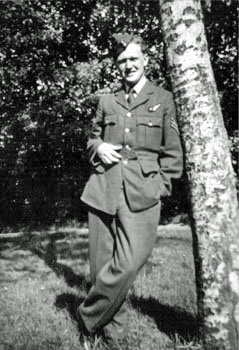 Peter Flower
Photograph with thanks to his nephew, Chris Hoyle
Peter was born in about mid 1922, the son of William Frank Flower and Winifred Agnes (née Castle). The parents’ Q2 1910 marriage – when William was aged 42 and Winifred only 19 – was registered in the Rochford, Essex District, as was Peter’s birth in Q2 1922.
The family seem to have moved to the Borough by 1933 to run a Confectioner’s shop at Ruxley Parade, 433 Kingston Road, Ewell. The parents were recorded at that address in the September 1939 Register. This lists the now 71 year old William as a “Builders Clerk” and 38 year old Winifred with the conventional “Unpaid Domestic Duties”. There is one currently closed record at the address, doubtless of the 17 year old Peter. (And 433 Kingston Road was still their address when William died there in Q3 1946, aged 78. He was interred in Plot G407 of Epsom Cemetery on 10 August 1946.)
With the Service Number 1295414, Peter appears to have enlisted with the RAF at Cardington in or after May 1940. Between May and July 1943, he was based at 22 Operational Training Unit, Wellesbourne, Warwickshire on Course 43a. This was reportedly provided for experienced Canadian ex-No 2 Group crews who were to convert to medium/heavy bombers in No 6 Group under the “Canadianization” programme.
On 23 September 1943, Peter was the Wireless Operator aboard Halifax EB207 – NA-B of the RCAF 428 (Ghost) Squadron which took off from RAF Middleton St. George, County Durham, for a bombing mission over Mannheim. At 22.39 hours, south-west of Mayen and before reaching the target, Oblt. Heinz-Martin Hadeball in his Me 110-night fighter from 3.NJG6, shot at the Halifax which caught fire. It appears that the pilot was attempting a controlled landing from 5,000 metres. During its descent, the crew dropped a 2-ton air-mine of two tons (which, according to an eye-witness, blew out all the windows in Kötterichen).
The aircraft crashed into the forest near Kötterichen. It exploded on impact killing all the crew, who were:-
• P/O William Anderson Hadden (RCAF),
• Sgt. Joseph Curran
• Sgt. Alexander F Morris
• Sgt. Sydney A Whitby
• Sgt. Peter J Flower
• Sgt. Clifford W Renwick
• Sgt. Archibald Yuill
They were initially buried in the Uersfeld Cemetery. On 5 March 1947, they were reinterred in Collective Grave 9.K.8-11 among the 3,183 Commonwealth WW2 casualties collected into the Rheinberg War Cemetery, about 50 miles north of Cologne.
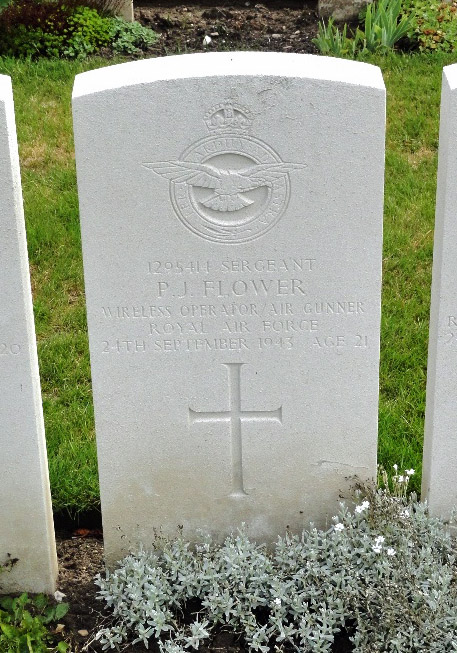 Peter’s headstone in the Rheinberg War Cemetery
Photograph (18406592) by Des Phillipet via findagrave.com
Brian Bouchard & Roger Morgan © 2018
Please contact us if you have information or pictures that can extend this entry.
FOLEY, Herbert Onslow. Warrant Electrician
Royal Navy.
Died 19 July 1941, aged 41.
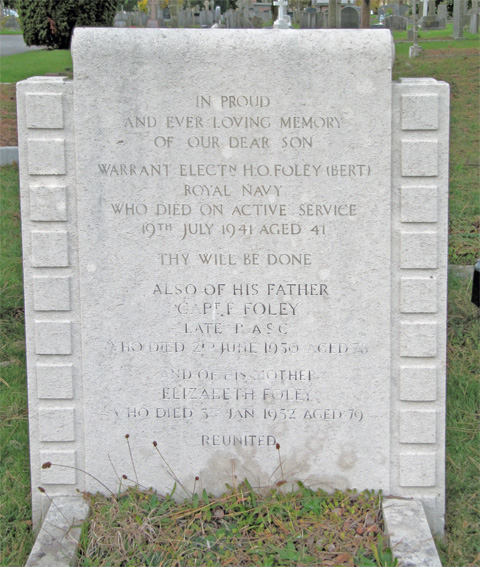 The Foley family headstone Epsom Cemetery.
Photograph by Roger Morgan © 2017
Herbert (apparently always known as “Bert”) was born in Devonport, Devon on 6 November 1899, the second child of Captain Frederick Foley and Elizabeth (née Griffiths). They couple had married in Elizabeth’s home patch of East Stonehouse (on the outskirts of Plymouth) around the turn of 1896/97 and Frederick’s address was the Granby Barracks, Devonport.
The 1901 Census records Elizabeth as the head of the household at 19 Cumberland Street, Devonport: Frederick was presumably off soldiering somewhere. With her were her two sons (three year old Reginald and one year old Bert) and her widowed 52 year old mother, another Elizabeth Griffiths. The family is not readily found in the 1911 Census, although there is a record of Bert’s 1912 admission to a secondary school in Plymouth.
At the end of WW1, Bert (with the Service No.185730) appears to have served with the Training Battalion of the Machine Gun Corps. However, he later joined the Royal Navy and, in WW2, served as a Warrant Electrician based in Portsmouth.
The connection with the Borough is that his parents retired here. The 1939 Register records them at 1 Willow Way, Ewell. 76 year old Frederick is listed as “Captain retired – Regular Army” and 70 year old Elizabeth with the conventional “Unpaid Domestic Duties”.
On 19 July 1941, Albert died in the Naval Hospital, Haslar, Gosport – according to naval-history.net, this was the result of illness rather than enemy action.
He is buried in Epsom Cemetery (plot G601) – where his father and mother were also buried after their deaths in 1950 and 1952 respectively.
Roger Morgan © 2017
Please contact us if you have information or pictures that can extend this entry.
FORD, Leslie Arthur. Leading Aircraftman (845761)
615 Squadron, Royal Air Force
Died 28 August 1941, aged 29
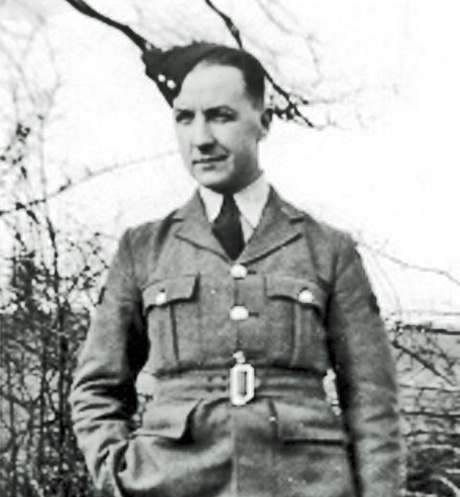 Leslie Ford, pictured in 1940
Copyright acknowledged
Leslie was born Q4 in Bradfield, Berkshire, the only son of Eli Arthur William Ford and Edith May (née Marshall – they had married in Midhurst, Sussex Q4 1908).
After his schooling, Leslie worked for Shell Petroleum at Shell-Mex House in London. In 1933, Katharine Anne Hughes (second daughter of Ernest and Jane Hughes) accepted his proposal of marriage. After a four year engagement, they married in St Gabriel’s Church, Pimlico, on 1 June 1937. They had decided to live in Surrey, and completed on a new house at 103 Newbury Gardens, Stoneleigh on 9 July 1937. (The Probate records also give that as his address when administration of his estate was awarded to his widow in February 1942.)
By 1939, the threat of war with Germany had become real and, on 24 August, Leslie was called up to join 615 Squadron at Kenley, Surrey. In November, the Squadron went to France as part of the Air Component of the British Expeditionary Force. It was back at Kenley by 20 May 1940 and took part in the early actions of the Battle of Britain.
In July 1940, Leslie and Katherine’s only child, Tony, was born. (Much of this article is condensed from his detailed 2005 contribution to “WW2 People’s War“, the BBC’s online archive of wartime memories – which is acknowledged with thanks.)
After a rest period in Scotland, and a spell taking part in offensive sweeps over Europe, the Squadron was stationed at RAF Valley (on the west coast of Anglesey) for defence duties over the Irish Sea and North Atlantic. in Wales. It is unclear what Leslie’s particular role had been earlier in his RAF career but, by this point, he was serving as the CO’s driver. (Interestingly, the 1939 Register – which found Leslie’s parents living at 7 Shafto Mews, Chelsea – listed his father’s occupation as “Chauffeur”.)
As recorded in the web-based Home Front Museum, the morning of 28 August 1941 saw the Isle of Anglesey being lashed by gale force winds in a fierce unseasonal storm. Aircraft would not normally have flown in such conditions with, but RAF Valley received reports that an allied merchant shipping convoy was under attack from a German U-boat, and a Blackburn Botha (with a crew of three) was sent out to reconnoitre the area.
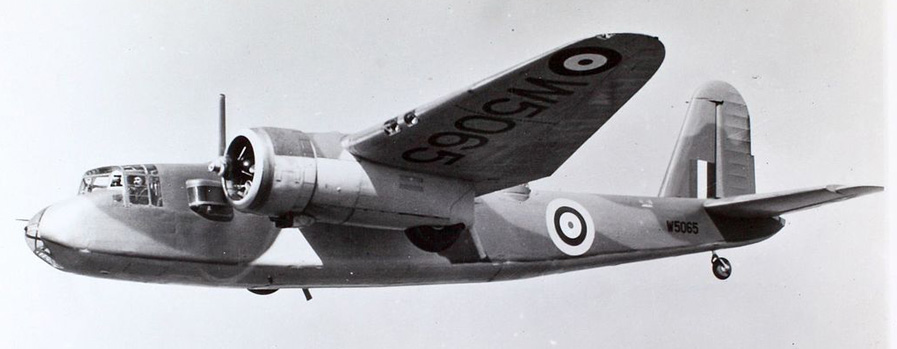 The Blackburn B.26 Botha
Public domain photograph via Wikimedia Commons
The B.26 Botha was one of the least successful British aircraft of the Second World War. It suffered from a serious lack of engine power, and was withdrawn from front-line service after only three months. Its weaknesses were all too evident on this occasion and, shortly after taking off, it crashed into the sea about 300 yards off Rhosneigr, a couple of miles south of the airfield.
A rescue attempt was initiated by local villagers, RAF Valley personnel and Royal Artillery soldiers stationed at the nearby Ty Croes camp. From the beach the three RAF crew, Kazimierz Rosiewicz, Thomas Dixon and Frederick Glockler could be seen clinging to the debris of their plane in the choppy waters offshore. The rescuers launched three boats, but all were swamped by the large waves and strong swell caused by the gale force, south westerly winds. Meanwhile, the exhausted crew members were unable to cling on to their ditched aircraft any longer and were washed out to sea.
Eleven gallant rescuers lost their lives in the tragedy that morning; three RAF personnel, five Royal Artillery soldiers and three local men. The local victims included a coastguard, a merchant seaman on leave and Rhosneigr’s village bobby, P.C. George Arthur. One of the other would-be rescuers was Leslie. Having driven the CO to the site to co-ordinate the rescue operation, he – an apparently strong swimmer – then tried to swim out to the stricken plane.
From their vantage point on the beach, and having watched the drama unfold, two 17 year old lads fearlessly put to sea in a sailing dinghy in an effort to reach the stricken plane. They too were unable to make it to the aircraft and capsized in the towering waves. The boys were rescued by holidaymakers who roped themselves together and waded out to them. For their bravery the two boys were awarded the George Medal by King George VI; silver gallantry awards from the RNLI and, as the pilot of the Blackburn Botha was a Polish national, cigarette cases from General Sikorski, Commander of Polish forces.
 The memorial erected at Rhosneigr in 1991 to honour those who perished in the tragedy.
Copyright acknowledged.
The incident was recorded in the Operations Record Book for 615 Squadron in the following terms:
In a violent gale a Botha landed just offshore at Rhosneigr Bay and in addition to the crew of three, twelve of the rescuers were lost. They included 845761 LAC Ford, LA, the C.O.’s driver, who apparently tried to swim out. No one saw him go. Also, 819139 LAC Bannister, D.W., a Flight Mechanic out of ‘A’ Flight. Ten of our aircraft were patrolling and a number of Mae Wests and dinghies were dropped, some of which were picked up by those in the sea.
A week after the tragedy, Squadron Leader Gillam, Officer Commanding RAF Valley, wrote to Leslie’s widow as below.
You will already have received notification of the fact that your husband, 845761 LAC Ford, L.A. has been missing from this unit since the 28th August.
On that day, an aircraft crashed into the sea some 300 yards from the shore nearby, and those of our personnel who could be spared from their duties voluntarily went down to the beach to render whatever assistance they could. Your husband was amongst them and although he was seen walking along the sands, no-one saw him enter the sea, although it is now assumed that he did.
Since that day a week has passed, and we are forced to conclude that he drowned in an attempt to save the lives of the aircrew concerned in the crash.
I believe he was an excellent swimmer and it would have been typical of him just to have gone out there without saying a word to anyone. I should like you to know how greatly we all admire the pluck and courageous spirit shown by your husband in this gallant effort of his to save the lives of others. He has been with the squadron for a long time and was deservedly popular with every one of us, more especially with our pilots and myself who knew him so well.
As you are no doubt aware he was my personal driver, and I felt he fully deserved promotion to a higher status in the Royal Air Force, and had decided to recommend him for a commission.
Leslie’s body was later recovered and he was buried in Grave B.1009 of the Farnham (Green Lane) Cemetery, Surrey – one of 13 Commonwealth WW2 casualties WW2 there.
Roger Morgan © 2018
Please contact us if you have information or pictures that can extend this entry.
FOSTER, Frank Joseph. Aircraftman 2nd Class (913626)
Royal Air Force Volunteer Reserve
Died 12 May 1940, Age 21
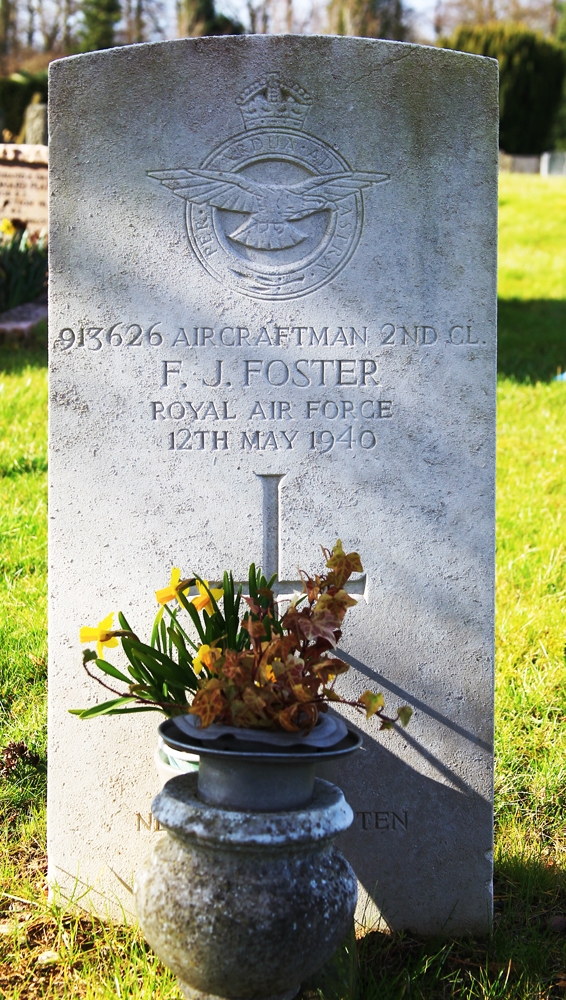 Frank’s headstone in Epsom Cemetery
Image courtesy of Clive Gilbert © 2018
Not listed in the Book of Remembrance
Frank was born on 10 June 1918, the fourth child of Donald Frederick Foster and Gertrude Beatrice Sarah (née Plumpton). The parents had married on 12 February 1909 at Sutton’s parish church of St Nicholas – which, at the time, came within the Epsom Registration District. The Register entry records the 27 year old Donald as a mining engineer (whose late father had been a farmer). No occupation was listed for the 23 year old Gertrude. Both were living with Gertrude’s parents at 1 Cliff Cottages, Downs Road, Belmont – her father, George Plumpton, being the “Foreman Carpenter at Banstead Asylum”.
The 1911 Census records the recently-married 25 year old Gertrude staying with her parents at 1 Cliff Cottages together with her first child, 18 month old Donald. Between Donald and Frank came Mary (Q3 1912) and Gertrude (Q1 1915), both of whose births were registered in the Epsom District. Frank was followed by a fifth child, Helen (Q1 1922): like first-born Donald’s birth in Q3 1909, hers was registered in the Brentford District.
Gertrude’s husband, Donald, had been born in Australia in 1882. As a Mining Engineer, he seems to have spent much of his time abroad, probably why he is not found in either the 1911 Census or the 1939 Register. (Between November 1916 and July 1918, Donald served as Sapper 212161 in the Royal Engineers as a “tunneller’s mate”. His service was mainly in England but, in 1917/18, included 8 months in France, doubtless involved in mining enemy positions. On his record card, he gave Gertrude’s address as “Corner Shop, Belmont”.)
In the September 1939 Register, Gertrude and the four youngest children are recorded still in Downs Avenue, Belmont – but now at Number 29. (One of her brothers and his family are recorded living next door at Number 27.) 44 year old Gertrude is listed with the conventional “Unpaid Domestic Duties”. As for the children and their occupations, they were:
• 27 year old Mary – “Gardener”;
• 24 year old Gertrude – “Nurse”;
• 21 year old Frank (the subject of this article) – “Photographer” (the Commonwealth War Graves Commission records him as AMIBPP, being an associate member of the Institute of British Professional Photographers); and
• 17 year old Helen – “Civil Service (Clerk)”.
Frank was called up in January 1940 and, at Uxbridge, enlisted with the Royal Air Force. Shortly after this, he became ill and was sent home to Belmont on sick leave. His condition worsened and he was admitted to Epsom County Hospital where, on 12 May 1940, he died of pneumonia.
Frank was buried in Epsom Cemetery on 16 May 1940, His family took the option of adding a personal inscription to his headstone on Grave M.614,
“Never forgotten.”
Brian Bouchard & Roger Morgan © 2021
Please contact us if you have information or pictures that can extend this entry.
FOURNIER, Bernard Maurice. Pilot Officer (85242)
49 Squadron, Royal Air Force Volunteer Reserve
Died 29 August 1941, aged 21
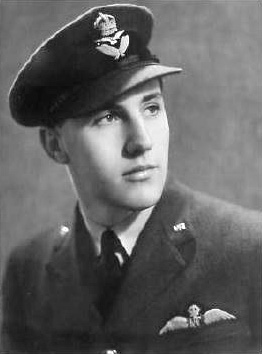 Bernard Fournier
Photograph from the 49 Squadron Association. Copyright acknowledged.
Bernard’s parents were Louis Bernard Fournier and Beatrice Elizabeth (née Brown). They had married in St Andrew’s, Stockwell on 5 March 1915, when the 24 year old Louis was a Sergeant in the Territorial 21st (County of London) Battalion. It is understood that he saw action in France during WW1.
The couple had four children, all born in the Lambeth District:
• Beatrice, born on 15 March 1917;
• Bernard, born on 20 July 1920;
• Gordon, born Q4 1924; and
• Yvonne, born Q4 1928.
The family then moved to Epsom’s Langley Vale. They lived in “La Maison Blanche”, Beaconsfield Road – recorded there for apparently the first time in the 1931 Electoral Register. The family became faithful members of the congregation of St Stephen’s with father Louis becoming the Scoutmaster. (Bernard subsequently became the Cubmaster.)
The late 40s parents and eldest daughter were recorded at “La Maison Blanche” in the September 1939 Register. And this remained the family address until at least Louis’ death in 1954 – following which some objects were donated to St Stephen’s in his memory, inscribed: “To the Glory of God in gratitude for his life and work in this church these candlesticks and vases were given by friends.”
In the 1939 Register, Louis is listed as “Chartered Surveyor, Estate Manager”; mother Beatrice with the conventional “Unpaid Domestic Duties”; and 22 year old daughter Beatrice as “Clerk, Insurance Office”. (The original record was later annotated to show that all three had taken Air Raid Warden duties.) The 1939 Register has four more currently closed records at the address: one of these seems certain to be of the 19 year old Bernard.
Bernard’s secondary education was at Epsom County School for Boys (now Glyn School) which he joined in 1932. He appears to have been an average pupil, but it is reported that made useful contributions to school life, most notably with interesting and original contributions to the school’s newsletter, Ebba’s Scrip.
On joining up in 1940, he was attached to 49 Squadron, part of the RAF’s Bomber Command. He wrote amusingly of a brief time on leave when, having just gained his “wings”, he met an acquaintance in the street.
“You’re in the Air Force aren’t you? What are you exactly?”
“A pilot” I replied proudly.
“Oh!” she said “I suppose they haven’t let you handle the controls yet have they?”
At the time, this 21-year old was piloting his Handley Page Hampden medium bomber on raids on targets in Germany!
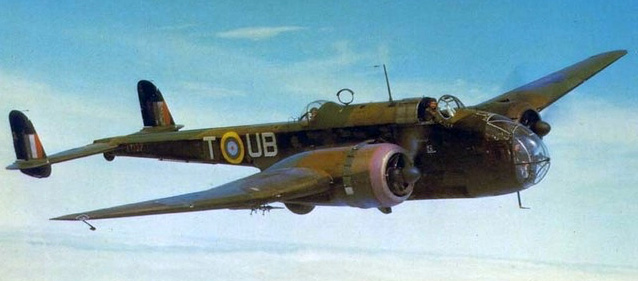 The Handley Page HP.52 Hampden
Public domain photograph via Wikimedia Commons
On 29 August 1941, Bernard was the pilot of aircraft AD971 (EA-O) – one of eight which took off from RAF Scampton on a bombing mission to Duisberg, a major logistical centre in the Ruhr and the location of chemical, steel and iron industries. The journey was uneventful until they met haze and flak close to the Dutch border. Bernard’s aircraft was attacked by a night fighter and, at 0330hrs, fell in flames into the Waddenzee just south of Ameland (an island some 15 miles off the north coast of the Netherlands). There were no survivors.
It was, however, some time before Bernard’s death was confirmed. An entry in the November 1941 Parish Magazine states:
“Because of the necessarily long interval between going to press and the publication of the Magazine, I deliberately omitted to refer last month to the fact that Pilot Officer Bernard Fournier, R.A.F.V.R., had been reported missing after night operations late in August. Up to the time of writing (October 17th [six weeks after the crash]) no news has come through of his whereabouts. Like the rest of his family, he was a most keen, loyal and devoted supporter of St. Stephen’s, and we join with the prayers of his family in this their time of strain and anxiety. R.W.”
(After the war, it became known that the crew had become victims of one of the top German “aces”, Oberst Helmut Lent, who shot down 110 aircraft, 103 of them at night. He was the first night fighter pilot to claim 100 nocturnal aerial victories, a feat which earned him the Knight’s Cross of the Iron Cross with Oak Leaves, Swords and Diamonds.)
Bernard and his crew – Navigator Sergeant D H Barrett (901205), Wireless Operator/Air Gunner Flight Sergeant E R Palmer (747878) & Wireless Operator/Air Gunner Sergeant D Watson (942231) – are among 49 Commonwealth WW2 casualties buried in the Nes Cemetery on the island of Ameland. His parents took the option of adding a personal inscription to his headstone on Grave D.14,1,
“The Lord is thy shepherd.”
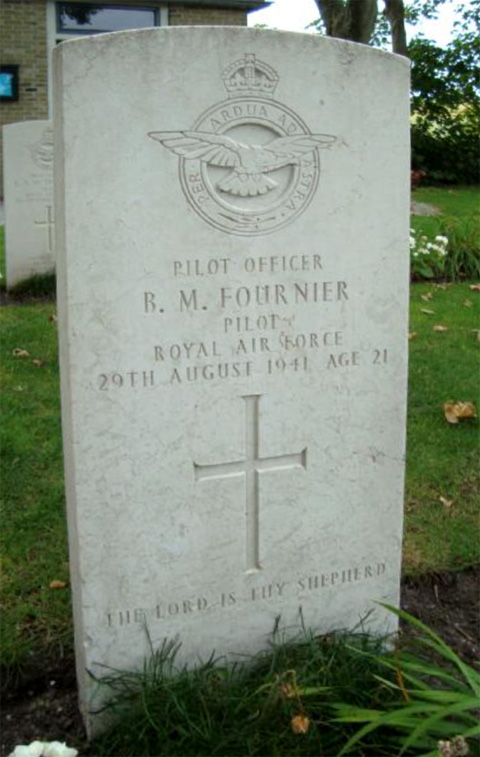 Bernard’s gravestone at Nes, Ameland, the Netherlands
Photograph from the 49 Squadron Association. Copyright acknowledged.
Bernard’s father died in 1954. The headstone erected over his grave also, as shown below, commemorates his son.
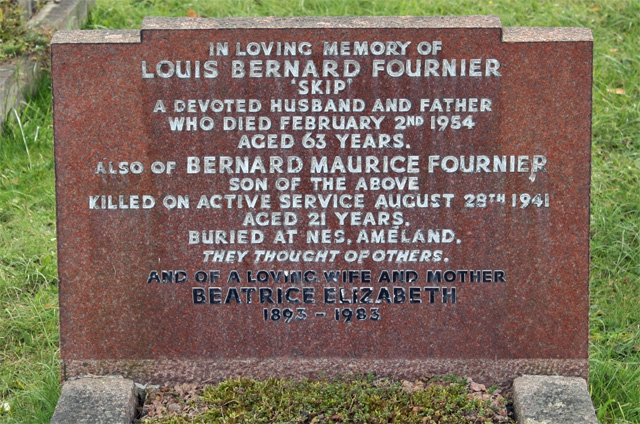 Memorial to Bernard’s WW2 death on Louis Fournier’s headstone over grave P21 in Epsom Cemetery.
Photograph with thanks to thebignote.com
Roger Morgan © 2022
With special thanks to Section 3 (“The War Years”) of the Glyn School history,
and to Judith Mitchell for information on the St Stephen’s connection
Please contact us if you have information or pictures that can extend this entry.
FOWLER, Leslie Gordon. Flight Lieutenant/Navigator (126036) DFC
214 Squadron, Royal Air Force Volunteer Reserve
Died 15 March 1945, aged 23
 Leslie Gordon Fowler
Photograph and much of the information below with thanks to 214squadron.org.uk
Leslie was born in Herne Bay, Kent on 13 June 1922, the only child of George Robson Fowler and Mabel Lilian (née Lawler). The parents’ Q2 1921 marriage and Leslie’s birth were both registered in the Blean, Kent District.
In 1934, the family moved to 4 Kinross Avenue, Worcester Park for George to run his newsagents and stationers business at 117 Central Road, Worcester Park. (At the time of writing, the family name remains on the facia although the business is now carried on by Burkitt Stationery.) The September 1939 Register recorded the residents of 4 Kinross Avenue as 43 year old George – a “Retail Stationer” (he was also the Hon Treasurer of the local Chamber of Trade) and 46 year old Mabel – listed with the conventional “Unpaid Domestic Duties”. There is one currently closed record at the address, doubtless of the 17 year old Leslie.
Leslie’s secondary education was at King’s College School, Wimbledon. It had long been his ambition to have a career in commercial flying. However, the war came along and, in 1941 at Euston, he enlisted in the Royal Air Force Volunteer Reserve with a Service Number 1387456. He learned to fly in Canada and, as a LAC, was commissioned Pilot Officer on 11 July 1942. He was promoted to Flying Officer a year later.
Between 31 December 1942 and the middle of June 1943, Leslie flew 23 operations as a Navigator with 199 Squadron in Vickers Wellington bombers from RAF Blyton and RAF Ingham, both in Lincolnshire.
He was very good at his job. As announced by the Air Ministry on 10 September, 1943: –
The KING has been graciously pleased to approve the award of a Distinguished Flying Cross to Acting Flight Lieutenant Leslie Gordon FOWLER (126036) Royal Air Force Volunteer Reserve, No. 199 Squadron – for gallantry and devotion to duty in the execution of air operations.
Citation:-
“This officer has completed many operational missions over enemy territory, including attacks on main targets such as Cologne and Essen and mine laying operations in enemy waters.
At all times Flight Lieut Fowler has displayed navigational abilities of a high order which has contributed much to the success of these sorties. This officer possesses a fine fighting spirit, which has inspired confidence in his crew.”
Leslie’s further promotion to Flight Lieutenant came into effect on 11 July 1944.
After retraining on Boeing B17 heavy bombers (the “Flying Fortress”), Leslie had been posted to 214 Squadron which was equipped with various navigation and countermeasure instruments (Fortress Electronic Equipment).
On 24 February 1945, Leslie one of the 9-man crew aboard Mk. III Flying Fortress HB805 which took off from RAF Oulton for a mission over Germany. At 20.08 hours, the bomber was about 15-20 miles west of Dusseldorf when it was shot down by Oblt. Kurt Matzak of Stab IV/NJG1 – a Luftwaffe night fighter ace with 19 kills to his score. An eyewitness described the crash at 20.10 into the River Niers, near Neersen, Germany. The starboard inner engine was on fire and the fire was spreading so fast that the aircraft rapidly lost altitude and was unable to reach a flat area only 100 metres away which had earlier been a dummy airfield. The fuel tanks exploded when close to the Konradkapelle, [St Konrad Chapel]. The starboard wing broke off and fell on the house occupied by the Gaspers family, whilst cockpit and fuselage fell into the Niers, the port wing section smashing into the opposite bank of the Niers.
Seven of the nine crew were killed in the crash. However, Leslie and Flight Sergeant Geoffrey J E Jennings (1394514) DFM had managed to bale out and were taken PoW. While Jennings survived the remaining months of the War, Leslie was very badly injured. Shortly after the War ended, Jennings provided the following information.
“I saw F/Lt Fowler in a civil hospital about ten miles to the south or south-west of Krefeld on the 27th or 28th February 1945 [which matched the crash location and would be just prior to the US troops occupying the area]. We were then taken to a military unit about 2 miles from Krefeld as far as I can tell. F/Lt Fowler was in a very bad way – he was burned all over and was clearly in great pain. A sister said that the index finger of his right hand had to be amputated. Fowler however seemed to think that his recovery was proceeding satisfactorily. He was taken away in an ambulance and I never saw him again.”
For some unknown reason, Leslie was taken to Kriegslazarett 3/541 at Dennenoord, Zuidlaren – between Groningen and Assen in the Netherlands. (This former psychiatric institution had been cleared of inmates by the Germans and taken over as a war hospital only on 20 February 1945.) He died there of his wounds on 15 March 1945, a month before Zuidlaren was liberated by Canadians on 13 April 1945.
Leslie is buried in Grave 1.E.12 of the Zuidlaren General Cemetery, Drenthe, Netherlands – the only Commonwealth WW2 casualty there.
 Leslie’s headstone in the Zuidlaren General Cemetery.
Photograph with thanks to Anneke Moerenhout via tracesofwar.com
Brian Bouchard & Roger Morgan © 2018
Please contact us if you have information or pictures that can extend this entry.
FOX, Stafford Harry John. Gunner (1450673)
282 Battery, 88 Heavy Anti Aircraft Regiment, Royal Artillery
Died 17 August 1942, aged 30
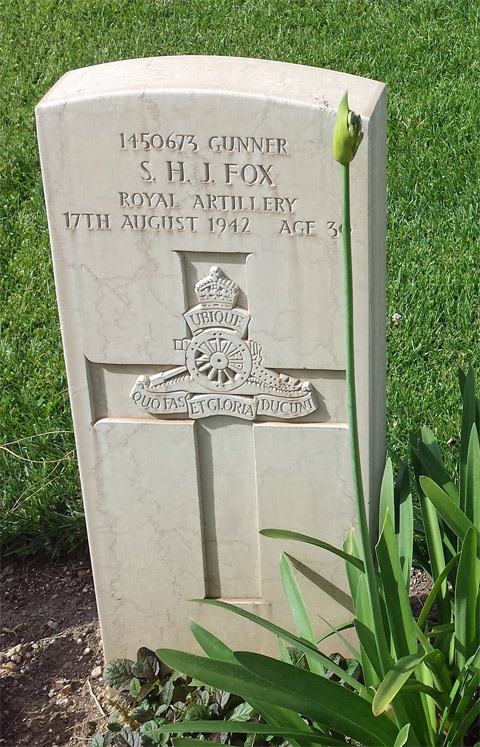 Stafford’s headstone in the Bari War Cemetery
Photograph (56107127) with thanks to Dave Barlow via findagrave.com
Not listed in the Book of Remembrance
Stafford was born Q2 1912, the first child of Samuel Harvey Fox and Nellie (née Swannell). Their Q2 1911 marriage was registered in the Lewisham District. While the births of both Stafford and his sister Pamela (Q4 1920) were registered in the Epsom District, the district then extended to Cheam, where the 1921 Electoral Roll records the family living at “Elstow” (later No. 11), Norman Road. Stafford’s secondary education was at Epsom College.
In Q2 1937, the 25 year old Stafford married Elizabeth Robertson. Their marriage was registered in the Surrey Mid Eastern District (into which the Borough falls) – as was the Q3 1940 birth of their twins Ann and Jill. Stafford was probably already in uniform at the time of the 1939 Register. However, the 27 year old Elizabeth was recorded living with her widowed father, John, at 90 Arundel Avenue, Ewell.
Stafford’s WW2 service was with the 88 Heavy Anti Aircraft Regiment, Royal Artillery. After an initial period of home duty, the Regiment was sent to Egypt, arriving at Port Tewfik (now Suez Port) at the southern end of the Suez Canal on 23 July 1941. The disembarkation strength of Stafford’s 282 Battery was 11 Officers and 346 Other Ranks.
There are few details of the Battery’s engagements in the ebb and flow of the North African Campaign, but it is clear that it suffered heavy losses in the Cyrenaica area of the eastern Libyan Coast as Axis forces advanced towards the prizes of the Suez Canal and the Middle Eastern oilfields. (This apparently inexorable progress was halted in the 1-27 July 1942 first Battle of El Alamein and, in a turning point of the whole war, decisively reversed in the 23 October – 11 November 1942 second Battle of El Alamein.)
Casualty List No. 889 reported that Stafford was missing in action on 20 June. It was later confirmed that he had been wounded and taken prisoner. His captors took him to one of the hospitals attached to the PoW camp at Bari in SE Italy, where he died of his wounds on 17 August 1942.
Stafford was initially buried in the civil cemetery at Bari. He was subsequently reinterred in Grave II.E.10 of the Bari War Cemetery, founded in late 1943 initially for Commonwealth casualties from the Allies’ action to capture the town in the early stages of the invasion of mainland Italy. The Cemetery now holds 2,054 Commonwealth WW2 casualties.
Roger Morgan © 2018
Please contact us if you have information or pictures that can extend this entry.
FRANCK, Douglas George. Air Fitter FAA/FX 75637.
HMS Glorious, Royal Navy, Fleet Air Arm
Died 8 June 1940, aged 18
Douglas is not listed in the Borough’s Book of Remembrance but is remembered here because the Commonwealth War Graves Commission records note that he was the “son of George and Dorothy Maria Franck, of Epsom”. As will be seen, this radically understates the complicated family background here. With some difficulty, this has now been unpicked and, for the record, is set out in detail in the Annex to this article.
Briefly, however, Douglas’s father, George, was born in Denmark. In his early 20s, he emigrated to Australia where, in 1913, he was granted naturalised status. During WW1, he served in the Pay Corps of the Australian Imperial Force – initially in Egypt but then at Epsom’s Woodcote Park Convalescent Hospital, which must be how he came to meet Epsom-born Dorothy Skinner. In March 1917, the couple married at St Martin’s, Epsom. The late 1918 birth of their first child, Joan, was registered in the Wandsworth District. In 1919, the family went to Australia where Douglas, the subject of this article, was born on 6 September 1921 in Coolamon, New South Wales.
Sadly, the marriage did not last. In 1922, Dorothy and her two young children returned to Epsom to live with her parents at “Sunnyside”, East Street. (George remained in Australia.) The September 1939 Register records Dorothy (listed as “Clerk – Motor Garage)” still with her now-retired parents at what was now numbered 97, East Street. The teenage Douglas, the subject of this article, has not yet been found in the 1939 Register and the assumption is that he was already in uniform with the Fleet Air Arm, with which he saw WW2 service as an Air Fitter aboard HMS Glorious.
HMS Glorious was built during WW1 as the second of the three Courageous-class battle cruisers and, after commissioning in January 1917, spent the war patrolling the North Sea. She participated in the Second Battle of Heligoland Bight in November 1917 and was present when the German High Seas Fleet surrendered a year later.
In the late 1920s, HMS Glorious was converted to an aircraft carrier. Re-commissioned in 1930, she spent most of that decade operating in the Mediterranean. After the start of WW2, she spent the rest of 1939 in the Indian Ocean unsuccessfully hunting for the commerce-raiding German cruiser Admiral Graf Spee and then returned to the Mediterranean. She was recalled home in April 1940 to support operations in Norway.
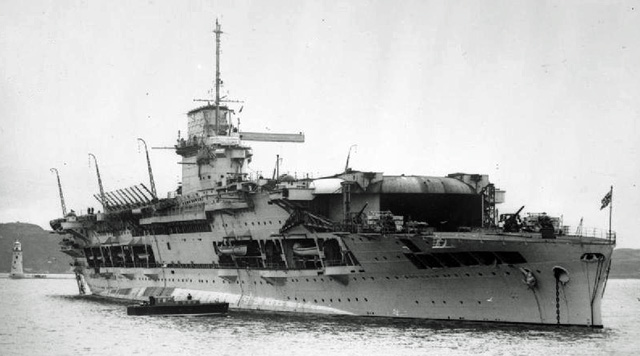 HMS Glorious at anchor in 1935
IWM photograph FL 22991 – Public Domain
Although Norway had determined to be neutral in WW2, its strategic importance led to its invasion by German forces in early April 1940 – more than a month before the German invasion of the low countries and France. British and French forces were quickly sent to Norway to try to deny Germany its prize. The role of HMS Glorious was to provide air cover for the offensive. Despite moderate success in the northern parts of Norway, the Allies were eventually compelled to withdraw by Germany’s invasion of France. HMS Glorious was then involved in evacuating aircraft from Norway.
On 8 June 1940, HMS Glorious – escorted by the destroyers Acasta and Arden – was on her way back to Scapa Flow. In the late afternoon, the British ships were caught and engaged by German battleships Scharnhorst and Gneisenau. Because of confusion over radio frequencies, other Royal Navy ships that were near enough to help, did not hear the appeals for help. In spite of smoke screens and other evasive action, all three British ships were sunk, with the loss of 1,519 lives – 1,207 of which (including Douglas) were from HMS Glorious alone. There were only 40 survivors.
Douglas’s body was never found and he is commemorated on the Fleet Air Arm Memorial (near its principal base at Lee-on-Solent) as one of the nearly 2,000 men of that service who died during WW2 and have no known grave.
 The Fleet Air Arm Memorial at Lee-on-Solent
Photograph with thanks to the Commonwealth War Graves Commission
Roger Morgan © 2022
Please contact us if you have information or pictures that can extend this entry.
ANNEX: Douglas Franck’s complicated family background
As noted in the main article above, the Commonwealth War Graves Commission’s record that Douglas was the “son of George and Dorothy Maria Franck, of Epsom” radically understates the complicated family background. The following sets out the detail of what was briefly summarised above.
The first trace of Douglas’s father in the readily available UK records is the 17 March 1917 marriage of this 31 year old to 22 year old Dorothy Skinner at St Martin’s, Epsom. The Register entry records George as a “Soldier”, of 41 Denbigh Street, Pimlico, and as the son of “George Franck, Merchant”. It also gives his full name as “Archibald Charles George Owen Franck”.
However, his name at birth (on 2 October 1887 in Copenhagen, Denmark) was Aage Carl George Olaf Franck. At the age of 23, he left Denmark and, having travelled on SS Rangatira, arrived in Melbourne on 26 February 1911. In March 1913, having lived in Australia for the required minimum of two years, he applied for – and was in due course granted – naturalised status. His application noted that he had been living in Albury, New South Wales, and working as a “Groom & Station Clerk”.
The UK – and its then Empire – declared war on Germany on 4 August 1914. Less than three weeks later, on 22 August 1914, the nearly 28 year old attested with the Australian Imperial Force with the service number 737. He was assigned to the 2nd Battalion of the 1st Infantry Brigade. His attestation papers note that: his “trade or calling” was as a “Clerk & Bookkeeper” for which he had served a 4 year apprenticeship in Copenhagen; and that (obviously before his emigration) he had served for two years in the Royal Danish Reserve. He attested with his birth names of “Aage Carl George Olaf”, but soon Anglicised these to “Archibald Charles George Owen” – his preferred forename of George being common to both.
After initial training in Australia, George (now promoted to Lance Corporal and, because of his clerical background, destined always to be away from the front line as a postal clerk and, later, in the Pay Corps) arrived in Egypt. In mid-1915, George was moved to England and, on 4 February 1916, was attached to Epsom’s Woodcote Park Convalescent Hospital.
It must be at this time that he first met his future bride, Dorothy Maria Skinner. Her background is much more straightforward. She was born in Epsom on 22 November 1894. The 1911 Census records her as a 16 year old “Clerk at a Servants Agency” living with her parents (William – a “Poultry Keeper” – and Hannah Catherine) and five of her seven siblings at “Sunnyside” (probably No. 97 as for 1939 – see below), East Street, Epsom. Given her clerical background, it may even be that she also became a war-time clerk at the Woodcote Park Convalescent Hospital.
Anyway, the birth of the couple’s first child, Joan Dorothy Franck, on 27 December 1918, was registered in the Wandsworth district in Q1 1919. The family then returned to Australia, arriving on 18 December 1919 aboard the SS Koningen Luise, following which George was demobbed. The couple’s second child, Douglas (the subject of the main article) was born in Coolamon, New South Wales on 6 September 1921.
Sadly, the parents’ relationship did not last. The 27 year old Dorothy, together with 3 year old Joan and 6 month old Douglas arrived back in London on 2 July 1922 having sailed from Sydney aboard P&O’s HMS Benalla – the manifest of which notes that they were bound for her parents’ home of “Sunnyside” in East Street, Epsom. Her husband, George, remained in Australia and, in 1929, remarried there. (This presumably followed a formal divorce from Dorothy, but she referred to herself as still “married” in the 1939 Register – and never remarried, dying Q1 1990 in Tunbridge Wells still as “Dorothy M Franck”.)
The September 1939 Register records the now 44 year old Dorothy living with her retired parents at 97 (probably the “Sunnyside” of the 1911 Census) East Street, Epsom. She is listed as “Clerk (Motor Garage)”. The household was completed by 42 year old Mabel E Lewis – Dorothy’s now married younger sister – who was listed with the conventional “Unpaid Domestic Duties”.
The 18 year old Douglas is not found in the 1939 Register (which was taken on 29 September) and seems certain already to have been in uniform with the Fleet Air Arm. (One service record implies that, at some point, he had returned to Australia – perhaps to live with his father – as it notes his “residence” as Coolamon, New South Wales. As already noted, that was his birthplace and it is more likely that, for this rogue record, it was mistakenly taken as his continuing residence.)
As to Douglas’s sister, Joan, she had married Reuban D Moody – a Divisional Engineer with Sheffield Corporation in Q3 1939. The marriage was registered in Sheffield, and the 1939 Register recorded the newly-married couple living at 45 Bingham Park, Sheffield.
Roger Morgan © 2022
with special thanks to Hazel Ballan and Richard Crozier.
FREAKES, Kenneth, Flight Sergeant/Navigator (1604876)
115 Squadron, Royal Air Force Volunteer Reserve
Died 15 February 1945, aged 21
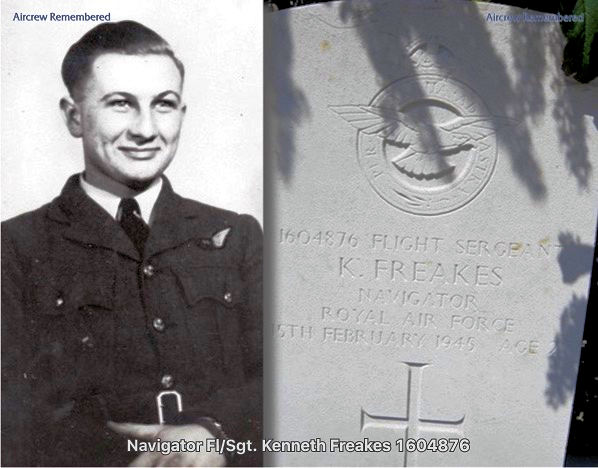 Kenneth Freakes and his headstone in the Haveluy Communal Cemetery
Image © Beryl Lock (Kenneth’s cousin) and courtesy Kelvin Youngs of Aircrew Remembered
Kenneth was born in Ash (a Surrey village on the outskirts of Aldershot) on 10 February 1924. He was the only child of Herbert Freakes and Violet (née Lock) who had married in Christ Church Epsom Common on 16 April 1923.
Violet had been born in Epsom on 16 April 1901. She was the fifth of the nine surviving children from the twelve born to Frederick and Ellen Lock. Frederick Lock (otherwise Smith and sometimes Lock-Smith or Locksmith) was an Epsom butcher. The 1911 Census records the family – including 9 year old Ellen – living at of 39-41 High Street, Epsom (later renumbered to 55). Kenneth’s father, Herbert, was from Ash: he had had been born there on 12 August 1901 and, from 9 December 1918, had been a porter with the London and South Western Railway Company at North Camp, Aldershot.
After their marriage, Herbert and Violet lived in Ash where, as noted above, Kenneth was born in 1924. On 24 March 1927, Herbert became a porter at Epsom and the family moved to 11 West Street, Epsom where they lived until at least 1931. By the time of the September 1939 Register, the family were living at 17 Limecroft Close, West Ewell. The Register lists 38 year old Herbert as a “Railway Parcel Porter” and 38 year old Violet as a “Laundress”.
There is a currently closed record at the address which seems bound to be the 15 year old Kenneth. He was attending Epsom County School for Boys (now Glyn School) for his secondary education – and had won the form prize in 1938.
Kenneth joined the Royal Air Force Volunteer Reserve, and his service number suggests that he was inducted to the RAF at Oxford in September 1941. Having trained as a Navigator he was posted to 115 Squadron, part of the RAF’s Bomber Command.
On Wednesday 14 February 1945, Kenneth was among the 7-man crew of Lancaster Mk. III, LM 725, call sign KO-X. The aircraft took off from R.A.F. Witchford in Cambridgeshire at 20.37 hours to join an armada of 717 aircraft from 1, 3, 4, 6 and 8 Groups taking part in “Operation Thunderclap” to bomb Chemnitz. This city in the east of Germany (near Dresden) was an important industrial centre and home to an oil refinery. The bombing was hampered by cloud and, although many parts of the city were hit, the majority of the bombs fell in open country.
Kenneth’s Lancaster LM725 was one of only 13 (out of the 717) aircraft lost during the raid. The cause of the fire on the return leg which led to LM725 crashing near Haveluy in Nord-Pas-de-Calais, France (about 25 miles south east of Lille) is not known: no claim has been traced from a Luftwaffe night fighter.
The aircraft was already in trouble at 01.00 hours on Thursday 15 February 1945 when arrangements were made for it to attempt a forced landing at Valenciennes (Prouvy) – now Aéroport de Valenciennes-Denain. (All this French territory was now securely back in Allied hands.) It came down about 4 miles short of Valenciennes.
The mayor of Haveluy subsequently recalled that (as translated from the French):
“The airfield at Cambrai Epinoy had received a radio message from the stricken bomber – ‘Three engines on fire … the 4th white hot … clearing the built up area before landing.’ The aircraft lost more and more height. The pilot managed to avoid houses, and possible civilian casualties, but shed part of one wing at 2.25 a.m. and plunged into the ground near a place called “Calvary”, with a terrible explosion causing a crater 20 metres wide and 8 metres deep. 7 heroic English airmen had just died to save lives and our village.”
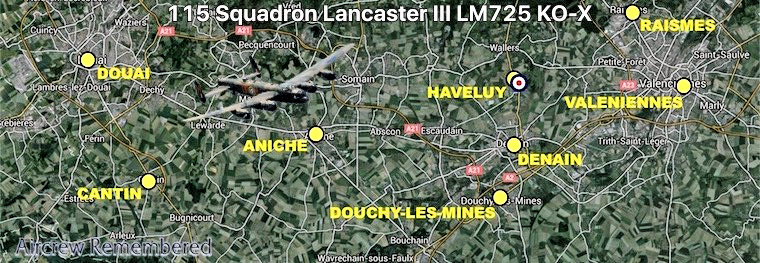 Location Map for 115 Squadron Lancaster III LM725 KO-X.
With kind permission of Kelvin Young of Aircrew Remembered
All seven of the crew were killed. They were buried in a collective grave in the Haveluy Communal Cemetery and are the only WW2 commonwealth burials there. Kenneth’s parents took the option of adding a personal inscription to his headstone,
“A beautiful memory, a smiling face. A broken link we can never replace.”
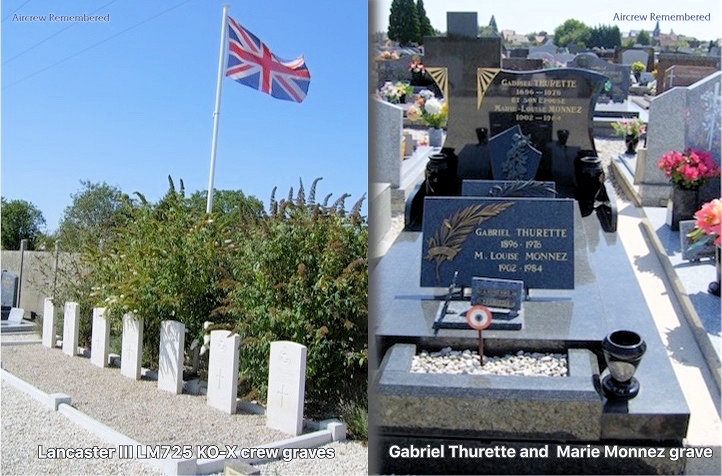 Above left: Crew graves at Haveluy Right: Thurette family plot
With kind permission of Kelvin Young of Aircrew Remembered
After the war, Kenneth’s parents kept in touch with Haveluy locals Marie Louise Monnez and her husband Gabriel Thurette (former members of the French Resistance). Sadly, while Herbert was on a visit his son’s grave, he suffered a heart attack and died. Marie Louise Monnez gained permission for him to be buried in the Thurette family plot so that he could be near to his son. The widowed Violet died in the local the local Surrey Mid Eastern District in Q1 1980.
In addition to Kenneth’s entry in the Borough’s Book of Remembrance, his name is commemorated on the Glyn School War Memorial.
Brian Bouchard & Roger Morgan © 2018
Please contact us if you have information or pictures that can extend this entry.
FRECKER, Peter Farrow. Captain (105352)
Royal Artillery – attached to 9 Field Regiment, Royal Indian Artillery
Died 9 December 1944, aged 28
Peter was born Q4 1916, the second of three children born to Albert Charles Frecker and Silvia (née Hamilton – they married Q2 1912). The parents’ marriage was registered in the Kingston District, as was Peter’s birth and the 27 September 1913 birth of his older brother Albert Derek. The 9 January 1918 birth of younger sister Silvia Joan was registered in Romford, Essex.
At some point, the family moved to the Borough. The September 1939 Register records the parents and their children (other than Peter) living at 51 Ewell Downs Road, Ewell. 56 year old Albert senior is listed as “Manager of Bank (Trustee Dept)” with an MS annotation that he was a volunteer Air Raid Warden in Epsom. 49 year old Silvia senior has the conventional “Unpaid Domestic Duties” – with an MS annotation that she was a British Red Cross volunteer in Ewell. 26 year old Albert junior’s occupation is listed as “None (see next column)” – that column being the MS annotation that he was an RAFVR Sergeant. (Albert later became a Pilot Officer. He survived the war and, on 22 January 1943, was awarded the Distinguished Flying Cross after exploits with 252 Squadron in the Middle East.) 21 year old Silvia junior is listed as a “Dancing Mistress” (and also an “ARP Ambulance Driver”). Her Frecker School of Dance (understood to operate in Ebbisham Hall) became, with the subsequent partnership with Betty Laine, the Frecker-Laine School of Dance and, after the death of Silvia (she had been Silvia Swiss since her marriage to Kenneth Gordon Swill in Q4 1940) Epsom’s “Laine Theatre Arts”.
23 year old Peter is not readily found in the 1939 Register. However, it is known from Coutts Bank’s WW2 Roll of Honour that Peter had – perhaps following his father – worked for them.
On 22 October 1939, Peter was awarded an emergency commission as a Second Lieutenant, the gazetted announcement noting that he was from the Inns of Court Regiment (Cadets, 3rd Cavalry Officer Cadet Training Wing). He later transferred to the Royal Artillery and, as a Captain, was attached to 9 Field Regiment, Royal Indian Artillery.
Sadly, searches of the readily available records provide no useful information about the WW2 activities of the RIA’s 9 Field Regiment. It is known from Casualty List No. 1631 of 16 December 1944 that Peter’s death on 9 December was the result of an accident rather than enemy action- and, unhelpfully, the list notes the duty location only as “India”. However, a record has been found of Peter’s burial on 10 December 1944 during a service conducted by the “Rev J E M Drummond, Chaplain of Shaharanpur” – nowadays known as Sharjahanpur – some 150 miles east of Delhi. That record notes the cause of death as a “motor accident”.
Peter is now buried in the Delhi War Cemetery. This was created in 1951 when graves were moved there from many cemeteries in northern India to ensure their permanent maintenance. The Cemetery holds some 1,020 Commonwealth WW2 casualties, together with a number of WW2 graves of other nationalities, mostly Dutch.
The parents took up the option of adding a personal inscription to Peter’s headstone on Grave 2.E.8,
“In lasting memory of Peter, beloved younger son of A and S Frecker of Ewell, Surrey.”
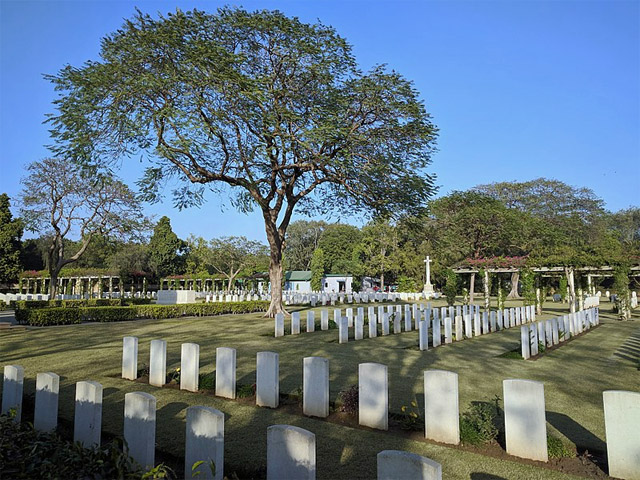 The Delhi War Cemetery
Photograph by Pulakit Singh, via Wikimedia, CC BY-SA 4.0
Roger Morgan © 2020
Please contact us if you have information or pictures that can extend this entry.
FREEMAN, Henry Alfred. Sergeant (932778)
207 Squadron, Royal Air Force Volunteer Reserve
Died 22 September 1943, aged 31
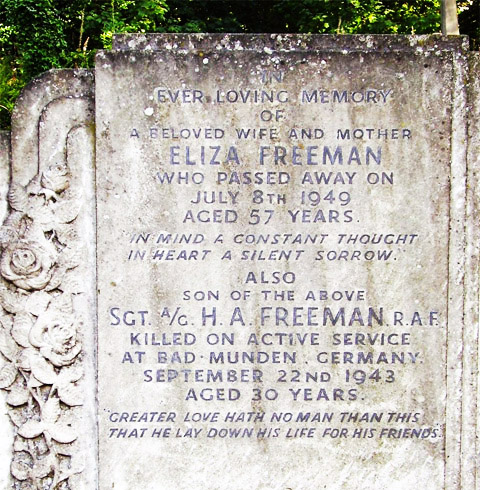 Alfred’s mention on his mother’s headstone in West Norwood Cemetery
Photograph (60159927) by “caryatid” via findagrave.com
Henry is not listed in the Borough’s Book of Remembrance but is remembered here because the Commonwealth War Graves Commission’s records note that his widow, Mabel Alice Freeman, was “of West Ewell, Surrey”. The connection with the Borough does not appear to be particularly strong but, as noted at the end of this article, the link has been established.
Henry Alfred Freeman was born Q3 1913, the first child of Henry Freeman and Eliza (née Heath). Their Q2 1912 marriage and Henry junior’s birth were both registered in the Lambeth District. The record of Henry’s baptism on 17 January 1914, note the family’s address as 6 Martell Road and his father’s occupation as “Engineer”.
The couple then had five other children whose births, like Henry’s, were registered in the Lambeth District. The summary details of all six are:
| Name | Born/Baptised |
|---|---|
| Henry Alfred | Born: Q3 1913 Baptised: 17 January 1914 Emmanuel Church, West Dulwich |
| Mabel Irene | Born: 13 December 1913 Baptised: 13 February 1914 St. Lukes Church, West Norwood |
| William George Ernest | Born:5 June 1917 Baptised: 9 September 1917 St. Lukes Church, West Norwood |
| Cyril Arthur | Born: 22 October 1919 West Norwood |
| Ronald E | Born: 1920 West Norwood |
| Joyce V C | Born: 1925 West Norwood |
In Q4 1934 and registered in the Lambeth District, the 21 year old Henry married 22 year old Mabel Alice Redgewell. At least by 1938, they had set up home at 37 Brocks Drive, North Cheam, Sutton, Surrey. The 27 year old Mabel (listed with the conventional “Unpaid Domestic Duties”) is recorded at the address in the September 1939 Register. The 26 year old Henry is not found in the Register and is likely already to be in uniform and away from home. There is no record of the couple having any children, but living with Mabel were her mid-50s parents – Henry Charles (a “Printers Warehouseman Retired) and Helena Ann (“Unpaid Domestic Duties”). Mabel was the third of their four children.
Henry’s WW2 service was in 207 Squadron, part of the RAF’s Bomber Command. On 22 September 1943, he was the rear gunner in Lancaster ED442 EM-W which took off from RAF Langar in Nottinghamshire for a night Raid on Hanover. The pilot was P/O G L Coxon and the rest of the crew were:-
• Sgt A W Marsh
• Sgt H Fulton
• Sgt F C Shergold
• Sgt J L Holding
• Sgt K Saville
• Sgt E D Kite
• Sgt H A Freeman.
Having been hit by Flak, the aircraft crashed near Bad Münder in the Deister hills about 10 miles northeast of Hamelin. All the crew were killed in the crash and were buried in the Bad Münder Cemetery. On 15 May 1947, they were reinterred among the 2,407 WW2 Commonwealth casualties in Hanover War Cemetery, some 20 miles northeast of Bad Münder.
The widowed Mabel took the option of adding a personal inscription to his headstone on Grave 4.E.8,
“Gone but for ever in our thoughts. He died in war that we might live in peace.”
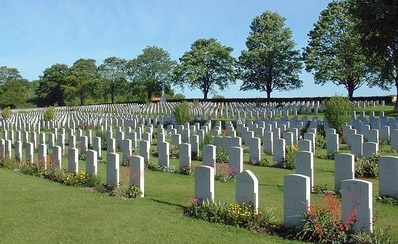 The Hanover War Cemetery
Photograph with thanks to the Commonwealth War Graves Commission
As shown at the head of this article, Alfred is also remembered on his mother’s 1949 headstone in the West Norwood Cemetery.
As to the widowed Mabel’s link with the Borough, Electoral Roll records for 1948/9 find her living at Grove Stables, The Grove, Epsom, with her younger brother Walter E Redgewell and his new wife Nellie W (née Saunders) – their Q2 1947 marriage had been registered in the local Surrey Mid Eastern District. By 1951, Mabel was living in 15 Belfield Road, West Ewell, possibly as a lodger, with the apparently unrelated Fanny and George W Cox. Later that year, she got married again, to Kitchener Roberts Charles. That Q4 1951 marriage was registered in the local Surrey Mid Eastern District but the couple then seem to have moved away to Guildford.
Brian Bouchard © 2018
Updated by Roger Morgan & Hazel Ballan
Please contact us if you have information or pictures that can extend this entry.
FROST, Rupert Chatham. Pilot Officer (42497)
16 Operational Training Unit, Royal Air Force
Died 28 May 1940, aged 26
 Rupert’s headstone in Upper Heyford Cemetery
Photograph with thanks to theygavetheirtoday.com
Unusually, the Commonwealth War Graves Commission’s database contains no details of Rupert’s family background, but the information below has been found from other readily available sources. Rupert’s entry in the Book of Remembrance clearly shows a connection with the Borough and, in spite of the unpromising start to his story, that has been established – but, with confidence, only through his family rather than him.
Rupert was born in the Croydon District on 11 March 1914, the first child of Albert William Chatham Frost and Florence (née Burslem). Their 31 May 1913 wedding at a civil ceremony in Berlin was a second marriage for the widowed Albert. As a travel-writer/journalist, he had been living in Berlin since the mid-1890s: the record of Albert’s 1 June 1898 marriage at St Peter’s, Leicester (the city where he had been born on 7 July 1872) to his first wife, Emma Caroline Dudgeon, noted his residence as “Berlin, Germany”. Albert and Emma (then aged 26 and 27 respectively) returned to Berlin, where they had three children: Olga, Elsie and Stanley.
The readily available records do not reveal when Emma died but, as noted above, the widowed Albert remarried in Berlin on 31 May 1913. His bride, Florence Burslem, had been born in Crewe on 5 March 1876 and was aged 38: Albert was then aged 41. Perhaps prompted by increasing tensions between the UK and Germany in the build up to WW1, Albert and Florence returned to England together with the children from his first marriage. The births of their own children – Rupert and Beryl – were registered in the Croydon District, respectively in Q1 1914 and Q1 1916.
Rupert’s secondary education was as a boarder at Eastbourne College – in Wargrave House between 1928-30. The College’s records noted him as the son of Albert W C Frost, journalist, of “Nenna”, Limpsfield, Surrey. Between 1931 and 1935, Rupert studied in the Medical Science faculty of King’s College, London – where the admission records recorded his home address as Lunghurst Rise, Woldingham, Surrey. He left without completing his degree.
On 19 August 1939, Rupert enlisted for 6 years from on a short service commission with the RAF becoming an Acting Pilot Officer, on probation. At about the same time, his 23 year old sister Beryl married 32 year old Charles Williams Wagner. The marriage was registered in the Surrey North Eastern District Q3 1939, but the September 1939 Register records the newly married couple living at 23 Ewell Bypass. Charles is listed as a “Textile Shipping Chief Clerk” and Beryl with the conventional “Unpaid Domestic Duties”. While her mother, 53 year old Florence (also with the conventional “Unpaid Domestic Duties”) was recorded living with them, the Register records 57 year old Albert as one of six people staying in Georgina Strange’s boarding house at 103 Bedford Street South, Liverpool. Like three of the other residents there, he is cryptically listed as being “On Government Work” – likely, in those early weeks of WW2, to be utilising his knowledge of German.
In due course, it is understood that Florence and Albert moved to “Grafton House”, 19 The Avenue, Worcester Park (subsequently demolished for the construction of Squirrels Court). Albert’s death, at the age of 82, was registered in the local Surrey Mid Eastern District Q3 1958.
To return to Rupert, the main subject of this article, his probationary appointment was confirmed with effect from 1 February 1940. He was assigned to No 16 Operational Training Unit, based at RAF Upper Heyford, Oxfordshire. Later, flying a Hampden L4156 (together with fellow Pilot Officer Neil George Dryburgh in L4158), he was detached to RAF Stormy Down (near St Athan, South Wales), home of the No 7 School of Air Gunnery.
The Handley Page HP.52 Hampden
Public domain photograph via Wikimedia Commons
On 27 May 1940, these two aircraft took off from RAF Stormy Down for an air firing exercise over the Bristol Channel. Hampdens L4156 and L4158 collided in mid-air near Ilfracombe in North Devon. The crash resulted in the deaths of both pilots and others on board, some of whose bodies were never recovered. Rupert, having been rescued from the crash, died from his injuries the following day, 28 May. (His death was registered in the Barnstaple District a few days later, thus falling into the next Quarter, Q3 1940.)
Rupert is buried in Grave B38 of the Upper Heyford Cemetery, near the 16 OTU base – one of the 40 WW2 Commonwealth casualties (all airmen) there.
Brian Bouchard & Roger Morgan © 2019
Please contact us if you have information or pictures that can extend this entry.
FRYER, Herbert Arthur. Private (6105811)
1/5th Battalion, The Queen’s Royal Regiment (West Surrey)
Died 30 September 1942, aged 35
Herbert was born on 8 July 1907 at 28 Newland Terrace, Queenstown Road, Lambeth – the first child of Arthur Henri Fryer (a Sorter in the London Postal Service) and Elizabeth Ann (née Collins – they had married Q2 1905 in Wincanton, Somerset). The couple appear to have had three or four other children.
In Q2 1933, the 26 year old Herbert married 24 year old Ruby Mavis Felstead. She was also a Londoner, and the marriage was registered in Battersea. However, they set up home at 15 Amberley Gardens, Stoneleigh, where they were recorded by the September 1939 Register with their locally-born 1 year old daughter, Norma. Herbert is listed as “Clerk to Gas Light & Coke Company” (with a manuscript annotation that he was also a volunteer Air Raid Warden), and Ruby with the conventional “Unpaid Domestic Duties”.
Herbert’s WW2 service was with 1/5th Battalion of The Queen’s Royal Regiment (West Surrey). It is not currently known when he enlisted, but this may have been in time to be sent to France in 1940 when the Battalion was quickly involved in the Battle of France and subsequent Dunkirk evacuation. In mid-1942, the Battalion was sent to North Africa to reinforce the British Eighth Army.
While it was not involved in the July 1942 First Battle of El Alamein (in which British forces finally halted the Axis forces’ apparently inexorable eastward advance towards the prizes of the Suez Canal and the Middle Eastern oilfields), it did participate in the Battle of Alam el Halfa fought south of El Alamein between 30 August and 5 September 1942. Forewarned of Rommel’s intentions by Bletchley Park’s Enigma-based “Ultra” intelligence, Montgomery successfully resisted that last major Axis offensive of the Western Desert Campaign, setting the stage for the Second Battle of El Alamein (23 October-11 November 1942) when, in a turning point of the whole war, British forces decisively gained the upper hand and began to push the Axis forces back again.
There was, of course, much skirmishing between the more set piece battles, and Herbert was killed in such action on 30 September 1942. He is one of the 6,480 Commonwealth WW2 casualties buried in the El Alamein War Cemetery, Egypt. The widowed Ruby took the option of adding a personal inscription on the headstone on Grave XX.C.10,
“Beloved husband of Ruby, Daddy of Norma and Graham. Dearly loved and so sadly missed.”
(This second child, Graham, was born Q1 1943 – a few months after Herbert’s death.)
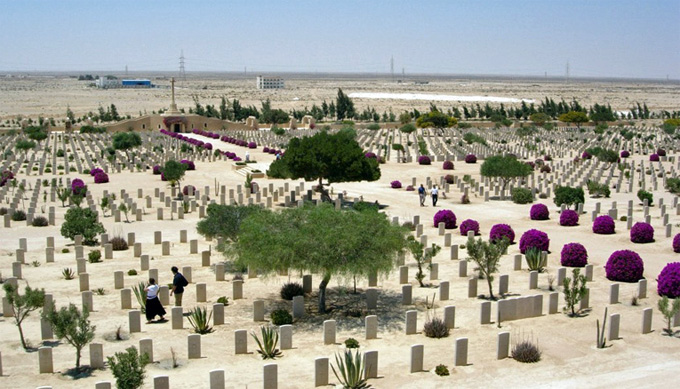 The El Alamein War Cemetery, Egypt.
Photograph with thanks to the Commonwealth War Graves Commission.
Roger Morgan © 2018
Please contact us if you have information or pictures that can extend this entry.
FURNELL, Harry Leonard. Flight Lieutenant/Navigator (124535)
24 Squadron, Royal Air Force Volunteer Reserve.
Died 17 April 1945, aged 24.
 Harry’s headstone in Epsom Cemetery
Image courtesy of Clive Gilbert © 2018
Harry was born Q3 1920, the first child of Tom Furnell and Evelyn Constance (née Scarfe). Their Q4 marriage was registered in the Aylsham District of Norfolk – as was Harry’s birth and that of his two siblings (Doreen in Q4 1924 and John on 23 February 1926). It seems likely that the family home was in the village of Erpingham, 3 miles north of the market town of Aylsham. The September 1939 Register records the parents living at “Bridge Cottage” Erpingham. 43 year old Tom Furnell is listed as “Ex Regular Soldier (Disabled) Oxy-Acetylene Cutter” – during WW1 he had been Private 10278 in the Bedfordshire Regiment and 46 year old Evelyn with the conventional “Unpaid Domestic Duties”. In between two currently closed records at the address is listed 14 year old schoolboy John.
One of the closed records could cover the 19 year old Harry. On the other hand, he may have already been in uniform. With a Service Number 657311, he entered the RAF from the Army in or after 1939. Having reached the rank of LAC, he was commissioned Pilot Officer, on 6 June 1942.
At some point and probably in or near Epsom, Harry met Bessie Otway. Bessie had been born in Epsom Q3 1922, the seventh and last child of George Otway and Epsom-born Bertha Louisa (née Simmonds). The 1911 Census records George and Bertha (who were both 31 and had then been married for 3 years) and their first two children living with Bertha’s widowed mother at 1 Nyes Yard, High Street Epsom.
George is listed in the 1911 Census as a “Groom Gardner Domestic”. He died aged 55 and was buried in Grave K320 of Epsom Cemetery on 27 December 1935. The Cemetery records note that had been a Council employee and had lived at 11 Ebbisham Road, Epsom.
The September 1939 Register records the widowed 60 year old Bertha living at 88 Upper High Street, Epsom with a couple of her older unmarried children and a currently closed record which seems likely to cover the 17 year old Bessie. Anyway, in Q3 1942 and registered in the local Surrey Mid Eastern District, the now 20 year Bessie Otway and Harry Furnell got married. The Q3 1944 birth of their only child, Delphine, was also registered locally.
On 6 December 1942, shortly after their marriage, Harry was promoted to Flying Officer and then, on 6 June 1944, to Flight Lieutenant. His WW2 service was in 24 Squadron, based at Hendon. Its role was providing short-range transport for VIPs using the Douglas Dakota, designed for civil use. This was not as dangerous as flying either fighters or bombers – but was not, of course, risk-free.
In his wildest dreams, however, Harry cannot have foreseen the bizarre circumstances in which he (together with Warrant Officer Donald Richard Terrington DFM) would meet his death – as reported in the following newspaper articles about a fire at Hendon Aerodrome on 17 April 1945:
Daily Mirror – Thursday 19 April 1945
“TRIED TO SEE IF IT WOULD BURN – 2 DIED.
In a hangar at Hendon aerodrome on Tuesday two young RAF officers were discussing whether lino, which they were cleaning with petrol would catch fire if a flame were applied. To prove that it wouldn’t, one of the men held the flame of his lighter to the corner and it immediately flamed in his face.
The five men in the hangar attempted to leave but found one of the doors locked and the others inaccessible because of the blaze. Three of the men managed to climb their way out to safety, but the other two were trapped and burned to death.”
Daily Record – Thursday 19 April 1945
“TWO RAF OFFICERS BURNED TO DEATH.
Two young RAF officers were trapped and burned to death at Hendon aerodrome on Tuesday. Whilst some linoleum was being cleaned with petrol it caught fire. The flames spread and the two officers and other men in the hangar tried to get away but the door they tried first was locked. Three of the men managed to leave by climbing out, but the two officers were trapped.”
Harry’s death was registered in Hendon, but he was brought back to Epsom for burial in the same grave (K320) as his father in law, George (who, as he had died in 1935, Harry seems unlikely ever to have known). The Cemetery records note that Harry was “late of Hendon Aerodrome, NW9”. (Harry’s mother in law, Bertha, joined them both there when she died in July 1954.)
Harry’s widow, Bessie, is unsurprisingly described by the Commonwealth War Graves Commission as being “of Epsom, Surrey”. In Q2 1946 and registered in the local Surrey Mid Eastern District, she got married again – to William G Oliver.
Brian Bouchard & Roger Morgan © 2018
Please contact us if you have information or pictures that can extend this entry.
Please Note: We believe that the information on this page is accurate however users should satisfy themselves that the information is correct before incurring any expense or undertaking any journeys. This is particularly important when purchasing certificates from other bodies, for example the General Register Office. You might like to use the following links to Freebmd and Find My Past (Links open in a new window).