
War Memorials – WW2 – Surnames A
Back to our main war memorials page
Index
Click on the name to jump to the relevant entry
ABBOTT, Elizabeth * (Revised 21/02/2024)
ABEL, Jack Sydney (Revised 22/11/2018)
ABSALOM, Leonard Cyril (Revised 30/05/2018)
ADAMS, Albert E (Revised 08/02/2018)
ADKINS, Henry Charles (Revised 27/07/2019)
AITKEN, Janet Stevenson Hardie * (Revised 30/05/2018)
ALDERTON, Peter Henry (Revised 30/05/2018)
ALEXANDER, Sidney Walter * (NEW 10/10/2022)
ALLSOPP, Cyril George (Revised 30/05/2018)
ALWAY, Edwin John (Revised 30/05/2018)
ANGEL, John Lindsay (Revised 02/06/2018)
ANSELL, James Jack (Revised 02/06/2018)
APPLEBY, John (Revised 02/06/2018)
ARCHER, Harriet * (Revised 02/06/2018)
ARNOLD, John Turney (Revised 02/06/2018)
ASHDOWN, Michael Henry Charles (Revised 02/06/2018)
ASHLING, Oliver Charles (Revised 02/06/2018)
ASTON, Henry Withall (NEW 29/07/2021)
ATKINSON, Trevor Marsh (Revised 23/05/2020)
AUSTEN, Kate Dorothy * (Revised 02/06/2018)
AYLING, Alfred (Revised 15/05/2020)
* = Not included in the Book of Remembrance for reasons unknown.
If you are looking for someone whose name starts with a different letter please try:
A B C D E F G H I J K L M N O P Q R S T U V W X Y Z
Content
ABBOTT, Elizabeth
Civilian
Died 19 September 1940, aged 33
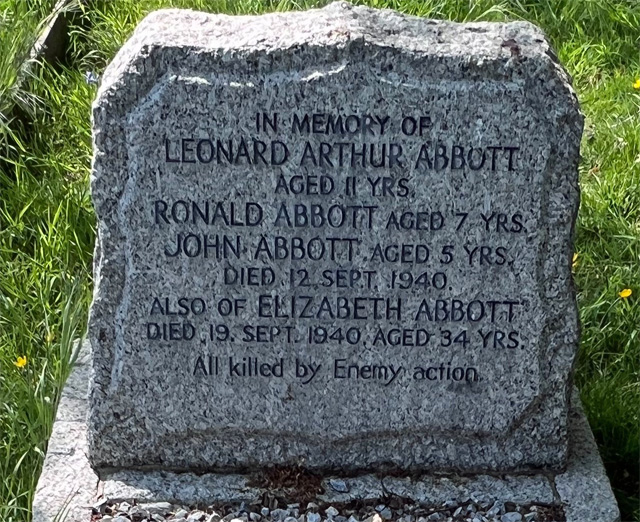 Headstone over the grave of Elizabeth and three of her children in Bandon Hill Cemetery, Wallington.
Photograph with thanks to “Recording the forgotten” via findagrave.com
Elizabeth is not listed in the Book of Remembrance but is remembered here because, after injury during an air raid on her home in Wallington (which killed three of her children outright), she was brought to one of Epsom’s war hospitals where she died a week later.
Tracing Elizabeth’s background was complicated by an unusual slip in the Commonwealth War Graves Commission’s records which listed her as the “daughter of John Ponsby of New York, Northumberland” which, when this article was first written in 2018, led nowhere in the readily available records. Information that has come online recently allows her story now to be more fully told.
Elizabeth was, in fact, the daughter of Ralph Punshon (also of “New York, Northumberland”) and his wife, Catherine (née Mason). The couple had married in Q2 1906, registered in Catherine’s home town of South Shields in County Durham.
They made their home in Hedley’s Buildings, New York, Murton, Northumberland where the 1911 Census recorded the 28 year olds together with their three children: 4 year old Elizabeth (born on 16 November 1906); 3 year old Eleanor; and 1 year old Ralph. Ralph senior is recorded as “Miner Stoneman (Underground Coal Mineworker)”. The 1921 Census finds the family (but minus young Ralph who had died in Q1 1913) still in Hedley’s Buildings. Ralph senior, now aged 38, was still a “Coalminer Stoneman”, plus the information that this was at the Preston Colliery in North Shields. The 14½ year old Elizabeth is listed working as a “Domestic Servant”.
At some point, Elizabeth moved to Surrey. She is next found in the readily available records as a 22 year old at her 16 February 1929 marriage to widowed 32 year old Leonard Arthur Abbott, a Milkman. The wedding was in their Parish Church of St John the Evangelist in Coulsdon.
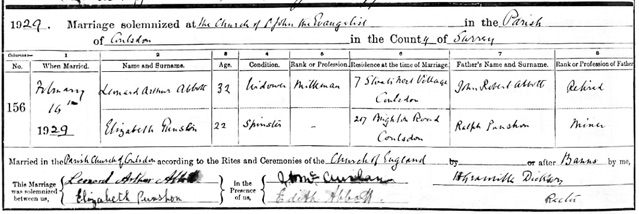 The Register entry for Elizabeth and Leonard’s Marriage.
The couple – now with four children – are next found in the 1939 Register living at 17 Ross Parade, Wallington, Surrey, as (presumably) lodgers with 38 year old shopkeeper Horace W Keefe. 42 year old Leonard is listed as an “Insurance Agent” and 32 year old Elizabeth with the conventional “Unpaid Domestic Duties”. The original record (not the transcript) records that both Horace Keefe and Leonard Abbott were in the Police War Reserve.
On 12 September 1940 – in the first week of the Luftwaffe’s “Blitz” bombing campaign – a bomb hit 17 Ross Parade. It killed three of the children – John (5), Ronald (7) and Leonard Arthur (11) – outright. They were buried in Grave R214 of Wallington’s Bandon Hill Cemetery on 17 September. As noted above, the injured Elizabeth was taken to Horton Emergency Hospital (one of Epsom’s mental hospitals that, as for WW1, had been taken over for wartime casualties), where she died of her injuries on 19 September. She was buried with her three children on 24 September.
If daughter Audrey (9), husband Leonard and Horace Keefe were injured in the bombing, they all recovered.
Roger Morgan © 2018 & 2024
Please contact us if you have information or pictures that can extend this entry.
ABEL, Jack Sydney. Flying Officer/Navigator (120353)
115 Squadron, Royal Air Force Volunteer Reserve
Died 6 December 1942, aged 26
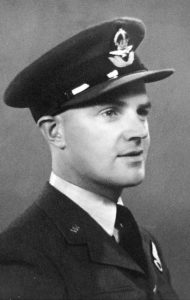
Jack Abel
Photograph courtesy of his married daughter, Margaret Thompson
Jack was born on 21 January 1917, the first child of Albert Arthur Abel and Florence Edith May (née Tooley). The parents’ Q1 1916 marriage was registered in Great Yarmouth but they appear to have made their first home a few miles south: Jack’s birth was registered in the Mutford District of Norfolk, as was the Q4 1923 birth of his sister, Joan.
By the time of the September 1939 Register, Jack and his family were living at 4 Keyes Avenue, Great Yarmouth. 49 year old Albert is listed as a “Railway Clerk”; 47 year old Florence with the conventional “Unpaid Domestic Duties”; and 22 year old Jack as “Post Office Sorting Clerk & Telegraphist”. (Jack had joined the Post office in 1933 as Temporary Postman/Messenger and, by Limited Competition during 1935, was appointed to the grade he still held in 1939.) Jack’s entry in the 1939 Register is followed by a currently closed record, doubtless of his 16 year old sister, Joan.
Following enlistment in the RAFVR, Jack would have been inducted at Cardington around April 1940 with a Service Number 122267. Subsequently, he is known to have trained in South Africa at 75 Air School, Lyttleton, Pretoria. Possibly this would have been followed by a period in 45 Air School at Oudtsshoorn, about 200 miles east of Cape Town, – ‘A.O.N.S & B & GS’, otherwise Air Observers Navigation School, and Bombing & Gunnery School.
Jack returned to the UK and, in Q2 1941 when he was aged 24, married the 26 year old Victoria Mary McCondach. The marriage was registered in Cardigan, and it is assumed that Jack was stationed in Wales for training. However, it seems certain that the couple first met in Great Yarmouth. Although Victoria’s 21 October 1914 birth had been registered in the Romford District, the 28 August 1920 birth of her youngest brother, Robert McCondach’s birth was registered in Great Yarmouth. And the 1939 Register records the 24 year old Victoria (an “Oilskin Overlooker”) living with her widowed mother and three siblings at 107 Middleton Road, Great Yarmouth – about 4 miles from Jack’s 1939 address of 4 Keyes Avenue.
Victoria and Jack had a daughter, Margaret Victoria, whose Q2 1942 birth was registered in the local Surrey Mid Eastern District where Victoria was living with two of her sisters (Josephine Charlotte and Louvine Elizabeth) at 27 Oakhurst Road, West Ewell.
Jack’s WW2 service was in 115 Squadron (part of the RAF’s Bomber Command) which, in late 1942, was stationed at RAF East Wretham, near Thetford in Norfolk. On 6 December 1942, Jack was the Navigator among the five-man crew of Wellington Mk111, BJ 898, KO-C. This took off at 17.33 hours from East Wretham to join 271 other aircraft on a bombing mission against Mannheim. The Wellington was down at 20.12 hours about 10 miles north of Worms – claimed to be by Ofw. Wilhelm Engel of Nachtjagdgeschwader 4 (8/NJG 4), a Luftwaffe night-fighter wing. The aircraft crashed in a vineyard about 2 miles west of Alsheim, killing Jack and the other four on board.
The crew were initially buried in the local Alsheim cemetery. On 14 May 1948, they were re-interred in the Rheinberg War Cemetery, which is about 50 miles north of Köln/Cologne and holds 3,183 Commonwealth WW2 casualties. The widowed Victoria took the option of adding a personal inscription to Jack’s headstone on Grave 8.A.21,
“At the going down of the sun and in the morning we will remember.”
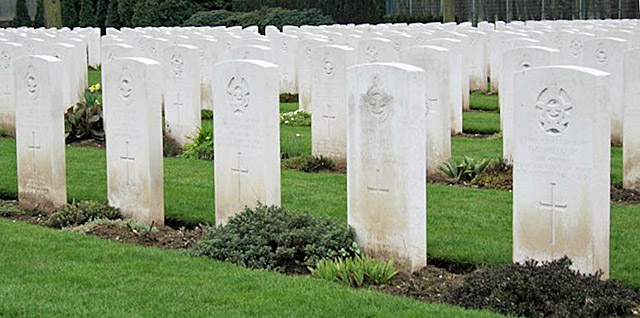 The crew’s headstones in plots 8.C.18-22 of the Rheinberg War Cemetery.
From Left to Right: Sergeant R E Hayman, Air bomber
Flying Officer H W Larkins, Pilot
Flight Sergeant E F Stammers RCAF, Air Gunner
Flying Officer J S Abel, Navigator
Flight Sergeant D G Williams RCAF, Air Gunner
Photograph courtesy of Frank East from the now lost www.luntfamilyhistory.pwp.blueyonder.co.uk
The widowed Victoria – who the Commonwealth War Graves Commission noted as being “of West Ewell” – never remarried. When she died (in Epsom Hospital) on 11 January 1959 her home address was, as in 1942, 27 Oakhurst Road, West Ewell. In 1964, daughter Margaret married Vere O Shaun Thompson. They emigrated to Canada in 1970 and, 2014, were resident in Southampton, Ontario.
Brian Bouchard & Roger Morgan © 2018
Please contact us if you have information or pictures that can extend this entry.
ABSALOM, Leonard Cyril. Private (6467583)
6th Battalion Queen’s Own Royal West Kent Regiment
Died 22 November 1942, aged 25
Leonard was born on 12 June 1917, the son of Robert Cyril and Fanny Absalom. The September 1939 Register records all three living at 75 Lower Court Road, Epsom. The 22 year old Leonard is listed as “Salesman & Stock-keeper – Men’s”. His 62 year old father is listed as “Mental Nurse (Retired)” – doubtless having worked in one of Epsom’s “cluster” of metal hospitals – while his 50 year old mother was listed with the conventional “Unpaid Domestic Duties”.
In Q4 1941, Leonard married Emily Dale – the marriage being registered in the local Surrey Mid-Eastern District. The Commonwealth War Graves Commission’s post-war records note Emily as being “of Carshalton, Surrey”.
Leonard’s WW2 service was in the 6th Battalion Queen’s Own Royal West Kent Regiment. In November 1942, the Battalion was part of Operation Torch, the joint British-US invasion of French North Africa – the first stage of the Allies’ eventually successful recapture of the North African coast providing the springboard for the invasion of Italy. Specifically, Leonard’s Battalion was part of the Allies’ “Run for Tunis” aiming to forestall an Axis build up in Tunisia. The rapid advance was nearly successful, getting to within 20 miles of Tunis before the Axis counter-attack was launched and drove the Allies back.
Leonard was killed during this fierce fighting, and is one of the 441 Commonwealth WW2 casualties buried in Tabarka Ras Rajel War Cemetery, Tunisia. (Ras Rajel is about 7 miles east of the coastal town of Tabarka which is a similar distance from the border with Algeria.) The widowed Emily took the option of adding a personal inscription to his headstone on Grave 3.A.18,
“In loving memory of dear Leonard who gave his life that we might live. RIP.”
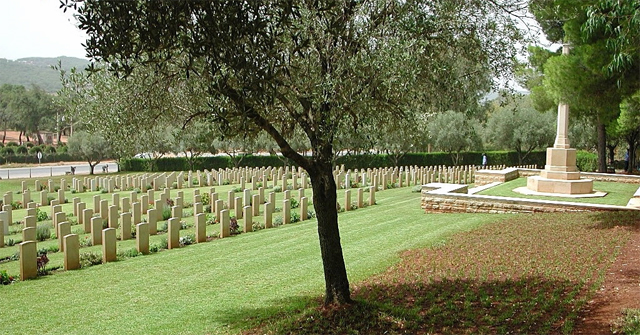 The Tabarka Ras Rajel War Cemetery, Tunisia
Photograph with thanks to the Commonwealth War Graves Commission
Roger Morgan © 2018
Please contact us if you have information or pictures that can extend this entry.
ADAMS, Albert Edward. Private (6018777)
7th Battalion, Queen’s Own Royal West Kent Regiment.
Died 21 May 1940, aged 20.
Albert was born in Epsom Q3 1919, the second child of William Adams and Annie (née Terry – they had married in Epsom Q4 1917).
Both parents had been born in Epsom themselves. William (born on 28 December 1888) was the youngest of some six children born to Frederick (formerly a racehorse trainer and then a stableman) and Annie Adams. Frederick died in 1893, and the 1901 Census records the widowed Annie (working as a “Laundress”) and five of her children (including William) at the family home 2 Beech Road, Epsom. By the time of the 1911 Census ,William had joined forces with his older brother Herbert as co-proprietor of Adams Bros, Bootmakers in Epsom High Street. Living with them were their mother and a couple of siblings.
Albert’s mother, Annie, was born in Epsom on 11 November 1889. The 1901 Census records the 11 year old as one of eight children (aged from 4 to 19) living with their parents George (a “house Painter”) and Sarah Terry at the family home of 9 Lintons Lane, Epsom. By the time of the 1911 Census, Annie was the “General Domestic Servant” in the home of Frank and Rose Harsant at “Worsley”, The Parade, Epsom. (Frank – listed as a “Chemist” – was the proprietor of Harsant & Lee, Chemists at 127 High Street, Epsom – nowadays, Lloyd’s Chemists.)
William and Annie’s first child, Frank, was born in Epsom Q3 1918 but, sadly, died when only a month old. The record of his 30 September 1918 burial in Epsom Cemetery notes the home address as 9 Lintons Lane – the same as his mother’s childhood address in 1901. As noted above, Albert was born in Q3 1919.
The September 1939 Register records William and Annie living with William’s brother, Herbert, at 98 Eastdean Avenue, Epsom. (Both brothers are now listed as “Grocers”, and their 1911 Bootmakers had been demolished when Epsom High Street was widened in the 1930s.) There is one currently closed record at the address which could be of the 20 year old Albert: he is readily not found elsewhere in the Register, but may already have been in uniform. (When William died in 1957, his address was in Church Side, on the Common.)
Albert’s WW2 service was In 7th Battalion, Queen’s Own Royal West Kent Regiment. This was sent to France on 19 April 1940, Albert’s Battalion as part of the 12th Infantry Brigade (which had been formed as a 2nd Line duplicate of the 132nd (Kent) Infantry Brigade). It underwent training and performed labour duties at Albert (near the Somme, about midway between Paris and Calais). It then fought in what is called the Battle of France from 10 May to 25 June 1940.
While the overall British Expeditionary Force (under the command of the highly decorated WW1 hero, Field Marshal the Viscount Gort) was preparing to resist the expected German advance into France, it did not anticipate the speed of the Blitzkrieg assault. When that came, the 12th Infantry Brigade (including Albert’s Battalion) was simply overrun by the German forces: it had none of its support units in place and the infantrymen had had little training. The Brigade suffered very heavy casualties: only about 70 of the total managed to escape back to the UK.
Casualty List 244 initially reported Albert as missing in action. But Casualty List No. 541 (of 17 June 1941) confirmed that he had died on 21 May.
Albert was initially buried where he had fallen but, with 25 other Commonwealth WW2 casualties from scattered sites around the town, was later reinterred in the extension of the Albert Communal Cemetery. (This is about 18 miles north-east of Amiens, on the Somme, and was originally established for WW1 casualties, of which it holds 862.)
His parents took the option of adding a personal inscription to his headstone on Grave II.D.10,
“His life was full of beautiful memories.”
 The Albert Communal Cemetery extension, France
Photograph with thanks to the Commonwealth War Graves Commission
Roger Morgan © 2019
Please contact us if you have information or pictures that can extend this entry.
ADKINS, Henry Charles. Sergeant (1269014)
15 Squadron, Royal Air Force Volunteer Reserve
Died 8 December 1942, aged 31
Henry Charles Adkins was born on 12 February 1911, the fourth child of William Thomas Chapman Adkins and Clara Jane (née Henden) who had married at Christ Church, Battersea, on 25 December 1895. The 1911 Census recorded the family at 14 Barchard Street, Wandsworth. 44 year old William is listed as “Surveyor’s Clerk, Taxes Department”. 40 year old Clara had her hands full with new-born Charles (and the three other children – then aged 10, 9 & 7, and all at school)
Henry’s next appearance in the readily-available records is in the September 1939 Register as a 28 year “Bank Clerk” and head of the household at 18 Amberley Gardens, Stoneleigh. The only other occupant was his widowed 69 year old mother, Clara (listed with the conventional “Unpaid Domestic Duties”): his father, William, had died in November 1929.
In Q2 1940, Henry (now aged 29) married 26 year old Evelyn Barbara Joyce. The wedding was registered in Edmonton, consistent with finding Evelyn (a “Stenographer”) living with her early 60s parents (Charles, a “Gardener”, and Harriet, the conventional “Unpaid Domestic Duties”) at 137 Windmill Road, Edmonton. The newly-weds then lived at Henry’s home, 18 Amberley Gardens, Stoneleigh. There is no record of the couple having any children.
Their wedding was at about the time Henry (who had enlisted in the Royal Air Force Volunteer Reserve) was inducted, probably at Uxbridge, about May 1940. Eventually, he was assigned to 15 Squadron, part of Bomber Command, which had been equipped with Short Stirling Mk 1 aircraft from April 1941. In August 1942, the Squadron moved to RAF Bourn, Cambridgeshire.
On 8 December 1942, Henry was the Navigator/Bomber among the crew of Stirling I (W7635 – LS-V) which took off from Bourn at 16.42 on a mine laying detail in the Sweet Pea region (Rostock and Arcone Light) intent on ‘Gardening’ in the Baltic south east of Lolland & Falster islands.
Attacks against a Stirling were reported on 8 December 1942 by pilots of Nachtjagdgeschwader 3, a Luftwaffe night-fighter wing – Feldwebel (Sergeant) Helmut Schuppan of 2./NJG 3 [2. Staffel of Nachtjagdgeschwader 3 (2nd Squadron, Night Fighter Wing 3)] 21.48 at 3600m, and Oberleutnant(1st lieutenant) Hans Graf, 4./NJG 3, 22.03 at 400m. It seems certain that their target was Henry’s Stirling W7635 which finally crashed into the North Sea, west of the island of Rømø.
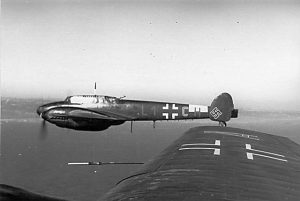
Messerschmitt bf 110, a twin-engine heavy fighter
(Zerstörer-German for “Destroyer”) as flown by NJG3
Most of the crew (Pilot, Sergeant Jochemus J. Blignaut; Flight Engineer, Sergeantt Eric Bance; Navigator, Sergeant Francis G. Crapp; Wireless Operator, Sergeantt Richard G. Oliver; and Air Gunner, Sergeant Robert Skelton) have no known grave and are commemorated on the Runnymede Memorial. Air Gunner, Flight Sergeant Alfred T. Kelley (of the RCAF, although originally from Kansas City) was found to have drifted ashore on the island of Rømø near Lakolk on 17 December and was laid to rest in Kirkeby cemetery the following day.
Finally, Henry was apparently also brought in from the island of Rømø and was laid to rest in Fourfelt cemetery, Esbjerg, on 18 December 1942. The widowed Evelyn took the option of adding a personal inscription to his headstone on Grave AIII.8.10,
“Death is the gateway to life / ‘Until’ “
Evelyn was later granted administration of Henry’s £1,507 estate. She never remarried and, having remained in Stoneleigh at least to the end of the war, eventually moved away – dying in Braintree, Essex in 1991.
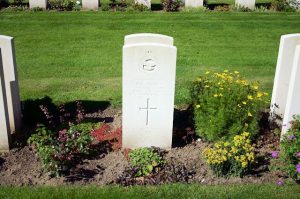 Henry’s headstone in Fourfelt cemetery
Image courtesy of Søren Flensted, Billund, Denmark © 2014
With acknowledgement of material derived from Airwar over Denmark with kind permission
Brian Bouchard & Roger Morgan ©2019
Please contact us if you have information or pictures that can extend this entry.
AITKEN, Janet Stevenson Hardie
Civilian
Died 25 September 1941, aged 36
Janet is not listed in the Book of Remembrance but is remembered here because the Commonwealth War Graves Commission notes that she was the “daughter of James G Aitken, of Oakhanger, Woodcote Hurst, Epsom, Surrey”. However, he was not at that address in the September 1939 Register: the occupants then were the apparently unrelated Douglas and May Fothergill.
There are only two people named James G Aitken listed in that 1939 Register. One is, at the age of 28, obviously too young to be Janet’s father. The other is a 75 year old retired grain inspector living with his 69 year old wife Annie and their 33 year old son Gillon (an “unemployed tobacco traveller”) living at The Firs, Glenwood Road, Wimborne, Dorset. (Also in the household were the mid-30s Tea Planter Henry Swayne and his wife Anne, but it’s not clear if they are resident there or just visiting.) Now, a James Gillon Aitken and Annie Ross Blake had married in Glasgow in 1892, and there is a Scottish record of a Janet Stevenson Hardie Aitken being born at a date consistent with this Janet’s age. If all that solves the family background, it throws no light on the reported link with Epsom, particularly as both James and Annie died in Dorset in 1944 and 1948 respectively.
As the family seems absent from various other censuses, there must be a suspicion that they spent time abroad. And that is consistent with the record of Janet’s leaving Liverpool on 4 October 1938, sailing on the SS Adda to Lagos, Nigeria. The next record is of her death on 25 September 1941 as a passenger on SS Avoceta. The ship was part of convoy HG-73 from Lisbon to Liverpool. It was carrying 469 tons of general cargo and mail, and 88 passengers.
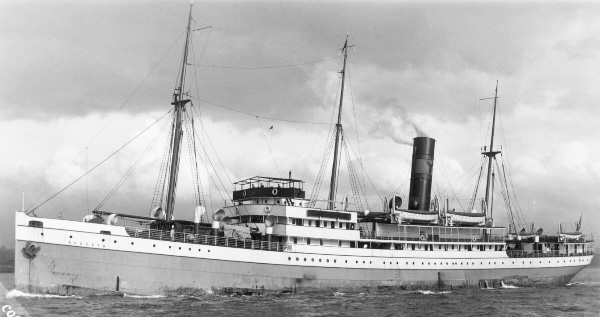 The SS Avoceta
Photo courtesy of State Library of New South Wales
(via uboat.net, from which also come the incident details below)
At 00:31 hours on 26 September 1941, U-203 fired a spread of four torpedoes at the convoy which was a little north of the Azores. One of these hit SS Avoceta on the port side close to the engine room. She sank quickly with the loss of 43 crew members, four gunners and 76 passengers – including Janet. The master, the commodore, five naval staff members 19 crew members, two gunners and 12 passengers were picked up by ships in the escort. (SS Varanga, another ship of the convoy was sunk in the same attack, with the loss of 21 of its complement of 27.)
Roger Morgan © 2017
Please contact us if you have information or pictures that can extend this entry.
ALDERTON, Peter Henry. Flight Sergeant/Pilot (1331632)
61 Squadron, Royal Air Force Volunteer Reserve
Died 13 May 1943, aged 21
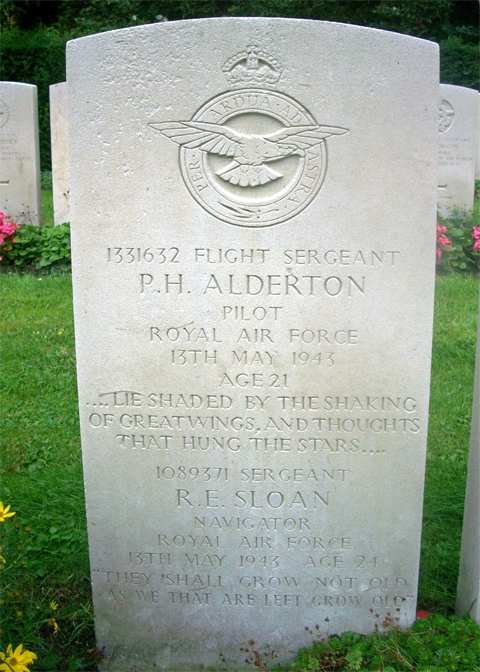 Peter’s headstone in the Amsterdam New Eastern Cemetery
Photograph (12726180) by “fulhamrocks” via findagrave.com
The Commonwealth War Graves Commission database does not give the usual brief family background for Peter – nor even his age when he died. The latter is odd since, as illustrated above, it’s on his headstone that they commissioned.
Peter’s birth was registered in Portsmouth Q2 1922. He was apparently the only child of Henry Alderton and Mildred (née Bogusz) who had married Q3 1920 in Alverstoke , Hampshire. The 1939 Register records the parents living at 52 Court Farm Avenue, Ewell with one currently closed record – probably the 17 year old Peter’s. The 48 year old Henry is listed as “Asst. Manager School Shop Epsom” (the original – rather than the transcript – also notes that he was a “Pensioner Royal Navy”) and the 42 year old Mildred with the conventional “Unpaid Domestic Duties”.
The London Gazette for 10 May 1940 records that the (17/18 year old) Peter secured an appointment as an attendant at the British Museum in Bloomsbury. In due course, he was called for war duty and served as a Flight Sergeant/Pilot in 61 Squadron, part of RAF’s Bomber Command. In 1943, the Squadron was based at RAF Syerston (near Newark, Nottinghamshire) flying Avro Lancasters.
On 12 May 1943, Peter was the pilot of Lancaster W4269 – one of the 572 aircraft sent to bomb Duisburg as part of the so-called “Battle of the Ruhr”. Thanks to precise Pathfinder marking on this night the bombing was particularly well concentrated, and the centre of Duisburg and the port area just off the River Rhine (the largest inland port in Germany) suffered severe damage. 34 aircraft – 6% of the force – were brought down during the raid. In the case of Peter’s Lancaster, this was over Holland. All seven on board were killed and are among the 278 WW2 casualties buried in the Amsterdam New Eastern Cemetery.
Peter’s parents took the option of adding a personal inscription – drawn from Wilfred Owen’s WW1 poem “Asleep” – to his headstone on Grave 69.C.10 (shared with his navigator, Sergeant Robert Edward Sloan),
“… Lie shaded by the shaking of great wings, and thoughts that hung the stars …”
Peter is also commemorated on the British Museum’s war memorial (on the pillar to the right of main entrance when entering), one of the four WW2 names added to the original WW1 memorial.
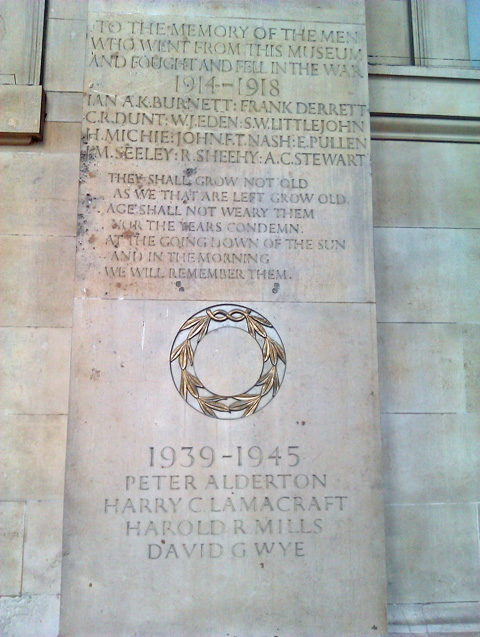 The British Museum’s war memorial.
Photograph courtesy of the War Memorials Trust
Roger Morgan © 2018
Please contact us if you have information or pictures that can extend this entry.
ALEXANDER, Sidney Walter
Civilian
Died 18 June 1944, aged 64
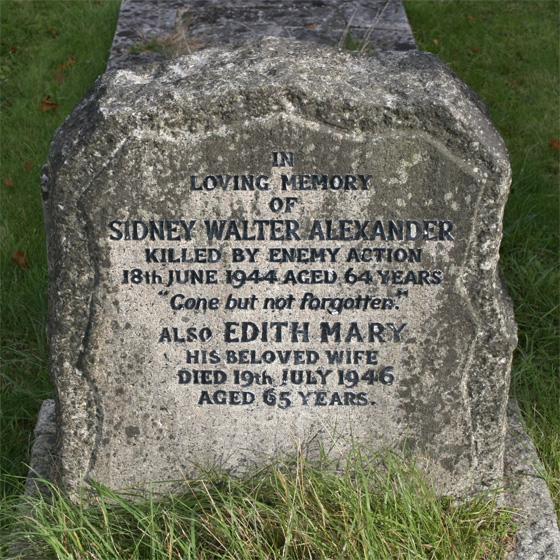 Sidney’s headstone in Epsom Cemetery.
Photograph with thanks to thebignote.com
The 650+ WW2 casualties remembered on these pages are all those commemorated on various memorials in the Borough plus others where the Commonwealth War Graves Commission’s records identify some connection with Epsom and Ewell. Sidney Walter Alexander slipped through that net as the Commission notes only that he was “Buried or commemorated at Wandsworth Metropolitan Borough”. As Sidney lived and died a quarter of a mile south of London’s Nine Elms market, he is doubtless commemorated on one or more local memorials. However, as we have now found his burial in Epsom Cemetery, he merits commemoration on these pages.
[This recent discovery is thanks to “magicfingers” whose bignote blog about the many war-related headstones in Epsom Cemetery spotted this previously overlooked case.]
Sidney was born on 20 June 1880, the first child of Walter and Agnes Alexander. The 1881 Census records the young family living in the High Street of the village of Overton, some 7 miles west of Basingstoke – with Walter listed as a farrier. By the time of the 1891 Census, the family – now with five more children – had moved a few miles southeast to the Village of Steventon. Sidney is now listed as a Scholar and his father as a Blacksmith.
In the 1901 Census, Sidney is recorded as a lodger with the widowed Mary Burness at 47 Heath Gardens, Twickenham and, like the other two lodgers, working as a locomotive fireman with London & South Western Railways.
On 5 February 1910, and registered in the Lambeth District, the 29 year old Sidney married 28 year old Edith Mary Jones. The 1911 Census finds the couple (and their first child, Martha Edith Emily) visiting Sidney’s parents at Watlington in Oxfordshire. Sidney has moved up from fireman to become an engine driver (still with London & South Western Railways) and his father is now listed as a farrier and blacksmith. The 1911 Census was taken on 2 April, the date on which 7 week old Martha was baptised in Watlington’s parish church of St Leonard’s. The couple’s second child, Sidney F Alexander was born in Q2 1913, the birth (like his sister’s) being registered in the Wandsworth District.
During WW1, Sidney served as Driver 173778 in the Royal Engineers. He then returned to the railways as an engine driver. By the time of the September 1939 Register, Sidney and Edith are recorded living at 12A Bridport Terrace, Clapham. 59 year old Sidney is still an engine driver (but now with Southern Railways) and 58 year old Edith is listed with the conventional “Unpaid Domestic Duties”. Both their children had married and left home, and particular mention needs to be made of daughter Martha.
On 17 October 1931, this 20 year old had married 28 year old Archie Edwin Prickett, in Christ Church, Clapham. The Register entry shows that Archie was a Police Constable, living at 39 Church Road, Epsom. They made their marital home in Epsom, after several short term stays settling at 31 Woodcote Side. While no photograph has yet been found of Sidney, the subject of this article, we do have (as below) his signature as a witness to Martha’s 1931 marriage.
 Sidney’s signature.
The 64 year old Sidney was killed by enemy action on 18 June 1944 at or outside his and Edith’s home of 12A Bridport Terrace: the Commonwealth War Graves Commission’s record specifies the place of death as the road rather than the specific address. (If Edith was injured in the attack, she survived.)
Sidney’s burial in grave O485 of Epsom Cemetery on 24 June 1944 seems certain to be down to his Epsom-based daughter, Martha. Her widowed mother, Edith, then moved in with Martha and Archie at 31 Woodcote Side – which is where, aged 65, she died on 19 July 1946. She was then buried with her husband on 24 July.
Roger Morgan © 2022
Please contact us if you have information or pictures that can extend this entry.
ALLSOPP, Cyril George MM
Civilian
Died 4 July 1944, aged 44
Cyril was born in Worksop, Nottinghamshire on 25 August 1899. He was the second or third child born to Elijah Allsopp and Annie Bethia (née Rawson – they had married in Worksop Q4 1896). The 1911 Census records the late 30s parents (Elijah being listed as an “Architect & Surveyor”) and their three surviving children (one had died) living at 38 Sherwood Road, Worksop.
In 1917, at the age of 18, Cyril (by then living in Lancashire) is recorded as having joined the Royal Flying Corps. That obviously did not work out because he is later recorded as having served as a Private (634838) in the 20th Battalion of the Royal West Kent Regiment. This saw action in France during the closing stages of WW1, during which Cyril was awarded the Military Medal for “bravery in the field”. (The 22 July 1919 Gazette record of this award – page 9390 – gives Cyril’s home address as Rotherham.)
In Mansfield, Nottinghamshire Q3 1922, Cyril married Chryssa Morris Allison. (She had been born in Lytham, Lancashire on 17 March 1901 to railwayman Frank and Mary Allison but, by the time of the 1911 Census, her family had moved to Worksop – Cyril’s home town.)
Cyril and Chryssa had three children: Margaret (whose Q2 1924 birth was registered in Staines, Middlesex); Dorothy (whose Q2 1929 birth was registered in Elham, Kent); and John (whose Q3 1931 birth was also registered in Elham).
The September 1939 Register records Cyril as resident in two places. The first is as one of twelve in the Seaton household at “Woodcote End House, 5 Woodcote Road, Epsom”. The head of that household, Leslie R F Seaton, is recorded as a “Builders Manager” and Cyril is shown as a “Contractors Manager). Cyril’s other entry in the 1939 Register is of him living in Bracklesham Lane, Chichester with his wife, two of their children (Margaret and John), a 13 year old Allan Comer and one currently closed record – probably their middle child Dorothy. In this entry, Cyril is recorded as an “Architect”.
Whatever all that was about, the fact is that, on Tuesday 4 July 1944, Cyril was in Central Road, Morden when a V-1 “doodlebug” landed in front of No 169 and he was killed in the explosion.
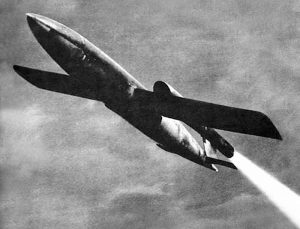 A V-1 in flight
Copyright acknowledged
The name V-1 comes from the German Vergeltungswaffe 1, meaning “Vengeance Weapon 1”. Between June and September 1944, around 9,500 of these flying bombs were launched on London – about 100 a day. Although launched it the general direction of the London area, these weapons were not guided after launch. Their course would be affected by winds and they flew until their fuel ran out. While in flight, the pulse jet engine made a distinctive throbbing sound – and, when that sound stopped, people knew they had only a few seconds before it fell to earth and its tonne of high explosive was detonated. (The V-1 was succeeded by the rocket-powered V-2 which fell from the stratosphere at supersonic speed and thus with no forewarning at all – see the article about Walter Yeomans.)
The Commonwealth War Graves Commission’s post-war records list Cyril as being “of” South Lodge (now No 6) Woodcote Road, Epsom. That is also given as his address in the 1945 Probate records granting administration of his £ 3,482 estate to the widowed Chryssa and Barclays Bank Ltd. Chryssa never re-married and died in Cheltenham Q4 1980.
Roger Morgan © 2017
Please contact us if you have information or pictures that can extend this entry.
ALWAY, Edwin John. Flight Lieutenant (77382)
Royal Air Force Volunteer Reserve
Died 5 September 1940, aged 37
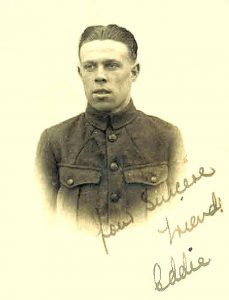 Edwin John Alway
Image courtesy of Wendy Jeffrey, a grand-daughter © 2014
Edwin was born in Epsom on 28 September 1903, and was baptised at St Barnabas’ Church on 3 December 1903. He was the first child of George Edwin Alway (born 13 Jul 1875 in Pack Horse Cottage, Barton Hill Bristol, Gloucester) and Eliza Martha ‘Dolly’ (née Graysmark). She had been born in Holborn, London, in 1878, but their Q1 1902 marriage was registered in the Epsom District.
The 1911 Census records the family – now with a second child, new-born George Edward – living at 38 Miles Road, Epsom. George Alway’s occupation is found variously stated as bricklayer/general foreman (building)/ master builder/master bricklayer. The Municipal Review, 1957, reported that Ald. G. E. Alway (Epsom & Ewell) [elected to Epsom Urban District Council in 1920] received the council’s congratulations upon completing more than 36 years as a member of the Highways committee, 24 of them as chairman. Alderman Alway, the ‘Father’ of the council served as mayor of the borough (incorporated 1937) [1946] and as chairman of the former UDC [1930-31].
By 1921, when aged about 18, Edwin had become Hon. Sec. of the Wireless Society of Epsom. It seems he entered the Royal Air Force at an early age and, during 1926, is found serving at Ismailia, Egypt, as a Corporal. Presumably this was as a member of 208 Squadron, an army co-operation and reconnaissance squadron formed at Ismailia by the renumbering of 113 Squadron, which spent the pre-war years based in the Middle East. He became an Associate Member of the Institution of Radio Engineers – ‘A.M.I.R.E’.
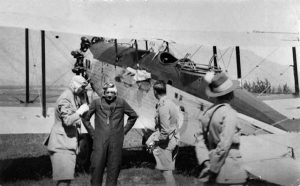 Photograph from E J Alway’s album – possibly of a Bristol F2C, type 22B,
two seat fighter-recce biplane with a Bentley B.R.2 Rotary engine – as flown by 208 Squadron in Egypt.
Image courtesy of Wendy Jeffrey, a grand-daughter © 2014
In Q4 1927 and registered in the Wandsworth District, the 24 year old Edwin married 23 year old Grace Lilian Innes. They lived at 50 Canford Road, SW.11, (probably with his wife’s parents) where he operated as a radio ‘ham’, using the call sign 5AU. Also in that year he wrote from Kings Lynn about frequencies describing himself as ‘Sergeant in RAF’.
Having returned to civilian life, he pops up in 1933 residing at 579 Gander Green Lane, Sutton, presumably a rented property because a year later his address had changed to number 535. E J Alway became involved with the BBC Empire Service operating from 1932 out of Chelmsford with short wave equipment rented from Marconi, call sign G5SW. Programme material was wholly derived from the Home Service but a small studio had been set up manned by two BBC engineers, one of whom was Edwin Alway – they were responsible the opening and closing announcements.
By 1936, under L W Hayes, he had been appointed Engineer in Charge, Empire Section, Overseas and Engineering Department of the British Broadcasting Corporation. During 1937 he was back at Canford Road, Clapham Common before moving to 18 Laburnum Road, Epsom for 1938. He applied for UK patents involving radio technologies in 1937 & 1939.
The 29 September 1939 Register recorded Edwin and Grace living at “The Bakery”, Westmore Road, Godstone. The just 26 year old Edwin is listed as “BBC Engineer, Specialist in Shortwave Propagation Studies” and 24 year old Grace with the conventional “Unpaid Domestic Duties”. Also at their address were the single 24 year old Helena Porter (“Spanish Assistant BBC Overseas Department’) and single 31 year old Thomas Henn (“Editor: BBC Overseas Journal”). All four of their entries are annotated “Liable to travel”. (The last person at the address was the apparently unrelated 63 year old widow Nellie Woodhouse, listed with “Unpaid Domestic Duties”.)
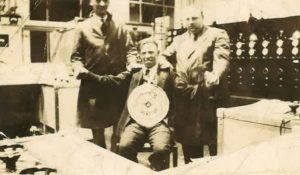 E J Alway at the BBC
Image courtesy of Wendy Jeffrey, a grand-daughter © 2014
Following his entry to the RAFVR, he was enlisted, for the duration of hostilities, Pilot Officer 77382, on probation from 6 January 1940. A transfer to Technical Branch in April was followed by elevation to the substantive rank of Flying Officer on 19 July of that year. Briefly, he had commanded a ‘Listening Post’, part of the ‘Y’ Service, set up in a caravan on corner of RAF Hawkinge which operated long range Hallicrafter VHF receivers listening to German transmissions. Having subsequently been attached to the Air Ministry for work on radio countermeasures, he was very shortly acting with the rank of Flight Lieutenant.
Knickebein – the German bombing beam
Prior to the War, the German aircraft industry had invested heavily in research and development of blind landing aids which allowed aircraft to approach an airport at night or in bad weather: the primary system developed for this role was called Lorenz. For bombing use the modifications to Lorenz were fairly minor but much larger antennae were needed to provide the required accuracy. This was achieved by using aerials with many more elements, but it retained the simple switching of two of the reflector elements to alter the beam directions very marginally. The beam angles were so dramatically reduced that it was only a few tens of yards wide over the target. It was the shape of the aerials that gave the new system its code name, Knickebein, which means “bent leg”. For the required range, broadcast power was increased considerably. The Knickebein receivers were disguised as a standard blind landing system.
A single broadcaster would guide the bombers towards the target, but could not tell them when they were over it. To add this ranging feature, a second broadcaster similar to the first was set up so it crossed the guidance beam at the point where the bombs should be dropped. The aerials could be rotated to make the beams from two transmitters cross over the target. The bombers would fly into the beam of one and ride it until they started hearing the tones from the other (on a second receiver). When the steady “on course” sound was heard from the second beam, they dropped their bombs.
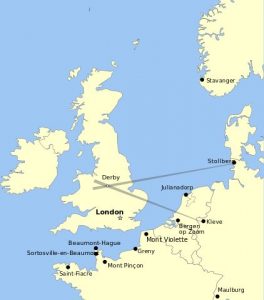
Map showing the positions of Knickebein transmitters during the battle of Britain.
Map by Dahnielson and reproduced under the Creative Commons Attribution-Share Alike 3.0 Unported license.
Early in June 1940 no signals which could be ascribed to a Knickebein beam had been detected in England. As a matter of urgency, however, arrangements were put in train to attempt interception. American VHF receivers were acquired, and modified to run on on 28 volts DC rather than 250 volts AC. Mountings and VHF aerials needed to be fitted to three elderly Anson Mk 1 aircraft (N9945, N9938 & L7983); all the work being undertaken almost single handed by Edwin J Alway, drawing on his experience with the BBC. On 19 June 1940, a test flight failed with a fault in the HT generator and nothing could be heard over the following night by detectors in N9945. Alway, who had previously been aboard was to tired to fly for a third test on 21 June. The three Ansons from Boscombe Down’s Blind Flying Development Unit (under the command of Sqn. Leader R. S. Blucke) had been moved to RAF Wyton, Huntingdonshire, nearer the East Coast, and on that occasion the investigation flight proved successful.
On 5 September 1940, still working with BAT & DU (Blind Approach Training and Development Unit – otherwise Wireless Intelligence Development Unit ), Edwin was aboard another Avro Anson, R9815, engaged in a beam approach development flight whilst enemy aircraft were in area. A wing struck ground on the final approach and Fg. Off. K. Munro, Flt. Lt. E.J. Alway, Sgt. C.J. Hames, W.op/AG. Sgt. F.W.K. Wood, Obs. were casualties
Amongst other details the Flying Accident Card records:
“Crashed making Lorenz approach in fog. Flew into ground on a turn with subsequent bounce and stall from low height. Made approach down beam to left of contact lights. As boundary is in line with lights a/c (aircraft) turned or banked to avoid same, wheel hit ground.”
Michael Cumming, writing Beam Bombers:The Secret War of No 109 Squadron in 1998, remarked on page 18: –
“…Anson crashed at Boscombe Down while making a blind approach landing in fog at night. Munro was the captain and pilot this time and he died in his plane, as did one of the NCOs in his crew. Two more died either in or on their way to hospital. One of the dead men was a member of an Air Ministry radio countermeasures establishment who had taken part in the very first investigations into the enemy’s beams over Britain, Flight Lieutenant E J Alway. It was Alway who reported back to the Air Ministry after the initial flight on 19 June and it was Alway who flew as wireless operator the following day when Bafton made his debut investigative flight on resuming his service with BAT&DU. There was just a single survivor of this fatal crash, Sergeant A D F Allen, air gunner, who escaped with only slight injuries. Allen was awarded the George Medal for his actions during this incident.”
The Air Ministry reported that Acting Flight Lieutenant E J Alway died of wounds or injuries received on active service, 5 September 1940, presumably having been extricated fron the crashed aircraft. His demise, aged 36, is recorded at Salisbury for the September quarter of 1940, with the other casualties from the crew.
Edwin was brought from Boscombe Down Aerodrome, Amesbury, back to Epsom Cemetery for burial on 9 September 1940. The widowed Grace took the option of adding a personal inscription to his headstone on Grave N.263 (in a group of CWGC graves),
“Rather death than false of faith”.
While his headstone states his age as 37, the Cemetery records are more precise, specifying this as “36 yrs. 11 mths”.
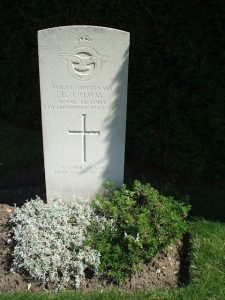 Edwin’s Headstone in Epsom Cemetery
Image courtesy of Brian Bouchard © 2014
His mother, Mrs Eliza Martha (Graysmark) Alway from 38 Miles Road, Epsom,aged 64, was brought to be interred nearby, in Plot N 229, on 16 June 1942. Her husband, George Edwin, died 4 January 1962 in Epsom Hospital, aged 86 (reg. Surrey Mid E 3/1962) to be buried in the Cemetery on 8 Jan 1962 [Epsom & Ewell Herald, 12 Jan 1962. ‘Last Tributes to Ald. G.E. Alway – Forty years of voluntary service acknowledged’].
The ashes of the widowed Mrs Grace Lilian Al(l)way of 18 Laburnum Road, who had died aged 72 in West Park Hospital, Epsom, on 8 February 1979 were scattered on Grave Space M263, 20 February 1979.
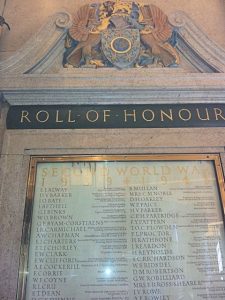 Edwin’s Inscription on the BBC Roll of Honour
Image courtesy of Wendy Jeffery © 2014
Brian Bouchard ©2014
With additional information provided in 2016 by Martyn Rapley.
Updated 2018 by Roger Morgan.
The man who pulled Edwin Alway from the burning plane:
As you know, Edwin Alway died in a plane crash at RAF Boscombe Down on 5th September 1940.
My interest in Edwin Alway is that my wife’s father was Dudley Allen who was the sole survivor of the crash and was subsequently awarded the George Medal for extricating three of the crew from the wreckage, including Edwin Alway, although sadly all three died of their injuries. Dudley only survived because he was in the turret gun position. At the time Dudley was a Sergeant and he eventually became a Squadron Gunnery Leader with the rank of Wing Commander. In the crash he suffered head injuries which caused his eyesight to steadily deteriorate and, by the 1950’s, he was blind.
As part of my research into Dudley’s life I was aware of Edwin Alway through RAF records and also from Michael Cummings’ book “Beam Bombers: The Secret War of No 109 Squadron“. When I came across your article during my research I was fascinated to learn about the earlier part of Edwin Alway’s life. Given the crucial part he played in radio beam development during the early part of the war it does seem remarkable that his services were not recognised (as far as I am aware) by an award of some sort, albeit posthumously.
Martyn Rapley, January 2016
Please contact us if you have information or pictures that can extend this entry.
ANGEL, John Lindsay. Lance Bombardier (1552212)
21 Light Anti-aircraft Regiment, Royal Artillery
Died 2 August 1945, aged 29
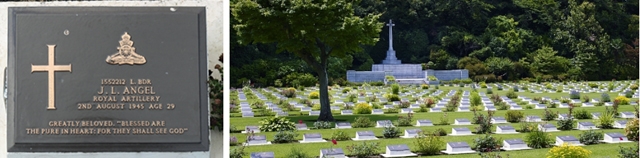 John’s gravemarker and the Yokohama War Cemetery
Left: Photograph (12970261) by Michel Nelis via findagrave.com
Right: Photograph with thaks to the Commonwealth War Graves Commission
John was born in August 1915, the third and last child of Henry Angel and Janet (née Lindsay – presumably the inspiration for John’s middle name). Henry was originally from Liverpool and Janet from Leeds, but their 8 September 1909 marriage was in Meriden, Flintshire.
The April 1911 Census records the couple living at 35 Wingate Road in the Liverpool district of Garston. 30 year old Henry is listed as a “Cashier, Meat Importer”. As usual, no occupation is listed for 29 year old housewife Janet who, in Q3 1910, had given birth to the third member of the household, 6 month old James.
Before long, the couple moved to London. The births of their second and third children (Elizabeth in January 1913 and John in August 1915) were both registered in Barnet, Middlesex (now the London Borough). The family then moved to Epsom and all, except for 29 year old James, are recorded in the September 1939 Register living at 27 Upper High Street. 58 year old Henry is listed as a “Commercial Clerk”; Janet, also 58, is listed with the conventional “Unpaid Domestic Duties”; 26 year old Elizabeth is a “School Teacher”; and 24 year old John as a “Foreman” Nurseryman”.
John had attested for the Royal Artillery in 1938 and his WW2 service was in its 21st Light Anti-aircraft Regiment. It seems likely that he was already providing anti-aircraft fire in the mid-1940 “Battle of Britain”. When the threat of German invasion of the UK had properly receded, the Regiment was readied for deployment abroad. After what is reported as fairly cursory training in mobile warfare and with their equipment was painted in desert camouflage, the men sailed from the UK in early December 1941 on their way, so it was understood, to the Middle East via the Cape of Good Hope. (Unknown to the men, there was a secret plan for them to be part of a surprise attack on Tunisia. But that was aborted shortly after they left the UK, and they were then on the way to the Middle East.)
However, on reaching Capetown, they learned that Britain was at war with Japan, and they were instead re-routed to defend Singapore. By the time they neared Singapore, it was already under attack and they were diverted to Batavia on the jungle-covered island of Java, then part of the Dutch East Indies (now Indonesia). They were attacked by Japanese forces as they arrived in port.
Notwithstanding much fierce fighting – with heavy casualties on both sides – the Allies were overcome and surrendered to the Japanese in February 1942. John was among those then taken prisoner. Readily available records do not provide any information about most of John’s time as a Japanese PoW but, like his fellow prisoners, he will have experienced some dreadful conditions and harsh treatment. At some point, he was taken to the Fukuoka PoW Camp on Japan’s Kyushu Island – doubtless transported in the appallingly cramped and insanitary conditions of what rightly became known as “hellships”.
Having endured 3½ years in captivity, John died on 2 August 1945, of acute enteritis and beriberi. This was nearly three months after hostilities ended in Europe on 8 May and less than a fortnight before Japan’s surrender on 15 August.
John was first buried locally and, on 16 September 1946, reinterred as one of 1,507 WW2 casualties in the British Section of the Yokohama War Cemetery, on the west coast of Tokyo Bay, Japan. His family took the option of adding a personal inscription to his headstone on Grave N.D.1,
“Greatly beloved. ‘Blessed are the pure in heart: for they shall see God’ “
Roger Morgan © 2018
Please contact us if you have information or pictures that can extend this entry.
ANSELL, James Jack. Private (5574579)
4th Battalion, Wiltshire Regiment.
Died 10 July 1944, aged 29.
James was born in Epsom on 7 January 1915, the first of four children (all boys) born to James Edgar Ansell and Florence (née Ryan – they had married in Epsom Q2 1914). The September 1939 Register records the family living at 180 Hook Road, Epsom. James Senior Is listed as a “Sewage Works Labourer”; Florence as a “Domestic Cleaner; and James junior as a “Leather Factory Colour Carrier”. (His youngest brother, Edward born on 2 July 1903, also worked in a Leather Factory.)
James’ WW2 service was in the 4th Battalion of the Wiltshire Regiment. This was a Territorial Army unit called up to active duty in late 1939 and, for much of the war, was stationed in Great Britain. Its posting was near RAF Oakington, west of Cambridge with the task of defending the airfield in case of a German invasion. In November 1940, the Battalion was moved to Kent and undertook various defensive duties along its coast. (At some point, it was decided the Battalion would leave the division for service in “a hot climate”. All men were given a short embarkation leave but, when they returned from this leave, the operation order was cancelled, much to the relief of the men.)
As the tide of the war turned, the Battalion became part of the massed forces training for the invasion of Normandy. That was launched with the D-Day landings on 6 June 1944. Many more waves of men and equipment followed after that. James’ Battalion disembarked in Normandy a couple of weeks later and moved to the appointed concentration area at Sommervieu.
The Battalion was then engaged in the unexpectedly fierce and protracted fighting to capture the strategically-sited German stronghold of Caen, a few miles inland from the Normandy beaches. James was killed in this action, on 10 July 1944, shortly before the town was eventually taken. (Fighting on some of its outskirts continued until 6 August.)
James is one of the 2,038 Commonwealth burials in the Banneville-La-Campagne War Cemetery, about 5 miles east of Caen. (Almost all these men were killed in the fighting for Caen in that second week of July 1944.) His parents took the option of adding a personal inscription to his headstone on Grave XI.E.26,
“Gone from us but not forgotten never shall his memory fade. RIP.”
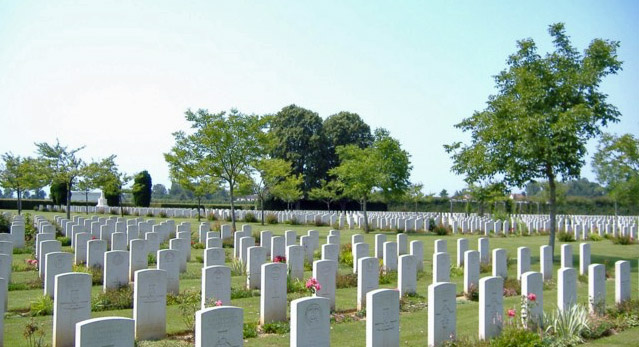 The Banneville-La-Campagne War Cemetery, Caen
Photograph with thanks to ww2cemeteries.com
Roger Morgan © 2018
Please contact us if you have information or pictures that can extend this entry.
APPLEBY, John Francis (“Jack”), Corporal (6142115)
Royal Armoured Corps
Died 13 April 1942, aged 27
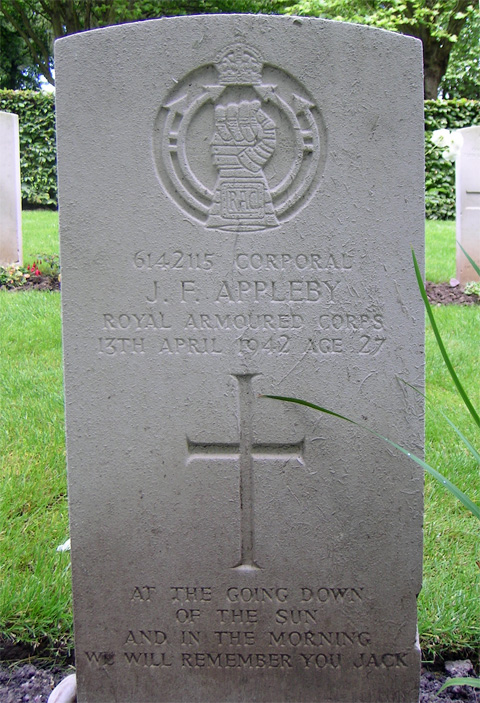
John/Jack’s headstone in Birmingham (Lodge Hill) Cemetery
Photograph (83741652) by Myra Mason via findagrave.com
John – known as “Jack” – was born Q1 1915 in Dover, the second and last child of Thomas William Appleby and Ruth (née Beardwell – they had married in Q3 1907 in Lambeth). The parents have left a very light trace in the readily available records, probably explained by the 1939 Register recording the 68 year old Thomas as “Retired (Indian Army)”. He and 67 year old Ruth (listed with the conventional “Unpaid domestic duties” were by then living at 23 Fairford Gardens, Worcester Park. Also living with them was their first child, 31 year old Dorothy Appleby, who is listed as a “shorthand typist”
24 year old John/Jack is not readily found in the September 1939 Register – but his future wife, 22 year old Daisy Amelia Godbeer (a “Draper’s Assistant”) is listed living with her parents at 124 Brocks Drive, Sutton, only a couple of miles from Jack’s parents in Fairford Gardens. Jack and Daisy married in Q4 1939, registered in the local Surrey Mid Eastern District. However, they made their home at 191 Farren Road, Northfield, Birmingham. No record has been found of their having any children.
Readily available records provide scant details of Jack’s wartime service with the Royal Armoured Corps. Casualty List No. 802 reporting his death on 13 April 1942, states that he was in the RAC’s 51 Training Regiment. His Death Certificate records that he died at All Saints Emergency Hospital, Bromsgrove of a prolonged epileptic attack. (This must have been late-onset epilepsy, otherwise he would surely have failed his medical on joining up.) The certificate also records that Jack had previously been a “Clerk for Electric Company”.
Jack is one of 630 WW2 casualties buried in the Birmingham (Lodge Hill) Cemetery. His family took the option of adding a personal inscription to his headstone on Grave 2E.2890,
“At the going down / of the sun / and in the morning / we will remember you, Jack.”
Roger Morgan © 2018
Please contact us if you have information or pictures that can extend this entry.
ARCHER, Harriet
Civilian
Died 14 December 1940, aged 87
Not listed in the Book of Remembrance
The Commonwealth War Graves Commission’s database records that Harriet:
• lived at 20 Pawson’s Road, West Croydon;
• was the widow of W Archer;
• was injured 10 November 1940;
• died on 14 December 1940, aged 87, at Horton Emergency Hospital, Epsom; and
• is buried in Epsom Cemetery.
For someone with fairly common names, this limited information means that her family background cannot be traced with any confidence in the readily available records. And things are further complicated by the September 1939 Register recording Harriet living alone at 20 Pawson’s Road as a widowed pensioner, born on 15 April 1853 – but quite clearly with the surname Williams. Every other readily available record (including the General Record Office index of 1940 deaths and Epsom Cemetery’s of her burial) has her surname as Archer.
Harriet’s section of Pawson’s Road was made up of small terraced houses. No 20 appears to have been divided into two flats: the 1939 Register records Sydney Hicks (a 41 year old plumber) and his wife Gertrude (with the conventional “Unpaid Domestic Duties”) as a separate household at the same address.
There are reports of a high explosive bomb falling in Pawson’s Road in November 1940 which destroyed a number of properties included the terrace of which Harriet’s No 20 was part. She was injured in the raid and taken to the Emergency Hospital at Horton – one of Epsom’s cluster of mental hospitals that, as for WW1, had been taken over to deal with military and civilian wartime casualties. Just over a month after being injured, she died there on 14 December. (There is no record of Sydney and Gertrude Hicks, the other occupants of No 20 Pawson’s Road in the 1939 Register, being wartime casualties.)
On 19 December 1940, Harriet was buried in Grave M438 of Epsom Cemetery, which now has no visible grave marker.
Roger Morgan © 2018
Please contact us if you have information or pictures that can extend this entry.
ARNOLD, John Turney. Apprentice.
SS Lulworth Hill, Merchant Navy
Died 12 May 1943, aged 18.
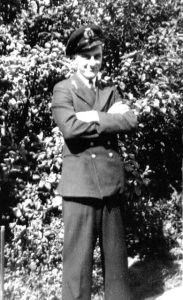 John Turney Arnold in his uniform.
Image source David Arnold © 2012
John Turney Arnold was born on 2 April 1925 in Camberwell to Edgar Arnold and Catherine, known as “Nina” (née Smith – their Q4 1918 marriage was registered in the Camberwell District). He was probably neither their first nor last child, but “Arnold” and Smith” are too common surnames to track others with any confidence in the readily available records. The family moved away from Camberwell. In 1931, the 6 year old John was attending Collingwood School for Boys, Wallington. The family then moved to West Ewell, and John attended Ewell Castle School.
Their address then was probably the 101 Bellfield Road, West Ewell at which they were recorded in the September 1939 Register. In that, 58 year old Edgar is listed as “LCC Clerk” and 43 year old Nina with the conventional “Unpaid Domestic Duties”. 14 year old John is “at School”, and his entry is followed by a currently closed record which is probably of a younger sibling. (The last entry at the address is the apparently unrelated Doris R—–ton, an unmarried 43 year old “Music Teacher”. The surname is unclear as the Register entry is struck through when later overwritten with her married name of Miles.)
In 1941, the now 16 year old John joined the Merchant Navy as an apprentice, sailing with the 7,628 ton freighter, SS Lulworth Hill. He would have experienced at first hand the hazards of merchant shipping during wartime, and doubtless been in a number of convoys alongside ships that had been sunk by the enemy. (For the same reasons of denying supplies to the enemy, Allied forces also attached Axis shipping.)
Shortly before SS Lulworth Hill left Hull on Sunday 27 September 1942, John wrote a letter to his father which, prophetically, included the thought that “it may be us this trip”.
After leaving Hull, SS Lulworth Hill sailed round the North of Scotland, three days later joining a convoy of 57 ships protected by a pack of frigates and corvettes, and led by a destroyer. She was carrying 7,000 tons of aircraft engines as well as 7,000 tons of high explosive 250lb bombs intended for the troops in North Africa. After only 7 hours, the convoy was attacked and at least 4 ships were sunk.
After a couple of weeks, the convoy split up and SS Lulworth Hill continued alone via Brazil, Cape Town, the Red Sea and Suez Canal, eventually arriving at Alexandria where the cargo was offloaded. On the return journey, the ship called at Mauritius to pick up 10,000 tons of sugar, some fibre and 400 tons of rum. After refuelling at the Cape, the plan had been to rendezvous with nine other ships in Walvis Bay for the convoy home. However, for some currently unknown reason, the crew were instructed to take her home alone.
While German U-boats were the major predators of Allied shipping in the Atlantic during WW2, Italy also operated a substantial fleet of submarines, although these were larger and less manoeuvrable than the German U-boats. Italian submarine commanders usually operated alone and preferred the method of torpedoing a victim from periscope depth before rising to the surface to finish of the attack with gunfire. In 1942 the Italian submarines based at Bordeaux, France, began venturing farther out to look for ships travelling alone in waters off the Caribbean, along the western coast of Africa and off north-eastern South America.
On 19 March 1943 the SS Lulworth Hill was attacked and sunk by the “Leonardo da Vinci”, under Captain Gianfranco Gazzana-Priaroggia. The submarine surfaced among the struggling survivors and they hoped to be rescued – but the captain shouted to them from his conning tower, “Your aircraft bomb our cities, you shall all die”.
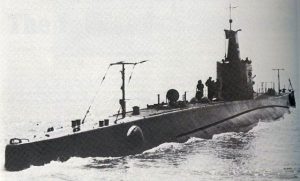
The Italian U-boat Leonardo da Vinci
Image source Wikipedia
Fourteen men – including John – managed to board a life raft but, after 50 days adrift, only two remained alive. They were picked up by HMS Rapid on 7 May 1943. Both were later awarded the George Medal. One of them, Kenneth Cooke, described their ordeal in his book “What Cares The Sea?”
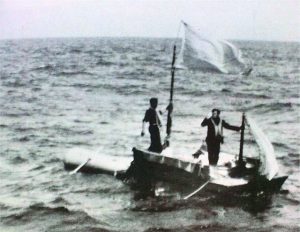
The two survivors of the SS Lulworth Hill after 50 days adrift.
Image source not known
John Turney Arnold, having spent his eighteenth birthday on the raft, died on 12 April 1943. In addition to his entry in the Borough’s Book Of Remembrance at Epsom’s Town Hall, his name can also be seen on: the WW2 memorial at Ewell Castle School; Panel 66 of the Merchant Navy Memorial at Tower Hill, London; the Urban Saints Memorial at Westbrook House, Isle of Wight; and a memorial plaque at the National Memorial Arboretum, Alrewas, Staffordshire.
Information supplied by John’s brother, David Arnold.
Please contact us if you have information or pictures that can extend this entry.
ASHDOWN, Michael Henry Charles. Sergeant/Pilot (1320551)
75 Squadron (NZ), Royal Air Force Volunteer Reserve.
Died 26 July 1943, aged 20.
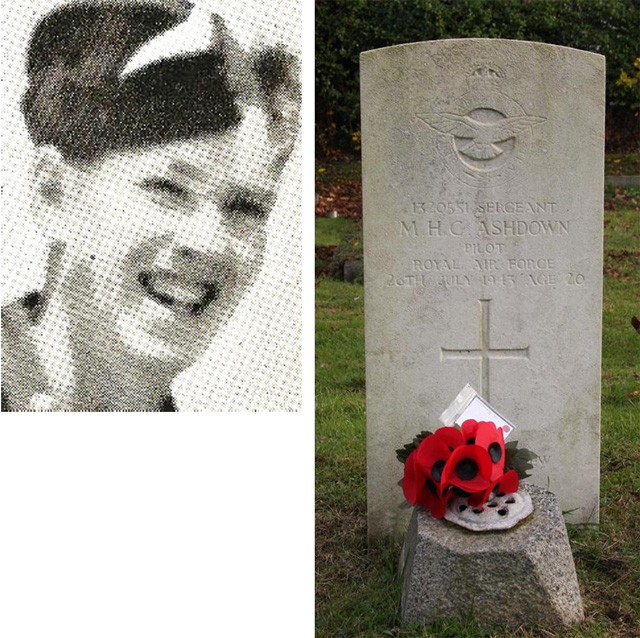
Michael Ashdown and his headstone in Cuddington Cemetery
Pictures with thanks to findagrave.com
Michael was born Q1 1923. The birth was registered in Eastry, Kent, where his parents – Charles Robert Ashdown and Ivy Ann (née Hopper) had married in Q3 1920. The couple had at least one other child: Robert was born on 27 March 1927, also registered in Eastry (near Kent’s east coast).
At some point, the family move to 22 Kinross Avenue, Worcester Park. The 1939 Register records them there with Charles listed as “Staff Superintendent, Pullman Car Co (Railway Restaurant Carriages)” and Ivy with the conventional “”Unpaid Domestic Duties”. (On the original Register, but not the transcript, it is noted that Ivy was also involved with the Civil Nursing Auxiliary Service – and also that Charles was a Special Constable.) There are two currently closed records at the address, one of which is likely to be the 16 year old Michael’s.
Michael’s WW2 service was as a pilot with 75 Squadron (NZ), part of the RAF’s Bomber Command. (The “NZ” in the Squadron’s name is because, in 1940, a Flight from New Zealand Flight had been redesignated No 75 (New Zealand) Squadron. It was the only Commonwealth Squadron to include its country name in its official title, and the only one to operate as a standard RAF squadron – the others served “on attachment” to the RAF.)
In 1943, 75 Squadron, flying Short Stirling heavy bombers, was based at RAF Mepal (Near Ely) Thanks to the detailed history of 75 Squadron at https://75nzsquadron.wordpress.com, we know that Michael’s first mission was on 4 July 1943 when he flew one of four Stirlings from the Squadron to drop mines off Ile de Re, an island off the west coast of France near La Rochelle. His second mission was on 8 July, dropping mines in the Gironde estuary. On 13 July, he was 2nd pilot on his first bombing raid – on Aachen. On 24 July, he piloted his aircraft during a bombing raid on Hamburg.
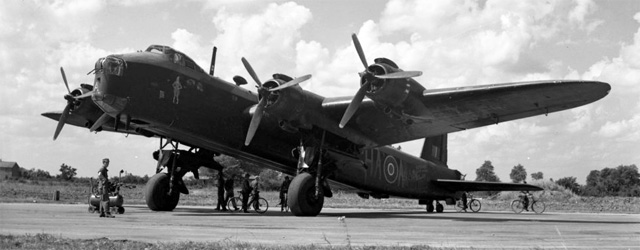
The Short Stirling
Image courtesy of www.flying-tigers.co.uk
Late on the next day, 25 July, he and his crew of six took off in Stirling Mk.III EE892 AA-F with nineteen other aircraft for a bombing raid on Essen. The mission was successfully completed but Michael’s aircraft came down in the sea off Southwold, Suffolk, while returning to base. Eyewitness reports indicated that the Stirling was on fire before it struck the water. All on board perished. Four bodies, including Michael’s, were picked up by the Aldeburgh lifeboat crew.
Michael is buried in Worcester Park (Cuddington) Cemetery. His parents took the option of adding a personal inscription to his headstone on Grave L.1273,
“One of the Few.”
For reasons yet to be discovered, he is also remembered on the WW2 Memorial Panel in St Mary’s Church, Sunbury-on-Thames.
Roger Morgan © 2018
Please contact us if you have information or pictures that can extend this entry.
ASHLING, Oliver Charles. Private (6289356)
5th Battalion, The Buffs (Royal East Kent Regiment)
Died 3 July 1940, Age 20
Not listed in the Book of Remembrance
Oliver was born in Kent in Q3 1919, the first of eight children born to Alfred O Ashling and Dorothy (née Veasey – they married Q3 1918, registered in the Elham District of Kent, between Folkestone and Canterbury).
The September 1939 Register records the family living at 5 Morrison Road, Folkestone. 46 year old Arthur is listed as “Hardware Stores Manager” and 44 year old Dorothy with “Household Duties”. There are eight other records at the address, seven of which are currently closed. But these are doubtless their eight children – including the 18/19 year old Oliver, since the open record is their third child (13 year old Gladys – who died in 1991), third in sequence of the records after the parents. At some point during WW2, the family moved to 11 Ewell Bypass – hence the Commonwealth War Graves Commission’s post-war records noting that the parents were “of Ewell, Surrey”.
Oliver’s WW2 service was in the 5th Battalion of Royal East Kent Regiment, known as “The Buffs”. The Battalion was sent to France in 1940 in a support role to the British Expeditionary Force. Following the unexpectedly rapid German invasion in mid-May 1940, the Battalion was quickly pressed into front-line action – not least in the fighting retreat to Dunkirk and the 27 May to 4 June evacuation.
There were many losses during the retreat. These included Oliver who was injured and taken prisoner. He died – presumably of his injuries – as a PoW on 3 July 1940, and buried locally. In 1946, he was one of 165 WW2 casualties brought in from various sites for reburial in the London Cemetery and Extension, Longueval, in NE France. This is the third largest cemetery on the Somme with 3,873 WW1 burials (3,114 of them unidentified). The 165 WW2 burials are in one central plot at the extreme end of the cemetery, behind the Cross of Sacrifice.
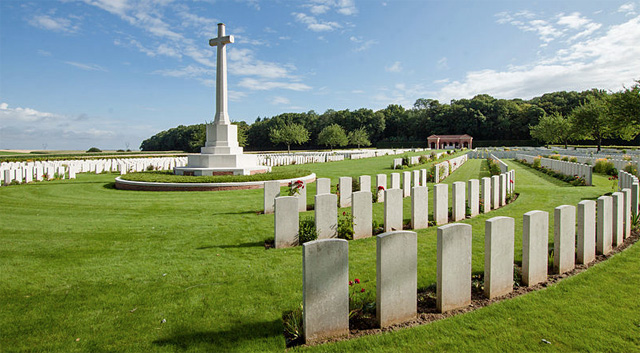 The London Cemetery and Extension, Longueva
Photograph via Wikimedia Commons
Oliver’s parents took the option of adding a personal inscription to his headstone on Grave 13.E.20,
“Parting is bitter pain but courage bids us struggle on until we meet again.”
Roger Morgan © 2018
Please contact us if you have information or pictures that can extend this entry.
ASTON, Harold Withall, TD. Pilot Officer (83051)
Royal Air Force Volunteer Reserve
(who also saw Army service during WW1)
Died 10 January 1941, Age 56
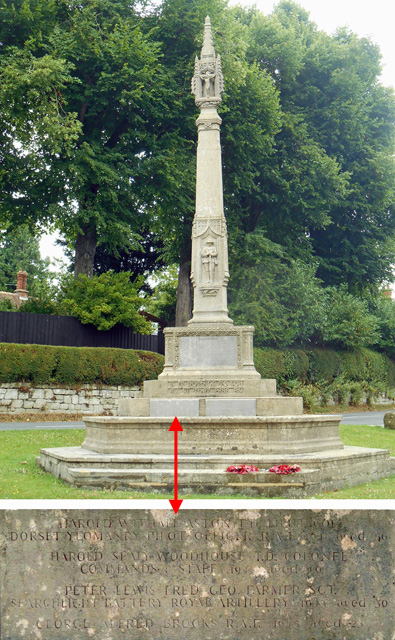
The War Memorial in Iwerne Minster, Dorset
Main photograph with thanks to Mr C E Moreton via War Memorials online
Detail of the relevant WW2 plaque with thanks to Lost Ancestors
This series of articles on the Borough’s WW2 casualties results from a major exercise which began in 2017/18. The initial aim was to cover all names on WW2 memorials in the Borough, but it was then discovered that the Commonwealth War Graves Commission’s records listed more than as many again who had some connection with the Borough and they were also brought into the project.
The Commission’s records give no indication of Harold’s direct connection with the Borough over most of his first quarter century. The link came to light only in mid-2021 when, in researching for an article about Alfred Aston (a person of some local significance in late Victorian and early Edwardian times), I stumbled across the fact that his son, Harold, was noted as a WW2 casualty in the Commonwealth War Graves Commission’s records (in which the only geographical reference is to his later home in Iwerne Minster, Dorset). This article is therefore a very late addition to the 630+ others in this series.
Harold was born in London on 29 September 1884, the third child of Stockbroker Alfred Withall Aston and Frances Amy Aston (née Hennell) of 41 Bryanston Square. He was baptised at St Mary’s Church, Marylebone on 10 November 1884. About a year later, the family moved to West Hill Lodge – a grander house than its name suggests – on West Hill, Epsom. (The house was demolished in 1959 and the homes around 35 West Hill were built on its site.) The family attended the nearby Christ Church Epsom Common at which, by 1887, Alfred was already serving in the significant post of Churchwarden.
The 1891 Census records the family at West Hill Lodge. 39 year old Alfred is listed as “London Stock Exchange Dealer”. His wife, Frances, was aged 32 and their three children were: 10 year old Dorothy; 9 year old Norman; and 6 year old Harold. They had four visitors staying with them on Census day, and the prosperous household was supported by seven domestic servants.
On 7 May 1895, the couple’s fourth child, May, was born. She was baptised in Christ Church on 1 June that year, and it is a measure of the close friendship that Alfred had developed with Lord Rosebery (a regular worshipper at Christ Church) that May was given the second name of Primrose, Lord Rosebery’s family name.
Shortly after that, the family moved to the grander house of Woodcote Grove in Chalk Lane, Epsom which Alfred leased from Lord Rosebery. Son Norman started attending Eton College, followed a few years later by younger brother Harold. Tragedy struck in 1900 with the death of 17 year old Norman at Eton on Good Friday 1900, for whom the parents commissioned a splendid memorial in Christ Church.
While the 1901 Census recorded Harold’s parents (with Alfred now listed as “member of the London Stock Exchange, Gentleman, JP”) and two sisters (in the case of just-married 20 year old Dorothy together with her Stockbroker husband Francis Worthy) – all supported by seven servants and a coachman – at Woodcote Grove, 16 year old Harold was recorded as a boarder at Eton College.
After Eton, Harold studied at Christ Church College, Oxford. As his father (Warden of the Worshipful Company of Skinners) had long been a Freeman of the City of London, Harold was able to claim the same right by patrimony and was duly elected as a Freeman of the City of London as a member of the Skinners Company on 19 April 1906.
On 28 July 1906, Harold was commissioned as a 2nd Lieutenant in the Surrey Yeomanry (Queen Mary’s Regiment) but had resigned the commission well before 8 November 1910, when the 26 year old Harold married 24 year old Evelyn Langham Reed in St Thomas, Portman Square, Mayfair. The register entry notes Harold’s address as his parents’ Woodcote Grove, Epsom and, indeed, the marriage service was conducted by the Revd Archer Hunter, Vicar of the family’s Christ Church Epsom Common. Harold’s “Rank or Profession” was noted as “Gentleman” – as was that of his and Evelyn’s fathers.
The newly-wed couple made their home at The Red House, 11 Bell Street, Sawbridgeworth, Hertfordshire where they (both of “Private Means”) were recorded in the 1911 Census, supported by three domestic servants. They later moved to their long-term home Orchard House (sometimes apparently called “Preston House”) in Iwerne Minister, Dorset.
On 6 August 1914, two days after Britain joined the escalating conflict now known as the First World War, Harold was commissioned as a 2nd Lieutenant in his former Surrey Yeomanry (Queen Mary’s Regiment) and was appointed to the command of 3 Troop, B Squadron 1/1st Regiment. On 17 January 1915, he embarked for France with his regiment on board the SS Kingstonian, landing at Le Havre the following day. He saw service in both France and the Balkans. On 14 June 1918, six months before the Armistice, Harold was promoted to Captain.
After the war, Harold transferred to the Queen’s Own Dorset Yeomanry with the rank of Captain on 2 September 1920 and, on 14 April 1921, transferred to 4th Battalion Dorset Regiment – from which he resigned on 6 July 1921. On 31 March 1922, he was re-appointed to the 94th (Somerset & Dorset Yeomanry) Field Brigade, Royal Field Artillery as a Captain, and was promoted to Major on 30 September 1922. He was awarded the Territorial Decoration on 13 January 1928. On his 52nd birthday (29 September 1936), he retired from the service with the rank of Major.
The September 1939 Register records the couple – who never had any children – at Preston House, Iwerne Minister, Dorset, supported by a couple of domestic servants. As for the 1911 Census, both are listed as being of “Private Means”, although other records show that Harold was an Underwriter at Lloyds of London.
On 2 July 1940, the 55 year old Harold was granted a commission as a Pilot Officer (obviously in a non-flying role) in the Royal Air Force Volunteer Reserve. While that was for the duration of hostilities, he died only six months later – on 10 January 1941, in the Military Hospital, Douglas, Isle of Man. His body was taken home for burial in the churchyard of St Mary’s, Iwerne Minster. The funeral was reported in the Western Gazette of 24 January 1941 which noted that he had died “after a short illness.”
Harold is commemorated on the war memorials at Eton College, Lloyd’s of London and, as shown at the head of this article, at Iwerne Minster on one of the two WW2 plaques added to what was originally the WW1 memorial. The wording of Harold’s entry (which is first – but by virtue of the date of death rather than alphabetical order) is:
HAROLD WITHALL ASTON, LIEUT. COL.
DORSET YEOMANRY, PILOT-OFFICER R.A.F. 1941, aged 56
He left an estate valued at £14,044, of which the widowed Evelyn was an executor. She remained in Iwerne Minster, dying (in Poole General Hospital) on 6 January 1966, just short of her 80th birthday. Her estate was valued at £17,572.
Roger Morgan © 2021
(with special thanks to Christ Church, Oxford’s “Fallen Alumni” page for many of the service career details)
ATKINSON, Trevor Marsh. Apprentice
SS Berwickshire (Glasgow), Merchant Navy
Died 20 August 1944, aged 20
Unusually, the Commonwealth War Graves Commission database gives no family background for Trevor – nor even his age when he died.
However, other research has found that Trevor was born in Croydon on 12 March 1924 and was thus, as noted above, 20 when he died. He was the second child and only surviving son of Richard Atkinson and Bessie, née Russell – they had married in Croydon Q3 1920. The couple’s first child, Richard (after his father) Norman Atkinson was born in Croydon in Q3 1921 but, sadly, died in Q2 1928 shortly before his 7th birthday. The death was registered in the Epsom District, but the child’s burial in the Morden Cemetery suggests that the family were living at “Dunrobin” (later No 4) Langley Avenue, Cheam (which came within the then Epsom District) at which the parents were recorded in the Electoral Rolls for 1930-34. Shortly after young Richard’s untimely death, the couple’s last child, Theresa June Atkinson, was born in Q3 1929 – also registered in the Epsom District.
The family then moved into the Borough. The Electoral Rolls in 1936 and 1939 record the parents at “Purbeck” (later No 2) Longdown Lane North, Epsom – which is where the September 1939 Register records the parents (with Richard as a “Builder & Contractor”), now in their early 40s. Their names are followed by a currently closed record which, assuming the 15 year old Trevor was already apprenticed in the Merchant Navy, will have been his 10 year old sister June. At some point during WW2, the family moved to Port Gaverne on the north Cornish Coast – and, except for a brief return to Surrey shortly after the war (minus, of course, Trevor) remained based in North Cornwall for the rest of their lives.
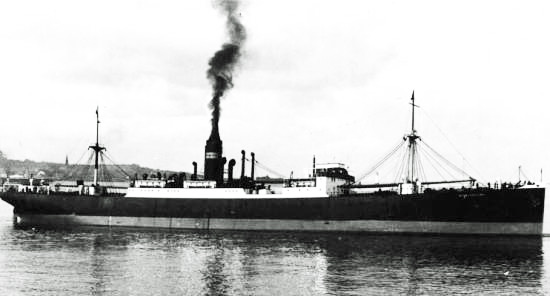 The SS Berwickshire
Photo courtesy of the Allen Collection
(via uboat.net, from which also came the details below)
During WW2, Trevor served as an apprentice on the cargo ship SS Berwickshire. In August 1944, the ship was part of Convoy DN-68 en route from Liverpool to Tamatave (in Madagascar) via Durban. She was carrying 6,000 tons of general cargo and a deck cargo of 70 tons of high octane motor spirit in drums.
About midway between Durban and Tamatave, the SS Berwickshire was torpedoed and sunk by German U-boat U-861. Eight crew members – including Trevor – were lost. The master, 82 crew members and eleven gunners were picked up by the escort ship HMS Norwich City and landed at Durban.
Trevor is commemorated on the Tower Hill Memorial as one of nearly 24,000 merchant seamen who were WW2 casualties and have no known grave. In addition to his inclusion in the Borough’s Book of Remembrance, he is commemorated on the WW2 Memorial of Port Isaac (which also includes those from the adjacent cove of Port Gaverne). Local records there have Trevor’s address as “Hillside, Port Gaverne” and his father’s residence as “103, Grove Road, Sutton” – where, indeed, he is recorded in the 1945 Electoral Roll.
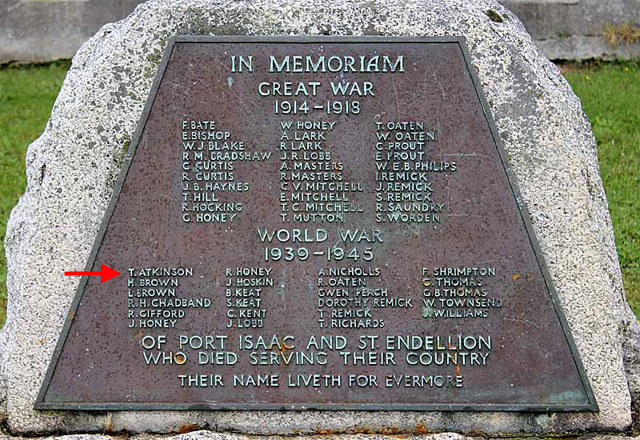
Trevor’s mention (arrowed) on the Ports Isaac/Gaverne War memorial.
Photograph with thanks to Port Isaac Heritage
The 1946 Electoral Roll records both parents back at their pre-war home of 2 Longdown Lane North, Epsom. This was perhaps to finalise the sale before returning to Port Gaverne, where they lived at “The Moorings” – perhaps the re-named “Hillside”. In Q4 1957 and registered in the Bodmin District, daughter Theresa (always known by her second name of “June”) married Martin Anthony Pengelly and moved to Chapel Amble (and perhaps the farm at nearby Middle Amble which, at the turn of this century, was being farmed by their son). Chapel/Middle Amble is about 4 miles south of Port Gaverne, where her parents remained at “The Moorings”. June’s mother, Bessie, died there on 6 June 1972. The widowed Richard moved to Middle Amble where he died on 19 July 1973.
Roger Morgan © 2020
Please contact us if you have information or pictures that can extend this entry.
AUSTEN, Kate Dorothy. State Registered Nurse
Civilian
Died 21 March 1946, aged 55
Not listed in the Book of Remembrance
Dorothy was born on 24 February 1891, apparently the fifth of six children born to William George Austen and Emma Elizabeth (née Elmore – they had married in Walmer, Kent, on 22 May 1882). She was baptised on 28 June 1891 at St Luke’s, Ramsgate. The 1911 Census records the six children living at 5 Dane Road, Ramsgate with their widowed 40 year old father, listed as a domestic gardener.
Kate (who never married) qualified as a nurse. The September 1939 Register records her as 2nd Assistant Matron at the Orpington Hospital. This had been built in 1915/16 as a military hospital and, after WW1, was taken over by the then Ministry of Pensions to provide treatment and care for a thousand disabled ex-servicemen. It later became the Orpington Hospital, a municipal general hospital for the local population. However, during WW2 it became an Emergency Medical Service Hospital – and received many evacuees from Dunkirk at the end of May, 1940.
The readily available records do not show when Kate moved from Orpington to the Queen’s Road Homes in Croydon. These had been a workhouse which, when taken over by Croydon Borough Council in 1930, were renamed the “Queen’s Road Homes” after their location. They continued in use as a home for the destitute in which workhouse conditions prevailed until WW2. Under the Emergency Medical Scheme, they then became a Class 2 hospital for war casualties.
The cause of Kate’s injuries on 19 February 1944 may well have been the high explosive bomb that, late in WW2, destroyed part of the southern wing of the Homes. Kate was taken to the Emergency Hospital at Horton – one of Epsom’s cluster of mental hospitals that, as for WW1, had been taken over to deal with military and civilian wartime casualties. Over a year later, she died there on 21 March 1946.
The Commonwealth War Graves Commission notes Kate as being “of 30 Dane Road, Ramsgate, Kent”. However, the 27 September 1946 record of Probate on her £670 estate being awarded to her brother (Edgar Ernest Austen, a trawler skipper) lists her as being “of 9 Dane Road, Ramsgate.” Both addresses are only a few doors away from her childhood home at No 5.
Roger Morgan © 2018
Please contact us if you have information or pictures that can extend this entry.
AYLING, Alfred
 Alfred’s entry in the Borough’s Book of Remembrance
Image courtesy of Clive Gilbert © 2014
Alfred’s entry in the Borough’s Book of Remembrance is one of only two among its 342 names to give no indication of the person’s service (or, in the case of civilian casualties, to note the cause of death as “Enemy Action”). The other instance is Eric Hutchins, but material found in the Commonwealth War Graves Commission’s database and researched elsewhere has enabled Eric’s story to be properly told.
Sadly, that is not the case for Alfred. The Commonwealth War Graves Commission’s database lists two Alfred Aylings, neither of whom has yet been found to have any connection with the Borough. They are:
- Alfred Charles Ayling, the 10 year old son of Alfred and Lucy Ayling of Flatworth Cottages, Petworth, Sussex – one of the many who died in the 29 September 1942 bombing of Petworth Boys’ School (see the PS below for details of that tragedy); and
- Alfred Douglas Charles Ayling, Stoker 1st Class (P/KX 121007) on HMS Cornwall, Royal Navy, who died on 5 April 1942, aged 24. He was the son of Frederick and Beatrice Ayling; and husband of Ada Ayling, of Peckham, London.)
During the WW2 years, the GRO recorded only three deaths of individuals named plain “Alfred Ayling” (ie with no middle name). The one whose death on 10 January 1945 was registered in the adjoining Surrey North-Eastern District initially seemed a possibility for the person mentioned in the Borough’s Book of Remembrance, but further research established that this 88 year old farmer had died of natural causes at his home of Little Heath Farm, Oxshott.
And no link with the Borough has yet been discovered about the other two, who were:
- a 64 year old painter and decorator whose Q1 1942 death was registered in Wandsworth; and
- a retired and widowed 79 year old farmer of Loxwood, Sussex who died on 24 August 1944.
And, in any event, none of these three plain “Alfred Aylings” are in the Commonwealth War Graves Commission’s comprehensive list of WW2 military and civilian casualties.
Another possibility is that, somewhere along the way of compiling of the Borough’s Book of Remembrance, there was some transcription error. If that was the case, then the intended individual will have been picked up in our trawl of the Commonwealth War Graves Commission’s database in which we picked up many WW2 casualties connected to the Borough who were not listed in the original Book.
Roger Morgan © 2020
Please contact the Webmaster if you know of the intended Alfred Ayling connected to the Borough and can thus help build a proper entry for the individual listed in the Borough’s Book of Remembrance.
PS (to the entry for Alfred Ayling): The 1942 bombing of Petworth Boys’ School
(Incident details with thanks to gravelroots.net – where photographs of the bomb damage and the mass funeral can be found.)
In mid-morning on Tuesday 29 September 1942, a lone German bomber, approaching from the south, aimed its bombs at Canadian troops (of the Toronto Scottish Regiment) encamped in the grounds of Petworth House. All missed their intended target, falling instead on the Petworth Boys’ School near the junction of North Street & Horsham Road.
There had been no air raid warning and, of the 80 children at school that day, 28 were killed and many others were injured. The explosions also killed the headmaster, one of the teachers and someone working in the nearby laundry.
Almost all the casualties, including 10 year old Alfred Charles Ayling, were buried in a mass grave in the nearby Horsham Road Cemetery.

Main picture: The mass grave for the victims of the 29 September 1942 bombing.
Inset: Young Alfred Ayling’s memorial plaque on the kerb of the mass grave.
Photographs with thanks to “wertypop” via findagrave.com
Please Note: We believe that the information on this page is accurate however users should satisfy themselves that the information is correct before incurring any expense or undertaking any journeys. This is particularly important when purchasing certificates from other bodies, for example the General Register Office. You might like to use the following links to Freebmd and Find My Past (Links open in a new window).