
A surprise glimpse into 1883
Out of the blue, Christ Church Epsom Common was recently approached by a Worcestershire-based bookseller and gratefully accepted her kind gift of a bound volume (about the size of a modern paperback) of parish magazines from 1883. (The volume was an item in a recently acquired old library, but was far too battered – not to mention rather too niche – for resale.) As discussed below, the contents provide a fascinating insight into the life of Christ Church just seven years after its consecration in 1876.
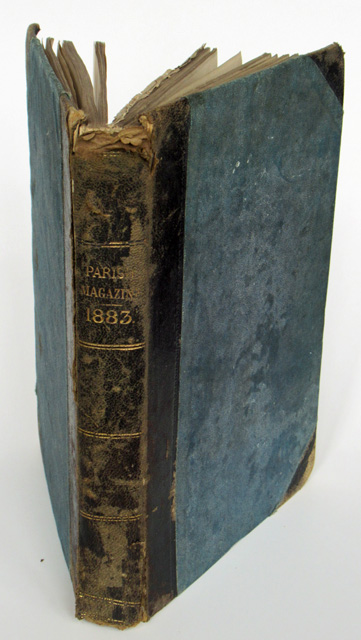 The volume of Christ Church’s 1883 parish magazines.
Photograph by Roger Morgan © 2022
(There were Christ Church parish magazines before this: the January 1883 edition refers to an item in the now-lost December 1882 magazine. Magazines seem ephemeral at the time and, although published monthly, the next edition in the Christ Church archive dates from 1900. The collection is then very patchy until the late 1940s, after which there was a concerted effort to retain copies for future reference – and they have proved valuable on many occasions.)
Both the gold-stamped spine and the volume’s frontispiece (below) give the contents as “Parish Magazine 1883” with no mention of the parish name.
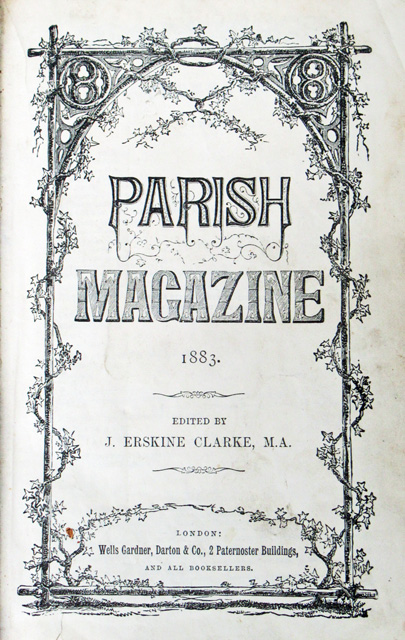 The volume’s frontispiece
Photograph by Roger Morgan © 2022
The frontispiece names the editor as J Erskine Clarke MA. As noted in the Wikipedia article about him, he was an Anglican clergyman who, in January 1859, started the world’s first commercial parish magazine inset, prosaically named just Parish Magazine. Each month’s edition was of about 24 pages. In addition to overtly religious matters (such as short sermons and Bible studies), there was much secular material. The latter included: fiction (albeit of a moralising nature); notes on various practical matters; articles on British wildlife; and descriptions of interesting churches and other places at home and abroad.
Examples from the twelve 1883 editions include: “First Aid to the Sick”; “Making a Will”; a visit to Malta; a surprisingly open-minded piece about Islam and the Prophet Mohammed; and the intriguing “Worms and their Habits”. Each edition had at least two engraved illustrations (such as the one shown below), mainly to accompany the travel-related items.
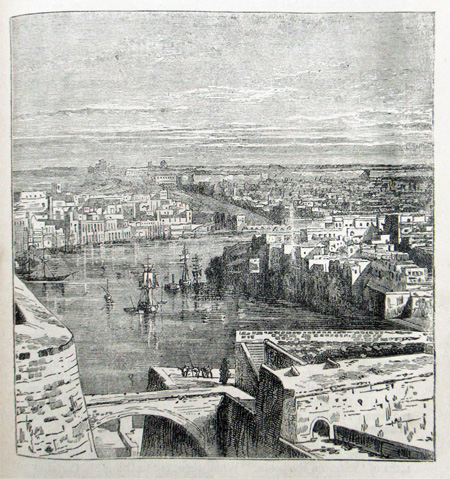 Engraving of the Grand Harbour of Valetta, Malta from page 16 of the July 1883 edition
Photograph by Roger Morgan © 2022
The inset’s publishers were Wells Gardner, Darton and Company of 2 Paternoster Buildings, London (alongside St Paul’s Cathedral) who specialised in ecclesiastical publications – subsequently branching out into children’s publications, among which was the Revd J Erskine Clarke’s later Chatterbox magazine. The insets were printed by Strangeways & Sons of Upper St Martin’s Lane.
Clarke’s Parish Magazine was always intended as an “inset” for subscribing parishes (which were sent copies of each instalment) to surround with their own material. In the case of Christ Church, this local material was normally another 8 pages – printed (and bound with the inset) by local firm L W Andrews & Son. In some months, Christ Church’s own material ran only to 4 pages: in those instances, the usual rather plain cover (as on the left below) was changed (as on the right) to maximise the available space.
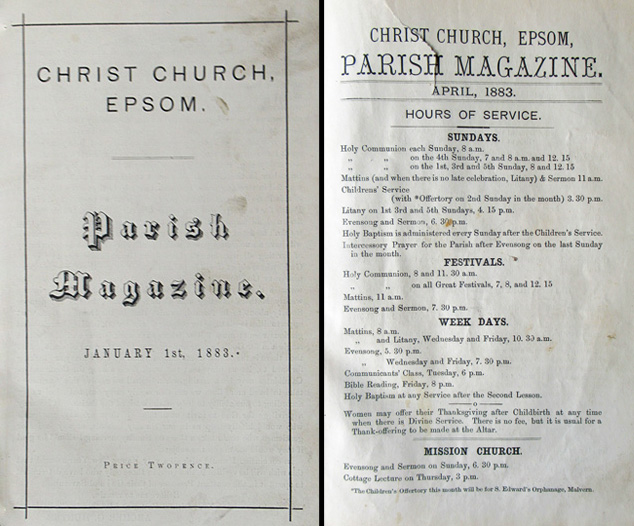 The front pages of the January and April 1883 editions
Photographs by Roger Morgan © 2022
The price parishioners paid per issue was 2d. – about £1 at today’s prices.
Much of each month’s local pages was routine. The schedule of Services over the coming month (not only Christ Church’s three Sunday services but also the Wednesday and Friday Mattins and Evensong plus the Sunday evening service at the little Mission Room – later replaced by St Michael’s, which closed in the 1950s – in Woodlands Road) also itemised all the hymns to be sung.
There were lists of baptisms, marriages and funerals, followed by a standard notice that “Women may offer their Thanksgiving after Childbirth at any time there is Divine Service. There is no fee, but it is usual for a Thank-offering to be made at the Altar.” Also recorded were details of the previous month’s collections.
Christ Church did not have its own Church Hall until 1899. Pending that, other places had to be found for meetings and events. The notice of forthcoming events in the January edition lists Christ Church meetings to be held in the Vicarage, the Working Men’s Club, “the Infant School” and “the Guild Room”. The absurdly grandiose Vicarage (demolished and replaced in 1938) was just across the road from the Church and the Working Men’s Club – which opened in 1881 (and, much later, was re-named the Epsom Common Club) was just across Stamford Green
The now-lost “Infant School” was on West Hill (at the time, called Clay Hill). Thanks to an 1844 endowment by Miss Elizabeth Trotter of Horton Manor (renowned as “founder of the Christ Church parish”) O’Kelly’s racing stables were converted for use as an Infant School for the benefit of families on Epsom Common. The school closed in 1925 and was later demolished. Three houses were built on its footprint – see the “before and after” pictures below.
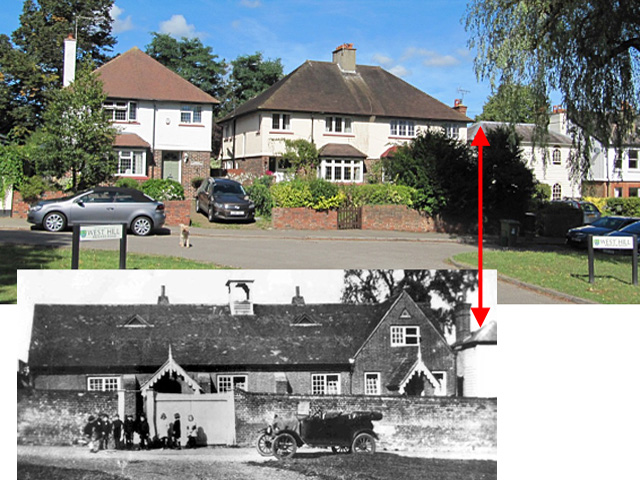 Main image: West Hill today (Photograph by Roger Morgan © 2022)
Inset: the now-lost Infant School (Photograph with thanks to Bourne Hall Museum)
Thanks to Charman’s reminiscences of Epsom, the “Guild Room” (the 1882-83 rental for which was recorded in the May edition as £12 10s.) can confidently be located in what is now 6-8 West Street.
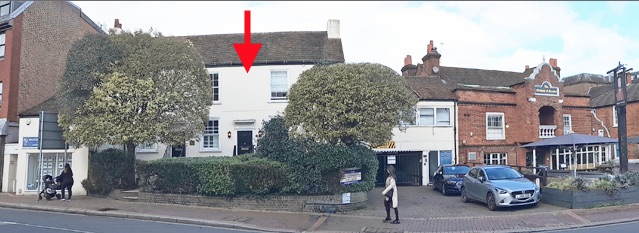 The location of Christ Church’s 1880’s “Guild Room”.
Photograph by Roger Morgan © 2024
The last routine item worth mentioning is the short item about the “Penny Bank”, being:
Deposits from One Penny and upwards may be made every Monday at the Vicarage at 12 o’clock and money may be withdrawn on giving a week’s notice.
All Adults are invited to join and children under 14 may become depositors if they are members of Christ Church Sunday School.
Interest will be allowed at the rate of 2½ per cent., and to Children attending Christ Church Sunday School 5 per cent.
The January 1883 issue opened with a letter from the Vicar, the Revd Archer Hunter, who was barely a year into his 30-year incumbency at Christ Church. Having set out his vision for developing the still relatively new parish, he turned to current needs which (plus ça change) included a plea for more Sunday School teachers. He concluded by wishing “all a very Happy New Year” but with the no-nonsense qualification “assured that this wish will be verified in those and in those only [emphasis not in the original] who have determined to spend it in the constant Presence of their God and Saviour.”
Under the heading “Dickens’ Christmas Carol” (a book published only 30 years earlier), the February edition included the following report which suggests that Victorian children were heard as well as seen.
“Mr Mechelen Rogers gave a recitation the above Carol in the Infant School room on Monday, January 22nd, before a large audience, composed of many of our more influential parishioners, and the elder children in our Sunday Schools. If certain members of the audience were not amused perhaps it was owing to the touching Carol, certainly most admirably given by Mr Rogers, being a little beyond them – all qualified to give an opinion have spoken in the highest terms of Mr Rogers’s recitation and we will promise him if he comes among us again, as we heartily wish he may, an enthusiastic and noiseless [emphasis in the original] reception.”
The March edition recorded the 26 February founding of a parish branch of the Church of England Temperance Society at a meeting of 37 parishioners who unanimously adopted the following resolution.
“That this Meeting recognises the widespread sin of Intemperance to be the fruitful source of Poverty, Crime and Irreligion, and believes that such an association as the Church of England Temperance Society will be a likely means, in God’s hands, of helping to reclaim the drunkard, discouraging drunkenness and of guarding the young from that insidious and fatal habit. This meeting therefore agrees to form herewith a Branch Society in this Parish.”
All present signed pledges either for total abstention or to promote the Society’s aims by both “effort and example”. A third available option seems something of a fudge by undertaking to “refrain from the use of all intoxicating drinks, as beverages, except at mealtimes.” The May edition noted that membership had grown to 61 (of whom 30 were total abstainers) and recorded the inauguration of the Juvenile Branch with a membership of 70. The August edition records the Branch’s first excursion, with 74 people having enjoyed some 10 hours in and around Hampton Court on Tuesday 3 July – the 1¼ hour journey each way being in 4 horse-drawn wagonettes.
Also in the March edition was an itemised list of “Our Wants”, being:
- Sunday School Teachers, especially Gentlemen;
- a Parish Bier;
- Bookcase and Books for the Parochial Library; (and see the surprise in the final paragraph below)
- New Stop for Organ.
The need for the bier was explained in the following terms: “Our parish being so far away from the cemetery and the majority of our dead being at present borne to the grave on men’s shoulders, it is suggested that a bier should be provided for the better and more easy conveyance of the dead.” (Epsom Cemetery – a walk of some 2 miles from Christ Church – had been opened in 1871.)
The bier was subsequently procured – with the £35 cost being partly defrayed by a collection on Good Friday, 23 March (which, according to the April edition’s summary of the previous month’s collections, had yielded £1 3s. 2d. – meticulously recorded as being made up of 58 coins).
Summary accounts for Christ Church’s year to Easter 1883 were published in the May edition. Total running costs had been £407 13s. Thanks to some large one-off items, there was an in-year deficit of £25 11s. 5d. (Outside these sums were collections for various local and wider good causes amounting to some £185.)
The May edition also reported on a “most amusing entertainment” at the Working Men’s Club. This appears to have been mounted by the Working Men’s Club rather than Christ Church. There will, however, have been quite some overlap in their memberships – not least in that the Honorary Secretary of the Working Men’s Club was Henry Willis of Horton Lodge, who was also a very long-serving Churchwarden at Christ Church. The “entertainment” was a lavish production of Mrs Jarley’s Far-famed Collection of Waxworks, a then popular work by G B Bartlett which expanded on the character who made a brief appearance in Dickens’ Old Curiosity Shop. Bartlett’s work provided Mrs Jarley with amusing descriptions of her various waxworks each of which, appropriately costumed, sprang into life as automata.
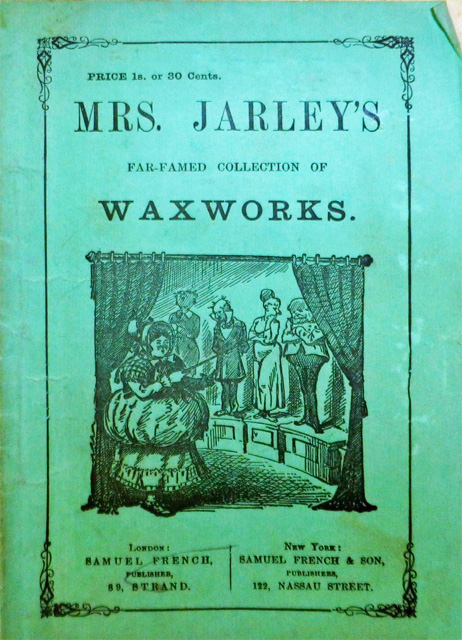 Copyright acknowledged.
In the August edition were brief reports of the Choir’s annual day trip – on this occasion a 16½ hour round trip to Southsea – and of the annual Sunday School treat in the grounds of the Trotters’ Horton Manor.
The October edition included a whole page report (held over from the September edition “for the want of room”) on the Working Men’s Club first “Annual Amateur Athletic Sports” on Thursday 9 August that were held in the extensive grounds of Horton Lodge, home of the previously-mentioned Henry Willis. The report deals with each of the eleven events in some detail, a few of which are:
- the 100 yards race was won by an S Reynolds in what seems the commendable time of 10½ seconds;
- the 220 yards Boys’ race was won by P Langlands (doubtless Percy Langlands) noted as “the biggest 15 years old we have seen”; and
- the host (and Hon Sec of the Club), Henry Willis, was disappointed to be beaten by just 3 yards in the 200 yards Veterans’ Race, thus missing out on the prize of “a handsome spirits basket”.
To continue banging his Temperance drum, the Vicar included in the November edition an item he had found in an 1790 publication, which he noted “may be interesting to many of our readers”. It was – as in the image below – “A Moral and Physical Thermometer; or a Scale of the Progress of Temperance and Intemperance” which listed “Liquors, with their Effects, in their usual order”.
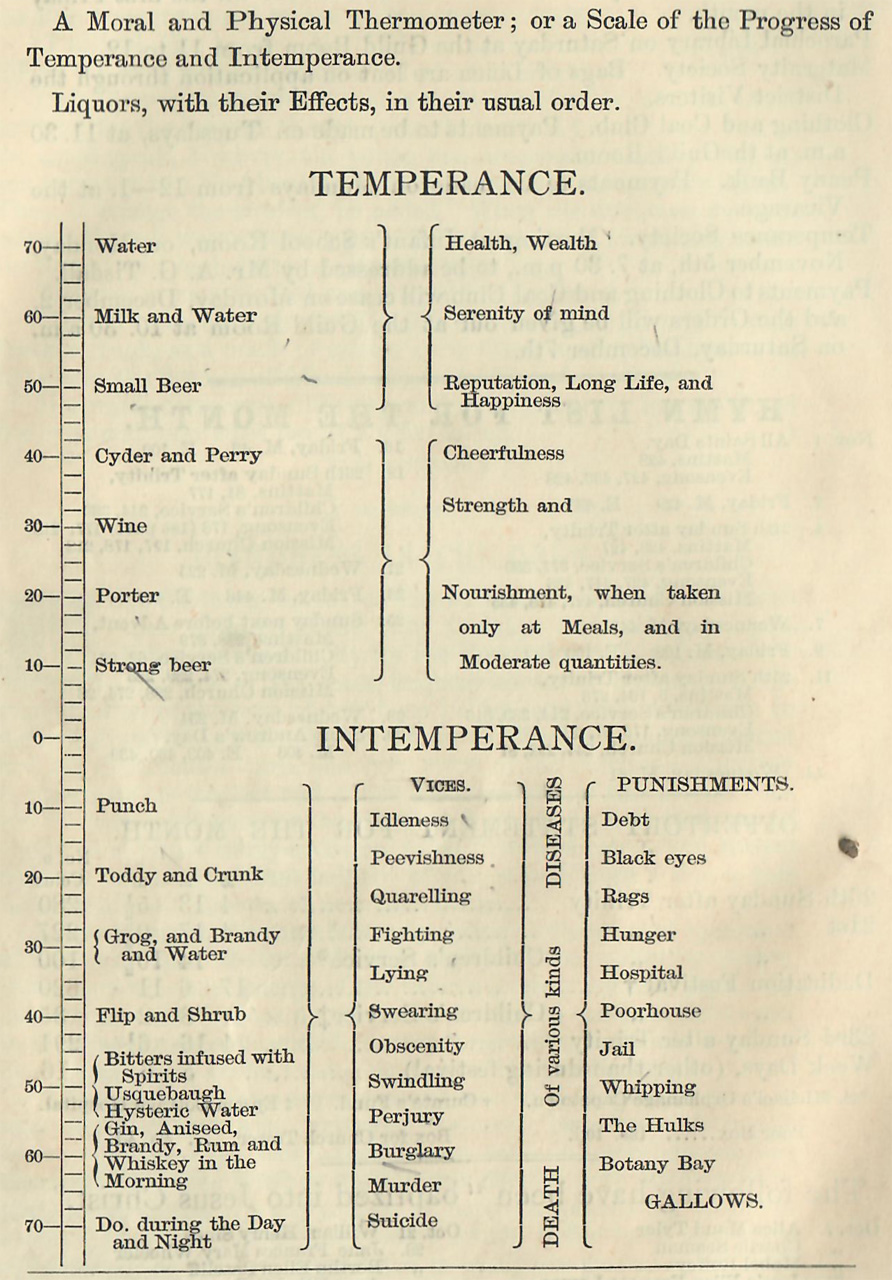 A “Moral and Physical Thermometer”.
Photograph by Roger Morgan © 2022
(Click image to enlarge.)
The December magazine records the first of a series of monthly “Penny Readings” in the Infant School. According to the earliest programme (dated Thursday 17 February 1887) in the archives for these events, they consisted of musical items and readings by and for parishioners in those days without even radio, let alone 24/7 multi-channel TV. Doors opened at 7.30pm for commencement at 8pm. Admission was “Front Seats, 1d. & Back Seats, 6d.”
For those parishes which chose to bind their year’s magazines into a single volume, the national publishers provided a frontispiece (as shown near the top of this article) plus a two page index for their material. The actual binding was a local matter, and a tiny label (about ¾” or 2 cm square) inside the rear cover of this volume shows that is was bound by John Snashall of High Street, Epsom. Although the book is now in a poor condition, it was a good quality binding, with a real leather spine (with gold-blocked title) and corners.
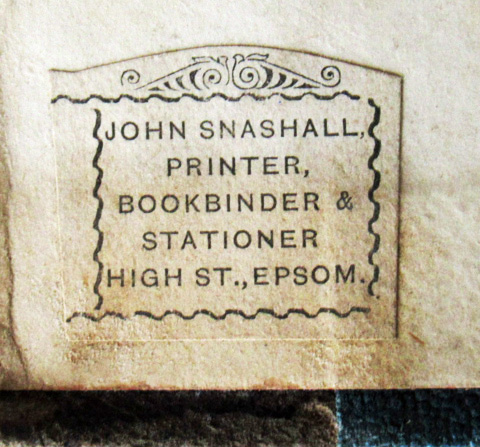 John Snashall’s label inside the back cover.
Photograph by Roger Morgan © 2022
I noted above that one of the items in the March edition’s list of “Our Wants” was “Bookcase and Books for the Parochial Library”. It is therefore exciting to find inside the front cover a label (as below) showing that this very volume had been an item in that library, the handwritten “436” presumably being its reference number. The volume’s poor state is testament of its heavy use – presumably more for the general interest “inset” pages that the essentially ephemeral local material.
 The Christ Church Library Rules.
(Click image to enlarge.)
Photograph by Roger Morgan © 2022
Roger Morgan © 2022