
St Michael’s Mission Church (1908-1955)
Woodlands Road, Epsom
(a daughter church of Christ Church Epsom Common)
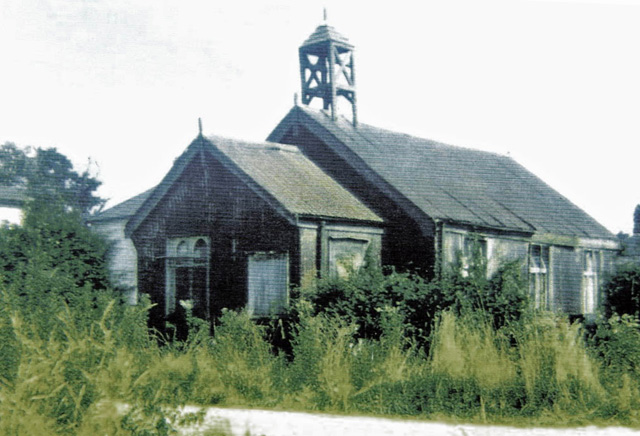
The derelict St Michael’s in the 1960s.
Photograph © Terry Friday, used here with permission.
In about 1880, a “Mission Room” was set up at the east end of Woodlands Road (between the old Epsom Well and the Dorking Road – now the A24) to provide those in the immediate locality with a space for meetings and worship.
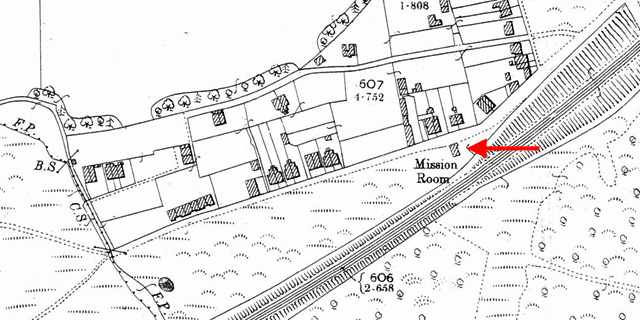
Extract from the 1895 Ordnance Survey map, with the 1880-ish “Mission Room” arrowed.
(Given its 1880-ish date, the “Room” should have been on the OS map published in 1884 – but that map was based on 1866-67 survey data.)
It is not clear to what extent the recently-established parish church of Christ Church Epsom Common was involved in setting up what is assumed to be a wood-framed structure, but it was soon closely involved in the worship held there.
The report by the Vicar (Canon Archer Hunter) for 1894 records that, during the summer months, open air services had been held in the neighbourhood and that a monthly celebration of Holy Communion had been started in Lent.
The parish’s schedule of services for the run up to Easter 1900 included the following fairly full programme for the “Mission Church, Epsom Common”:
• (Wednesday) 4 April – Lantern Service, 7.30pm;
• Palm Sunday (8 April) – Evensong and address, 6.30pm;
• Monday, Tuesday, Wednesday & Thursday – Short service with an address on “The Passion”, 7pm;
• Good Friday – Evensong and address, 5.30pm; and
• Easter Day – Holy Communion, 8am & Evensong and address, 6.30pm.
In 1905, Canon Hunter’s annual report noted that the little church had further quickened into life under the care of Mr Burnett, Lay Reader, and that a small choir had been formed, much to the encouragement of Miss Symes who had toiled on for many years as organist, amid much discouragement.
This was doubtless the spur for Christ Church’s decision to provide the Woodlands Road community with a purpose-built chapel. Land was acquired at the bottom of the hill and a wood-framed corrugated iron “Tin Tabernacle” was erected. In 1908, this was formally dedicated (a step short of the “consecration” that a parish church would get) as St Michael’s.
Notwithstanding that naming, the 1913 Ordnance Survey map (see below) still labelled it as a “Mission Room”, while its predecessor (which had disappeared by the time of the 1933 OS map) was designated as a “Club”.
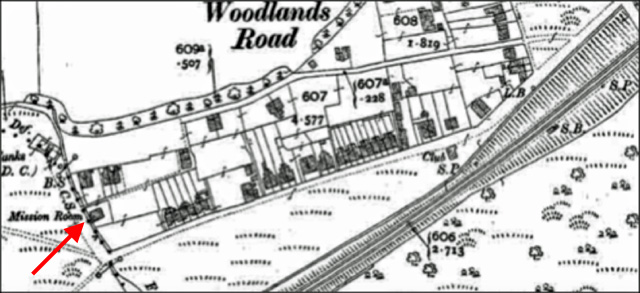
Extract from the 1913 Ordnance Survey map, with the 1908 St Michael’s shown as “Mission Room”.
In 1926, Christ Church celebrated its 50th Anniversary. The history published to mark the occasion concluded with a brief appendix about St Michael’s. This began with the following remarks by Canon Archer Hunter, vicar of Christ Church from 1881 to 1911:
“In telling of Christ Church, the little Mission Church of St Michael must not be left out. It was dedicated in 1908, and took the place of another temporary building, which had been in use both for worship and meetings of various kinds for more than 30 years.
“I do not think the influence that has centred round this little ‘House of Prayer’ can be measured by the size of the building or its accommodation. Whether in the hands of Mr. Neal, or of the late Mr Daniell, or of Mr South, the work has been greatly appreciated; and I must not forget Miss Bradnam’s long and indefatigable work in the musical part of the service.
“The beautiful Altar Piece was the work of Miss Read, who has long since left Epsom.”
The appendix concluded with: “For the last six or seven years, the services at St Michael’s have been conducted by Mr W McIntyre, who has followed worthily in the footsteps of his predecessors and has won appreciation equal to theirs.”
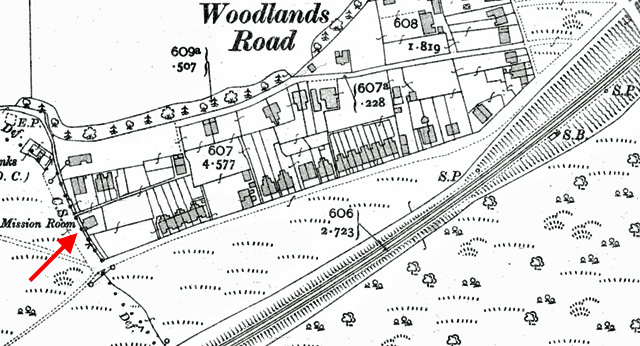
Extract from the 1933 Ordnance Survey map. As in the 1913 edition, St Michael’s is shown as “Mission Room” – but note that the old “Club” building at the top of Woodlands Road has now gone.
The only photograph so far found of St Michael’s as a going concern is in the following 1953 aerial view of the relatively new Wells estate. The original print is about A3 size and the inset image – with St Michael’s at its centre – is a mere 15 mm wide on the original.
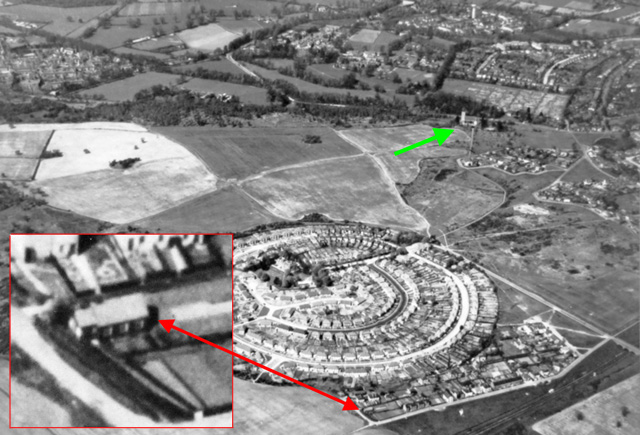
A 1953 aerial view of the Wells Estate and Epsom Common.
Inset is an enlargement of St Michael’s. The parent Christ Church is arrowed green.
That photograph, however, was very near the end of St Michael’s time. As noted in Christ Church’s 1976 Centenary history, “The little church continued for many years, sustained by the valiant efforts of the clergy, lay readers and a loyal band of helpers, but eventually falling congregations and, later on, the disrepair of the building itself caused its closure.”
The disrepair was actually the crunch issue leading to the closure in 1955. (There was a lively Sunday School for which the building provided inadequate space for the numbers attending, and alternative arrangements were made – in, it is understood, Wells House – for their accommodation.)
The essential problem was damp. Letters of the time say: “the building is very damp, inadequately heated, and in spite of many efforts to remedy the trouble, the floor is always wet. A considerable amount of money has been spent on it from time to time but the building has ceased to be usable”; and “the perpetually wet state of the floor makes the building unsuitable and injurious to health.” The building and site was sold for £60 at the end of 1956.
Shortly before the sale was completed, Mrs A Dench of 46 Woodlands Road wrote to Christ Church with the “one shilling (5p) yearly payment for use of the allotment round the St Michael’s Church.” The payment was declined and Mrs Dench was put in touch with the purchaser.
The purchaser did nothing with his purchase for some years – other than, apparently, to sell it on. The building became quite derelict, as shown in the photograph at the head of this article. In 1964, the Borough Engineer wrote to Christ Church saying that his attention had been drawn to the condition of the disused St Michael’s and asking whether it was intended either to demolish the building or put it in good repair. He noted that some of the corrugated iron cladding had rusted through and was on the point of becoming dangerous. Christ Church referred him to the purchaser, but nothing happened for some years: locals recall the building still standing in the early 1970s.
The Christ Church archive includes the following undated photograph.
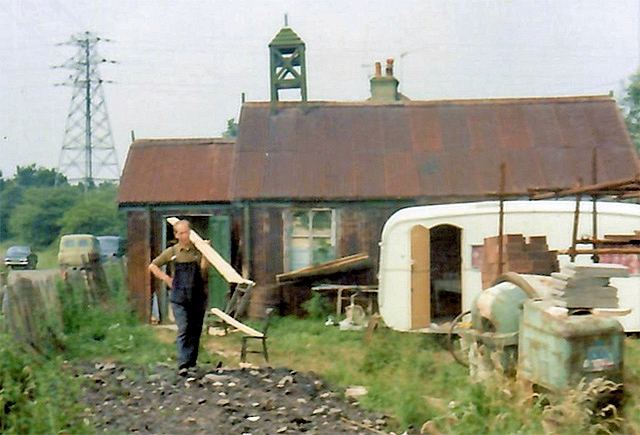 As noted on the back of the photograph, “St Michael’s Church before demolition”.
Photograph from the Christ Church archives.
The photograph seems certain to date from the 1970s and it seems that the building is being used as a store for materials being used in the construction of 42 and 44 Woodlands Road – the latter (as pictured below) being actually on the footprint of the now-lost St Michael’s.

44 Woodlands Road, built on the footprint of the 1908 St Michael’s.
Photograph by Roger Morgan © 2021
Roger Morgan © 2021
Please let us know if you have memories or pictures of St Michael’s