
A Parcel of Land on Epsom Common…
If Only I Could Speak!
As far back as I can remember I was part of a large open area of land, no fences or boundaries, just trees and grass and distant views. I had many owners and came to be called the Lord of the Manor’s Common Waste. In the seventeenth century a brick and tile works were opened to my southeast, this encouraged some unofficial squatting around the brickworks. But life was quiet, and the seasons came and went, until gradually the encroachments started one upon another, and side by side they grew. It was in the time of Mawby and Briscoe that this appropriation accelerated, and many parcels of land were removed from the common waste. They formed three separate areas centred around the brick kilns and although the Manor of Epsom was managed by a steward and a bailiff, the encroachments continued.
In 1838 a map of my area was commissioned, and this began stabilising and ending the land grab, as a record now existed, and boundaries could be checked. Sometimes the boundaries moved but only a little – as they do to this day!
 1838 /1843 Tithe Map plot 997. Cottage and garden, owner John
Ivatt Brisco, occupier Joseph Aptet and others. That’s me!
As was normal at this time, there was much confusion and secrecy existed over who the occupiers were. This suited the squatters as their tenure was questionable and not secure! In my case it was in the year 1834 that George Porter removed me from the common waste, built a cottage and girdled me with a boundary fence. I was so proud; I was now a large individual property with status!
On the 1841 census return you can see that George Porter of Epsom Common, a forty-year-old carpenter and journeyman, was married to Ruth Vint aged 30 and they had one son John Porter aged 13. The Vint family came from East Street, by the Gas Works, and they like George and the Vint family are well recorded in documents from that time.
Twenty-two years after the original encroachment, George Porter went before a Commissioner of Oaths and claimed squatters’ rights. I now became a freehold title. No Court Baron for me!
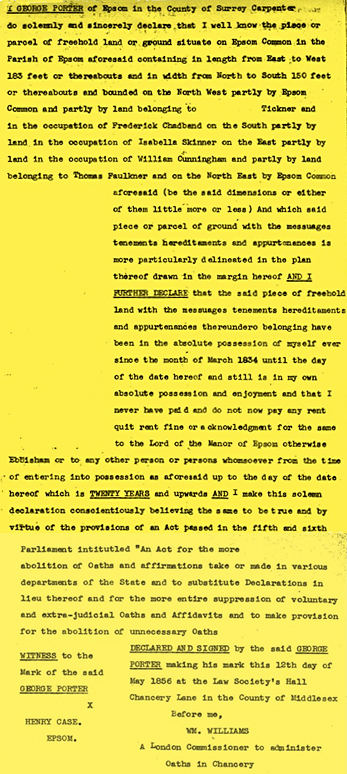 Porter claim to the freehold the parcel of land
 A diagram, not to scale, of the land claimed by George Porter in 1856:
Willow Cottage top left, the future Ede Cottages bottom right. Note my neighbours!
In about 1850 George Porter had added a new pair of single-storey cottages. He also enlarged his original cottage into three. So, now I had five cottages and was a very large parcel of land with had an unequalled view across the common and a pond on the northeast side. Sadly, some subdivision was taking place, and I was no longer sure of who I was.
 The 1866 Ordnance Survey map, with an L-shaped boundary to the plot of land
Then in 1876 my long-term owner George Porter died! He’d had already lost his wife Ruth and son John, so in his will he left all his property on Epsom Common to long-term friends Charles Ede and his family, who were already tenants.
 The will of George Porter
As the will shows, the group of three cottages went to Charles Ede, the small pair of cottages to Maria Harriet Ede (eldest daughter of Charles and Sophia Ede) and the strip of land between their cottages was to be sold for the benefit of Charles Ede’s other children. So started the subdivision – the breakup of what had always defined me!
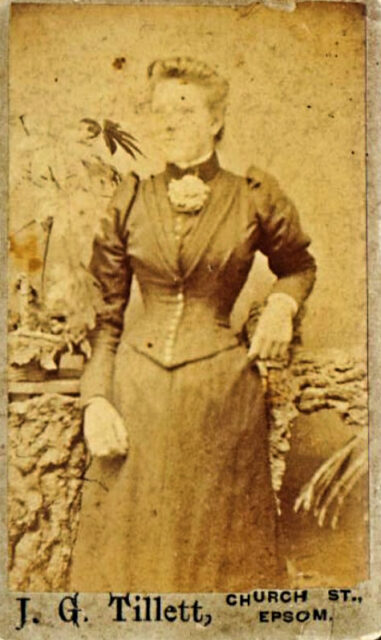 Maria Harriet Grieg née Ede, c.1881,
the beneficiary of George Porter’s two cottages
 The only view (positive on metal plate) of the original cottage built by George Porter,
taken c.1881. Sophia Ede with her daughters, Mary on her lap and Jane Ede to her right
In an 1882 Memorandum of Agreement, James Stuart Strange, Lord of the Manor, granted Charles Ede the use of an area on which to hang clothes to dry. The laundry had begun!
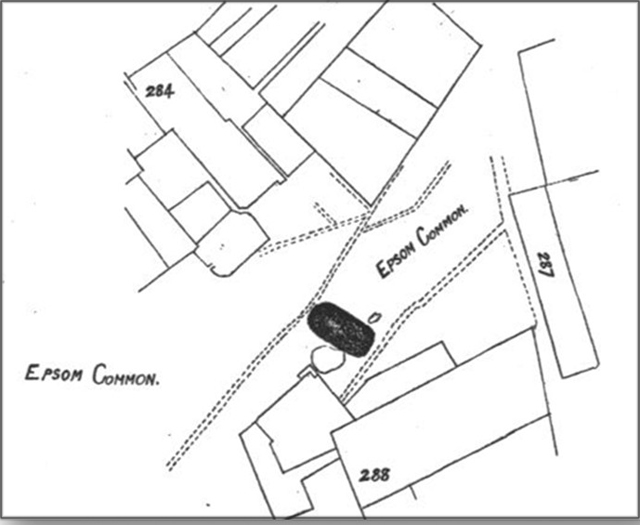
The area of the memorandum of agreement is marked in black, in front of Willow Cottage
The strip of land to be sold for Charles Ede’s children was purchased by Walter Wing and between 1882 and 1890 a semi-detached pair of houses were built there, called Wing Cottages. The design of the houses was determined by the narrow plot which is why the main entrance was at the front, not on the side which was usual at the time. The loft space was used as a further room, and the rear garden access for one house was via the side and rear of the other (involving a right of way). These houses were built for rental income and first appear in the 1891 census.
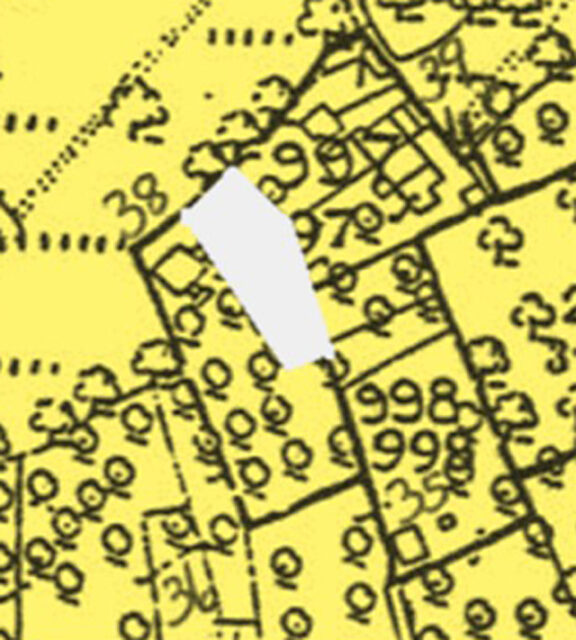 The plot or strip of land sold as instructed in the will of George Porter
In the 1890s Charles Ede demolished the original three timber cottages. They were replaced by a well-built semi-detached pair called Willow Cottages, with a single-storey laundry attached to the north side. The was Ede’s Laundry, for Charles had decided to go into the laundry business.
 1896 Ordnance Survey Map with (from left to right) Edes Cottages c.1850,
Wings Cottages c.1890, the laundry, and Willow Cottages c.1894
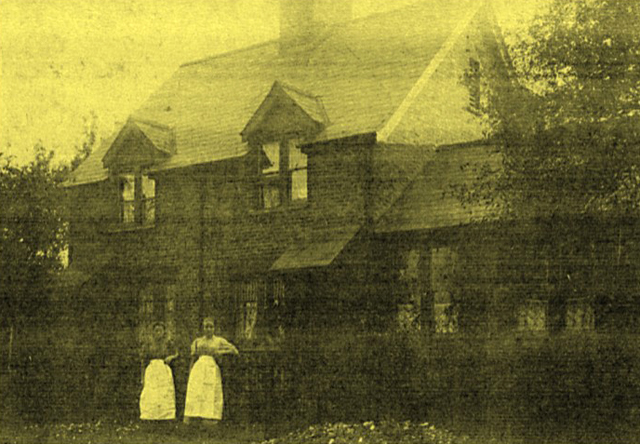 1897c. Willow Cottages with Elizabeth Ede and Mary Ede, daughters of
Charles and Sophia Ede, both working in the laundry
We now have a layout that will persist – the three properties appear on the 1896 Inland Revenue Valuation. Willow Cottages were owned by Charles Ede and occupied by himself and James Risbridger. Edes Cottages were owned by Sophia Ede and occupied by John Murray Grieg and Lucy Skinner (Sophia may have bought them from Maria Harriet Ede, who married Grieg). And Wings Cottages were owned by W.J. Wing and occupied by Henry Wells and James Findley.
On 21st September 1910 Sophia Ede died at Willow Cottage, followed six years later by Charles Ede. According to the probate of his will, which had been made on 16th September 1913, ‘By his will of this date Charles Ede of Willow Cottages, Epsom Common, Epsom, Surrey laundry man gave and devised unto his daughter Harriett Osborn his laundry and house on the laundry site he lived with the yard and garden thereto belonging and testator gave and devised to his daughter Jane Mann the house on the other side in which said daughter (Mary Ann Martin) then lived the same mentioned two houses being called Willow Cottages, Epsom Common. As to all the rest and residue of his estate testator gave same unto and between his said two daughters Jane Mann and Harriett Osborn. The estate was valued at £760 8s 6d.
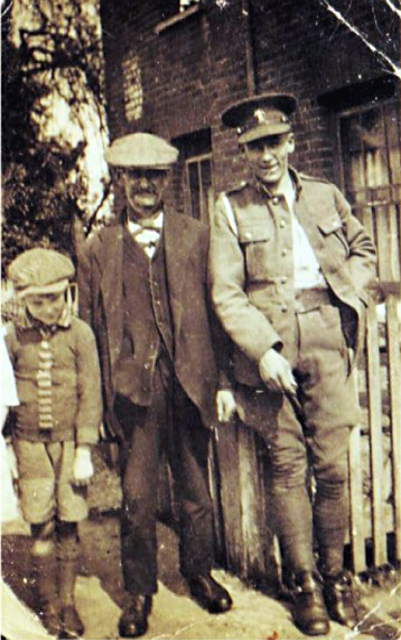 The earliest view of Wings Cottages with the
Pledge family, 1916–18
 Edes Cottages
Things now settled down; Edes Cottages remained in the Ede family until 1946. The redundant laundry and attached cottage also remained with them until 1950, and the other half of Willow Cottages until 1990.
But from the 1950s, big changes took place. The laundry was converted into habitable accommodation and a detached bungalow was built in its garden. We lost Edes Cottages to a pair of houses and Wings Cottages lost part of its back garden to one of the houses. From now on owners and occupiers changed often and each of the older properties would have much in the way of improvements.
 A view of the original L- shaped parcel of land with all the subsequent
developments, c.1974. Note the outline of the original Ede Cottages
 Wings Cottages at left and the houses that replaced Edes Cottages at right, 2006
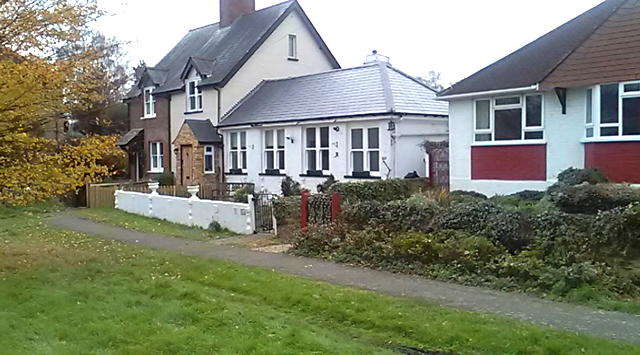 In 2017 all the windows in Willow Cottages and the converted laundry
were replaced in replication of the original sash windows
 A composite view showing Willow Cottages, the converted laundry,
the bungalow and Wings Cottages, 2017
Photographs and documents from the Friday Collection
© Terry Friday, March 2025