
The Rev Dr JOHN HARRIS (1802–1856)
The noted theologian who rose to national fame during his time as
Minister of Epsom’s Congregational Chapel (1825-1837)

John Harris in 1837, the year he left Epsom.
Engraving by Richard Woodman after Henry Room.
© National Portrait Gallery, reproduced here under CC-BY-NC-ND
John Harris was born on 8 March 1802 in Ugborough in Devon, the eldest son of a tailor and draper. He was of a pious and studious disposition, and acquired the nickname “Little Parson Harris”.
In about 1815, his parents removed to Bristol. During the day, John worked in his father’s shop but gave much of his spare time to study and self-improvement, in due course under Rev Walter Scott of Rowell. In connection with the Bristol Itinerant Society, he began to preach in villages around the city. He became a popular speaker, and crowds came to hear the one who came to be called the “Boy Preacher”. In 1823, John entered the independent Hackney Theological Seminary, at Hoxton. (This later became part of New College London – of which, as noted below, John became the first Principal.)
In 1825, having completed his academic course, John became minister of the Congregational Chapel in Epsom’s Church Street, as in the map below. (The building dated from the mid 1700s and was eventually replaced with a new building – on the chapel’s graveyard plot – in 1904. That building was further extended in 1963 and forms today’s United Reformed Church.)
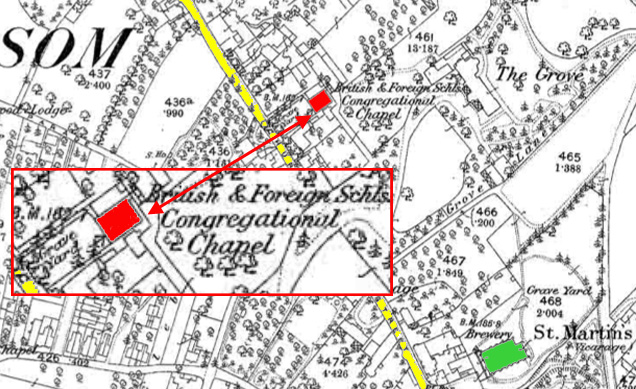
Extract from the 1866 Ordnance Survey map showing Epsom’s Congregational Chapel (shaded red)
– enlarged in the inset for greater clarity – on Church Street (shaded yellow)
about 200m from St Martin’s (shaded green).
In Epsom, John continued to enhance his reputation as a preacher – apparently more for content than any great oratorical skill – attracting large and enthusiastic congregations. By the 1830s, he began to think about giving more permanent form to his teachings and, in 1835, his first work – “The Great Teacher: Characteristics of Our Lord’s Ministry” – was published. Soon after that, John won a prize of a hundred guineas (a sum that, today, would purchase some £15,000’s worth of goods and services) for the best essay on the sin of covetousness. That essay was published in 1836 under the title of “Mammon, or Covetousness the Sin of the Christian Church”. It sold over 100,000 copies, making his name in not only the UK but also internationally – particularly in the USA. (In his 1860 book “Handbook of Epsom”, C J Swete mentioned John’s 1825-37 service at the chapel but, some 20 years after that ended, noted that he would now be better known as the author of “Mammon”.)
During the rest of his life, John published many other religious books, a number of which also won substantial prizes. His hallmark was infusing a more genial and humane spirit into the dry dogmas of theology – alongside urging Christians to put their beliefs into practice.
John left Epsom in 1837 on appointment to the theological chair at Cheshunt College. He returned to Epsom in Q3 1838 to marry Mary Ann Wrangham, daughter of William (a “Gentleman”) and Judith Wrangham of Church Street, Epsom. The couple had at least one child, Mary, born in 1842.
Some key events in the concluding years of John’s life were as below.
- In 1838, Rhode Island’s Brown College (now one of America’s “Ivy League” Universities) awarded John a diploma as Doctor of Divinity.
- In 1850, John was appointed first Principal and Professor of Theology of the New College (now part of London University) at St John’s Wood, London formed by the merger of a number of small Independent Colleges (including the successor of Hackney Theological Seminary where John had studied in the 1820s).
- In 1852, he was elected chairman of the Congregational Union of England and Wales.
John died of septicaemia at his college in St John’s Wood on 21 December 1856, aged 54. He is buried in Dr Watt’s Walk of Abney Park cemetery, Stoke Newington. (His daughter, Mary, died in 1869 at the age of 28 and was buried with her father.)
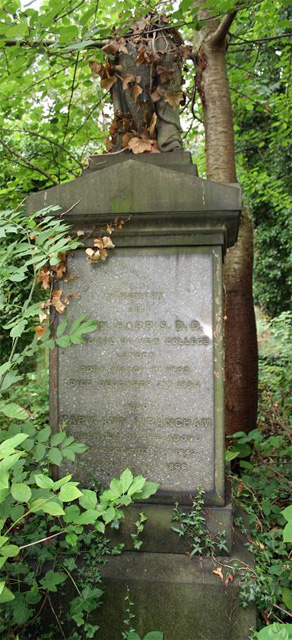
The memorial over John’s grave.
Photograph with thanks to “julia&keld” via findagrave.com
Roger Morgan © 2020