
Charles John SWETE (1820-73)
and his 1860 “Handbook of Epsom”

Charles’s confident signature from an 1846 letter – of which more below.
The Book
C J Swete’s “Handbook of Epsom” was published in 1860 jointly by John Nelson Collingwood of Epsom and by Simpkin, Marshall & Co, London. It is an invaluable survey of the town and its surroundings some 20 years into the reign of Queen Victoria, usefully bridging the gap between Henry Pownall‘s 1825 “Some Particulars Relating to the History of Epsom” and Gordon Home’s 1901 “Epsom: its History and surroundings”.
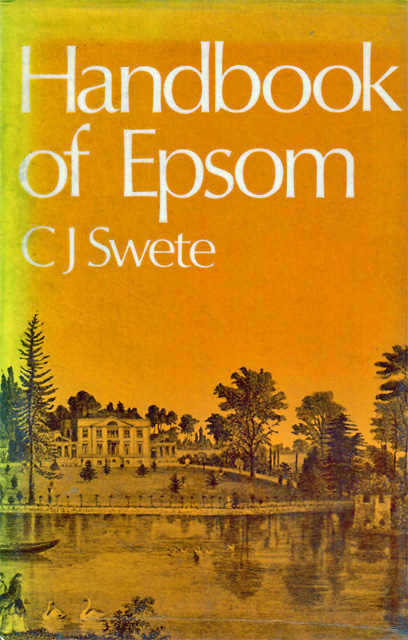
The dust jacket of EP Publishing’s 1973 reprint of the book, the illustration being
part of the engraving of Ewell’s now-lost Garbrand Hall facing page 96 of the original.
From the writer’s bookshelf.
The title “Handbook of Epsom” does not do justice to the book’s extensive contents. As noted on the title page, its 10 chapters over 200 pages also cover “the villages of Ewell, Letherhead [the then spelling], Ashtead, Banstead and Chessington with their varied points of attractive scenery, fishing on the Mole, the Downs, Geological, Botanical & Entomological notices.”
The scanned text of the original book (together with its 14 illustrations – “on Wood & Steel”) may be viewed by clicking this link to Google Books.
The book was reprinted in facsimile by EP Publishing Ltd in 1973. Copies of that may be found via specialist booksellers – as may, for much higher prices, copies of the original 1860 edition.
The Man
While all that is straightforward, the author himself proved something of a puzzle.
The short prefatory note to his 1860 book is signed off as “C SWETE MA” at “Parade Gardens, Epsom”. That property is mentioned in Lehmann’s “The Residential Copyholds of Epsom” and, from its diagrams, would seem be about No 14 of “The Parade” in Epsom, on its south side, looking across to Dulshot Green.
It is understood that C J Swete served as a Curate at St Martin of Tours in Church Street – an understanding that flows from the following matters.
(1) The local Post Office Directory for 1859 (probably compiled in late 1858) notes that St Martin’s Curate was then Rev Gerrard Lewis. He is also listed in the “Private Residents” section of the Directory at the address “Parish Gardens”. Is that a mis-transcription of “Parade Gardens” at which our Mr Swete signed off his book?
(2) In Chapter 3 on “Epsom Churches”, Mr Swete devotes the first 13 of 18 pages to the Parish Church of St Martin’s, including a detailed description of its many monuments, and the next two describing Christ Church which had been established by St Martin’s in 1843 as a “Chapel of Ease” (or daughter church) and was thus serviced by St Martin’s clergy. (Those churches are – see below – the subject of two of the book’s 14 illustrations and the only ones in that chapter.) The chapter ends with just over two pages to cover Epsom’s other five chapels (plus the workhouse).
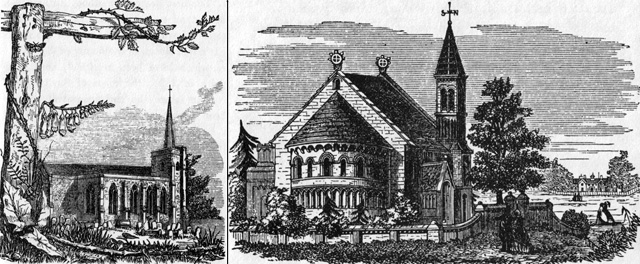
Left: St Martin’s, in the illustrated “E” of “Epsom” that opens the book’s chapter 3.
Right: the first Christ Church (replaced by the present church in 1876).
(3) Almost two of those 13 pages about St Martin’s are, as noted in the Chapter summary on the book’s Contents page, “Anecdotes from experience of a Parish Clerk“. During those anecdotes – about baptisms and marriages – Mr Swete must be referring to himself when he writes (on page 57), “This functionary is himself generally one of the most Protean characters in the parish, he gives away brides by the dozen, and becomes imaginary godfather to scores of infants.”
(4) One of the only two individuals Mr Swete thanks by name is “Rev B Bradney Bockett MA, Vicar of Epsom for [his notice] of the entomological peculiarities of this district”. (The other is “Rev A Barrett MA of North Cheam for his geological notice”.)
Much searching of the readily available English records finds the the first mention of our man (Charles John Swete – although his name is mis-transcribed as “Sweet”) in the 1861 Census, the year after the Handbook’s publication. However, this “Chaplain” living with his wife Frances is not in Epsom but in the Soyland area of Yorkshire. Both are listed as having been born in Ireland, and this opened up a whole new area for research, the results of which are reported below.
Charles was born in mid-1820 in Munster, County Cork as the fifth of 11 children of Rev Benjamin and Eliza (née Bigger) Swete. He followed his father into the Church of Ireland (part of the Anglican Communion). On 8 January 1846, Charles married Katherine Walker in Kilmalooda, County Cork. This was about the time that he took up the appointment as Curate at Rathcormac, County Cork. Alongside his parish duties, he was also secretary of the Rathcormac Relief Committee working to alleviate the distress and starvation of the “Great Famine” caused by the failure of the potato crop. The signature at the head of this article comes, thanks to the Famine Relief Commission’s archived papers, from Charles’s July 1846 letter to the authorities about the needs of his area. in November 1849, towards the end of the famine period, Charles was appointed as Curate to Kilbrittain, also in County Cork.
A Limerick newspaper of 27 July 1859 reported that Catherine (sic), wife of the Rev Charles J Swete had died at Kilmalooda Rectory. Her death may have been the spur for Charles to come to England for a fresh start. Why Charles chose Epsom is not currently known, but he was long enough in the town after Rev Gerrard Lewis’s Curacy to research and write his 1860 Handbook (which, as he said in his introductory chapter, was “the fruit of considerable labour”). He returned to Ireland in mid-1860 (about the time of the book’s publication) to marry Frances Sweeny in the church of St Thomas, Dublin on 7 August 1860.
As noted, he – with his new wife – were in Yorkshire by early 1861. Their first child, Herbert was born on 24 September 1862, and was baptised in St Bartholomew’s, Ripponden with Rishworth, Halifax on 29 October. The Parish records note Charles John Swete – now DD (Doctor of Divinity) – as a “Clergyman and Chaplain at College”.
By 1870, the Electoral Rolls record Charles as having moved south to 59 St Paul’s Road, Camden. That is where he (as “DD Curate of St Mary’s”) , Frances and their now three children (newborn Alice; 1 year old Florence; and 8 year old Herbert) were recorded in the 1871 Census. Charles’s birthplace is wrongly entered there as “Richmond, Surrey”.
Shortly after that, Charles and family moved to 371 East India Dock Road, Poplar – for him to serve at St Michael-and-All-Angels, Bromley. Charles died in Poplar on 27 June 1873, aged 52, and was buried in the South Metropolitan (West Norwood) Cemetery on 31 July.
Roger Morgan © 2020
with special thanks to Hazel Ballan for her help in tracing Charles’s background
Please contact us if you have information that can clarify C J Swete’s links with Epsom.