
St MARTIN OF TOURS, EPSOM
A summary of its internal monuments
(Click here for information about its external monuments – and
click here for our main page about St Martin’s)
The oldest memorial in St. Martin’s Church dates from 1511, being a small brass plate set into a slab of grey stone on the floor in the south aisle.
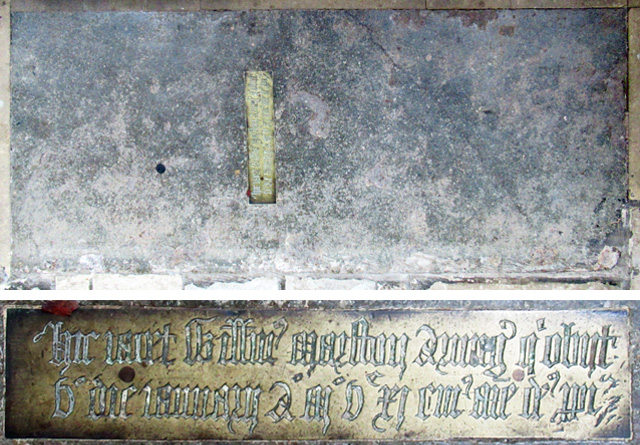
The setting of St Martin’s oldest memorial and (detail) the inscription.
(In the upper image, East is to the left.)
Photographs by Roger Morgan © 2021
Its Latin inscription translates as, “Here lies William Marston Esquire who died / 5 January 1511 whose soul may God preserve.”
The church’s most amusing memorial is probably that to Charles Parkhurst – again located on the floor, this time on the edge of the south transept beneath the hymn board – as below.
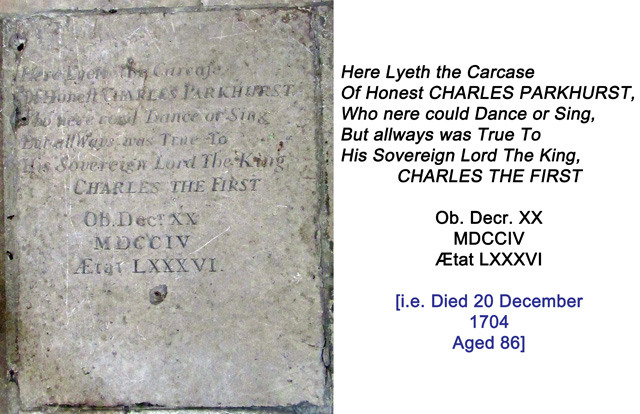
The Parkhurst memorial, and the text of its inscription.
Photograph by Roger Morgan © 2021
At the west end of the north aisle is to be found a small black marble tablet, bearing the arms of Coke and Berkeley, which carries a long Latin inscription to Sir Robert Coke, who died in 1643. In his 1840s Topographical History of Surrey, Brayley mentioned that beneath the tablet was a white fronted altar tomb with a black marble slab on the top, but this has since disappeared. [C J Swete’s 1860 Handbook of Epsom mentions the memorial, but not the tomb.]
Further to the east of the same aisle is a splendid monument to another Robert Coke. Flanked by drawn swords, surrounded by three busts, and positively dripping with fruit, this memorial commemorates “Robert Coke, late of Nonsuch, Esq. youngest son of Clement Coke ye 6th son of ye Rt. Honble, Sir Edward Coke, late Ld. Chief Justice of England.” In a glowing eulogy, the inscription recounts how “After he had faithfully served as a commander to his late Majesty, King Charles ye 1st, and lived to see ye disappointment of his enemies in ye restauration and above 20 years reign of our present sovereign.” Robert Coke died peaceably at Nonsuch on the 23rd of June 1681, aged fifty nine.
 The two “Robert Coke” memorials.
(In reality, the one on the right is twice the height of the other.)
Photographs by Roger Morgan © 2021
The monument to Elizabeth Evelyn, who died in 1691, which is to be found in the south transept, is one of the finest late seventeenth century memorials in Surrey. The carving, like that on Robert Coke’s monument is rich, florid and heavy, in the best baroque tradition, and features of the work are the barley sugar Corinthian columns which frame the Latin inscription, and the neatly carved cherubs’ heads which flank the decorative carving at the base of the monument. Elizabeth Evelyn was the widow of Richard Evelyn of Woodcote, whose own memorial, a more restrained work than that of his widow, is to be found on the south wall of the nave. On Elizabeth Evelyn’s death, the estate of Woodcote passed to her relative, Charles Calvert, 4th Lord Baltimore, and it was this nobleman who was responsible for erecting the tablet commemorating his benefactress.
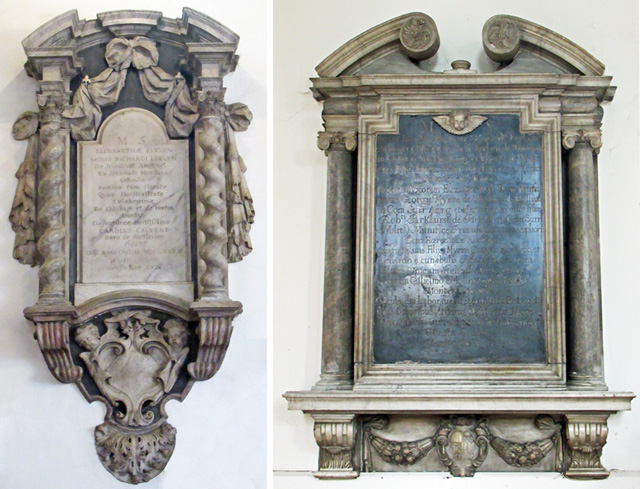
The memorials to Elizabeth (left) and Richard (right) Evelyn.
Photographs by Roger Morgan © 2021
The memorial to the Rev. Jonathan Boucher, M.A. [Vicar 1784 to 1805] which is to be found on the north wall of the chancel, is the work of the little known sculptor, Alexander Goblet.

The Boucher memorial
Photograph by Roger Morgan © 2021
As shown above, it takes the form of a portrait bust surmounting a sarcophagus, the latter resting upon an engraved tablet recounting the many virtues of the late priest. He emigrated to America at the age of sixteen and became rector of a parish in Virginia. He returned to England to obtain episcopal ordination, but returned to America where he spent some time in Maryland. On the outbreak of the American Revolution in 1775 he remained true to the crown and “for conscience’ sake, he resigned ease and affluence in America, to endure hardship and poverty in his native land.” Jonathan Boucher’s luck, however, was soon to change. He was presented to the living of Epsom in 1784, rapidly made his mark upon the intellectual life of his time, being the author of several scholarly works, and, by the time of his death in 1804, was a respected and affluent cleric. As Alexander Goblet noted on his subject’s memorial tablet, “the Lord gave him twice as much as he had before; and blessed his latter end more than his beginning.”
Perhaps the best of the late Georgian monuments in St. Martin’s is that commemorating Mrs. Jane Rowe, which is the work of John Bacon junior, and which is to be found beneath the window on the wall of the south transept.

The Jane Rowe memorial
Photograph by Roger Morgan © 2021
On a ground of grey marble, the sculptor has depicted in relief a wreathed urn on a pedestal, supported by two female figures; one bearing a staff and an open book, the other a pelican. The pelican is shown standing above its nest, wounding its own breast in order to nourish its young with its own blood. It is blazoned (described in heraldic terms) “a pelican in its piety,” and it is traditionally a symbol of the Eucharist. The charges on the Rowe family coat of arms, three holy lambs bearing pennants, appear on a lozenge within a decorated tablet beneath the main body of the monument.
There are four monuments in St. Martin’s which are the work of the celebrated Georgian sculptor, John Flaxman, who was described by his successor as Professor of Sculpture at the Royal Academy as a man who “not only had all the fine feeling of the ancient Greeks, but united to it a readiness of invention and a simplicity of design truly astonishing.”
The first commission which Flaxman executed in Epsom was the memorial to the Rev. John Parkhurst, who lived at Epsom Court, once the manor house of the town.
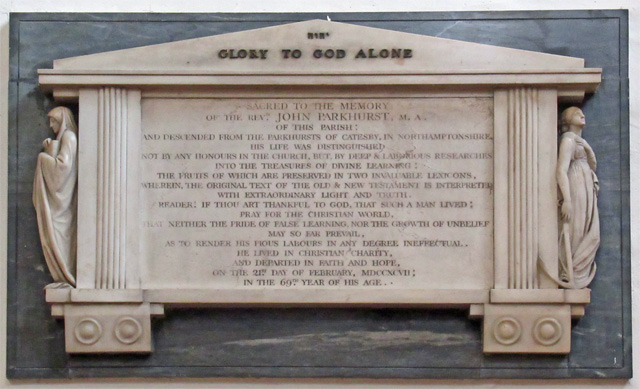
The Rev John Parkhurst memorial
Photograph by Roger Morgan © 2021
The work, which dates from 1797, is to be found on the north wall of the chancel. According to C. J. Swete [in his 1860 Handbook of Epsom], it takes the form of “a simple tablet with an exquisitely sculptured whole length figure, on either slide; one, of a woman, her hands clasped and a hood over her head, the other representing Hope, an anchor, as usual, in her right hand.” John Parkhurst himself, to quote the inscription, was famed for “deep and laborious researches into the treasures of Divine learning” which, although failing to produce any honours in the church, resulted in “two invaluable Lexicons in which the original text of the Old and New Testament is interpreted, with extraordinary light and truth.”
Following this, Flaxman produced three monuments commemorating John Brathwaite and various members of his family. Two of these, those to John Brathwaite himself, executed in 1800, and his nephew by marriage, John Warre, which was produced in 1801, are to be found in the north transept. The first shows a female figure gazing sadly and thoughtfully into space, her right arm resting on a votive urn surmounting a pillar. The second is similar in theme, with another female in evidence, this time leaning against a classical column, her head in her arms with grief.
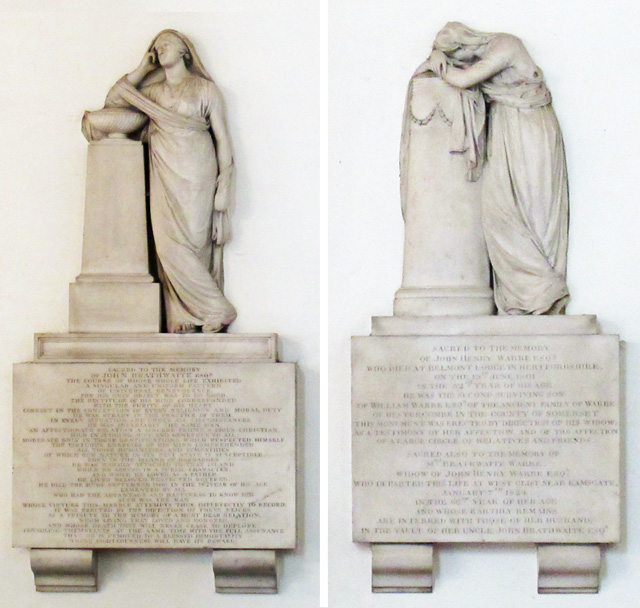
Left: The Brathwaite memorial.
Right: The Warre memorial (which, in reality, is about ¾ the size of its companion).
Photographs by Roger Morgan © 2021
The Art Museum of University College, London has a plaster model of the upper part of the Brathwaite memorial – perhaps Flaxman’s maquette (it is only 52 cm/20″ high) – showing how the memorial looked before it lost its backing.
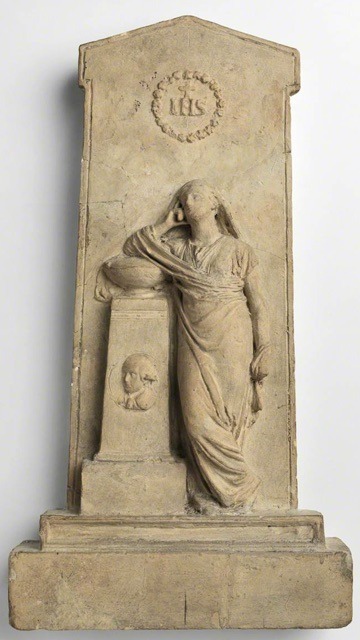 Model of the Brathwaite memorial in the Art Museum of University College, London.
(CC BY-NC-SA)
Across in the south transept is the memorial to Miss Eleanor Belfield, which dates from 1802. It forms a pair with its neighbour, a tablet commemorating Brathwaite’s niece, Rebecca Gibbons, who died in 1815, and the works were described by Gordon Home, in 1901, as “very chaste looking monuments with the inscriptions surrounded by circular wreaths.” They are, in fact, almost identical in appearance, but the Belfield memorial by Flaxman has within the circle a touch of symbolism in the shape of a sculptured lily, severed from its stem.
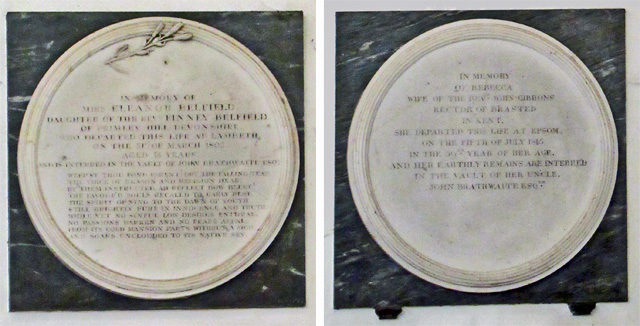
The Eleanor Belfield (left) Rebecca Gibbons (right) memorials.
(In reality, the Gibbons memorial is immediately below the Belfield one.)
Photographs by Roger Morgan © 2021
Sir Francis Chantrey is one of the best known late eighteenth century sculptors, His most popular funerary monument is undoubtedly the “Sleeping Children” of the Rev. W. Robinson, to be found in Lichfield Cathedral and completed in 1817, five years after the children’s death. Sir Francis’ contribution to the varied array of Georgian memorials in St. Martin’s Church was produced four years after his masterpiece at Lichfield. It is the memorial to Susan Warre, another of John Brathwaite’s relatives by marriage, and is to be found in the south transept next to the tablet commemorating Jane Rowe.
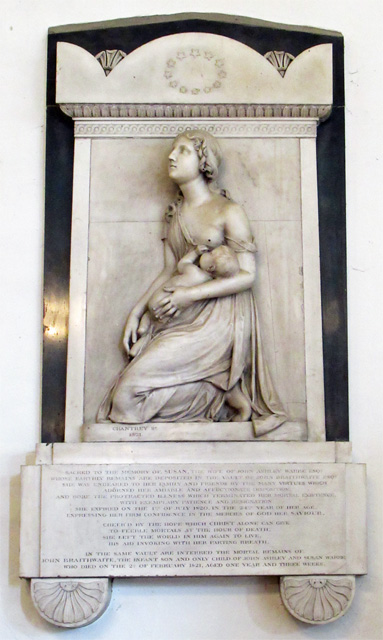
The Susan Warre memorial.
Photograph by Roger Morgan © 2021
It could hardly be described as one of Chantrey’s greatest achievements. As C. J. Swete noted [in his 1860 Handbook of Epsom]: “There is a production of Chantrey’s which is well done, but not pleasing, of a female figure, with a child, looking half strangled in her arms, and she herself looks as if she laterally had a large slice taken from her body.” Nevertheless Chantrey joins Goblet, Bacon, and Flaxman to form a quartet of distinguished Georgian artists to adorn the walls of St. Martin’s, and the church would be the poorer without this example of his work.
Two more monuments worth noting in this survey are those commemorating members of the Cuthbert family, which are to be found on the south wall of the nave. The two memorials in question are splendid creations. The inscriptions themselves are contained within classical frames, complete with Ionic columns, and surmounted by obelisks, and the monuments contain interesting heraldic details.

The Cuthbert family memorials.
(Below the two mentioned in the text are two plainer tablets memorialising other family members.)
Photograph by Roger Morgan © 2021
The arms of the Cuthbert family are blazoned “Or, a serpent gliding in pale ppr. debruised by a fesse gu.” Loosely translated, this means that, on a gold background, a purple snake wriggles down the middle and vertical third of the shield, and is neatly bisected by a thick, red, horizontal line. In the same way, the Cuthbert crest is blazoned as “An arm embowed in armour grasping a broken spear aIl ppr.” and means, to the layman, a curved arm, dressed in armour and coloured purple, clutching a broken spear. Both the shield, which bears the arms, and the crest, which usually surmounts a helmet, are integral parts of the full coat of arms, and in this case the Cuthbert crest surmounts the monument on the right, and the shield that on the left. The latter also benefits from having the Cuthbert motto “Nec Minus Fortiter” (”Not the less Bravely”) as well.
There are two monuments which, although of no great artistic merit, are of historic interest. The first of these is to the east of the Cuthbert tablets and is a plaque commemorating Colonel Francis Vernon Northey (a brother of the Rev. E. W. Northey) [who had funded a memorial window in St Martin’s to their father, E. R. Northey]) who was killed in 1879, fighting in the Zulu War. The second, which is in the south transept, is a tablet to the memory of Peak Garland Esq., of Woodcote Grove, who was born in 1778 and died in 1841. Woodcote Grove, now the home of W. S. Atkins & Co., was acquired by the Garland family in the late seventeenth century, and for the next century and more was popularly known in Epsom as “Garland’s” as a result of that family’s occupation.
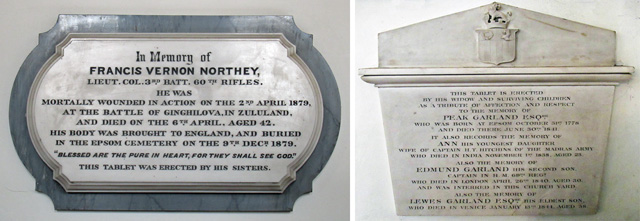
The Frank Northey (left) and Peak Garland (right) memorials.
Photographs by Roger Morgan © 2021
Finally, at the east end of the south aisle, there is a tablet commemorating the terms of a bequest made “to the minister and Churchwardens of this parish” by Mrs. Elizabeth Culling, widow of William Culling, on condition that their vault in the parish churchyard be kept in good repair. “The inscription on the stonework of the said vault,” insisted Mrs. Culling, “is to be kept legible” and the stonework was to be “constantly clean from weeds and dirt.”
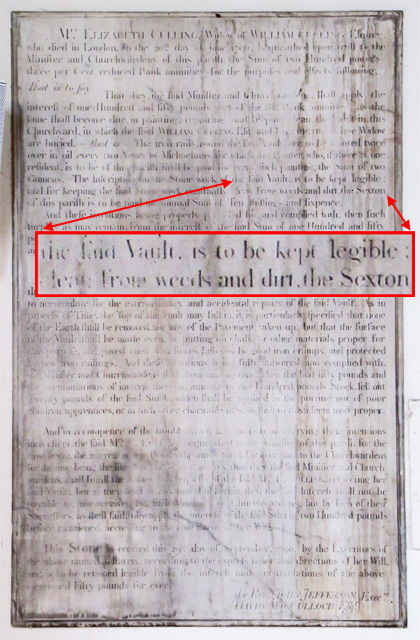
The large marble Culling tablet, and a detail of its lengthy text.
Photograph by Roger Morgan © 2021
Mrs. Culling died on the 30th. June, 1790, and she would have been pleased to note that in 1802, “on pursuance of the directions of MRS. CULLING,” a new tomb was erected “at the expence of the Fund left for that purpose by the said will” as the original inscription had become “injured by time” and was “so decayed as to be incapable of repair.”
Stephen Turner
July 1977
Notes:
The text above comes, with thanks, almost wholly from a chapter in the history booklet written by Stephen Turner in 1977 (and reissued by St Martin’s in 2004). The exceptions are the square-bracketed notes and some minor changes to accommodate the 2021 addition of photographs to the originally unillustrated text.
The Appendix below provides some additional background.
Other complementary material may be found in other articles reached by the links below:
- The transcribed texts of the inscriptions on the memorials mentioned above – together with those of the many other monuments within St Martin’s;
- St Martin’s stained glass, almost all of which was installed as memorials;
- The painted Rathbone memorial; &
- St Martin’s war memorials.
You may also be interested also to see Bob Speel’s more detailed survey of the church’s monuments.
Roger Morgan 2019 & 2021
APPENDIX
As noted in our main page about St Martin’s, the medieval church was (except for the tower) demolished in 1824 to make way for a larger building which opened in 1825. In turn, the chancel of that was demolished in 1907 and replaced by what was intended as the first stage of a complete (but unrealised) rebuild. Memorials dating from before the 1820s have therefore been relocated at least once and, in a number of cases, twice.
Most of the monuments shown in the 1895 postcard below were first erected in the medieval church – and all (bar one, which appears to have been lost) were moved again in the 1907 rebuild.
 An 1895 postcard of St Martin’s then Chancel and High Altar.
(For the key to 1-9, see below.)
Picture with thanks to the Epsom & Ewell History Centre.
The memorials numbered 1 to 6 (all of which feature in the summary article above) had all been moved from the medieval church. Those memorialised (and where the memorials were again moved to in the 1907 rebuild) are:
1. John Warre (d. 1797), now in the north transept;
2. Jane Rowe (d. 1810), now in the south transept;
3. The Revd Jonathan Boucher (d. 1804), now in the new chancel;
4. John Brathwaite (d. 1800), now in the north transept;
5. The Revd. John Parkhurst (d. 1797), now in the new chancel; &
6. Susan Warre (d.1820), now in the south transept.
Those numbered 7 and 9 both date (as below) from after the 1824 rebuild and are thus shown in the postcard in their original positions.
7. Peak Garland (d.1841), now in the south transept; &
9. Benjamin (d. 1828) and Sarah (d. 1867) Pugh, now in the Lady Chapel.
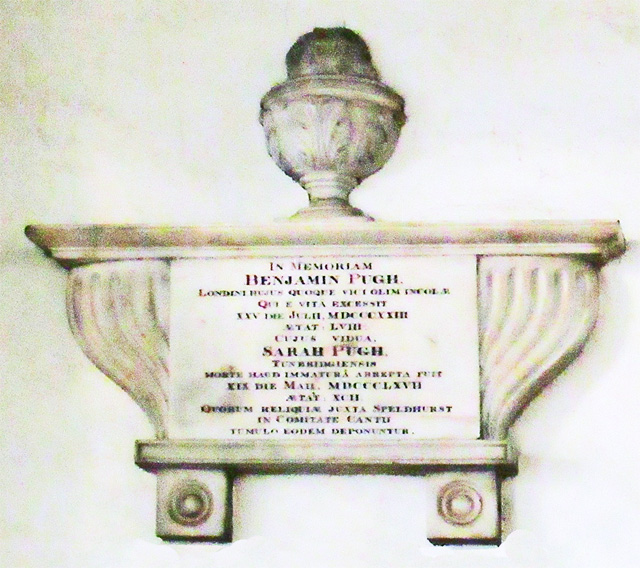
The Pugh memorial.
Photograph by Roger Morgan © 2021.
The memorial numbered 8 does not match any that are now found in St Martin’s. The supposition is that it was damaged beyond repair in preparing for the 1907 rebuild. It was presumably replaced, but it is not currently known which of the many other memorials is that replacement.
It was hoped that C J Swete’s 1860 Handbook of Epsom might provide the answer to the puzzle. On page 48, he says that “in the Chancel are eight mural tablets”. Sadly, he then describes only six of these – which happen to be those numbered 1 to 6 in the postcard above. The memorial to Peak Garland (who died 19 years before Swete wrote his book) ought to be one of his “eight”. Assuming that the Pugh memorial (9) was not erected until after Sarah’s death in 1867 (at the age of 92), our currently unidentified one (8) should be the one to complete the tally.
That assumption is reinforced by Gordon Home’s 1901 Epsom: its history and surroundings in which he notes (on page 68) that “on the south wall of the chancel are nine [NB one more that Swete’s eight] monuments”. Unfortunately (and like C J Swete), he then describes only those we have numbered 1 to 6!
It can be seen that all nine memorials in the 1895 postcard are backed by a dark stone background. (Gordon Home states that the backgrounds were generally of “grey marble”.) Many of these backgrounds were lost in the subsequent relocation: the only ones remaining are those for Jane Rowe (1), The Revd. John Parkhurst (5) and Susan Warre (6). (The lost background to the Brathwaite memorial (4) carried decoration which Swete thought “perfectly unmeaning” and detracted from the accomplished sculpture. There are more details, with pictures, in our article about Mr Brathwaite.)
The memorials to Richard Evelyn and his widow, Elizabeth, mentioned in the main article above (currently found in, respectively, the south aisle and south transept), both date from the 17th Century and will therefore have been first erected in the medieval church. In his 1860 Handbook of Epsom, C J Swete mentions Elizabeth’s memorial as one “of considerable interest and some antiquity, which is generally overlooked by strangers and has received no mention in any chronicle which we have met. It is situated on the wall of the staircase leading to the north gallery.” As shown in the following drawing, the church as rebuilt in 1825 had galleries over each of the side aisles.

The interior of St Martin’s in 1841 showing the now-lost galleries.
Image from the St Martin’s archives.
Those galleries were removed as part of the 1907 enlargement but, as shown below, this has left the memorials that were installed to be read from those galleries now far too high on the walls to be read with the naked eye.
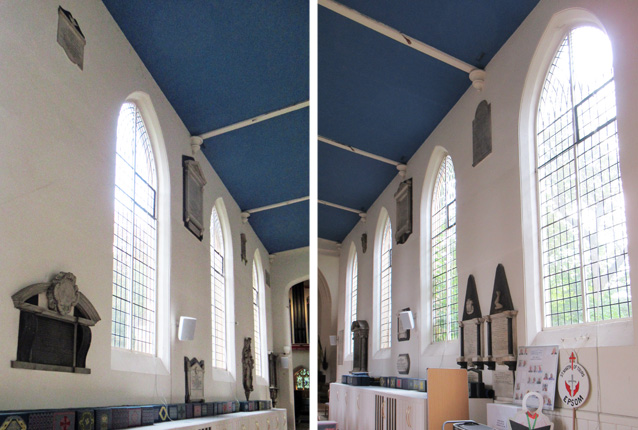
The north (left) and south (right) aisles showing the now-stranded high level memorials.
Photographs by Roger Morgan © 2021.
Finally, today’s chancel is far more restrained that its rather cluttered 19th Century predecessor.
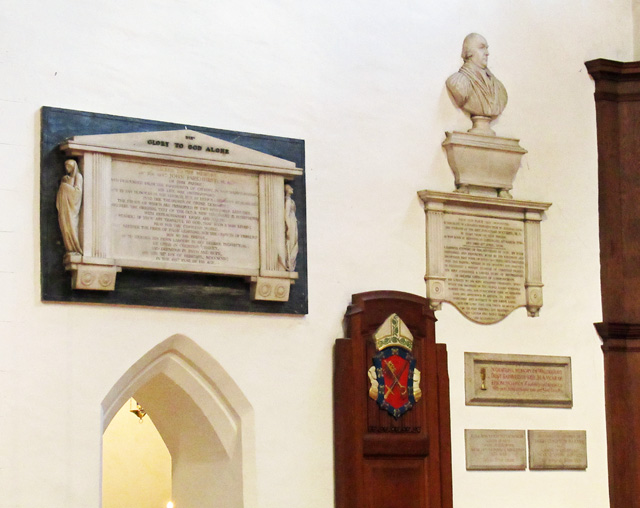
Memorials on the north wall of today’s chancel.
Photograph by Roger Morgan © 2021.
It has only five memorials. At the top are the Parkhurst and Boucher memorials that were marked, respectively, 5 and 3 in the 1895 postcard. (It will be noted that the Parkhurst memorial has retained its dark background while the Boucher one has not.)
Below them are memorials to three former Vicars, namely:
- The Revd Waldegrave Bainbridge-Bell, Vicar from 1904 until 1924 (during whose time St Martin’s was enlarged – hence the quotation from Ezra 4.3 added to his plaque “With us to build an house unto our God“.);
- The Revd Clive Robertson Pattison Muir, Vicar from 1924 to 1938; and
- The Revd Hugh Compton Warner, Vicar from 1938 to 1950.
Roger Morgan © 2021