
THE STAINED GLASS OF St MARTIN’S, EPSOM
 St Martin (336-397) as Bishop of Tours.
From the East Window of the Lady Chapel (No 13 on the plan below).
In the introduction to his 2018 booklet “The Stained Glass of St Martin’s, Epsom” (from which, with kind permission, this article has been developed), retired priest the Revd Canon Adrian Esdaile wrote:
The metaphors of light and darkness have a richness in the history of Christian theology and teaching upon which the stained glass artists drew so much inspiration. Every stained glass artist, designer and craftsman writes of their dependence upon light for their work and upon the mystical qualities it has.
Lawrence Lee who died in 2011 at the age of 101, and who has much glass in Guildford Cathedral, wrote this:
“Stained glass is unique among the arts of the world because of the relationship that exists between glass and light. We see colour on a painted surface through the reflection of light; the colour we see in a stained glass window is from the light refracted through it …. Essentially a dynamic, daylight art, stained glass is energised through its relationship with light and changes according to the time of day.”
As noted on our main page for St Martin’s, the present building is a fusion of an 1825 Nave and older tower (walls shown in grey on the plan below) and a 1908 East End (walls shown in brown below) which is on a slightly different axis.
Apart from the West Window over the main entrance, all the church’s stained glass is in the 1908 East End – although, as explained below, some of this is older since it came from the replaced 1825 East End.
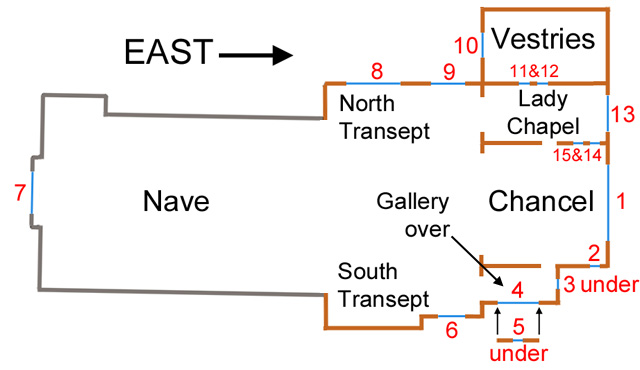 Outline plan of St Martin’s, in which the windows containing stained glass
are numbered from 1 – the East window – clockwise to 15.
(The windows numbered 11, 12, 14 & 15 are, of course, above
the roofs of the adjoining vestries and chapel.)
Drawing by Roger Morgan © 2019
INDEX
Clicking on the links below will take you straight to the indicated section. At the end of each item is a link to this index which, when clicked, will bring you back here.
Three generations of the East Window (Nos 1, 2, 4, 10, 14 & 15)
South Chancel Aisle, under the Gallery (Nos 3 & 5)
South Transept (the Northey window, No 6)
West Window (the Bockett window, No 7)
North Transept (the Benedicite and Bishops’ windows, Nos 8 & 9)
The Lady Chapel (St Francis, St George and Crucifixion windows, Nos 11, 12 & 13)
Note: Some of images are “Click to enlarge”. If you right click, you should be offered the option of opening the link in a new tab which, if chosen, means you will not lose your place in the main text.
THREE GENERATIONS OF THE EAST WINDOW: Stained glass in the Chancel, Gallery and Choir Vestry (Windows numbered 1, 2, 4, 10, 14 & 15 on the plan above)
As traditional, the high altar of St Martin’s is at its east end and the East Window (No 1 on the plan) is the conventional visual focus from the main entry at the west.
The current East Window is the work of Christopher Webb (1886-1966) who was educated at Rugby, the Slade School of Art and was then assistant to Sir Ninian Comper, architect and stained-glass artist. Characteristic of his glass is clarity of design, accuracy of historical detail and the prominence of clear glass. As he wrote himself:-
“It should be remembered that the first purpose of a window is to admit daylight and that once this is shut out and artificial lighting has to be resorted to, a coloured window defeats its own end.”
St Martin’s has Christopher Webb’s original design for the window, as on the left below. However, as shown in the photograph on the right, only the central three lights were installed.
 Left: Webb’s design for the East Window; and
Right: As installed, and remains to date (Photograph by Roger Morgan © 2019).
When the extended St Martin’s was dedicated in 1908, the East window was all plain glass (in geometric leading, as still to be seen in the present outer lights). The stained glass was installed in 1923 in memory of the Buller family of Down Hall. A Church Magazine of 1922 recorded that a legacy (which amounted to £383) had been received from the Buller family and Christopher Webb was instructed to prepare a design.
It was recognised that the money would cover the cost of only the central three lights, but Webb was instructed also to design the two lights on either side “to be inserted subsequently” (as the magazine put it), but that date has not yet arrived. Webb’s unrealised designs for those outer lights were:
• on the left, a Noli me Tangere (“Do not touch me”, the words Jesus used to Mary Magdalene after the Resurrection – John 20:17); and
• on the left, an Annunciation (Luke 1:26–38).
 The three central lights of the East Window.
(Click to enlarge.)
Of the lights that were made and installed, the central figure is Christ in glory. On the left is his mother, Mary, above whose head are (in Latin), the opening words of the Magnificat (“My soul doth magnify the Lord …” Luke 1:46). On the right is John the Baptist. Above his head is, again in Latin, “Behold the Lamb of God” (John 1:29).
In the corners are the signs of the four Gospel writers or “Evangelists”:
• top left – the angel for Matthew;
• top right – the lion for Mark;
• bottom left – the ox for Luke; and
• bottom right – the eagle for John.
Above the three main lights (as may be seen in the photograph of the whole window further above) are the arms of, on the left, Canterbury and, on the right, Winchester. The latter was the Diocese into which Epsom came at the time: it now comes within the Diocese of Guildford that was created in 1927. The window is signed with Christopher Webb’s “W” and the date “1923” – although this is virtually impossible to see because of the height of the reredos.
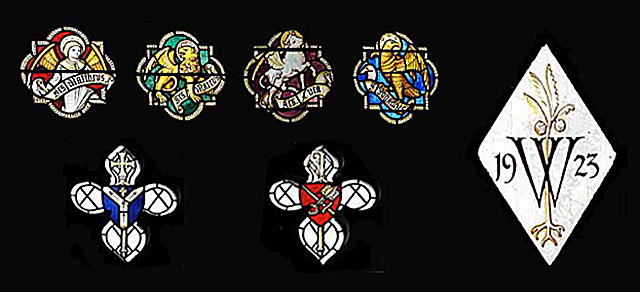 Some details of the East Window as described in the immediately preceding paragraphs.
Top: the symbols for Saints Matthew, Mark, Luke and John.
Bottom: the arms of Canterbury and Winchester.
On the right: Christopher Webb’s “W”.
There was, of course, an East Window in the East End of the 1825 church that was demolished to make way for the 1908 extension. Happily, glass from that can still be seen in the windows of today’s church. The first known picture of the 1825 East End is an 1830 water colour, as below.
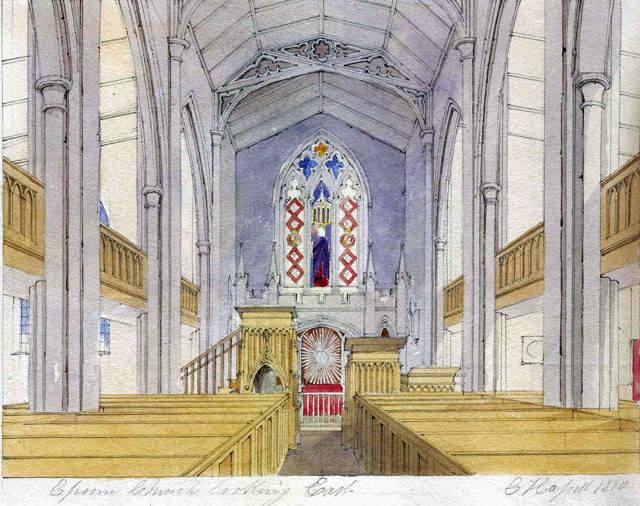 The East End of St Martin’s in 1830.
Water colour by Edward Hassell.
Image courtesy of Bourne Hall Museum.
The stained glass seen in the East Window above was the work of Thomas Willement (1786-1871) – often known as the “father of Victorian Glass”. Initially a plumber and glazier (the two jobs, involving lead, went together), he began with heraldic glass and became both knowledgeable and skilful -becoming the Heraldic Artist to William IV and Stained Glass Artist to Queen Victoria.
Between 1500 and 1800, the skills of stained glass as we know it had died out. Willement was one of those who revived it, using the skills of the medieval artists. There was a strong movement to study both the methods and the results of the artists of medieval times. Societies were dedicated to this, for example, the Cambridge Camden Society, together with architects like Pugin and Butterfield. This led to an explosion of building and restoration which led in turn to new stained glass windows all over the country. Willement was part and parcel of this movement. He was one of 25 stained glass artists who shared a section of the 1851 Great Exhibition at Crystal Palace. By 1845 he had become wealthy and purchased Davington Priory in Kent, where examples of his work can be seen. (It has been the home of Bob Geldof since 1983.)
The window was replaced in 1892 and, but for a couple of sections, is now long lost. However, we do have Thomas Willement’s original design for it, as below.
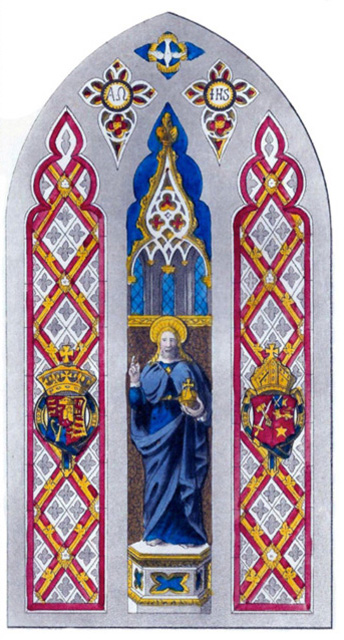 Thomas Willement’s design for the 1825 East Window.
From Henry Pownall’s 1825 “History of Epsom”
The two remaining sections of that window are the roundels from each side of the central figure of Christ in glory – being, on left, the arms of George IV (1820-30) and, on the right, those of the Bishop of Winchester into whose diocese Epsom came until the creation of the Diocese of Guildford in 1927. They are to be found in the otherwise plain windows of the Choir Vestry – at No 10 on the plan at the head of this article – and are pictured below.
 Two roundels from the 1825-92 East Window, now installed in the windows of the Choir Vestry.
Left: the arms of George IV. Right: the arms of the Bishop of Winchester.
In 1892, the 1825 East Window was replaced by one designed by the stained glass artist, Francis Allcock Oldaker. He was born in late 1844, the son of surgeon Francis Allcock Oldaker senior and Anna Maria (née Perkins). He was baptised on 4 January 1845 in the family’s local church of St Peter, Hackney. Francis senior died in 1849 and the 1851 Census records Francis junior living in Pershore St Andrew, Worcestershire with his maternal grandparents – his grandfather, Francis Davies, being another medical practitioner.
Francis junior’s mother died in 1857. Doubtless because of the medical connection, he was in 1855 an early admission to Epsom’s “Medical Benevolent College” (which opened in 1851 and subsequently became Epsom College) – which he attended until 1862. He learned his trade as a stained glass artist with the prominent London firm of Clayton and Bell. In 1870, he married Mary Clothier in Hambledon, and the couple set up home in East Molesey where their first child was born. They then moved to Worple Road, Epsom, where their daughter, Edith Mary, was born. She was baptised on 14 November 1879 in St Martin’s where her father became a Church Warden. Later, he also became a member of the Council at Epsom College. There are examples of his stained glass work in the Chapel at the College (including a memorial window to Bishop Samuel Wilberforce, who is also commemorated at St Martin’s in the North Transept window numbered 9 on the plan at the head of this article.)
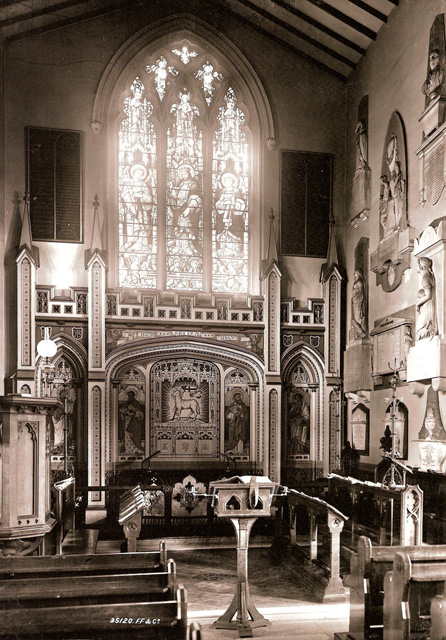 An 1895 postcard of St Martin’s showing the Oldaker East Window in situ.
Picture courtesy of Bourne Hall Museum.
The 1895 postcard above shows the Oldaker window, three years after it replaced Willement’s original 1825 window. While it had a rather shorter life there (the whole east end was rebuilt in 1907/08), the Oldaker window was not lost. With slight modifications, it was reinstalled in the gallery to the south of the new chancel – window No 4 in the plan at the head of this article.
 Left: the original Oldaker window (a reformatted detail from the above).
Right: as reinstalled in the gallery.
 (Click on the thumbnail above for a more detailed view of the Gallery window.)
As will be seen from the comparison above, much of the window is in its original form. The central light shows Jesus as “the Light of the World”, inspired by the well-known Holman Hunt painting in St Paul’s Cathedral (with copies in Melbourne and Keble College Oxford). To the left and right are the archangels Gabriel and Raphael. The text running across the three lights towards the bottom comes from Revelation 3:20, being: “Behold, I stand at the door and knock. If any man hear my voice and open the door, I will come in to him and will sup with him, and he with me.”
The main lights of this Gallery window are a little shorter that in the former East window, and the comparison above shows that these lights have been reworked above the heads of the main figures, with new material in place of the smaller figures that can be see in the 1895 image. Those smaller figures are not, however, lost. They were installed in the top of the otherwise clear glass lancet windows high on the Chancel walls each side of the high altar – those on the south (Nos 14 & 15 on the plan at the head of this article) being as immediately below.
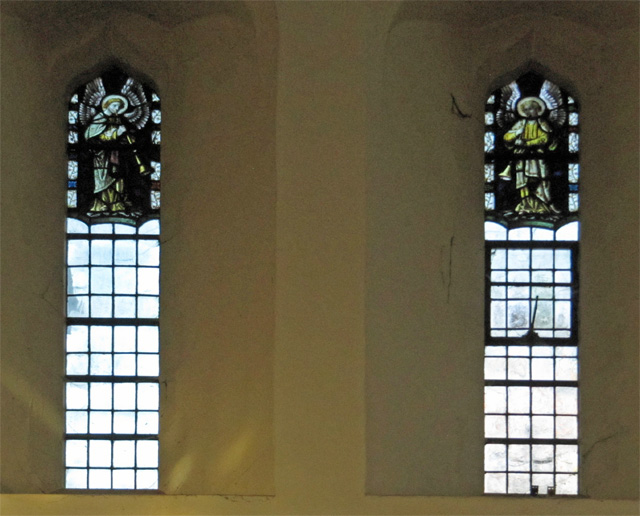 The two lancet windows high on the chancel wall to the south of the high altar.
Photograph by Roger Morgan © 2019
The north wall of the chancel has just one lancet window – the architect was apparently fond of these little asymmetries – also headed by one of the figures from the 1892 Oldaker window.
 The figures in the chancel’s lancet windows in the order they appear in the original
1892 Oldaker window. The outer figures are now in the south chancel windows, and the central one now in the chancel’s north.
It is not only the upper parts of the main lights of the Oldaker window that were changed for installation in the gallery. As shown in the comparison below, the two angels and central dove from the upper part of the 1892 window have been adapted for the differently shaped tracery at the top of the gallery window, and other sections of the gallery window’s tracery have been filled with complementary new material.
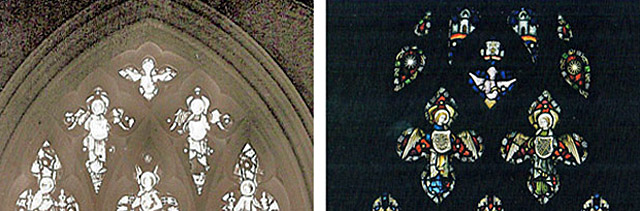 A comparison of the tracery above the 1892 East Window and the present-day gallery window.
SOUTH CHANCEL AISLE, UNDER THE GALLERY (3. Moses & 5. Iaac & Rebekah)
[Note: Window 4. – in the Gallery – was covered in the previous section.]
The two windows in this space under the Gallery are the work of Archibald Nicholson, the middle of three brothers – each one deeply involved in working for the Church. Their father was the polymath Charles Nicholson who advanced from humble beginnings to become the 1st Baronet of Luddenham in 1859. Although born in England, he spent much of his early life in Australia. He returned to England in 1865 and married Sarah Elizabeth Keightley.
Their first child, Charles (1867-1949) – who succeeded to the Baronetcy on the death of his father in 1903 (thus becoming Sir Charles Nicholson) – was a prolific ecclesiastical architect. Indeed, he was the architect of the 1907/08 rebuild of the east end of St Martin’s.
The next child, Archibald (1871-1937), became a stained-glass artist – and the family connection was surely a factor in his being commissioned for windows in the building his brother had designed. Archibald began his background training with the architect Henry Wilson, later moving to a commercial studio to learn the craft of stained glass. Throughout his career, Archibald created some 700 windows, of which the most famous is the Edward Elgar memorial window in Worcester Cathedral. From the beginning, he had the assistance of Gerald Smith, who took on the firm after Archibald’s death, then providing some more stained glass for St Martin’s in the Lady Chapel – windows numbered 11 & 12 on the plan at the head of this article. (Archibald’s home church of St Sepulchre-without-Newgate – near Holborn Viaduct – has a memorial window for him, designed by Gerald Smith and showing the team at work in the studio.)
(For completeness, the youngest brother, Sydney (1875-1947), was an accomplished musician – both as an organist and composer. While organist at Manchester Cathedral, he edited the 1916 Hymns Ancient and Modern. He was organist at Westminster Abbey for 1919-28 and went on to found what became the Royal School of Church Music. He was knighted for his services to church music in the 1940s.)
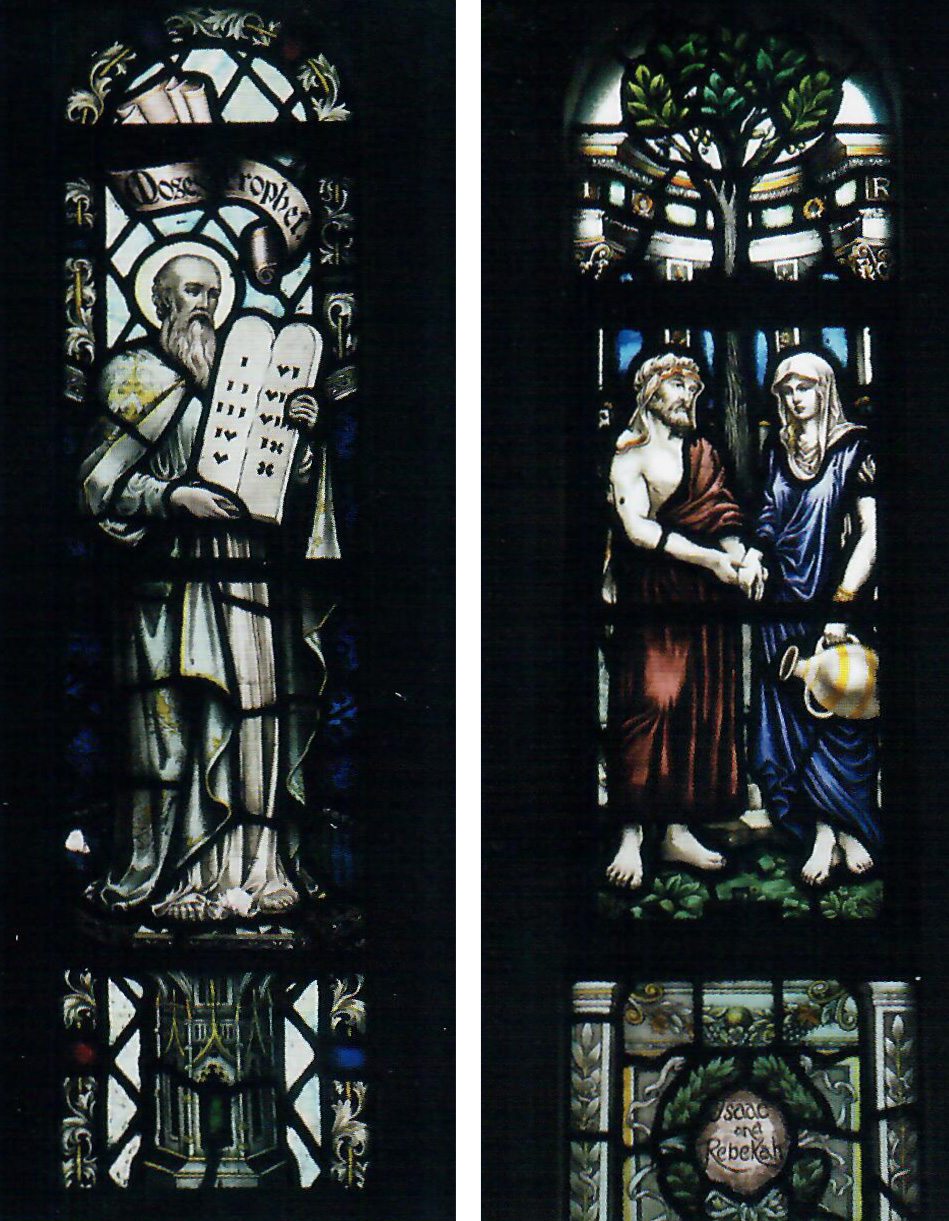 The two windows under the gallery.
Moses (on the left) and Isaac & Rebekah (on the right).
Photographs by Roger Morgan © 2019
Click to enlarge
Archibald Nicholson’s two small windows under the gallery (as immediately above) are
- of Moses (in the east wall), shown carrying tablets with 1 to 10 in Roman numerals to represent the Ten Commandments – and over whose head are the words “Moses Prophet”; and
- of Isaac (the son of Patriarch Abraham) and his wife Rebekah – both as identified at the foot of the window.
The Church magazine of March 1909 tells us that the windows were “inserted” that month, only a few months after this part of the church had been built. Archibald’s first commission is said to have been in 1902, so these – and the “Bishop’s Window” (No 9, in the North Transept) – are relatively early in his career.
SOUTH TRANSEPT WINDOW (6. The Northey Window)
 The South Transept “Northey” window.
Photograph by Roger Morgan © 2019
(Click to enlarge)
This window was presented by the Revd Edward William Northey of Woodcote House in memory of his father who died at the age of 85. The dedication running across the bottom of both lights reads: “In loving memory of Edward R Northey / born Feb 8th 1795, entered into rest Dec 21st 1878.”
The main subjects of the window are (as labelled just below their feet): David, an early King of Israel (on the left); and Hezekiah, a later King – of Judah, after the division of the Kingdom. The words being held by Hezekiah are his as recorded in Isaiah 38:19. “The living, the living, he shall treasure, as I do this day”.
In the tracery above the main lights are the Northey “arms”. Such heraldry was often used to identify donors and families easily. The device is recognisable at a distance, especially by those “in the know”.
The Northeys were an influential local family, and this website has ten pages about the various generations. They start with Sir Edward Northey (1652-1723) who rose to be Attorney General under William III and Queen Anne.
The memorialised Edward Richard Northey (1795-1878) had a long army career. He served in Spain (the “Peninsular War”) and was wounded at the Battle of Vittoria. He returned to duty in time to fight in the Battle of Waterloo. On leaving the Army, he married and was active in the life of Epsom: he was Chairman of the Epsom Bench of Magistrates and the School Managers and, in 1856, was Deputy Lieutenant for the County of Surrey and High Sheriff.
(Edward’s youngest son, Francis Richard Northey, also served in the Army and died in 1879 – the year after his father – of wounds incurred during the Zulu Wars. He was brought back to Epsom for burial, and his sisters erected a memorial plaque for him in St Martin’s.)
The window is by Frederick Charles Eden (1864-1944). Eden was born in Brighton and originally started out as an architect, later concentrating on designing church fittings and stained glass. He established his studio in Red Lion Square in London in 1910. There is more of Eden’s work in the Lady Chapel.
THE WEST WINDOW (7. The Bockett window)
 The west “Bockett” window
The west window is the only stained glass in the nave of St Martin’s (which, since the 1907/08 rebuild of the east end, is the remaining part the 1825 replacement of the earlier buildings). Dated 1878 (but see below), the window is also the oldest complete one in the church.
The window was given by the Revd Benjamin Bradney Bockett (Vicar of St Martin’s from 1839 to 1883) in memory of two of his maiden sisters – from whom he inherited Burghfield Bridge Lodge, near Reading, to which he retired in 1883. (He was a colourful and controversial character throughout his long incumbency. He had some very definite low-church ideas, putting forward the view that there should be no robes and no ritual – views which caused the Bishop to threaten to suspend him.)
Running across the three main lights, about a quarter of the way up, is the dedication (in Latin):
“Ad honorem Dei et in / memoriam Juliæ Rebeccæ et / Harriettæ Sophiæ gratam // frater mærens B Bradney / Bockett hanc fenestram / ornandam cuiravit AD 1878.”
A colloquial translation is:
“To honour God and in memory of Julia Rebecca and Harriet Sophia, their grieving brother B Bradney Bockett had this pleasing decorated window made.”
The main subject of the window is Christ the Healer. The centre light shows a blind woman kneeling at the feet of Jesus. The left light depicts two women, one seeking a cure for the other whose pale face indicates that she is ill. The right light shows two old men, one of them crippled, coming to Jesus for healing. Immediately under these figures is the text (from Mark 6:56): “As many as touched him were made whole”. At the very top of the window are the letter “IHS” – the first three letters of “Jesus” in Greek.
The window is the work of Arthur Moore, the son of a Clerkenwell clockmaker who, in 1871 co-founded the London Company of Gibbs and Moore, glassmakers. Quite early on, Gibbs dropped out and Moore operated on his own as A L Moore from premises in Southampton Row. In 1896, he was joined by his son, Charles, and the business continued until 1952. (The window was restored in 2001 by Jonathan Leckie of Walton-on-Thames, and some relatives of Mr Bockett attended the service of re-dedication.)
There are some question marks over the 1878 date in the window. Both sisters died that year: Harriet on 24 April and Julia on 14 June. There would have to have been rapid action to get the window commissioned and completed in the remaining months of 1878, so the actual installation may have been later.
However, a bigger puzzle is that, in his 1901 book “EPSOM, its history & its surroundings”, Gordon Home maintained that “with the exception of the east window of the church, all (windows) are filled with plain leaded glass”. That statement is supported by the parish magazine of December 1904 which stated that “not a single memorial window … stands as part or parcel of the fabric”. On the other hand, the Bockett memorial window is not listed in the record of gifts to the church from 1905 onwards – and, in any case, Mr Bockett died in 1898.
And there is yet another puzzle. An 1860 photograph of the west frontage of St Martin’s (on the left below) seems to show this west window filled with other than standard rectangular leaded lights. Could it have been geometric stained glass to complement the then Willement East Window (as on the right)? Such decoration, however, would not have been visible from within the church because, from the building’s opening in 1825 until 1873 (when the organ was moved from over the west door to north of the chancel), it was hidden behind the organ pipes.
 Left: An 1860 photograph of the St Martin’s (from the writer’s collection)
Right: the Willement East Window (from Henry Pownall’s 1825 “History of Epsom”)
Incidentally, this west window was not Mr Bockett’s first significant gift to the parish. Together with his wife, Fanny, he presented the clock in 1875. (Note that the now-familiar clock face – at the top of the tower – is missing in 1860 photograph above.)
NORTH TRANSEPT (8. Benedicite & 9. Bishops’)
a. The “Benedicite window” (No 8)

The Benedicite Window
(Click to enlarge)
The title and theme of this window come from the first verse of a Prayer Book Canticle “O all ye Works of the Lord, bless ye the Lord: praise him, and magnify him for ever” – the words running across the bottom the five main lights – being a translation of the earlier Latin “Benedicite, omnia opera Domini, Domino: laudate et superexaltate eum in sæcula.”
The window was dedicated by the Bishop of Guildford in October 1926. (At the time, Epsom remained under the diocese of Winchester and the Bishop of Guildford was a suffragan or deputy. The diocese of Guildford, of which Epsom is now part, was created in 1927.) The parish magazine for December 1926 described the window in detail.
It was designed by Karl Parsons (1884-1934). Parsons left school at the age of 14 and began working in the offices of the stained glass firm Powells. He was persuaded to join Christopher Whall in his Hammersmith Studio and in due course became one of his assistants. He was an excellent draughtsman and is said to have contributed some of the drawings in Christopher Whall’s 1905 “Stained Glass Work: A Text Book for Students and Workers in Glass“ – the standard and important book known to every stained glass artist even to this day. Parsons died early at the age of 50. Even so, his output was prodigious.
The preparatory drawings for the window are held in the V&A archive. Parsons was one of the great exponents of the Arts and Crafts movement. He himself wrote:
“painting and sculpture and tapestry and every other craft we appreciate by the light that falls upon it. But stained glass we can only see by the light coming through it. The glass worker, in fact, designs in coloured light.”
The window is full of colour and movement. It is intense with much detail. Parsons himself described it in the parish magazine as “a glittering web of light and colours”. Reference can be seen to the four elements – air, earth, fire and water – and to the seasons.
In the centre are Mary and the Christ child, with the words “Unto us a child is born” (Isaiah 9:6). Around her are swirling figures and creatures. Above are representations of day and night, shown by the sun and moon.
Each piece of glass in this Benedicite window will have received Parsons’ skill and attention. The range and the depth of the colours were largely due to the quality of glass produced by the firm of Hartley Wood of Sunderland.
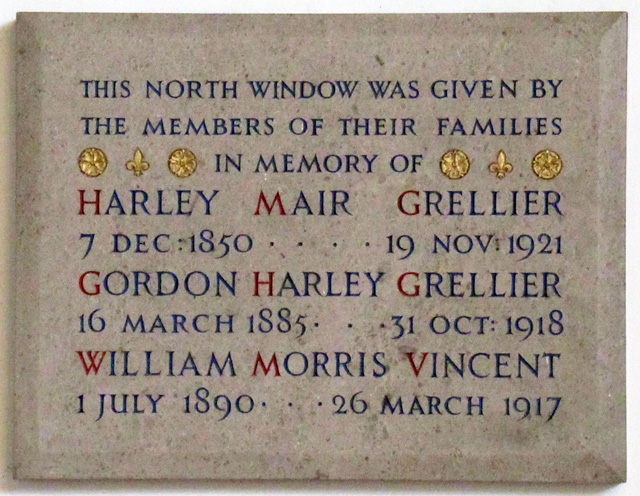 The Benedicite Window memorial plaque.
Photograph © Roger Morgan 2020
As noted in the wall plaque pictured above, the window was given by their families in memory of Harley Grellier (1851-1921), his son Gordon Grellier (1885-1918) and his son-in-law William Vincent (1890-1917). Both young men were killed in action during WW1 – in Gordon’s case on 31 October 1918, less than a fortnight before the Armistice – and are commemorated on the parish Great War memorial appropriately positioned immediately under the window. Harley was the Chairman of St Martin’s Church War Memorial Committee and lived to see the memorial’s dedication on Sunday 12 June 1921, dying a few months later, aged 70 – and the window memorial plaque is positioned just to the right of the War Memorial.
b. The “Bishops’ window” (No 9)

The “Bishop’s Window”
Photograph by Roger Morgan © 2019
The three-light “Bishops’ Window” is the work of Archibald Nicholson. As noted in relation to his windows (Nos 3 & 5) in the South Transept aisle, under the Gallery, he was a younger brother of Sir Charles Nicholson – the architect of the 1907/08 rebuild of St Martin’s east end. Like the under-gallery windows, this one was installed in 1909. The parish magazine for April 1909 notes that Sir Charles donated the central light, as alluded to in the window’s text, of which more below.
The window shows three of the most prominent bishops over the centuries of the Winchester Diocese, of which Epsom was part until the Diocese of Guildford came into being in 1927. (The Diocese of Winchester was originally the diocese for the whole of Wessex, with the Bishop’s seat in Dorchester in Oxfordshire. In 660, the seat was moved to Winchester. Some areas to the north and west were allocated to newer dioceses. Even so, the Victorian diocese covered an area stretching from the Isle of Wight to the Thames, and the Bishop had his Palace on the banks of the Thames near what is now Southwark Cathedral. As the population grew, the area now covered by the Diocese of Southwark was transferred to the Diocese of Rochester in 1877. Southwark became a diocese in 1905.)
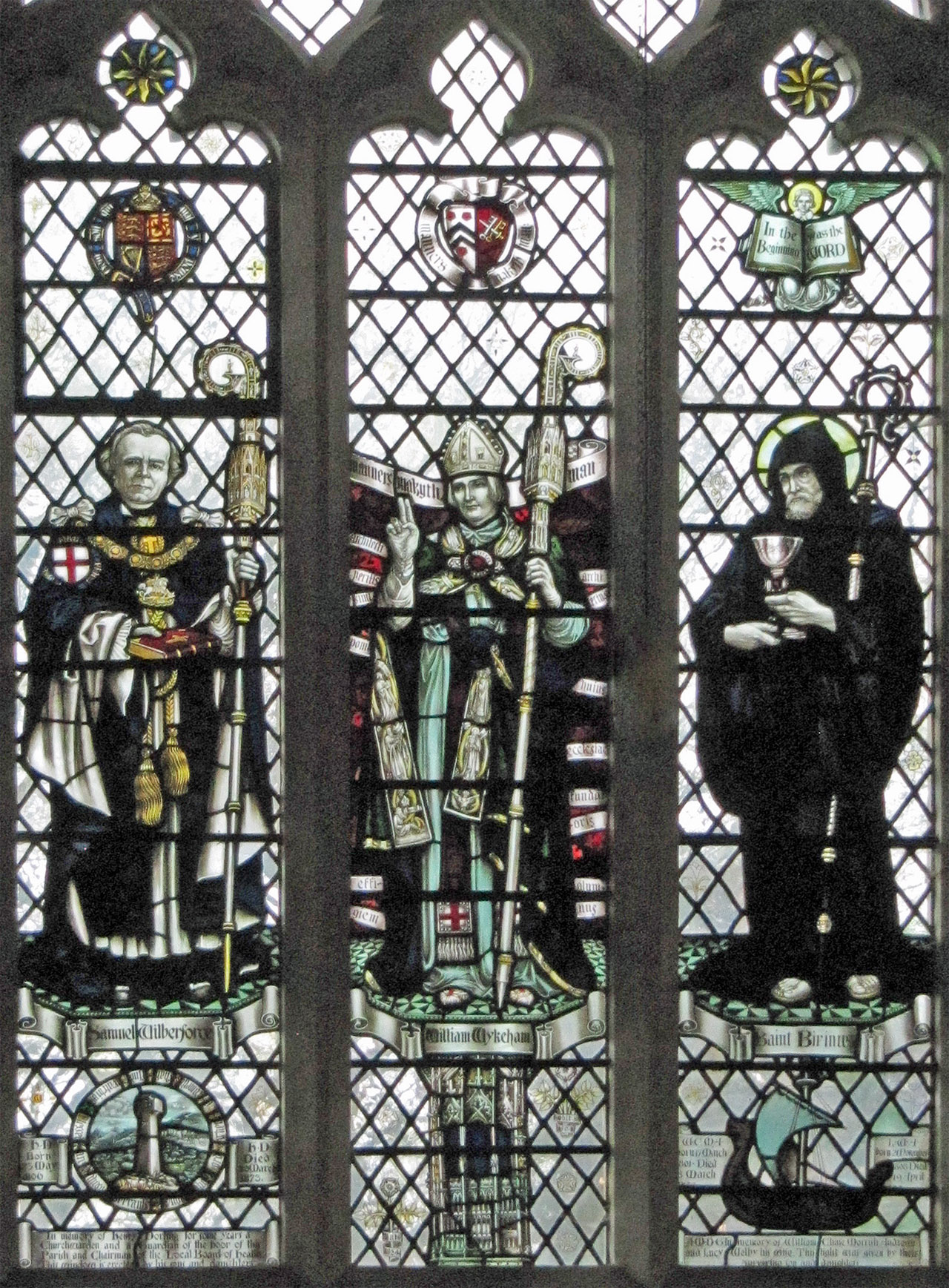
Click on this thumbnail to see the main part
of the Bishops’ Window in more detail
In chronological order, the bishops depicted in the window are as below.
St BIRINUS (c 600-650, the first Bishop), in the right hand light.
Birinus landed at what is now Southampton in 634, not long after the landing in Kent of the first Christian missionary, St Augustine, in 597. He and his team worked their Christian mission roughly as far as Bracknell. Above the figure of Birinus is an angel holding a Bible which shows the opening words of St John’s Gospel “In the beginning was the word”. The boat below the figure indicates his landfall at Southampton. The words under the boat are “AMDG In memory of William Chase Morrish Andrews and Lucy Welby his wife. This light was given by their surviving son and daughters.” This husband and wife’s dates are noted in the text each side of the boat: to the left of the boat, “WCMA born 17 March 1801; died 8 March 1857”; and, to its right, “LWA born 21 November 1808; died 18 April 1896”. (Lucy was the younger sister of Henry Dorling – in whose memory the Wilberforce light of this Bishops’ Window was given.)
WILLIAM WYKEHAM (circa 1320-1404 and Bishop 1367-1404), in the centre light
William was instrumental in founding the College at Winchester and New College, Oxford, the arms of both of which are at the top of the light. He was clerk of the works when much of Windsor Castle was built, and did much to popularise the perpendicular style of architecture, hence the architectural decoration under his figure. Behind William’s head is his motto, the well-known “Manners Makyth Man” – as also seen in his arms at the top of the light.
As noted above, this central light of the window was given by the architect of the 1907/08 rebuild, Sir Charles Nicholson, who had a special interest as a graduate of New College and emphasised his interest in the architecture promoted by William of Wykeham. Interwoven into each side of the figure are the Latin words: “Archetecti ponit effigiem architectus hujius ecclesiæ fundatoris alumnus” – a free translation of which is: “The architect of this Church as a former student placed a likeness of his college’s founder and architect.”
SAMUEL WILBERFORCE (1805-1873 and Bishop 1870-1873) in the left hand light.
Samuel was the son of William Wilberforce, the campaigner against the slave trade. Alongside his ecclesiastical role, he was a scientist and Fellow of the Royal Society. He was unconvinced by the science behind Charles Darwin’s theories and is – perhaps unfairly – best remembered for his participation in the famous 1860 British Association debate with Thomas Huxley (a prominent supporter of Darwin) in which he asked whether it was through his grandmother or his grandfather that Huxley considered himself descended from a monkey.
Before his appointment to Winchester, Wilberforce was Bishop of Oxford and, as such, was ex officio Chancellor of the Order of the Garter. As Bishop of Winchester he became the ex officio Prelate of the Order. The window depicts him standing under the Royal arms and wearing the robe of Order. He is wearing round his neck what is known as “The Great George”, showing a figure of St George on horseback slaying the dragon.
Samuel’s tenure as Bishop was cut short by his accidental death in 1873. He was on the way home from a Confirmation at Epsom College when he fell off his horse on Abinger Common, near Dorking. As shown in the photograph below, the spot is marked by a memorial – as also pictured in the window, underneath the figure. (Because of Samuel’s sudden and tragic death, there are more memorial windows to him in the original Winchester Diocese than to any other person.)
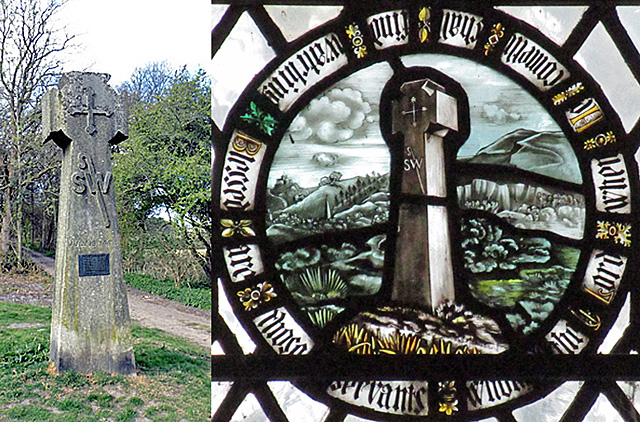 Left: The Wilberforce memorial on Abinger Common in 2014,
cc-by-sa/2.0 – © Dr Neil Clifton – geograph.org.uk/p/4437146
Right: Detail from St Martin’s Wilberforce window,
Photograph by Roger Morgan © 2020
The text around the image of the memorial is from Luke 12:37 and reads: “Blessed are the servants whom when the Lord cometh he shall find waiting.”
As noted in the text at the bottom of the light it is “In memory of Henry Dorling, for some years Churchwarden and Guardian of the Poor of the Parish, and Chairman of the Local Board of Health. This window is erected by his sons and daughters.” His dates (born 25 May 1806 and died 20 March 1873) are shown each side of the memorial roundel.
[Note: Window 10, in the Choir Vestry, was covered in the first section of this article about “Three generations of the East Window”]
THE LADY CHAPEL (11. St Francis, 12. St George & 13. Crucifixion)
The three sets of windows in the Lady Chapel were originally the work of Frederic Charles Eden, who also designed the “Northey Window” (No 6) in the South Transept. While his East Window (No 13) – depicting the Crucifixion – remains, the preparatory windows on the north of the Chapel (according to the Parish magazine of September 1908, of the Last Supper and the washing of the disciples’ feet) were “maliciously damaged” beyond repair in 1945.
As described below, the two replacements – both dated to 1946 – are on entirely unrelated themes. They are the work of Gerald Smith, for many years the partner of Archibald Nicholson – whose work is found in the under-gallery windows (Nos 3 & 5) and the Bishops’ Window (No 9) – and, having taken over after Archibald’s death in 1937, still trading as Nicholson’s. The “Nicholson” replacements were dedicated on 15 December 1946 – when, interestingly, the parish magazine report refers to the chapel as the “Morning Chapel”.
a. St Francis (No 11)

Photograph by Roger Morgan © 2019
(Click to enlarge)
The 1946 Smith/Nicholson replacement window nearer the entrance to the Chapel has St Francis of Assisi in the central light. He is known as the patron saint of animals and the natural environment: the well known hymn “All creatures of our God and King” is a paraphrase of Francis’s “Cantico di fratre sole”. In these windows, he is surrounded by a number of animals (rabbits, hedgehog, stoat, squirrel and lamb) and birds (including a lark, robin, magpie, pheasant, blackbird – and, above the figure, a chaffinch, sparrow, starling, thrush, bullfinch, great tit and pigeon).
b. St George (No 12)

Photograph by Roger Morgan © 2019
(Click to enlarge)
The other 1946 Smith/Nicholson replacement window has St George in its central light. As noted at the bottom of the light to its right, the window is “In memory of Lt. Col James Buller the 57th Regiment and H.M. Bodyguard to the King who died at Down Hall, Epsom 7th of August 1895.” As noted early in this article, it was in memory of other members of the Buller family that the present East Window (No 1) was installed in 1923. (The arms partly shown in the corner of this right hand light are those of the Buller family.)
In the window’s left light is the badge of James Buller’s 57th (West Middlesex) Regiment of Foot. This infantry regiment was raised in 1755 and, in 1881, was amalgamated with the 77th (East Middlesex) Regiment of Foot to form the Middlesex Regiment.
c. The Chapel’s East Window (No 13)
 The Lady Chapel’s main (east) window.
Click to enlarge.
The Chapel’s five-light East Window is the work of Frederick Charles Eden (as were the the originals of what are now the St Francis and St George windows discussed immediately above).
As noted at the bottom of the rightmost light, the window is “To the glory of God and in loving memory of Charles Frederick Murray, born Dec 9 1833, died Dec 13 1904”. Charles, a partner in the solicitors Murray, Hutchins & Stirling had moved to Epsom in the 1870s and lived in the then grand Woodcote Hall with his wife, Catherine Georgiana (née Tanqueray-Willaume) and their large family. (One of his sons, Frederick Dymoke Murray, was killed in action during the Boer War. Another, Charles William Murray, was killed in action during WW1.) The widowed Catherine eventually left Epsom for Kensington where, aged 91, she died in 1932.
The central light of the window depicts the crucifixion, with Mary Magdalen at the foot of the Cross. The scroll behind the cross reads “Consummatum est” being “It is finished”, the words spoken by Jesus as he died (John 19:30). Around Jesus are four angels holding chalices to catch the blood from his wounds ready for the Communion. Above Jesus’s head is the sign “I.N.R.I”, the abbreviation of the Latin “Iesus Nazarenus, Rex Iudæorum” (“Jesus the Nazarene, King of the Jews”). This was the notice that, in contempt of those who had brought Jesus to him for crucifixion, Pontius Pilate had put up in Hebrew, Latin and Greek (John 19:19-20).
At the top of that central light is an angel carrying a chalice to heaven under whom is a scroll with the Latin “Calix salutaris” – “the cup of salvation” foreshadowed in Psalm 116:13. (It is an interesting technical note that the yellow/gold of this angel was achieved not by pigmented paint but by baking a silver oxide stain on the outside of the glass.)
Around the frame of the central light are several medallions of“IHS” (the first three letters of Jesus in Greek). Similar medallions may be seen in the outer four lights, in these cases being the first letter of the name of the person depicted, from left to right:
• Longinus, the name traditionally given to the Roman soldier who pierced Jesus’s side with the spear he is shown holding here (John 19:34);
• Mary, the mother of Jesus;
• John, the disciple; and,
• (unhistorically) St Martin of Tours, the church’s patron saint.
At the top of their lights are the named symbols of the four evangelists – from left to right: Matthew; Mark; Luke; and John.
In the tracery above the main lights are the ten “instruments of the Passion”, each one surrounded by a crown of thorns, from left to right: a lamp, carried by the soldiers who came with Judas to arrest Jesus; nails; hammer and pliers; spear and hyssop; whip and pillar; and cock – and above: sword; dice; bag of Judas’s “30 pieces of silver”; and three pots of ointment carried by the women who came to anoint the body of Jesus on Easter morning.
[Note: Windows 14 & 15, in the north wall of the chancel, were covered in the first section of this article about “Three generations of the East Window”]
Roger Morgan © 2020
With special thanks to Canon Adrian Esdaile for permission to develop material
from his 2018 booklet “The stained glass of St Martin’s, Epsom”
from which, unless credited otherwise, come the images above.
POSTSCRIPT
The Revd Canon Adrian Esdaile was a parish priest throughout his ministry. Since retirement in 2001, he has been associated with St Martin’s Church. His post-retirement study of stained glass led to the writing and publications of his 2018 booklet “The stained glass of St Martin’s, Epsom” – from which, with kind permission, the article above has been adapted. In the concluding section of his booklet, he wrote:
THE ART OF STAINED GLASS AND THE IMPORTANCE OF LIGHT
The early golden age of English stained glass was 1100 to 1530 and some of the best in Europe was to be found in England and can still be seen in Canterbury, Wells, York, Gloucester, Salisbury and Lincoln as well as in some of our Parish Churches such as Fairford, Stratford-upon-Avon and Malvern Priory or in Oxford colleges in the Chapels of All Souls, New College and Merton.
While much glass was destroyed at the Reformation, the revival of the art of stained glass in the style of the medieval craftsmen came in the 19th century, led by Thomas Willement (who made the original East Window in St Martin’s, with some remnants of it to be seen in the choir vestry). The art of stained glass expanded widely and rapidly.
An enthusiast, Birkin Hayward, surveyed, visited and recorded all the stained glass which existed in the County of Norfolk in 1984. Victorian Glass can be seen in 772 Churches in almost 1,400 windows. No one living in Norfolk (or in this country for that matter) lives more an a few miles from a stained- glass window. Some of the best-known artists were involved – such as William Morris and Henry Holiday. But at the same time little-known workshops grew up locally too. Some of their work was brilliant and inspiring – other glass was poor and garish – perhaps it is a matter of taste.
Robert Eberhard, who lives in Epsom, has, over many years, developed a record of Victorian windows in South and South-east England, recording 24,827 windows in 4,034 churches with the details of subject matter, designer, artist and donor. His website indicates the massive nature of this research.
Stained glass is seldom to be seen in galleries or exhibitions. It is to be viewed in situ, where it was intended to be to enhance the architecture of the building and to give additional meaning to the liturgy and life of the Church. So, in St Martin’s there is the Ascended Christ in the East Window, the Healing Christ in the West Window, the Crucified Christ in the East Window of the Lady Chapel, the wonder of God’s creation in the North Transept and in the Lady Chapel, and the Light of Christ over the Gallery.
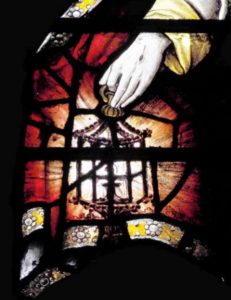 Detail from the Gallery window
Stained glass is unique because of the relationship between glass and light. We all value the existence of light and we see colour on a surface through the reflection of light. But with stained glass the light is refracted through it: at night there is nothing to see.
Moira Forsyth, who was the artist of a substantial amount of the glass in Guildford Cathedral and lived in Farnham, wrote:
“The perfect harmony of architecture, sculpture and glass work to the same end: the greater glory of God. The creative expression of faith can find no more perfect medium than glass with its glowing, joyous colour; more than any other, with the sole exception of music, it is capable of saying to us all ‘Sursum Corda’ … Lift up your hearts.”
Light has to be one of the most wonderful aspects of God’s Creation and the words of Jesus “I am the Light of the World” have to be one of his greatest communications with us. There is a great depth of meaning and even theology as we look at the stained glass in our Church.
Adrian Esdaile © 2018