
St MARTIN’S CHURCH, EPSOM
SOME HISTORIC IMAGES
As noted on our main page for St Martin’s, the first church on the site seems certain to have been in the eighth century – Saxon times. The structures that had housed that were lost when a new church was built in about the twelfth century, to which a chancel was added in the thirteenth century.
The Medieval building

The earliest known image (dated 1790) of the medieval building.
Image (1998.144-026) with thanks to Bourne Hall Museum.
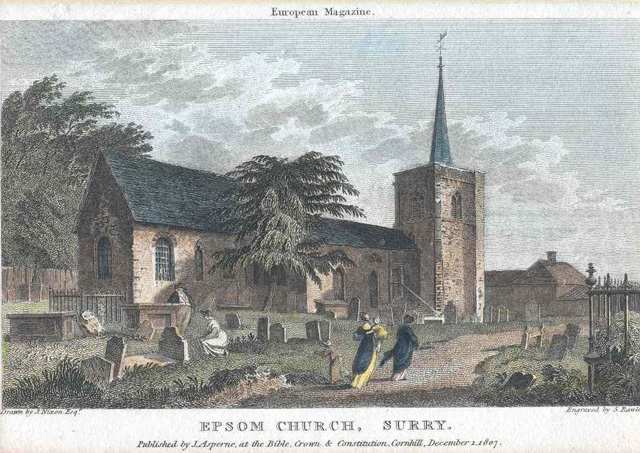
A view from the north east, dated 1807.
A hand-coloured copper engraving by J. Nixon, engraved by S. Rawle, and published by J. Asperne.
Image (1998.144-028) with thanks to Bourne Hall Museum.

A view from the south east, circa 1810.
Painting by Joseph Powell (1780-1834).
Image (GP4755) with thanks to Bourne Hall Museum.
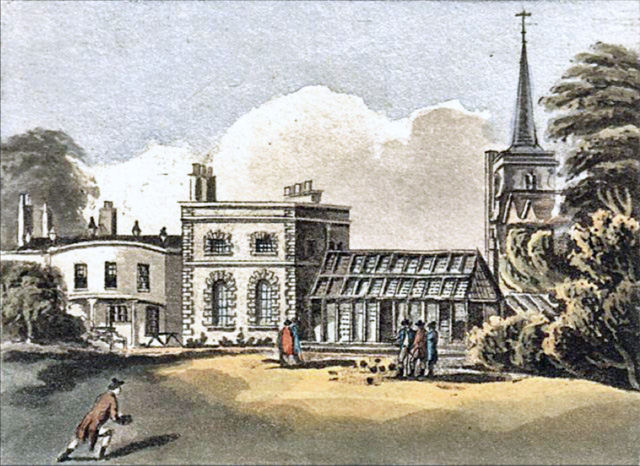
Pitt Place, with the west end and tower of St Martin’s behind, c. 1816.
Water colour by John Hassell (of whom more below).
Image (2018.007-002) with thanks to Bourne Hall Museum.

Another north east view, understood to be from about 1820.
Image (2018.007-002) with thanks to Bourne Hall Museum.
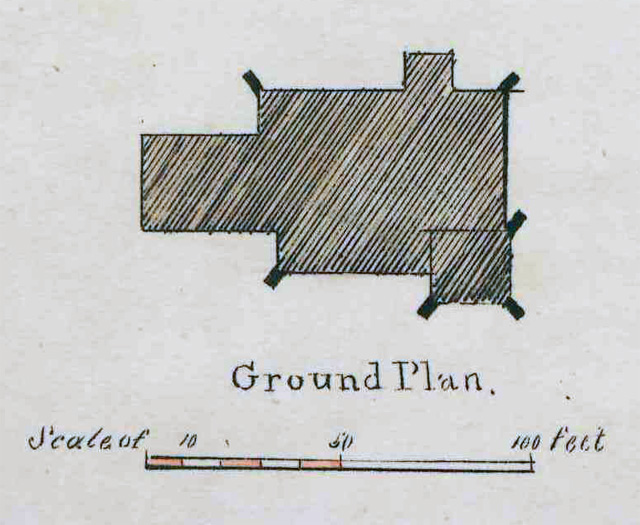
Detail of the Ground Plan at the foot of the previous image.
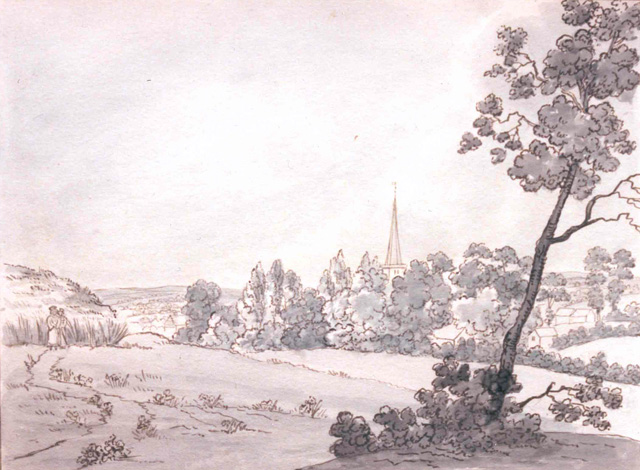
This line and wash drawing towards St Martin’s, dated 1800, is a reminder that Epsom was far smaller then.
Image (1998.144-009) with thanks to Bourne Hall Museum.
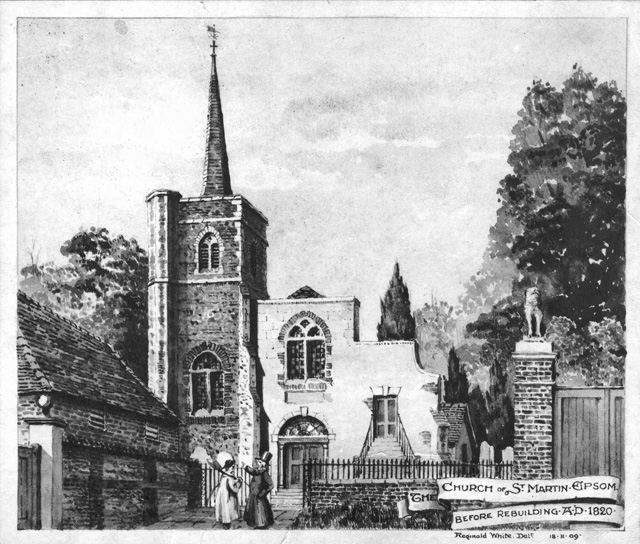
The west end of the medieval church in 1820 – taken from the 1935 Christmas card from Reginald White of “Millwood”, Epsom, and apparently a reproduction of his 1909 copy of an 1820 original, five years before the rebuilding.
Image (1998.007-016) with thanks to Bourne Hall Museum.
The 1825 rebuild
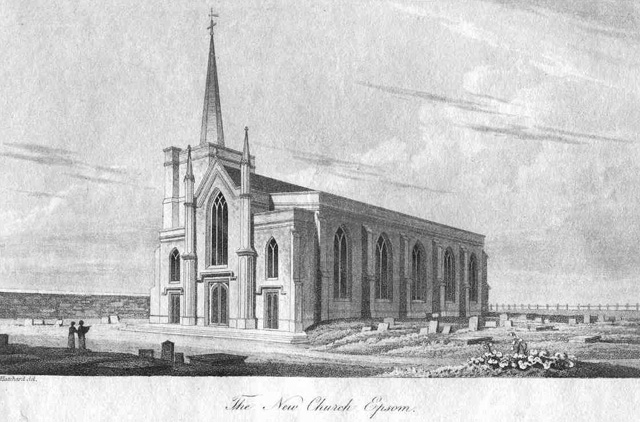
A drawing by the architect, Charles Hatchard, of his design for the new St Martin’s.
Image (1998.144-033) with thanks to Bourne Hall Museum.
The new building quickly attracted the interest of topographical artists who, in those days before photography, found a ready market (among the wealthy upper classes) for images – both for general display and to add to their copies of thinly-illustrated books such as Manning & Bray’s “History and Antiquities of the County of Surrey“.
One such artist was Gideon Yates (1790-1837). He was a maritime insurance broker in Lancaster until 1803 and then spent most of 1804 in Lancaster Castle imprisoned for debt. It is thought that he developed his painting during this time as as a means of paying his way out. By 1811, had become a professional – and prolific – artist of places across England. We have three of Yates’s pictures of the new St Martin’s as below – all dated 1825, the year of the new church’s consecration.

A “West View” of the new St Martin’s by Gideon Yates, 1825.
Image (1995.171-019) with thanks to Bourne Hall Museum.
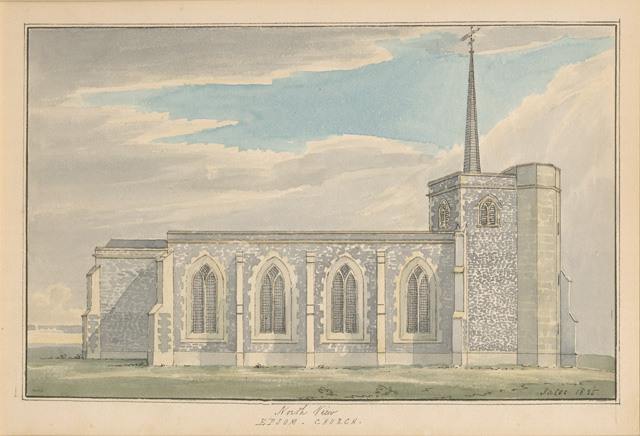
A “North View” of the new St Martin’s by Gideon Yates, 1825.
Image (1998.144-01) with thanks to Bourne Hall Museum.
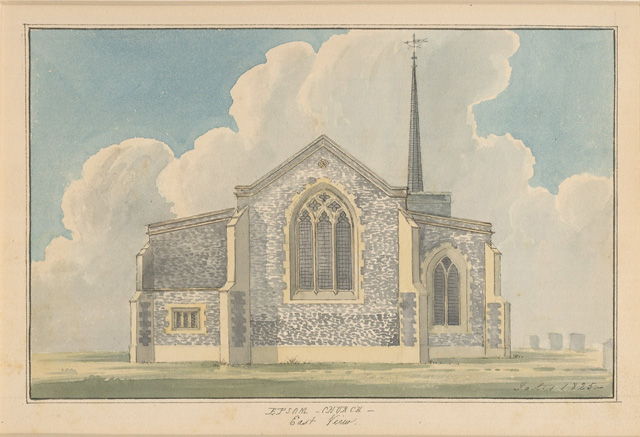
An “East View” of the new St Martin’s by Gideon Yates, 1825.
Image (1998.144-019) with thanks to Bourne Hall Museum.
Another well-known topographical artist of the time was John Hassell (1767-1825). He appears to have been born in Wales, and first appeared as an exhibitor at the Royal Academy in 1789. He was a popular drawing-master and published several works on the techniques of drawing and painting in watercolour. He also published books of topographical views – several of which (notably his “Views of Gentleman’s Seats Adjacent to London” of 1804-1805, “Picturesque Rides and Walks within Thirty Miles of the British Metropolis” of 1817-1818 and “Excursions of Pleasure” of 1823) show Hassell’s deep interest in Surrey. His partnership with his equally talented son, Edward (who died in 1852) generated over 2,000 watercolours of Surrey’s churches, houses and other buildings. During a visit to Epsom in 1824, John painted the then St Martin’s Vicarage. In 1825 (the year of his death), he was in Epsom again to paint the new St Martin’s.

A West view of he new St Martin’s by John Hassell, 1825.
Image (1995.171-003) with thanks to Bourne Hall Museum.
Indeed, John Hassell’s other two pictures – of the new church’s interior – seem to make clear that his visit was before the work was completed. (Compare these with his son’s 1830 pictures a little further below.)
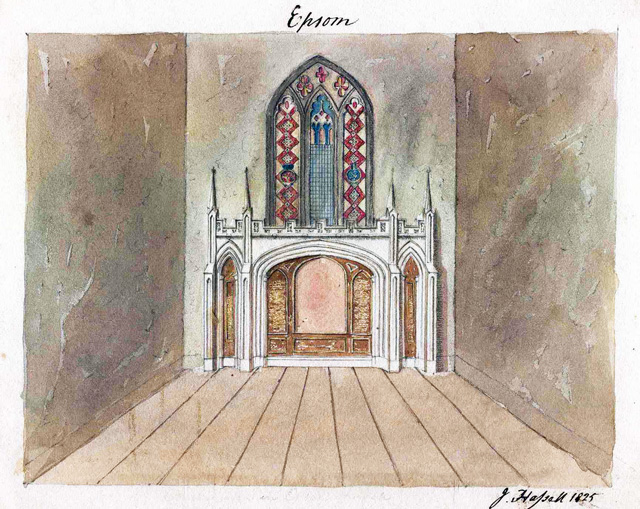
Inside the new St Martin’s, looking east by John Hassell, 1825.
Image (1995.171-004) with thanks to Bourne Hall Museum.
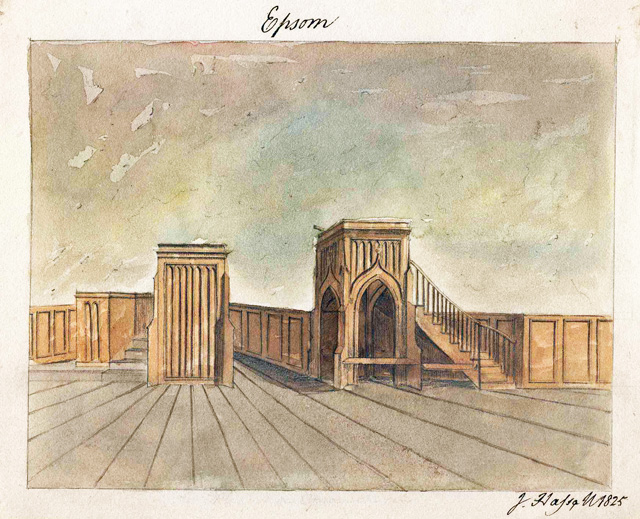
Inside the new St Martin’s, from the east looking west towards the pulpit and lectern
(and ignoring the nave beyond).
Painting by John Hassell, 1825 (1995.171-004) with thanks to Bourne Hall Museum.
The following two pictures are the work of John Hassell’s son, Edward. Painted in 1830, five years after his father’s pictures, they show a now fully operational church.
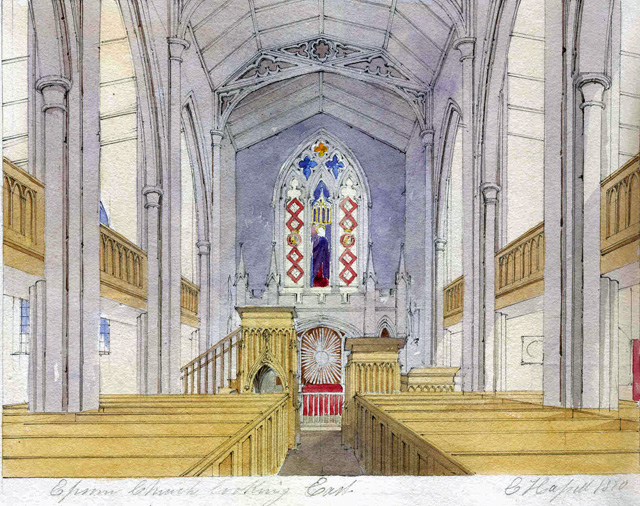
Inside the new St Martin’s, “looking East”, by Edward Hassell, 1830.
Image (1995.171-011) with thanks to Bourne Hall Museum.
Unlike his father’s 1825 painting, this shows the east end in its final form. The window is now complete, as is the decoration in the arch below. A contemporary record describes the central feature as a “glory” – a sun of radiating rays done to represent embroidery in gold upon a crimson velvet ground – surrounding the name JEHOVAH in Hebrew characters.
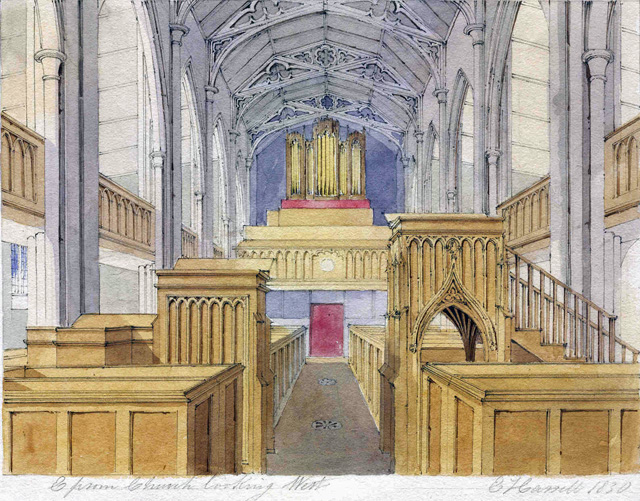
Inside the new St Martin’s, “looking West”, by Edward Hassell, 1830.
Image (1995.171-012) with thanks to Bourne Hall Museum.
The main structure of the nave shown in the above image is as remains today: the early 1900s rebuild was only half realised, leaving this 1820s nave attached to the 1907 transepts and chancel. The differences from the same view today are the later removed: galleries; organ (rebuilt to the north of the chancel); and pulpit & lectern (the height of which would have enabled the preacher and reader to be better seen from the then galleries).
The first photographs
In 1860, the enterprising George Snashall of Epsom Bazaar was a pioneer in the new field of photography, offering reprints of his small (9 x 6 cm or 3¾ x 2½ inches) pictures of local scenes for 6d. (2½p), which the Bank of England’s inflation calculator reckons is £3 at 2018 prices.
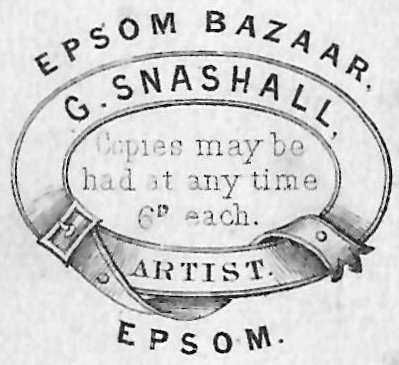 The back of one of George Snashall’s prints.
From the writer’s collection.
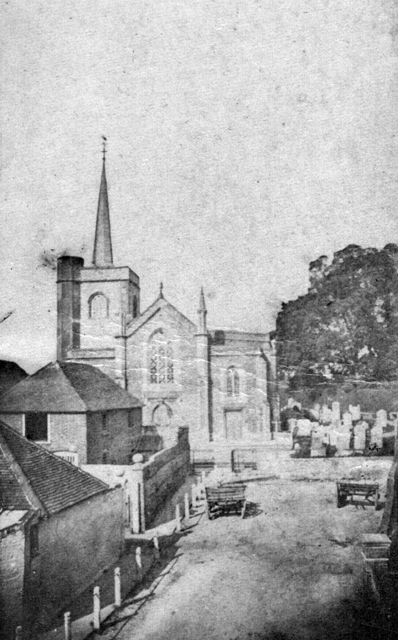
George Snashall’s 1860 photograph of St Martin’s west end, with the old brewery in the foreground.
Photograph from the writer’s collection.
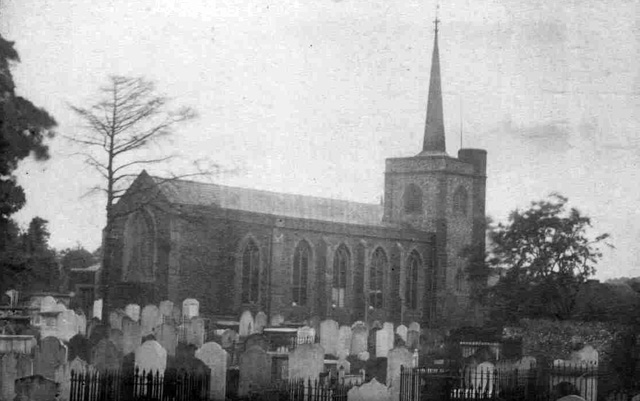
George Snashall’s 1860 photograph of St Martin from the north.
Photograph from the writer’s collection.

George Snashall’s 1860 photograph of the then Mead House (a site now occupied by Novellus Court at 61 South Street, alongside Rosebery Park) taken looking east from what is now Mounthill Gardens.
As in the enlarged inset, St Martin’s now lost spire can be seen in the distance.
Photograph from the writer’s collection.
And here is another “Snashall” photograph, probably a little later (and perhaps not by George – see further below).
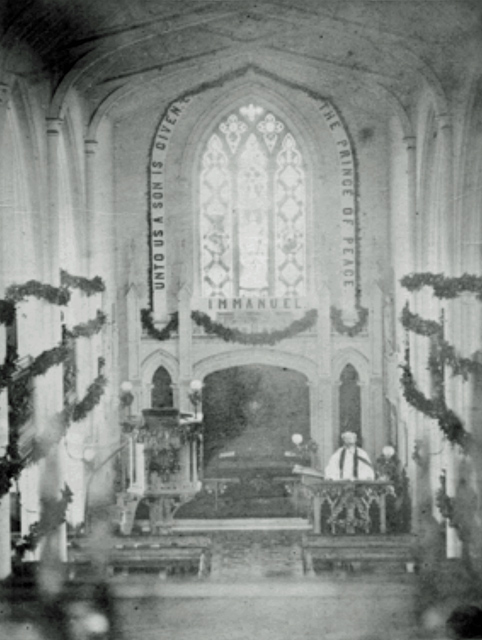
A Christmastime service under way in about 1870, photographed from the East Gallery.
Photograph by “C. Snashall”, courtesy of Howard Bluett.
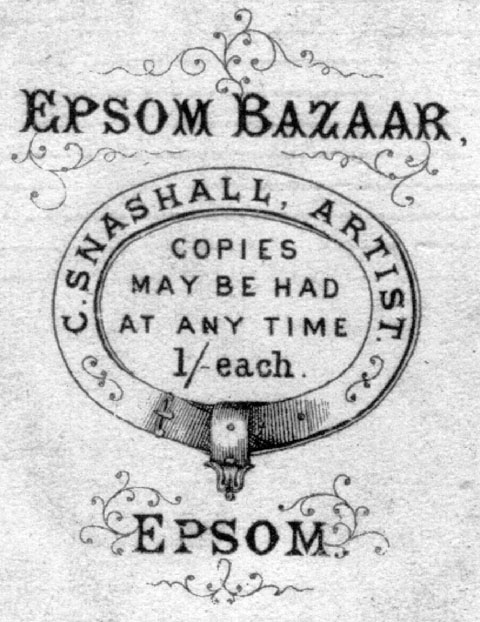
The stamp on the back of “C. Snashall’s” photographs – copies now sold for 1/- (5p).
(Or is the “C” a wrongly engraved or badly printed “G”?)
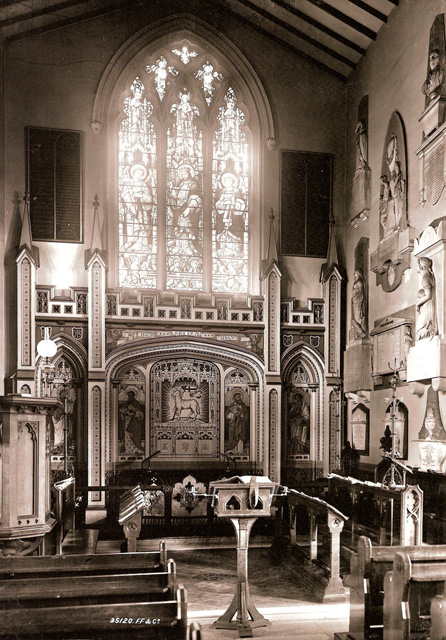
An 1895 postcard of St Martin’s Chancel and High Altar.
Picture with thanks to the Epsom & Ewell History Centre.
In the 1895 postcard above, note not only that the “glory” seen in the 1830 watercolour (and the 1870-ish photograph?) has been replaced by a painting of the “Lamb of God” but also that there is a different East Window, this one having been installed in 1892. The many memorials seen on the walls here were taken down for the 1907 rebuilding and then refixed – mainly away from the Chancel – in the enlarged church. The East Window was also saved and, for the most part, reinstalled in a window over the new Gallery – see our separate article on the stained glass.
While the reredos behind the High Altar was lost in the rebuilding, the “Lamb of God” painting was saved and may now be seen in the North Transept of St Martin’s- see below.
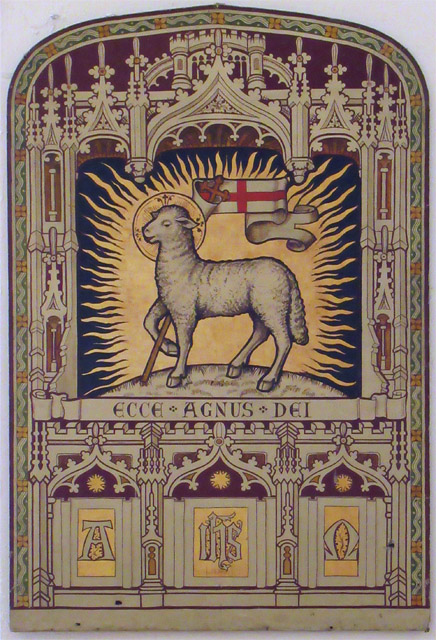
The “Lamb of God” painting first seen in the 1895 postcard.
Photograph by Roger Morgan © 2020.
This painting shows the “Lamb of God” in the traditional form, holding a flag with his front leg. Immediately under the main image are the Latin words “ECCE AGNUS DEI” – being John the Baptist’s welcome of Jesus as recorded in John 1:29, “Behold the Lamb of God“. The central IHS monogram under that are the first three letters of “Jesus” in Greek (Iota-Eta-Sigma). That is flanked by the Greek Alpha and Omega – an appellation of Jesus in Revelation 1:8, 21:6, and 22:13.
1907 – Laying the foundation for the new East End
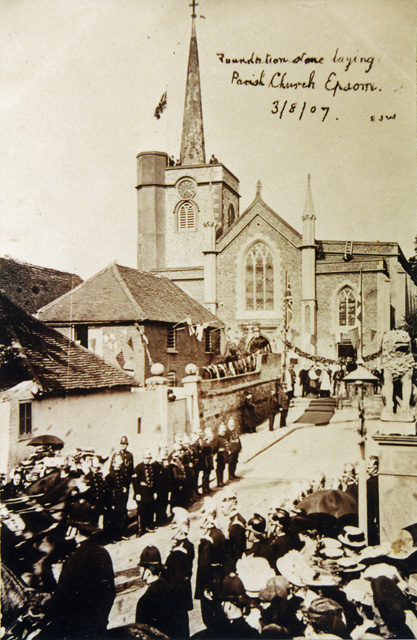
“Foundation Stone Laying Parish Church Epsom 3/8/07”
Photograph (OP 9912) with thanks to Bourne Hall Museum
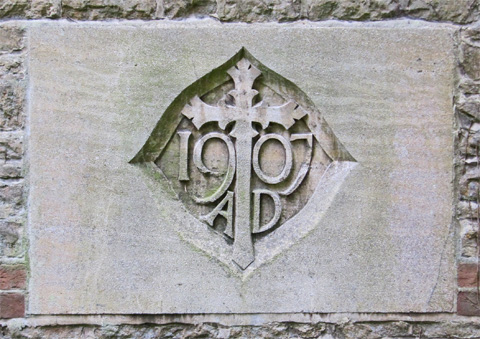
The 1907 foundation stone, underneath the East Window on the external wall.
Photograph by Roger Morgan © 2019.
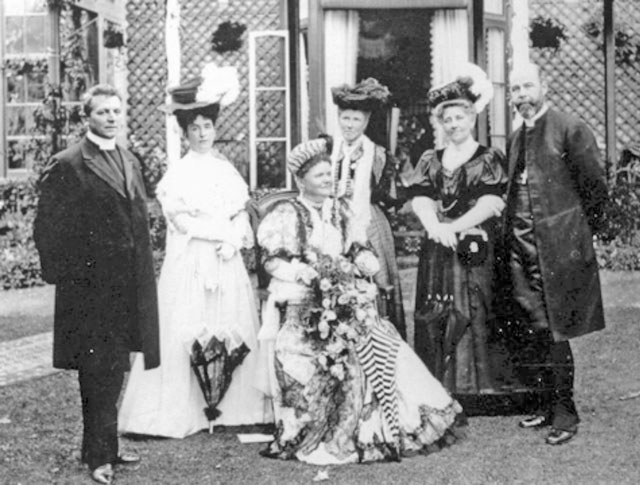
This photograph was taken to commemorate the laying of the foundation stone.
(L to R): The Vicar, the Revd W Bainbridge-Bell & his wife, Ethel;
the Duchess of Albany (seated – and who formally “laid” the stone); Mrs Florence Northey;
Mrs Ryle and her husband the Bishop, the Rt Revd Herbert Edward Ryle.
Image (OP 2373) courtesy of Bourne Hall Museum.
And, to round off this sequence –
 Aerial view of St Martin’s and its surroundings in 1928.
Photograph with thanks to Britain from Above.
Roger Morgan, 2019 & 2020