
Percy George Rathbone (1874-1926)
&
Mary Elsie Rathbone (1877-1957)

Mary (aged 24) & Percy (aged 27), shortly before their 1902 marriage.
A detail from the family photograph further below.
The memorial to this couple in St Martin of Tours, Epsom is, as on the left of the photograph below, the image of angels plus dedication (enlarged in the inset). For reasons we’ll come to later, this is out of view of the congregation – being, to them, on the rear face of a structural pillar between the chancel and a small chapel to its south.
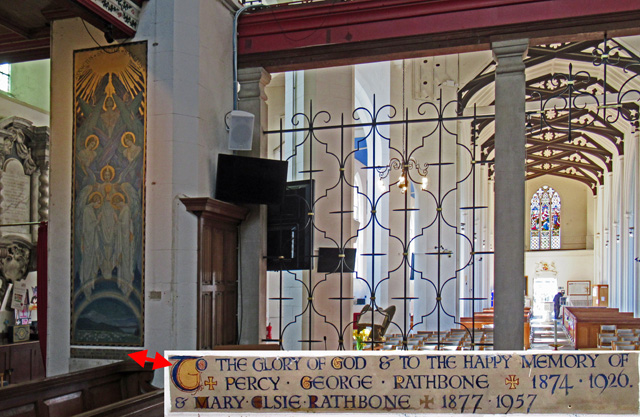
The Rathbone memorial (and, enlarged in the inset, its dedication) in St Martin’s, Epsom.
Photograph by Roger Morgan © 2021.
First, some background to the individuals. Percy George Rathbone was the first child of Harry and Clara Rathbone. The parents had married on 3 July 1873, in 30 year old Clara’s parish church in Weybridge. 35 year old Harry was a corn merchant, having gone into business with his father, Edward, at Stone’s End, SE London (about 200 yards south of Borough Market) – being the “& Son” in the overprinted stamps below.
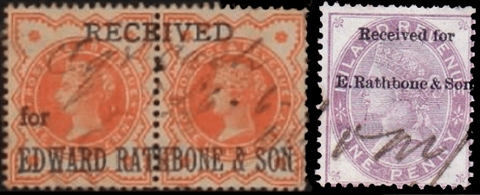
Overprinted stamps for Edward Rathbone & Son, Corn Merchants.
With thanks to Mark Matlach © 2021
In neither case was this their first marriage – although, some years before, both had wanted it to be so. Their parents, however, had forbidden the match on grounds of the close blood relationship: Harry and Clara were first cousins (Clara being the daughter of Harry’s aunt Emma, who had married Thomas Seamer).
Accordingly, Harry’s first marriage was on 4 October 1866 to Charlotte Ann Paxton (incidentally, the great niece of Sir Joseph Paxton, designer of the Crystal Palace) with whom he had four children. Sadly, she died in 1872, aged only 25. Clara née Seamer’s first marriage was to Charles Duncum on 4 April 1867. They had a child together before, sadly, he also died well before his time in May 1870, aged only 26.
Harry and his first wife had lived at Paxton Villa, Church Road, Brixton. By the time of the 1881 Census (and probably soon after their 1873 marriage), Harry and Clara were living at “Herbert Lodge“, Streatham with the two of the children from their previous marriages plus the three that they had had together. This was a prosperous household, supported by four domestic servants.
As noted above, Percy was their first child together. His birth was registered in the Lambeth District (which covered Streatham) in Q3 1874. While the precise date is not currently clear, he was baptised in their parish church of Immanuel & St Andrew, Streatham Common on 22 July 1874.
By the time of the 1891 Census, the family had moved a short distance to “Wood Lodge” in Tooting Bec Road, but 16 year old Percy is found as a pupil at Charterhouse School in Godalming. The 26 year old Percy was back in the family home (still “Wood Lodge“) in time for the 1901 Census and, with his paternal half-brother Harry junior, had joined the family business as a “Corn Merchant”.
As to Percy’s future bride, Mary Elsie, she was born on 9 September 1877, the third child of John and Elizabeth Hooper. (She seems always to have been called by her second name of Elsie, and we follow suit here.) The 1881 Census records the family living at “Deepdene”, Coventry Park, Streatham. Her 35 year old father is listed as “Manager, Hooper’s Telegraph & India Rubber Works” – which were in Mitcham. (The company was founded by his father, William, to exploit his invention of a vulcanised rubber core for submarine telegraph cables – see the Wikipedia entry.) Her 25 year old mother was assisted in looking after the three young children by a live-in nurse, and the household was supported by two domestic servants.
The family was still at that address for the 1901 Census. There were now six children, all still unmarried. The two oldest were listed as “engineers”, presumably working in the family firm alongside their father, now styled “Electrical Engineer MJEE (Employer)”. No occupation is listed for 23 year old Elsie.
The Hoopers and the Rathbones lived quite near each other. Doubtless mixing in the same circles, Percy and Elsie met and fell in love. During a visit to the spectacular Blickling Hall in Norfolk (now a National Trust property), Percy formally proposed marriage to Elsie, and she accepted.
Shortly before their wedding, the engaged couple were photographed as part of a relaxed family gathering, understood to be at the Rathbone parents’ new home of “Bramleigh“, Leigham Court Road, Streatham.

A mid 1902 family photograph.
Back row: Elsie & Percy (the subjects of this article); Dora Rathbone (Percy’s sister); Bertie Duncum (Percy’s maternal half-brother); & Harry Rathbone Jr (Percy’s paternal half-brother).
Front Row: Harry Rathbone Sr (Percy’s father); Molly Rathbone (Percy’s sister); Clara Rathbone (Percy’s mother); & Kitty Rathbone (Percy’s paternal half-sister).
Image courtesy of Rowan Banks © 2021
According to family memory, the (most unusual, for the period) jollity of the scene was the result of Percy’s fooling about by wearing Elsie’s hat. And another twist to the complicated family histories here is that the photographer was Elsie’s brother, Fred Hooper, who in 1904 married Percy’s sister, Dora.
It seems that, before his parents moved to “Bramleigh“, Percy had set up home on his own. When he and Elsie married on 3 June 1902 (in the church of Immanuel & St Andrew, Streatham Common – where Percy had been baptised in 1874) the Register records Percy’s address as 4 Peladon Terrace, Streatham Common. It seems that they continued there for some years: their first child, Christopher was born in the Norbury District in 1908 and baptised in the now familiar church of Immanuel & St Andrew, Streatham Common.
The family then moved to Epsom, where the couple’s second child, John, was born in 1910. The 1911 Census records the family of four living in Links Road. In memory of the place of their engagement, they named the house “Blickling“. The now 36 year old Percy is listed as a “Corn Merchant (Employer)”. The family of four was supported by a domestic nurse and two servants. Three more children followed: Michael in 1912; Mary (known as Wendy) in 1916; and Angela in 1918. In the 1920s, the family moved within Epsom – to Ashley Road, and a house they also called “Blickling“, later numbered 59.

Elsie and Percy in about 1916 with the first three of their five children.
Photograph with thanks to their grandson, Mark Rathbone © 2021.
Outside his work, Percy was a keen singer – with a “fine tenor voice” – and had joined the choir at St Martin’s, Epsom. He and Elsie were also early recruits to the Epsom Choral Society, founded in 1922. Sadly, Percy died on 5 November 1926 – aged only 52. The Probate record of administration of his £7,930 estate being awarded to his widow and others notes that he died at his Epsom home of “Blickling” in Ashley Road – but that he was also “of” 74 Great Tower Street, London.
When the widowed Elsie decided to have a memorial to her late husband, she wanted it to be placed near where he had sung in the church choir – hence its location where, while out of sight for the congregation, it could be seen by choristers. As to its theme, she remembered that, in early 1926 (the year that Percy died), the Choral Society had rehearsed sections of J S Bach’s monumental B minor mass for the Leith Hill Musical Festival. Walking home from a rehearsal, Percy said that he thought the Sanctus (a modern translation being “Holy, holy, holy Lord, God of power and might…”) to be the greatest piece of choral music ever written. The friend with whom the couple were walking home then remarked that a book she had been reading described the phrases of the Sanctus as being “like angels’ wings ascending in prayer and worship“.
Elsie commissioned Jessie Bayes (1878-1970) – a well-known painter, illuminator, muralist and designer in the Arts and Crafts and later Pre-Raphaelite tradition – to produce a suitable work to that brief. The first step was a smaller draft image, still in the family and – as shown below – currently hanging in the home of grandson Mark Rathbone.
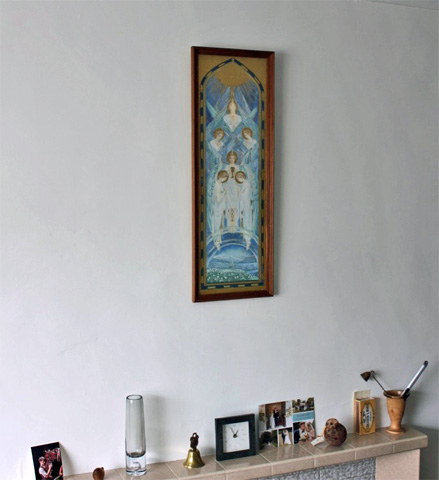
Jessie Bayes’s draft for the mural (see below for a more detailed view of the painting itself).
Photograph with thanks to Mark Rathbone © 2021.
On the way to securing the necessary permission from the Diocese for the final mural in St Martin’s (again undertaken by Jessie Bayes), two small changes were made to the initial design: the central angel was given a chalice to hold, better linking the mural to the Mass (or Communion); and (for Elsie, the particularly evocative) “Sanctus, Sanctus, Sanctus” was added (but only to the final mural) in an arc at the top of the image.
The result was the mural pictured towards the head of this article, and it is touching that the dedication (as in the insert there) mentions the “happy memory” of Percy. The actual mural – and the first draft – may be viewed in greater detail by clicking the double image below.

The Rathbone memorial – first draft on the left and the final mural on the right.
Click the images to enlarge.
Photographs by Mark Rathbone (left) and Roger Morgan (right), both © 2021.
Contrary to the impression given by the double image above, the two pictures are quite different in size. The memorial is 74 cm x 259 cm (29″ x 102″ or 2’5″ x 8’6″) – just over 12 times the area of the first draft, the height of which is almost exactly the same as the width of the memorial proper. (The linear relationship is about 1:3.5.) It should also be mentioned that the memorial is not a true mural since it is not painted on the wall itself but on what seems to be paper (and thus doubtless painted in Jessie Bayes’ studio rather than in situ) then mounted on a board, on which the border is painted. The whole sits flush in a custom-made recess in the column. Both pictures are signed in the bottom right corner with the artist’s JB monogram enclosed in a circle.
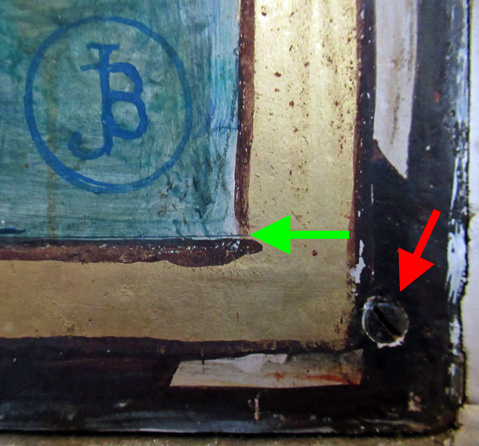
The bottom right hand corner of the memorial showing: the JB monogram;
the edge of the material on which the main picture was painted (arrowed green); and
one of the screws (arrowed red) holding the whole in place.
Photograph by Roger Morgan © 2021
As noted above, the memorial’s location was chosen so that it would be clearly seen by Percy’s fellow choristers. It was also in clear view from the Sanctuary, and it is reported that the Revd Clive Pattison Muir – Vicar of St Martin’s from 1924 to 1938 – found it a great inspiration when he was at the High Altar looking down the church.
Elsie never remarried. The 62 year old was still at “Blickling” in Ashley Road at the time of the September 1939 Register, listed with the conventional “Unpaid Domestic Duties”. There is one currently closed record at the address – perhaps one of the children. Also a resident then was the 24 year old Norman Blow, listed as “Clergyman (Church of England)“. He was the Priest in charge of St Martin’s then daughter church of St John’s at the junction of Church Road and East Street, Epsom and also Assistant Chaplain of the County Hospital & Institution (that became today’s Epsom General Hospital).
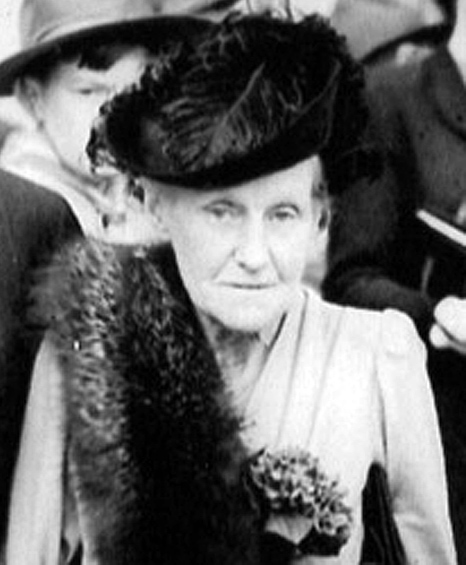
The 69 year old Elsie on the steps of St Martin’s immediately after the Q2 1947 wedding of her daughter, Angela, to Robert Warburg.
Photograph with thanks to Mark Rathbone © 2021.
In the mid-1950s, Elsie moved from Ashley Road to a smaller and newly built house at 19 Woodcote Close, Epsom – and that was her home address when she died, aged 80, on 21 September 1957. One of the executors of her £4,943 estate was her son, Christopher Percy Rathbone – who, continuing the family tradition, was noted as a “member of the Corn Exchange“. Elsie’s name was then added to her husband’s memorial in St Martin’s.
Roger Morgan © 2021
POSTSCRIPT
As may be seen in Hazel Ballan’s article about Pollie, Elaine and Rosalind Ogilvy, Elsie and Percy’s daughter Mary (known as Wendy) was fortunate to survive the 1935 accident that resulted in the death of her friend Elaine Ogilvy. In June 1940, Elsie and Percy’s son John – by now a lieutenant in the Royal Navy – married the late Elaine’s sister Rosalind. In 1942, John was Mentioned in Dispatches as Lieutenant Commander of HMS Orion. He continued to serve with distinction and, in 1944, was awarded the Distinguished Service Cross.