
EPSOM CHORAL SOCIETY
Founded in 1922: Registered Charity 273757
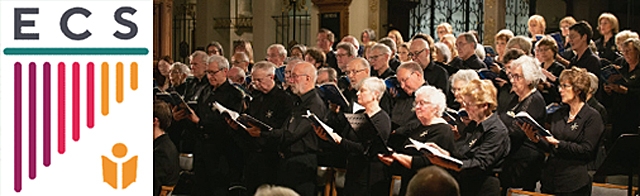
The Society’s logo and some members during a recent concert at St Martin’s, Epsom.
To mark Epsom Choral Society’s centenary in 2022, this article sets out something of its long history of music-making. Details of its present and future activities may be found on the Society’s website.
Origins
Epsom Choral Society (“ECS” hereafter) was founded in 1922 by Humphrey Milford, publisher to the University of Oxford and head of the London operations of the Oxford University Press. (He was knighted in 1936.) ECS – then much smaller than its 100 or so members today – met for rehearsals in the Milford’s now-lost home at 7 St Martin’s Avenue, Epsom.

Robin Milford, ECS’s first conductor.
Left: On holiday in the 1920s during his time with ECS (copyright acknowledged).
Right: in later life, photograph with thanks to the Robin Milford Trust.
The purpose was to give his 19 year old son, Robin Milford, experience as a conductor by taking part in what was then the Leith Hill Musical Competition (renamed the Leith Hill Musical Festival in 1950 – and both incarnations are “the LHMF” hereafter). The musically-gifted Robin had, in 1921 (the previous year), gained a place at the Royal College of Music to study with, among others, Gustav Holst and Ralph Vaughan Williams (“RVW” hereafter).
Background note on the LHMF: The event was founded in 1905 – among others, by Margaret Vaughan Williams, older sister of the 33 year old and then little known RVW. (RVW remained devoted to the annual event and, alongside his increasing fame, continued as the festival conductor until 1953.) The Festival, as it is now, is for amateur choirs across Surrey – but, thanks to RVW’s involvement, it became nationally known and able to attract top flight professionals to participate in its concert elements. Each year, members from member choirs combine to rehearse with the festival conductor a major choral work, such as Verdi’s Requiem. This is then performed, with a full orchestra, at a public concert in Dorking – near RVW’s beloved Leith Hill Place. A few weeks later, three days of competition (again in Dorking), is between three subgroups of the member choirs. During a morning session, they compete with each other in excerpts of various competition pieces to a piano accompaniment (and, following professional adjudication, win various awards). In the afternoon, they combine to rehearse the complete works with the festival conductor and full orchestra, which are then performed in a public evening concert.
(A couple of early recruits to ECS were Percy and Elsie Rathbone, to whom there is a significant memorial in St Martin’s, Epsom.)
Shortly before his 1926 graduation from the Royal College of Music, Robin took some time off from ECS. Ronald Dussek stood in for his ECS duties that year, and ECS was then dormant for a couple of years.
Apart from his graduation, Robin was doubtless distracted by preparations for marriage. His fiancée was Kirstie Newsom – an able viola player and singer with a fine voice. They had probably first met when, before the Milfords’ move to Epsom, they had been near neighbours in Ashtead (where Kirstie was governess to the grand-daughters of Victorian composer Sir John Stainer).
On 16 July 1927, Robin and Kirstie married at St Mary the Virgin, Headley. The Register entry for these two mid-20 year olds uses their names as registered at birth, namely “Robert” and “Kathleen”. It also records that Robin was resident in Headley at the time, with Kirstie being from Westbury on Trym, near Bristol. Anyway, the couple then made their home at 7 Meadway, Epsom and, in time for the 1929 LHMF, Robin re-engaged with ECS. However, to free up time for his composition (which resulted in a number of well-regarded instrumental and choral pieces) and other music-related work, he then formally stood down from ECS in 1934.
His successor as the ECS Music Director was the 25 year old William Cole, the organist at St Martin’s Church, Dorking and music master at Dorking County School. (At this point ECS rehearsals moved to the Church Room of St Martin’s, Epsom and that has been its principal base ever since.) Through William’s involvement with the LHMF, he became friendly with RVW – succeeding him as the Festival Conductor in 1954.

William Cole at the organ in about 1950.
Image (a movie screenshot) with thanks to the William Cole Church Music Trust at St Martin’s, Dorking.
Like so many other social activities, ECS and the LHMF were suspended during the Second World War. By the time things restarted in 1945/46, William Cole had succeeded to the Chair of Harmony and Composition at the Royal Academy of Music and stood down from ECS. However, he maintained his links with the Society by later becoming its honorary President from 1985 until his death in 1997.
After WW2
ECS relaunched itself after the War under the leadership of the 42 year old Richard P Fentiman of 20 Ridgeway, Epsom. While his day job was as an “Engineer’s Draughtsman”, he was a keen amateur musician and it is understood that it was through the pre-war ECS activities that he first met Margery Pullinger (“Madge”, as she was always known, the sister of local Frank Pullinger, who was also a keen ECS member): they had married in early 1939.
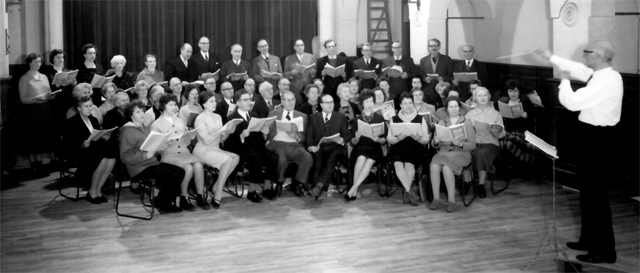
An ECS rehearsal sometime in the 1950s, held in the usual St Martin’s Church House, with Richard Fentiman senior conducting.
Under Richard Fentiman, ECS broadened its activities beyond the LHMF and began its popular Christmas Concerts in St Martin’s Church. For the decade from 1962, the ECS accompanist was Kathleen Hugman. She died in post in April 1972, aged 60. To commemorate her, the Society donated the Kathleen Hugman Silver Cup for use in the competition rounds of the LHMF.
When Richard stood down in 1976 (a couple of years before his death at the age of 74), he was succeeded by his 35 year old son, Richard E Fentiman. During Richard junior’s four-year tenure (after which he left to pursue his professional career in music and theatre), ECS began its regular Summer Concerts, also generally at St Martin’s.
This is a convenient point at which to mention that ECS was particularly honoured to have RVW’s widow, Ursula, as its honorary President from 1967 to 1977. She was a well-known poet and, shortly after her 1953 marriage to the widowed RVW, wrote words which, in 1995 and dedicated to LHMF, RVW set to music as “Song for a Spring Festival“. It has been sung at the opening of each competition day ever since.
During the 1980s, ECS was fortunate to have a series of three rising stars as Musical Director – Peter Chase, Murray Stewart and Nicholas Kok.
In 1991, ECS appointed Robin Kimber as Musical Director. During his 20+ year tenure, the choir grew: in numbers (to a membership of over 100); the range of the repertoire; and the quality of music making. In all this, ECS continued to be supported (as remains the case at the time of writing) by Marion Lea in the crucial role of rehearsal pianist: members never cease to be amazed at her ability to play anything at sight, as necessary merging or enhancing particular lines of a score.
A particular high spot came in 2007 when, in the relevant division of the LHMF, ECS came top in all but one of the lesser categories. The photograph below (taken the following week back in Epsom) shows most of the singers together with the silverware and banner prizes that were won and held for the next year.
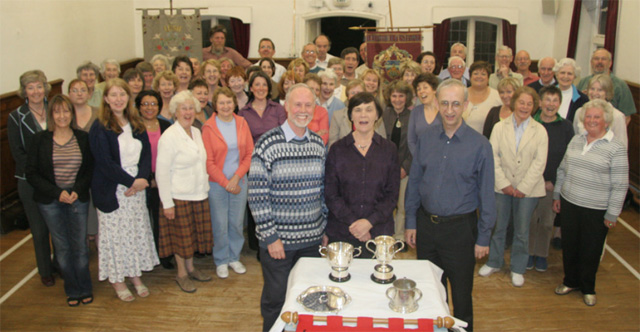
ECS and its LHMF prizes, 2007.
Immediately behind the table at the front are, from left to right: Chris Westbey (Chairman); Marion Lea (Accompanist); and Robin Kimber (Musical Director)
Photograph courtesy of Clive Richardson © 2021
After over 20 years in post, Robin Kimber stood down in mid-2015. After an autumn term in the very capable hands of Benedict Lewis-Smith (during which ECS sang Bach’s B minor Mass in concert), Julian Collings was appointed as Musical Director.
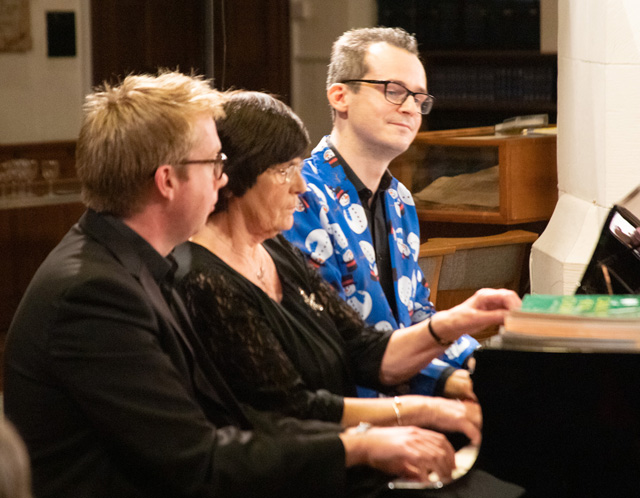
A six-handed piano piece at the December 2019 Christmas concert in St Martin’s, Epsom.
The pianists, from left to right, are: Benedict Lewis-Smith, Marion Lea and Julian Collings.
Photograph courtesy of Clive Richardson © 2021
ECS has continued to flourish with Julian Collings at the helm, and he has helped develop the Society’s repertoire in terms of both range and ambition. Particular high spots to date have been a rousing June 2017 concert of Opera Choruses in St Andrew’s, Cheam and, joined by the Barnes Choir and the Arcubus Ensemble (both also led by Julian), Elgar’s epic Dream of Gerontius in Southwark Cathedral in June 2019.

ECS and others about to perform Elgar’s Dream of Gerontius in Southwark Cathedral, June 2019.
Photograph courtesy of Clive Richardson © 2021
ECS recordings and commissions
ECS’s first published recording was a cassette tape of the 5 December 1992 70th Anniversary Concert.
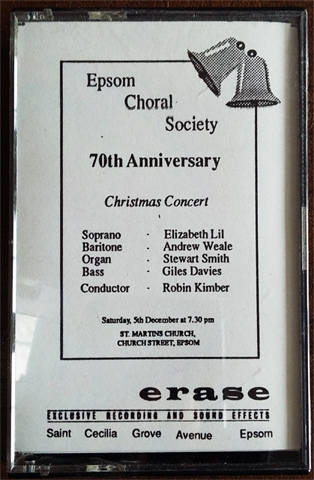
The 1993 cassette of ECS’s 70th Anniversary Concert.
(The boxed text and graphic were copied from the original concert programme.)
The first half of the 70th Anniversary Concert was a performance of that choral favourite, Fauré’s Requiem. The second half was of short pieces by various composers whose interesting links with ECS are worth setting out, as below.
- By Robin Milford, the Society’s founding conductor: This endris night; Cradle Song; God be in my head; In the bleak midwinter; Port after stormy seas; Bemerton Cantata No 3; & Two pieces for organ.
- By William Cole, Robin Milford’s successor (and ECS’s long-standing President): What child is this?
- By James Angel, the Society’s accompanist from 1934 to 1956: Villagers All (dedicated to both Richard Fentiman senior – the conductor under whom ECS restarted after WW2 – and ECS).
- By Felton Rapley, a former organist & choirmaster at St Martin’s who also played at a number of ECS concerts (and was nationally known in the 1940s and 1950s as the BBC’s theatre organist): Love came down at Christmas; & (arr) O sleep thou heaven-born treasure.
- By William Llewellyn, Conductor of the LHMF 1981-95, ECS conductor during the 1988 interregnum and, from 1997 to 2018, Bill Cole’s successor as ECS President): In the bleak midwinter (from his recently-published Novello Book of Carols).
- By Robin Kimber, the then ECS conductor: A Carol, to words by Anne Ridler (Robin Milford’s cousin) and dedicated to both Marion Lea (ECS’s accompanist since 1974) and the Society; & (arr) A Dutch Carol – in both cases, premiere performances.
Those pieces were sandwiched between four traditional carols (Hark the herald angels sing; Once in royal David’s city; God rest ye merry gentlemen; & O come all ye faithful) for audience participation.
With advances in technology (and graphics), ECS moved to CDs – and has issued four to date, the covers of which are illustrated below.
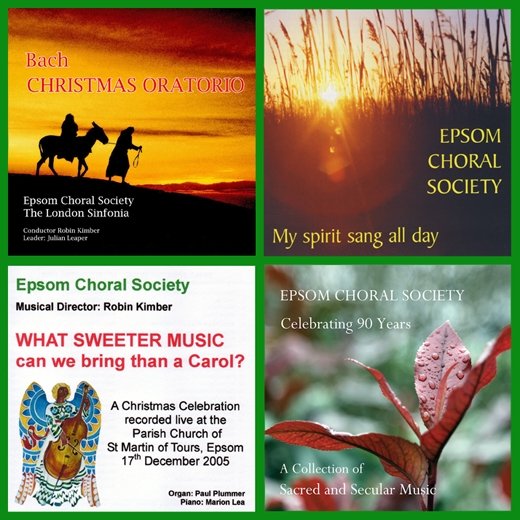
ECS’s four CDs (see below).
Those CDs are:
- top left – a live recording of the 16 December 1995 concert performance of J S Bach’s “Christmas Oratorio“;
- top right – a collection of short works from the Society’s repertoire, recorded in St Martin’s on 23 & 24 February 2001 – the title, “My spirit sang all day” (by Gerald Finzi), being one of the songs;
- bottom left – a live recording of the 17 December 2005 Christmas Concert at St Martin’s – the title, “What sweeter music can we bring but a carol?” (by John Rutter), being one of the pieces; and
- bottom right – “Celebrating 90 Years“, issued in 2012 to mark ECS’s 90th anniversary. It contains 18 short pieces by British (or British-based) composers – with two (one sacred and one secular) from each decade of the Society’s life. These had been performed at the June 2011 Summer Concert, but the album was recorded in St Martin’s on 28 & 30 September and 1 October 2011.
The Society has also commissioned two choral works, of which it gave the premiere performances:
- a setting of “I know that my redeemer liveth” by Cecilia McDowall and premiered in March 2009 as an interlude in Brahms’ “Ein Deutches Requiem”; and
- “O Joyful Soul” by Jonathan Willcocks and premiered in June 2018.
“O Joyful Soul” was commissioned in memory of Cecil Wiltshire (1920-2015), who had sung with ECS for 67 years – and had sung in the choir of St Martin’s, Epsom since the age of 9. It was funded from the generous legacy that he left the Society. The piece’s five movements were selected from religious and secular texts that encapsulated both his interests and his gentle and generous nature. To commemorate him, ECS donated the Cecil Wiltshire Cup for use in the competition rounds of the LHMF – and, on its first outing in 2022, the Cup was won by the Society!
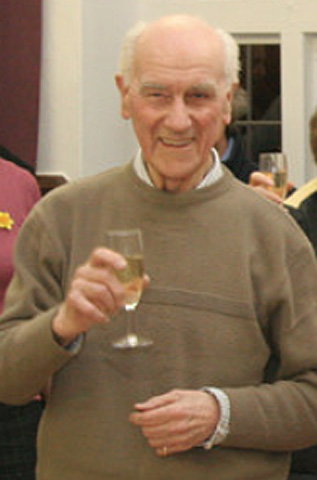
Cecil Wiltshire at an ECS celebration of his 90th birthday in March 2010.
Photograph courtesy of Clive Richardson © 2021
Summer Tours
In 1996, ECS undertook its first Summer Tour – on this occasion, to Epsom’s twin town of Chantilly. Only a proportion of members are able to commit to the three or four days away, but they are normally joined by “other halves”.
The core activity is, of course, singing – and the normal pattern is one or two free concerts for locals plus participation at a Sunday morning church service to provide anthems etc. Alongside this, there is of course social time and sightseeing.
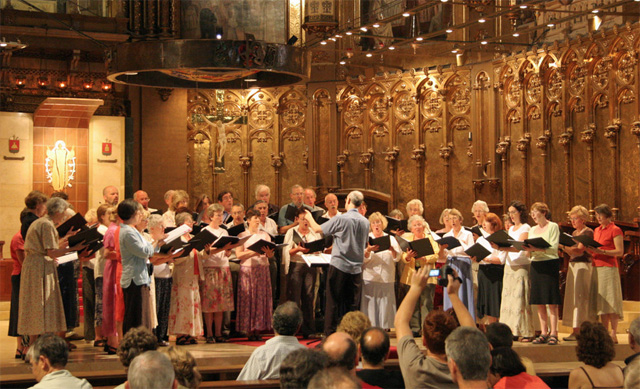
The concert in Montserrat Abbey, July 2005.
Photograph courtesy of Clive Richardson © 2021
There have been Summer Tours in most years since, a few within the UK but mainly to destinations in mainland Europe. These include: Klagenfurt (Austria) in 2000; Barcelona & Montserrat (Spain) in 2005; Lucca (Italy) in 2008; Utrecht (Holland) in 2010; Ypres (Belgium) in 2012; Cologne (Germany) in 2013.
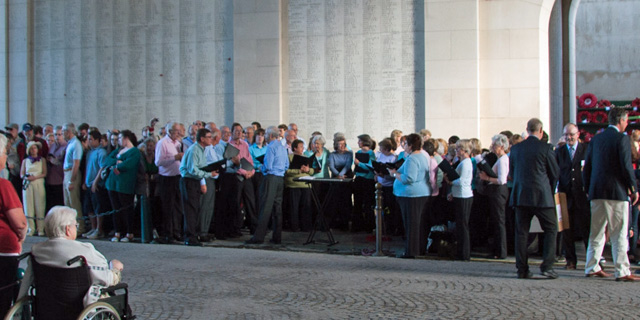
ECS members (in pastel tops) preparing to sing an anthem during the Last Post Ceremony at the Menin Gate in Ypres, 6 July 2012.
Photograph courtesy of Clive Richardson © 2021
Most of the Summer Tour destinations are in the UK’s nearest neighbour, France – most recently (at the time of writing) to Chartres in 2018. What a thrill it was to be able to sing Parry’s majestic “I was glad” in the magnificent acoustic of Chartres Cathedral!
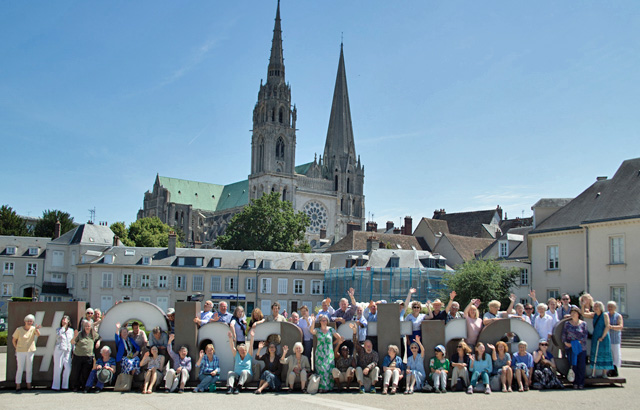
The touring group in Chartres, July 2018.
Photograph courtesy of Clive Richardson © 2021
Covid complications 2020-21
The rapidly escalating Covid pandemic led to the cancellation of the 14 March 2020 “Baroque Splendour” concert at two days’ notice. After a brief hiatus, the membership reconvened online, and produced a number of recordings stitched together from individual recordings. Socially-distanced rehearsals restarted with the aim of presenting the usual pre-Christmas concert in December 2020, but a resurgence of the pandemic led to the cancellation of that – again at two days’ notice.
Restrictions continued long into 2021 but, within the rules, the Society (having rehearsed in smaller groups) was, on 30 June, able to present a socially-distanced “Songs from the Shows” from the fourth floor of the Ashley Centre Car Park – which provided a generous acoustic! The concert was well-received by the online audience, and by others who happened to be within earshot.
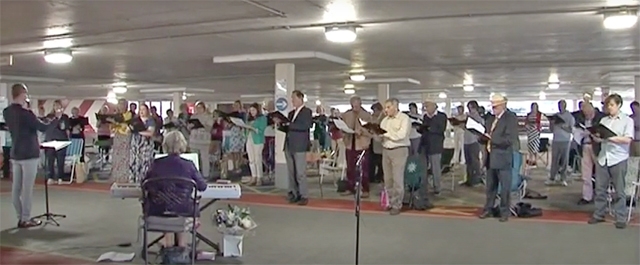 The 30 June 2021 “Songs from the Shows” concert presented online from the Ashley Centre Car Park.
Photograph courtesy of Clive Richardson © 2021
As Covid restrictions eased, the Society was at long last able to present – and to live audiences – both (in (November 2021) the “Baroque Splendour” concert that had to be cancelled in March 2020 and the usual December Carol Concert.
The 2022 Centenary
Fortunately, things had returned sufficiently to normal in the Society’s Centenary year to allow the year’s usual four concerts. The highlight of these was a sold-out and well-received presentation of Handel’s “Messiah” in Epsom Playhouse on 3 December.
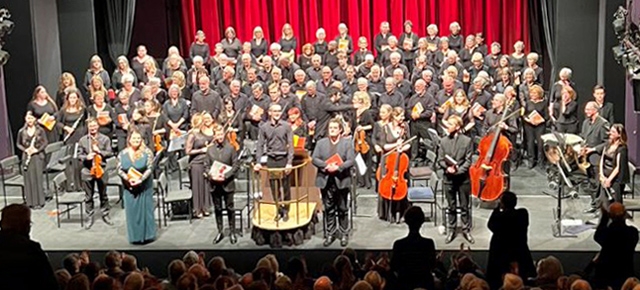 “Messiah” in Epsom Playhouse on 3 December 2022.
Photograph courtesy of Clive Richardson © 2022
Conclusion
The Society now moves into its second century. Details of forthcoming concerts are posted on the Society’s website. (Alongside music-making, ECS also makes some time for socialising and, indeed, runs a number of purely social events during the year.)
Anyone thinking of joining the Society is invited to contact the society’s Membership Secretary. While ECS does not audition, it does aim for high performance standards – and an ability to read music is invaluable.
Roger Morgan © 2022
with special thanks to long-standing ECS member and current President, Jon Pullinger, for his help in quarrying the archives.