
THE NUTHALLS
 P Nuthall & Co, 3-5 High Street, Epsom
Image courtesy of Bourne Hall Museum
Introduction
Percy Nuthall once had a shop in High Street, Epsom, comprising numbers 3-5. Number 3 was a domestic stores and the adjacent premises purveyed groceries. You probably think that there is nothing extraordinary about that and you’re right, apart from the fact that it looks an interesting and well-stocked enterprise, but I must draw your attention to the gate at the right-hand end, which presumably led to a yard. ‘Tea & Coffee Specialists’ it says, and thereby hangs this tale.
There was also a Nuthall shop at 5 Cheam Road, Ewell, run by Percy’s son, John Edward Nuthall. This later became the Imperial Wine Stores and was demolished in 1968.
 5 Cheam Road (as Nuthall’s)
Image courtesy of Bourne Hall Museum
 5 Cheam Road (as Imperial Wine Stores)
Image courtesy of Bourne Hall Museum
The (abbreviated) story of tea
Do not panic. This is not an article about tea as such, but we need to understand how this unassuming little leaf became the everyday and relatively cheap beverage we all know and why that wasn’t always the case.
This is a tea plant.
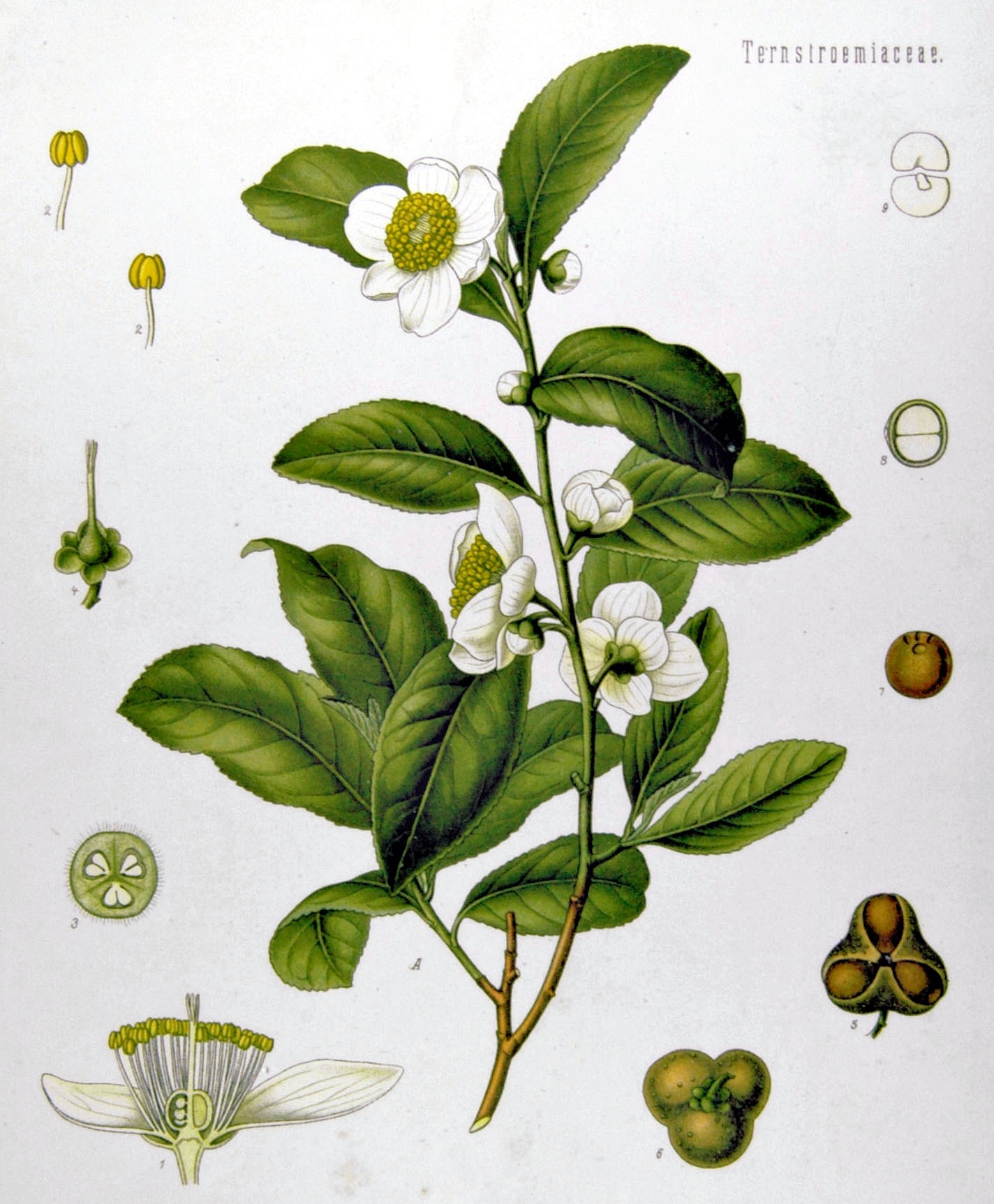 Camellia sinensis
Image source: Wikipedia
You can grow this yourself in the UK and produce your own tea (with an effort), but it’s not entirely frost hardy, as you would expect when it’s native to countries such as China, Japan and Korea. Legend has it that about 5000 years ago a dead leaf from a wild tea bush dropped into the boiled drinking water of a Chinese Emperor and the rest was history.
Tea was prohibitively expensive for centuries, on a par with silk or the finest porcelain, and it was only when the East India Company got in on the act that it began to be imported to Britain. It was very expensive in its own right and also heavily taxed (at 119% at one time); obviously, only the wealthy could afford it and the household supply was kept under lock and key. Here is a fine example of an old English tea caddy – note the keyhole.
 An English tea box
Photo by Hannes Grobe (CC-BY-SA-2.5)
Image source: wikimedia commons
Needless to say, the East India Company had a big hand in introducing tea production to India. In due course tea became more widely available in Britain and the price came down, making the beverage more accessible to the general population. Today many everyday teas are blends but there is still a market for what we might call pure speciality teas from particular areas, such as Assam and Darjeeling.
 Tea estate in Darjeeling
Image © Linda Jackson 2023
Origins of the Nuthalls
This family goes way back to the small village of Frostenden in Suffolk. A family tree on ancestry.co.uk has them there in the early 18th century. They seem to have been in various occupations and trades, such as farming, grocery, drapery, baking, but by the 19th century many of them had gravitated southward and, in particular, to Richmond and Kingston-upon-Thames, which is where we will pick them up.
Edward Nuthall the elder
Edward (born 1811 Frostenden) was a tea dealer and by 1841 he was at George Street in Richmond, Surrey with his wife Charlotte and his two eldest sons, Edward (aged one) and Thomas (two). By 1861 he had moved on to Eden Street, Kingston, still dealing in tea. It was this Edward who established a shop, E Nuthall & Sons in Market Place, Kingston and then apparently retired, leaving the & Sons to run the business.

Edward Nuthall’s little shop in Market Place, Kingston (immediately right of the statue).
The next building on the right (a printing operation at the time) eventually
became a very elaborate branch of Boot’s, which then took over the Nuthall
premises as well.
Image source: writer’s own collection
 ‘The elaborate Boot’s’ (back left) with the former Nuthall shop to its immediate left.
Image source: writer’s own collection
This Edward died in 1891 and, at the time, the Kingston tea dealers were his sons, John Frederick and Alfred.
We need to wind back now and look at what the Kingston people were up to and how it probably came about that Percy set up shop in Epsom.
The Kingston Bigwigs (KBs)
Basically, these were the aforementioned Alfred and John Frederick, who were in tea, plus George (brother of Edward the elder) and his son, Charles Edward, who dealt in wholesale confectionery. I don’t know exactly who did what at any given moment, but the firm still existed in some form long after Percy had set up his Epsom business.
 Afternoon Tea, Rosebery Hall, Nuthalls Ltd, Kingston-on-Thames
Image source: writer’s own collection
The webmaster and I thought this looked as near to The Ritz as you could get outside a major city and I will give you a flavour of all the Nuthall activities associated with it (source: The Surrey Comet, 25 November 1905 – this was a Saturday edition so that people could drool over the goodies at their leisure).
|
NOW OPEN! NOW OPEN!! NUTHALLS’ NUTHALLS’ NOTED SEASONABLE GOODS: BON-BONS, GAME PIES, CHRISTMAS CAKES, GALANTINES, CARLSBAD PRUNES, DRESSED HAMS, CRYSTALLISED & GLACE FRUITS, JORDANALMONDS, CHOCOLATES OF CHOICEST MAKES, IMPERIAL PLUMS, CAVIARE, MINCE MEAT, ELVAS PLUMS, MUSCATEL RAISINS, PULLED FIGS, PATES DE FOIE GRAS ARE THE CHOICEST OBTAINABLE BONBONNIERES, CRACKERS, COSAQUES, |
A lot of these fancy-sounding items were posh versions of plums and prunes (at a posh price, no doubt). Cosaques were not the exotica they sounded and were in fact Christmas crackers – the sort you pull rather than a component of cheese and biscuits.
I haven’t finished yet. There were more strings to the Nuthall bow.
|
NUTHALLS’ RESTAURANT. NUTHALLS’ ROSEBERY HALL NUTHALLS’ CATERING DEPARTMENT NUTHALLS’ quote most favourable terms for Private Dinner Parties, Banquets, Luncheons, Wedding Breakfasts, At Homes, Evening Soirees, &c. Specimen Menus, detailed and priced, free on application. Contracts for every description of Entertainment carried out in any part of England. SINGLE DISHES: – NUTHALLS’ NEW LIST with PRICES OF ANY SINGLE DISH required for Luncheons, Dinners, Balls or Wedding Receptions forwarded by post on application. |
All this gluttony and rich living is getting me down, so we’ll have an intermission. The next picture is the Sun Hotel, another Nuthall enterprise (notwithstanding the mis-spelt name on the caption). I can’t find out much about it, except that it hosted a large number of auctions, inquests and rowing club dinners etc.
 Sun Hotel & Nuthalls, Kingston-on-Thames
Image source: writer’s own collection
Are you ready for more rich living? No, me neither. As I said, these Nuthalls were Kingston bigwigs and two of them, the cousins Alfred and Charles Edward, were Mayors of the Borough, Alfred in 1883/4 and Charles Edward from 1884 to 1886 (two terms).
 Alfred Nuthall in masonic regalia
Image source: Robyn Nuthall ©2023
 Charles Edward Nuthall
By permission of Kingston Heritage Service ©.
We shall need to return to these people in due course, since they eventually produced a major sporting star, but for now we shall continue on the road to Percy Nuthall.
Edward the younger
Edward was the eldest & Son of the business and, presumably, would have been the senior man in due course. He was born in Richmond in 1839 and became a wholesale dealer in tea. He married Sarah Ann Nuthall in 1863. Sarah had been a Nuthall (from a baking family) before her marriage to Edward at King’s Lynn, Norfolk, and you don’t need to go far up the tree to find ancestry in Wrentham, Suffolk, which is a mere stone’s throw from Frostenden. However, I’m not going up there, or we shall be here for weeks.
It seems that all was not well with Edward. His brother-in-law, a surgeon, said he was in good bodily health but worried about a lawsuit and that he was a man of very excitable disposition who was sometimes very sanguine and sometimes very much depressed. This culminated in Edward’s suicide on the railway line near Norbiton Station on 14 July 1877, when he allowed himself to be struck by an oncoming train (source: The Surrey Advertiser and County Times, 21 July 1877).
It seems that Edward didn’t leave a will but his estate came out at about £5000 – over £600,000 in today’s terms – and Sarah inherited all of it, including the family home at King’s Road, Kingston.
By the 1881 census, Sarah was still in Kingston, with four of her children, the eldest of those being 12. Daughter Sarah Ann was at school in Islington and subsequently married Walter Southcombe, an advertising agent. Percy, the youngest, was just seven years old. In 1891 he was a tea dealer’s assistant – presumably with one or other of the older Nuthalls – but elder brother Herbert had become an electrical engineer. By 1901 only Herbert and Percy were at home with their mother, the former having changed his occupation to management of a printing works, and the latter was a commercial traveller in grocery.
Percy
It seems obvious that Percy was intent on setting up something of his own and, by 1905, according to Kelly’s Directory, he was in business as Percy Charles Nuthall & Co, grocers, at 5 High Street, Epsom. The premises were owned by James Ede (father of Chuter Ede) and Percy was licensed to sell beer and wine for consumption off the premises. In fact, Percy’s establishment was James Ede’s old shop.
 Cropped view of Percy Nuthall’s shop from a 1904 postcard
On 14 March 1906, Percy (described as a tea dealer of St Martin’s, Epsom) married Elsie Kathleen Chapple of Strand, at St Martin in the Fields. Elsie was the daughter of a solicitor who had business premises in London, but the family lived in Kingston.
In 1911 the Nuthalls were living over the High Street shop, but by 1921 the whole family had moved to 2 Randolph Road, Epsom. There were three children at this point, the eldest being John Edward Nuthall, who was 14.
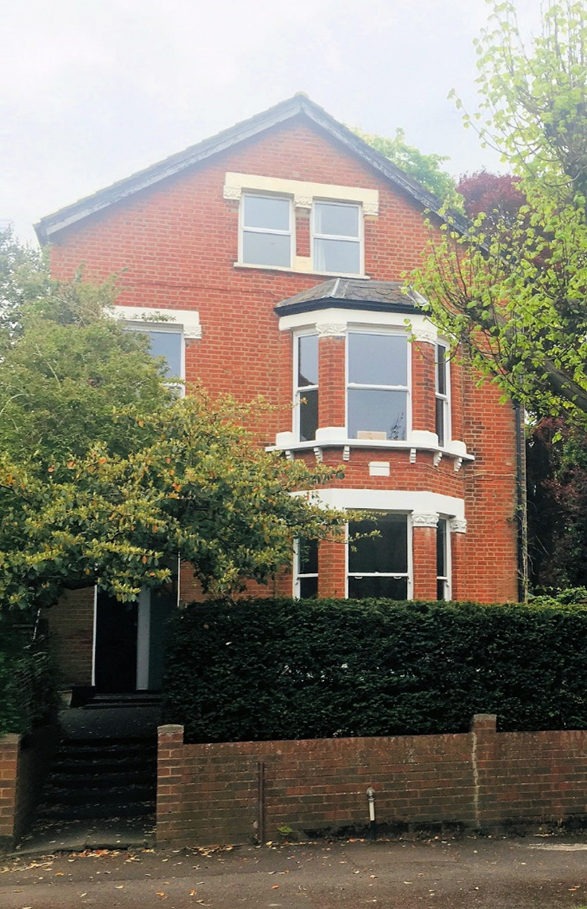 2 Randolph Road, Epsom, photographed in 2022
Image ©Ian Parker 2023
Percy died in 1933, having retired to Esher. Elsie was residing in the village of Gomshall, Surrey at the time of her death in 1981.
John Edward Nuthall died in 1995.
Betty May Nuthall
As mentioned some time back, there was a major sporting star in the Nuthall family. Believe it or not, I had heard of this lady, but I knew only that she was something to do with tennis (before my time).
 Betty May Nuthall
issued by John Player & Sons
colour relief halftone cigarette card, 1936
2 5/8 in. x 1 3/8 in. (67 mm x 35 mm) overall
Reference Collection
NPG D47361 (CC BY-NC-ND 3.0)
© National Portrait Gallery, London
She is included here because she was a direct descendant of George Nuthall the Kingston confectioner, father of the mayoral Charles Edward. Her father was (Wilfred) Stuart Nuthall, born 1883 Kingston, son of William Henry N, who was the nephew of Charles Edward. There were too many male Nuthalls for them all to be Kingston Bigwigs and Stuart seems to have become something clerical on the railways, later becoming a hotelier (the Hotel Stuart on Richmond Hill); he died in 1924.
Apparently it was Stuart who taught Betty to play tennis (her mother was also a keen tennis player). You can read all about Betty’s stellar career here
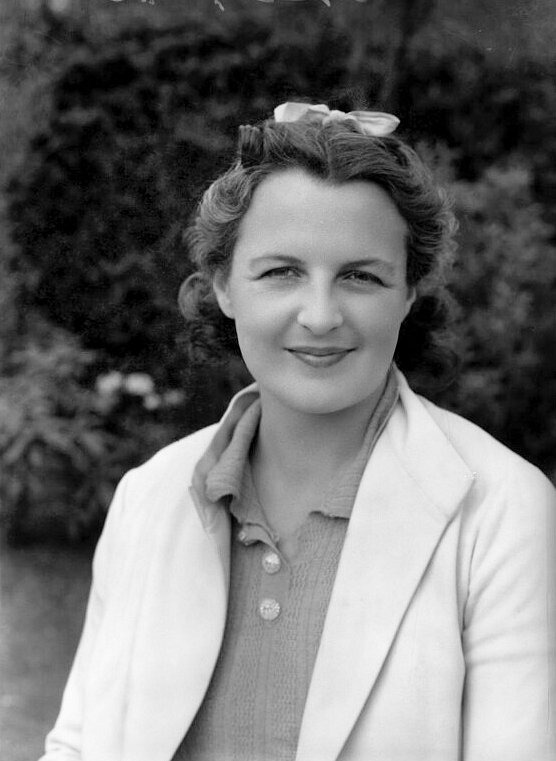
Betty May Nuthall (1911 – 83) in 1938
by Bassano Ltd
half-plate film negative, 29 April 1938
NPG x31370 (CC BY-NC-ND 3.0)
© National Portrait Gallery, London
Linda Jackson 2023
.