
Epsom Market Place’s plaques
From the earliest days, the west end of Epsom’s High Street (commonly known as the Market Place) had two-way traffic. This passed each side of Epsom’s Watch House (which was replaced by the present Clock Tower in 1847) and then the pond (long since drained) at the western end.
 The western High Street in about 1910
Image courtesy of Epsom & Ewell Local And Family History Centre
The 1980’s development of the Ashley Centre required the demolition of the old Ashley Avenue (a residential cul de sac accessed from Ashley Road). Its replacement, a little further south, linked Ashley Road to South Street to allow for the introduction of a one-way system to reduce traffic congestion.
That allowed the area to the south of the Clock Tower (on the left in the picture above) to be reclaimed for a pedestrian Market Place. The work on that was completed in 1993. This was also the Diamond Jubilee of the year in which the local government of Epsom and Ewell was fully unified, as noted in the perhaps little-noticed octagonal slate plaque (as shown below) that remains in the centre of the pedestrianised area. (The 1933 “Urban District” was granted municipal borough status in 1937, during the mayoralty of James Chuter Ede, “Epsom’s greatest son”.)
 The slate octagon in the centre of Epsom’s Market Place.
Around the Borough’s Coat of Arms are the inscriptions:
“New Market Place Scheme 1993” &
“The Diamond Jubilee of the union of Epsom with Ewell”.
Photograph by Roger Morgan © 2024
The 1993 work also included a couple of information plaques outside what was then known as Waterloo House – and which, at the time, was sadly boarded up in the middle of what turned out to be over a decade’s limbo. (Following complete refurbishment, the late 17th Century building reopened in 1992 and, acknowledging its original purpose in the days of the Epsom Spa, was named The Assembly Rooms.)
The pedestrianised Market Place had a complete revamp in 2020-22, during which those information plaques were removed. I recently came across some pictures taken of them in 2017 (by when they were getting rather weathered), and thought it would be useful to republish them here for the record.
 The two now-lost plaques outside the Assembly Rooms in 2017.
Photograph with thanks to Nick Harrison (CC BY-NC-SA 2.0 DEED)
Details of the individual plaques are below, dealing first with the one on the left which summarised the history of the High Street.
 The left hand plaque in 2017, the text of which is repeated below.
Photograph with thanks to Nick Harrison (CC BY-NC-SA 2.0 DEED)
The central image there is a grey-scale copy of the following.
 Watch House & Clock c1840 from Dugdale’s England & Wales.
Image courtesy of Epsom & Ewell Local And Family History Centre
The text of the plaque was as below.
EPSOM HIGH STREET 1618-2993
Three hundred years have left their mark on the High Street.
1618 The mineral well on Epsom Common is discovered to have medicinal qualities.
1672 Thomas Shadwell’s play Epsom Wells is performed for Charles II.
[When Charles II and his mistress, Nell Gwynne, visited Epsom Spa they stayed in Bramshott House.
1707 John Livingstone open entertainment facilities at the New Wells off the High Street.
1724 Defoe’s Tour through Britain comments: – “. . . the nobility and gentry go to Tunbridge, the merchants and rich citizens go to Epsom . . . the common people chiefly to Dulwich and Streatham.”
1779 The first Oaks horse race is run on the Downs, followed by the first Derby in 1780.
1833 Epsom Market is re-established in the High Street.
1847 A railway station opens in Upper High Street, followed by one on the present site in 1859.
1937 A dual carriageway is completed in the eastern half of the High Street.
[This had required the demolition of all properties on its north side. It may be noticed that the late 1930s buildings that were erected behind them are far more uniform than the mixed-date buildings on the south.]
1990 The highway [of the western half] moved to the north side to provide a pedestrian Market Place once again.
1993 The new Market Place Improvement scheme is completed.
The second plaque, on the right of the earlier photograph, summarised the history of what had long been known as Waterloo House – which, since 2002, has reverted to the earlier name of The Assembly Rooms.

The right hand plaque in 2017, the text of which is repeated below.
Photograph with thanks to Nick Harrison (CC BY-NC-SA 2.0 DEED)
The central image here is a reproduction of the following.
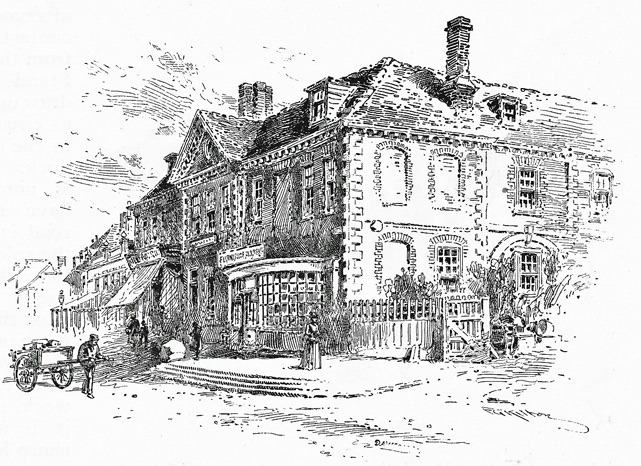 An 1890s print of what was then known as Waterloo House.
Image with thanks to Bourne Hall Museum.
The text of the plaque was as below.
WATERLOO HOUSE 1692-1993
1692-99 This building, originally the New Tavern, was developed as part of Epsom Spa. The Assembly Rooms stood behind it*, flanking the bowling green. Shops for milliners and china dealers were provided on the ground floor, and there was a cockpit at the back.
[* This is not the current understanding. There were doubtless ancillary rooms alongside the bowling green, but it is clear that the Assembly Rooms were in the building now renamed as such.]
1755 The coffee house and bowling green were closed down, and part of the premises were leased to a blacksmith.
1820 The New Tavern was sold in two lots. One side came to Messrs Gardom, Auctioneers, and the other to Bailey the draper. After being converted as a theatre, the Assembly Rooms were pulled down. [See * above.]
1820 [the date should be later, say 1890] The draper’s shop was expanded by Oldridge, who chose the name “Waterloo House”.
1913 Wheeler Bros. put in a new shop front, which was extended along the building by Elys in their 1953 restoration. Waterloo House, listed as a Grade II* building in 1954, is one of the most important historic buildings in the Borough.
A fuller history of the building is in our four-part article.
__________________
PS
See also our article about Some Derby Trivia.
As noted above, the plaques summarising the history of Epsom High Street and Waterloo House (originally—and now—The Assembly Rooms were removed during the early 2000s’ revamp of Epsom’s Market Place.
Shortly after Wetherspoon’s 2025 complete refit of the Assembly Rooms, those plaques were refixed to the frontage, as on the lower left in the photograph below.
 Photograph by Roger Morgan © 2025
Roger Morgan © 2024
with special thanks to Nick Harrison for his photographs