
BRAMSHOTT HOUSE
and its royal connection
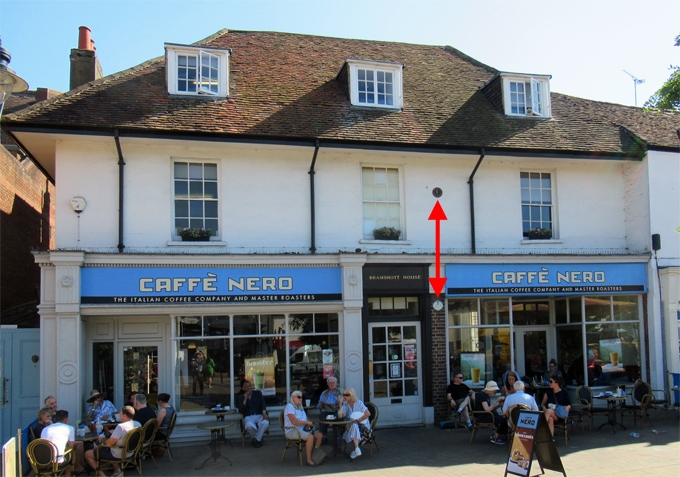 Bramshott House in the Market Place, Epsom
(see below for details of the arrowed plaques)
Photograph by Roger Morgan © 2022
Bramshott House in Epsom’s Market Place (at the time of writing, best known as Caffé Nero) has, for well over a century, been in commercial use. It was, however, originally a residential property – being built in the late 1600s to provide accommodation for gentry coming to Epsom to “take the waters” from Epsom’s Well and enjoy the facilities of England’s first modern spa town.
The building (the address of which is 137a & 139 High Street, Epsom) is listed by Historic England as Grade II with the description, “Late C17. Two storeys and attic, plastered. Three sash windows. Large square hipped old tile roof with wide eaves. Three flat top dormers. Simple C20 shops to ground floor.” (See below for more about the ground floor.)
As noted in one of the Borough Council’s Jubilee memorial plaques mounted alongside the building’s central entrance (as pictured below), the most famous residents were Charles II and his favourite mistress, “Nell” Gwynne. (The other plaque pictured below – and at first floor level) records that Surrey County Council noted this as a “building of special interest”.)
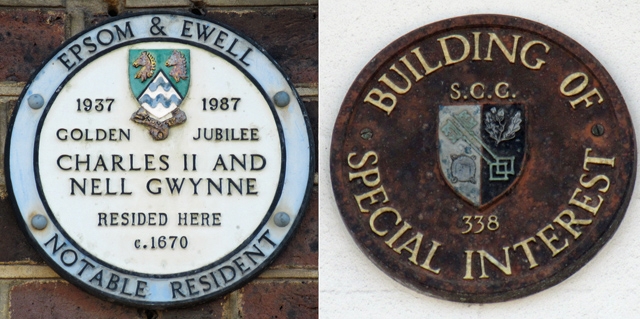 The plaques on Bramshott House.
(Situated as arrowed in the photograph at the head of this article.)
Photographs by Roger Morgan © 2022
After England’s dalliance with republicanism under Cromwell’s Commonwealth established after the Civil War, the executed Charles I’s son was restored to the monarchy in 1660 as Charles II. Charles married Catherine of Braganza in 1662, but also maintained a string of over a dozen mistresses, among which his undoubted favourite was Eleanor (“Nell”) Gwynne (also spelled “Gwyn” or “Gwynn”). Although she came from humble beginnings, her lively personality led her to becoming one of England’s earliest female actors who then caught the eye of many admirers and, ultimately, that of Charles II.
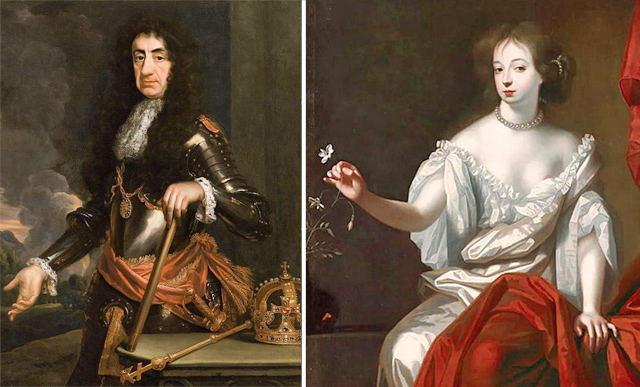 Charles II (c. 1683) by John Riley and “Nell” Gwynne (c. 1680) by Simon Verelst
Both images public domain, via Wikimedia at the links above.

Epsom was famous for its waters before the Civil War and, by the time of the Restoration, the town was something of a recreational magnet for London’s upper classes. Charles II was a frequent visitor: for example, on 7 March 1661 he attended the first race meeting (at Epsom) held after the Commonwealth’s ban was lifted.
Samuel Pepys was also a regular visitor and, in his diary entry for 14 July 1667, noted that Nell Gwynne was, together with Lord Buckhurst and Sir Charles Sedley, were in residence at what we now call Bramshott House and that they “keep a merry house”. When Charles II accompanied her, his court would stay in Epsom’s Assembly Rooms (an even older building than Bramshott House and, at the time of writing, housing the Wetherspoon pub of that name).
In his 1860 “Handbook of Epsom“, C J Swete mentions Bramshott House (although not by name) as being frequented by “the infamous but noted” Nell Gwynn. He remarked on a couple of since lost features of the house, the first of which were its two bay windows, of which more below. The other was a balcony which (in 1860) “has been just taken away“, adding that it was in that balcony that she “was accustomed to sit, watching the fashionable throng as they passed on in search of health or pleasure to the Wells.”
In 1901, Gordon Home noted in his “Epsom: its history and surroundings”, that the ground floor of the property was being “utilised as a grocer’s shop. Unfortunately, the interior has been altered too much to leave anything suggestive of that [i.e. Nell Gwynne’s] time, and one is forced to be content with knowing that the court favourite occupied the two little bay-windowed rooms overlooking the street, one of them being used as a bedroom and the other as a sitting-room.”
Those bay windows were lost with the subsequent installation of the large ground floor shop windows as seen today. We do, however, have a circa 1910 photograph of them on the left of the image below. (On the right is the then incarnation of the Assembly Rooms – known as Waterloo House – and used for a variety of retail purposes.)

Bramshott House and the Assembly Rooms in about 1910.
Photograph from the writer’s collection.
Roger Morgan © 2022