
THE ASSEMBLY ROOMS, EPSOM: Part 2
(from Victorian times to 2000 known as “Waterloo House”)
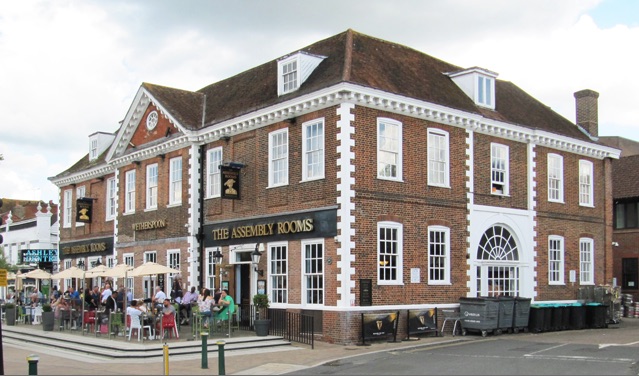 The Assembly Rooms in 2023.
Photograph © Roger Morgan.
Part 1 dealt with the 1692 building of the Assembly Rooms and their initial use. I now turn to the first of the remaining three sections about the building’s post Spa use.
PART 2: c.1730-1900
Sadly, Epsom Spa lost its attraction for its fickle clientele (not helped by the exhaustion and closure of the original well) and, by the 1730s, the Assembly Rooms fell out of use. At first, they were divided up for residential use but at least the ground floor frontage was then converted for retail purposes. The first we know of is “Bailey’s” – an up-market drapers established in 1770 by John Bailey senior (whose life is covered in our article about his son, John Bailey junior). Bailey’s occupied the left side of the building and, although no sign is shown, must be pictured – with post-Spa bay windows – in the 1820s watercolour below, which is the earliest known image of the old Assembly Rooms.
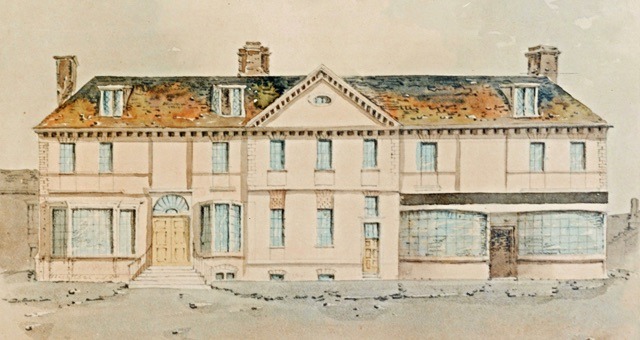 An 1820s watercolour of the Assembly Rooms by John Hassell.
Bailey’s shop is on the left. (And note that windows to the basement can be seen, as well as a new door to access the central section.)
Image with thanks to Bourne Hall Museum.
It seems certain that the right side of the building (with its post-Spa bow windows) was also in commercial use, but about the first certain record we have of that comes from the consequences of the 1841 affray reported in our article about Riotous Epsom. One of the rabble rousers was the 25 year old George Gardom. He was described in contemporary sources as an “Upholsterer, High Street, son of a most respectable tradesman” and appears to have been the son of another George Gardom and the grandson of Barnabas Gardom of Ebbisham House (described as Auctioneer, Carpenter, Broker and Retail Shopkeeper). Barnabas’s widow was in business as Martha Gardom and Sons adjacent to the retail premises of John Bailey in the former Assembly Rooms. “GARDOM / CARPENTER” can be made out in the following c.1840 picture. (Young George got a year in prison for his offences and died, aged only 33, in 1848 – the same year as his 67 year old father.)
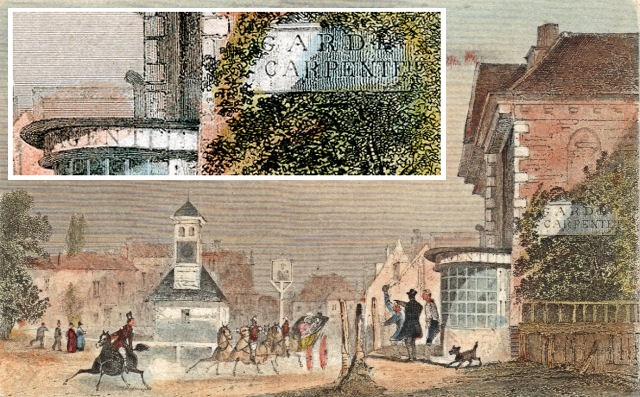 Epsom’s Watch House & Clock in about 1840, with the Assembly Rooms building on the right – and note that the pavement in front of the building has now been raised, covering the windows to the basement.
(The inset is an enlargement of the sign board for “George Gardom, Carpenter” on the side of the Assembly Rooms and the word “Agent” over the bow window.)
An illustration from Dugdale’s “England & Wales”.
Image courtesy of Epsom & Ewell Local And Family History Centre
The Assembly Room proper remained a valuable large space for local use. In 1829, Mr Fishwick (“of the Theatres Royal Bristol, Liverpool, Manchester and York”) issued a handbill notifying residents of Epsom and the vicinity that he would be opening a theatre in the “Old Assembly Room“, and offered an evening’s entertainment of “The admired play Speed the Plough“, some musical items and “the laughable farce of The Rendezvous“, with tickets from 6d (2½p) to 2/6 (12½p).
The next image we have is the engraving below from from C J Swete’s 1860 Handbook of Epsom. He captioned this as “The New Inn, 1706“, some 14 years later than its now understood date of 1692 – so it would seem that the name of “Waterloo House” had not yet caught on. Calling the building “The New Inn” was a mistake, apparently arising from some confusion in Henry Pownall‘s 1895 book, “Some Particulars Relating to the History of Epsom” and his mention of “New Inn Lane” (now the Dorking Road). The actual “New Inn” of the early Spa days was on the site of Hylands House, where the road to the original well branched off. (The New Inn subsequently moved to new premises – still on the Dorking Road but a little nearer the centre of Epsom – which later became the White Horse Inn.) As noted in Part 1, the first (street-facing) phase of what we now know as the Assembly Rooms included a tavern, coffee house and billiard room and was thus known as the “New Tavern” – perhaps insufficiently different from the “New Inn”. The Assembly Room and Dancing Room arrived with the second phase.
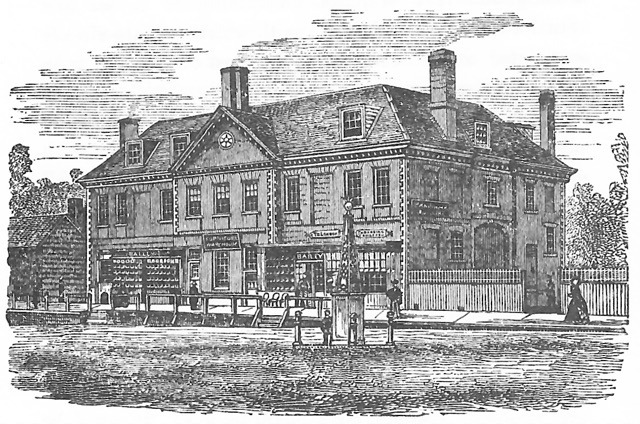 Copy of the engraving in the body of C J Swete’s 1860 Handbook of Epsom.
(It can be see that the left ground floor frontage has been radically changed from what is seen in the 1820s watercolour near the beginning of this part.)
Swete notes the whole building as belonging to Mr Bailey, and goes on to describe it in the following terms.
“In High Street there is an antique but noble building, belonging to Mr. Bailey, Goods Merchant (whose ware-rooms now possess the place of bygone revelry) well worthy of the attention of the traveller. This was the great Inn, in the times of the old Wells. It possessed a noble Assembly room which still exists in its altered form. An archway now built up, but which did run quite through the centre of what is Mr. Bailey’s shop, may be traced on the Western wall.“
That identical engraving is also used by John Bailey in the advertisement pages at the back of the 1860 Handbook. The sign over both doors is “Bailey” and the sign between them reads “Furniture Warehouse”. (The indistinct sign on the side of the building could also say “Furniture Warehouse”). In his advertisement, John Bailey extolled his business (“Established 1770“) in the following terms.
“Linen and Woollen Draper, Silk Mercer, Hosier, Haberbasher, Glover & Laceman.
READY-MADE CLOTHES & BOOT & SHOE WAREHOUSE, HATTER AND OUTFITTER IN GENERAL.
FAMILY MOURNING
“This well known house continues to supply as heretofore, at the lowest possible remunerative profit, every article in the above departments, and hopes by that unremitting assiduity and attention to any order entrusted for execution and which has always characterised this firm to merit that patronage and support that has for so many years been conferred. The Stock being altogether of first-rate quality and description, consists of Table Linens, Sheetings, Irish Linens. Diapers & Huckabacks, Blankets and Flannels in every variety, rich black and coloured Glaces, Shawls, in Paisley, Cashmere and Lama, Silk and Cloth Mantles, Mantillas and Lace Shawls, Hosiery and Gloves in every description, Bonnets and Hats in every variety, Boots, Shoes and Stays of every description.
“Every attention is given by the Proprietor of this Establishment to any order entrusted to him in the Family Mourning Department, and no pains will be spared by him in carrying out this part of the business in the most efficient manner, so as to give that satisfaction which he feels has been previously accorded to him in the numerous instances in which he has performed the necessary requirements.”
That text makes no mention of a “Furniture Warehouse” part of Mr Bailey’s business, and the reason for that is found elsewhere in the advertisement pages in Swete’s 1860 handbook where (as below) John Gray promotes his business as the “successor to Mr Bailey” – a few pages away from Mr Henson’s contradictory advertisement.
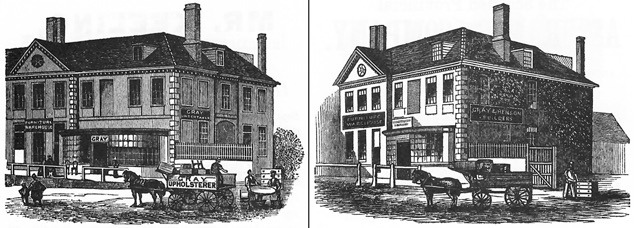 From the advertisement pages in Swete’s 1860 Handbook of Epsom – these relating to the western side of the building.
Left: “John Gray (successor to Mr Bailey) Undertaker, Cabinet Maker, Upholster etc.”
Right: “R. Henson (Late Gray and Henson) Builder, Carpenter & Joiner.”
Although clearly different images, the horse & cart and chest of drawers in the centre and right foreground indicate either a common starting point or, as the image on the right omits the far end of the building, more probably that the engraver of that took the image on the left as his starting point and ignored/overlooked the bit of roof beyond the central gable. In both cases, the sign on the left reads (as for John Bailey’s advertisement above) “Furniture Warehouse”. In the image on the left, the sign over the door reads “Gray” and, while the cart is labelled “Gray / Upholsterer”, the sign on the side of the building reads “Gray / Undertaker”. In the right hand image, the engraver filed the signs over the doors with random marks rather than actual letters, but the sign on the side reads “Gray & Henson / Builders”.
John Gray would appear to be the 26 year old Jonathan Gray (“Carpenter“) found in the 1861 Census living with his wife, Harriet, and their three children in Lintons Lane, Epsom. As to “R. Henson (Late Gray and Henson)”, the 1861 Census records the 73 year old John Robert Henson (“Builder employing 5 men“) living in Church Street, Epsom with his wife Lynne, supported by a domestic servant – notwithstanding that, as recorded in the London Gazette of 21 December 1860, “J Gray and J R Henson, Epsom, Surrey, Upholsterers” had been declared bankrupt. (I invite others to try untangling all this further.)
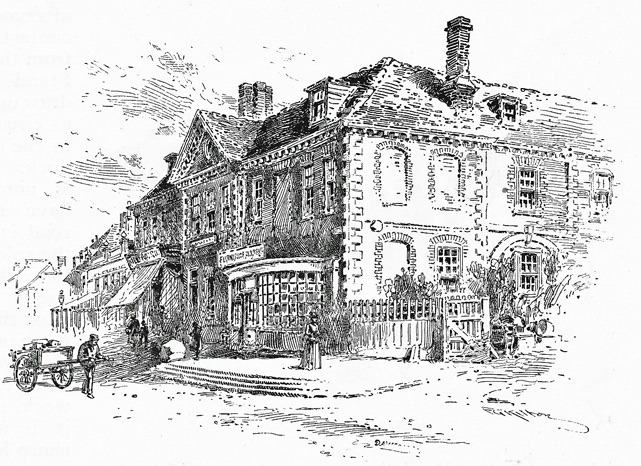 An 1890s print of the Assembly Rooms.
Image with thanks to Bourne Hall Museum.
The 1890s print above is about contemporaneous with J M Oldridge taking over from the long-running Bailey’s at the far end of the building: 1890 saw Mr Olridge’s first appearance (as “Draper, High Street“) in the local Kelly’s local Directory. (Mr Bailey’s last mention in Kelly’s is found in the 1855 edition.) At the near end of the building, the sign over the bow window can just be made out as reading “Furniture . . .“. There is more about both these things in the next part.
That concludes Part 2. Click this link for Part 3 (1900-1950) – or these for Part 1 (1692-1730) or Part 4 (1950 to date).
Roger Morgan © 2023
With special thanks to the late Peter Reed for his encouragement in tackling this,
and his invaluable help in sourcing many of the illustrations.
NOTE: This four-part article is necessarily something of a dash through 300+ years of history. For much more detail – particularly about the initial construction – see the 1998 report by the Royal Commission on the Historical Monuments of England (which, in 1999, was merged with Historic England) and the Nonsuch Antiquarian Society’s Occasional Paper No 17 published in 1999. (Both of these documents use the building’s then current name of “Waterloo House”.)