
THE EBBISHAM & MYERS HALLS
(Epsom’s social centre – 1929-1981)
&
THE EPSOM BROTHERHOOD
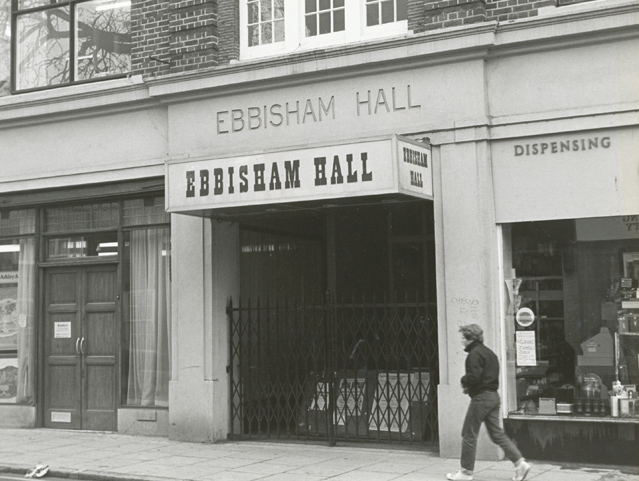
A 1970s photograph of the entrance to Ebbisham Hall.
(Little changed, this frontage remains on Ashley Road.)
Courtesy of Bourne Hall Museum.
The story of Ebbisham Hall – together with its adjoining and smaller sibling, the Myers Hall – has to begin with something about the Epsom Brotherhood (which, as will be seen, remains integral to the narrative).
The national “Brotherhood” movement began around 1900 at the initiative of a minister in the then Congregational Church (now part of the United Reformed Church). While it was a non-denominational movement, there remained a strong Congregationalist attachment, and the Epsom Brotherhood was founded in 1909 by the Revd Henry Atkinson, minister of the Congregational chapel in Church Street. All men “in trade . . . irrespective of creed, politics, or social position” were welcomed to the Brotherhood which took its remit as Christian study and the moral welfare of local townspeople.
The Epsom Brotherhood’s core activities were Sunday meetings and talks (usually on a moral, Christian theme) and often a “sacred concert” performed by its own orchestra. Alongside these were a number of sporting activities – for example, through its cricket, football and bowls teams.
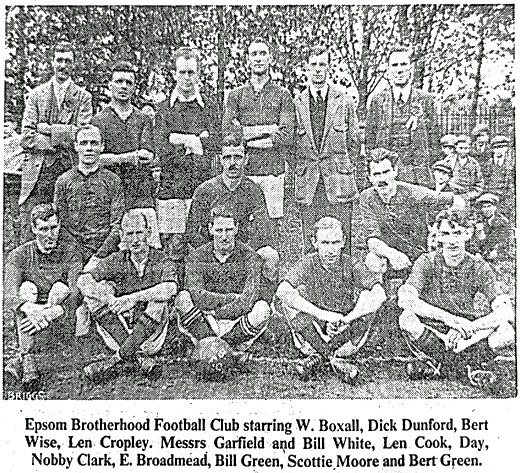 A recently discovered press cutting about the Brotherhood’s football team.
It is undated, but perhaps from about 1930. (Len Cropley is probably Leonard J Cropley – see our article about his father’s business – who was born in 1896 and would thus in his mid 30s here.)
Image courtesy of Epsom and Ewell Local and Family History Centre
The Brotherhood’s ethos led to the formation of a charitable arm of the organisation and, having a strong local membership, it would seem that various projects were carried out in conjunction with Epsom local authorities.
The membership grew quickly. For example, it had 178 (younger) members who served during WW1 of whom 22 died, as commemorated on the Brotherhood’s war memorial. It is known that an early member was son of a grocer (James) Chuter Ede (in due course, Epsom & Ewell’s Charter Mayor and, later, Baron Chuter-Ede).
For many years, the Epsom Brotherhood was based in the Upper High Street’s now-lost Congregational Lecture Hall. This was shared with others and, in the late 1920s, the Brotherhood decided that it should have its own premises which would also provide facilities for a range of other activities in the centre of Epsom. It purchased what had been the kitchen garden (shaded red in the 1913 map on the left below) of what had been the grand Ashley House (which was being converted for use as Council offices) and built the Ebbisham and Myers Halls, with ancillary rooms – marked “Hall” in the 1932 map on the right below. (Other notable additions between the two maps include: the now-lost Court House; the first phase of the present Epsom Methodist Church; and Ashley Avenue that was later demolished to make way for the Ashley Centre.)

Left: Extract from the 1913 OS map, on which Ashley House’s kitchen garden is shaded red.
Right: Extract from the 1932 OS map showing the new Halls.
Work began on the new building and, on 28 October 1928, the foundation stone was laid by Henry Myers (“A benefactor of the Brotherhood”) and Herbert W Smith, the Brotherhood’s honorary treasurer. The foundation stone may still be seen on the south wall of the alleyway first on the right up Ashley Road from Epsom’s central crossroads.
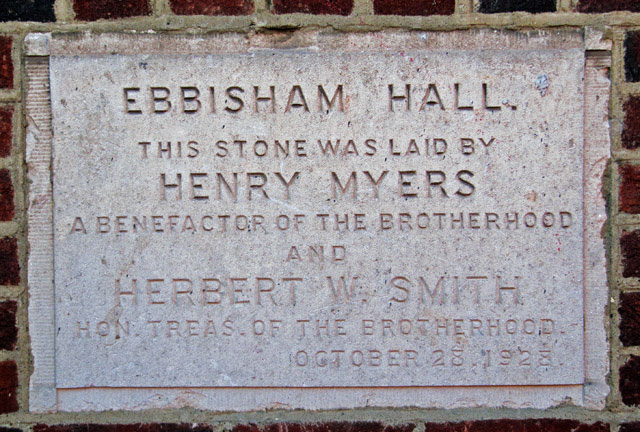
The Ebbisham Hall foundation stone.
Photograph by Roger Morgan © 2020.
The building (designed by A C Williams and erected by local builders HH & F Roll) progressed quickly and, in October 1929, was formally opened by Prince Arthur of Connaught (a grandson of Queen Victoria and Governor-General of South Africa, 1920-24).
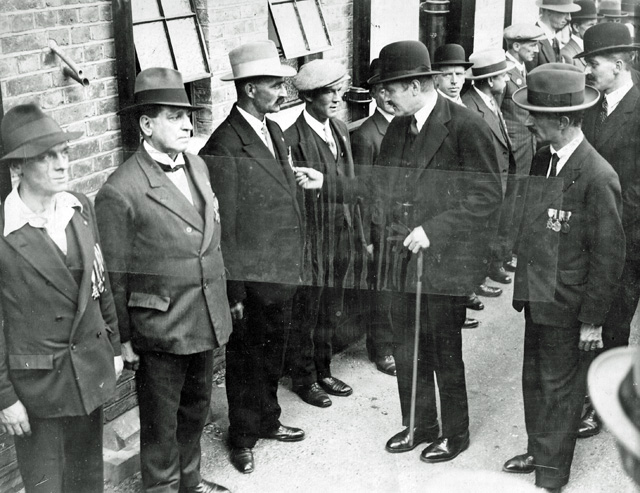 Prince Arthur of Connaught at the October 1929 opening of the Ebbisham and Myers Halls.
Photograph (the original of which is slightly damaged) courtesy of Bourne Hall Museum.
The Epsom Brotherhood always intended the new building to be not only its new base, but also available for wide use. The main “Ebbisham Hall” had a stage and space to seat an audience of some 600. (The floor was level and the seating movable to allow the hall also to be used for dances and exhibitions.) In addition, there was a large kitchen together with various smaller rooms for committee meetings etc.
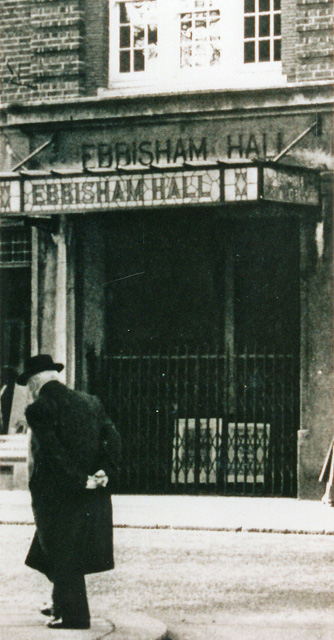
The original canopied entrance to the Ebbisham Hall.
1930s photograph courtesy of Bourne Hall Museum.
As shown immediately above – and more clearly in the photograph at the head of the article – there was a shop on each side of the entrance to Ebbisham Hall. In both cases, posters for forthcoming events can be seen behind the sliding grille across the entrance to the hall proper.
Behind the main hall was the smaller “Myers Hall” intended for medium-sized meetings and exhibitions, over which was a billiard room. These had a separate entrance alongside the Council Offices (the former Ashley House). While the main Ebbisham Hall used an old name for Epsom (derived from “Ebba’s Ham“), the Myers Hall’s name was to honour Henry Myers who, as a “benefactor of the Brotherhood” had helped lay the main hall’s foundation stone. Indeed, the dedication of the Brotherhood’s memorial photograph below acknowledged him as a “great benefactor of the Epsom Brotherhood.”

The Epsom Brotherhood’s memorial picture of Henry Myers
& (inset) the frame’s dedication.
Photographs courtesy of Bourne Hall Museum.
Henry moved to Epsom in the early 1920s, where he lived at “Ebbisham Lodge” (later numbered 1) Downs Avenue for the rest of his life – the name of his house perhaps also influencing the choice of name for the main hall. The September 1939 Register records the then 82 year old (of “Private Means”) at the address together with his 72 year old wife, Ada Mary, their 47 year old unmarried daughter, Ada Margery, and their 43 year old parlour maid, Ruth Elliman.
Henry and Ada Mary (née Arnold) had married on 30 July 1891 at St Stephen’s Church, Clapham Park. The marriage certificate describes not only Henry but also his father (John) and Ada’s father (Edward) – both of Grove Road (now Weir Road), Clapham Park – as “Gentleman”. However, both Henry and in his father were in (albeit upmarket) “trade”. The 1861 Census records the Myers family living at Grove House, Isleworth with father John listed as a “Watchmaker” – however, the fact that the parents and their children were supported by a groom, a “nurse” (three of the four children were under 6) and two domestic servants confirms that this his watchmaking was a significant business.
The 1871 Census records the 14 year old Henry apprenticed to “Watch Manufacturer” William Owen at 49 Craven Street, Coventry. He subsequently worked in his father’s firm of John Myers & Co, Watchmakers & Jewellers, at 131 & 135 Westminster Bridge Road, and took over the business on his father’s retirement at the end of 1891. In the 1901 Census (which recorded Henry, Ada and and their only child, 8 year old Ada Margery, together with three domestic servants at – perhaps temporarily – 2 Babbacombe Bay Terrace, Torquay), Henry is listed as “Governing Director of Limited Company selling watches and jewellery to retail”. When Henry died in December 1946, his estate was valued at £96,000 – worth over £3.5m in terms of goods and services at 2019 prices (and yet more if the inflation of property prices could be taken into account). He was buried in grave O46 of Epsom Cemetery, where his modest headstone notes that he had been “called into life and to higher service“. The widowed Ada died in 1948 and their only child, Ada Margery (who had moved away to Dorset), in 1964. Both are also buried in Henry’s grave.
While Henry Myers’ wealth helped make the new building a reality, members of the Epsom Brotherhood were aware just how much the project owned to the energy and drive of their President, John Griffin Beaumont – and acknowledged this in the memorial (see below) erected in the Ebbisham Hall.
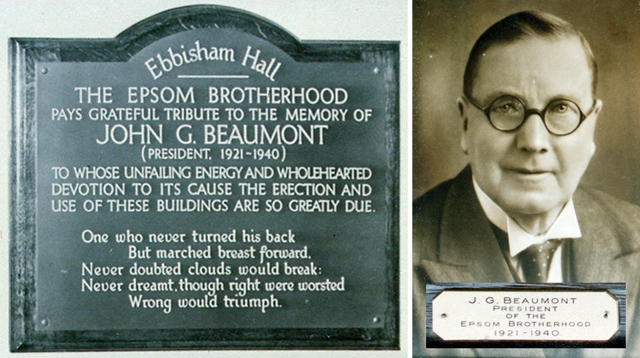
Left: the Brotherhood’s memorial to their late President, John Griffin Beaumont.
Right: John Beaumont & (inset) the frame’s dedication.
Photographs courtesy of Bourne Hall Museum.
John Beaumont’s first wife (Louisa, née Mumby, with whom he had three children) died in 1916. In February 1918, the widowed John got married again – to Gladys Hope Flecker. They then moved from Purley to Epsom, and settled in “The Homestead”, 9 Lynwood Road – where they had two children together. John quickly became involved in the Epsom Brotherhood, being elected as its President in 1921 – a post he still held when he died in March 1940. The September 1939 Register had recorded the 70 year old John (an “Export Merchant Of Clothing & Outfitting”) and 50 year old Gladys still at Lynwood Road, together with their children and supported by two domestic servants.
John died in post as the Brotherhood’s President in March 1940, and left an estate valued at a then sizeable £30,500. An obituary described him as “a born leader of men and inspired with high ideals of duty and service“. He gave full reign to those qualities in the Epsom Brotherhood: in addition to overseeing the major building project, he set up a Provident Club, a Hospital Saving Association and a monthly magazine, “The Watch Tower” which, with a free circulation of 5,000, contained news from Epsom and other Surrey Brotherhoods, sermons, hymns and local Epsom and Ewell trade adverts.
In February 1930, shortly after the completion the Ebbisham and Myers Halls, the Epsom Brotherhood reaffirmed its association with the national movement as recognised in the Charter pictured below.
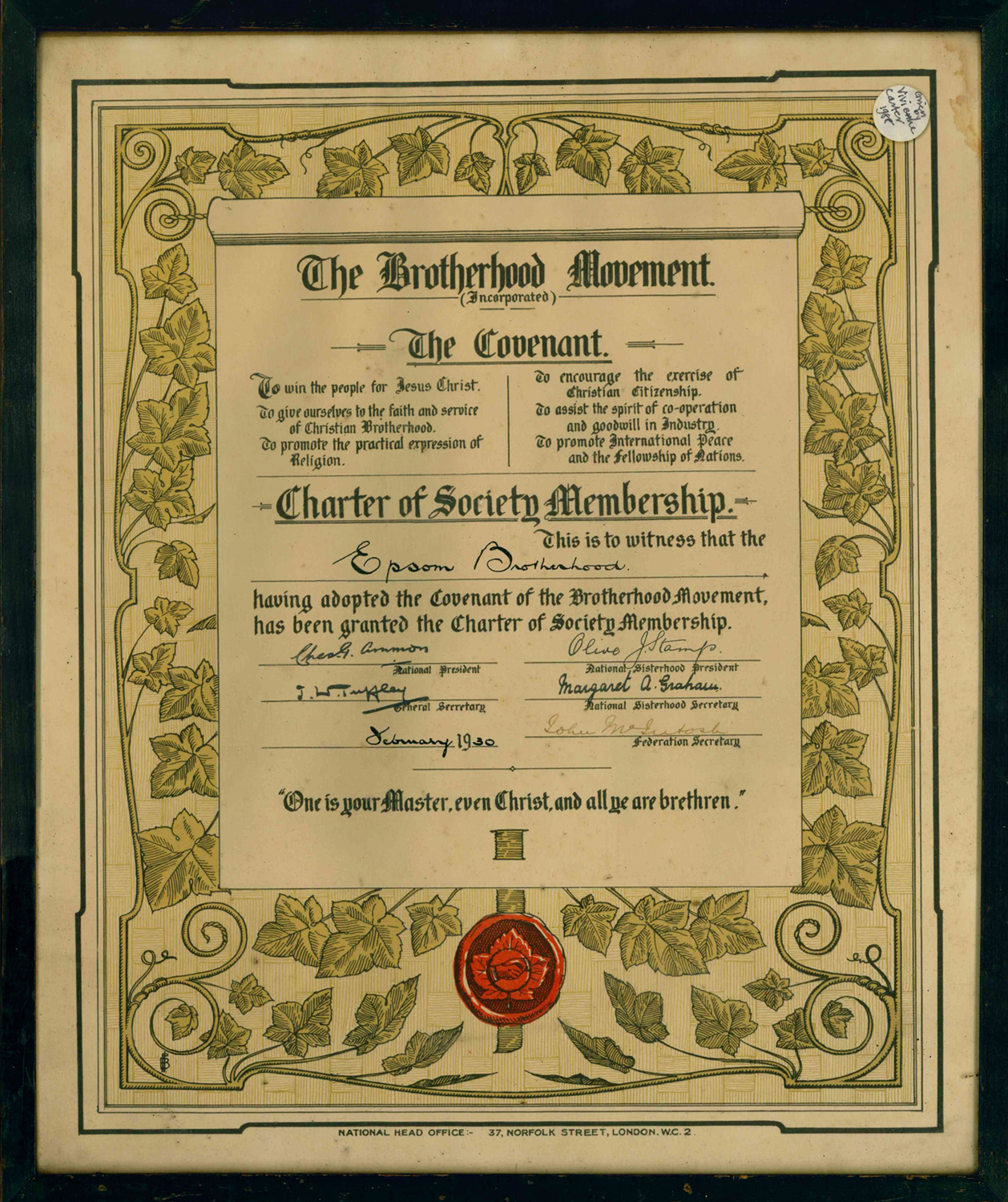
The Epsom Brotherhood Charter (click to enlarge).
Photograph courtesy of Bourne Hall Museum.
The new premises were planned primarily for use by the Epsom Brotherhood but it accepted that “others could hire it if they so wished“. As the late John Furniss recalled in his 1992 memoir EPSOM: Talk of the Town, “very many ‘others’ did so wish. [During their lifetime, the Halls] not only housed operatic and dramatic productions, but public and private meetings, jumble sales, church services, dances, parties, trade fairs, exhibitions, blood donating and various charity functions.” A particular user was Epsom Methodist Church from just across Ashley Road which, until 1950, lacked a large hall of its own.
John Furniss had inherited a love of amateur dramatics from his father, George Furniss, and was pleased to join with him in the Epsom Operatic Company’s December 1929 production of a popular operetta, “The Geisha“. The Company had been in suspended animation since WW1 and the loss of the old Public Hall. Notwithstanding the limitations of the Ebbisham Hall’s stage (which John Furniss notes was not only very shallow, but made most difficult for staging by odd shaped partitions, steps and ceilings), they were glad to be back in business.
The following photograph is of a 1930s Epsom Brotherhood event in the Ebbisham Hall – probably another of their “Sacred Concerts”. 20 members of the Committee are on the stage (with the President, John Beaumont, at the centre table – the sign in front of which says “SMILE PLEASE!”).
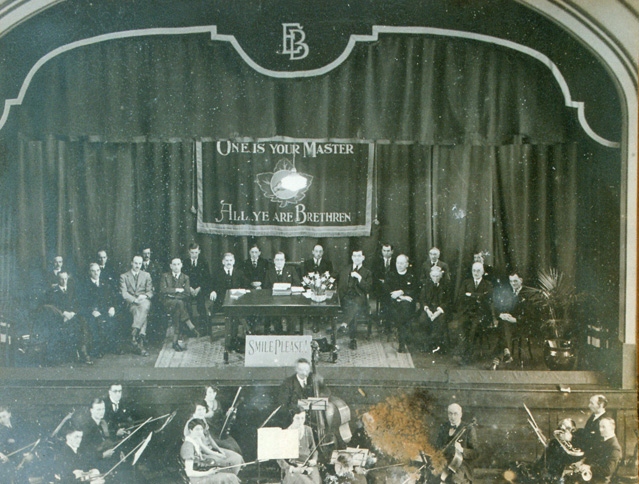
A 1930s Epsom Brotherhood event in Ebbisham Hall.
Photograph (the original of which is slightly damaged) courtesy of Bourne Hall Museum.
When WW2 came, the Halls were requisitioned for Army use. Very much the worse for wear, they were released in 1949. After necessary repairs, they came back into community use and hosted a range of meetings, plays, concerts and exhibitions.

Two exhibitions in the Ebbisham Hall.
Left: The September 1958 exhibition to mark the Borough’s 21st anniversary.
Right: A 1960s art exhibition.
Photographs courtesy of the Epsom & Ewell Local History Centre.
The Myers Hall also continued in good use for smaller meetings and exhibitions.
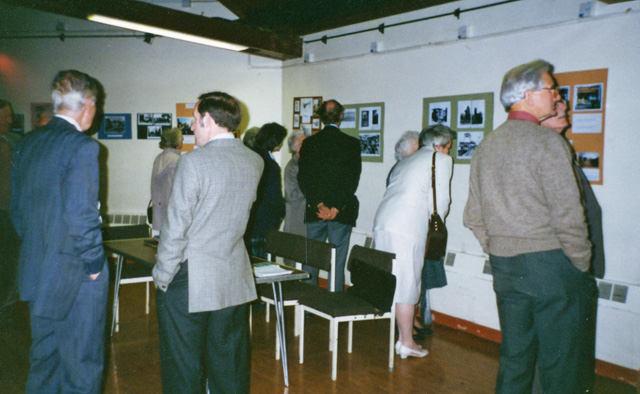
A 1960s exhibition by the Epsom Protection Society (now Epsom Civic Society) in the Myers Hall.
Photograph courtesy of Bourne Hall Museum.
At the time of writing, it is not clear when the Epsom Brotherhood disbanded, but the Halls became a Borough resource. After half a century’s use, the premises were at the end of the 1970s in need of major renovation. Initial thinking about that was overtaken by plans for the new Ashley Centre. That 1981-84 development redeveloped the Ebbisham and Myers Halls as retail space linked to the new Centre. To replace the Halls, the new Epsom Playhouse was built, within which Henry Myers name lives on in the smaller Myers Studio. (The plans attracted some criticism at the time: the Playhouse had two-thirds the seating capacity of the Ebbisham Hall and, with its raked seating, did not offer the same facility for exhibitions.)
The initial occupant of the redeveloped Ebbisham and Myers Halls site was the newsagent and stationary chain John Menzies – a firm subsequently taken over by WH Smith which continues to operate in the space.
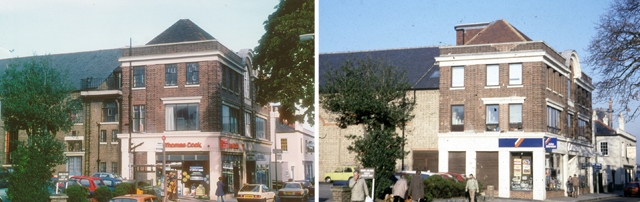
Left: Ebbisham Hall in the 1970s, with shops each side of the entrance.
Right: The redeveloped “Hall” (behind the tweaked original frontage) in the 1980s as John Menzies.
Photographs courtesy of Bourne Hall Museum.
As in the photograph above, the John Menzies shop was originally accessible not only via the new Ashley Centre but also through the original Ebbisham Hall entrance. That continued when WH Smith took over, but security concerns eventually led to the closure of the Ashley Road entrance in the 1990s.
While, as shown below, the 1929 frontage of the Ebbisham Hall remains pretty much unchanged, only the 1928 foundation stone (as inset and arrowed) is left to indicate its origins.
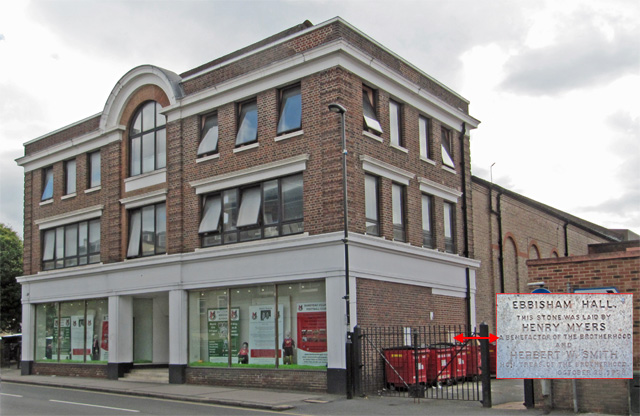
The front section of the original Ebbisham Hall as it is today.
(Inset and arrowed: the 1928 foundation stone.)
Photographs by Roger Morgan © 2020.
Roger Morgan © 2020
APPENDIX
MY MEMORIES OF THE EBBISHAM AND
MYERS HALLS
By Mrs Ann Marshall
My mother commenced work cleaning at the Epsom Brotherhood in 1949, around the time Ebbisham Hall was being renovated – the Canadians had been billeted there in WW2. I remember the carpenter kneeling to repair the floor, with one leg outstretched due to a war wound.
My mother was a widow my father having died in February 1949 due to ill health caused by WW1. My parents were Arthur John Donhue born 1894 in London, and May Flynn born 1900 in Scotland. The Donhue family lived firstly in Miles Road and then no. 9 Hook Road, having moved from London.
It was probably late 1949 or early 1950 that the Epsom Brotherhood advertised for a caretaker. Mr Leonard Charles Whitehorn successfully applied for the job. My mother and Mr Whitehorn married. He had served in the Merchant Navy working for the Union Castle Line all his working life. My mother died in the autumn of 1953.
I spent many an afternoon after school, evenings and Saturdays at the halls. The Epsom Operatic & Dramatic Society used the halls annually for their productions. Myers Hall being curtained off to provide changing rooms. I used to watch their shows from the balcony – I also enjoyed watching the weddings next door on Saturdays.
Ebbisham Hall was used for dances, concerts and the Billy Graham crusades. There was an upright piano and a grand piano on the stage.
Myers Hall, with an upright piano, was also used for whist drives, jumble sales, wedding receptions, birthday parties and as a polling station.
The kitchen had a very large kitchen table, large gas cooker and double copper sink with wooden draining boards. The large window looked out on to greenery, presumably a garden in Ashley Avenue. Outside the back door were steps down to the boiler room, coke fired, where my stepfather had to stoke the boiler. The other much smaller window looked out towards the road along the side of Ebbisham Hall.
There was a very small office in the entrance hall and next to it a small cupboard under the stairs where spare druggets and mats etc. were kept. The Ladies was also off this entrance hall; I can’t remember where The Gents was.
Upstairs was a small committee room and a billiards room over Myers Hall. I cannot remember the exact layout. There was a plaque on the wall at the head of the stairs that read “Play up and play the game, for when the one great scorer comes, he’ll ask not that you won or lost but how you played the game.”
Back downstairs there was a single door that led into the back of Ebbisham Hall. Turning right up a few steps you were on the back of the stage. Turning left along the corridor you came out into the main hall next to the front of the stage. The chairs were kept under the stage. There were at least two fire exit doors one either side towards the back of the hall. In the middle of the back wall under the balcony were the double doors through to the main entrance and the toilets. The stairs on the right led up to the balcony seats. In the balcony on the right, towards the stage, there was another staircase (fire exit) that led down to the passageway by the entrance to Jean Frecker’s dance school.
Mrs Ann Marshall, ©2021
MY MEMORIES OF THE EBBISHAM AND
MYERS HALLS
By Steve Meyer
Following a Google search I have come across your piece on Ebbisham Hall – a place that has special memories for me. However, I’m surprised that such memories are not mentioned in the piece – namely it being a venue for a number of gigs (as we called them) back in the mid 1970s.
As a late teens rocker I attended some memorable concerts by the likes of Camel, String Driven Thing & Bronx Cheer plus others I’ve long forgotten. It was a wonderful venue – small and intimate for a few hundred devotees of modern music with the pub right next door. [This was The White Hart, the renovated premises of which now house the Metro Bank.]
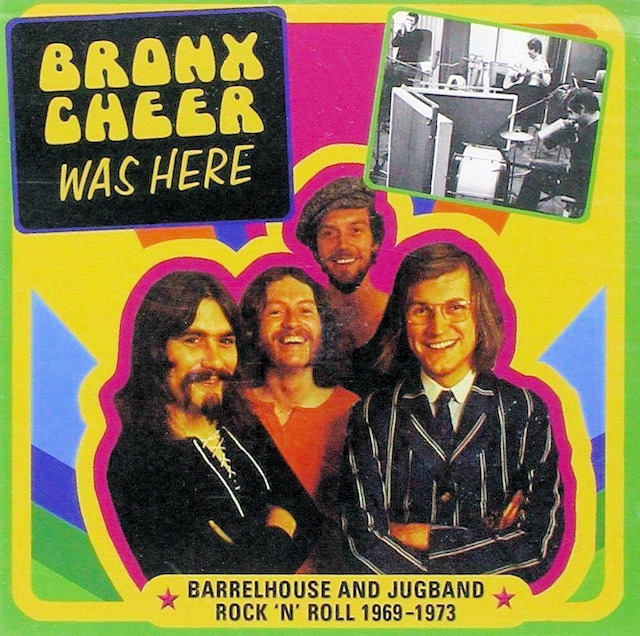 A Bronx Cheer Album Cover
Source not known
Then the last No.164 RouteMaster back to Banstead at 11.20pm.
Happy Days.
Steve Meyer ©2022