
The (now lost) Court House, Epsom
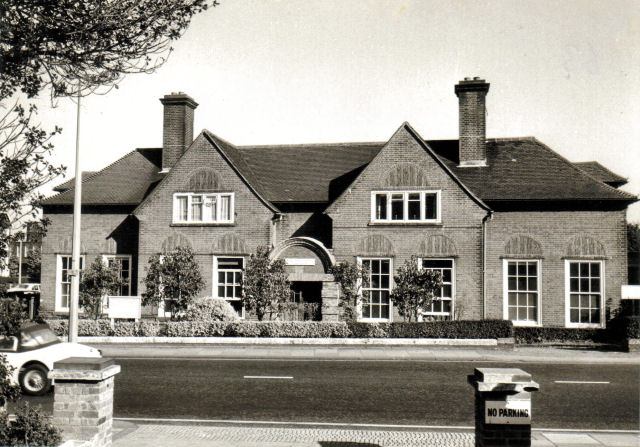 Epsom Court House, Ashley Road
Photographed by L.R. James, October 1971
Image courtesy of Epsom & Ewell Local And Family History Centre
Courts presumably have been held in and around Epsom from the thirteenth century. Records prior to the nineteenth century are rather sparse. Entries in the calendar of Assizes illustrate some of the matters that would have been dealt initially at least by the Justices of the Peace. In June 1565 a Rose a’ Borrow was indicted for “Witching to Death, Alice Lambert wife of Geoffrey Lambert”. The information was laid before William Saunders JP. She was eventually sentenced at Guildford Assizes to hang. A tailor of Epsom was on occasions a “Common Barrator stirring up discord among his neighbours”. Richard Cole, a Vicar of Epsom and his Wife, were tried for Barratry (defined as “Frequently inciting suits and quarrels among his Majesty’s subjects”). The verdict was not recorded. Epsom was not spared religious problems, for a Nicholas Coe was found Not Guilty of Recusancy (defined as “Separating ones self from the established church and those who wilfully absent themselves from the Parish Church”).
The actual location of the courts is not clear until the eighteenth century. In common with other parts of the country, the Court would be held in a variety of places, such as the Spread Eagle coaching inn; the building itself is still standing but now houses several shops. The minutes of the Copthorne Hundred show that in the latter part of the Eighteenth century, courts were being held in Epsom in the “Coffee House”. This is thought to refer to the Public House now known as the Albion. 16 Waterloo Road, once known as the White House, was designated under the 1879 Summary Jurisdiction Act as an “Occasional Court House”. Whether it was actually use as such is not clear. During the eighteenth and nineteenth century, courts were also occasionally held in the Magistrates’ residences. The plan in a sales catalogue for the sale of Nork House, Banstead, in 1890, indicates there was Magistrates’ room with a rear entrance on the ground floor. This house, first built in 1740, for Christopher Buckle, was subsequently the residence of the Earl of Egmont, who was the Chairman of the Epsom bench from 1878-89.
 Interior of Epsom Magistrates Court in 1919
This photo was taken at the award ceremony following the Epsom Riot in 1919
Image courtesy of Bourne Hall Museum (Opens in a new window).
In 1829, the first year of the new Grandstand at the Derby race course a room was set aside in the basement for the confinement of prisoners and The “Morning Post” of 29 April 1830 carried an advertisement regarding the amenities in the new Grandstand, which ended with the statement that The Magistrates for the County of Surrey are respectfully informed that they will be admitted free”. I doubt if the same courtesy would be extended in today’s Queen’s Stand.
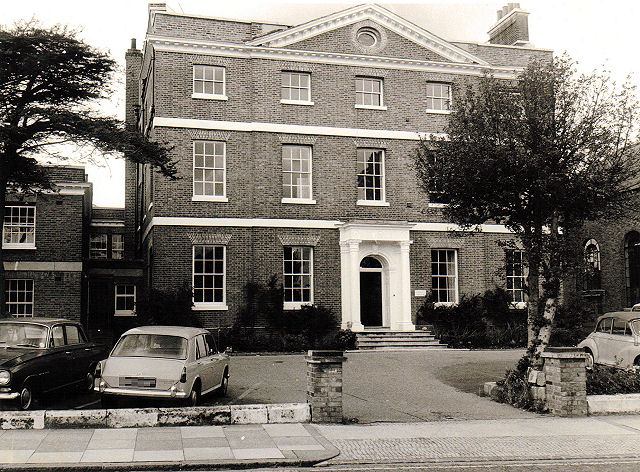 Ashley House, Ashley Road
Photographed by L.R. James, August 1966
Image courtesy of Epsom & Ewell Local And Family History Centre
A map of Epsom dated 1857; shows the courthouse located in Ashley House, in Ashley Road, a Georgian building dating back to 1776, that eventually housed the offices of Social Services and the Register Office before being adapted for housing again. There is an article by “Touchstone” in the local press in 1911, suggesting that the building had become totally unsuited as a court. Presumably, because of this unsuitability, it was decided to build the present Courthouse, which is located directly opposite in Ashley Road. Court 1 was opened in 1912, and Court 2 was added in 1931. The building suffered some damage during the 1919 riot by Canadian troops, when the Police Station opposite in Ashley Road was attacked. It also suffered some superficial damage from enemy action in 1944, when a Flying Bomb demolished the top story of the Police Station diagonally across the road. Both courts were refurbished in 1992, when the old wrought-iron dock in Court 1 was removed out and new escape-proof docks (?) constructed in both Courts.
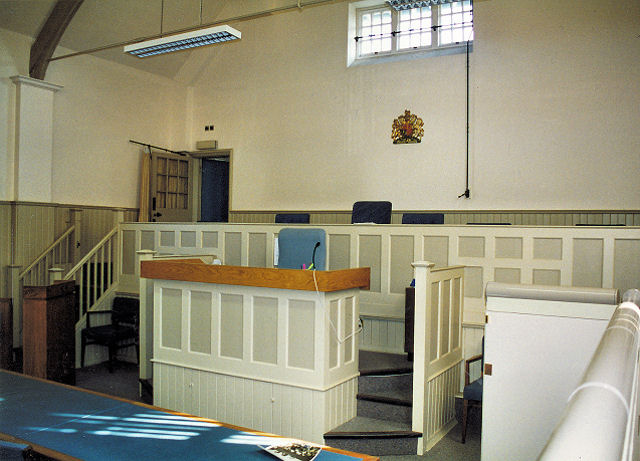 Interior of Epsom Magistrates Court c.1993
Image courtesy of Bourne Hall Museum (Opens in a new window).
Epsom as a Petty Sessional Division ceased to exist in 1993, although the courthouse continued in use for various purposes, and finally for Immigration Appeals Tribunals. In about 2005, that use ended and the Courthouse was sold – as was that of the 1930s County Court building to its rear (and fronting onto The Parade). After various rounds of negotiation, Country and Metropolitan Homes (part of Gladedale Homes) secured planning permission to demolish both buildings and erect two apartment blocks. The block on the Magistrates Court site – named “Windsor Court” (and as pictured at the end of this article), also provided space for a GP surgery on the ground floor.
 A drawing by L. Hassell of Epsom High Street showing the Watch House. c.1816
Image courtesy of Epsom & Ewell Local And Family History Centre
Prior to and often after their appearances in front of the justices, offenders had to be confined. An engraving of Epsom High Street, by L. Hassell in 1816, shows the Watch House. This building, located near to where the Clock Tower now stands also contained a “Lock-up” and stocks were apparently adjacent although they do not appear in the engraving. They were all demolished in 1848. From an article one of the local papers in 1935, it appears that when number 45 High Street, now The ASK restaurant, was being vacated; the remains of what appeared to be two cells were discovered. Although the some alterations had been made to the doors, the door bolts were still attached. Each door contained small trap about 6″x8″ presumably to allow food to be given to the prisoner.
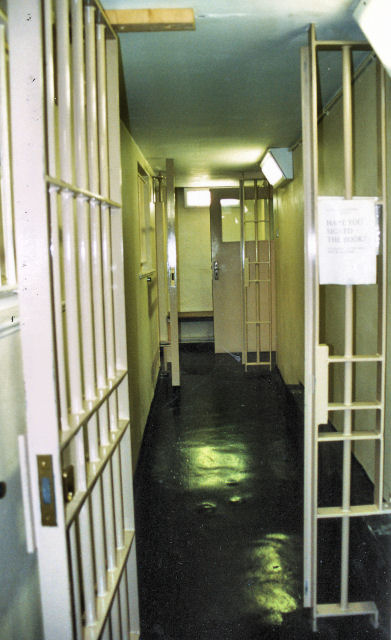 View looking from a court cell along the corridor towards the court room c.1993
Image courtesy of Bourne Hall Museum (Opens in a new window).
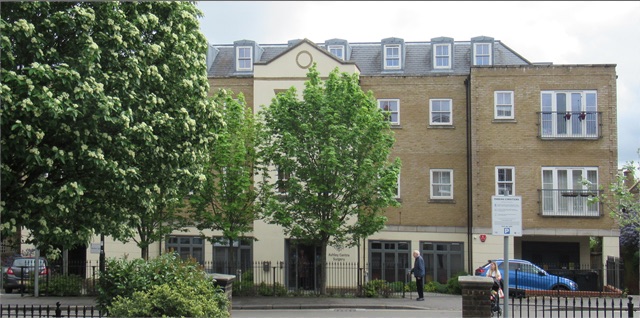 “Windsor Court” – the doctors’ surgery and apartments that replaced the Court House.
Photograph by Roger Morgan © 2023
This article was researched and written by Mr Trefor Jones © 2009
Updated RM 2023