
Hospital Cluster – Horton
This page is part of a series of articles on the 5 hospitals that made up the Epsom Hospital Cluster it should be read in conjunction with the main introduction page. We only cover the general development of the hospital but if you are looking for more specific information or want hospital records please see the following research guide Horton Hospital.
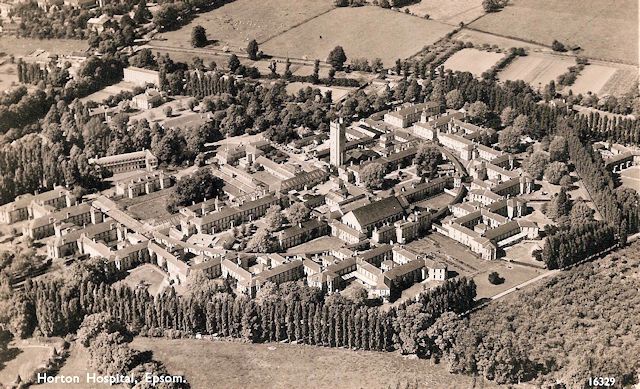 Postcard view of Horton Hospital, date not known
Image courtesy of Epsom and Ewell Local and Family History Centre
In 1896 the London County Council (LCC) bought a rundown estate in Epsom called Horton Manor from Sir Thomas Buxton. The Estate was 15 miles from the centre of London, covered 1060 acres of land and had a Mansion House, offices, gardens and grounds, woods, four farms together with land set aside for arable and pasture. The original plan was to build six large hospitals, each to hold two thousand patients but in the end only 5 hospitals were built.
Work began on the infrastructure for Horton Asylum in 1897, but accommodation was urgently needed so as a stop gap measure the old manor house was renovated and turned into staff accommodation and a number of ‘temporary’ buildings were dotted around the original manor house to form Manor Hospital.
The new Horton Asylum (Epsom Cluster No.2) was built to an existing design by George Thomas Hine and was opened in March 1902 at a cost of £327,590.14s.4d (or about £264m at 2012 prices). The site lay on clay and, to avoid the buildings cracking up as the clay expanded and contracted deep excavations were needed to get to firm sub-soil. The extracted clay was turned into yellow bricks on site for use in the buildings. Work was carried on by day and night, in fine weather and in wet, and created havoc and complete ruin along the roads to the site. The Hook Road in particular was utterly unfit for such heavy traffic, being in places no more substantial or wider than a mere country lane.
‘…The miseries endured during that period by those dwelling along the route will long be remembered with a feeling akin to indignation. The constant vibration of houses, the falling of ceilings, and the sleeplessness induced by the night traction, and the ultimate burden of a special rate of sixpence in the pound towards the reparation of the road, these are features the memory of which will survive for a long time …’
Epsom Herald, 1905
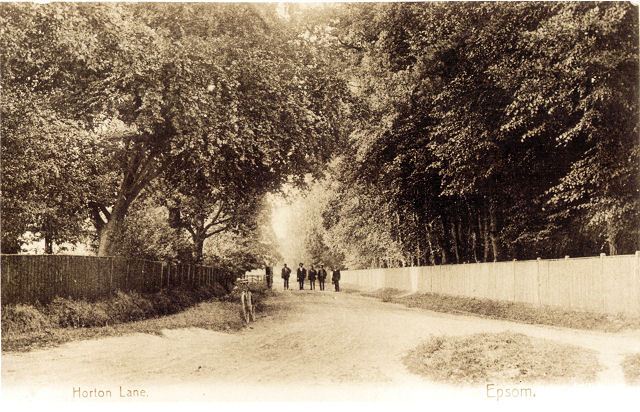 Horton Lane, Epsom c.1900
Image courtesy of Epsom & Ewell Local And Family History Centre
Hine’s design included two-storey blocks arranged regularly around the perimeter of an immense semi-circular corridor, and within the semi-circle an administration block, recreation hall, laundry, boiler room, kitchen and water tower. The idea was that staff could get to any part of the hospital quickly. Many parts of the buildings and corridors were made of glazed bricks to save the cost of plastering walls and to be easily kept clean and hygienic. Male patients were moved into the new building as soon as the male wing was finished, female patients had to wait till their wing was completed: however, full capacity could not be reached until the sewerage system was fully operational. Of course, social custom demanded that male and female patients were segregated, with males in the wards on one arm of the curved central corridor and females on the other.
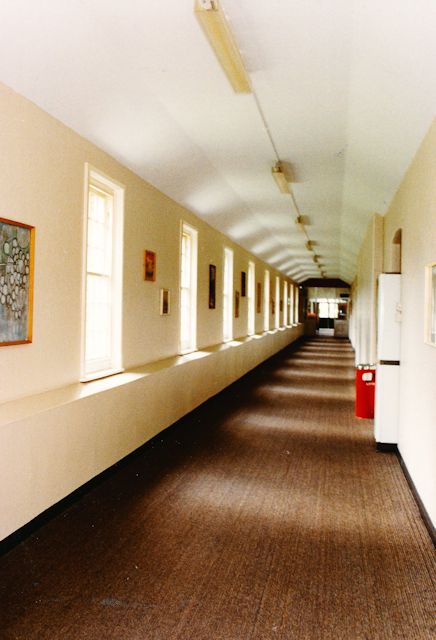 A corridor in Horton Hospital 19 June 1991
Image courtesy of John R Rifkin www.jrrifkinphoto.co.uk © 2014
Please contact John if you wish would like a copy or want to use this image.
Recruitment of staff was a constant problem at first. The untrained male attendants and female nurses received between £18 and £39 per annum with free board and lodging. Men had to ask permission to marry and only single women were employed. Often several members of a family worked at the hospitals and their social life was often based there. Each hospital in the cluster began with about fifty people employed on support services, including the farms, as against four hundred nursing staff.
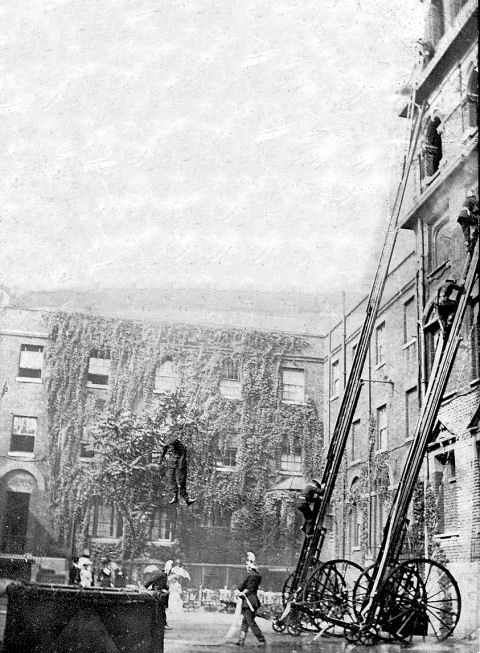 Horton Hospital Fire Drill c.1910
Image Courtesy of Mr Piner
Male and female patients were assigned separate living and working areas and even received different amounts of food. The diet in the early years was closely controlled by the LCC and was balanced, adequate but plain. Like other hospital functions, food preparation was divided between a male side (baking and butchery) and a female side (cooking).
‘An asylum is not a place one usually conjures up as a scene of festivity, but facts are facts, and it is incontrovertible that on Saturday afternoon the grounds of Horton Asylum were filled with the laughter and merriment of the patients and the staff. Though the many hundreds of mentally defective in this, as in other asylums, need to be taken care of, a large proportion of them have, if not at all times, a capacity for wholesome enjoyment of the pleasures of life, and on Saturday, when the annual fete took place, an army of patients were to be seen entering into the ‘fun of the fair’ with a zest that showed them to be capable of thoroughly enjoying themselves. The staff ministered to their happiness in all possible ways, and one’s ideas of what asylum life is like were somewhat upset by seeing the patients having shies, amid hilarious laughter, at the coconuts and at Aunt Sally, indulging – more merriment – in rides on the switchback railway, and on intractable donkeys, and competing with much enthusiasm in sports arranged for their particular benefit’.
Horton 1900s
 The cobblers’ workshop in Horton. Date not known
Image courtesy of Eric Hill ©2014
War Hospital – WW1
On 9 February 1915 the decision was made that Horton Asylum would become a war hospital. The medical superintendent since 1907, John Robert Lord, remained in charge but now with the army rank of Lieutenant Colonel. (He continued in charge of the Hospital when it reverted to civilian use in 1919 – and served there until his death in 1931. In 1920, he published a detailed “Story of Horton War Hospital”, the text of which is available at this link.)

Lt Col John Robert Lord.
Photograph with thanks to the Imperial War Museum © IWM HU 124317
So between 12 March and 8 April 1915, and with much overcrowding, some 2,143 mental patients were shoehorned in to other LCC mental hospitals. During the next four years, Horton (County of London) War Hospital treated more than 44,000 wounded servicemen, from all parts of the Empire. It had a capacity of 2,532 beds and the first batch of 72 wounded servicemen arrived on 20 May 1915, and the war hospital finally closed on 17 October 1919.
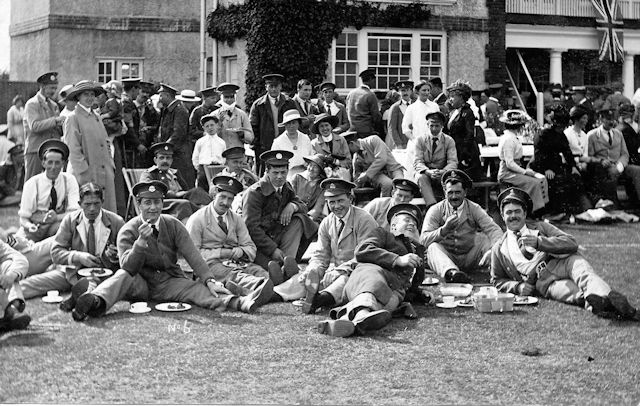 Postcard view of patients relaxing outside Horton (County of London) War Hospital. Date not known.
Image courtesy of Bourne Hall Museum
During this time Horton treated 44,613 service personnel of whom less than 1 percent (351) died. The CWGC plot in Epsom cemetery saw the burial of 94 of these men, the other 257 presumably being returned to their hometowns. (Of the other 54 burials in the CWGC plot 19 died at Long Grove, 30 at Manor and the other 5 at various locations).
[Click here for our article on Horton Hospital’s WW1 and WW2 memorials.]
After the end of the First World War the hospital reverted to treating the mentally ill but with a new name – Horton Hospital.
7 Dec 1928 – “I also inspected the new nurses’ home for 80 nurses which is now approaching completion. I was pleased to hear also that the proposed annexe to A. Hospital to include three side rooms, a room for Plombière Treatment, a ‘light’ room and a veranda is likely to be commenced shortly.”
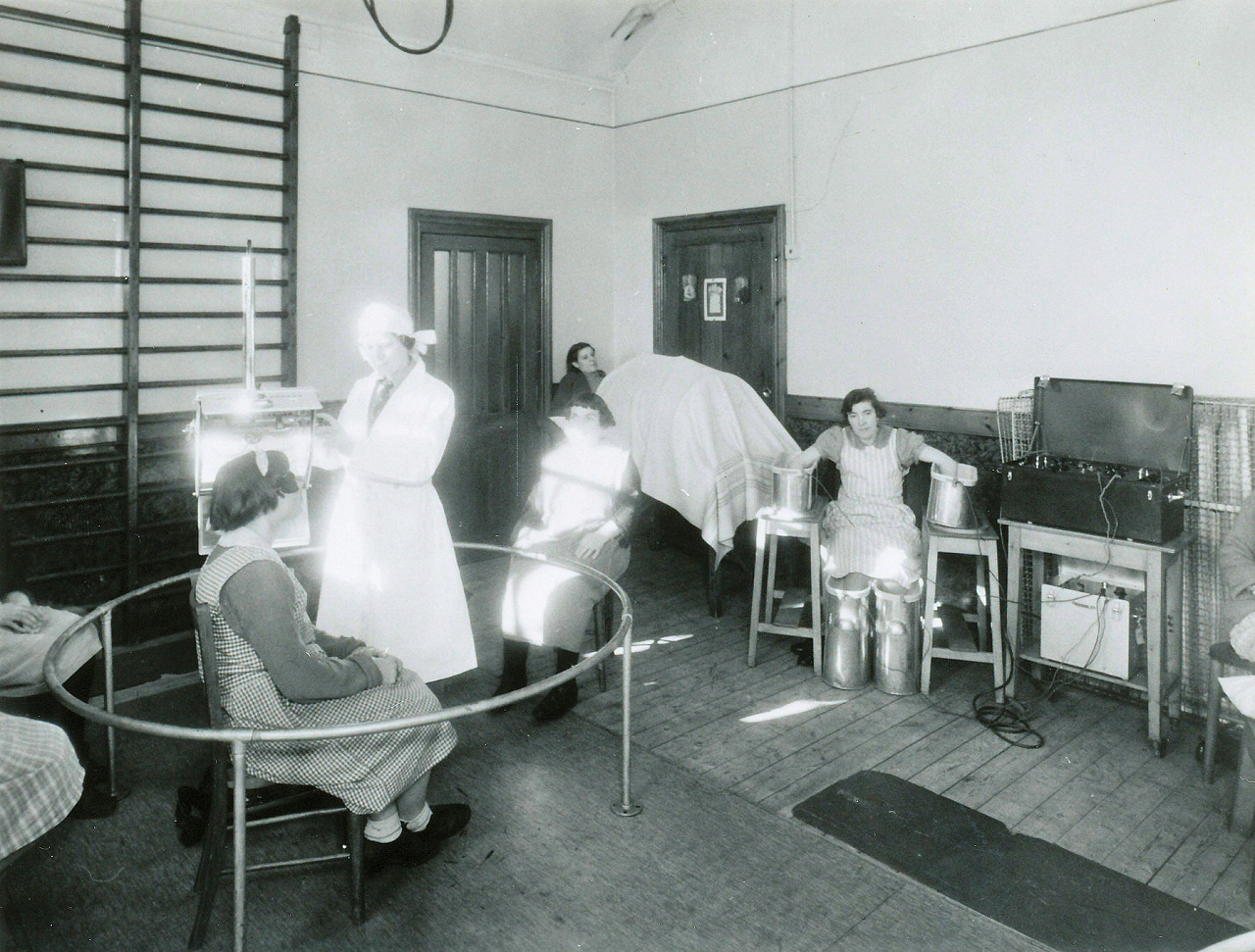
30 Dec 1931 – “With the coming into operation on 1st of last January of the Mental Treatment Act two new categories of patients in public mental hospitals have been created, namely, Voluntary and Temporary patients. At the moment 1 man and 8 women are voluntary patients and 3 women are temporary patients. We look forward to a great extension of the use of these two methods of admission and to the time when possibly the majority of the direct admissions will be either voluntary or temporary patients.”
10 Oct 1937 – “Physical training classes for male patients continue to be held with the assistance of seven trained instructors all of whom are drawn from the nursing staff.”
“We hope too that in the course of time a supply of warm water will be available in every washbowl used by a patient. At present a hot water can has to be employed in every ward in order to fill the basins”.”
“We also commend to the consideration of the Committee the enlargement of the present staff lavatories with the provision of washing accommodation and of a cloak room for their clothes when not in use.”
“The X-Ray department serves for this and for other hospitals in locality. The number of successful plates registered during this year 1936 was 1191 and the total number of cases examined was 787; of these numbers 440 and 269 respectively related to this hospital.”
“The issue of milk for ordinary diets amounted to 11/16ths pints per patient per day. In addition 403 pints are issued daily as sick and extra diets. The average caloric value of the ordinary diet issued is stated to be 3016 calories per patient per day.”
War Hospital – WW2
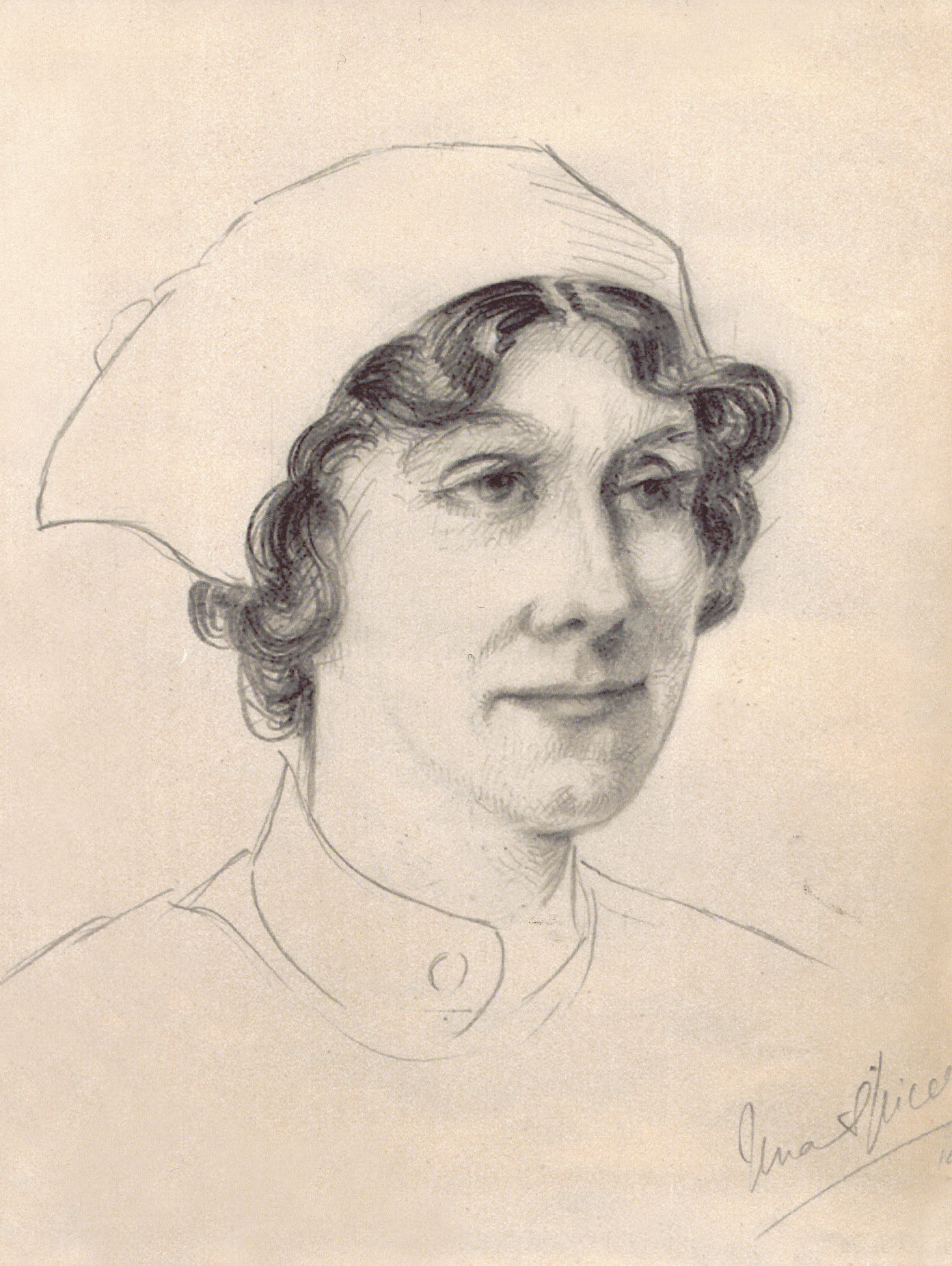 Drawing of Horton Hospital Nurse Eva Dymond
By Una Spicer c.1940’s
Courtesy of Bourne Hall Museum
In 1939, the patients were again evacuated. A strong team of consultants was drafted in, mainly from King’s College Hospital, but also from St Thomas’s, Westminster and Guy’s Hospitals. To give some idea of the turnover, 32,870 service patients (including battle casualties) and 47,488 civilian sick and air raid casualties were admitted between 1939 and April 1948, when the hospital ceased to be an Emergency Hospital.
Horton Hospital had been converted to a military hospital and as our back garden backed onto the grounds, we could see some of the wounded in the grounds. Nothing had prepared us for the sight of the Green Line buses that had been converted into ambulances, bringing the wounded survivors of Dunkirk to the hospital. The staff were rushed off their feet, but still the ambulance buses came, night and day, day and night—would they never stop? From my bedroom window, I could see some of the casualties; they were bandaged, on crutches, arms in slings, some in wheelchairs, some being guided because they couldn’t see.
Dorothy Collis, WW2 People’s War
bbc.co.uk/ww2peopleswar
I was 14 when the Second World War broke out. When I had finished my education I went to become a nurse. In October 1943 I started training at Kings College Hospital. I was sent to the emergency hospital at Epsom in April 1944. I was there until the following January. After the D-Day landings the wounded came to us on a hospital train.
Freda Purdie, WW2 People’s War
bbc.co.uk/ww2peopleswar
‘We were the first military draft of casualties from France in January 1940. And the nursing staff were all girls from various hospitals who were volunteers – wonderfully educated girls from Guys, Bartholomews, St. Marys, Paddington and St. Thomas. At one end of the ward there was a padded cell – well, more than one – and there were strait-jackets still hanging in there. How do I know this? Because I, like all men of that age, was chasing the nurses about – you know – and the nurses decided to teach me a lesson. And they all grabbed me, and put me in the padded cell. Mind you, I didn’t fight, not very hard. And they put a strait-jacket on me, tied me up, and slammed the door and left me in there. Put it this way – I’d led a very hard life. I didn’t get claustrophobia, but I must say it was very strange – I thought, well, nobody could hold me down, nobody could tie me up, but – have you ever seen a strait-jacket? All I know is, your arms are by your side, and they put this thing round you, and they button it up at the back, and then there’s a belt, and your arms are inside, and as far as I know, there were no sleeves. I wasn’t frightened, in fact it was all part of the joke. What I was more worried about was the humiliation of going in amongst soldiers, and they going ‘Ha, ha, ha – clever boy, not as strong as you thought you were’’.
Horton, 1940s
‘I remember the soldiers. We used to watch all the ambulances come up Horton Lane. They were Green Line buses, and when they’d meet a ship, they’d be queued right up the lane, trying to take their turn to get in. We’d sit there as kids, fascinated by the buses and stretchers. It’s only when you grew up you realised – it came home to me once – they had these operating theatres in there – when I had to strip this building out. There was a massive incinerator in it – what the hell did they use that for? – because the building had been shut up for years. And talking to an old timer, talking to me as a youngster, it was where they used to burn all the limbs that they cut off in the operating theatre. The soldiers wore blue uniforms with red ties, and the prisoners-of-war had a big diamond in the seat of their trousers of a different colour. We used to look at them as Look At Them Foreigners, and run like hell – probably make faces at them and run’.
Horton 1940s
‘One of the first jobs in the morning was, you had to strip all the beds off. You had a long narrow ward, and you had fifteen beds there, then you had a strip of linoleum, and fifteen beds, and then head to head, you had a further fifteen beds, and a strip of linoleum, and fifteen beds and then the windows. And the first job in the morning was strip all the beds off and you had to pull the beds together, and you swept all that wooden floor, and changed all the beds, and then after that you started the bath book. The bath book was like an ordinary exercise book, and you had all the names of all the patients in the bath book. And because you had sixty of them you couldn’t bath all of them in the morning, so you used to try to bath thirty of them in the morning and thirty of them in the afternoon. Just to the side of the ward, they had a big bathroom. It used to have four baths in it. They had duckboards that you stood on. You put one in to soak, while you washed the other one’.
Horton 1950s
‘There were padded rooms that I couldn’t go in on my own. A nurse would accompany me, or sometimes the patient was removed. It was very distressing, especially if it was a female. Male patients you could put up with. Their mattress was on the floor – that was all they had. The padding was rubber and it was made up from floor to ceiling, and filled with cork. I’ve seen it come apart so I know that. It went right up to the ceiling apart from the door itself, and there was a window up high. The light itself was in an unbreakable glass section. You had to get steps and go up there, and keep your eye on the patient as well because sometimes the nurse would leave you, which I never liked. The floor was padded too, hooped and filled with cork. They had a pot. But more than often it was empty – not very pleasant at all. Either they didn’t use it, or after a while they got fed up looking at it, or smelling it – not very hygienic’.
Horton 1950s
30 Mar 1950 – “Eight wards and villas, 6 on the female side and 2 on the male side, are administered on the open door principle and 108 patients (66m – 42f) enjoy full parole.”
‘I started on the wards in 1965. By then it was getting freer everywhere. Before our time it was really segregated: if you were going out with a girl from the hospital you couldn’t even walk up the drive together. My mother used to work here as a cleaner. There was one time I had a girlfriend she didn’t approve of. So my mother went to the Chief Male Nurse, and said: You’ve got to stop him, or I’m going to throw him out. He called me in and told me; but all he said was: If she does, I’ll have to give you a room here’.
Horton, 1960s
‘There was one lady, who must have been over 75, and whenever you bumped into her in the corridor she was always waiting for John to visit her. I assume John was her son, but I never found out. And I can remember going into the hospital, about midnight, and I bumped into her, and I said, ‘Why don’t you go and sit and watch television in the warm, with the rest of the ladies on your ward?’ and got the smart reply straight back from her, ‘I’m not going to sit with a lot of old ladies watching television!’’.
Horton 1970s
‘A patient we knew used to come and cut the hedges in the garden. I made the mistake, when I had just moved in, of cutting the hedges in my garden, and he came and told me off. Without a shadow of a doubt, I’d done the wrong thing; that was his job. He worked his way from one end of the hospital to the other, and nobody else cut the hedges. After that, I knew that some time in the Autumn, the hedge would end up being cut’.
Horton, 1970s
‘I used to go with my Dad on callouts down the subway which is all the underground tunnelling that’s under the hospital, and where all the heating and hot water is. Because I worked for my Dad as well, I had to do a survey of the subways which was quite interesting – it was amazing how easy it was to get lost down there – it was pretty spooky, and we saw a few stray cats down there. The hotter the subways became, the closer you knew you were to, say, the laundry. They connect to most of the buildings, in the vicinity of the centre, though the outer buildings had their own. When I went down they were starting to close them off because they were starting to become unsafe because they’d been down there for a hundred years’.
Horton 1980s
Some extracts from the official reports on the early years of Horton Hospital can be read here Horton – Down the Years .
This document covers the general development of Horton hospital. If you are looking for more specific information or want hospital records, please see the following research guide: Horton Hospital.
Links to pages on this website:
Horton Cemetery
Horton Cemetery Burial Registers
Horton Hospital Chaplin Rev Hockly
Patient Numbers
29 July 1905 – Total 2030 (M.906, F. 1124). [3524 patients had been admitted, 829 discharged or removed of which 492 were ‘recovered’ and 662 had died.]
4 Dec 1914 – Total 2179 (M.1005, F.1174)
19 Dec 25 – Total 1926 (M.268, F.1658)
15 Nov 1932 ” …. When all these changes have taken place the night accommodation will be for males 556 and for females 1616 a total of 2172 as compared with 2062 at present.”
9 Dec 1938 – “One of the most important developments at this hospital which is taking place at the present time is the extension of the male side …. this will result in the prescribed accommodation working out at 1490 beds on the female side and 681 on the male side.”
16 Jan 1952 – Total 918 (M.303, F.615) [Staff Male Nurses 81, Female Nurses Full-time 85, Part-time 109 and Medical Staff 9.]
Management:
1899-1948 : London County Council Asylum Committee
1948-1974 : Horton Hospital Management Committee under the South West Metropolitan Regional Hospital Board
1974-1982: North East (Teaching) Health Authority under the North West Thames Regional Hospital Authority
1982- : Riverside Health Authority under the North West Thames Regional Hospital Authority
Related Images
 Composite 1930s OS Map showing Horton Hospital
Click on the map to see it full size

Ward Plan (September 1985)
Click on the map to see it full size
 Unloading war casualties destined for Horton War Hospital at Epsom Station
Image courtesy of Epsom and Ewell Local and Family History Centre
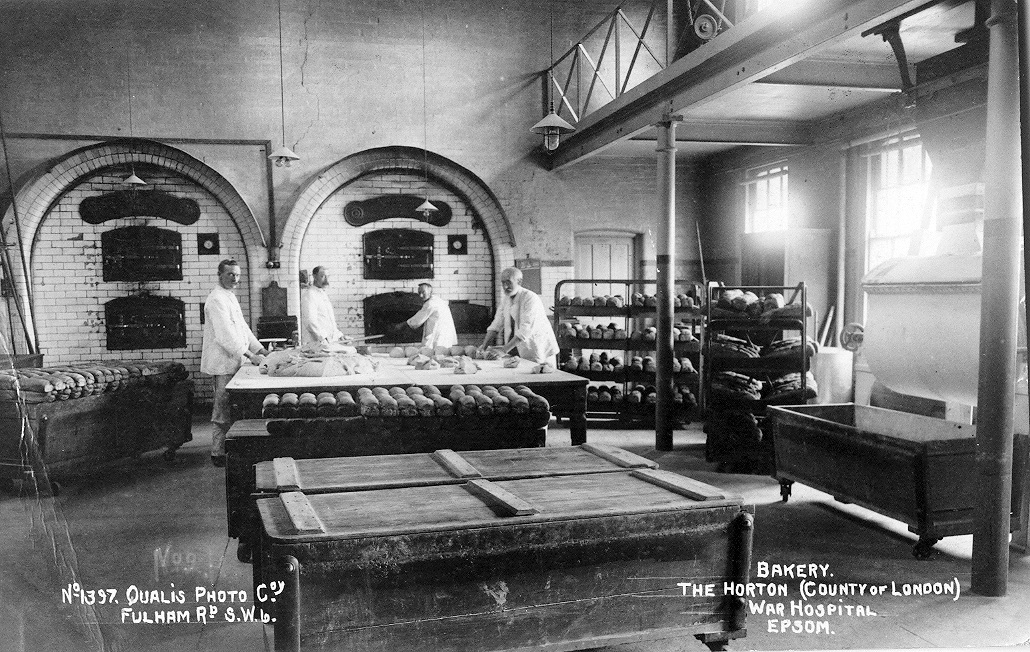
The Hospital Bakery (1915-1919)
Image courtesy of Bourne Hall Museum A Hospital Ward (1915-1919)
Image courtesy of Bourne Hall Museum 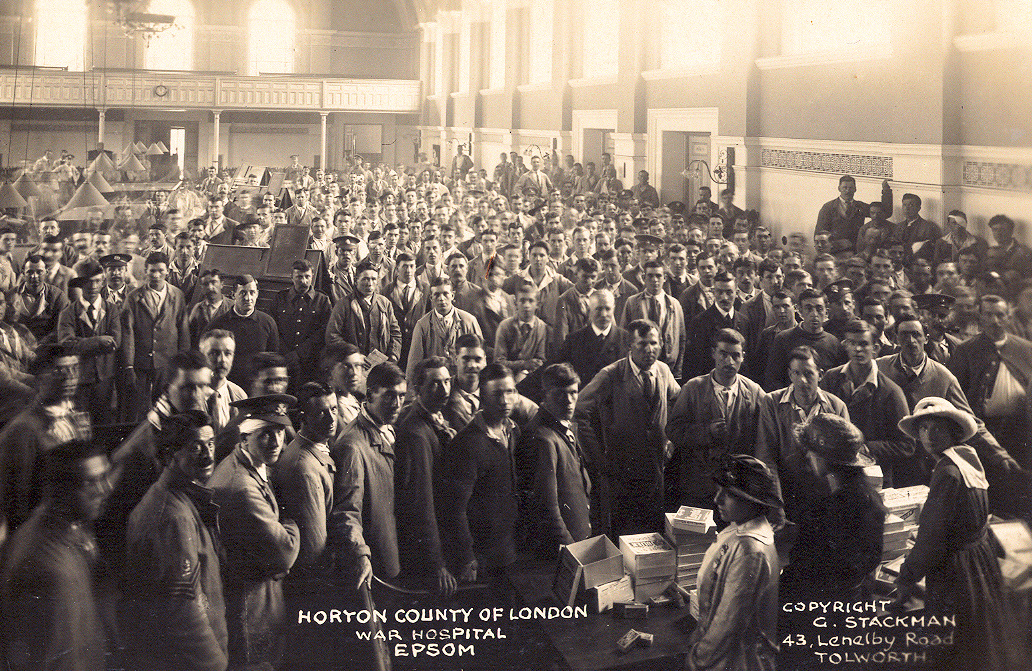 Recreation Hall (1915-1919)
Image courtesy of Bourne Hall Museum
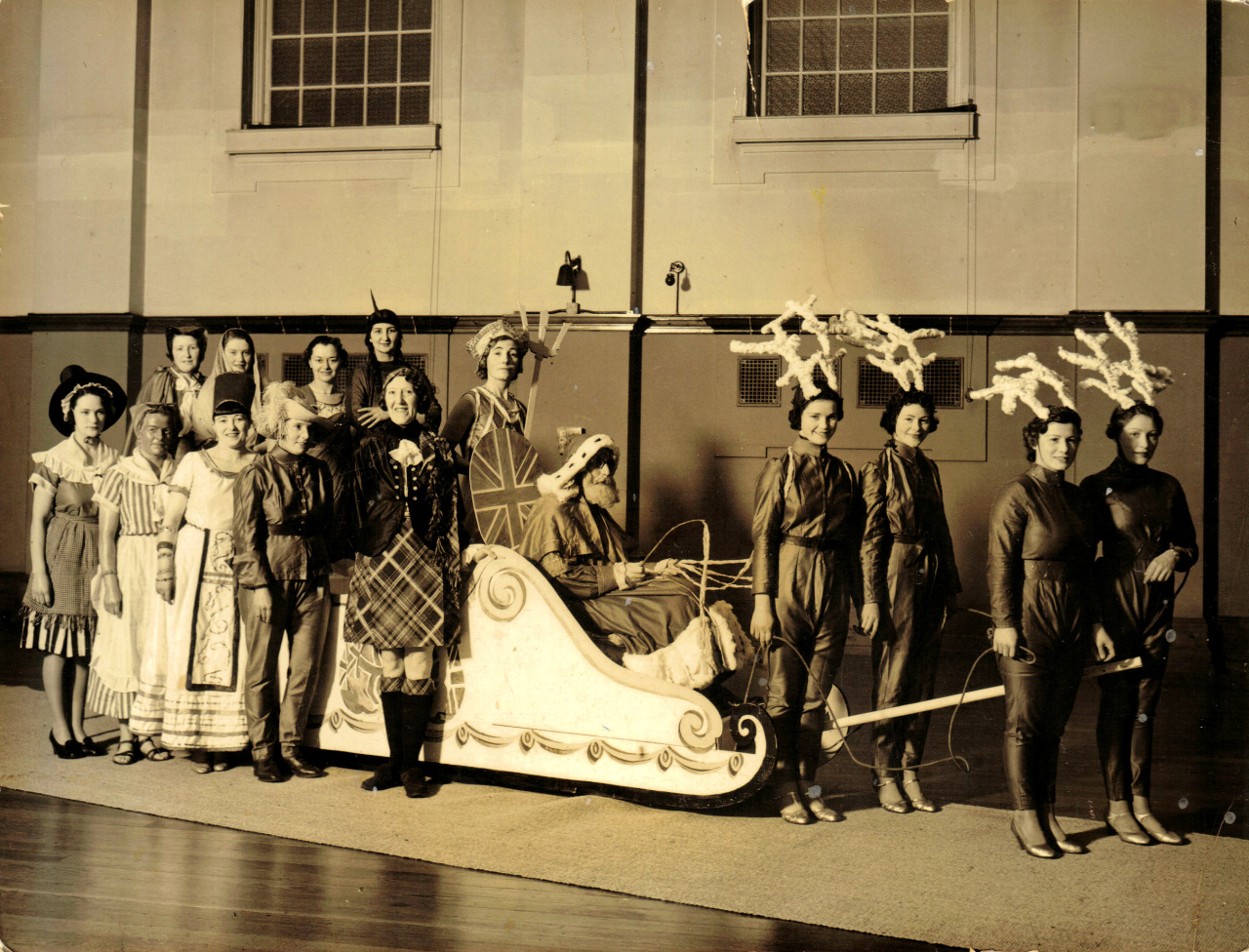 1932 Christmas pantomime performed by staff.
Image courtesy of Epsom and Ewell Local and Family History Centre
 Some staff (date not known).
Image courtesy of Epsom and Ewell Local and Family History Centre
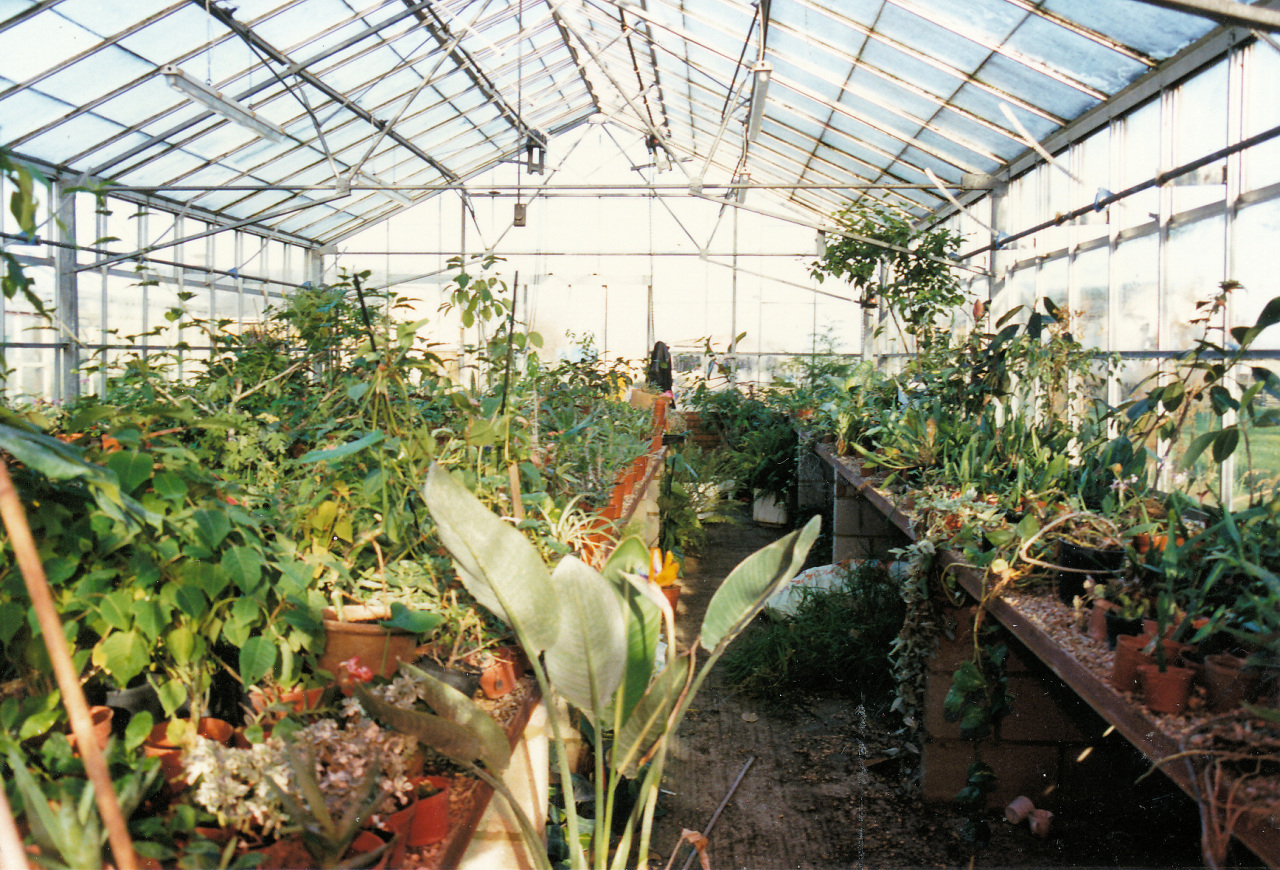 Interior of one of the Hospital greenhouses
Image courtesy of Bourne Hall Museum
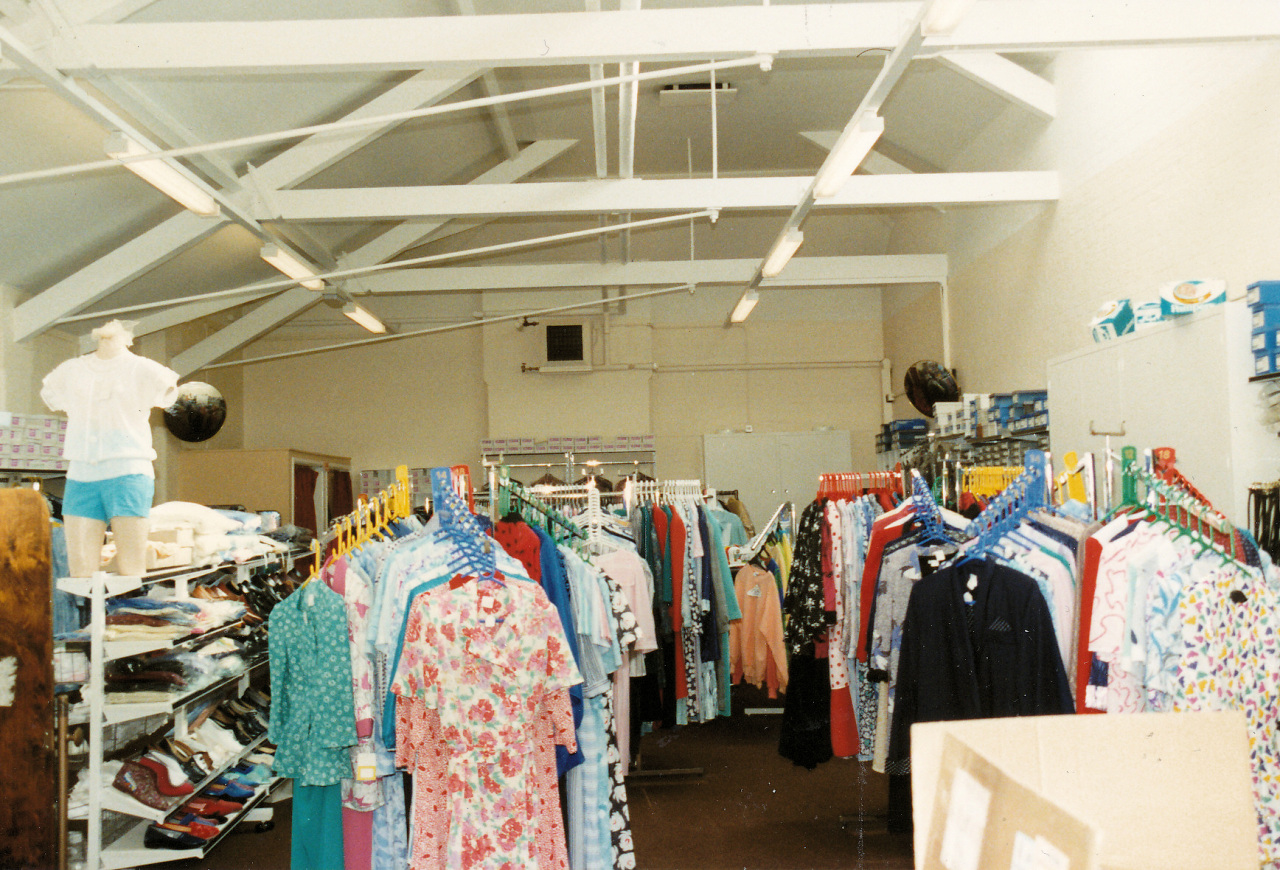 Patients Clothes Store
Image courtesy of Bourne Hall Museum
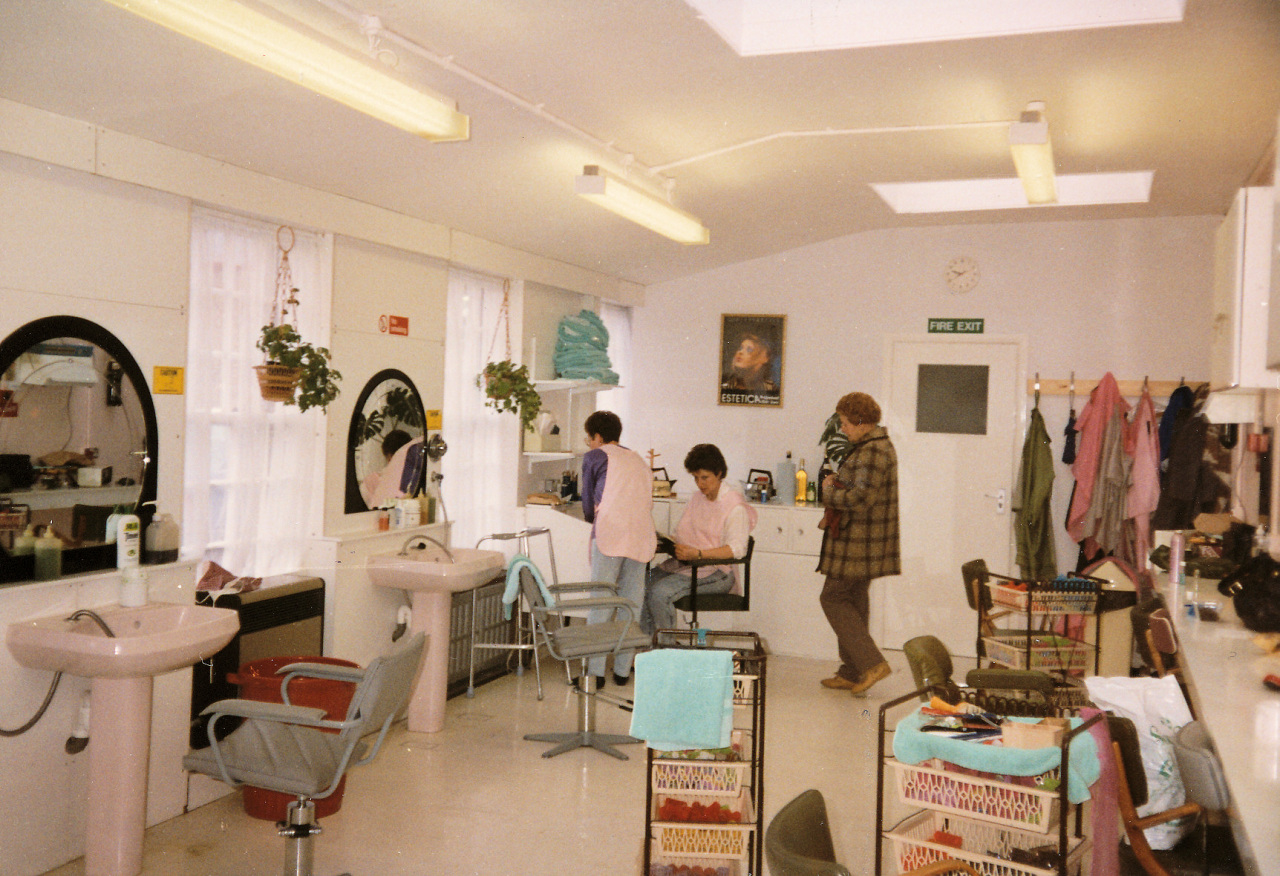 Patients Hairdressing Salon
Image courtesy of Bourne Hall Museum 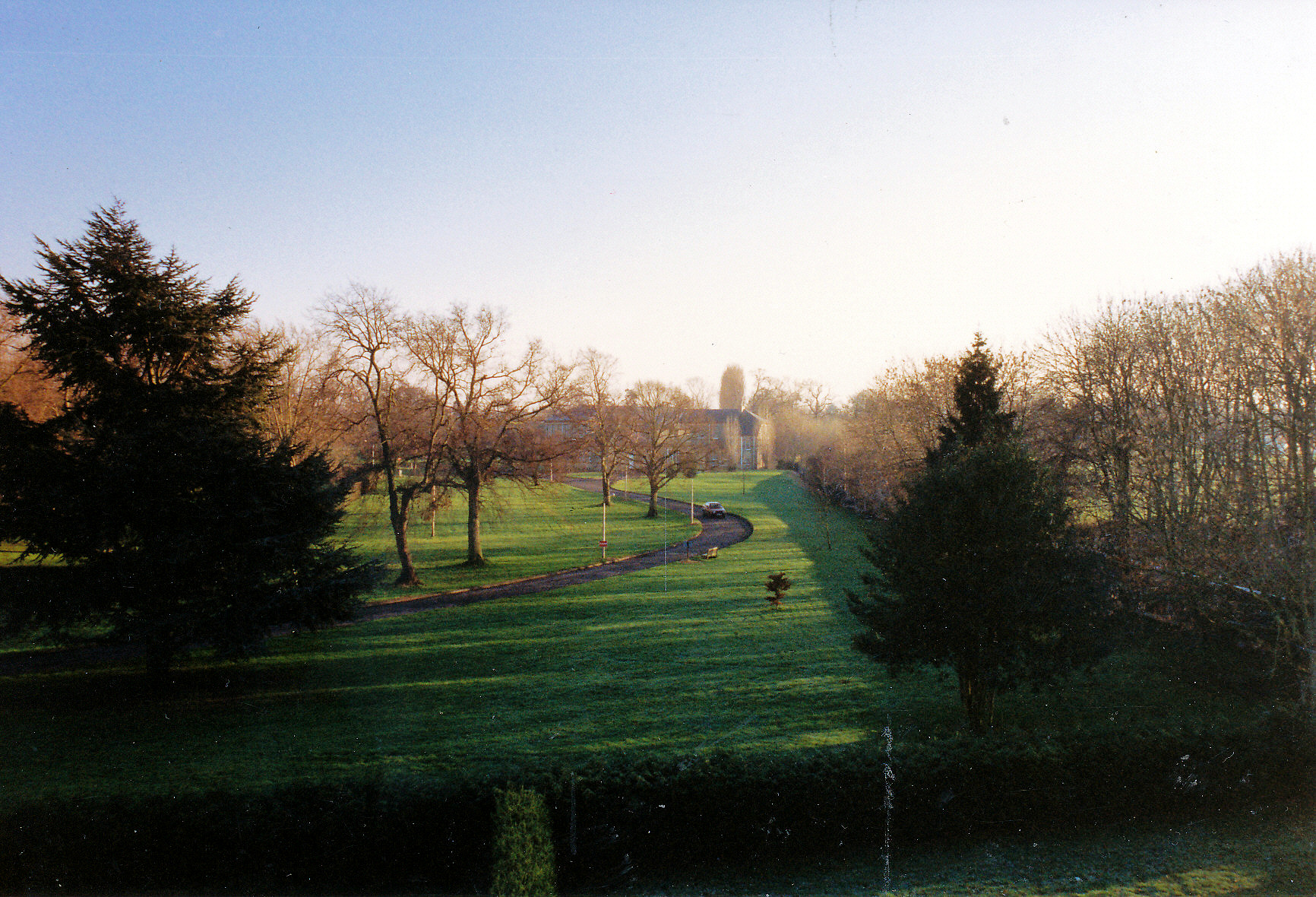 View of Hospital Grounds
Image courtesy of Bourne Hall Museum
 Occupational Therapy – Shaping and cutting flower baskets
Image courtesy of Bourne Hall Museum
Links to related pages on this website:
Horton Cluster – Introduction
Horton Cluster – Manor Hospital
Horton Cluster – Horton Hospital
Horton Cluster – St Ebba’s Hospital
Horton Cluster – Long Grove Hospital
Horton Cluster – West Park Hospital
Horton Cemetery (History)
The burial records are split into 26 parts: A B C D E F G H I J K L M N O P Q R S T U V W X Y Z
Railways Serving The Epsom Hospital Cluster
Other pages that you may be interested in:
Electrotherapy at Horton (County of London) War Hospital, Epsom, in WWI.
The Long Grove Psychiatrists Of 1911
Malaria Laboratory (1925-1975) – The Mott Clinic
Ogilvy, Dr David / Smith, Pollie Eaton