
MRS MARY ELMSLIE (1780-1868)
Resident of Woodcote Place, philanthropist and orphanage founder
 Mrs Mary Elmslie
(This image has been digitally enhanced)
Image courtesy of Aberdeen Endowment Trust ©
It’s a relief that we don’t need to deal with the Elmslie family tree in this article. They were complicated and, as with many large families who were in business/trade, the forenames repeated themselves across and down the generations, to the extent that a casual researcher cannot be certain which one is which. However, I do want to mention another Elmslie later on and you will see why in due course.
 JamesElmslie
(This image has been digitally enhanced)
Image courtesy of Aberdeen Endowment Trust ©
James Elmslie was a partner in a firm of East India merchants, principally with Thomas Stooks and John Linblad: they had operations in London and Gibraltar. James died on 29 January 1833. It is evident from his will that he possessed large property holdings, particularly in Buckland St Mary, Somerset, and he left virtually everything to his wife (they were childless), but he also made bequests to various relatives, the children of a late servant and charities in Aberdeen, including the ‘Poor Asylum’. We shall go to Aberdeen shortly, but meanwhile let’s look at Mrs Elmslie’s background
The Calders
Mary Calder was born on 17 September 1780, one of eight children of Aberdeen wine merchant James Calder and his wife Anne (née Stephen). Anne was a member of the distinguished Stephen family, which eventually resulted in the writer Virginia Woolf and the painter Vanessa Bell. None of the Calder children married, except Mary: she wed James Elmslie in 1811 in Chesterton, Cambridgeshire.
The Elmslies lived at Woodcote Place for nearly all their married life and Mary remained there until her own death.
Mary’s father, James, had been successful in the wine trade and in the early 1800s he made donations totalling around £3,000 (roughly £260,000 in current money) to the parishes of St Nicholas, Nigg, Nether Banchory and Old Machar, all in Aberdeen.
Much of the information about the Calders comes from a short memoir written in 1883 by John Smith, an advocate in Aberdeen and then a senior trustee of Mrs Elmslie’s orphanage. He says this.
‘Hitherto, unusual prosperity had attended Mr Calder, but a mad reverse was at hand. In an evil hour he purchased a share of a tannery company for his son William, then in pupilarity, intending it to form a provision for him, but in a year or two the boy died and the concern became bankrupt. The creditors came upon him, and after a long and expensive litigation he was found liable for the debts of the concern, by decree of the Court of Session, 11th December 1811, affirmed by the House of Lords on appeal, 24th April 1815. Mr Calder never got the better of this disaster and during the latter years of his life he lived in a humble and contented manner in Shiprow, along with his sons Alexander and Edward and his unmarried daughter Ann. He died … in 1832 and he and his wife are buried in the Churchyard of Nigg, close to the south wall of the old church.
On the death of their father, Alexander and Edward removed to London and were liberally provided for by their sister, Mrs Elmslie. Alexander showed the family generosity of mind by various charitable and benevolent donations to his native town, but in such a private and unobtrusive manner that no record remains of them except such as passed through the hands of Mr Smith, the writer of this brief memoir …’
Mary’s younger sister, Ann(e), had died in 1835, aged 47, and was buried in St Martin’s, Epsom. Edward, who had been at Woodcote Place with Mary in the 1861 census, passed away in August of that year at the age of 67; Alexander lived until he was 82 and expired in 1867. All three of these Calders are in a vault at St Martin’s with James and Mary Elmslie.
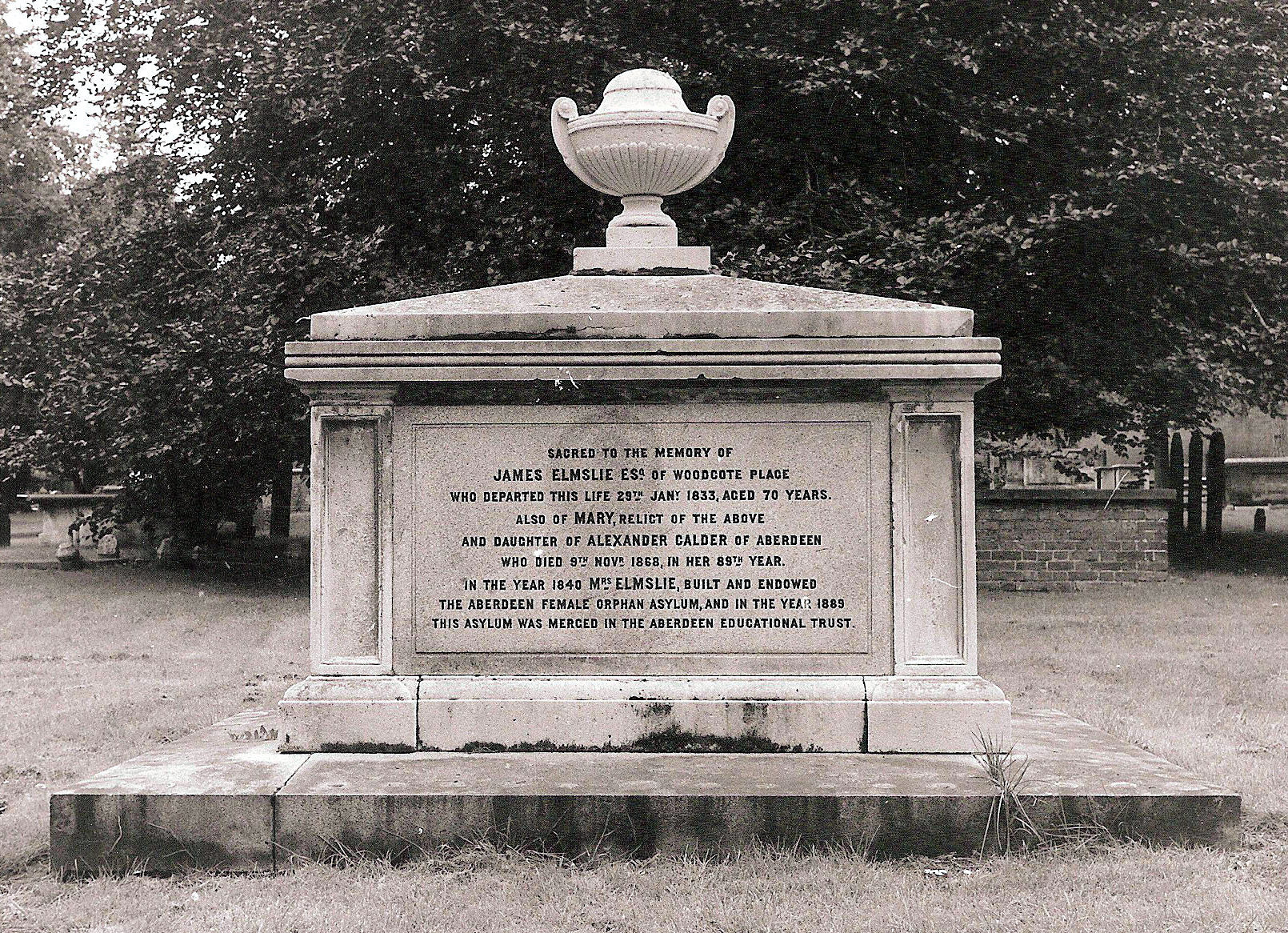
The Elmslie Vault in St Martin’s graveyard Epsom in 1968,
Photo by L.R. James and held in the Epsom & Ewell Local & Family History Centre
The orphanage
You will have gathered that both James Elmslie and the Calder family were philanthropic towards the general area they came from – i.e. St Nicholas, Nigg, Nether Banchory and Old Machar. Mary, who had been left very comfortably off, followed in their footsteps. Deciding to establish an orphanage for young girls, she purchased some land in Albyn Place, Old Machar. The eventual building, at 19 Albyn Place, was called the Aberdeen Female Orphan Asylum and Mary endowed it with £35,820 of 3% Government annuities. £35,820 is roughly £3.6 million in today’s money.
The architect for the project was Archibald Simpson, who was immensely important in shaping the ‘Granite City’ of Aberdeen, along with his rival, John Smith (not the same John Smith mentioned earlier). In particular, Simpson was responsible for Aberdeen’s Marischal College, which has been added to over the years and is now the second largest granite building in the world, after El Escorial in Spain.

Archibald Simpson by James Giles RA
Image source: Wikipedia
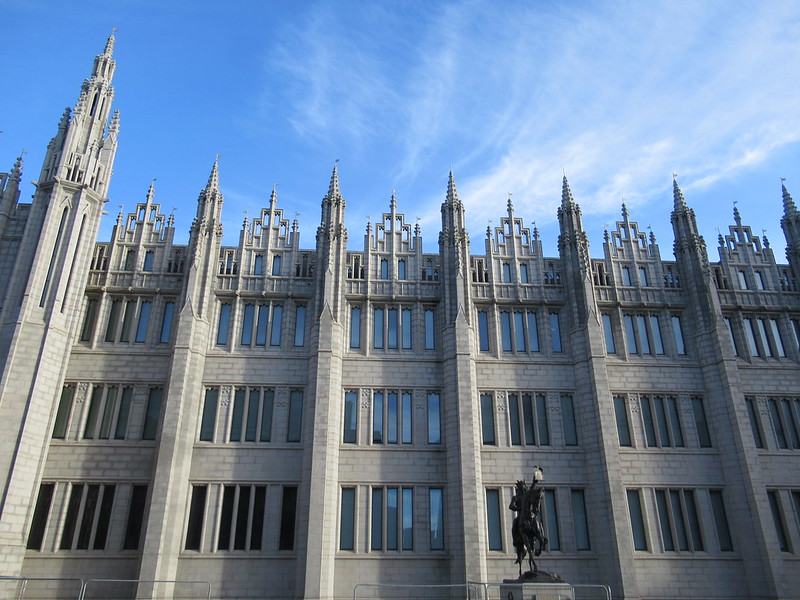
Marischal College in 2018 (with a statue of Robert the Bruce in front)
by Alex Liivet (CC BY 2.0)
Here are two drawings of the orphanage, plus a map.
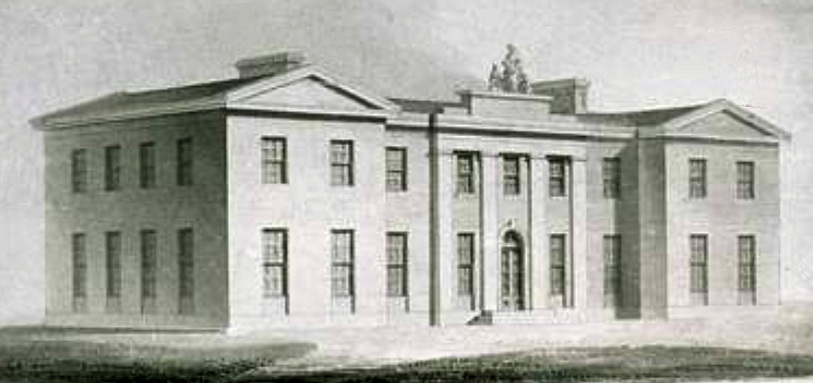 A sketch by the architect Archibald Simpson (Source not known)
 A print of the Orphan Girls’ Asylum (Source not known)
1869 Ordnance Survey map showing the orphanage as property 1894
The entry conditions for the orphanage were very strict – i.e. they did not take just any female orphan.
A girl had to fulfil the following criteria.
- No younger than 4 and no older than 8
- Her parents must have been married
- She had to leave at 16
- Her parents must have lived in the parishes of St Nicholas, Nigg, Old Machar or Banchory Devenick for at least 3 years.
If accepted (the institution catered for around 50 girls at a time), you could expect to be prepared and trained for a life of domestic service, which was just about the only ‘vocation’ open to girls at the time. Much later, however, the training envisaged girls becoming shopworkers or even nurses. Not the dizzy heights of a fantastic career, but, given the status of females at that time, a place at the orphanage was likely a lot better than the kind of life they would otherwise have led, with all its deprivation and health/moral hazards.
Mrs Elmslie took a very active interest in the orphanage and you do get the feeling that she made sure the place was properly run and up to scratch. There is a letter, dated December 1842, from a Mr Simpson at the orphanage, responding to Mrs Elmslie’s communication earlier in the month. He talks about one particular girl, recently admitted, and there is detailed mention of work on a tunnel, burn and drainage at the side of the premises.
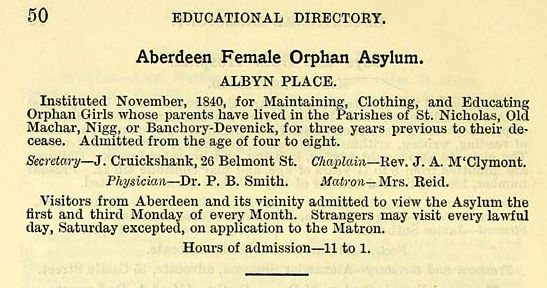
Extract from Aberdeen Post Office Directory 1883/4.
Image source: National Library of Scotland
Mary’s later years and death
Mary’s last will was dated 11 May 1858, making numerous bequests (probably, in the main, to charitable causes, friends and servants), with her properties going to her brother Edward and the residual estate to her brother Alexander. However, at some point soon thereafter, and presumably before 1861, she seems to have lost her faculties and, indeed, in one newspaper report after her death she was described as a ‘lunatic’, which probably meant that she suffered from dementia (‘lunatic’ being the derogatory and catch-all term for any form of mental impairment in those far-off days).
Edward might have been expected to outlast his sister, being many years younger, but he died at Woodcote Place on 1 August 1861, his usual abode being Upper Woburn Place in London. Since Mary did not change her will, we can probably assume that, either she was by then incapable of managing her affairs properly, or perhaps she merely thought the properties would pass to Alexander automatically.
Her executors were named as Alexander Calder, John Hopton Forbes (a solicitor) and the Reverend Edward Richard Northey. Had she thought rather more carefully about all this back in 1858, when she made the will, she might have made provision as to what would happen if her two brothers predeceased her. Alexander expired on 8 August 1867 at the age of 82, leaving the properties and residual estate in effective limbo, since both brothers had been unmarried without descendants.
When Mary died on 9 November 1868, aged 88, the Lunacy Office was involved with her will and probate was granted to the surviving executors, Forbes and Northey, on 11 December 1869. Curiously, it was acknowledged that Alexander had predeceased her, but not that Edward had. A scramble for the spoils ensued, with very distant relatives making claims against the estate. There was a Mrs Anne Mary Dicey, formerly a Stephen and a descendant of Mary’s maternal aunt, plus some people who claimed to be descendants of a Gilbert Calder, who dated back to the 17th century, and others too. What happened in the end I don’t know (I rather think that there would have been multiple heirs, making the sale of the properties essential, so that the proceeds could be spread around). Woodcote Place had been sold by mid-1873, with the furniture being the subject of a separate auction shortly afterwards.
In 1888 the orphanage was amalgamated with the Aberdeen Educational Trust and Mrs Elmslie’s establishment was replaced by a Girls’ Home and School of Domestic Economy, which was designed to teach 60 foundationers and maintain 30 girls. There is more about all this in the Aberdeen City Archives . In 1891, 19 Albyn Place was sold to the Aberdeen School Board and is now a part of Harlaw Academy.
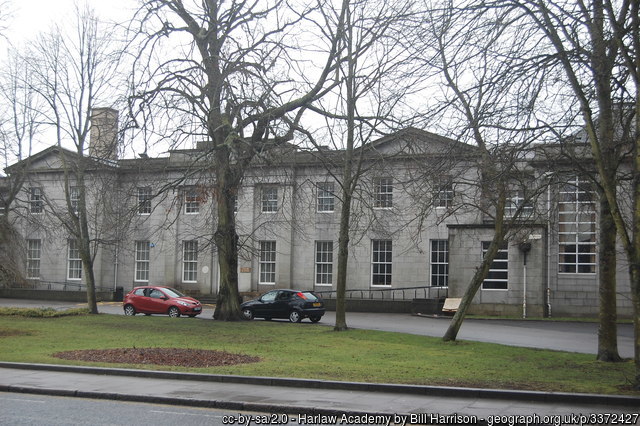
Harlaw Academy
As an epitaph for Mary Elmslie, I offer you this report from the Aberdeen Press and Journal of 15 July 1879.
‘ABERDEEN ORPHAN INSTITUTION. – On Saturday the little girls of the Orphan Institution, as has been their wont since 1840, had their annual excursion to Newlands House, kindly invited by the Misses Duguid, friends of the late Mrs Elmslie, of Woodcote Place, Epsom, the foundress of the institution. Punctually at four o’clock the girls appeared in the avenue and ranged themselves according to height in the circle before the house. Welcome given, they sang two songs with charming effect, and after a short repast proceeded to their various games. The great attraction appeared to be the stream of water that flows from the Pitfodels reservoir to the Dee. After a rest, the whole group engaged in the rope dance, the invited guests joining in the sport, and adding to the zest of the meeting by a distribution of fruit and confections. The proceedings were wound up by singing the Queen’s Anthem, a mouthful of milk sent from the farm for the orphans, and three cheers for the friends of the noble foundress, who in her early years lived in the locality, and in old age liberally provided for all who had served in her family. The conclusion of the proceedings was the presentation to the matron (Mrs Reid) of the portrait of Sir Alfred Stephen, recently appointed Lieutenant-Governor of New South Wales as a mark of Royal approbation of his long services in the colony. Sir Alfred being a near relative of Mrs Elmslie, the portrait will be prized in the institution. The children went away delighted with their excursion.’
Syrie Elmslie
As I said at the beginning of this piece, another Elmslie has relevance to the general subject-matter and she was Sarah Louise, known as Syrie. She came from another branch of Elmslies but it is very likely that all of them were from the same family originally. A little way up the tree, Syrie’s branch apparently sprang from a John Elmslie, who was born in Oldmeldrum, Aberdeenshire (approximately 17 miles from Old Machar for reference purposes) and died in 1822 in London. John was a West India merchant and, whilst no connection has been suggested between his business and that of Epsom’s James Elmslie, the latter did make mention of an Adam Elmslie and his son, Edward, in his will. John had a son called Adam Wallace Elmslie, who in turn was the father of an Edward, so this may imply a family connection. However, the fact that John had 21 children in all emphasises how complicated and prolific this family was.
Syrie was in a similar line to our Epsom Elmslies, in the sense that she ran a ‘ragged school’ (in Richmond), as had the man she married in 1873 – Dr Thomas John Barnardo, whose name became synonymous with orphanages and, of course, there was one such establishment at Clayton House (formerly Mittendorff House) in East Street, Epsom, which came into the hands of Barnardo’s in 1896.

Thomas John Barnardo
by Stepney Causeway Studios
bromide postcard print, 1900-1905
NPG x136278 (CC BY-NC-ND 3.0)
After Dr Barnardo died in 1905, Syrie carried on the good work for four more decades, dying at the age of 96 in 1944.
A group of Barnardo Boys at Australia House, 1938. Mrs Barnardo is seated in the centre.
One of the children of Dr Barnardo and Syrie was Gwendoline Maud (or vice versa) Syrie, who was famous in her own right as a fashionable interior designer for high society (all-white rooms were one of her innovations, although she subsequently turned pastel), but also for her love life. Her first husband was the American pharmaceuticals tycoon Henry Wellcome, whose will established the Wellcome Trust. The marriage was unhappy (as may possibly be inferred from the odd poses in the next photo).
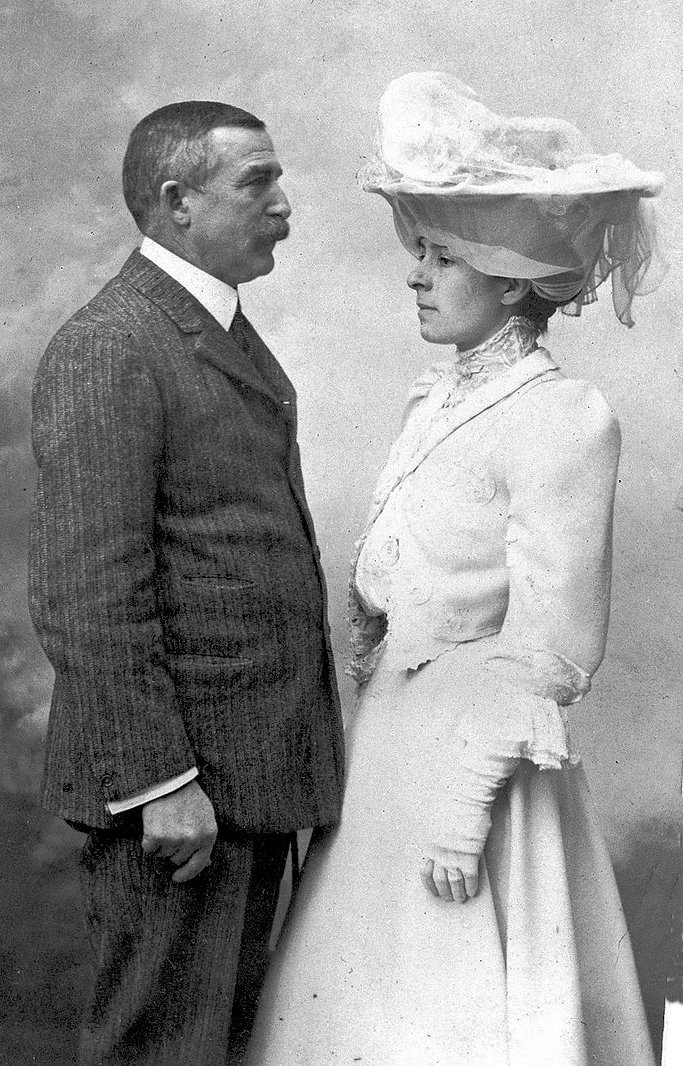
Sir Henry Wellcome and Gwendoline Syrie Wellcome.
Wellcome Collection. Attribution 4.0 International (CC BY 4.0)
Syrie Junior had been carrying on an affair with the author Somerset Maugham whilst still married to Wellcome and bore a daughter, Liza, by him; she also had an affair with Harry Gordon Selfridge, the department store man. Syrie and Somerset Maugham were married in 1917, by which time he was heavily involved with Gerald Haxton and the two men set up home together in Cap Ferrat in 1927. The Maughams then divorced. Liza (strictly Mary Elizabeth or vice versa) later became Lady Glendevon.
Linda Jackson 2020