
The Rt Hon Baron Russell of Killowen GCMG QC (1832-1900)
and family
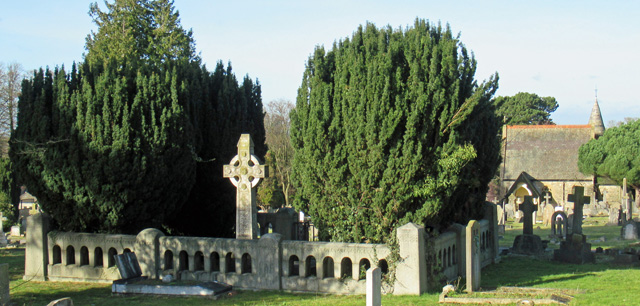
The Russell family plot in Epsom Cemetery.
Photograph by Roger Morgan © 2020
While Epsom Cemetery contains a number of family plots, by far the most substantial is that of the Russell family, as illustrated above. It is sited about 80m uphill from the Cemetery’s chapel (in the left background of the image above).
The first burial in the plot, on 14 August 1900, was of Charles Arthur Russell, the first Baron Russell of Killowen. He had died on 10 August 1900, as England’s Lord Chief Justice – a post he had held since 1894.

Baron Russell as Lord Chief Justice of England.
Portrait by John Singer Sargent, 1899. Public domain.
Although not resident in the Borough during his lifetime, Charles was a near neighbour in his later years when living at his country home of Tadworth Court, now the home of the Children’s Trust). And we know that, at a previous stage in his legal career, he had some direct involvement in an Epsom matter by advising Robert Applegarth in his 1892 case against the Grand Stand Committee. Anyway, as he has now lain in Epsom Cemetery for 120 years, it is fitting that we should note his interesting life and something of his high-achieving family buried alongside him.
Charles was born on 10 November 1832 in Newry, County Down – then part of the Province of Ireland but, since 1922, one of the six counties of Northern Ireland. He was one of five children born to Arthur and Margaret (née Mullin) Russell. The family was in moderate circumstances, generations of their ancestors having suffered much for their Roman Catholic faith.
Unlike his four siblings, all of whom went into the church (the three sisters as nuns and brother as a Jesuit priest), Charles opted for the law. Having gained his degree at Trinity College, Dublin, he was admitted as a solicitor in 1854 and practised in Belfast for the next couple of years. In 1856, he moved to London and was admitted at Lincoln’s Inn. Obviously good at his calling, he was called to the Bar in January 1859. He continued to progress: by 1872, he was a QC on the Northern Circuit, where his oratorical vehemence led to his advocacy being described as an “elemental force”.
While progressing yet further in the legal profession, Charles also went into politics – as a Liberal. His first seat as an MP was Dundalk, County Louth (since 1922, part of Eire) which he held from 1880 to 1885. In 1885, he became MP for the new constituency of South Hackney, a seat he held until his elevation in 1894. The UK’s politics were quite unsettled in the last fifteen years of the nineteenth century with short-lived minority administrations switching between the Liberal and Conservative parties. In the second (and last) year of Gladstone’s 1885-86 government, Charles served as Attorney-General. He held the post again the 1892-94 minority government. (In that capacity, he acted in 1893 as counsel for the British claims in the Bering Sea Commission, convened to examine the contested sealing rights of the US, Russia and UK/Canada in those waters. This was a matter that was also significant in the legal career of his son, Charles junior.)
For the last year of that 1892-94 government, Gladstone was succeeded as Prime Minister by Lord Rosebery – whose Epsom home, at The Durdans, made him a close-ish neighbour of Charles’s country home of Tadworth Court. As Liberals, Charles and Lord Rosebery had been Parliamentary colleagues until 1894. They had also had business together when, in 1889, Lord Rosebery was chairman of the new London County Council’s Licensing Authority. In his two-volume biography of Lord Rosebery (his father in law as a result of his marriage to Margaret), the Marquis of Crewe noted (on page 335) that, in a series of appeals about music halls, the Authority “had secured the incomparable services of (the then) Sir Charles Russell, and Rosebery observed with pleasure that he recited music hall songs with the same modulation he might have used for Tennyson. . . . He also praised Sir Charles Russell’s conduct of the principal case.”
On 11 July 1894, Charles’s abilities led to his being appointed as Lord Chief Justice of England – the first Roman Catholic to hold the post since the Reformation. The appointment meant standing down as an MP and elevation to the House of Lords. As a “Law Lord” he was made a Baron for life – in modern parlance, a “life peer” – meaning the title would not pass to his eldest son. His chosen title was “of Killowen”, being the village in County Down from which his late father had come. (As we shall see, being a Law Lord became something of a family tradition.)
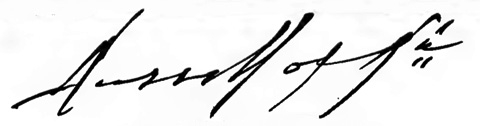
Baron Russell’s confident signature.
As to Charles’s personal life, in 1858 and aged 26, he had married 20 year old Ellen Mulholland, daughter of Belfast doctor Joseph Stevenson Mulholland MD. Between 1861 and 1879, they had ten children (five sons and five daughters), five of whom (in two cases, with their wives) came to be buried with their parents in the family plot – and a sixth (with his wife) buried nearby. We’ll get to their details shortly, when considering their gravestones. In the meantime, the couple’s other four children (all daughters) buried elsewhere were as below.
- First-born (1859) Lilian Frances who died aged only 5 on 2 November 1864.
- Fourth-born (1865) Eileen Mary who, on 4 February 1891, married Douglas Lyon Holms, the stockbroker son of one her father’s political colleagues. The couple had three children. The 1911 census finds the mid-40s couple living at 19 Prince of Wales Terrace, Kensington supported by three domestic servants. By the time of Douglas’s death in 1924, they had moved to 6 Hazelwell Road, Putney – although he died (and is buried) in Littlehampton. The widowed Eileen was still at the Putney address the she died on 6 April 1941.
- Sixth born (1874) Mary Gertrude who became a nun at the Convent Of The Holy Child, Uckfield, where she died, aged 86, on 1 December 1960.
- Ninth-born (1878) Lilian Mary who, on 3 May 1906, married Henry Olpherts Drummond. The 1911 Census records them (with Henry as a “Company Director”) living at Farr Lodge, Henley, with three young children and supported by five domestic staff. Henry died at that address in 1928. The widowed Lilian died on 28 December 1948 at 53 St Andrew’s Road, Henley (perhaps the now numbered “Farr Lodge”). The executors of her £13,299 estate were sons David (a “Solicitor”) and Peter (a “Chartered Patent Agent”).
The family plot and first burials
As shown in the picture at the head of this article and immediately below, the Russell family plot in Epsom Cemetery is enclosed by a low granite wall (relieved by arched openings) between substantial pillars – between two of which is a wrought iron gate for access. The plot is about square and, in the corners, has four yew trees which are understood to have been gifted by the four provinces of pre-partition Ireland.

The entrance to the Russell family plot.
Photograph by Roger Morgan © 2020
The now large trees make the following photograph the best view of the plot’s symmetrical layout.
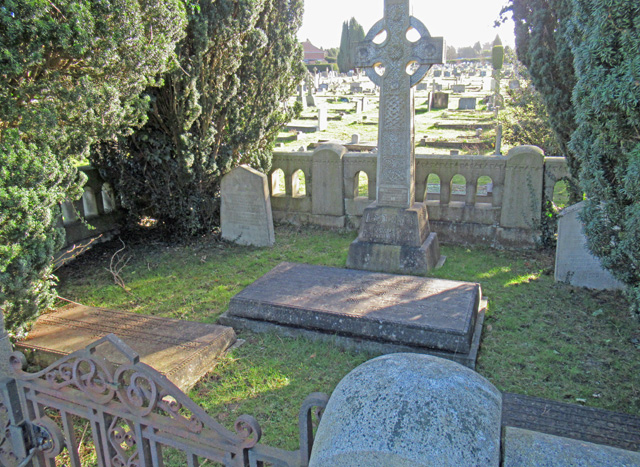
Overview of the family plot.
Photograph by Roger Morgan © 2020
And the following diagram will clarify things.

A diagram of the Russell family plot.
As noted at the end of this article, another son – Francis or “Frank” – is buried just outside the plot
(below right in relation to this diagram), together with his wife and daughter.
Drawn by Roger Morgan © 2020
The main feature of the enclosure is the memorial cross. Immediately in front of that is a large stone covering the graves of Charles, Baron Russell of Killowen, and his wife Ellen. On each side of the memorial cross are more traditional headstones. These mark some graves of the next generation as also do the large stones in the left and right foreground – and we’ll turn to those individuals further below.

Celtic detail on the memorial cross.
Photograph by Roger Morgan © 2020
All through the enclosure (and on its boundary walls) is a wealth of Celtic decoration, acknowledging Charles’s Irish heritage. This detail is most clearly seen on the memorial cross in the image above.
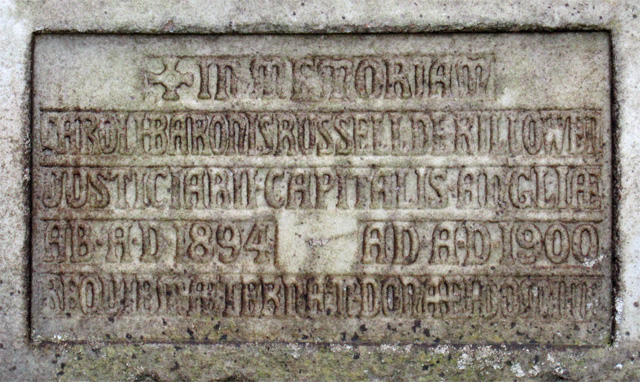
The Latin inscription at the base of the cross.
Photograph by Roger Morgan © 2020
At the base of the memorial cross (facing into the plot) is a Latin inscription (pictured above) which, translated, reads “In memory of / Charles Baron Russell of Killowen / Chief Justice of England / from 1894 to 1900 / Grant him eternal rest, O Lord“.
On the ground in front of the cross is a white marble slab covering the graves of Charles and his wife Ellen. As shown below, the central feature is another Celtic-inspired cross. However, the surface of the white marble – which will have been dazzling when first installed – has become discoloured, making the inscription hard to read.

The stone covering the grates of Baron Russell and his wife.
Photograph by Roger Morgan © 2020
The stone’s text is, “Pray for the soul of Charles Russell / Baron Russell of Killowen / Lord Chief Justice of England 1894-1900 / Born 10 Nov 1832 Died 10 Aug 1900 / and of Ellen his wife / Born 3 March 1838 Died 10 March 1918“.
Charles was still in post as Lord Chief Justice when he died at his London home of 2 Cromwell House, Kensington. The probate record of administration of his £147,200 estate being awarded to the widowed Ellen notes that Charles was also “of Tadworth Court”. He was buried in Epsom Cemetery on 14 August 1900, four days after his death. Work on the family plot clearly took some time after that.
Thanks to Lord Russell’s great-grandson, Gregory Bratza, we have the following photographs (from an unknown journal of the time) of the funeral and interment.
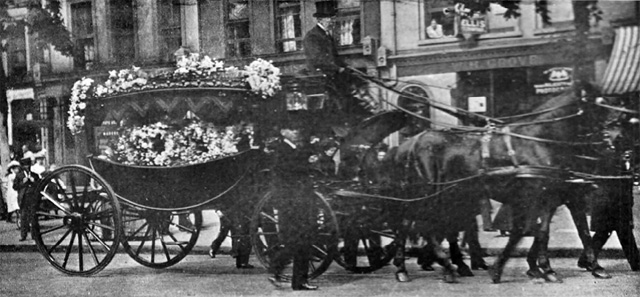
The hearse taking the body of Lord Russell from his London home for the first part of
funeral, held at the Brompton Oratory.
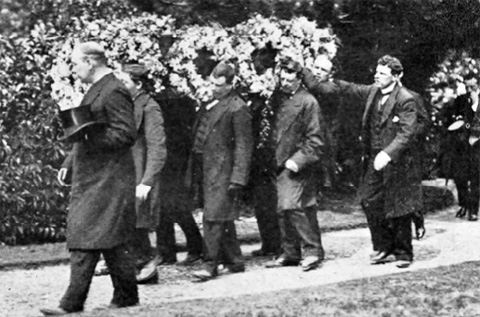
The coffin and pall bearers on arrival at Epsom Cemetery.

The original caption reads, “The scene at the graveside in Epsom cemetery. Father Morrissey, who officiated, conducted the ceremony in the most impressive manner.”
The widowed Ellen later moved to 6 Hyde Park Gate, where she died on 11 March 1918 – being buried with her late husband in Epsom two days later, on 13 March. Administration of her £103,728 estate was awarded to sons Charles and Cyril. (Although this section is headed “first burials”, the death and burial of son Arthur – see immediately below – in 1907 was before his mother’s.)
GRAVES OF THE NEXT GENERATION
As shown below, the white marble headstones each side of the memorial cross has weathered better than the slab over the main grave of Charles and Ellen.

The more traditional headstone for son Arthur and daughter Margaret.
Photograph by Roger Morgan © 2020
The text of the headstone above (which is to the left of the memorial cross) is “Pray for the soul of / Arthur Russell / eldest son of Baron Russell of Killowen / Born February 19th 1861 / Died November 22nd 1907 / and for that of his sister / Margaret Russell / Born April 21st 1879 / Died October 27th 1945 / RIP“.
Arthur Russell (1861-1907)
As his father’s peerage was not hereditary, second-born but first son Arthur (whose second name was Joseph) continued life as “the Honourable”, the style of children of barons. Arthur had followed his father into the law, becoming a barrister in 1886. In October 1891, aged 30, he married the 28 year old Florence Cuming, only daughter of Dr Cuming of Belfast. The couple appear not to have had any children. The 1901 Census records them (with Arthur now a judge at the Wandsworth County Court) living at 16 Norfolk Square, Paddington, supported by three domestic servants. By the time of Arthur’s death in 1907, the couple had moved to Woking. The widowed Florence lived until 1933 and is buried elsewhere.
Margaret Russell (1879-1945)
Tenth- and last-born Margaret (whose middle names were Agnes Mary) never married. The 1911 Census records the 31 year old living with her widowed mother at 5 Hyde Park Gate, Kensington – the two supported by six domestic servants. She subsequently moved to Walton on the Hill, where the September 1939 Register records her living (on “private means”) at “Uplands” in Epsom Lane, supported by two domestic servants. She died at home on 27 October 1945, and was buried in the family plot four days later, on 31 October. She left an estate of £28,367.
Cyril Russell (1866-1920)

The headstone for son Cyril and his wife Helen.
Photograph by Roger Morgan © 2020
The text of the headstone in the photograph above (which is to the right of the memorial cross) is “Pray for the soul of / Cyril Russell / 3rd son of / Baron Russell of Killowen / Born 3rd March 1866 / Died 14th May 1920 / and of Helen Mary his wife / Born 7th June 1869 / Died 22nd August 1937 / RIP“.
Fifth-born Cyril became a stockbroker with merchant bankers Helbert, Wagg & Co. In January 1893, aged 26, he married 22 year old Helen Mary Pirie, daughter of Alexander George Pirie, of Leckmelm, County Ross. The 1901 Census records them living at 13 Hyde Park Street, Paddington with three children, supported by six domestic staff. By the time of the 1911 Census, the couple had moved to the 24 room Kensington House, Bayswater Hill. Three more children had arrived, and the family were supported by ten domestic servants.
Cyril died on 14 May 1920, aged 54. The probate record of administration of his £72,401 estate being awarded to the widowed Helen notes that his principal address was “South Sea House, 37 Threadneedle Street, London – while also being “of” Kensington House, Bayswater Hill. He was buried in the family plot on 18 May 1920.
Helen died, aged 66, on 22 August 1937 when the Probate records of her £45,730 estate note that her address was 46 Fursecroft, George Street, Byanston Square, London W1. She joined her husband in the family plot on 25 August 1937.
Sir Charles Russell junior (1863-1928)
The text of the grave marker just to the left inside the gated entrance to the plot is “In loving memory of / Charles Russell / 1st Baronet / 2nd son of Baron Russell of Killowen / Born July 8th 1863 Died March 27th 1928 / RIP“. (The trees in the corners of the plot make it difficult to take useful photographs of the flat grave markers just inside the entrance to the plot – and, in any case, weathering has made them as hard to read as that of Baron Russell and his wife pictured above.)
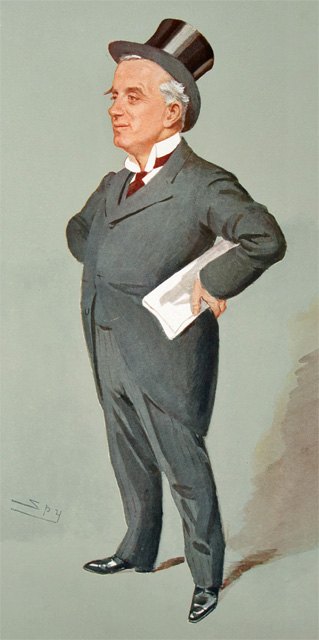
Charles Russell, “A son of his father”.
1907 Vanity Fair caricature by “Spy”, Public Domain
Third-born Charles junior followed his father into the law. After completing his schooling at Beaumont College, Windsor, he trained as a Solicitor and was in practice by 1888. In 1891, he set up his own eponymous firm. The firm grew, partly by amalgamations, and the name was retained in the 2014 merger that created international solicitors Charles Russell Speechlys.
In 1889, Charles, now aged 26, married 22 year old Adah Adeline Walmsley Williams, daughter of Welsh banker, William Williams. (The 1891 Census records the couple, supported by two domestic servants living at 5 St James Terrace, St Marylebone. Their only child, Monica, was born in 1895 and, by the time of the 1901 Census, they were living at 40 Hyde Park Gate, Kensington, supported by a governess and three domestic servants.)
in 1893, Oscar Wilde sued the Marquess of Queensberry for criminal libel over the latter’s allegations of homosexuality. The Marquess retained Charles as his solicitor for the ill-advised action in which the Marquess was quickly found not guilty. Charles passed the evidence he had gathered about Oscar Wilde to the Director of Public Prosecutions, and this led to Wilde’s imprisonment for “gross indecency”. In the same year, Charles was also solicitor for British Agents before the Behring Sea Commission in connection with which, as noted earlier, his father was serving as Counsel for British interests.
While Charles’s legal career went from strength to strength – helped by having inherited his father’s oratorical gifts – he was also active in wider society. Having twice failed to become a Liberal MP, he was a member of the London County Council from 1910 to 1913, and Chairman of the Collection Committee of the British Red Cross Society during WW1. In Catholic matters, he was a leading and zealous layman – for years, serving on the Executive of the Catholic Education Council. He was also closely involved in the various stages leading up to the establishment of the Catholic Confederation of England and Wales.
In recognition of his public work he was created a Baronet in 1916 – taking the title, “of Littleworth Corner, Burnham, Buckinghamshire”, being his country residence. In 1921, he was further honoured by being appointed as Knight Commander of the Royal Victorian Order (KCVO) and, by the Catholic Church as a Knight of Grace in the Most Venerable Order of the Hospital of St John of Jerusalem (KGStJ).
In early 1928, Charles was found to have a condition requiring surgical intervention. The operation (at the Hospital of St John & St Elizabeth in St John’s Wood, London) was felt successful and Charles seemed set on a complete recovery. It was therefore unexpected when he died in the hospital only a few days later, on 27 March 1928. He was buried in the family plot on 30 March.
In normal circumstances, his Baronetcy (a knighthood that is hereditary down the male line) would have ended with him. However, having only a daughter and knowing that he would have no other children, this clever lawyer had secured a “remainder” for the title to pass down his father’s line. The title thus passed to the oldest male of the next generation being the son (Alec Charles) of Charles’s younger brother Cyril. (In a wry twist, Charles’s only child, Monica married her cousin, this Alec Charles, in April 1917. A decade later, on the death of her father the 1st Baronet, she found herself married to the 2nd Baronet!)
The widowed Adah never remarried. The September 1939 Register records her living with her now divorced daughter at 5 Seaford Court in Great Portland Street. Adah died, aged 92, in January 1959 at 2 Aberdeen House, Adelaide Road, Hampstead. She is not buried in the family plot.
Bertrand Joseph Russell DSO (1876-1960)
The text of the grave marker just to the right of the entrance is “In Loving memory of / Dorothy Caroline / Wife of Bertrand Russell / Died 24 February 1921 / Aged 42 years / And of the above Bertrand Russell / who died on May 9th 1960 / Aged 83 years / RIP“.
After his schooling, eighth-born Bertrand Joseph went into the Army, joining the Royal Horse Artillery. He fought in South Africa during the Boer War, taking part in actions west of Pretoria in July 1900, for which he was awarded the Queen’s Medal with three clasps.
In July 1902, Betrand (now aged 25) married the 23 year old Dorothy Leeming. The 1911 Census records Bertrand (“Captain, Royal Horse Artillery”) and Dorothy visiting his brother Cyril and family in their grand Kensington House in Bayswater. However, their family home was The Manor House, Holt, Nr Trowbridge, Wiltshire and the 1911 Census records the couple’s three young children (a fourth was born in 1912) there together with eight domestic servants.
Bertrand was in action again during WW1. He was wounded on one occasion meriting a “Mention in Dispatches”. He was twice wounded on 9 May 1915, in action for which he was awarded the Distinguished Service Order. The citation in the London Gazette of 3 July 1915 is:
“The Honourable Bertrand Joseph Russell, Capt. (Reserve of Officers), 104th Battery, Royal Field Artillery. On 9 May 1915, near Rue Petillon (Fromelles), this officer commanded a section in the trenches, greatly helping the infantry. He was heavily shelled all day, the parapet in front of one gun being destroyed. They kept on firing, however, and the success was greatly due to the courage displayed by Capt Russell, who was twice wounded earlier in the day.”
Bertrand retired from the Army in June 1919 with the rank of Lieutenant-Colonel. Sadly, Dorothy died aged 42 on 24 February 1921, when the Probate records note the family address was 73 Pont Street, Knightsbridge. She was buried in the family plot on 28 February.
On 31 October 1922, Bertrand got married again, to Mavis Winifred Hazell, and they had a son the following September. The couple divorced in 1936. The September 1939 Register records the 62 year old Bertram living at “Silverwood”, Crawley Ridge, Camberley, supported by three domestic servants. His occupation is listed as “Director (Active) Manufacture of Printing Ink etc”. He was still at that address when he died, aged 83, on 9 May 1960. He was buried in the family plot, together with his first wife, Dorothy, on 12 May. He left an estate of £144,594.
Francis Xavier Joseph, another Baron Russell of Killowen (1867-1946)
In the foreground of the photograph below is another family grave, for which there was insufficient room within the plot.

In the foreground is the grave marker for son Francis, his wife Mary and daughter, also Mary.
Photograph by Roger Morgan © 2020
The style of the grave marker is clearly intended to harmonise with those in the plot, and its text is “Sacred / to the memory of / Francis Xavier / 2nd Baron / Russell of Killowen / 1867-1946 / RIP / And of his daughter / Mary Lilian / Ritchie Russell / 1901 – 1956 / Also of his wife / Mary / 1870 -1956“.
Sixth-born Francis was always known as “Frank”, and we follow suit here.

Frank Russell in June 1928
Photograph by Lafayette © National Portrait Gallery
Used here with permission under a Creative Commons Licence
After his schooling and graduation from Oriel College,Oxford, Frank was yet another son who followed his father into the Law. He was admitted to Lincoln’s Inn in 1893 entitled to practise as a Barrister-at-Law, and was appointed “King’s Counsel” 1908. By 1919, he was a Judge of the High Court’s Chancery Division.
In 1928, the date of the photograph above, he became a Lord Justice of Appeal. On 18 November 1929, Frank matched his father in becoming a Law Lord as “Lord of Appeal in Ordinary” . Accordingly, he was created a Life Peer – and copied his father by also taking the title of Baron Russell of Killowen.
On 17 February 1900, the 33 year old Frank had married the 31 year old Hon Mary Emily Ritchie, daughter of Charles Thomson Ritchie, 1st Baron Ritchie of Dundee. The 1901 Census records the couple (with their newborn first child and a supporting nurse) staying on Seaford on the Sussex coast. By the time of the 1911 Census, they were living at 7 Hyde Park Gate, Kensington. Three more children had arrived – although second-born Eileen had died only a few months old on 23 August 1904. For reasons noted in the PS below, particular mention needs to be made of their last child, 3 year old Charles Ritchie. The family were supported by six domestic servants.
By the time of the September 1939 Register, the late 60s couple were living at Lane End, Chuck’s Lane, Walton on the Hill. Frank is listed as “Lord of Appeal in Ordinary” and Mary with the conventional “Unpaid Domestic Duties” – in which she was supported by three domestic servants. Also living with them was their “Incapacitated” first child, Mary Lilian – now aged 38, and supported by a “Nurse companion”.
Frank died at home on 20 December 1946, aged 79. There now being insufficient room in the family plot, he was buried just outside it on Christmas Eve. The widowed Mary Emily was awarded administration of Frank’s £62,886 estate, and remained at Lane End. Daughter Mary Lilian died, aged 55, on 15 February and was buried with her father on 18 February. Her mother also died at Lane End later that year, on 10 November 1956. She was buried with Frank and her daughter on 14 November.
Roger Morgan © 2021
PS: Charles Ritchie, a third Baron Russell of Killowen, Kt (1908-1986)
Frank and Mary’s youngest son, Charles Ritchie Russell (born on 12 January 1908), inherited the family’s legal gene. Like his father he graduated from Oriel College and, in 1931, was admitted to Lincoln’s Inn entitled to practise as a barrister. In 1933, this 25 year old married 22 year old Joan Elizabeth Torrens.
The September 1939 Register records the couple (with Charles as a “Barrister at Law”) living at Butt’s Gate, Petworth in Sussex with some domestic servants and a couple of currently closed records doubtless covering their first two children: two more were to follow.
During WW2, Charles was commissioned into the Royal Artillery, and flew into France on D-Day by glider. He was wounded in action, mentioned in dispatches and received the French Croix de Guerre.
Returning to the Bar after the war, he “took silk” (became a King’s Counsel) in 1948. From 1951 to 1960, he was Attorney General of the Duchy of Cornwall. As a leading Chancery counsel, he was appointed to the Chancery Division of the High Court in 1960, receiving the customary knighthood. He was promoted Lord Justice of Appeal in 1962.

Charles Ritchie Russell in October 1970
Photograph by Godfrey Argent © National Portrait Gallery
Used here with permission under a Creative Commons Licence
In September 1975, he matched his father by being appointed Lord of Appeal in Ordinary with the consequential life peerage. Like his father and grandfather, he took the title of Baron Russell of Killowen.
His wife, Joan, died in 1976, aged 67. In 1979, Charles got married again, to Elizabeth Cecilia Foster, daughter of Air Vice Marshall William Foster Macneece Foster. Charles died, aged 78, on 23 June 1986 at Orchard House, Petworth. He was buried with his first wife Joan in the Churchyard of St Anthony and St George, Duncton, three miles south of Petworth.
Roger Morgan © 2020