
The Ancient Order of Foresters
(See also our page about the Epsom Branch’s WW1 memorial.)

The Ancient Order of Foresters date not known
Image courtesy of Bourne Hall Museum
The Ancient Order of Foresters (AOF) is one of the oldest friendly societies, with its origins in Yorkshire. The earliest verifiable evidence of the Foresters’ existence is in 1790, for which date a list survives of the members of the of Court No.1 of the order, which met at the Old Crown Inn in Kirkdale in Leeds. It was already unequivocally a benefit society by the early nineteenth century and probably was so from its beginnings. The AOF flourished in the 19th century, by 1895 having 4899 courts and 731,442 members, with court funds amounting to £5,119,842, and engaging in general charity as well as providing financial support for its members.
In the late 19th century, Forestry spread throughout the world, particularly to the British colonies but also to the United States. In 1892 the Order was opened to women with the formation of female courts. In the 20th century, between the war the AOF was an Approved Society operating within the National Health Insurance Scheme, so it had both voluntary and State members. Unlike many others, it survived the slump in friendly society membership after the creation of the National Health Service in relatively good order, and still flourishes, offering both financial services and social activities, just as it did at its inception (although the courts have been renamed branches), as well as supporting a variety of charity work, and also has an historical section producing publications on Forestric history.
 The Ancient Order of Foresters in 1939, during a presentation to Henry Saunders (just right of centre) to mark his years as Hon Sec from 1895 to 1938.
Image courtesy of Bourne Hall Museum
In Forestry, the word ‘court’ is used instead of ‘lodge’, derived from the law courts of the of the royal forests which, since the Middle Ages, had met to administer the special forest laws. Similarly, the officers of the society used the titles of officials of the medieval forest courts, such as Ranger and Woodward. Thus the chief official was the Ranger. Courts were guarded by two Beadles, and a Senior and Junior Woodward, whose job was to serve all summonses, visit the sick, dispense allowances and take charge of all court property. The regalia of the Beadles included huge cow horns (real cow horns) slung from the left shoulder, and axes; each Woodward carried an axe.
The various officers and levels of membership were:
• C.R. – Chief Ranger
• P.C.R. – Past Chief Ranger
• P.D.C.R. – Past District Chief Ranger
• S.C.R. – Sub Chief Ranger.
• D.S.C.R. – District Sub Chief Ranger
• S.B. – Senior Beadle
• J.B. – Junior Beadle
• S.W. – Senior Woodward
• J.W. – Junior Woodward
• Treasurer
• C.T. – Chief Treasurer
• C.S. – Chief Secretary
• Sub Secretary
• Assistant Secretary
• Honorary Member
• Trustee
• Juvenile Society Officer
• Juvenile
 Examples of the ribbons worn by members of the Foresters (click image to enlarge)
Image courtesy of Bourne Hall Museum
In 1815 the AOF emblem was devised. It consists of a shield divided by a cross and has an escutcheon in the centre with bugle horn and bow and arrows. In the top-left quarter of the shield is a pair of clasped hands; in the top-right hand quarter, three running stags; in the lower left is a chevron, a lamb and flag above the chevron and a bugle horn beneath; in the lower-right quarter is a quiver over a bow, arrow and bugle horn. Above the shield is a stag’s head issuing out of a coronet; flanking it are the figures of two foresters (both male before 1892, one male and one female after). The motto is ‘Unity, Benevolence & Concord’, sometimes given in Latin as ‘Unitas, Benevolentia, Concordia‘. Sometimes the All-Seeing Eye surmounts all, and there are variations in colours and details, and often extra symbolic decorations may be added.
The form of the personal regalia includes a sash, sometimes known by Foresters as a ‘scarf’, 6 inches wide and 2½ long, worn over the right shoulder and tied at the left of the waist. The stag’s head, the insignia of the order and the initials of the office held were embroidered in gold thread, or shown on an attached panel with the emblem woven or printed in colour or in black and white. Either instead of or as well as the sash was worn a neck-ribbon 2½ inches wide and 1½ long. By the 1980s the sash was no longer worn and the neck ribbon was being worn on its own with a tassel at the centre front ( two for Chief Rangers). All-black sashes and ribbons were prescribed for Forester funeral ceremonies.
 Epsom Foresters in full dress uniform
Image courtesy of Bourne Hall Museum
The Ancient Order of Foresters became a registered Friendly Society in 1834. The Epsom Branch of the Dorking, Epsom and West Surrey Branch was established in 1860. It was styled ‘Court Wellington’ (No.3449), because it originally convened in Epsom’s Duke of Wellington public house, in the predecessor of the 1906 building at No 72 High Street, Epsom. It later moved to its own premises in Waterloo Road, being the Wesleyan Chapel that had been built in 1863 – and vacated when the new Methodist Church in Ashley Road was completed in 1914. (The Hall was demolished in 1979 and its site is now covered by the southeast corner of Hudson House – the corner that has the Co-op on the ground floor.)
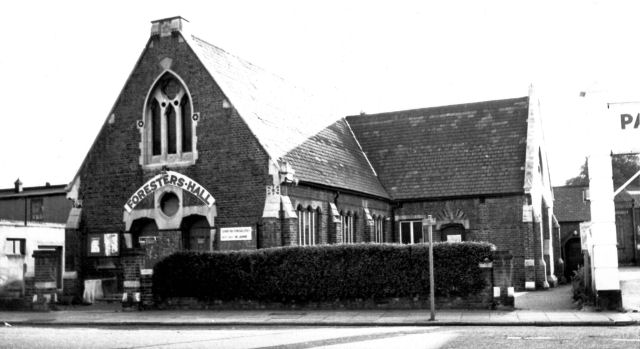
Foresters Hall, Waterloo Road in July 1971.
Image courtesy of Epsom & Ewell Local And Family History Centre.
 Interior shot of the Foresters Hall
Image courtesy of Bourne Hall Museum
Both men and women were entitled to become members provided that they were in work, over the age of eighteen and that their application had been proposed and seconded by a member of the Order. (The Epsom Juvenile Foresters Branch was established in 1871. Its members had to be between four and eighteen years of age.) There were several grades of membership with accordingly varied levels of support.
Members paid a monthly contribution which was apportioned to various funds, chiefly the Sick & Funeral Fund, the Management Committee (the salaried administrative body) and the Benevolent Fund.
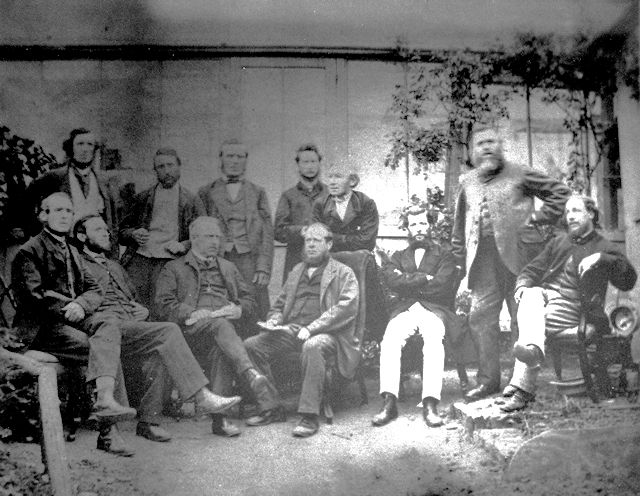
An early photograph of the Epsom Foresters
Image courtesy of Bourne Hall Museum
Men who had families or other dependants, and were the main wage earners, could pay a level of contributions which ensured that their families would be supported if they should die or become sick or unemployed.
 The Ancient Order of Foresters date not known
Image courtesy of Bourne Hall Museum
Text courtesy of Jeremy Harte, Curator Bourne Hall Museum, also The Surrey History Centre
For general information on the history of the Foresters we suggest you contact The Foresters Heritage Trust.